
The Mirror in the Room
You are sitting at a table you did not choose, in a room that was arranged before you arrived. Someone is speaking — not loudly, not aggressively, but with that particular quality of voice that assumes it will not be interrupted. You notice, without quite deciding to notice, that everyone else has shifted slightly in their chairs. Shoulders have dropped a degree or two. Eye contact has redirected itself toward the speaker the way iron filings redirect toward a magnet, not because anyone commanded it but because something older than command is operating in the room. You feel it in your own body before you think it in your mind: a faint muscular adjustment, a pulling back, a recalibration of how much space you are entitled to occupy.

This is not a meeting about anything important. It could be a budget review, a family dinner where one person controls the narrative of the shared past, a queue at a government office where the clerk’s indifference carries the full weight of institutional authority. The content is almost irrelevant. What is happening beneath the content is a choreography so rehearsed it has become invisible, and invisible things are the most powerful things in any room.
Watch who speaks twice before others speak once. Watch who touches objects on the table — a pen, a folder, a glass — as though the table belongs to them. Watch who laughs first after a tense moment, who waits for permission to laugh, and who does not laugh at all because they are too busy calculating what the laughter means for their position. Watch yourself. You are doing all of this too, and you have been doing it since long before this particular room, this particular table, this particular choreography of glances and silences.
There is a man sitting across from the one who is speaking. He has something to say — you can see it, a small brightness in his expression that keeps approaching the surface and then retreating. He opens his mouth twice and both times something stops him, something that has no name but has been working in him since childhood, building a very precise internal architecture of when it is safe to speak and when it is not. He will go home tonight and think of what he did not say, and he will frame it as a choice he made, a strategic decision to remain quiet, because the alternative — that something outside himself reached into his mouth and held his words back — is too uncomfortable to accept.
Power prefers to be mistaken for choice. This is its most elegant trick, and the room is full of it.
You did not walk into this room as a blank surface. You walked in carrying an entire sediment of accumulated experiences, each one having deposited another thin layer of information about where you fit in the order of things. Some of those layers were placed deliberately — a teacher’s correction delivered in front of the class, a parent’s silence at the precise moment you needed validation, a first employer’s tone when they explained how things are done here. Most were placed without any intention at all, which makes them heavier, not lighter, because you cannot argue against something that was never argued at you. It simply was. And what simply is becomes what you assume must be.
The discomfort you feel when someone refuses to follow the choreography — when a person in a supposedly subordinate position holds eye contact a second longer than expected, speaks without waiting for the unspoken signal, occupies physical space that the room had quietly allocated to someone else — that discomfort is information. It tells you exactly where the lines were drawn, lines you had forgotten were drawn at all because you stopped seeing them the moment you began walking along them.
The mirror in the room is not hanging on any wall. It is the room itself, and what it reflects is not your face but your position, and you have been looking at it for so long that you have stopped knowing you are looking.
Return to Planet Underground

Drama, Thriller, by Gideon Homes, Netherlands, 2025.
A former underground techno DJ working in a large and famous law firm delves into the dark side of society. With one eye on the past and one on the future, he stirs up the ashes of the true underground. The demand of society to function superficially and deliver top performance increasingly clashes with the protagonist's questioning of his own life reality and the values of his past. After being employed for almost six years and being a respected employee, Tyrel falls ill. On top of that, he witnesses a fraud within the company and asks to leave. But the illness creates a complex situation in which his employer starts playing a game of chess with Tyrel.
In "Return To Planet Underground", director Gideon Homes gives the audience a gripping insight into the Dutch underground techno scene, offering a gripping drama set in a dark world, full of intense moments and touching human tragedies. This film is not just a visual feast; it is a gripping exploration that immerses viewers in the lives of its protagonists. Set to a backdrop of thumping techno beats, "Return To Planet Underground" takes audiences on a rollercoaster ride through the highs and lows of human desires, drug-fueled escapades, societal pressures and the pursuit of perfectionism. Drawing inspiration from iconic films such as Trainspotting, Berlin Calling and Human Traffic, Gideon Homes' work stands out for its unique stylistic devices and unconventional storylines. Based on real events and personal experiences, "Return To Planet Underground" faced numerous lawsuits before finally conquering audiences around the world. Prepare yourself for an immersive dive into a world where music, morality and the human spirit collide.
LANGUAGE: English, Dutch
SUBTITLES: Spanish, French, German, Portuguese
What Power Actually Is (And What It Pretends to Be)
You have watched it happen and probably misread it completely. Someone walks into a room — not the loudest, not the most decorated, not even particularly imposing — and yet something shifts. Conversations recalibrate. Bodies reorient almost imperceptibly. And then he does something that should, by any reasonable logic, dissolve his authority instantly: he stops speaking. Mid-sentence, almost. A pause so deliberate it becomes its own kind of pressure. The silence spreads outward like a stone dropped in water, and everyone in that room, without understanding why, waits. Not because he told them to. Because the architecture of the moment made waiting feel like the only intelligent response. That pause was not an absence of power. It was power at its most concentrated, stripped of all its theatrical costumes.
This is where the popular mythology falls apart. The mythology insists that power is a thing, a possession, something extraordinary people acquire and ordinary people lack. It imagines power as a reservoir — the powerful have it, the powerless do not, and the transaction between them is essentially about transfer or theft. This image is deeply embedded in the way revolutions are imagined, in the way institutions are criticized, in the way people console themselves for their own invisibility. But it is wrong in a way that is almost architectural, wrong at the level of the structure it assumes.
Michel Foucault spent much of his career dismantling precisely this image. In his 1975 work on punishment and surveillance, he argued that power is not a substance held by a sovereign hand but a network of relations that traverses every social body. Power circulates. It is exercised rather than possessed. It runs not only downward from rulers to subjects but laterally, diagonally, through institutions, habits, schedules, spatial arrangements, and the smallest gestures of daily life. The prison, the hospital, the school — these are not simply places where power is applied. They are machines through which power is produced and reproduced, and the bodies inside them are not merely its objects but its instruments. What Foucault noticed, with a clarity that continues to unsettle, is that the most effective power is the kind that no longer needs to announce itself.
Hannah Arendt arrived at a related but distinct unease from a different direction. Writing in 1951, in the shadow of totalitarianism’s worst evidence, she made a distinction that most political thinking still refuses to absorb: power and violence are not the same thing, and in fact they are almost opposites. Power, for Arendt, emerges when people act together, when collective will generates something that no single individual could produce alone. Violence, by contrast, is what power reaches for when it begins to collapse. A regime that rules by terror is not demonstrating its power — it is revealing its loss of it. The gun in the room is the confession that consent has evaporated. This is why the most brittle forms of authority are often the loudest, the most theatrical in their coercion, the most insistent on visible submission.
Return to the man and his pause. He does not shout. He does not threaten. He does not even ask. He simply creates a silence that the room fills for him with its own anxiety. That silence is a grammatical structure, and he has learned, perhaps without ever studying it consciously, exactly where to place it. Power understood this way is less like a weapon and more like a language — with syntax, with register, with the possibility of being spoken fluently or haltingly, consciously or by reflex. Most people have been embedded in this grammar since childhood, since the first time they learned to modulate their voice around a parent’s mood, or felt the particular weight of a teacher’s gaze.
The terrifying implication, the one that neither Foucault nor Arendt fully lets you escape, is that this grammar is not spoken only by the powerful. It is spoken by everyone, including those who believe themselves entirely outside it.

The Historical Architecture of Obedience
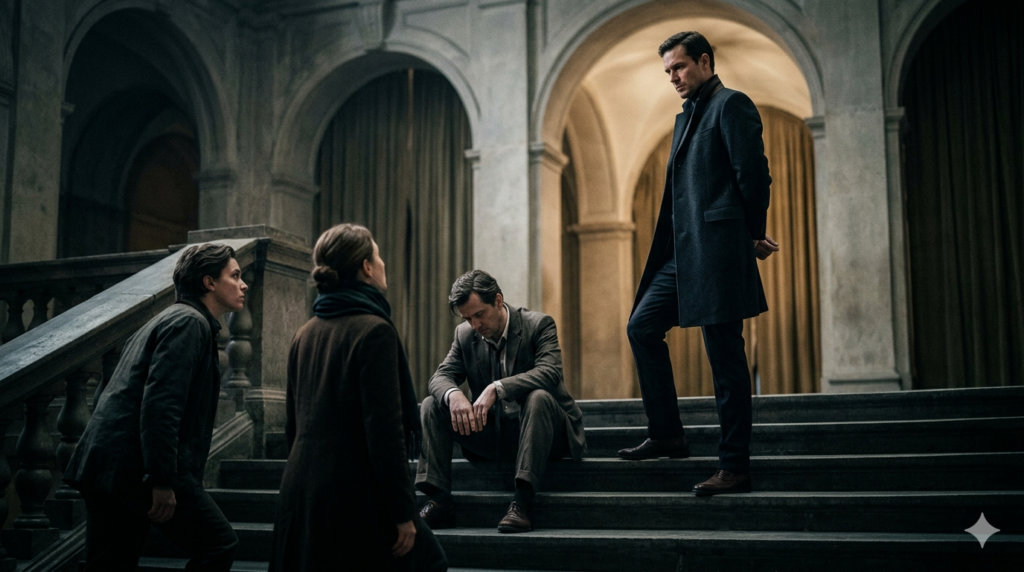
There is a moment you have probably lived without naming it. Someone above you in a chain — a manager, a committee, a process with no visible face — asks you to do something that sits wrong in your chest. Not catastrophically wrong. Wrong in the way a slightly off note sounds wrong: you feel it before you can explain it. And you do it anyway. Not because you are afraid of punishment, not because you have calculated the consequences and decided submission is the safer bet. You do it because not doing it would require you to construct a sentence that the institution has never taught you how to finish. Refusal, in that moment, does not feel like a moral choice. It feels like a grammatical error.
This is not a modern failure. It is an ancient engineering achievement.
The historian Norbert Elias spent years tracing how European societies between the medieval period and the early modern age underwent a transformation so gradual it became invisible to those living inside it. In his 1939 work on the civilizing process, Elias argued that what we call civilization is essentially the progressive internalization of external coercions. The court society of the sixteenth and seventeenth centuries did not simply demand obedience to the king’s edicts. It trained bodies: how to eat, how to move, how to manage embarrassment, how to suppress impulse. The external sword was slowly replaced by internal shame. You no longer needed a guard at the door when the prisoner had rebuilt the door inside himself.
The divine right of kings was never really about theology. It was a remarkably efficient technology. When authority is attributed to God, disobedience is not political resistance — it becomes ontological transgression. You are not arguing with a man or a system. You are arguing with the structure of the universe. And most people, confronted with that choice, discover they have nothing to argue with. They do not capitulate out of cowardice. They capitulate because the conceptual equipment for resistance has been confiscated before they ever needed it.
Stanley Milgram proved this with numbers in 1963, and the numbers have never stopped being disturbing. In his Yale experiments, ordinary American adults — teachers, clerks, workers, the unremarkable architecture of any society — were instructed by an authority figure in a white coat to administer electric shocks to a person in another room who screamed and begged them to stop. Sixty-five percent of participants delivered what they believed to be the maximum voltage of 450 volts. Not sadists. Not ideologues. People who, in the debriefing, showed genuine distress. Milgram’s conclusion was not that humanity is secretly cruel. His conclusion was more unsettling: that the situation does most of the moral work. The costume of authority — a lab coat, a clipboard, a calm institutional voice saying “please continue” — was sufficient to override personal ethical judgment in the majority of cases. The institution does not need to threaten you. It only needs to be legible, to seem like something that has already decided.
What Milgram captured in a laboratory, Elias had already mapped across centuries. The performance review is the divine right of kings translated into quarterly cycles. The organizational chart is the court hierarchy with the religious language scrubbed out. The email that asks you to sign off on something questionable — and that you sign, because the alternative is a conversation nobody in the building knows how to have — is the electric shock button, pressed not by a monster but by someone who, like you, has confused institutional grammar with moral reality.
The most efficient systems of domination are the ones that make compliance feel like common sense. Not like a choice at all. A man sits in a room, hears the screaming from the other side of the wall, looks at the person in the white coat, and receives the instruction to continue. He continues. Not because he has abandoned his conscience. Because somewhere in the architecture of that room, conscience has been reclassified as noise.
The Mirror and the Rascal
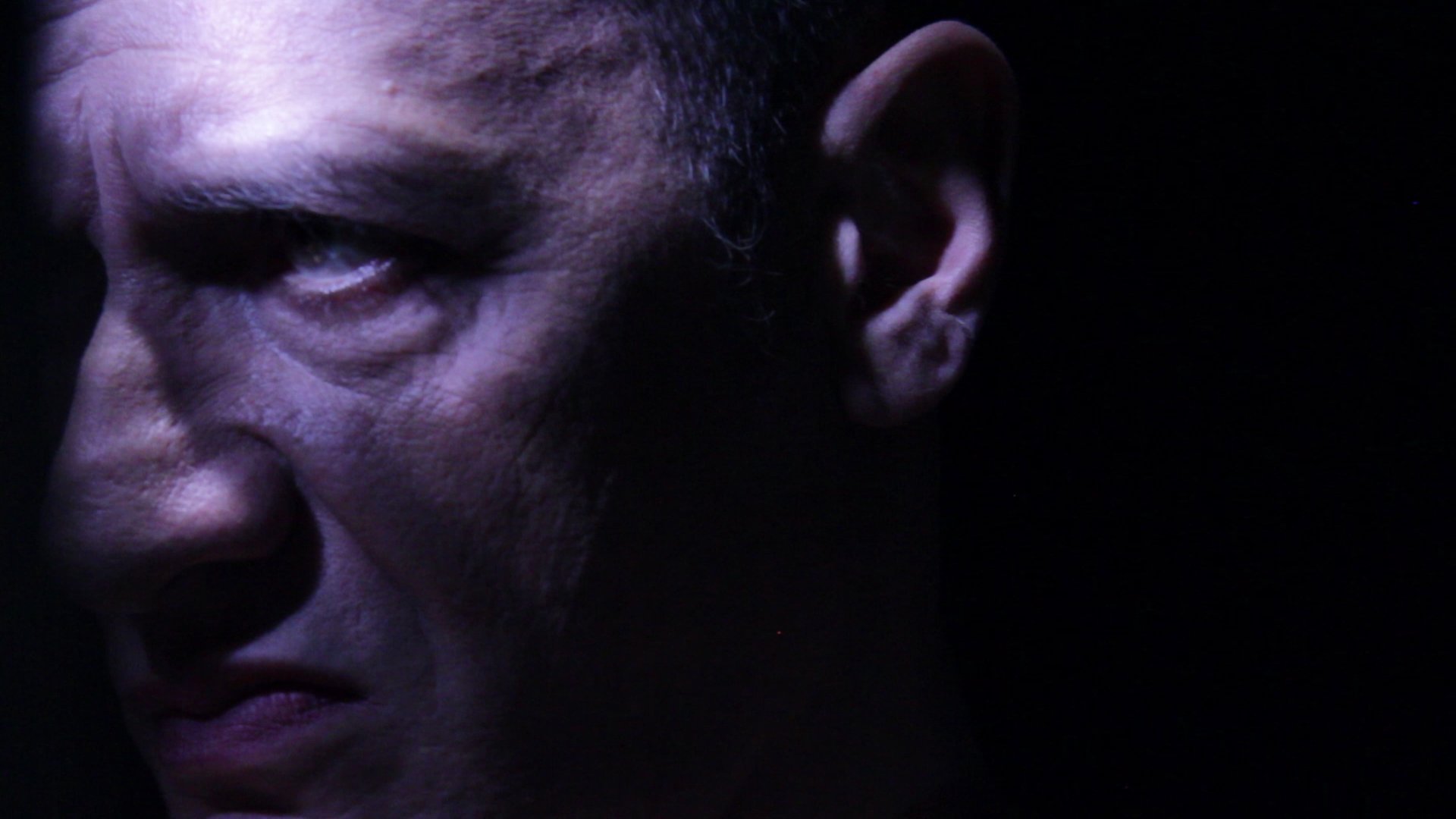
Drama film, by Valerio De Filippis, Italy, 2019.
The mirror and the rascal is an experimental film based on the tragedy "Richard III" by William Shakespeare. It tells the delirium of contemporary power in an author's reinterpretation of cinema, video art and music. The protagonist, Richard Duke of Gloucester, brother of King Edward IV, through a long series of crimes eliminates all the obstacles that stand between him and the throne of England.
Valerio de Filippis, a well-known painter who has been following his research path for a long time, investigating the relationship between light, corporeality and the psyche. The mirror and the rogue and the cinematographic equivalent of Valerio De Filippis' painting, his figurative style is in fact very recognizable looking at his paintings. But cinema is a new way where the artist can also be involved as an actor and performer, with an original mix between acting and singing. Staging the dark side of the human soul, the film is a surreal and disturbing interpretation of a great classic. The director says: "The first suggestion was musical: I was interested in transforming the text of Shakespeare's tragedy Richard III into notes. I love cinema and at a certain point I felt that the time had come to combine research on the image of painting to my love for cinema and music. When the film is finished I realize that I have remained faithful to painting: every frame of the film appears to me like a painting: the same light, the same colors, the same atmosphere ". The mirror and the rascal is a kind of psychoanalytic session that the painter does while hiding behind the mask of Richard III. Behind this ferocious and unscrupulous character we find a path of self-analysis by De Filippis, who is mainly interested in the more violent and turbid aspects. An experimental film in which, with great courage, the author gets involved completely, fragmenting the images in an unconventional montage, which is at the same time a flow of consciousness and spectacle.
LANGUAGE: English
SUBTITLES: Italian
The Seduction of the Dominated
There is a moment — you have had it, even if you have never named it — when you realize you have been defending something that was built to exclude you. Not defending it reluctantly, under duress, but with genuine conviction, with the heat of someone protecting a thing they love. You discovered your arguments were borrowed from people who benefited from your silence. And the worst part was not the betrayal from outside. It was the one from inside.
Erich Fromm spent the years between the wars watching something that disturbed him more than simple oppression: he watched people flee toward the very constraints that diminished them. In 1941, in a book that reads today like a document of anthropological emergency, he described the authoritarian character not as a monster but as a recognizable human structure — someone who desires submission and domination simultaneously, who bends joyfully toward a stronger force above while pressing with equal energy downward on whoever falls below. The two movements are not contradictory. They are the same impulse in both directions, a single engine running on the fuel of escaped freedom.
Because freedom is terrifying. Fromm was precise about this: the burden of individual autonomy, of genuine self-determination, of facing an open and unscripted existence, generates an anxiety so profound that many people will trade it voluntarily for the comfort of a hierarchy that thinks for them. The dominated person does not simply submit. They rationalize. They construct an entire interior architecture that makes the submission look like wisdom, the hierarchy look like nature, and their own diminishment look like the rightful consequence of someone else’s superiority.
This is where Pierre Bourdieu enters with something surgical. What he called symbolic violence — developed with Jean-Claude Passeron in their 1970 work on education and social reproduction — is not metaphorical violence. It is the specific mechanism by which domination reproduces itself without force, without visible coercion, through the active complicity of the dominated themselves. The dominated misrecognize their condition. They do not see the hierarchy as arbitrary and historical; they see it as legitimate, as corresponding to some real order of things. The student who internalizes the idea that their working-class accent marks them as intellectually inferior is not simply deceived. They are participating in their own diminishment, applying the categories of the dominant class to themselves, becoming the instrument of their own exclusion.
Think of the man who has spent forty years in a system that systematically undervalued people like him — same labor, lower wage, same competence, lesser title — and who, when a younger colleague from a similar background begins to protest, turns to him and says: that is simply how things work, you have to earn it. He believes this. He has arranged the facts of his life into a story of merit and patience, a story in which his endurance was dignified rather than exploited. To acknowledge the exploitation would be to dismantle the meaning he built from it. Bourdieu understood that symbolic violence is most effective precisely here — not on the openly resistant, but on those who have invested their self-worth in the legitimacy of the system that limited them.
The scene Fromm would have recognized: a man in a closed room, late at night, scrolling through the architecture of his own beliefs and finding, brick by brick, that none of them were originally his. That what he called his values were transmitted to him by institutions that needed him to remain in a particular place. And yet he cannot simply discard them, because they are now the load-bearing walls of his identity. This is the deepest seduction of power — not that it forces you to obey, but that it makes you want to. That it gives you a story in which your subordination is proof of your integrity, your patience a virtue rather than a concession, your place in the hierarchy a reflection of something true about who you are.
The dominated do not always know they are dominated. Sometimes they are the most passionate guardians of the gate.
The Faces Power Wears in Intimate Life
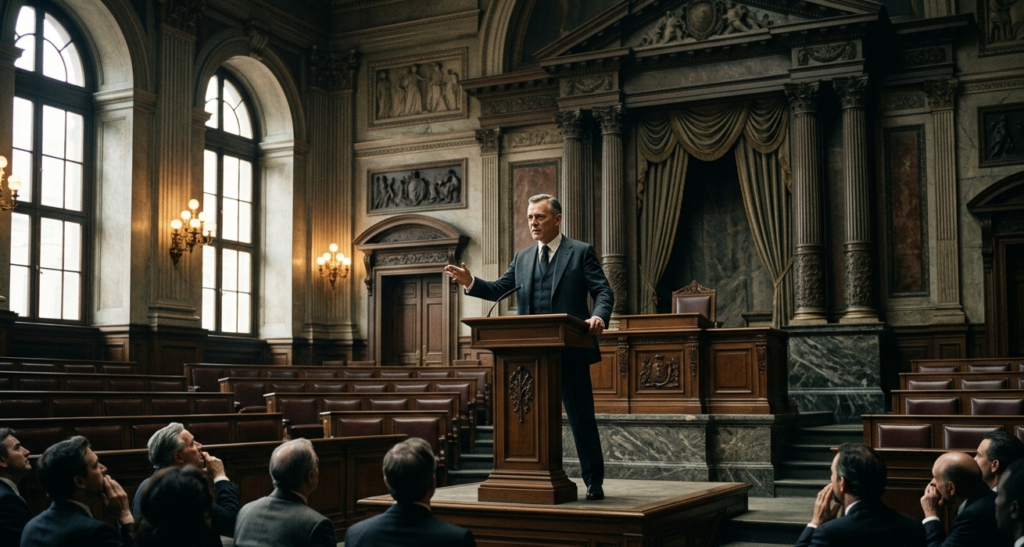
There is a moment — and you have probably lived it without naming it — when you are in the middle of a sentence and you hear yourself making your voice smaller. Not quieter. Smaller. You are reducing the claim of what you are saying before the other person has even had time to disagree. You are preemptively surrendering territory you never formally ceded, in a negotiation you never formally entered. The conversation might be about where to spend the holidays, or about money, or about something as structurally insignificant as a restaurant. And yet the architecture of the exchange is identical to something that happens in ministries and boardrooms. The distribution of silence, the management of the other person’s comfort, the careful calibration of how much space your opinion is permitted to occupy — these are political acts, conducted in a kitchen, in a bed, in the pause before you say what you actually think.
R.D. Laing spent much of his 1967 work insisting that what we call madness is often simply the most honest response available to an impossible relational situation. But the deeper provocation in that book is structural: that the family, and by extension every intimate bond, is a political unit. Not metaphorically. Literally. It produces subjects who have internalized specific distributions of authority, specific rules about whose reality counts, whose discomfort overrides whose desire. The person who has learned, over years of proximity to a volatile or simply dominant other, to make themselves legible and non-threatening — that person has not developed a personality. They have developed a survival protocol that gradually colonized the space where a personality might have lived.
This is what Alfred Adler was circling in 1912, in his foundational work on organ inferiority and the compensatory structures of character, though the culture absorbed his ideas in a diluted, therapeutic form that stripped them of their social dimension. Adler was not describing a psychological quirk. He was describing the structural consequence of living in a hierarchy. The inferiority complex is not a malfunction. It is what happens to a self that has been consistently positioned beneath another self and has learned to inhabit that position so completely that the position begins to feel like identity. The smallness stops feeling like performance and starts feeling like truth.
The man in that exchange — the one who reroutes himself mid-sentence, who edits the sentence before completing it, who laughs slightly too quickly at the other person’s corrections — he is not weak. He has simply been thorough. He has done the work of adaptation so efficiently that the adaptation has become invisible even to him. At some point the performance of smallness and the actual smallness became indistinguishable, and the tragedy is not the smallness itself but the moment he realizes, perhaps years in, that he can no longer find the seam between what he chose and what he became.
There is a scene that stays with you — a woman sitting at a table, listening to her own thoughts be described back to her in a form she does not recognize, by someone who has done this so many times that she has started to wonder whether the original thought was actually hers. Not because the other person is cruel. Because this is how intimate power operates at its most efficient: it does not suppress. It translates. It takes what you bring and returns it to you in a version that fits the shape of someone else’s authority, and the insidious genius of the mechanism is that you can spend years grateful for the translation, believing it to be understanding.
Laing called this mystification — the process by which one person’s experience is systematically reframed by another until the first person loses confidence in their own perception. It does not require malice. It requires only that one person’s interpretation of reality carry more institutional weight than the other’s, and in intimate life that weight is distributed through a thousand wordless precedents before a single word of conflict is ever spoken.
A vision curated by a filmmaker, not an algorithm
In this video I explain our vision
The Unfinished Grammar
There is a moment, familiar to anyone who has spent years studying the architecture of domination, when knowledge begins to feel like its own kind of cage. You have read the histories, traced the genealogies, mapped the invisible corridors through which compliance travels. You can name the mechanisms before they complete their first rotation. You recognize the seduction in the offer, the threat disguised as invitation, the way institutions absorb dissent by giving it a title and a budget. And yet, standing at the threshold of a room where a decision is about to be made — a room where your presence has been carefully arranged, where the chairs have been positioned and the agenda has been set before you arrived — you hesitate. Not because you do not understand. Because you understand everything, and understanding has not told you what to do with your hands.
This is the problem that Foucault spent the last years of his life circling, almost obsessively, in the lecture halls of the Collège de France. Between 1982 and 1984, in what would become his final courses before his death, he turned away from the structural analysis of power that had made him famous and toward something stranger, more intimate, more dangerous: the question of truth-telling as a practice of the self. He called it parrhesia, borrowing the term from classical Greek thought — the act of speaking frankly, of saying what is true even when the truth places you at risk. Not the bureaucratic disclosure of facts, but the kind of speech that costs something, that changes the relationship between speaker and listener precisely because it cannot be unsaid. What interested Foucault was not that parrhesia liberates. He was too honest for that comfort. What interested him was that it constitutes a different kind of risk than silence, and that the courage required to take that risk is not the absence of fear but its direct encounter.
The man who has read every map of the labyrinth is not free of the labyrinth. He is simply a different kind of prisoner, one who can trace the walls with his fingers in the dark and name each turn as he makes it. Pierre Bourdieu, whose work on symbolic violence occupied him from the 1970s through Masculine Domination in 1998, argued that the most durable forms of power are those that have been incorporated into the body itself — into posture, gesture, the reflexive hesitation before a certain kind of door. Intellectual awareness does not dissolve this incorporation. You can know, with absolute theoretical clarity, that the deference you feel is conditioned, historical, manufactured across generations of social discipline, and still feel your shoulders drop as you enter a room full of people who have always moved through the world as if it belonged to them. The knowledge sits in your cortex. The conditioning sits deeper.
And so the question that refuses to close is whether naming the game is an act of resistance or simply the most sophisticated move available within it. Whether the person who can articulate every seduction is genuinely outside the structure or merely occupying its most prestigious cell. Hannah Arendt, writing in The Origins of Totalitarianism in 1951, observed that the most terrifying feature of modern power is not its brutality but its capacity to make even its opponents think in its categories, to frame resistance in the language of the thing being resisted. The grammar of power is not broken by someone who learns to conjugate it fluently.
And yet the hesitation at the threshold is not nothing. It is the moment before the word, before the choice to speak or to remain inside the silence that the room has prepared for you. Foucault did not claim that parrhesia wins. He claimed only that it was a different posture toward truth than the one power prefers — and that the difference, however small, however easily absorbed, however quickly reframed by the structures it disturbs, is still the only place where something genuinely human continues to move.
⚡ The Architecture of Power: Thought and History
Power is not simply a force — it is a concept shaped by centuries of political thought, philosophy, and human ambition. Understanding its psychological roots means tracing the ideas of those who first dared to theorize domination, legitimacy, and resistance. These articles open the labyrinth of power at its most fundamental level.
Thomas Hobbes: Life and Political Thought
Thomas Hobbes built one of the most consequential theories of political power in Western history, arguing that without a sovereign authority human life would be ‘solitary, poor, nasty, brutish, and short.’ His Leviathan remains an essential reference for understanding how fear and self-preservation drive the psychology of political submission. Exploring his life and thought means confronting the darkest premises of modern statecraft.
GO TO THE SELECTION: Thomas Hobbes: Life and Political Thought
Machiavelli’s The Prince: Meaning and Analysis
Machiavelli's The Prince is perhaps the most honest and unsettling manual of political power ever written, stripping away moral pretense to expose the mechanics of domination and survival. Its analysis of how rulers acquire, maintain, and lose power continues to resonate in modern political psychology and leadership theory. Reading it today is both a historical exercise and a mirror held up to contemporary power structures.
GO TO THE SELECTION: Machiavelli’s The Prince: Meaning and Analysis
Niccolò Machiavelli: Life and Political Thought
Niccolò Machiavelli lived at the crossroads of Renaissance idealism and brutal political reality, and his biography illuminates why his thought emerged as a radical break from medieval political theology. His direct experience of Florentine politics and diplomatic missions shaped a vision of power grounded in observation rather than abstraction. Understanding his life is inseparable from understanding why his name became synonymous with cunning and realpolitik.
GO TO THE SELECTION: Niccolò Machiavelli: Life and Political Thought
Hannah Arendt: the Philosopher Who Unmasked the Banality of Evil
Hannah Arendt approached power not as domination but as collective action, famously distinguishing it from violence and authority in ways that transformed modern political philosophy. Her analysis of totalitarianism and the ‘banality of evil‘ shed unprecedented light on how ordinary people become instruments of oppressive systems. Her work remains one of the most psychologically incisive contributions to the study of power and its human consequences.
GO TO THE SELECTION: Hannah Arendt: the Philosopher Who Unmasked the Banality of Evil
Cinema as a Laboratory of Power
The psychology of power finds some of its most vivid expressions not in treatises but on screen — in the faces of those who command and those who obey. On Indiecinema you can discover independent films that challenge, subvert, and reimagine the structures of authority from unexpected angles. Let the journey continue beyond the page.
👉 EXPLORE THE CATALOG: Watch Indie Films in Streaming
A vision curated by a filmmaker, not an algorithm
In this video I explain our vision

