
The Blast of the City Horn
You step off the train and the city swallows you whole. Not metaphorically — physically, immediately, without ceremony. The platform narrows into a corridor of shoulders and briefcases and downward-cast eyes, and you move not because you have decided to move but because the mass behind you is already moving, already pressing, already converting you from a person with a particular history and a particular name into a unit of flow. You are a particle in a fluid. The turnstile accepts you. The escalator carries you. The street receives you and you join its current, and within forty seconds of emerging into the open air you have passed thirty-seven human faces without registering a single one.

This is not rudeness. This is not coldness, though it looks like both to anyone who has arrived from somewhere smaller. This is survival. This is what the city has trained you to do, what it requires of you as the price of functioning within it, what it extracts from your nervous system every single morning before you have even reached your desk or your counter or your classroom. The city makes a demand on you that a village never made, that a small town never imagined making, that no human nervous system was originally built to meet. It asks you to receive an almost incomprehensible volume of stimulation and to feel almost none of it.
Georg Simmel understood this with a precision that still cuts. In 1903, delivering his essay “Die Großstädte und das Geistesleben” — The Metropolis and Mental Life — to an audience in Dresden assembled for the Cities Exhibition, he named something that had not yet been named with any real force. The modern city, he argued, produces a specific psychological type. Not accidentally, not as a side effect, but structurally, necessarily, as a direct consequence of what city life is. The type it produces is the blasé individual — someone who has turned down the volume on their own responsiveness to the world as an act of self-preservation so complete it has become character.
Simmel was writing in a Berlin that had tripled in population across the previous three decades, a city of nearly two million souls in 1900, a machine-city of trams and department stores and electric lighting and the ceaseless monetary exchange that turns every encounter into a transaction measured in time and value. He was not romanticizing the village. He was not mourning some lost organic community. He was doing something more uncomfortable: he was describing a new kind of interior life that the city was manufacturing, and asking whether the freedom it offered — real freedom, genuine individual freedom of a kind the village never permitted — was compatible with the self that was being quietly dismantled in order to bear it.
Think about what you actually do on a busy street. You have developed, without ever consciously deciding to, an entire perceptual grammar of urban non-encounter. You know how to look slightly past someone’s face rather than at it. You know the precise bodily angle that signals you are not available for interaction. You know how to stand in a packed elevator with six strangers in a space meant for four and maintain, through the rigidity of your gaze and the studied neutrality of your expression, an illusion of privacy so thorough it almost convinces you. This is not natural. It is learned, and it has been learned in response to a pressure so constant and so ambient that you stopped noticing the learning decades ago.
What the city demands is a specific kind of numbness. And Simmel’s great, uncomfortable gift is the insistence that this numbness is not a failure of the human being who exhibits it. It is a rational response to an irrational volume of demand. The intellect, he wrote, protects us from the disruptions and discontinuities that the external environment threatens to force upon us. The head does what the heart cannot afford to do. You think instead of feel, because feeling everything the city throws at you would tear you apart by noon.
Venetian Arcanum
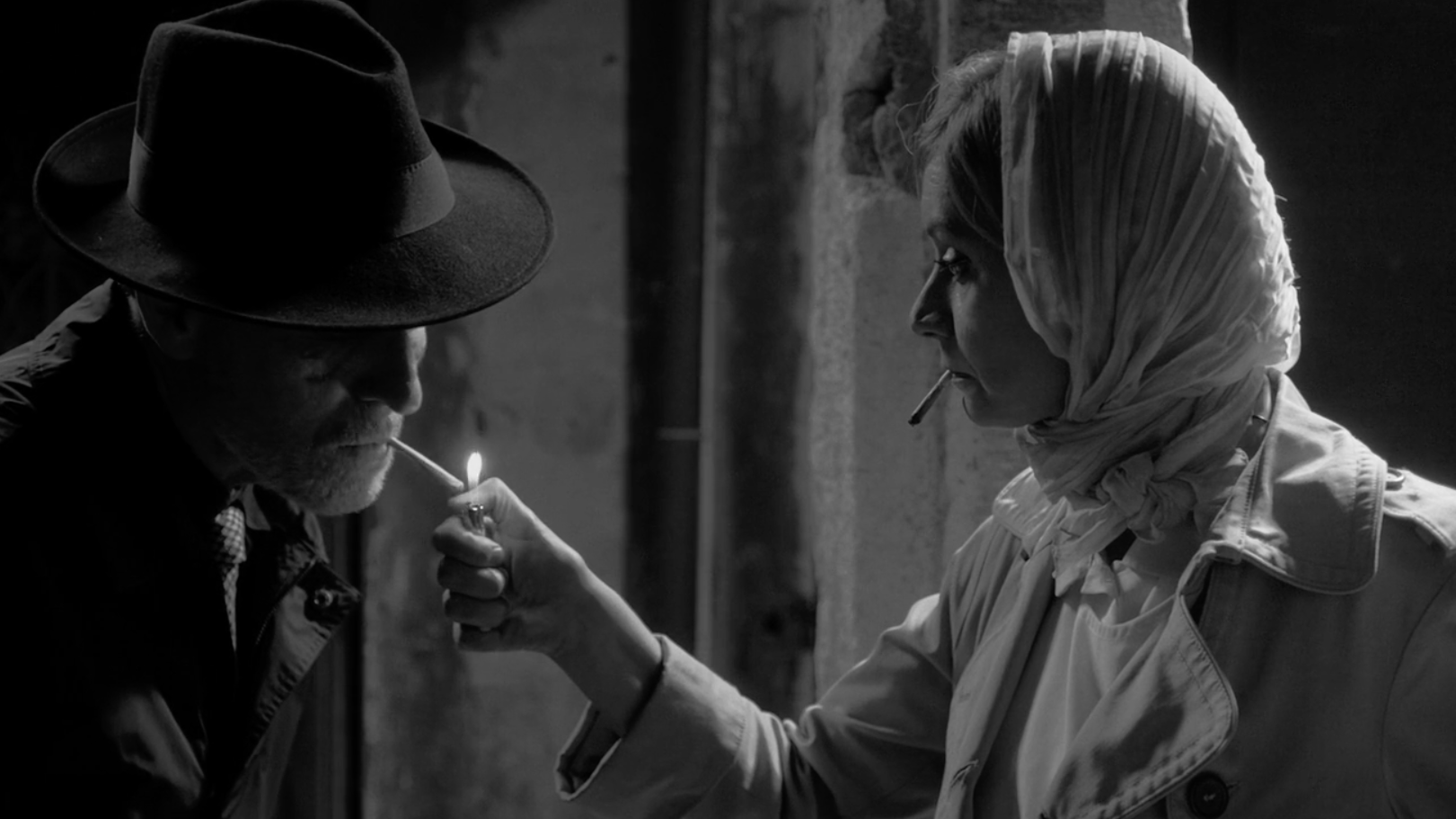
Thriller, by Serge Turgeon, Italy, 2025.
In Venice, a mysterious presence appears once every century or two, haunting the canals and hidden corners of the city. Driven by a sense of destiny, a woman decides to search for it. Following its elusive traces, she is drawn deeper and deeper into the city’s arcane secrets. Reality and myth begin to blur, and Venice itself transforms into a labyrinth of dangers.
LANGUAGE: Italian
SUBTITLES: English
Simmel’s Diagnosis, Written in 1903
Georg Simmel was not a man who theorized from a distance. He walked the same streets he wrote about, took the same trams, stood in the same crowds that swallowed individuality whole. Berlin in 1903 was not yet the city it would become by the 1920s, but it was already something the world had no previous name for — a place where half a million decisions were being made simultaneously within a radius of a few kilometers, where the price of everything had been established and the value of nothing was certain. When Simmel sat down to write what would become one of the most quietly devastating documents of modern social thought, he was not constructing a hypothesis. He was describing what was already happening to people, including himself.
The essay he produced, barely thirty pages long, does something rare in the history of ideas. It tells you what you are living through before you have had the language to name it. Simmel begins not with institutions or economics but with nerves. Literally, with nerves. The metropolitan type, he writes, is shaped above all by the intensification of nervous stimulation that results from the swift and continuous shift of outer and inner stimuli. This is not metaphor. He means the actual neurological cost of processing a city in real time — the faces that change every ten seconds on a crowded street, the sounds that overlap and cancel each other, the decisions demanded before the previous one has settled. The small town moves slowly enough that a person can meet each impression with a genuine feeling, can let something land before the next thing arrives. The city does not permit this. The city never stops arriving.
What the metropolitan develops in response is what Simmel calls the blasé attitude, and here is where the essay becomes something more than sociology. He is careful, almost insistent, to clarify that this is not a moral failing. It is not indifference born from contempt, not coldness chosen from arrogance. It is a protective mechanism that the psyche generates under conditions of permanent overload. The nerves, having been stimulated beyond their capacity to respond individually, lose the ability to respond at all. Not deadness, exactly — something more precise than that. The incapacity to react to new sensations with the appropriate energy. The exhaustion of responsiveness itself.
Simmel connects this to something he identifies as the money economy, and this is where his diagnosis deepens into something almost unbearable in its accuracy. In a world organized around monetary exchange, all qualitative differences between things are reduced to a single question: how much? A painting and a sack of grain occupy the same register. A conversation and a transaction. An hour of grief and an hour of labor. The money economy does not merely measure things — it flattens them, converts their particularity into a common denominator that makes comparison possible and meaning disposable. The result, Simmel argues, is that the metropolitan person begins to relate to the world the way money relates to goods: with perfect neutrality. With the precision that comes from having stripped away everything that cannot be quantified.
This is why a person can walk past someone collapsed on a pavement and feel nothing that halts their stride. Not because they are cruel. Because the city has spent years teaching them that the appropriate response to overwhelming stimulus is no response at all. The blasé attitude is not what they chose. It is what the city made efficient.
What Simmel understood, writing in Berlin at the exact moment the twentieth century was becoming legible to itself, is that modernity did not corrupt the individual. It restructured their nervous system. And once you see it that way, the question of whether someone is cold or simply surviving becomes very much harder to answer.

The Blasé Face as Armor
There is a man on the subway platform. He is standing close enough to see it happen — the sudden buckle of someone’s knees, the way a body surrenders to gravity before the mind has processed what the body already knows. He watches. He does not move. He does not look away either, which is the detail that matters most, because looking away would require a decision, and he has already spent every decision he had by nine in the morning. What crosses his face is nothing. Not callousness, not fear, not the calculation of risk. Nothing. And that nothing is not an absence. It has been constructed, brick by brick, over years of daily exposure to a city that presents more demands on human attention than any single nervous system was designed to absorb.
Simmel understood this in 1903, when he published “The Metropolis and Mental Life” and described the blasé attitude not as a character flaw but as a physiological adaptation. The metropolitan type, he wrote, develops a protective organ against the profound disruption with which the fluctuations and discontinuities of the external milieu threaten it. The blasé face is that organ. It is not worn; it grows. And once it has grown, it is nearly impossible to distinguish from the original face beneath it.
The man on the platform has not stopped feeling. He has learned to feel at a distance, which is a different thing, and a more expensive one. Erving Goffman named the social choreography that makes this possible: civil inattention, the practice of acknowledging another person’s existence just enough to demonstrate that you pose no threat, and then immediately withdrawing your gaze, your attention, your presence. In his 1963 work “Behavior in Public Places,” Goffman described it as the basic ritual of urban coexistence, the minimum social acknowledgment that keeps the city from collapsing into either intimacy or hostility. You see someone. You let them know you’ve seen them. You look away. The transaction takes less than a second and it is performed hundreds of times each day, by everyone, without ever being taught.
What Goffman did not fully calculate was the cumulative toll of performing this ritual across a lifetime. Think of someone who has lived in a large city for twenty years. The daily count of strangers encountered in a single commute alone runs into the hundreds. Multiplied across decades, the number of micro-acknowledgments and micro-withdrawals becomes staggering, an endless series of tiny emotional brakes applied and released, applied and released, until the braking mechanism begins to wear smooth. The result is not numbness. It is something more precise: a learned compression of response, a trained latency between stimulus and reaction that eventually becomes the default mode of perception.
There is a kind of walking that city people do, and you know it if you have ever done it — moving through a crowd in a state of complete internal dissociation, present in body and absent in every other sense, the eyes registering faces, obstacles, distances, while something behind the eyes has gone very quiet and very far away. The world arrives as data rather than experience. You navigate, you calculate, you perform the minimal social rituals, but the deeper registers of response have been suspended, the way a computer suspends non-essential processes when the processor is overloaded.
This is not pathology. That is the most unsettling part. This is competence. The man on the platform who does not move has become very good at being in a city. He has mastered the adaptive response that Simmel identified as the psychic price of metropolitan existence. The question that Simmel left open, and that Goffman’s elegant sociology of surfaces could not answer, is what happens to everything that gets compressed in the process — where it goes, whether it accumulates somewhere, whether there is a point at which the armor and the body inside it become indistinguishable.
The Money Economy and the Flattening of the World
There is a moment you recognize immediately, even if you have never lived it yourself. A man moves through a penthouse apartment the size of a small museum — marble floors, art on every wall, a view of the city that costs more than most people earn in a decade — and his face is perfectly, absolutely empty. He is not sad. He is not numb in any interesting sense. He simply cannot be reached. He picks up a glass of something expensive, sets it down, moves to the window, looks out at millions of lit windows, and feels nothing that resembles curiosity about a single one of them.
This is not a failure of character. This is the money economy completing its work.
Georg Simmel understood this with a precision that still feels surgical. In “The Metropolis and Mental Life,” written in 1903, he argued that the money economy does something specific and devastating to human perception: it makes everything equivalent. When every object, every experience, every relationship can be translated into a price, they all begin to occupy the same register. The qualitative differences between things — what makes a particular street corner irreplaceable, what makes one face unlike any other — dissolve into the quantitative. Everything becomes exchangeable. And when everything is exchangeable, nothing is singular. Nothing is irreplaceable. Nothing is worth the full weight of your attention.
The blasé attitude, for Simmel, is not laziness or decadence. It is a rational adaptation. The metropolitan person who has been subjected to an economy of prices long enough simply loses the neurological equipment to make distinctions that the economy refuses to honor. Wonder requires the sense that something before you is not substitutable. The money economy spends decades teaching you that everything is substitutable. Eventually, you believe it. Eventually, you feel it — or rather, you stop feeling, which amounts to the same thing.
The city is this economy made architectural. Every block is a display case. Every storefront is a proposition about desire and its satisfaction. Walter Benjamin spent years assembling the ruins of this insight in what became the Arcades Project, his unfinished monument to the Parisian covered passages of the nineteenth century, those iron-and-glass corridors where commodity culture first learned to seduce at scale. Benjamin saw in those arcades the dream-world of capitalism — spaces designed to make you feel that browsing was a form of freedom, that looking was a form of living. The flâneur, that figure who walks without destination, who turns attention itself into a practice, was Benjamin’s ambiguous hero: the one who tries to resist the flattening by refusing to hurry past anything, by insisting that a shop window, a face in a crowd, a scrap of advertising hoarding deserves the full seriousness of a philosophical encounter.
But even Benjamin could see the trap closing. The flâneur’s wandering attention, his refusal to be a mere consumer, gets absorbed. The department stores of the late nineteenth century were already designing their layouts to manufacture exactly that feeling of unstructured drift — the sense of wandering freely through a world of objects — while steering every possible path toward a purchase. Attention as resistance becomes attention as market research. The person who stops to look at everything becomes the ideal customer.
The man in the penthouse has stopped stopping. He has moved past the flâneur stage entirely, past even the stage of being seduced. He has arrived at the terminal condition Simmel described: a world so thoroughly priced that the capacity to want anything specifically, anything irreplaceably, has simply atrophied. He can buy the painting on his wall. He can buy another one tomorrow. The fact that he could replace it is exactly what makes it impossible to really see it.
This is not wealth. This is what equivalence does to a human nervous system when it runs long enough and deep enough.
Freedom and Its Terrible Price
You arrive in the city with a suitcase and a secret relief. Behind you: the town where everyone knew which family you came from, what your father did wrong, what your mother never recovered from. The city asks none of this. It receives you as a blank surface and returns to you something that feels, at first, overwhelmingly like freedom.
Simmel understood this as one of the metropolis’s genuine gifts. In “The Metropolis and Mental Life,” published in 1903, he argued that the city dissolves the suffocating bonds of the small community — what he called the historical forms of oppression that had crushed individuality long before industrial capitalism had a name. The village, the guild, the parish: these institutions knew you completely and held you completely. The city, by contrast, grants anonymity, and anonymity is simply another word for the possibility of becoming something your origins did not authorize.
There is a man who left a place where his entire history was a sentence passed on him before he could speak. He boards a train. He arrives at a station that swallows him instantly into its indifferent mass. No one looks up. No one knows his surname, his shame, the particular way his family failed or was failed. He walks out into streets where he could be anyone, where the face he presents meets only the face of a stranger who is equally performing their own version of arrival. For a week, maybe two, this feels like oxygen. It feels like the first clean breath after years in a room with the windows sealed.
Then something begins to loosen that was never meant to come undone. The anonymity that freed him from his past also freed him from himself. With no one to contradict or confirm, with no continuous witness to his existence, he begins to navigate not by any internal direction but by the surfaces others present to him. He smiles when smiled at. He adopts the vocabulary of whatever room he enters. He dresses toward the approval he senses might be available. He is becoming responsive rather than present — an instrument tuned to frequencies he cannot even consciously hear.
David Riesman named this transformation with clinical precision. In “The Lonely Crowd,” published in 1950, Riesman identified a historical shift in the dominant character type of Western societies, particularly in the urban American context he was studying. The older type — what he called inner-directed — carried a kind of psychological gyroscope implanted in childhood by internalized values, parental authority, a coherent narrative of self that persisted regardless of social environment. The emerging type — other-directed — operated instead by a psychological radar, perpetually scanning the social field for cues about how to feel, what to desire, who to be. Riesman was not describing a moral failure. He was describing an adaptation. The city, with its density of strangers, its constant renegotiation of identity across shifting contexts, selects for people who are exquisitely sensitive to the reactions of others. The gyroscope becomes a liability. The radar becomes survival equipment.
But what Riesman could not quite resolve — and what Simmel before him had glimpsed but not followed to its most vertiginous conclusion — is that the radar eventually replaces the self it was meant to protect. The man who fled his origin to find himself finds instead that he has become an extraordinarily skilled reader of other people’s expectations. He is free. He is also, in any meaningful sense, gone. The rootlessness that felt like liberation has become the condition itself, not the passage through which something new was supposed to emerge.
Simmel called the price of metropolitan freedom a certain inner desolation. He was careful not to moralize it. But the word he chose — Verödung, a kind of inner barrenness — carries in it the sound of a landscape from which everything living has quietly withdrawn.
A vision curated by a filmmaker, not an algorithm
In this video I explain our vision
The Metropolis as Nervous System Made Stone

Look at a city from above at night and something shifts in you before you can name it. The grid of light stretching to every horizon, the arteries of amber and white pulsing with traffic that never fully stops, the clusters of brightness around nodes of commerce and then the dimmer residential capillaries feeding outward — it looks, unmistakably, like a nervous system. Not metaphorically. Structurally. The resemblance is too precise to be accidental, because it is not accidental. The city grew the way neurons grow, following paths of least resistance, reinforcing connections that fired most frequently, pruning what fell into disuse. Seen from that altitude, the individual disappears entirely. Not tragically, not dramatically — just factually. The light does not know you are inside it.
This is what Georg Simmel meant when he described the metropolis not as a place where people live but as the material crystallization of a particular form of social organization. In his 1903 essay he argued that the money economy and the intellect share a fundamental character: both operate through abstraction, both reduce the qualitative to the quantitative, both require the individual to become, in some functional sense, interchangeable. The city is not the backdrop to this process. It is its physical body. Every street that enforces a one-way flow, every zoning boundary that separates where you sleep from where you work, every underground system that moves human beings in sealed containers along predetermined lines — these are not conveniences layered over social life. They are social life given architecture. They are the division of labor turned to stone and steel and electrical cable.
Lewis Mumford, writing in The City in History in 1961, extended this diagnosis into something closer to a verdict. He traced the evolution of urban form across four thousand years and arrived at a conclusion that carried the weight of all that evidence: the megacity, at a certain threshold of scale and complexity, does not merely house a new kind of human being. It produces one. Technically proficient, capable of navigating systems of staggering intricacy, able to coordinate with millions of strangers through the medium of money and law and professional role — and yet emotionally contracted in precise proportion to that technical expansion. Mumford called this the bureaucratic personality, though the term undersells how physiological the transformation is. It is not a matter of character or choice. It is what the environment selects for, the way altitude selects for certain lung capacities.
That sequence seen from above — the city breathing its cold electric breath across the dark, utterly indifferent to the individual heartbeats folded inside its geometry — captures something that daylight and street-level perspective consistently obscure. At ground level you can still believe the city is made for you, that the shops and the benches and the transit maps constitute a kind of hospitality. From altitude the hospitality vanishes and what remains is pure system. The light pulses because capital flows. The arteries widen and narrow according to logics of property value and infrastructural investment that were decided before you were born and will continue after you are gone. You are, in Simmel’s precise formulation, a node through which the currents pass.
What Mumford added to Simmel’s analysis was the temporal dimension — the understanding that this is not a stable equilibrium but a process with a direction. Each generation born into greater urban density, greater functional specialization, greater mediation of experience through institutional and technological systems, inherits a slightly more contracted emotional range as its baseline. Not as loss, because loss requires a memory of what preceded it. As simple normality. Extraordinary complexity and extraordinary numbness arriving together, indistinguishable from each other, both called efficiency, both called modern, the one producing the other so seamlessly that separating them begins to feel like a category error rather than a critical act.
The Reserve and the Hatred Underneath
There is a moment in an elevator — you have been in it, everyone has been in it — where two people who do not know each other enter a metal box barely large enough to hold their combined silence. The doors close. Both faces go immediately, automatically, professionally blank. Eyes find the floor indicator, the wall, the vague middle distance that is the urban citizen’s practiced nowhere. The shoulders adjust, each body angling away from the other with such precision, such studied unobtrusiveness, that the adjustment itself becomes a form of communication. What is being communicated is not neutrality. What is being communicated, if you slow it down and look at it honestly, is the enormous effort required to suppress something.
Simmel noticed this. In his 1903 essay “The Metropolis and Mental Life,” he wrote with unusual directness that the reserve which metropolitan people maintain toward one another is not the absence of feeling but its inversion. If the mutual strangeness of city life were simply indifference — if people truly felt nothing — the reserve would cost nothing. But Simmel observed that scratching lightly at the surface of this practiced neutrality revealed not emptiness but a latent aversion, something closer to suppressed hostility, the particular discomfort of forced proximity to people you did not choose and cannot escape. The city does not produce cold people. It produces people who have learned, through sheer necessity, to keep something cold pressed against a heat they cannot acknowledge.
Freud arrived at something structurally identical twenty-seven years later. In “Civilization and Its Discontents,” published in 1930, he argued that civilization is not a neutral container for human life but a machine of repression, a system that demands the individual continuously sacrifice instinctual satisfaction — aggression, desire, the need for unrestricted contact — in exchange for the protection of social order. The price, he insisted, is not paid once. It is paid every day, extracted in small continuous increments, and it accumulates. What the city does is take Freud’s abstraction and make it architectural. Every corridor, every crowded subway car, every shared stairwell is a zone where the repression machine runs at maximum pressure. You are surrounded by people you did not invite, whose proximity you cannot refuse, toward whom you must perform benign unawareness while your nervous system registers each one as a variable, a potential threat, an unresolved claim on your attention.
The scene that makes this visible — rendered so precisely it is almost clinical — involves two people in the same corridor, one of whom holds a door a fraction of a second too long, offering the other a courtesy so rigid it functions as a weapon. The smile that accompanies it carries no warmth. It carries the information that warmth is not available, that the gesture fulfills a social contract and nothing more, that you are being tolerated at the exact minimum viable level civilization requires. The other person receives this and returns it in kind. Both leave the exchange having performed perfectly, having violated no rule, and both carrying something unresolved that they will deposit elsewhere — into an irritability with a colleague, a sharpness with someone they love, a disproportionate frustration at something trivial and innocent.
Erving Goffman, whose “The Presentation of Self in Everyday Life” appeared in 1959, mapped these rituals with sociological precision, showing how urban interaction is governed by what he called civil inattention — the practiced art of acknowledging another person’s presence just enough to demonstrate you are not a threat, then withdrawing attention entirely. It is a choreography of mutual erasure. But what neither Goffman’s framework nor polite sociological language quite captures is the emotional cost of performing that choreography hundreds of times a day, against hundreds of strangers, in a city that never stops generating them.
What lives underneath the reserve is not nothing. Simmel knew it. Freud knew it. And somewhere in the elevator, descending in silence, so do you.
What the City Does to Time
There is a moment — you have had it, even if you cannot place it exactly — when you realize you have checked the time three times in the last four minutes without retaining what the clock said. Not because you are distracted. Because the checking itself has become the reflex, the nervous system’s way of locating itself in a structure that does not pause. You are not late for anything. You simply cannot stop measuring.
Simmel saw this coming with a precision that still feels uncanny. In his 1903 essay “The Metropolis and Mental Life,” he wrote that the metropolitan type is compelled into an almost inhuman exactness by the sheer interdependence of urban functions — that without punctuality, the entire machine seizes. This was not a complaint. It was a diagnosis. The city did not ask you to internalize the clock; it restructured your nervous system until the clock was no longer outside you. Punctuality became a moral virtue not because it is intrinsically noble but because the system cannot tolerate imprecision. Miss the connection and the chain breaks. The chain breaking is socially unforgivable. So you do not miss it. And eventually you cannot imagine missing it, because the part of you that might have accepted the missed connection with equanimity has been quietly retired.
There is a man — and you may recognize him — who stands on a platform after a long absence from a city he once loved, trying to remember what it felt like to have an afternoon with no purpose. Not a vacation, which is structured leisure, which is rest instrumentalized. An actual afternoon that belonged to no trajectory, that arrived without preceding appointment and departed without consequence. He tries to reconstruct the feeling the way you try to reconstruct a dream an hour after waking — the outlines are there but the interiority is gone. He remembers that he sat somewhere. He remembers light. He cannot remember what it felt like to not be somewhere else simultaneously in his mind, not to be already at the next thing, running the soft arithmetic of duration that the city installed in him before he was old enough to refuse it.
The sociologist Hartmut Rosa, developing what Simmel intuited, built an entire theory of social acceleration around this precise phenomenon — his 2013 work “Social Acceleration: A New Theory of Modernity” argues that the compression of time is not a side effect of capitalist modernity but its engine, that acceleration becomes self-perpetuating because the system rewards those who adapt fastest and punishes those who cannot keep pace. Time is not simply spent in the metropolis; it is quantified, segmented, sold back to you in units you did not know you had purchased. The hour becomes a resource. The afternoon becomes a waste if it produces nothing. The nervous system learns this grammar young and fluently, and the learning leaves no visible scar.
What Simmel never fully answered — and what remains the open wound at the center of his metropolitan vision — is whether the adaptation is reversible. Whether the human nervous system, reshaped by generations of urban rhythm, retrained by the alarm clock and the appointment and the notification and the deadline, can still access what it surrendered. Whether somewhere beneath the blase attitude, beneath the quantified time, beneath the reflex of measurement, there is still an organism that remembers duration as something other than a problem to be managed. Or whether the city’s great unspoken achievement is precisely this: that it removed the organ by which the loss would be felt, so that the people who have sacrificed the capacity for purposeless time do not grieve it, cannot grieve it, and would not recognize the grief even if someone placed its name directly in front of them and said, this — this is what is missing from your life.
🏙️ The City, the Self, and the Modern Mind
Georg Simmel’s ‘The Metropolis and Mental Life’ opens a labyrinth of questions about how urban modernity reshapes human consciousness, identity, and social bonds. The following articles trace parallel corridors of thought — from the decline of cultural forms to the tyranny of spectacle — all converging on the same burning question: what does it mean to be a self in an overwhelmingly stimulating world?
Spengler’s The Decline of the West: Analysis
Spengler’s monumental work diagnoses Western civilization as an organism entering its twilight, a thesis that resonates deeply with Simmel’s anxiety about the metropolis as a site of cultural exhaustion. Just as Simmel observed the individual dissolving into the rhythms of money and mass life, Spengler saw entire civilizations losing their organic vitality to mechanization and abstraction. Together, they form a dark diptych of early twentieth-century cultural pessimism.
GO TO THE SELECTION: Spengler’s The Decline of the West: Analysis
Karl Marx and Alienation: Economic and Philosophical Manuscripts
Marx’s concept of alienation provides an essential economic foundation for understanding Simmel’s metropolitan blasé attitude, since both thinkers locate the estrangement of the self in the dominance of objectified, exchangeable value. Where Marx focused on the factory floor, Simmel extended the same logic to the streets, cafés, and crowds of the modern city. Reading them together reveals how alienation migrates from labor into the very fabric of everyday urban experience.
GO TO THE SELECTION: Karl Marx and Alienation: Economic and Philosophical Manuscripts
Mass Social Homologation Today
Mass social homologation is the cultural endpoint that Simmel feared lurking beneath the metropolitan individual’s fierce claim to uniqueness — the irony that rebellion against conformity often produces its own standardized forms. This article examines how the pressure to belong and the pressure to stand out collapse into a single mechanism of social control in contemporary society. Simmel’s metropolitan nervous life thus finds its twenty-first century heir in the homogenizing logic of digital culture and consumer identity.
GO TO THE SELECTION: Mass Social Homologation Today
Postman’s Amusing Ourselves to Death: Analysis
Neil Postman’s critique of television culture echoes Simmel’s warnings about the overstimulation of metropolitan life, replacing the sensory chaos of the city with the relentless flicker of the screen. Both thinkers argue that the constant bombardment of impressions does not inform or deepen consciousness but rather numbs it into passive reception. Postman’s analysis of amusing ourselves to death is, in many ways, Simmel’s metropolis transported into the living room.
GO TO THE SELECTION: Postman’s Amusing Ourselves to Death: Analysis
Explore the City of the Mind on Indiecinema
If these ideas have stirred something in you, Indiecinema is where thought becomes image. Discover independent and auteur films that dare to explore the fractures of modern consciousness, urban solitude, and the restless search for meaning — stream them now on Indiecinema.
👉 EXPLORE THE CATALOG: Watch Indie Films in Streaming
A vision curated by a filmmaker, not an algorithm
In this video I explain our vision

