
The Screen at Breakfast
You reach for it before your eyes have fully adjusted to the light. The motion is so practiced it barely registers as a choice — arm extending sideways, fingers finding the glass rectangle with the certainty of muscle memory, screen flooding your face with blue-white brightness before the room itself has come into focus. Somewhere in the distance a bird is making noise. You do not hear it. You are already inside.

The first notification arrived while you slept. Then seventeen more. A politician said something inflammatory at 2 a.m. A celebrity’s relationship has ended. A video — you didn’t select it, it simply began — shows a man slipping on ice while his dog watches with what the caption insists is judgment. You smile. You scroll. Beneath it, someone is outraged about something that happened in a country you couldn’t locate on a map last week, and the outrage feels legitimate, immediate, yours. You share it. The morning has not yet begun and you have already participated in approximately four distinct emotional registers, none of which will stay with you past the second cup of coffee.
This is not a failure of character. This is design. But understanding it as design does not make it easier to escape, because the trap is not in the phone — the phone is only the latest container. The trap is in what we have come to believe information is for.
Neil Postman saw it coming with a clarity that still feels uncomfortable. Writing in 1985, when the dominant screen was the television and the internet was a military abstraction most civilians had never heard of, he argued in Amusing Ourselves to Death that the form of a medium is not neutral — that it actively shapes what kinds of thoughts are thinkable within it. He borrowed the framework from his teacher Marshall McLuhan, but where McLuhan was oracular and deliberately obscure, Postman was surgical. He wanted to know specifically what television had done to public discourse, to politics, to education, to the very concept of truth. What he found was that entertainment had become the supraideology of the age — the ambient assumption beneath all other assumptions — and that anything passing through the television screen would eventually be bent toward its logic, not because anyone decided this, but because the medium demanded it.
He was writing about television. He was writing about you, this morning, before you got out of bed.
The medium has changed shape and multiplied its surfaces. The argument has only deepened. Postman drew on Aldous Huxley‘s warning rather than Orwell’s — he believed we would not be undone by censorship but by pleasure, not by a government burning books but by a culture that had lost its appetite for them, not by silence imposed from above but by noise we generate ourselves, gratefully, compulsively, around the clock. Huxley wrote Brave New World in 1932, when the mechanisms of manufactured consent were still relatively crude. What he imagined as the dystopian endpoint — a population pacified not through suffering but through stimulation, not imprisoned but distracted into submission — has arrived not with sirens but with the soft percussion of a phone vibrating against a nightstand.
A man sits in a room somewhere. The walls around him are screens. He has not been forced into this room. He furnished it himself, over years, one subscription at a time, one upgrade at a time, and he experiences the room not as confinement but as comfort. This is the image that Postman’s book plants in you and refuses to remove. Because the man is not a cautionary figure from science fiction. He is recognizable. He is unremarkable.
He was already scrolling when you woke up. Or perhaps he is you, and the room has no walls you can see yet, only light, only the next thing, only the compelling and structureless and utterly consuming flood of now.
The Lost Poet

Drama, by Fabio Del Greco, Italy, 2024.
Dante Mezzadri wants to see an old friend, nicknamed the Iguana, whom he has lost sight of for many years, and who has managed to turn their shared youthful passion for poetry into a job, becoming a famous writer and poet. The man escapes from his bourgeois life and his wife to live homeless on the Roman coast, printing and trying to sell his poetry collections. At night he sleeps in a park of old carnival floats, inside a papier-mâché tank, and waits for the opportunity to meet his old friend, who however never shows up for appointments in the places they frequented when they were young, now in ruins. Dante's poetry books do not interest anyone and to support himself he is forced to "change product": he starts selling the infamous "cannibal pill" on behalf of young drug dealers, a new drug that sells like hot cakes and causes sensory and consumerist ecstasy. However, he realizes that this powerful drug is very dangerous for those who take it, he comes into conflict with his ethical conscience and throws all the pills into the sea. However, the dealers want to collect their money.
Shot over a period of 2 years, the film is a reflection on the cultural and artistic rubble of the society in which the protagonist lives, in an increasingly mechanized, consumerist and arid world. Dante Mezzadri is yet another human being who has renounced his inspiration and his creativity, but unlike many he is not willing to give his life to a system that distances him from his true identity. The physical world around him, however, seems constructed in such a way that it seems impossible to escape from this "invisible cage". The enthusiasm of the people he meets is ignited only by sensory gratification, by unreal visions of personal affirmation and success, by "metaverses" that offer an escape into an illusory and destructive reality. The poet's house on the coast, where he met with his friends as a young man, is just a pile of abandoned rubble. What happened to all those who wanted to become poets and ended up becoming something else? Are there internal forces with which that house can be "rebuilt"?
LANGUAGE: Italian
SUBTITLES: English, Spanish, French, German, Portuguese
What Postman Actually Said in 1985
There is a sentence near the beginning of Postman’s 1985 book that most people who cite the work have never actually read carefully. He writes that Huxley, not Orwell, was right. Not as a casual preference, not as a rhetorical flourish, but as the central premise from which everything else follows. The argument is architectural: remove that foundation and the entire structure collapses into something far more ordinary, another media critique, another lament about distraction. What Postman actually built was something more unsettling — a theory of how a civilization can lose its capacity for serious thought not through repression but through the willing consumption of its own intellectual dissolution.
The book appeared in 1985, at a moment when American television had completed what Postman understood as a decades-long colonization of public life. By that year, the average American household had the television running for nearly seven hours a day. The three major networks — ABC, NBC, CBS — commanded audiences that no subsequent media platform would ever replicate. Ronald Reagan, a former actor, had just won a second presidential term in a landslide, and Postman saw in that fact not a political curiosity but a symptom of something structural: the presidency had become a performance category, evaluated by the same criteria as entertainment.
His central concept, introduced in the book’s early chapters, is epistemology — not as a technical philosophical term but as something visceral and daily. How we know what we know is shaped by the medium through which we receive it. Postman drew explicitly on Marshall McLuhan’s insight that the medium is the message, but he pushed further: he argued that each medium carries within it a bias toward certain kinds of content and certain kinds of thinking. Print, he argued, demanded linearity, sustained attention, logical sequence, and the capacity to hold a complex argument across time. You could not skim Locke and claim to have understood him. The form itself enforced a discipline.
Television, by contrast, is structurally hostile to complexity. Its grammar is the cut, the image, the emotional impact sustained for no longer than a few seconds before the next stimulus arrives. Postman coined the phrase “Now this” to describe television’s fundamental rhetorical move — the transition between segments that erases everything that came before and demands you begin again, without context, without memory, without consequence. A segment on famine in Ethiopia followed immediately by a commercial for canned soup. A report on nuclear arms negotiations followed by a weather forecast delivered with a smile. The juxtapositions are not accidental. They are the medium’s native logic.
Chapter four, which Postman titled “The Typographic Mind,” reconstructs what he considered the high-water mark of American public discourse: the Lincoln-Douglas debates of 1858, in which two men spoke for hours to outdoor crowds without amplification, in full argumentative sentences, expecting their audiences to follow extended chains of reasoning. He is not being nostalgic about a golden age. He is establishing a baseline — proof that the cognitive capacity existed, that it was cultivated by a print culture, and that it has since been systematically eroded by a medium that rewards spectacle over substance.
The Huxley invocation is precise. In Brave New World, published in 1932, the population is controlled not by pain but by soma — a pleasure drug that makes suffering unthinkable and resistance unnecessary. Postman’s argument is that television functions as soma for an entire civilization. Nobody forced you to watch. Nobody took your books away. You chose the screen, every evening, freely, because it felt better than the alternative. And in that free choice, repeated across decades and across millions of households simultaneously, something was quietly surrendered — not under duress, but with the remote control already in hand.

The Typographic Mind and What We Lost
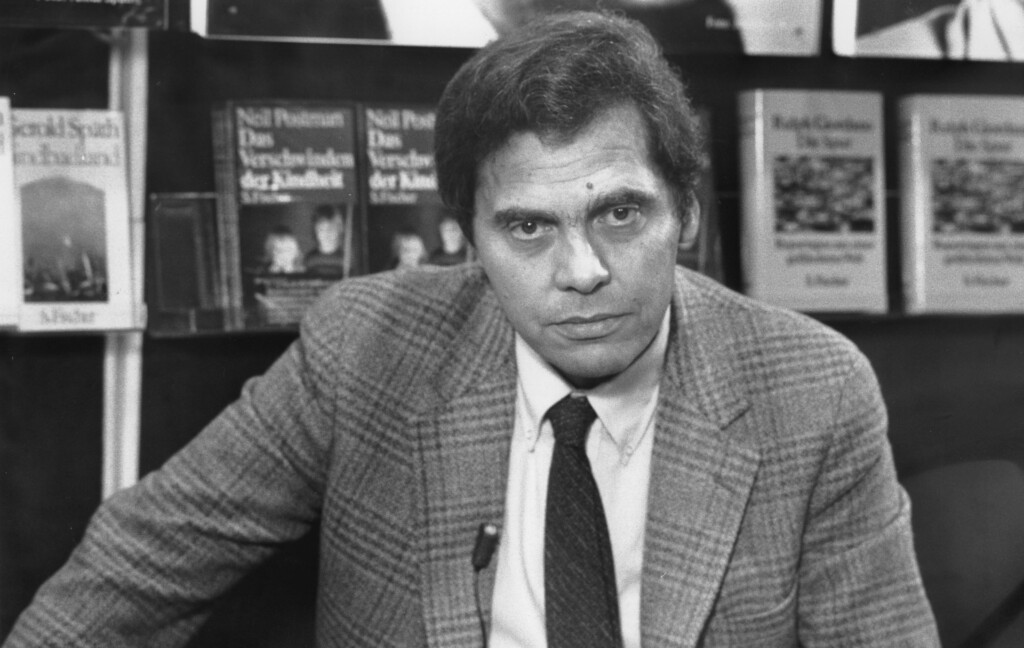
There is a man standing in front of a bathroom mirror, lips moving, rehearsing words he has been composing in his head for three days. He is preparing for a town council meeting, or perhaps a confrontation with a neighbor, or perhaps neither — the occasion barely matters. What matters is the architecture of his preparation: the logical sequence he has arranged, the counterargument he anticipates, the evidence he intends to cite. He has written notes. He has revised them. He has practiced the transition between his second and third point because he knows, instinctively, that the third point only lands if the second point has done its work. He will not give this speech. Something will interrupt him, or the meeting will run long, or he will lose his nerve in the parking lot. But the rehearsal itself is a monument to a particular kind of mind — one trained to believe that reason moves in a line, that a well-constructed argument has moral weight, that the person who speaks most logically deserves to be heard.
This is the mind Neil Postman loved. He called it the typographic mind, and he mourned its erosion with the grief of a man watching a cathedral being dismantled for scrap. In Amusing Ourselves to Death, published in 1985, Postman argued that the four centuries following Gutenberg produced a citizenry capable of sustained linear reasoning precisely because the medium of print demanded it. You cannot skim a logical proof. You cannot absorb a constitutional argument through emotional contagion. The page forced a discipline of attention that, in his telling, reached its civic apex in the Lincoln-Douglas debates of 1858 — seven hours of uninterrupted argument before crowds who followed the structure, tracked the premises, and judged the conclusions. This was democracy as epistemology.
The portrait is seductive. It is also, in important ways, a myth that Postman needed more than history can sustain.
Walter Ong, writing three years before Postman in Orality and Literacy, had already mapped the deeper transformation that print imposed on human consciousness — and his account is considerably less triumphal. Ong understood that literacy does not simply add a skill to an existing mind. It restructures the mind from within, producing what he called the interiorization of consciousness, a new kind of solitude and self-awareness that oral cultures neither possessed nor lacked. Print created the individual as a psychological category. It also created alienation, the sensation of thought separated from community, of knowledge archived rather than performed. The typographic mind Postman celebrated was a mind that had already paid an enormous cost he chose not to audit.
Elizabeth Eisenstein’s monumental study of the printing press complicates the picture further. Her research, drawing on decades of archival work across early modern Europe, demonstrated that the press was as much an engine of standardized error as of enlightened reason. It mass-produced astrology alongside astronomy, witch-trial manuals alongside humanist philosophy. The same technology that enabled Luther’s Reformation enabled the pamphlet wars that preceded decades of religious violence. The typographic revolution did not produce rational citizens as its primary output. It produced a new scale of information, which humans then organized according to the prejudices, power structures, and theological anxieties already in place.
Postman knew some of this, and he was too intelligent to pretend otherwise. But his argument required an idealized past as leverage against a degraded present, and so he held the contradictions loosely, pressing them behind the argument rather than through it. The man in the bathroom mirror is real. His rehearsed speech is real. But the assumption that a world organized around print would have given him a room where that speech could matter — that is the part worth examining more slowly, before the meeting starts, before the parking lot, before the nerve fails.
Entertainment as the New Epistemology
There is a man watching a political debate with the sound turned off. He is not doing this as an experiment. He simply forgot to unmute the television after a phone call, and by the time he realizes it, twenty minutes have passed and he already knows — he is certain, in the way you are certain about weather — who won. The posture, the micro-expressions around the mouth, the speed of blinking, the angle of the jaw when the other candidate speaks. He has read all of it without hearing a single word, and his conclusions feel more solid than anything a transcript could offer him. This is not a failure of attention. This is the grammar of the medium working exactly as designed.
Neil Postman‘s central argument in Amusing Ourselves to Death, published in 1985, is not that television is vulgar or distracting, though it can be both. The claim is more structurally violent than that: when a medium becomes the dominant carrier of public discourse, it does not simply change how we communicate. It changes what we are capable of thinking. The medium does not transmit epistemology — it is the epistemology. Every question that passes through it gets reformatted to fit its logic of image, speed, and emotional immediacy, and what cannot be reformatted simply ceases to exist as a legitimate question.
Marshall McLuhan had already laid the groundwork in 1964, when Understanding Media articulated the idea that the content of any medium is always another medium, and that the real message is never what is said but the shape of the saying. A medium trains perception before a single piece of content arrives. It establishes what counts as evidence, what counts as duration, what counts as the appropriate emotional register for serious thought. McLuhan was describing a structural condition, not a moral failure, and this distinction matters enormously. Postman inherited it and sharpened it into something more uncomfortable: the medium doesn’t just shape thought, it selects which thoughts are thinkable at all within its frame.
Television’s grammar has three primary rules. The first is that complexity must be visible, which means complexity must be eliminated. The second is that duration is an insult to the viewer, which means depth is structurally forbidden. The third is that emotional legibility outranks propositional content, which means the face of an argument always defeats its substance. Guy Debord understood this as early as 1967, writing in The Society of the Spectacle that the spectacle is not a collection of images but a social relation between people mediated by images. Once that mediation becomes total, the image is no longer a representation of reality — it becomes the only reality that counts politically, socially, epistemically.
This is why the man watching on mute is not malfunctioning. He has internalized the medium’s epistemology perfectly. He knows that in the grammar of television, the argument is the body, the evidence is the aura, the fact is the affect. He has learned to read the weather because the weather is all there is. The words, if he were to unmute the television, would arrive as decoration on top of a verdict already rendered by light and posture and timing.
What this produces, at scale, is a public whose cognitive habits have been reorganized around an entirely different definition of what it means to know something. Not a stupider public — that is the consoling misreading. A differently structured one. A public that has been trained, over decades of immersion, to experience the speed of an image as a form of proof, to mistake emotional recognition for factual understanding, to feel that anything requiring more than ninety seconds of sustained attention is probably not serious enough to deserve it.
The medium has not dumbed the audience down. It has taught them a new epistemology, fluently and completely, and they have learned it the way anyone learns their mother tongue — without ever being aware that another language once existed.
Huxley Was Right and That Is the Unbearable Part
There is a room you keep returning to. Not because you are forced. Not because anyone stands at the threshold with a key or a threat. You return because the light inside is extraordinary — warm, diffuse, calibrated to make everything look slightly better than it is. You have noticed, in quieter moments, that you cannot quite remember the last time you left. But the light is so beautiful that the thought dissolves before it fully forms.
This is the precise topology of Huxley’s nightmare, and it is more devastating than Orwell’s precisely because it offers you nothing to push against. Orwell gave us boots and faces and the grammar of domination — a structure legible enough to generate resistance, martyrdom, heroism. Winston Smith suffers, and in his suffering there is at least the dignity of an enemy worth naming. Huxley gave us something far crueler: a population that has been relieved of the desire to resist. The citizens of his World State in Brave New World, published in 1932, are not imprisoned. They are entertained. They are comfortable. They are, by every measurable standard, content. And that contentment is the cage.
Postman understood this distinction with unusual clarity. His central argument is not that television is unpleasant or degrading or even stupid. It is that television is pleasurable in ways that quietly evacuate the cognitive architecture required for serious thought. This is a different kind of harm entirely. Harm you can feel, you can name. Harm that arrives as pleasure — that sedates the very faculties you would need to detect it — operates below the threshold of grievance. You cannot protest your way out of a condition you experience as freedom.
Byung-Chul Han, writing in The Transparency Society in 2012, presses this wound further. The society of transparency, he argues, is not a society of clarity or honesty — it is a society of exposure, of constant visibility, of the relentless demand to be seen and to see. What it produces is not enlightenment but exhaustion. The subject of this society is not oppressed from outside but worn down from within, by the frictionless, accelerating circulation of images and information that leaves no residue, no sedimentation, no capacity for what Han calls the long breath of contemplation. Entertainment in the Postman-Huxley sense is a form of this transparency: everything flows, nothing accumulates, and the self becomes a surface rather than a depth.
Bernard Stiegler, whose massive project Technics and Time began appearing in 1994, offers the sharpest clinical term for what is actually happening: the loss of tertiary retention. For Stiegler, what is most human about us is our capacity to externalize memory — to store experience in tools, texts, institutions, and then to re-internalize that stored experience as knowledge, as orientation, as the ability to project forward in time. When a technical system — television, the feed, the algorithm — begins to manage that externalization for us, we do not simply become lazier. We become dispossessed. Something is removed from us that we did not know we owned. Distraction is what you experience. Dispossession is what is happening.
The man who cannot leave the room because the light inside is too beautiful is not lazy. He is not stupid. He has simply been made to feel that the light is enough — that the warmth and the softness constitute a sufficient form of being alive. And the terrible thing, the thing that makes Huxley’s vision so much harder to sit with than Orwell’s, is that on many mornings, the man would be right. The light is beautiful. The room is warm. And the question of what lies beyond the threshold — whether there is something out there that requires a different quality of attention, a different tolerance for discomfort — is a question that the room has been very carefully designed to make feel unnecessary.
A vision curated by a filmmaker, not an algorithm
In this video I explain our vision
The Algorithmic Sequel Postman Did Not Live to Write

You are standing at the back of a room where someone is being buried, and your thumb is moving. Not because you decided to check anything. Not because you are bored or indifferent or cruel. The gesture preceded the intention, the way a knee jerks before the brain registers the hammer. The feed refreshes. A sponsored post appears between two condolence messages. You put the phone away, ashamed, then pick it up again forty seconds later without noticing you did it.
This is not a failure of character. It is the completion of an architecture.
What Postman diagnosed in 1985 was a cultural disposition — the slow colonization of public discourse by entertainment’s logic, driven by television’s formal properties. What has happened since is that the disposition became infrastructure. The logic he described is no longer a tendency you can resist by changing the channel or reading more books. It has been engineered into the substrate of attention itself, written into the compulsive geometry of the scroll.
Tristan Harris, who spent years as a design ethicist at Google before testifying before the United States Senate Commerce Committee in 2017, described the mechanism with unusual candor for someone speaking from inside the industry. The techniques deployed — variable reward schedules, infinite scroll, notification pulses calibrated to interrupt at moments of maximum vulnerability — are not metaphorically similar to slot machine design. They are literally derived from the same behavioral psychology, the same operant conditioning frameworks B.F. Skinner identified in the mid-twentieth century. The phone in your pocket at that funeral is a Skinner box you carry voluntarily, and you paid for it.
In 2014, Facebook’s internal research team published findings in the Proceedings of the National Academy of Sciences demonstrating that emotional states could be transferred between users at scale by manipulating the content of their feeds — without their knowledge and without their consent. The study exposed nearly seven hundred thousand accounts to algorithmically curated emotional contagion. The researchers called it an experiment. What they had actually documented was that the platform had always been doing this, that the experiment was simply the moment they decided to measure what they were already doing. Postman wrote that television was remaking the American mind without anyone noticing; in 2014, a corporation published peer-reviewed evidence that it was remaking human emotion as a controllable variable.
Shoshana Zuboff, in The Age of Surveillance Capitalism published in 2019, gave this process its proper theoretical architecture. What she described is not simply the monetization of attention but something structurally new: behavioral data extracted from human experience, processed into predictive products, and sold to markets that trade in future behavior. The goal is not to show you what you want. The goal is to modify what you will want. Postman thought the danger was passivity — the citizen become spectator. Zuboff’s analysis suggests the citizen has become raw material, their attention not merely captured but transformed into an industrial input.
The difference between Postman’s television and the feed you refresh at a funeral is the difference between a stage and a nervous system. Television required you to sit down, to face a screen, to carve out a portion of time. The algorithmic feed has no edges. It occupies the pauses between everything else — the elevator, the waiting room, the graveside. It does not interrupt your life. It becomes the texture your life runs across.
And the recommendation algorithm does something television could never do: it learns you. Not the public you, not the citizen you, but the anxious, compulsive, longing pattern of you that emerges at two in the morning when your defenses are down. It learns that version and feeds it. Postman feared we would amuse ourselves to death.
The Trap of Lucidity
There is a particular comfort in finishing a book about manipulation. You close it, feel the weight of it in your hands, and something settles in your chest — a quiet conviction that you have now crossed a threshold. The people out there, the ones who have not read this, they are the ones caught in the trap. You have named the mechanism, and naming, you believe, is a form of escape.
It is not.
Pierre Bourdieu spent a significant portion of his intellectual life dismantling exactly this fantasy. In his 1996 work on television and its relationship to the cultural field, he argued that the academic, the journalist, the public intellectual — these figures do not stand outside the media system they critique. They occupy specific positions within it, positions that carry their own pressures, their own economies of attention, their own seductions. The sociologist who appears on television to denounce television is already playing by television’s rules: the compressed time, the performance of authority, the implicit demand to be interesting rather than rigorous. Lucidity about the game does not remove you from the game. It sometimes just makes you a more sophisticated player.
Think of the man who spent thirty years studying the architecture of political propaganda — the techniques, the historical precedents, the psychological mechanisms by which images override argument. He taught courses on it. He published papers that traced the genealogy of manufactured consent through three centuries of statecraft. And then, in a voting booth, he found himself drawn to a candidate not because of policy, not because of record, not because of anything he could defend over dinner, but because the man looked right. Something in the jaw, the posture, the controlled warmth of the smile. He voted, walked out into the street, and understood with full clarity what had just happened. The knowledge was intact. The behavior had gone ahead without it.
This is not a story about hypocrisy. It is a story about the depth at which media conditioning operates, which is a depth that intellectual awareness simply does not reach. Bourdieu’s concept of the habitus — the set of dispositions acquired through years of exposure to a given social environment — is precisely about this gap between what you know and what your body, your instincts, your attention have been trained to do. You can understand that you have been shaped without being able to unshape yourself through understanding alone.
Postman’s argument, read carefully, does not offer an exit. It offers a diagnosis, and there is a difference. The act of reading Amusing Ourselves to Death, of underlining passages, of recommending it to friends, of discussing it with the particular intensity that comes from feeling seen by a critique — all of this happens inside the same media ecosystem the book describes. The book itself, published in 1985, was marketed, reviewed, excerpted, covered in newspapers and magazines and eventually adapted into the kind of cultural reference that circulates as a signal of seriousness. You cite Postman the way you might share a long-form article: not necessarily to act on the insight, but to demonstrate that you are the kind of person who encounters such insights.
The cruelest irony is structural, not personal. It is not that you are weak or insufficiently committed. It is that the system Postman describes is not a system you can step outside of by knowing its name. It is the water. Naming water does not make you less wet.
And so you finish the book. You perhaps recommend it. You perhaps feel, for a while, that specific alert feeling of someone who has seen something clearly. The television is still on in the other room. The phone is still in your pocket. The teeth of the next candidate are already being calibrated for the screen.
What the Medium Does to the Body
There is a particular discomfort that arrives around the fourth or fifth minute of reading something difficult, something that does not resolve quickly, something that asks you to hold a premise in suspension while the argument builds beneath it. It is not boredom exactly. It is closer to an itch, a faint atmospheric pressure behind the eyes, a reaching of the hand toward the phone before the mind has consciously decided to reach. You have felt it. Most people feel it now without recognizing it as anything other than the normal texture of thought.
This is not a moral failure. It is a physiological one, and the distinction matters enormously. Maryanne Wolf, in her research on the reading brain, has documented with clinical precision what happens to the neural architecture when deep reading is practiced over years and what happens when it atrophies from disuse. The brain is not a fixed instrument. It remakes itself around its habits, and a mind that has spent a decade navigating fragmented, image-saturated, algorithmically accelerated surfaces is literally a different brain than one trained on sustained linear prose. The capacity for what Wolf calls deep reading — the ability to hold complex syntax, to infer, to analogize, to feel the gravitational pull of a long argument — is not an instinct. It is a technology of the self, constructed slowly, and it can be unconstructed just as slowly, without any single moment of rupture to mark its passing.
Jonathan Crary, writing in 2013, located this erosion within a larger economic logic. The capture of attention is not incidental to late capitalism; it is the primary site of extraction. Sleep itself has become the last territory not yet fully colonized, the final hours in which a human being is unreachable, unmonetizable, genuinely offline. The system does not want your attention occasionally. It wants it continuously, at every waking hour, structured around stimuli calibrated to prevent the kind of sustained focus that produces genuine thought. Crary understood that what looks like entertainment is in fact a form of metabolic reorganization, a retraining of the nervous system toward permanent low-level vigilance and away from the patient interiority that produces self-knowledge.
Simone Weil wrote, decades before any of this was visible as a crisis, that attention is the rarest and purest form of generosity. She meant something precise: that genuine attention is an act of self-emptying, a willingness to let the object of thought be fully what it is rather than what you need it to be. This kind of attention is not passive. It is intensely disciplined, and it requires the tolerance of silence, of not-knowing, of sitting with a question that will not immediately resolve into an answer or an image. What the screen environment systematically produces is the opposite condition: a mind that is always receiving, always stimulated, always moving, but never genuinely attending to anything long enough to let it change the structure of the self.
Postman saw the beginning of this. He saw it in television, in the conversion of public discourse into entertainment, in the slow replacement of the proposition with the image. What he could not have fully seen, writing in 1985, is the degree to which the medium would eventually migrate inside the body itself, reorganizing not just the public sphere but the private neurological one. The question his work leaves open — and that its readers must now carry — is not whether we have lost something. The evidence for loss is accumulated, measurable, felt in the body every time sustained thought becomes difficult. The question is whether the instrument required to measure the loss is still sufficiently intact to perform the measurement, whether the patient, solitary, linear mind that could once sit with silence and know what silence meant still exists in enough of us to recognize what its own disappearance looks like from the inside.
📺 When Media Becomes the Message and the Maze
Neil Postman‘s ‘Amusing Ourselves to Death’ diagnosed modern culture as a society surrendering critical thought to the seductions of television and entertainment. The articles below explore the philosophical, political, and cultural threads that weave through Postman’s central argument, from the nature of mass conformity to the deeper roots of media critique.
Mass Social Homologation Today
Postman’s thesis finds a living echo in the phenomenon of mass social homologation, where individuals increasingly mirror the values, desires, and rhythms dictated by dominant media. This article examines how contemporary society produces conformity not through overt coercion but through the subtle, pleasurable pressure of shared spectacle. Understanding homologation is essential to grasping why Postman saw entertainment culture as a more insidious threat than censorship.
GO TO THE SELECTION: Mass Social Homologation Today
Herbert Marcuse and Art: The Aesthetic Dimension
Herbert Marcuse‘s aesthetic theory offers a profound counterpoint to Postman’s critique, arguing that genuine art retains a subversive dimension capable of resisting the administered society of mass media. Marcuse believed that the aesthetic dimension could negate the false happiness propagated by consumer culture, a culture Postman would later identify with the television age. Together, their visions form a powerful indictment of a world where pleasure is manufactured to prevent thought.
GO TO THE SELECTION: Herbert Marcuse and Art: The Aesthetic Dimension
Hannah Arendt: the Philosopher Who Unmasked the Banality of Evil
Hannah Arendt‘s unmasking of the banality of evil resonates deeply with Postman’s warning about the normalization of triviality in public discourse. Both thinkers were concerned with the erosion of the capacity for genuine thought, whether through totalitarian ideology or the relentless distraction of entertainment media. Arendt’s political philosophy reminds us that the surrender of critical thinking is never without consequence.
GO TO THE SELECTION: Hannah Arendt: the Philosopher Who Unmasked the Banality of Evil
Shelley and the Defence of Poetry: Poets as Legislators
Shelley’s defence of poetry as a moral and political force stands as a historic counterargument to cultures that reduce communication to amusement and spectacle. His claim that poets are the unacknowledged legislators of the world carries a deep urgency when read alongside Postman’s lament for the decline of the written word as a vehicle of serious thought. This article explores how Romantic poetics prefigured modern debates about the relationship between language, media, and public life.
GO TO THE SELECTION: Shelley and the Defence of Poetry: Poets as Legislators
Rediscover Cinema That Refuses to Entertain Blindly
If Postman’s analysis has stirred something in you, Indiecinema is the streaming platform where cinema reclaims its role as a space for genuine thought, provocation, and cultural resistance. Explore a curated selection of independent and avant-garde films that challenge the logic of spectacle and invite you to see the world differently.
👉 EXPLORE THE CATALOG: Watch Indie Films in Streaming
A vision curated by a filmmaker, not an algorithm
In this video I explain our vision

