
The Morning You Stopped Asking Questions
You know the exact moment, even if you have never named it. You were sitting in a meeting — or standing in a corridor, or staring at a screen — and someone said something that was plainly, demonstrably wrong. Not morally ambiguous, not open to interpretation, but factually, structurally, obviously wrong. And you said nothing. Not because you were afraid, exactly. Not because you had calculated the risk and decided against speaking. But because somewhere between your thought and your mouth, a filter engaged that you did not install, that no one ever handed you the manual for, that operates with the quiet efficiency of something that has been running for years without maintenance. You said nothing because saying nothing had become the most natural thing in the world.

This is not a story about cowardice. That framing is too easy, and it lets the real mechanism off the hook entirely. Cowardice implies a choice you made under pressure. What actually happened is subtler and more unsettling: you had already reorganized your perception of the situation before the choice ever arrived. By the time the wrong thing was said, you had already begun translating it into something defensible, something you could live with, something that fit the shape of the room you were sitting in. The corruption was not in the silence. The corruption was in the translation.
George Orwell understood this with a precision that still feels almost violent when you encounter it directly. He had watched it happen in Spain during the Civil War, where he fought with the POUM militia in 1936 and witnessed firsthand how political language could be weaponized not merely to deceive others but to restructure the internal world of those who used it. He wrote about this experience in Homage to Catalonia in 1938, and it burned in him for years afterward, fueling a particular kind of rage — not the hot rage of the wronged, but the cold, precise rage of someone who has seen the mechanism exposed and cannot unsee it. By 1945, when Animal Farm was finally published after being rejected by four publishers who found its critique of Soviet Russia diplomatically inconvenient, Orwell had distilled that rage into something deceptively simple: a fable about farm animals who overthrow their human master and proceed, with magnificent inevitability, to reconstruct the very tyranny they destroyed.
The book is 112 pages. It has been translated into more than seventy languages. It is assigned in schools across the world, which is perhaps the most elegant irony Orwell never lived to witness — because the central operation of Animal Farm is precisely the transformation of critical thought into institutional habit, the conversion of rebellion into curriculum, the moment when the question becomes the answer and the answer stops any further questioning. A book about the death of dissent has been made compulsory.
But this is not actually about the book. Or rather, the book is the lens, not the subject. The subject is that filter you did not install. The subject is the morning — and there was a specific morning, even if you cannot locate it on a calendar — when you stopped asking whether the rules were right and began asking only whether you were following them correctly. When the metric of your own behavior shifted from truth to compliance without any formal announcement, without anyone demanding it of you, without even the drama of a conscious surrender.
Orwell’s animals did not surrender either. They voted. They sang. They believed, for a genuinely moving stretch of time, that they were building something new. The horror of the story is not that they were deceived from the outside. It is that the architecture of their deception was assembled from materials they themselves provided, brick by brick, in the language of their own liberation.
You know how that feels. You have been in that meeting.
A Fable That Refused to Stay Fictional
When the manuscript arrived at Victor Gollancz‘s desk in 1944, it was returned almost immediately. Then Jonathan Cape rejected it. Then T.S. Eliot, writing on behalf of Faber and Faber, declined it with a letter that remains one of the more remarkable documents in twentieth-century publishing history — Eliot praised the writing, acknowledged the craft, and then explained, with perfect editorial composure, that the book’s politics were simply not the right kind of politics for the moment. The pigs, he suggested, were portrayed unsympathetically. What the world needed, he implied, was not a critique of the left but a more constructive point of view. What Eliot meant, though he did not say it plainly, was that Stalin was an ally, the war was ongoing, and a satirical allegory dismantling the Soviet myth was not something a respectable publisher should touch in 1944.
This is where the fable becomes something more than a fable. The rejection of Animal Farm was not merely a commercial or aesthetic decision. It was, in miniature, a demonstration of the very mechanism Orwell was describing inside the book: the way power protects itself not through overt violence alone but through the management of what can be said, what can be published, what can be thought aloud in polite company. Four publishers refused the manuscript before Secker and Warburg finally released it in August 1945, and by then the war in Europe was over, the alliance with Stalin no longer required the same delicate maintenance, and the pigs could finally speak. The timing was not incidental. The permission to criticize followed the political necessity to do so, which is another way of saying the permission was never really about the book at all.
Orwell had been watching this machinery operate for years. He had returned from Spain in 1937 with a wound in his throat from a fascist sniper’s bullet and a deeper, less visible wound from witnessing how the communist press in Britain had systematically lied about the suppression of the POUM, the anarchist and anti-Stalinist factions with whom he had fought. The Spanish Civil War, he understood, was not just a military conflict. It was an epistemological one. In Homage to Catalonia, published in 1938 to near-total critical silence, he had already tried to tell a version of this story, and been largely ignored. Animal Farm was his attempt to tell it in a form so stripped down, so fable-simple, that it could not be misread — or so he believed. What he discovered instead was that the form made no difference. The problem was never clarity. The problem was that clarity, when it named the right names, became unspeakable.
The Soviet Union in 1944 was in its twenty-sixth year. The great purges of 1936 to 1938 had liquidated most of the original Bolshevik leadership. The show trials had extracted public confessions from men who had made the revolution with their own hands. Collectivization had killed millions in Ukraine between 1932 and 1933 — figures that historians like Robert Conquest would later document with painstaking precision in The Harvest of Sorrow, published in 1986, placing the death toll somewhere between six and seven million. None of this was unknown to attentive observers in the West. It was simply inconvenient. George Bernard Shaw had visited the Soviet Union in 1931 and returned to announce that reports of famine were capitalist fabrications. The Webbs published Soviet Communism: A New Civilisation? in 1935 — they removed the question mark from the second edition — with serene confidence in the progressive destiny of the Soviet experiment. The intellectual architecture of sympathy was formidable, and it had its own immune system.
What Orwell grasped, and what the rejection letters confirmed, was that a story does not need to be false to be suppressed. It only needs to be inconvenient.

The Pigs Were Never the Villains
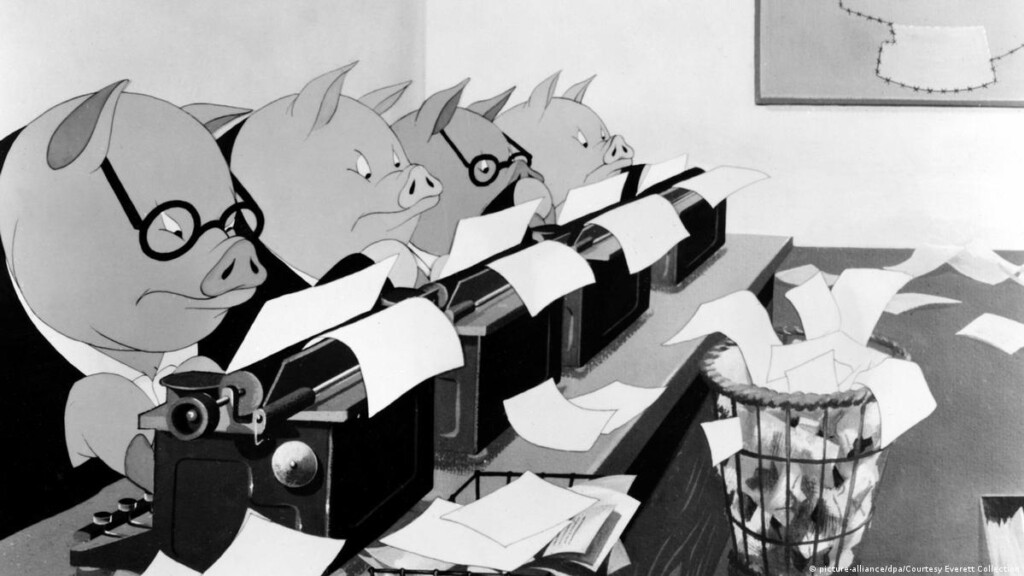
You already know who Boxer is. You have worked with him, lived with him, possibly been him. He is the one who arrives earliest and leaves latest, who meets every new directive from above with a slight furrow of the brow followed by a decision to simply try harder. When the harvest numbers do not add up, he does not question the arithmetic. He questions his own effort. “I will work harder” is not a slogan he was given. It is the conclusion he reaches entirely on his own, which is precisely what makes it so devastating.
The comfortable reading of the fable is that Napoleon and Squealer are the villains, that the pigs represent the corrupting logic of totalitarian power, and that the novel is a clean autopsy of Stalinism delivered in the form of a children’s story. This reading is not wrong. It is simply incomplete in the way that all comforting readings are incomplete — it allows you to locate the problem entirely outside yourself.
The deeper target of the book is not the pigs. The pigs are almost beside the point. They are doing what concentrated power always does when it encounters no structural resistance. The real subject is the psychology of the farm’s majority, the ones who made the whole thing possible not through malice but through a particular combination of loyalty, exhaustion, and the quiet terror of ambiguity.
Hannah Arendt, writing in 1963 in “Eichmann in Jerusalem,” introduced a phrase that the intellectual world has been misusing ever since — the banality of evil. What she actually observed was not that evil is ordinary but that the machinery of atrocity depends on people who have substituted role-performance for moral thinking. The farm’s horses and dogs and sheep do not perform evil. They perform function. They work, they guard, they repeat. The thinking has been outsourced, and outsourcing it feels, from the inside, like loyalty.
There is a man who comes home from a long shift to find that the rules of his household have changed in ways he does not fully understand, and he accepts the change not because he agrees with it but because disagreement requires an energy he does not have and a language he was never taught. This is the sheep. The sheep do not bleat “four legs good, two legs bad” because they believe it. They bleat it because the noise fills the space where a more complicated thought would have to live.
Elias Canetti in “Crowds and Power,” published in 1960, described how the crowd becomes a mechanism for the dissolution of individual accountability. To be inside the chant is to be relieved of the self. The relief is real. It is not stupidity that drives people into collective repetition — it is the genuine psychological cost of remaining separate, uncertain, responsible for one’s own perception when the perception available to you keeps shifting.
Squealer’s genius is statistical. He produces numbers the way a magician produces cards — not to inform but to occupy the part of the mind that might otherwise notice. Psychologist Robert Cialdini, whose work on influence and compliance spans decades of empirical research, documented how authority combined with complexity produces a kind of cognitive paralysis in otherwise intelligent people. You do not need to believe the numbers. You only need to find them difficult to immediately disprove, and in that gap between comprehension and refutation, the moment for resistance quietly closes.
Boxer is sent to the knacker’s yard, and the remaining animals accept the explanation they are given about a veterinary hospital. They accept it not because they are stupid. They accept it because the alternative — that they were wrong about everything, that their labor was the fuel for their own captivity — is a thought so total in its devastation that the mind simply will not complete it.
When Language Became the Last Fence
There is a meeting you remember, somewhere between a performance review and a disciplinary hearing, where the words used were so careful, so smooth, so perfectly arranged, that you walked out of the room genuinely unsure whether you had been threatened or congratulated. The language was impeccable. That is precisely what made it lethal.
Squealer does not bully. That is the first thing to understand about him, and it is the thing that makes him more dangerous than any dog. He arrives after the fact, always after the fact, when something has already changed or been taken or been quietly reversed, and he explains. He uses numbers — production figures, comparative harvest yields, welfare statistics from the Jones era — and the numbers are never quite checkable but always just plausible enough. He speaks in the syntax of reassurance. He asks whether the animals would prefer Jones to come back, and the question is structured so that the only rational answer is no, which means the only rational position is compliance. George Lakoff spent decades demonstrating exactly this mechanism: that political language does not describe reality, it constructs the cognitive frame through which reality becomes thinkable or unthinkable. When Squealer asks his question, he is not seeking information. He is installing a frame in which dissent becomes indistinguishable from sabotage.
The rewriting of the commandments is never witnessed in the act. That is essential. You find them already changed, already settled on the barn wall, and what you face is not the falsification but your own memory. Surely you misremembered. Surely it always said “without cause.” Surely the clause about sheets was always there. Timothy Snyder, writing in On Tyranny in 2017, identified this as one of the primary instruments of authoritarian consolidation: the assault not on facts themselves but on the belief that facts are recoverable, that your own perception constitutes evidence. Once a population learns to distrust its own recollection, the powerful need not even bother rewriting history thoroughly. The doubt does the work.
What makes this visceral — what makes it recognizable rather than theoretical — is that the syntax of the rewritten commandments is so close to legal language, to corporate policy documents, to the fine print on the agreements you signed without reading. “No animal shall sleep in a bed with sheets.” The addition of two words transforms an absolute prohibition into a technical specification. The prohibition remains, technically. It simply no longer applies to the situation at hand. You have read this sentence. You have signed this sentence. You have been governed by this sentence without ever having noticed the subordinate clause that voided your rights.
A man stands in a hallway of a government building watching another man efface pencil marks from a logbook and replace them with ink. He watches this happen slowly, methodically, in plain sight, because everyone in the building has already agreed, through the slow accumulation of small capitulations, not to see. The erasure is not hidden. It is performed openly, in the confidence that the structure of institutional life has already trained its inhabitants not to register what they are not supposed to register. Orwell understood that this is not a failure of intelligence. It is a success of framing. Smart people misremember commandments too.
Lakoff’s central argument in Don’t Think of an Elephant, published in 2004, is that frames, once established, cause contradicting facts to be rejected rather than absorbed. The brain does not neutrally evaluate incoming information. It filters it through the cognitive architecture already in place. Squealer does not need to be believed. He needs only to be the last voice before sleep, the explanation that fills the silence before the animals return to their stalls. By morning, the frame has set. The commandment has always read this way.
The Architecture of Forgetting
There is a moment when you realize you no longer remember what you used to believe. Not because the belief was wrong and you corrected it, but because the ground shifted so slowly beneath you that the original position became impossible to locate. You look back and the landscape has changed, and you cannot say exactly when it changed, or whether it was always like this, or whether you simply misremembered.
This is not a metaphor. This is what happens to the animals of the farm, and it happens without a single dramatic rupture, without a moment of declared war against the past. The Seven Commandments on the barn wall are not erased in one night. They are altered by degrees, a word added here, a negation inserted there, until the law that once said no animal shall sleep in a bed becomes no animal shall sleep in a bed with sheets, and the animals who look at it feel a vague unease they cannot name because the letters are there, the rule is there, and their memory — they begin to suspect — must simply be unreliable. What makes this mechanism devastating is not the lie itself but the weaponization of the animals’ own doubt against them.
Hannah Arendt, writing in The Origins of Totalitarianism in 1951, identified this as one of the core operations of authoritarian power: the systematic destruction of the private ability to trust one’s own experience. The totalitarian project does not merely rewrite public history. It colonizes the interior of the individual, making self-trust itself seem like a dangerous delusion. When the past becomes officially unstable, the self becomes structurally dependent on whoever controls the official version. Squealer is not simply a propagandist. He is the institutionalization of that dependency.
Milan Kundera, in The Book of Laughter and Forgetting published in 1979, wrote that the struggle of man against power is the struggle of memory against forgetting. It is a line that has been quoted so often it has grown smooth, but its roughness returns when you place it beside a specific image: a man standing in a photograph from which another man has been removed, the remaining figure’s arm still raised at an angle that no longer makes sense, reaching toward an absence that has been officially declared never to have existed. The wrongness is visible. And yet the man in the photograph learns, over time, to see his own raised arm as simply the way he stands.
This is what the animals cannot resist. Not violence, not hunger, not cold — though those come too — but the gradual normalization of discontinuity. The pigs sleeping in the farmhouse is wrong, and then it is debatable, and then it is simply the way things are, and the animals who remember the wrongness begin to feel that their memory is the problem. Boxer, strongest of them all, responds to every contradiction not with rebellion but with the addition of a new personal commandment: I must work harder. The erasure of the past finds its most perfect accomplice not in the cynical but in the earnest, in those who trust the system precisely because they cannot imagine that trust could be so completely betrayed.
Arendt understood that what totalitarianism destroys first is not freedom of speech or freedom of movement but the much quieter freedom of being able to say: I know what I saw. Once that is gone, once you have been persuaded that your own perception is suspect, the architecture is complete. The building stands not on force but on the rubble of individual certainty. And the most chilling element of Orwell’s construction is that the animals do not need to be individually broken. They only need to be left alone with their doubt long enough for the doubt to feel more reliable than the memory.
A vision curated by a filmmaker, not an algorithm
In this video I explain our vision
Napoleon Was Voted In

There is a moment when you watch the animals vote, and you realize you have seen this before — not in a story, but in a mirror. The pigs do not seize power in a single violent act. They are given it, incrementally, by creatures who believe they are making reasonable choices under difficult circumstances. The dogs growl at the right moment. The sheep bleat on cue. And the others, the ones who are neither cruel nor stupid, simply do not intervene, because intervention feels dangerous and abstention feels like neutrality.
It is not. It never is.
Robert Paxton, in his 2004 anatomy of fascism, made an argument that still unsettles people who prefer a tidier history: fascist regimes did not conquer democracies from outside. They were installed by conservative elites who believed they could use the energy of authoritarian movements as a tool and then discard it when convenient. The mechanism was not force. It was delegation. Someone else’s certainty was borrowed to manage a crisis, and by the time the borrowers understood the terms of the loan, the collateral had already been repossessed. Paxton was describing the 1930s, but the architecture he traced has no expiration date.
Napoleon is never elected in any formal sense, and yet he governs with the consent of the governed for a remarkably long time. The consent is manufactured, yes — through Squealer’s relentless revision of memory, through the slow erosion of the original commandments — but it is also genuinely given by animals who find the alternative to certainty too exhausting to contemplate. There is a scene where a character sits alone in a cold room, staring at a portrait on the wall, and something passes across his face that is not fear and not love but something older and more shameful than either: relief. The relief of having someone else carry the weight of deciding what is true.
Erich Fromm named this mechanism with uncomfortable precision. In “Escape from Freedom,” published in 1941 — the same year Orwell was beginning to sketch the fable that would become Animal Farm — Fromm argued that the unbearable condition of modern freedom, its isolation and its weight of self-determination, produces a genuine psychological hunger for submission. Not submission forced upon people, but submission actively sought. The authoritarian character, Fromm wrote, does not simply obey power; it loves power, because power resolves the intolerable anxiety of being free. This is not a pathology of the weak. It is a structural feature of what it costs to be an individual in a society that demands individualism while systematically undermining its conditions.
The animals on the farm did not lose their freedom. They exchanged it. And they received something real in return: the end of doubt, the comfort of a narrative that explained their suffering as necessary, their labor as noble, their hunger as temporary. Squealer does not only lie to them. He offers them meaning, which is a far more powerful currency than truth.
What Orwell understood, and what makes Animal Farm something other than a simple political allegory, is that the tragedy is not located in Napoleon. Napoleon is almost incidental — a pig with appetite and cunning, nothing more. The tragedy is located in the moment before Napoleon, in the conditions that make a Napoleon not just possible but welcome. The old boar Major dies with a vision still warm in his mouth. The rebellion happens. And then, in the space between liberation and consolidation, something goes wrong that cannot be traced to a single betrayal or a single vote or a single act of cowardice. It goes wrong the way most things go wrong in history — gradually, collectively, with everyone’s partial participation and no one’s full responsibility.
You cannot point to the moment the farm was lost. That is precisely the point.
The Sheep Are Not Stupid
There is a meeting you attended once, or a moment in a group where something was said — a slogan, a verdict, a collective agreement — and you added your voice to it without fully meaning it. Not because you were coerced at gunpoint. Because the room was moving in one direction and the cost of standing still was too high and your silence would have been read as dissent and dissent would have required an explanation you did not have the energy to give that day. You chanted along. You nodded. You signed.
The sheep in the story do this. Four legs good, two legs bad. They fill the air with it at every critical moment, drowning out any voice that might complicate the proceedings. And every intellectual who has ever read this has smiled at them with a particular kind of sadness — the condescending pity reserved for the manipulated masses, the people too simple to see what is being done to them. That smile is one of the most dangerous things in the room.
Simone Weil, writing in the early 1940s in what would become her posthumous masterwork The Need for Roots, developed a concept she called affliction — malheur in French — which is distinct from ordinary suffering. Affliction is the condition in which a person’s soul has been so thoroughly ground down by social weight, by exhaustion, by the sheer force of existing under oppressive conditions, that the capacity for independent thought becomes not a right that is suppressed but a luxury that is structurally unavailable. Weil had worked in factories. She understood that when your body is consumed by labor and your dignity is systematically negated, the mind does not simply rise above it through willpower. It adapts. It survives through simplification. The chant is not evidence of stupidity. It is evidence of a mind that has correctly calculated the ratio between cognitive expenditure and personal safety.
This is the thing the intellectual refuses to see, because seeing it would collapse the comfortable distance between themselves and the sheep. A young woman in a vast gray office joins in the applause at a mandatory company meeting for a policy she privately finds absurd. She does not applaud because she cannot think. She applauds because she has a rent payment due, a probationary contract, two children, and a manager who takes notes. Her applause is a performance of rationality, not an absence of it. The philosopher Jon Elster, in his 1983 work Sour Grapes, analyzed what he called adaptive preference formation — the way people come to genuinely desire what their circumstances make available and to stop desiring what they cannot reach. The sheep may have moved beyond performance. They may have arrived at a place where the chant feels true because truth has been restructured around what is survivable.
This is darker than stupidity. Stupidity is fixable with information. What Weil described, and what the sheep embody, is a wound in the relationship between a person and their own interiority. The capacity to disagree has not been argued out of existence. It has been made too expensive to maintain. And the pigs know this. They do not need the sheep to believe. They need them to chant at the right moment, loudly enough to cover whatever is happening at the podium.
You have been in that room. Not in a barnyard. In a faculty meeting, or a family dinner, or a political rally you attended more out of social obligation than conviction. You have felt the momentum of collective agreement moving through the space like a current, and you have let it carry you, and afterward you have told yourself it was harmless, it was just once, it was the pragmatic thing to do.
The sheep have been telling themselves the same thing since the beginning. The question is not whether they are stupid. The question is what it cost them to become so fluent.
Four Legs Good, Two Legs Also You
There is a moment when the thing you feared becomes the thing you are, and the horror is not that it happened but that you cannot find the language to say so. You are standing in a field. You have been standing in this field for as long as you can remember, and something has shifted in the house at the top of the hill, and you walk toward the window because the noise coming from inside sounds wrong, sounds like something you were told would never happen, and when you press your face to the glass what you see is the pigs sitting at the table, drinking, laughing, holding cards in their trotters — except they are not trotters anymore, they are hands, and the pigs are not on all fours, they are upright, they are indistinguishable from the men they once swore to replace. And the animals gathered at the window look from pig to man, from man to pig, and they cannot tell the difference, and the sentence they need does not exist because the sentence was erased before they knew they would need it.
This is the scene Orwell built his entire architecture toward. Not the execution of Boxer, not the reduction of the commandments, not even the first betrayal of the harvest — this. The walk. The moment the oppressed becomes the oppressor and does so without interruption, without gap, without any visible seam where one ended and the other began. Hannah Arendt spent years trying to name this continuity in “The Origins of Totalitarianism,” published in 1951, arguing that what makes totalitarian transformation so devastating is precisely that it does not announce itself as rupture. It flows. It adapts. It learns the grammar of the revolution it consumed and speaks it back to you until you cannot remember which words were yours.
The animals at the window are not watching history. They are watching the present tense. And you have stood at that window. Not in a barn, not in 1945, not in the Soviet Union — but in the meeting where the language of equity was used to consolidate a hierarchy, in the organization that hung the principles on the wall while the principles were being violated in the rooms behind the wall, in the movement that began by naming power and ended by practicing it silently, fluently, without apology. Michel Foucault’s insight in “Discipline and Punish,” from 1975, was not merely that power produces its own resistance but that resistance produces its own power — that the very structures built to oppose domination are built from the same materials as domination, and those materials remember their original shape.
Orwell understood this not as a political diagnosis but as a psychological one. The pigs did not become men because they were corrupted by external forces. They became men because the idea of men — the upright posture, the table, the whip, the glass of beer — was always already the image of arrival, of having made it, of being the kind of creature that matters. Napoleon did not want to destroy the farm. He wanted to own it. And ownership, in any language, looks the same from outside the window.
The question the novel leaves open, the one that does not resolve no matter how many times you read it, is not whether the pigs were always going to do this. The question is where you are standing. Because the window exists on both sides, and the animals who watched from the cold were certain they were the ones on the outside, and that certainty — calm, righteous, legible — is exactly what the pigs looked like once too, before they learned to walk on two legs and found, to their own surprise, that it felt completely natural.
🐾 Power, Propaganda, and the Politics of Control
Orwell’s Animal Farm is a masterwork of political allegory, exposing how revolutions can be corrupted by the very structures of power they sought to dismantle. To fully grasp its resonance, it helps to explore the philosophical and political traditions that illuminate the mechanisms of domination, manipulation, and ideological control.
Banal Evil and Radical Evil: Kant and Arendt
Hannah Arendt’s concept of the ‘banality of evil’ reveals how ordinary individuals can participate in systems of oppression without demonic intent, echoing the pigs’ gradual normalization of tyranny in Animal Farm. Kant’s notion of radical evil adds a deeper philosophical layer, asking whether some corruptions of will are irredeemable. Together, these frameworks help us understand how power distorts moral reasoning across history.
GO TO THE SELECTION: Banal Evil and Radical Evil: Kant and Arendt
The Psychology of Power: History and Theory
The psychology of power explores why those who acquire authority so often abuse it, a question that sits at the very heart of Orwell’s fable. From Stanley Milgram’s obedience experiments to Philip Zimbardo’s Stanford Prison Study, history shows that hierarchical structures can transform even well-intentioned individuals. Understanding these dynamics makes Napoleon the pig far more than a literary villain — he becomes a universal archetype.
GO TO THE SELECTION: The Psychology of Power: History and Theory
Machiavelli’s The Prince: Meaning and Analysis
Machiavelli’s The Prince is one of the foundational texts on the ruthless logic of political survival, offering a chilling manual for the kind of leadership Animal Farm satirizes. Machiavelli argued that a ruler must be both lion and fox — using force and cunning in equal measure — a strategy the pigs adopt with devastating effect. Reading Orwell alongside Machiavelli reveals the timeless grammar of authoritarian manipulation.
GO TO THE SELECTION: Machiavelli’s The Prince: Meaning and Analysis
The Surveillance Society: History and Theory
The surveillance society, from Bentham’s Panopticon to Foucault’s disciplinary power, describes a world in which control is internalized by the watched rather than enforced solely by the watcher — a reality the animals of Manor Farm come to live intimately. Orwell himself explored this theme more explicitly in Nineteen Eighty-Four, but its seeds are already present in the watchful eye of the pigs’ regime. Understanding the theory of surveillance deepens our reading of how fear and visibility become instruments of political domination.
GO TO THE SELECTION: The Surveillance Society: History and Theory
Discover the Cinema of Ideas on Indiecinema
If Orwell’s Animal Farm has sparked your curiosity about power, dissent, and the fragility of freedom, Indiecinema is the streaming platform where those questions come alive on screen. Explore a curated selection of independent and avant-garde films that dare to challenge every certainty — join us and keep thinking.
👉 EXPLORE THE CATALOG: Watch Indie Films in Streaming
A vision curated by a filmmaker, not an algorithm
In this video I explain our vision

