
The Mirror That Stares Back
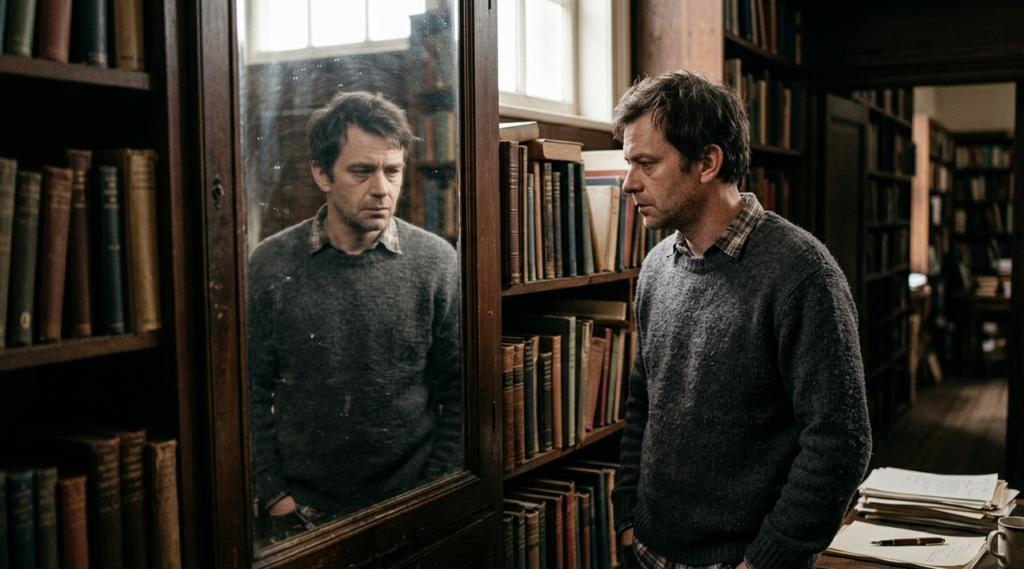
You catch it before you recognize it. A shop window on a grey afternoon, your reflection arriving half a second before your mind claims it, and for that fraction of a moment the face looking back at you is simply a face — not yours, not anyone’s, just a face staring from the glass with an expression you didn’t know you were wearing. Then the recognition clicks into place and the estrangement collapses, or seems to. But something lingers. Something in the quality of those two or three seconds refuses to dissolve entirely back into the ordinary. You walk on. You do not mention it to anyone. There is no language yet for what just happened, or rather there is language, but it belongs to a register you instinctively distrust — the register of the uncanny, the double, the shadow-self — words that sound too literary, too dramatic for a Tuesday afternoon outside a chemist’s shop. And yet the disturbance was real. The face in the glass was yours and was not yours, simultaneously, in a way that cannot be resolved by simply knowing better.

This is not a malfunction. Sigmund Freud, writing in 1919 in his essay “Das Unheimliche,” described precisely this phenomenon — the uncanny as the return of something that was once familiar but has been repressed, something that resurfaces wearing the mask of the strange. He had actually experienced the same ambush himself: catching his reflection in the swaying mirror of a train compartment and recoiling at the old man staring back before realizing the old man was himself. What interests Freud is not the anecdote but its structure — the way the self can become, for an unguarded instant, its own Other. The uncanny is not an aberration of consciousness. It is one of consciousness’s primary conditions, built into the architecture of a mind that can represent itself to itself, that carries within it the perpetual logical paradox of the observer and the observed occupying the same skull.
Jacques Lacan would later push this further, arguing that the very formation of the ego is bound up in a misrecognition — the infant seeing its unified image in the mirror and identifying with that image precisely because the image offers a coherence the infant does not yet feel from the inside. The “mirror stage,” which Lacan articulated across multiple seminars from the late 1930s through the 1950s, suggests that identity is not a foundation but a fiction we construct in glass. We are, from the very beginning, haunted by the version of ourselves that lives in reflection — smoother, stiller, reversed. The double, in other words, is not something literature invented. Literature discovered it because it was already there, lodged in the gap between the self that experiences and the self that is seen.
What the great writers of the nineteenth century understood — and understood with a ferocity that still cuts — is that this gap is not merely philosophical. It is moral. It is political. It is the site where everything unbearable about human nature gets quietly deposited. The double in literature is never simply a stylistic device, never a clever formal trick. It is the return address of everything we have refused to acknowledge about ourselves, dressed in fiction’s clothing and sent back through the post with alarming accuracy.
Fyodor Dostoevsky and Robert Louis Stevenson, working in different languages, different cities, different decades of the same tumultuous century, arrived at this return address by routes that could not look more different — and yet they were sending letters to the same place. One from the frozen fever-rooms of St. Petersburg. The other from the rain-soaked moral anxiety of Edinburgh. Both describing the same face in the glass.
Two Men, One Shadow: The Historical Roots of Doppelgänger Literature
You have looked at an old photograph of yourself and not recognized the face. Not because you were younger, or thinner, or dressed in clothes you no longer own, but because the expression belongs to someone whose interior you cannot access anymore. That person made decisions you would not make, wanted things you have quietly buried, smiled at a camera with a confidence or a sadness that feels borrowed from a stranger. The photograph does not lie. That is precisely what disturbs you.
This experience, so ordinary it barely registers as remarkable, is the emotional core of a literary obsession that began acquiring its formal vocabulary at the end of the eighteenth century. Jean Paul Richter, the German Romantic novelist whose influence on his era was enormous even as his name subsequently receded from popular memory, introduced the term Doppelgänger in his 1796 novel Siebenkäs. He used it to describe a character who encounters his own double walking through the world, and the word itself — meaning literally “double-goer,” one who goes alongside — crystallized something that had been circling European consciousness without a name. Once named, it proliferated with the speed of a thing whose time had arrived.
The Romantic era was not merely a stylistic movement. It was a philosophical crisis. The Enlightenment had promised that reason was sovereign, that the self was a unified instrument of rational will, that interiority could be mapped and governed the way a territory could be surveyed. By the close of the eighteenth century that promise was beginning to show its cracks. Immanuel Kant had already demonstrated in the Critique of Pure Reason in 1781 that the mind does not passively receive reality but actively constructs it, which meant the self was not a transparent window onto the world but a constitutive agent whose workings remained partly opaque even to itself. This was philosophically exhilarating and existentially terrifying in equal measure. If the mind shapes what it perceives, what shapes the mind? What lives in the regions you cannot illuminate?
E.T.A. Hoffmann answered that question with images rather than arguments. His stories, written in the first decades of the nineteenth century, populate an uncanny middle territory where the rational and the irrational bleed into one another without resolution. In one of his most unsettling narratives, a student becomes convinced that his reflection, his automaton, his projection have taken on independent life. The horror is not supernatural in the Gothic sense of ghosts and curses. The horror is epistemic: you cannot be certain where you end and the other begins. Hoffmann understood, with the intuition of an artist rather than the method of a philosopher, what Freud would later articulate in theoretical language — that the uncanny, das Unheimliche, is not the encounter with something alien but with something disturbingly familiar, something that was once home and has been repressed into strangeness.
The Doppelgänger emerges, then, not from a tradition of monsters but from a tradition of mirrors. It is the literary form that the question “who am I, really” takes when the culture can no longer sustain the fiction of a coherent answer. The Romantic double is not a villain imported from outside; it is the self’s own interior turned outward and given hostile autonomy. What the Enlightenment had suppressed — desire, irrationality, the animal substrate of human consciousness — began appearing in these stories as a second figure, walking just behind, wearing your face.
The historians of literature who trace this genealogy sometimes present it as a charming episode in the history of ideas, a period curiosity before psychology arrived to explain what fiction had only intuited. But that framing misses the urgency. These writers were not decorating a philosophical problem. They were feeling, in their bones, that the singular self was a social performance rather than a metaphysical fact, and that performance was becoming harder to sustain.

Dostoevsky’s Golyadkin and the Bureaucratic Hell of Being Replaced
You have watched someone else get the promotion. Not someone more talented, not someone who worked harder, not someone who deserved it by any measure you can honestly name. Someone more agreeable. Someone who laughed at the right moments, deferred to the right people, softened every edge that might have caught on something. You recognized the performance because you had almost performed it yourself, and you knew precisely where you had stopped, the exact moment you had refused to become what the institution needed you to be.
This is where Dostoevsky begins, in 1846, with a figure named Golyadkin walking through Saint Petersburg in a hired carriage he cannot afford, wearing a uniform that does not quite fit, rehearsing conversations he will never have the courage to start. He is a titular councillor, rank nine in the Russian Table of Ranks, which means he exists at the precise altitude where ambition is still technically possible but humiliation is constant and guaranteed. He attends a party he was not invited to. He is removed from it. He walks home alone through the dark and the snow. And then he meets himself coming the other way.
What follows is not a horror story. It is an administrative tragedy. Golyadkin’s double enters the office the next morning and within days has done everything Golyadkin could never bring himself to do. He flatters superiors without any visible shame. He runs small errands, delivers small compliments, positions himself with a kind of frictionless efficiency that the original Golyadkin finds disgusting and fascinating in equal measure. The double does not have more talent. He does not have more intelligence. He simply has no resistance. He has surrendered the part of himself that Golyadkin could not surrender, and in a bureaucratic world, that surrender is the only currency that actually spends.
Erving Goffman, writing in 1959, described social life as a continuous theatrical performance in which individuals manage the impressions others form of them, constructing a front stage self that differs in sometimes radical ways from whatever happens backstage. The language is sociological but the insight is almost unbearable in its precision: you are not one person but at minimum two, and the institution you inhabit every day requires the front stage version with a consistency and completeness that the back stage self cannot always provide. Golyadkin’s double is pure front stage. He is the performance with the performer removed. He is what the office actually wanted all along, which is not a person at all but a function that happens to arrive in human form.
Dostoevsky was twenty-four when he wrote this, young enough to still be shocked by what he was discovering. The novel was poorly received at the time, Vissarion Belinsky calling it too long, too obsessive, too strange. Dostoevsky himself would later say it contained his most serious idea, the one he never fully worked out. What he had grasped, without quite the language to name it, was that the bureaucratic structure does not simply employ people. It produces them. It selects for certain behaviors, rewards certain postures, and over time cultivates a secondary self in each person who stays long enough, a self that knows how to navigate the system by becoming legible to it, by eliminating everything that the system cannot process.
The tragedy of Golyadkin is not that he is replaced by a stranger. It is that he is replaced by his own capacity for compliance, the part of himself he kept suppressing, the performance he kept refusing to give. The double succeeds because the office was always waiting for exactly this version of Golyadkin, and Golyadkin himself was always the obstacle standing between the institution and what it needed. His breakdown at the end is not madness. It is the accurate perception of a man who finally understands what he was always being asked to become.
The Respectable Monster: Stevenson’s Jekyll and the Victorian Body
You know the feeling. You are at a dinner party, dressed well, saying the right things, laughing at the right moments, and somewhere beneath the sternum there is something pressing outward like a fist against a door. Not rage exactly. Not lust exactly. Something older and less nameable that your whole life has been organized around keeping quiet. You smile again. You reach for your glass. The door holds.
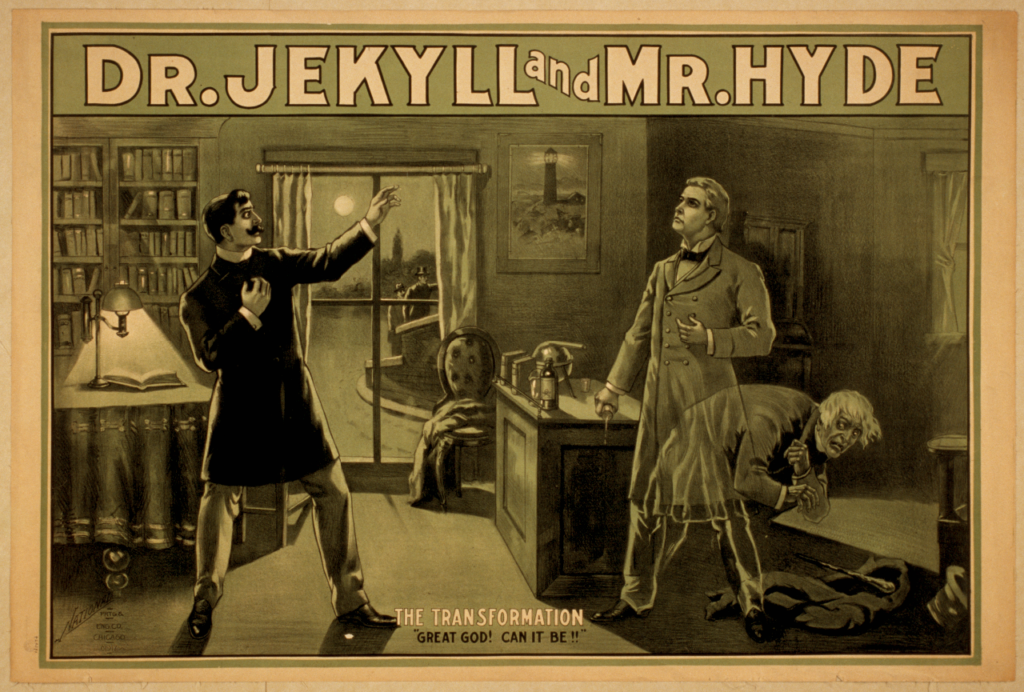
Robert Louis Stevenson published his strange little document in 1886, and what the Victorians read as a horror story about the dangers of science was in fact something far more unsettling: a precise clinical account of what happens to a civilization that teaches its most educated men to be ashamed of their own flesh. Henry Jekyll is not a good man corrupted. He is a good man who was never allowed to exist at all. The corruption was the original condition. Hyde is simply what got left out of the official portrait.
Michel Foucault spent much of his intellectual life mapping the architecture of this exclusion. In Discipline and Punish, published in 1975, he described how modern institutions, the prison, the hospital, the school, the barracks, did not simply punish the body but reorganized it, made it productive, docile, observable at every moment. The panopticon was not a metaphor. It was a design principle that had migrated from Jeremy Bentham’s prison blueprints into the arrangement of classrooms, factories, consulting rooms, the entire spatial grammar of Victorian respectability. You did not need a guard if the subject had internalized surveillance completely. Jekyll had internalized it so thoroughly that he required chemistry to get out.
Then in 1976, in the first volume of The History of Sexuality, Foucault made the argument that goes further: the Victorian era did not repress sexuality into silence. It produced an enormous machinery of discourse around it, confession, medical classification, moral literature, precisely in order to name it, contain it, and make its subjects complicit in their own discipline. The paradox is savage. The more a culture talks about what must not be done, the more it produces the subject who is defined by the prohibition. Jekyll is the product of this machinery. He is what happens when a man has been so completely produced by the discourse of respectability that his desires have nowhere to go except underground, where they grow dense and monstrous in the dark.
Hyde is smaller than Jekyll, the text tells us. Younger, more agile. This detail has always been misread as signifying evil’s diminishment, its lesser status. It means the opposite. Hyde is what Jekyll looked like before forty years of professional formation pressed him into the correct shape. The body remembers everything the mind agrees to forget. And when it finally speaks, it speaks in a register that the disciplined self cannot recognize as its own, which is precisely why Jekyll finds Hyde so alien, so other, so convenient a fiction.
There is a man in the story who glimpsed Hyde trampling a child and felt, without being able to name it, a kind of visceral recognition. Not of the act. Of the freedom underneath the act. The horror was not that something monstrous had appeared on a London street. The horror was the faint, shameful pull of it, the sense that something locked away had for one moment been visible and walking around in the gaslight like it had every right to be there.
The double in Stevenson is not the shadow of the good man. It is the evidence that the good man was always a performance, a role maintained at staggering psychological cost, and that the cost eventually comes due. The body does not negotiate. It does not accept the terms of the civilizational contract indefinitely. It waits. And the longer it waits, the less it resembles anything the respectable self would be willing to claim.
The Cinema of the Shattered Self
There is a moment when you watch footage of yourself — security camera, a phone someone else held at a party, a video call you forgot was recording — and the person moving through that frame feels genuinely foreign. Not unfamiliar the way a photograph makes you wince at your posture or your expression. Foreign in a deeper register, as if the body on screen made decisions you were not consulted about, inhabited a social performance so complete and autonomous that the self watching from behind the eyes has no claim on it. A man reviews surveillance recordings from his workplace and finds himself doing things he has no memory of: a conversation held in a corridor, a gesture toward a colleague, a door opened and closed with a purpose that escapes him entirely. He watches with the focused attention of someone studying a suspect. The suspect is wearing his face.
This is not a pathology. It is the structure of modern selfhood made visible by the technology that was supposed to simply record it. William James, writing in his Principles of Psychology in 1890, already identified the self as a multiplicity of social selves, each one summoned by a different audience, each one real within its context and discontinuous from the others. What the surveillance footage reveals is not a breakdown but an architecture — the fact that you have always been plural, and that only the illusion of continuous interiority made that plurality feel like a secret.
A woman begins spending time inside another woman’s life — her apartment, her friendships, eventually her way of moving through a room — and at some point the boundary between inhabiting and becoming stops being navigable. The memories she carries are no longer sorted by origin. She is not certain which grief belongs to her and which she absorbed like a language learned by total immersion. This is not delusion in any clinical sense. It is what happens when identity is understood as relational, as something built from the outside in, from accumulated contact with other subjectivities rather than from some inviolable interior core. The philosopher Paul Ricoeur, in Oneself as Another published in 1990, drew precisely this distinction between idem-identity — the sameness of a thing across time — and ipse-identity — the self that is constituted through narrative, through the stories told about it and to it. When those stories become entangled with another person’s stories, the self does not collapse. It becomes genuinely uncertain of its own borders.
The performer who cannot find the line between the role and the person who prepared it is living this uncertainty from the inside. Rehearsal requires a kind of methodical self-dissolution: you practice inhabiting an emotional state until it responds automatically, until the body produces it without the mediation of intention. And then the production closes and the state continues to arrive unbidden. Not as performance but as weather. The double in this case is not a shadowy external figure. It is the residue of performed selfhood that has fused with the original, and neither version can now claim priority.
What these situations share — the man studying his own stranger, the woman who cannot audit her memories, the performer abandoned by the boundary — is not psychosis or artistic metaphor. It is the same problem that Dostoevsky diagnosed in Golyadkin and Stevenson crystallized in Jekyll: the self is not a stable entity that occasionally fractures under pressure. It is a fracture that occasionally stabilizes under the pressure of social legibility. The double does not appear when something goes wrong. It appears when the effort required to maintain singularity becomes briefly visible, when the machinery of coherence skips and you catch a glimpse of how much work was always happening beneath the surface to produce the sensation of being one person.
A vision curated by a filmmaker, not an algorithm
In this video I explain our vision
Freud’s Uncanny and the Thing You Recognize Too Well

There is a moment — you have had it, even if you have never named it — when you meet someone and something shifts in a register below language. Not attraction, not recognition of a shared interest. Something colder. They gesture the way you gesture when you think no one is watching. They use a phrase you believed was private to you, a verbal tic you invented in some interior workshop of self-construction. They tilt their head at the same angle you tilt yours when you are deciding whether to lie. And instead of feeling seen, instead of feeling the warmth of unexpected kinship, you feel a specific kind of nausea. You want to leave the room. You want them to stop existing.
Sigmund Freud spent considerable energy in 1919 trying to anatomize exactly that sensation, and what he found was not what anyone expecting a clean psychoanalytic taxonomy would have predicted. The uncanny, he argued in Das Unheimliche, is not the terror of the foreign. It is the terror of the familiar rendered strange — or rather, the terror of the familiar that has been suppressed returning through a crack in the surface of ordinary life. The German word he was working with carried its own contradiction already embedded inside it: unheimlich, literally un-home-ly, contains heimlich, which means both familiar and secret, both comfortable and concealed. The thing that disturbs you most is not what was never yours. It is what was yours so completely that it had to be buried.
The double belongs entirely to this structure. A man watches another man — one who moves through the world wearing a different name, living a separate life, making choices that seem chosen from an alternative version of himself — and what he experiences is not the shock of difference. It is the shock of surplus resemblance. Too much sameness in the wrong place. A mirror that reflects not your surface but something underneath it, something you carefully arranged furniture to cover.
Otto Rank, five years before Freud published his essay, had already tracked this phenomenon across mythology, folklore, and literature with the obsessive precision of someone who suspects the problem is also personal. In Der Doppelgänger, published in 1914, Rank traced the double back to what he called a primitive narcissistic defense: the self, unable to tolerate the fact of its own extinction, projects a copy of itself into the world as a kind of ontological insurance policy. The shadow, the reflection, the portrait that does not age — these are not metaphors for vanity. They are the earliest technologies of immortality, strategies the psyche invents before it has language sophisticated enough to construct theology. But Rank noticed something disturbing in the archive: the double, which begins as a guardian against death, consistently transforms into a death omen. The very thing created to defeat annihilation becomes its announcement. The copy that was meant to survive you arrives instead to collect you.
This reversal is not incidental. It is the mechanism. Because the double does not actually protect you from death — it only forces you to see that you are not singular, not irreplaceable, not the necessary center of any story. And the moment you see that, something that was supposed to feel like salvation feels instead like a verdict. The man who watches his double move through a crowded city street — wearing his face but inhabiting it more freely, unburdened by every compromise and self-betrayal that made the original who he is — does not experience hope. He experiences something closer to cancellation.
That is the horror Freud was circling. Not the monster that is nothing like you. The version of yourself that is almost entirely like you, except it reveals, by existing, exactly which parts of you were always performance, always compensation, always the elaborate architecture built around an absence you never directly named.
The Double as Social Indictment: Race, Class, and the Shadow Self
There is a particular kind of exhaustion that comes not from overwork but from the labor of being perceived. You move through a room and you are already two people before you open your mouth — the one you know yourself to be, and the one the room has decided you are. This doubling is not metaphysical. It is structural. It is manufactured, maintained, and reproduced because it serves a purpose that has nothing to do with your inner life.
W.E.B. Du Bois named this with a precision that still cuts. Writing in 1903, he described the experience of Black Americans as a perpetual awareness of “two-ness” — two souls, two thoughts, two unreconciled strivings within a single body. He called it double consciousness, and the phrase has survived because it describes something too exact to be replaced. The tragedy Du Bois identified was not simply the burden of racism but the specific psychological violence of being forced to see yourself through the eyes of a society that has already decided what you are. You become your own shadow. You become the double of someone else’s fear.
This is what literary doubles had been encoding long before Du Bois gave it its clearest name. The Gothic tradition — so often read as a theater of individual neurosis — was in fact a laboratory of social anxiety. When respectable men in these stories discover their hidden selves are violent, primitive, or ungovernable, the language used to describe that hidden self is never neutral. It borrows from the colonial lexicon. It reaches for images of darkness, savagery, regression — the vocabulary that European civilization had spent centuries applying to the people it was in the process of destroying and enslaving. The monster in the basement is always coded as someone who already lives outside the gates.
Frantz Fanon understood this machinery with clinical and furious clarity. In 1952 he showed how colonialism does not merely occupy land — it occupies the psyche. The colonized person is forced to internalize the colonizer’s image of them: as the savage, the irrational, the body without civilization. This creates a split subjectivity that mirrors exactly what the Gothic double dramatizes, except that for the colonized the split is not a literary device. It is the daily condition of survival. You learn to speak the master’s language, wear the master’s dress, perform the master’s rationality — and somewhere beneath all of that performance, the part of you that was there before the performance waits, designated as the dangerous other, the shadow that must be kept hidden.
The same mechanism operates across class. The Victorian city produced its doubles with industrial efficiency: the gentleman and the criminal, the philanthropist and the pickpocket, the factory owner and the body broken on his factory floor. What disturbed the respectable classes was not simply poverty or crime but the suspicion — Gothic in its structure — that the distance between themselves and the men they condemned was thinner than morality could sustain. The double was the literary form that let them process this suspicion while simultaneously projecting it outward. The darkness is not in the system. It is in a particular, exceptional, monstrous individual. The horror is safely located in a single aberrant self, not in the arrangements that made certain people prosperous and certain people expendable.
This is the ideological function of the double that its readers rarely name. By aestheticizing social division as psychological pathology — as a split within one exceptional soul — the literature of the double quietly performs a disappearing act on the structures that make the split necessary. The violence of the slave economy, the brutality of colonial administration, the grinding machinery of class — all of it gets compressed into one man’s nightmare, one scientist’s experiment gone wrong, one respectable citizen discovering with horror that he has a shadow.
The shadow was never really his.
You Are Already Two
You already know the feeling. Before you pick up the phone, there is a fraction of a second — barely long enough to name it — in which you decide who you are going to be. You compose a face no one can see. You adjust something internal, some register of voice or intention, and then you answer. That adjustment is so fast, so practiced, so utterly automatic that most of the time you do not even register it as a choice. But it is. It has always been.
This is not metaphor. This is not the literary imagination borrowing from life to make a point about divided selfhood. This is the actual operating condition of anyone who has ever needed something from another person — approval, safety, love, employment, peace. Which is to say, everyone. Which is to say, you.
Golyadkin does not belong to the nineteenth century Russian bureaucratic imagination any more than Jekyll belongs to Victorian anxieties about science and moral respectability. They belong to the moment before the phone call. They belong to the meal at which you laughed at a joke you found offensive because the person telling it had power over you. They belong to the email you rewrote six times, scrubbing out the anger until only the acceptable surface remained. The double is not born in extreme psychological crisis. It is born in the first moment a child understands that what they feel and what they are permitted to show are not the same thing. Donald Winnicott, writing in 1960 on the theory of the true and false self, located this split not in pathology but in ordinary developmental necessity — the false self emerges, he argued, as a protective compliance, a socially functional mask that over time can become so dominant that the individual loses conscious access to anything underneath it. He was not describing madness. He was describing Tuesday.
Jung called it the Shadow — everything the conscious personality refuses to integrate, everything expelled from the official self-narrative and left to accumulate in the dark. By 1951, in Aion, he had traced the Shadow’s operations through centuries of religious imagery, mythology, and cultural projection, but the mechanism he identified is embarrassingly mundane: you decide what kind of person you are, and everything that contradicts that decision gets relocated. It does not disappear. It finds other routes.
What Dostoevsky understood — and what Stevenson confirmed from a different angle, in a different climate, with different fears — is that the relocation is never permanent. The expelled self returns. Not necessarily as a double who walks the streets wearing your face, not necessarily as the creature assembled in the laboratory from everything the respectable man disavowed. Sometimes it returns as a tone of voice that surprises you. A reaction you did not see coming from yourself. A moment of recognition in front of someone you have been trained to dismiss, in which something older and less managed in you responds before the managed version can intervene.
The literature of the double does not ask you to become more integrated, more whole, more honest with yourself in the way that self-improvement culture would phrase it. That is not what Golyadkin’s terror teaches, and it is not what the slow dissolution of a man who believed he could chemically contain his own contradictions is really about. What the tradition asks — what it has been asking since at least 1846, when a minor official in St. Petersburg began seeing himself on the street — is something considerably more uncomfortable: not whether you have a double, but whether you have ever, even once, been entirely certain which one of you is the original.
🪞 Mirrors, Shadows, and the Fractured Self
The theme of the double haunts literature, philosophy, and psychology alike, weaving through stories of identity, guilt, and the hidden self. From Dostoevsky’s tormented clerks to Stevenson’s divided gentlemen, the figure of the Doppelgänger reveals the deepest fault lines of human consciousness. These related explorations illuminate the labyrinthine corridors where the self meets its other.
Jacques Lacan and the Mirror Stage
Jacques Lacan’s mirror stage offers one of the most powerful theoretical frameworks for understanding the double: the moment a child recognizes its reflection is also the moment identity fractures into self and image. This originary split resonates deeply with literary doubles like Mr. Hyde, who embody the alienated reflection that the social self refuses to acknowledge. Lacan’s insight transforms the Gothic horror of the double into a structural condition of all human subjectivity.
GO TO THE SELECTION: Jacques Lacan and the Mirror Stage
Francis Bacon: Life and Works
Francis Bacon’s contorted figures seem to stage the Dostoevskian drama on canvas, splitting and smearing the human form until the boundary between subject and double dissolves entirely. His screaming popes and mirrored bodies evoke the same existential dread that animates the literature of the double, where identity is never singular or stable. Bacon’s painterly violence makes viscerally visible what writers like Stevenson could only render through narrative horror.
GO TO THE SELECTION: Francis Bacon: Life and Works
Jungian Individuation and the Great Work
Jung’s concept of individuation directly addresses the shadow — the repressed double that must be confronted and integrated rather than projected outward onto a monstrous other. This psychological framework illuminates why literary doubles so often end in violence or self-destruction: the failure to recognize one’s shadow leads to its annihilation of the conscious self. The Great Work of alchemy becomes, in Jungian reading, the same labor that Raskolnikov and Jekyll undertake at such terrible cost.
GO TO THE SELECTION: Jungian Individuation and the Great Work
Stream of Consciousness in Literature and Cinema
The stream of consciousness technique in literature and cinema is intimately linked to the problem of the double, since it reveals the multiplicity of voices and selves that coexist within a single mind. Where Dostoevsky staged the double as an external figure, modernist writers internalized the split, allowing the reader to inhabit the fractured interior directly. This formal innovation transforms the Gothic Doppelgänger into a permanent condition of narrative consciousness itself.
GO TO THE SELECTION: Stream of Consciousness in Literature and Cinema
Discover the Cinema of the Double on Indiecinema
The doubles, shadows, and fractured identities explored in these articles find their most visceral expression on screen. On Indiecinema, our curated streaming platform dedicated to independent and auteur cinema, you will discover films that dare to explore the labyrinth of the self with the same courage and depth as Dostoevsky and Stevenson. Step through the mirror and let independent cinema show you who is waiting on the other side.
👉 EXPLORE THE CATALOG: Watch Indie Films in Streaming
A vision curated by a filmmaker, not an algorithm
In this video I explain our vision

