
The Screaming Body
You wake at three in the morning with your heart doing something wrong. Not pain exactly, but a wrongness — a muscular insistence that cannot be argued with, cannot be reasoned away, cannot be filed under the category of ideas you hold about yourself. The body has simply begun speaking in a register that bypasses everything you think you are. You lie there and you are not a person with opinions and memories and a name. You are meat that knows it is meat.

This is where Francis Bacon lived. Not as a philosophical position. Not as an aesthetic choice. As a permanent address.
There is a man sitting in a glass box, and something is happening to his face. It is not quite a scream and not quite a grimace — it is what the face does when the social agreement that holds it together has momentarily collapsed. The mouth opens in a way mouths are not supposed to open in public. The flesh around the eyes loses its architecture. What remains is not expression but exposure: the soft animal fact of a human being stripped of the performance that makes human beings bearable to one another. You have seen this. Not in a gallery. You have seen this in a hospital corridor at two in the afternoon, when a doctor has just said something to a family gathered near a door, and one of them — the one nearest the wall — makes a sound and a shape that no one photographs and no one describes afterward because there is no social language for it. Bacon found the language. It just happens to be painted.
The philosophical stakes here are not small. Maurice Merleau-Ponty spent much of his career — most systematically in the Phenomenology of Perception, published in 1945 — arguing that consciousness is not something that happens above the body or despite it, but through it, in it, as it. The body is not the vehicle for the self. The body is the self, vibrating at a frequency that thought can rarely access directly. Bacon understood this not through Merleau-Ponty, whom he may or may not have read, but through the particular education of his own flesh: a childhood asthma so severe it structured his entire early life around the fact of a body that refused its assigned transparency, a sexuality that was criminalized in England until 1967 and that therefore made his body a legal object of persecution, a relationship to alcohol and gambling and desire that kept him permanently in contact with the unreliable animal he inhabited.
What Bacon painted is not the body in crisis as a special condition. He painted the body as it always is, beneath the muscle of social convention that holds it in recognizable shape. Gilles Deleuze, writing about Bacon in 1981 in his study Francis Bacon: The Logic of Sensation, made a distinction that cuts to the bone — the difference between figuration, which illustrates a story or an idea, and the Figure, which is what remains when illustration is stripped away and sensation is allowed to act directly on the nervous system. The Figure is not a person. It is a zone of intensity. It is what you are at three in the morning when your heart is doing something wrong and your name has become temporarily meaningless.
This is why encountering his work does not feel like encountering art history. Art history is something that happens in daylight, with catalogs and curatorial statements and the reassuring architecture of chronology. What Bacon made happens in a different jurisdiction entirely — closer to the moment before language arrives, when something has occurred to the body that the mind has not yet been briefed on.
Identity, in that moment, does not dissolve dramatically. It simply reveals that it was always more fragile than advertised. And that the flesh knew this all along.
The Mirror and the Rascal
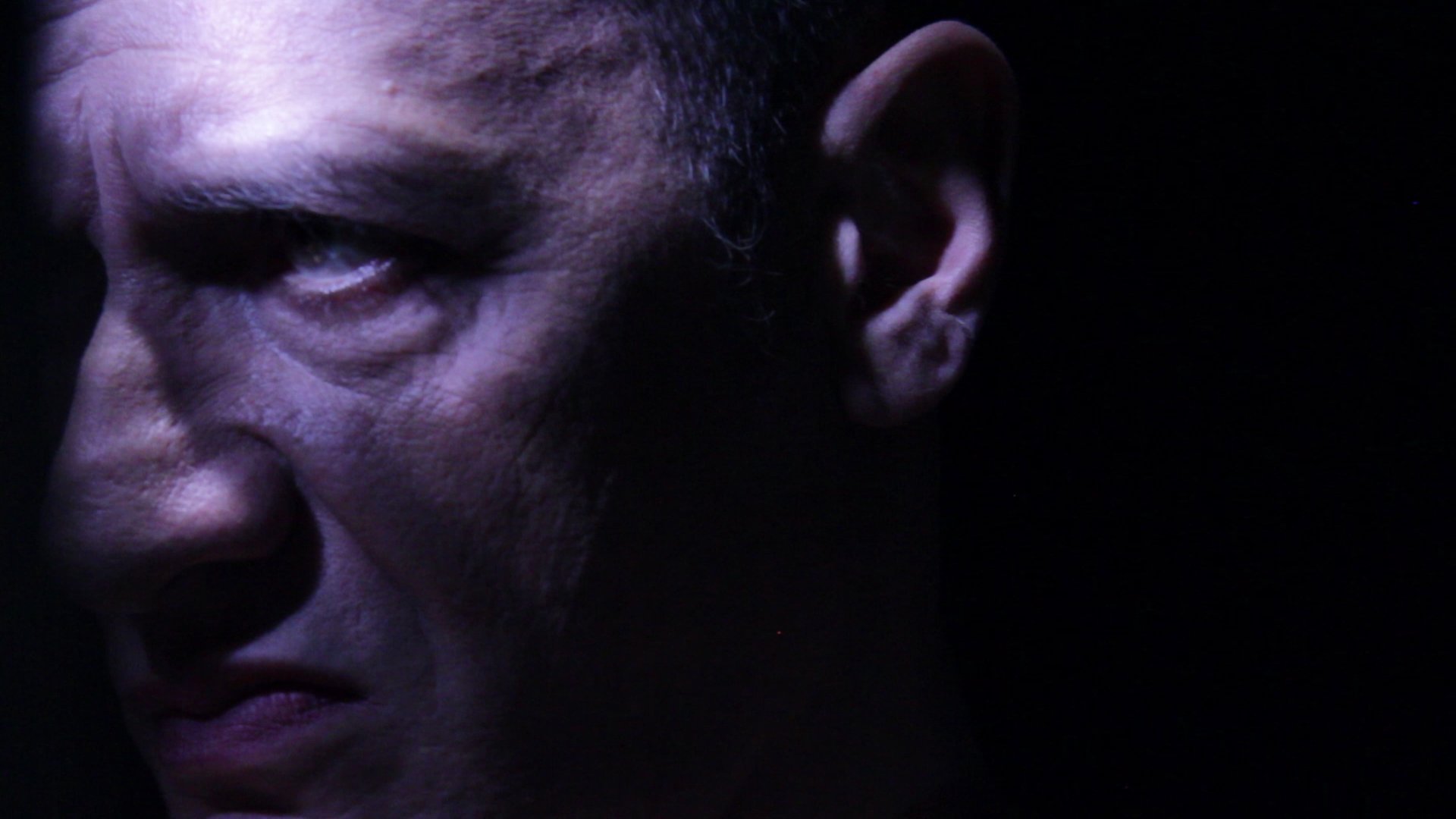
Drama film, by Valerio De Filippis, Italy, 2019.
The mirror and the rascal is an experimental film based on the tragedy "Richard III" by William Shakespeare. It tells the delirium of contemporary power in an author's reinterpretation of cinema, video art and music. The protagonist, Richard Duke of Gloucester, brother of King Edward IV, through a long series of crimes eliminates all the obstacles that stand between him and the throne of England.
Valerio de Filippis, a well-known painter who has been following his research path for a long time, investigating the relationship between light, corporeality and the psyche. The mirror and the rogue and the cinematographic equivalent of Valerio De Filippis' painting, his figurative style is in fact very recognizable looking at his paintings. But cinema is a new way where the artist can also be involved as an actor and performer, with an original mix between acting and singing. Staging the dark side of the human soul, the film is a surreal and disturbing interpretation of a great classic. The director says: "The first suggestion was musical: I was interested in transforming the text of Shakespeare's tragedy Richard III into notes. I love cinema and at a certain point I felt that the time had come to combine research on the image of painting to my love for cinema and music. When the film is finished I realize that I have remained faithful to painting: every frame of the film appears to me like a painting: the same light, the same colors, the same atmosphere ". The mirror and the rascal is a kind of psychoanalytic session that the painter does while hiding behind the mask of Richard III. Behind this ferocious and unscrupulous character we find a path of self-analysis by De Filippis, who is mainly interested in the more violent and turbid aspects. An experimental film in which, with great courage, the author gets involved completely, fragmenting the images in an unconventional montage, which is at the same time a flow of consciousness and spectacle.
LANGUAGE: English
SUBTITLES: Italian
A Life Built on Wreckage
There is a kind of person who learns the shape of the world not from books or mentors but from being thrown out of it. Bacon was sixteen when his father discovered him trying on his mother’s clothes and decided that whatever this thing was standing in the hallway, it would not remain under his roof. The expulsion was not dramatic in the cinematic sense. It was quiet, administrative, final. A door closed and did not reopen. What followed was not a coming-of-age story. It was something rawer and less teleological: a long drift through the margins of early twentieth-century Europe, a young man moving through spaces that had no name for what he was.
Berlin in the late 1920s was a city that had temporarily suspended certain rules, not out of generosity but out of exhaustion. The Weimar Republic was running on borrowed time and borrowed money, and in that interval of collapse, something resembling freedom existed in the gaps. Bacon moved through it, observing. Then Paris, where he encountered the work of Picasso in a gallery on the Rue La Boétie in 1927, and something detonated quietly inside him. He began making watercolors and drawings, then rugs and furniture, the practical arts of a man who had not yet permitted himself to believe he could paint. He was self-taught in the most absolute sense, meaning he had no institution to validate him, no lineage to claim, no teacher to absorb and eventually betray. He had only the evidence of what he had seen and what he could not stop feeling.
Michel Foucault, in his lectures collected as Abnormal, delivered at the Collège de France between 1974 and 1975, traced the genealogy of what he called the abnormal body, the body that power marks as deviant precisely because it exceeds the categories that power requires to function. This is not metaphor. It is a mechanism. The body that does not conform to the normative grid of gender, productivity, legibility becomes the body that must be either corrected or expelled. Bacon’s father performed that expulsion with bureaucratic efficiency. What Foucault understood, and what Bacon’s biography confirms in every detail, is that exclusion does not destroy the excluded. It turns them into witnesses. The person who has been pushed outside the structure can see the structure whole, can see its joints and its violence and its profound arbitrariness, in a way that no insider ever can.
Bacon returned to London eventually, as exiles often return, not because the city had changed but because the exile needed a fixed point to orbit around. He worked through the 1930s in near-total obscurity, showing a few pieces, destroying most of them, drinking heavily, gambling with the methodical dedication of someone who has decided that the relationship between effort and reward is a fiction he will not pretend to believe. He was dismissed repeatedly, not just ignored but actively dismissed, which is a different thing. Dismissal requires noticing. Someone looked at what he was making and decided it did not merit serious attention, and that decision was not merely aesthetic. It was also a reassertion of the border he had already been thrown across once.
The fractures accumulated without forming a pattern. Dublin, expulsion, Berlin, Paris, London, poverty, erasure, the slow grinding work of a man building a vocabulary out of materials no one had told him were available. What is striking, looking back, is not that he survived it. Survival is not remarkable. What is striking is that the wreckage became load-bearing. The displacement did not produce nostalgia or bitterness in his work, at least not in any recognizable form. It produced something else: a radical suspicion of surfaces, a conviction that beneath every composed exterior something is being compressed and distorted and held in place by force.

The Triptych and the Trial
There is a moment — you have had it, even if you cannot name it — when you stand before something and your body responds before your mind does. Not understanding, not interpreting, but a jolt in the sternum, a sudden awareness of your own breathing. Something has happened to you before you consented to it.
This is what it was to stand in front of Three Studies for Figures at the Base of a Crucifixion when it was first exhibited in London in April 1945. The war was not yet over. People walked in from streets that still carried the smell of rubble. And there they were: three organisms on orange grounds, neither human nor animal, with necks that stretched like accusations and mouths that opened onto nothing — not speech, not scream, not silence, but something prior to all three. Several visitors reported feeling physically ill. One critic described the experience as an assault. They were not wrong. The paintings did not invite contemplation. They enacted something.
Think of a woman sitting in a courtroom, watching a man on trial who was once her husband, and suddenly — not when the sentence is read, not when evidence is presented, but in a random, neutral moment — noticing the shape of his ear, the specific way his neck meets his collar, and feeling something collapse inside her that she cannot name as either grief or relief. The body knows before language arrives. Bacon’s figures operate in that same pre-linguistic register. They are not symbols of suffering. They are suffering rendered as organism, as nerve, as the body’s own unreasonable knowledge of itself.
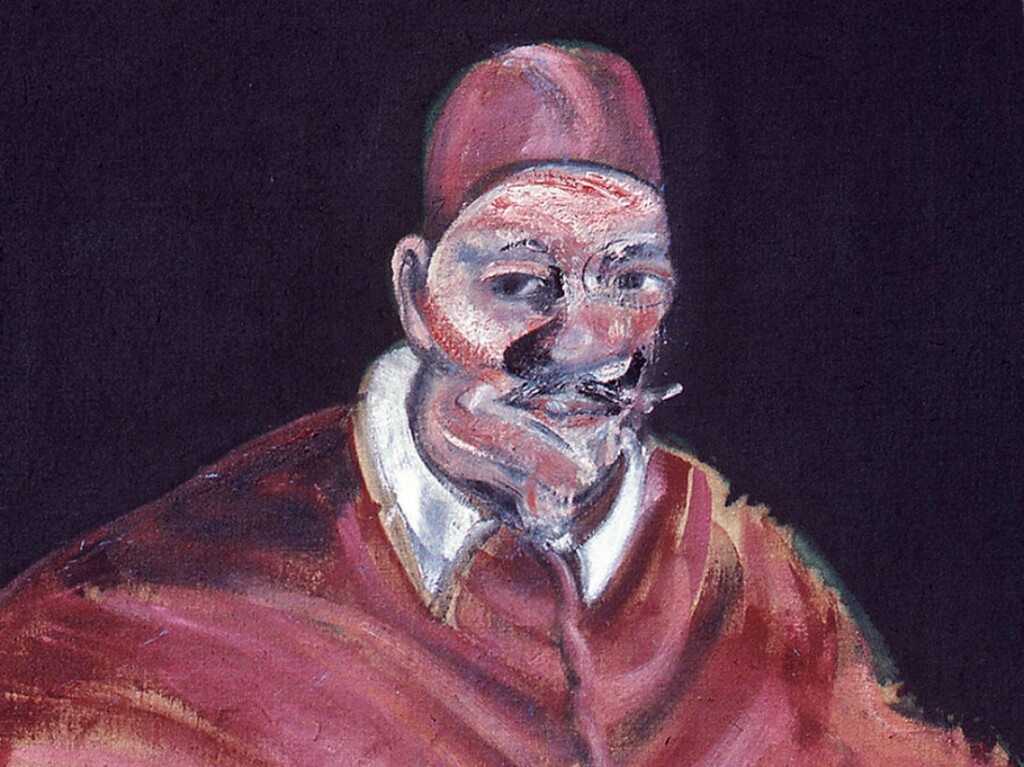
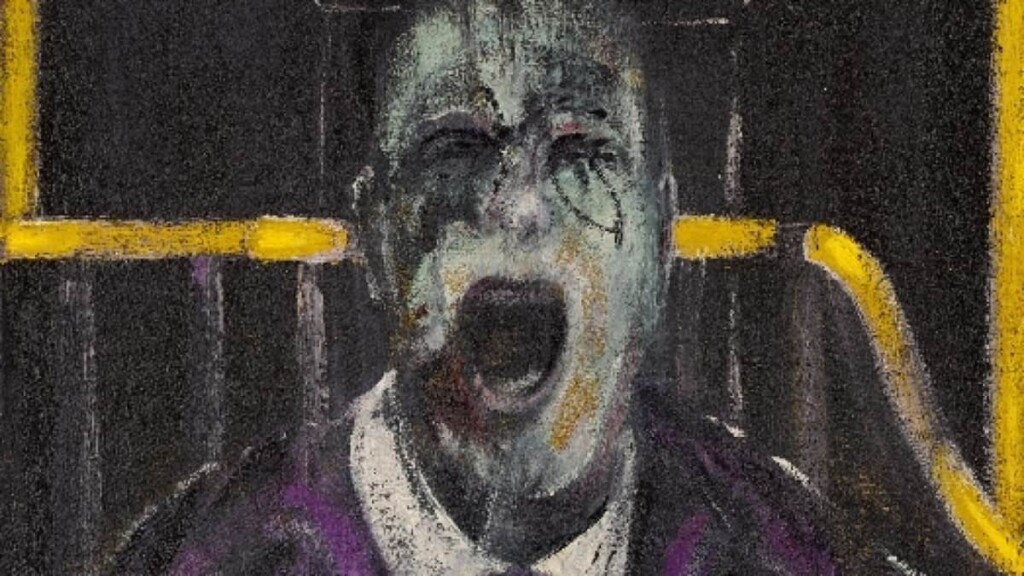
The screaming popes of the 1950s intensified this logic. The figure — derived from a Velázquez portrait that Bacon, by his own admission, never saw in the original and was almost afraid to see — sits encased in what appears to be a glass box, or perhaps a curtain of darkness, screaming into a void that offers no echo. What makes these paintings unbearable is not the scream itself but its futility. The mouth opens in maximum exposure and nothing reaches anywhere. Think of a man standing in a hallway, having just received news that undoes him, and the hallway is empty, and he understands for the first time what it means to have no witness. Not to be alone, but to have the act of suffering become purely private, sealed inside glass.
Gilles Deleuze, writing on Bacon in 1981, gave this experience a precise philosophical name. He argued that Bacon was not a figurative painter — not someone who represents human beings — but a painter of what he called the Figure: sensation made visible, the nervous system given form. Representation, in Deleuze’s framework, passes through the brain, moves through narrative and resemblance and recognition. Sensation bypasses all of that. It goes directly from the painting to the nervous system, from pigment to nerve ending, without asking permission from meaning. The screaming pope does not mean anguish. It is anguish, transmitted at a frequency that precedes interpretation. This is why standing before those works feels less like looking at art and more like being implicated in something.
By the time of the great triptychs of the 1970s — the ones painted in the aftermath of George Dyer’s death, the ones that try and fail and try again to locate a person who is no longer there — the logic has become almost unbearable in its precision. Three panels, because no single frame can hold it. The figure distorted, the flesh displaced from its own outline, the shadow more present than the body casting it. You do not look at these paintings and think about loss. You feel the specific weight of a body in a room that has not yet understood it is empty, the delay between event and comprehension that Bacon seemed to understand as the only honest place from which to begin.
What the Scream Cannot Say
There is a moment when the mouth opens and nothing useful comes out. Not silence, not speech — something before both. You have seen it, maybe felt it: the jaw drops, the throat contracts, and whatever was about to be said dissolves into a sound that belongs to no language, carries no argument, makes no claim that civilization can process. It is not a failure of communication. It is communication reaching its outer wall and finding the wall is made of flesh.
Elaine Scarry, in her 1985 study of pain and its relationship to language, argued something that most people sense but cannot articulate: that extreme physical sensation does not produce expression, it destroys it. Pain, she wrote, has no referential content. It does not point outward toward the world the way that hunger points toward food or desire points toward its object. It is, in her precise formulation, “language-destroying.” The person in agony regresses — not metaphorically but structurally — toward a pre-linguistic state, toward a mode of being in the body that precedes the entire project of meaning-making. The scream is not what pain says. The scream is what happens when pain has eaten everything that could be said.
Bacon understood this before he could have read Scarry. He returned obsessively, across decades, to a single image: an open mouth, frozen at the moment of maximum aperture, set within or beneath or instead of a face. The mouth that appears again and again in his reworkings of Velázquez’s portrait of Pope Innocent X is not screaming about something. It is not protesting an injustice or expressing a grief that could eventually be resolved into narrative. The purple and black and gold that Bacon poured around that papal throne, the smearing of the figure’s edges until the body seems to be dissolving under pressure from within — all of this frames a mouth that has passed beyond the reach of doctrine, authority, dignity, role. The Pope’s vestments mean nothing to that mouth. The centuries of theological language, the Latin weight of institutional Christianity, the entire symbolic apparatus of earthly power dressed in sacred fabric — all of it becomes irrelevant the moment the jaw drops that far.
There is a woman who watches her son being taken somewhere from which he will not return. She stands at a window, and her face goes through every human expression in the span of three seconds before settling into something that is no expression at all — a mask made of absence, a face that has stopped being a face and become a surface on which something terrible is being inscribed. When she eventually opens her mouth, what emerges is not a word, not a cry in any language anyone has chosen. It is the sound Scarry is describing. It is Bacon’s painting in acoustic form.
And then there is a man in a corridor, alone, who has just understood something he cannot un-understand. He sits. He breathes. The camera — life, memory, whatever you want to call the thing that records us — stays on him longer than is comfortable. Nothing happens in any theatrical sense. But his body is reorganizing itself around a knowledge that language cannot metabolize, and the process is visible in the way his shoulders fold inward, the way his hands lose their purpose, the way his face becomes the site of a private catastrophe that will never be fully translatable into words.
This is what Bacon was painting. Not the moment of the scream. The epistemological condition of the scream — what it means that a human nervous system, pushed past a certain threshold, stops producing meaning and starts producing pure signal. The screaming mouth in those papal images is not melodrama, not theatrical excess. It is a philosophical statement about the limits of the human animal’s capacity to convert experience into language, and what remains when that capacity fails.
Flesh, Meat, and the Sacred
There is a moment in any butcher’s shop — not the sanitized supermarket cabinet with its shrink-wrapped geometry, but a real one, with sawdust on the floor and a cold that carries the smell of iron — where you feel something shift in your chest. Not quite nausea. Something older. The hanging carcass catches your eye and for a fraction of a second, before thought intervenes and restores the proper categories, you see something you are not supposed to see. The meat looks back. Or rather, the meat looks like something that once looked. The skin, the fat, the exposed interior architecture — it is too familiar, and the familiarity is the problem.
Bacon never resolved that feeling. He cultivated it, deliberately, across decades of work. He spoke without apology about standing in a butcher’s shop and feeling no categorical distinction between the flayed animal on the hook and a figure on a cross. Not as provocation, not as blasphemy performed for effect, but as a straightforward observation about what flesh is when you remove the stories layered over it. The cross, after all, is a slaughterhouse instrument. The body of Christ is a carcass made sacred. Bacon simply refused the hierarchy that separates these two propositions.
Georges Bataille spent much of his intellectual life mapping precisely this territory. His concept of base materialism, developed through the late 1920s and early 1930s in the journal Documents, insists that Western civilization organizes itself around the violent suppression of certain encounters with matter — matter that refuses to be elevated, that drags thought back down into the biological, the putrid, the undifferentiated. What Bataille called the informe, the formless, is not simply ugliness. It is a structural threat to the systems of meaning that culture erects to make life bearable and organized. The slaughterhouse, which he wrote about directly in his 1929 essay on the abattoir, is not merely a place of killing. It is a place civilization needs to hide because it reveals what we are made of and what making food of animals actually requires. We eat the product and erase the process. Bacon paints the process.
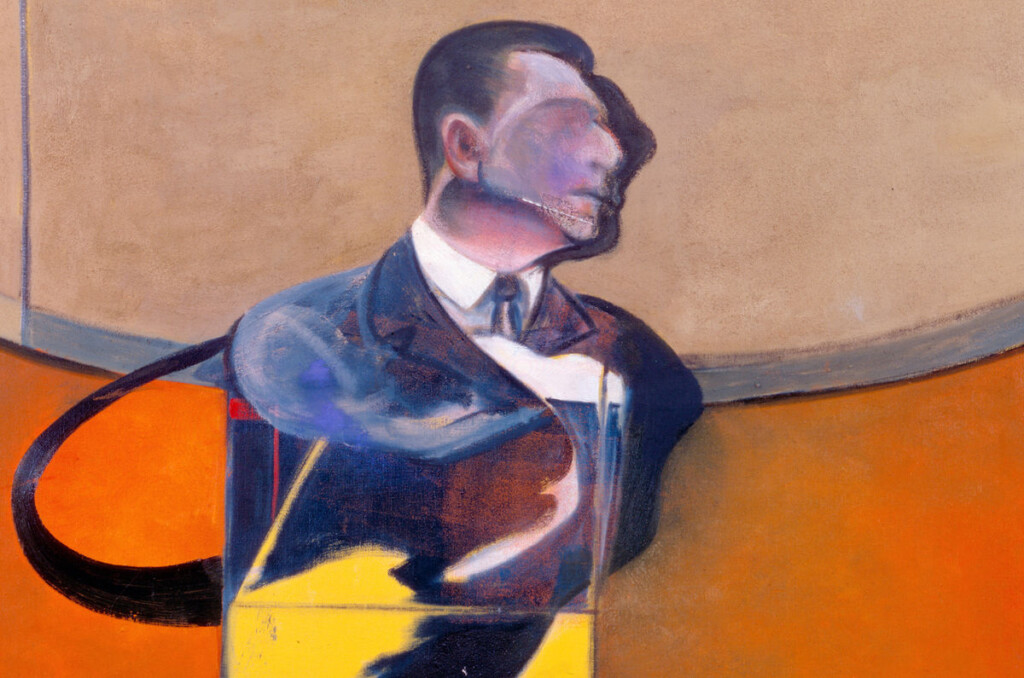
His Painting from 1945 — the dark umbrella, the suited figure, the suspended carcass hanging like a grotesque altarpiece behind — collapses the bureaucratic and the sacrificial into a single image with no exit. The suited man is not horrified. He is simply present, as we are present in front of a screen, in front of a meeting, in front of a meal. The carcass does not intrude into his world. It is his world. What makes the image unbearable is not the meat. It is the absence of the expected recoil.
What Bacon understood, and what Bataille theorized from a different angle, is that the sacred and the abject are not opposites arranged on a moral spectrum. They are structurally identical. Both mark a rupture in the ordinary surface of things. Both produce the same involuntary physical response — the held breath, the slight backward movement of the body, the recognition of something that exceeds the frame you had prepared. The church knows this. It has always known it. The Eucharist is a ritual consumption of a body. The martyr’s wound is displayed, not concealed. Religious art is saturated with torn flesh, with blood rendered in loving detail, with the punctured and the broken held up for extended contemplation. The sacred has always been built on the abject. It just requires you not to notice.
Bacon noticed, and painted the noticing. He stripped the gilt from the altarpiece and left the meat. He did not replace one meaning with another. He simply showed you what was there before the meaning arrived, and asked, with genuine curiosity rather than cruelty, whether the meaning had ever really changed anything at all.
A vision curated by a filmmaker, not an algorithm
In this video I explain our vision
The Studio as Crime Scene
When they opened the door after his death in 1992, the first instinct of everyone who saw it was not awe. It was something closer to the feeling you get walking into a room where something has happened — where the air still holds the shape of an event you arrived too late to witness. The floor was buried under decades of layered paint, a geological record of every splatter and accident and correction that never got corrected. Photographs were pinned to the walls and then torn down and repinned elsewhere, images of mouths and spines and animal movement culled from medical textbooks and Muybridge studies and newspaper cuttings, all of them creased and smeared with pigment as if the images themselves had been worked over, handled to the point of damage. Brushes clogged with dried paint. Mirrors angled in ways that made no obvious sense. Dust that had accumulated for decades into a substance with its own texture, its own color. The studio at Reece Mews in South Kensington was not a workspace. It was evidence.
The entirety of that room — every scrap of paper, every cracked canvas, every bent tube of paint — was catalogued and physically relocated to Dublin’s Hugh Lane Gallery, where it was reconstructed with forensic precision. Seven thousand individual items. The project took years and produced a kind of archive that functions less like a museum exhibit and more like a crime scene preserved for examination. Which is exactly the right frame for it, because what the studio reveals, if you look at it without the mythology that tends to accumulate around great artists the way paint accumulated on Bacon’s floor, is that the making of these images had almost nothing to do with controlled vision. It had everything to do with the management of chaos, the willingness to let an accident stand, the refusal to resolve what remained productively unresolved.
Walter Benjamin wrote about the dialectical image as a moment in which the past and the present collide in a flash — not a smooth continuity but a rupture, a sudden crystallization that makes something visible that was previously hidden inside the flow of time. What Bacon’s studio makes visible, standing in that reconstructed chaos, is the rupture at the heart of how all serious work actually gets made. The myth of artistic genius is a myth of mastery: the artist as someone who sees clearly and executes precisely, whose hand obeys the vision, whose vision obeys some higher order. The studio at Reece Mews is the physical refutation of that story. Every surface in it is evidence that the work emerged from a process that included failure, accident, indecision, and the accumulated residue of images that meant something without anyone knowing quite what they meant or why they kept getting repinned to different walls.
Bacon was explicit about this. He spoke repeatedly about the role of what he called the accident — not as a romantic disruption of intention but as the actual mechanism by which something real entered the canvas. You throw paint. You let it land somewhere you didn’t plan. Then you work with what the accident gave you rather than correcting it back toward what you originally intended. The image that results carries something that deliberate execution could never produce, because deliberate execution only ever delivers what you already knew.
This is the thing the Reece Mews studio makes impossible to look away from. The photographs pinned and repinned on those walls were not references in the way an architect consults a blueprint. They were provocations, collisions, material for a process that was closer to dreaming under pressure than to the application of skill. The seven thousand items catalogued in Dublin are not the tools of a controlled vision.
Intimacy as Destruction
George Dyer came into Bacon’s life through a broken window — a botched burglary, a chance meeting in the dark of the studio, and then years of a relationship that would end with Dyer’s death from an overdose in a Paris hotel bathroom, two nights before the opening of Bacon’s retrospective at the Grand Palais in 1971. Bacon painted him before and after, painted him as though the act of looking could somehow hold together what was already coming apart. The portraits of Dyer show a man folded over himself, his body a site of impossible pressure, his face sliding away from its own center as though the skull beneath were migrating toward some other arrangement. To look at those paintings is to understand that Bacon was not commemorating Dyer. He was consuming him.
Roland Barthes wrote in 1977 that the lover’s discourse is fundamentally a discourse of catastrophe — that to truly see another person is to enact upon them a kind of annihilation, because the act of seeing is never neutral, never without appetite. The gaze reorganizes what it touches. And what Bacon’s gaze touched, it reorganized with an almost surgical ferocity, stripping away the social surface of a face until what remained was something pre-linguistic, something that existed before the person had learned to perform themselves for others. Isabel Rawsthorne appears in his work with her face compressed and multiplied, as though several instants of her expression have been collapsed into one impossible moment. She is completely present and completely illegible at the same time.
This is the paradox that Barthes was circling when he described love as a regime of images — the beloved becomes a series of projections, each one more insistent than the last, until the real person disappears inside the accumulation of how urgently they are perceived. Bacon’s portraits literalize this violence. They are not distortions in the pejorative sense. They are honest records of what it costs to be looked at by someone who refuses to look away. Lucian Freud, who sat for Bacon and who painted Bacon in return across decades of charged, competitive friendship, understood this reciprocity. Each man tried to see through the other’s face to whatever was underneath. Neither entirely succeeded, which is perhaps why they remained necessary to each other for so long.
The faces in these portraits do not ask for sympathy. They occupy their own destruction with a kind of dignity that makes sentimentality impossible. This is not how painters traditionally handle grief or love. A tribute softens. A memorial flatters. Bacon does neither. He takes the face he loves and presses it until it yields something that the face itself could not have told you — something about the structure of need, the architecture of dependency, the way that proximity to another person wears away your edges until you are no longer entirely sure where you end and they begin.
Barthes called this condition the “ravissement” — the ravishment, the seizure — and he meant it as something closer to abduction than pleasure. You are taken from yourself by the fact of the other person. Bacon seems to have experienced this as a physical truth, not a metaphorical one. The bodies in his paintings press against each other and against the edges of their own skin with the urgency of people who cannot bear separation and cannot survive proximity. They are caught in the precise moment when intimacy becomes indistinguishable from dissolution.
What Bacon understood, and what makes these portraits almost unbearable to return to, is that to paint someone you love is to admit that you have already been looking at them with more honesty than they ever consented to. The painting is the evidence. It records not the beloved, but the act of beholding — which is always, in some sense, an act of trespass.
The Unsolvable Figure
He died in Madrid in April 1992, in a city that was not his own, which somehow feels right. A man who spent his entire life refusing to belong anywhere — to a school, to a movement, to a comfortable interpretation — should end somewhere peripheral to his own myth. He left behind more than five hundred works and a studio so chaotically layered with paint, photographs, dust and accumulated detritus that it had to be dismantled and reconstructed in its entirety inside a museum in Dublin, preserved as an artifact in itself. The disorder was not incidental. It was the condition of production. You cannot separate the paintings from the environment that generated them, any more than you can separate a wound from the body that carries it.
Maurice Merleau-Ponty argued, in the unfinished manuscript published posthumously as The Visible and the Invisible in 1968, that the body is not an object we inhabit but the very medium through which world and self become legible to each other. Perception, for Merleau-Ponty, is never clean or disembodied. It is always already entangled, always already caught in what he called the chiasm — the crossing over between the touching and the touched, the seeing and the seen. We do not look at the world from outside it. We are folded into it, and it into us. This is precisely why Bacon’s figures cannot be domesticated by interpretation. They do not offer themselves to a gaze that stands safely at distance. They reach back. They implicate the body of the viewer in something that has no comfortable name.
Every theoretical framework built to contain Bacon has eventually shown its seams. The existentialist reading — Bacon as philosopher of absurdity, of post-war despair — flattens the sensory excess into an idea. The formalist reading — Bacon as technical innovator, as master of impasto and distortion — evacuates the flesh and leaves only craft. Even the psychobiographical reading, which traces every screaming pope and contorted lover back to his childhood in County Kildare, his alcoholic father, his years of violence and erotic submission, reduces the paintings to symptoms, as if understanding the cause could neutralize the effect. None of these frameworks survive prolonged contact with the actual canvases. Stand in front of one long enough and the reading dissolves. What remains is the sensation.
There is a particular moment — you may have experienced something like it — when you are watching someone move through a familiar room, someone you know well, and for a fraction of a second they become strange to you. Not threatening, not unfamiliar exactly, but suddenly unhoused from the category you had placed them in. The body visible before you exceeds what you know about it. Bacon painted that moment, over and over, for nearly half a century. The figure on the bed, the man in the glass booth, the lovers fused into a single mass of pink and ochre — they are all caught in that fraction of a second where the body refuses to be only what it means.
Merleau-Ponty wrote that the visible is not a positive quantity but a fold in being, a place where the world’s flesh and the viewer’s flesh briefly touch and then separate again, leaving a trace that belongs to neither entirely. Bacon’s paintings are that fold. They do not illustrate suffering or desire or mortality. They are the texture of those things, arrived before any word was ready to receive them.
And that is the question his work leaves in you, not in your mind but somewhere lower, somewhere without a precise anatomical address: what do you do with a sensation that came before you were prepared for it, that no framework has yet absorbed, that is still in your body now, pressing quietly against the inside of whatever you think you are?
🎨 Paint, Flesh, and the Abyss of Existence
Francis Bacon’s raw, distorted figures place him at the intersection of art history, existential philosophy, and the radical reinvention of the human image. To fully grasp the depth of his vision, it helps to explore the broader currents of art and thought that surrounded and shaped his singular practice.
Caravaggio: Life and Works
Like Bacon, Caravaggio was a painter of extremes who used the human body as a site of raw psychological and spiritual intensity. His dramatic use of chiaroscuro and unflinching realism anticipates the visceral emotional charge that would define Bacon’s canvases centuries later. Studying Caravaggio‘s life and works illuminates a long tradition of painting that refuses to look away from darkness.
GO TO THE SELECTION: Caravaggio: Life and Works
Henri Matisse: Life and Works
Henri Matisse offers a compelling counterpoint to Bacon, pursuing joy and liberation through color and form while sharing the same modernist urgency to remake the language of painting. Understanding Matisse’s trajectory reveals how twentieth-century artists wrestled with figuration, abstraction, and the expressive limits of the painted surface. Together, Bacon and Matisse define the twin poles of modern painting’s emotional spectrum.
GO TO THE SELECTION: Henri Matisse: Life and Works
Albert Camus: Life and Philosophical Thought
Albert Camus and Francis Bacon were near-contemporaries who confronted the same postwar European landscape of existential dread and moral disorientation. Camus’s philosophy of the absurd, which insists on living fully in the face of meaninglessness, resonates deeply with Bacon’s screaming popes and trembling figures trapped in anonymous spaces. Exploring Camus’s thought enriches the philosophical framework through which Bacon’s art can be understood.
GO TO THE SELECTION: Albert Camus: Life and Philosophical Thought
Vanitas in Art: Symbolism and Meaning
The vanitas tradition in art—with its meditations on decay, mortality, and the fleeting nature of flesh—forms a crucial historical backdrop to Bacon’s obsession with the body’s vulnerability and impermanence. From Baroque still lifes to memento mori imagery, this symbolic language permeates Western art and finds a brutal, modern echo in Bacon’s decomposed forms and meat-like figures. This article traces the long shadow that the vanitas theme casts across art history.
GO TO THE SELECTION: Vanitas in Art: Symbolism and Meaning
Discover Art and Existential Cinema on Indiecinema
If Francis Bacon’s world of raw emotion and radical vision stirs something in you, Indiecinema streaming is your next destination. Explore a carefully curated selection of independent and avant-garde films that dive into art, philosophy, and the darkest corners of human experience—exactly where great cinema lives.
👉 EXPLORE THE CATALOG: Watch Indie Films in Streaming
A vision curated by a filmmaker, not an algorithm
In this video I explain our vision

