
The Man Who Walked Out
The candles are still lit. The wine has been refilled twice. Across the table, someone is performing wit for an audience of six, and you have stopped listening — not from rudeness, exactly, but from a sudden, vertiginous inability to locate any reason to continue sitting there. The conversation has become a kind of theater in which everyone knows their lines, and the knowledge of this, once it arrives, cannot be unfelt. You push back your chair. You say something vague about the hour. You are already gone before you reach the door.

Jean-Jacques Rousseau did this his entire life. Not metaphorically — physically, repeatedly, with a compulsiveness that alarmed his friends and bewildered his patrons. He would arrive at the salons of Paris, be welcomed by the most celebrated minds of the eighteenth century, and then leave abruptly, rudely, sometimes without explanation. He walked out of Diderot’s circle. He walked out of Madame d’Épinay’s hospitality after she had housed and supported him for years. He walked out of Hume’s friendship in one of the most spectacular breakdowns in the history of intellectual life. Each exit was followed by letters of agonized self-justification, desperate reconciliation attempts, and then, inevitably, another exit. The pattern was so consistent that it can no longer be read as mere eccentricity or paranoia, though both were present. It was something structural — a man constitutionally incapable of sustaining the performance that social life demands, and constitutionally unable to stop craving the warmth that same social life offered.
This contradiction is not a footnote to his philosophy. It is the philosophy. Everything Rousseau wrote — from the two Discourses that made him famous in the 1750s to the Confessions he labored over in his final years — grows from this specific tension: the person who knows, at a cellular level, that civilization is a kind of prolonged dinner party in which everyone is performing for everyone else, and who cannot stop attending.
He was born in Geneva in 1712, the son of a watchmaker, and lost his mother within days of his birth. That fact alone would interest a psychoanalyst, but what matters here is something more legible: he grew up at the edges of things, educated erratically, apprenticed humiliatingly, dependent on the charity of women who took him in and educated him — most crucially Françoise-Louise de Warens, the woman he called Maman and with whom he eventually became a lover, a relationship that condensed every possible contradiction of dependence, gratitude, erotic attachment, and intellectual debt into a single unbearable knot. He was never securely inside any social world. He always needed entry, always received it, and always found a reason the entry was false.
When he submitted his first Discourse to the Académie de Dijon in 1750 — asking whether the restoration of the sciences and arts had contributed to the purification of morals — and argued, scandalously, that it had not, he was not making an abstract argument. He was describing what he saw every night at those tables: intelligence deployed as ornament, virtue replaced by reputation, the real interior life of people buried under the compulsive management of appearances. The Discourse won the prize. It also made him a celebrity, which meant more dinner parties, more performances, more exits.
What Rousseau introduced into European thought was not simply a critique of progress. It was a diagnosis of inauthenticity so precise and so personal that it could only have come from someone who had lived inside the machine and could not make themselves stop caring. He was not a hermit philosophizing from a distance. He was a man who loved company desperately, who was constitutionally destroyed by what company required of him, and who turned that destruction into a system of ideas that the modern world has never fully recovered from.
Slow Life
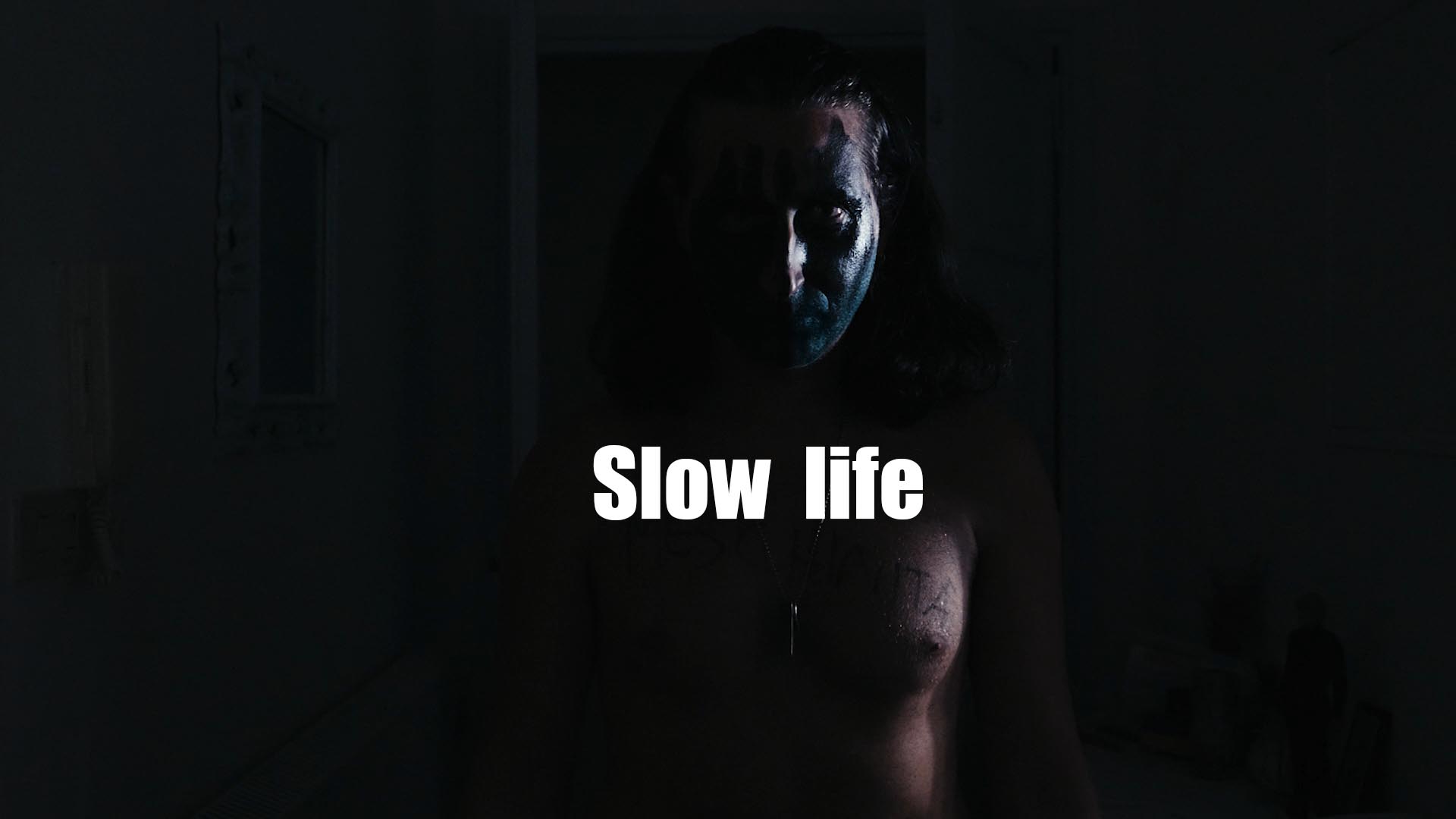
Drama, comedy, thriller, by Fabio Del Greco, Italy, 2021.
Lino Stella takes a period of vacation from his alienating job to devote himself to relaxation and his passion: drawing comics. But he did not foresee certain disturbing elements: the intrusive administrator of the building where he lives, the postman who delivers crazy fines and tax bills, an overbearing security guard, a very enterprising real estate agent, the old lady downstairs who raises the feline colony of the condominium. These characters will make his vacation hell.
Food for thought
The larger a social group is, the more rules and bureaucracy are needed, which often do not respect the individual. You have to learn to live with annoying people, but sometimes the social pressure and arrogance can become intolerable. The only laws that always come to our aid are the laws of Nature.
LANGUAGE: Italian
SUBTITLES: English, Spanish, French, German, Portuguese
Geneva, Abandonment, and the First Lie of Origins
His mother died nine days after he was born. That fact sits at the center of everything, though it took him decades to understand what it cost him, and longer still to understand what he made of the cost.
Geneva in 1712 was a city that believed in itself with the particular intensity of small republics. Calvin’s shadow still fell across its institutions, its moral architecture, its sense of civic virtue as something both earned and perpetually endangered. Isaac Rousseau, a watchmaker with restless ambitions and a temperament that made stability feel like a kind of defeat, raised his son Jean-Jacques on stories of ancient heroes and the novels his dead wife Suzanne had left behind. They read together at night, the father and the small boy, until dawn came through the windows and neither of them had slept. It was, by any reasonable measure, an unusual education. It was also the only real education Rousseau would claim as his own.
What a child absorbs when a parent reads to them is not the content of the stories. It is the emotional temperature of the room. And the temperature in that apartment in Geneva was grief dressed as tenderness, loss that had nowhere else to go. Isaac Rousseau was a man mourning his wife inside the body of his son, and Rousseau spent his entire adult life writing his way back through that room, trying to name what had been taken from him before he could even speak.
His father left. The exact circumstances shifted depending on who was telling the story, but the essential structure remained: a quarrel with a French officer named Gautier, a threat of imprisonment, and Isaac’s departure for Nyon in 1722, leaving ten-year-old Jean-Jacques with relatives who, whatever their virtues, were not his father. The abandonment was real even when it was rationalized. Rousseau himself never fully rationalized it. He returned to it compulsively in his writing, not to condemn Isaac but to trace the first rupture, the first moment when the world as it should be and the world as it was separated into irreconcilable distances.
This is where the personal and the philosophical become impossible to untangle, and where critics who have tried to treat them as separate categories have consistently misread him. When Rousseau writes in the Discourse on the Origin of Inequality, published in 1755, about a hypothetical natural man living in a state of self-sufficient solitude, he is not writing a prehistory of the species. He is writing a diagnostic account of what corruption means — and he knows what corruption means because he felt its first version as a child, felt the moment when pure relation curdled into dependency, into absence, into the slow confusion of needing someone who is no longer there.
Jean Starobinski, whose 1971 study Transparency and Obstruction remains the most penetrating account of Rousseau’s interior architecture, argued that his entire intellectual project was organized around the distance between a self that once existed in unmediated relation to its own experience and a self perpetually obscured by social surfaces and performed identities. That distance was not metaphysical for Rousseau. It was biographical. It had a date, roughly 1712, and a cause, roughly nine days.
Natural man, in Rousseau’s construction, is not a creature to be recovered or imitated. He is a measuring instrument. A baseline against which everything society has added — property, hierarchy, vanity, the lethal need for comparison — can be weighed and found wanting. The fact that this instrument was built from personal grief does not make it less precise. It may make it more so. A man who has felt original loss in the body tends to recognize its social equivalents when he encounters them, and to describe them with a specificity that more comfortable thinkers rarely achieve.

What the Prize Essay Actually Said
You have sat in a meeting where everyone performed competence. Not demonstrated it — performed it. The jargon was immaculate, the slides precise, the confidence calibrated to exactly the right frequency of authority. Nothing dangerous was said. Nothing true was risked. And yet, when it was over, you felt the strange exhaustion of having witnessed something theatrical, something that consumed enormous intelligence in the service of nothing except its own smooth continuation.
Rousseau felt this in 1750. The Dijon Academy had posed a question with the confident air of an institution that already knew the answer: had the restoration of the sciences and arts contributed to the purification of morals? The implied answer was obviously yes. Progress. Enlightenment. The century was in love with its own refinement, and the academies were its temples. What they expected was a ceremonial confirmation, a well-dressed argument dressed in the period’s preferred fabric of optimism.
What they received was a detonation.
His Discourse on the Sciences and Arts, the text that won the prize and made him suddenly famous at thirty-seven, did not argue that knowledge was bad. This is the most persistent misreading, and it has survived because it is more comfortable than the actual claim. Rousseau was not making a romantic argument for ignorance. He was making a structural argument about function — about what the performance of knowledge actually does in a society organized around hierarchy and appearance. He wrote that the sciences and arts, far from purifying morals, had built garlands of flowers over the chains that bind men. Not broken chains. Decorated ones. The decoration was the point.
The specific mechanism he identified was the displacement of virtue by politeness. As civilization advances, he argued, it becomes more important to seem good than to be good, because social survival depends on the judgment of others rather than on any internal measure. A man in what Rousseau called the state of nature — a theoretical construct, not a historical claim — was transparent to himself. His needs and his expressions aligned. The civilized man, by contrast, learned to manage appearances as his primary competence. He cultivated wit, elegance, and conversational ease not because these things expressed his character but because they concealed it. Rousseau’s word was art in the oldest sense: artifice, technique, the calculated production of effect.
This is what made the academies — with their prizes, their ceremonies, their hierarchies of citation — so perfectly representative of the problem he was diagnosing. They were institutions that rewarded the performance of intellectual refinement, and in doing so, they created a class of people whose survival depended on that performance. The philosophes Rousseau was observing in Paris salons were not corrupt in any simple moral sense. They were structurally conditioned to prioritize brilliance of expression over sincerity of conviction, because the social rewards flowed to expression. You could be devastatingly wrong and celebrated. You could be profoundly right and unpolished and ignored.
He pulled historical examples from Sparta and Rome, contrasting their periods of civic virtue — which he associated with a relative absence of sophisticated arts — with their periods of cultural flowering, which coincided, in his reading, with moral and political decline. These were not rigorous historical arguments by modern standards. But they were pointed. Sparta, which produced no philosophers and few poets, held its freedom for longer than Athens, which produced both in abundance. The argument was not about intelligence but about where intelligence gets directed when social approval becomes its primary feedback mechanism.
What the prize essay actually said, stripped of its rhetorical armor, was that civilization had invented a technology of social control so elegant that its subjects experienced it as self-improvement. The refinement was real. The chains underneath it were also real. And the function of the refinement was precisely to make the chains unfelt.
The Inequality That Is Not Natural
You are already doing it before you realize you are doing it. Someone posts a photograph, and you measure your life against theirs before the image has fully loaded. Someone mentions a salary, a promotion, a house, and something contracts in your chest — not quite envy, not quite grief, something older and more corrosive than either. That contraction is not a personal failing. It is, according to Rousseau writing in 1755, the foundational wound of civilized existence itself.
The Discourse on the Origins of Inequality is the more dangerous of his two prize essays, the one the Academy of Dijon did not award, perhaps because it cut too close to the bone of everything the Enlightenment assumed about progress. Where the 1750 Discourse had argued that arts and sciences corrupt morals, this second text went further and named the mechanism: property, comparison, and the particular form of self-regard Rousseau called amour-propre. The argument is surgical in a way that still draws blood.
Rousseau distinguishes with philosophical care between two kinds of love directed at oneself. Amour de soi is natural, pre-social, oriented purely toward self-preservation and physical well-being. It is calm, indifferent to others, unbothered by status. The animal lying in the sun has amour de soi. It does not wonder whether the other animals are watching. Amour-propre is something else entirely: it is self-love refracted through the eyes of others, a regard for oneself that depends structurally on being seen, evaluated, ranked. It does not exist in solitude. It cannot. It requires an audience and a hierarchy, and once it takes hold it is essentially insatiable, because no external confirmation is ever final, because the hierarchy always extends further upward, because the neighbor can always acquire more.
This is not a psychological observation about vanity. It is a structural diagnosis of what happens when human beings begin to compare themselves to other human beings systematically — which Rousseau locates at the moment when settled property becomes possible and inequality becomes heritable. He imagines the person who first enclosed a piece of land and said this is mine, and he notes, with an irony that does not soften, that this act required others to believe the claim. Property is not a thing you have. It is a social fiction requiring collective endorsement, and once endorsed it creates the condition under which human beings begin to perceive each other primarily as measures of their own worth or worthlessness.
What Rousseau saw, and what takes considerable nerve to follow through completely, is that the misery this produces is not incidental to civilization but constitutive of it. The progress is the trap. The refinement, the accumulation, the elaboration of needs and pleasures and social distinctions — all of it feeds amour-propre, all of it intensifies the dependence on external recognition, all of it multiplies the surfaces on which one can be found lacking. A person in what Rousseau calls the state of nature has no reputation to protect because reputation requires a social world organized around comparison. Every step toward what we call development is a step deeper into that world.
The philosopher Charles Taylor, writing more than two centuries later in Sources of the Self, would identify the hunger for recognition as one of the defining crises of modern identity — but the machinery Rousseau describes is already fully visible in 1755, not as prophecy but as diagnosis of what was already happening around him. The court at Versailles, with its exquisite calibrations of precedence and insult, its entire architecture built to make every gesture a statement about rank, was not an aberration. It was the logic of amour-propre rendered in stone and protocol, the same logic that now renders itself in follower counts and performance reviews and the particular silence that falls over a dinner table when someone mentions what their apartment is worth.
The Social Contract and the Paradox of Freedom Through Law
Someone is standing at a lectern in a cold hall in 1793, reading aloud from a small green-bound book. The crowd around him has already decided what they want to hear. They nod before he finishes the sentence. The text says one thing; they receive another. This is not a failure of literacy. It is something more deliberate, more structurally inevitable — and Rousseau, writing thirty-one years earlier, had almost certainly seen it coming.
The Social Contract, published in 1762 alongside Émile, opens with one of the most quoted and least examined sentences in European thought: man is born free, and everywhere he is in chains. What follows is not, as two centuries of selective reading have insisted, a manual for liberation. It is a forensic examination of why those chains are inescapable, and why the most dangerous ones are the ones we help forge ourselves. The general will — the volonté générale — is Rousseau’s central concept, and it is designed not as a solution but as a problem that refuses to dissolve. It cannot be represented, cannot be delegated, cannot be reliably known even by those who constitute it. A society can claim to act according to the general will while systematically betraying it. Rousseau knew this. He wrote it plainly. The revolutionaries read past it.
The sentence that has never stopped disturbing anyone who reads it carefully comes in Book I, Chapter VII: whoever refuses to obey the general will shall be constrained to do so by the whole body, which means nothing other than that he will be forced to be free. Forced to be free. Isaiah Berlin identified this construction in 1958 as the foundational move of what he called positive liberty — the liberty that claims to know what you truly want better than you do, and acts accordingly. Berlin saw it as the philosophical ancestor of every authoritarian project that wrapped coercion in the language of emancipation. He was not wrong. But he stopped one step short of what makes Rousseau genuinely unsettling: Rousseau was not naive about this. He was mapping a trap, not endorsing it.
The difficulty is that the trap is structurally necessary. Without some mechanism of collective constraint, the social body dissolves into competing private wills — what Rousseau calls the will of all, which is merely the sum of individual desires and produces no coherent common life. The general will is his attempt to name something real that exists beyond those competing interests: the genuine good of the community as a whole. But he offers no reliable instrument for identifying it. Legislation can approximate it. Direct democracy can approach it more closely than representation. But nothing guarantees it. This is not an oversight. It is the honest acknowledgment that political legitimacy is always provisional, always at risk of corruption, always one demagogue away from becoming its opposite.
Saint-Just and Robespierre found in this provisional structure exactly the certainty they needed. They decided they could read the general will directly, that the Terror was not a betrayal of popular sovereignty but its purest expression. They were not misquoting Rousseau. They were extracting from him what his honest philosophy had left dangerously available: the idea that coercion in the name of the collective good is not violence but a higher form of freedom. When the guillotine fell on those who dissented from the Republic’s vision of virtue, it fell with Rousseau’s vocabulary in the air above it, even as his actual arguments lay unread beneath the enthusiasm.
Robespierre called him the precursor of the Revolution and kept a lock of his hair like a relic. He did not seem to notice that Rousseau, who died in 1778, had spent his final years in a state of persecution mania, convinced that everyone around him was conspiring against him — including the very philosophes who would later claim the Revolution as their intellectual legacy.
A vision curated by a filmmaker, not an algorithm
In this video I explain our vision
Émile, or the Education That Unmakes Itself

There is a child who has never been lied to. He has never been told to sit still when he wanted to run, never been made to recite what he did not understand, never been forced to love what was chosen for him by others. He grows up in the countryside, near fields, near animals, near the honest resistance of physical things — a tree that does not bend because you wish it, a stone that does not move because you are frustrated. His tutor watches him without directing him, guides him without commanding him, lets him learn hunger before teaching him to eat. This child is Émile, and he does not exist.
Rousseau knew this. The five-hundred-page treatise he published in 1762 is not a manual. It is a thought experiment conducted with the full awareness that its conditions cannot be met, a blueprint for a building that cannot be built on any real ground. Émile requires a single tutor devoted entirely to one child, an artificial environment sealed from corrupting contact, a controlled sequence of experiences calibrated to each stage of development — what Rousseau called negative education, the art of protecting the child from premature instruction rather than filling him prematurely with lessons. It requires, in short, the absence of society. And society is where Émile must eventually go.
This is the structural wound of the book, and Rousseau does not hide it. He inscribes it. The closer Émile approaches adulthood, the more the treatise reveals its own impossibility: the young man raised for freedom must now encounter politics, money, women, opinion, all the mechanisms of dependence that the entire education was designed to prevent. He falls in love with Sophie, a woman Rousseau has shaped through a separate and deeply conventional education — patient, modest, domestically accomplished in ways that no serious reading of natural freedom could justify. The contradiction is not a flaw in the argument. It is the argument. Rousseau is showing what it would cost to raise a free human being, and the cost is a world that does not exist and cannot be made to exist.
The authorities did not read it as philosophy. The Paris Parlement ordered the book burned on June 9, 1762, days after publication. Geneva followed. The burning was not purely about the famous Profession of Faith of the Savoyard Vicar embedded in Book IV, in which Rousseau’s fictional priest rejects both dogmatic Christianity and militant atheism in favor of a natural religion of conscience — though that passage was incendiary enough in a Europe still organized around ecclesiastical authority. The burning was also a response to something harder to name: the implicit accusation running through every page that existing education was a systematic destruction of the human being, that schools and churches and families were manufacturing obedient servants rather than free persons. This was not abstract. It was personal for every magistrate who had sent his son to a Jesuit college.
Rousseau fled, and spent years moving between temporary shelters, pursued by warrants, dependent on the hospitality of people he would eventually quarrel with. The man who had designed the perfect education for an imaginary child was himself homeless, anxious, unable to form stable attachments, increasingly paranoid about betrayal from every direction.
And then there is the fact that cannot be dissolved into theory. Between 1746 and 1752, Rousseau and his companion Thérèse Levasseur had five children. He sent each one, immediately after birth, to the Foundlings’ Hospital in Paris — the Enfants-Trouvés — where mortality rates ran above fifty percent in the first year of life. He acknowledged this in the Confessions without flinching from it, offering rationalizations that satisfied no one, least of all himself. The man who understood childhood more precisely than perhaps anyone before him in European letters had ensured that his own children would have no childhood at all.
The Confessions and the Invention of the Interior Self
He stole a ribbon. He was young, working in a household in Turin, and when a small pink ribbon went missing, he accused a girl named Marion of taking it. She was innocent. He knew she was innocent. He watched her face as she denied it, watched the confusion become hurt become something worse, and he said nothing to correct what he had set in motion. Marion was dismissed. He never saw her again. He carried that afternoon for the rest of his life, and then, decades later, he wrote it down — not to excuse himself, not to perform contrition, but simply to record what had happened inside him while it was happening, the cowardice moving through him like something physical, the lie continuing because stopping it had become, in some way he could not explain, impossible.
This is the opening that Western literature had never quite dared to make before. Not the theft, not the cruelty to Marion, but the refusal to transform the event into instruction. Rousseau begins the Confessions, written between 1765 and 1770 and published only after his death, with a declaration that has the quality of a provocation: he intends to show a man in the full truth of his nature, and he believes no such book has ever existed. He is largely right. Augustine had confessed before God, which meant his self-examination moved toward a destination — sin acknowledged becomes grace approached. Rousseau confesses before the reader, which means the self-examination has no redemptive architecture beneath it. The ugliness does not lead anywhere. It simply is.
What he invents, in doing this, is a new moral currency. Before the Confessions, virtue was the standard against which a life could be measured and found wanting or adequate. After it, transparency becomes the competing standard — and in certain ways a more demanding one, because virtue can be performed while transparency, pursued honestly, cannot. When Rousseau describes his sexual shame, his episodes of exhibitionism as a young man in the streets of Turin, his emotional cruelties toward the women who loved him, he is not confessing weakness on the way to strength. He is proposing that the witnessed interiority of a life, including its failures, constitutes its own form of moral seriousness. Philippe Lejeune, who spent much of his scholarly life mapping what he called the autobiographical pact, identified the Confessions as the moment the genre establishes its foundational contract: the author, the narrator, and the protagonist are the same person, and that identity is the guarantee of the text’s claim on you.
The reader this creates is historically new. Before 1782, when the first part of the Confessions was published, readers encountered characters in fiction who were imperfect, occasionally shameful, recognizably human. But those characters existed at a protected fictional distance. Rousseau collapses the distance. He names himself. He names Marion. And something happens in the reader who has also done something cowardly, has also watched an innocent person absorb the consequences of a lie, has also carried a private shame too specific to confess aloud — they feel, suddenly and without preparation, less alone. Not consoled. Less alone. These are not the same thing. Consolation softens the thing. Recognition confirms its reality and then places you alongside someone else who also survived it.
This is the psychological mechanism that makes the Confessions radical in ways that extend far beyond literary history. When Rousseau writes about masturbation, about his need to be dominated, about the gap between his public philosophy of virtue and his private behavior as a father who sent five children to a foundling hospital, he is not performing self-destruction. He is betting that honesty about the interior life, the whole interior life, is the only form of intimacy that survives scrutiny. The reader who reaches the end of that bet and finds it somehow won — finds themselves reflected in someone else’s specific, unredeemed failures — has been changed by the encounter in a way that neither fiction nor philosophy had previously managed.
Paranoia, Exile, and the Thought That Would Not Close
The letter arrived in London in the winter of 1766, and Hume read it with what must have been a particular kind of exhaustion — the exhaustion of a man who had extended genuine goodwill and received, in return, a document of elaborate persecution. Rousseau had written to accuse him of conspiracy, of staged kindness, of a plot so intricate it required no evidence because its very absence was the proof. Hume, empiricist to the last, could not follow that logic. He never understood that for Rousseau, the absence of evidence was not an absence at all — it was the mechanism, the very fingerprint of the trap.
This rupture with Hume was not an episode. It was a theorem. Rousseau had spent forty years arguing that society corrupts the natural self, that recognition is a drug administered by an institution designed to enslave the people who crave it most. But he craved it with a ferocity that left marks on every relationship he formed. Denis Diderot had seen it. Voltaire had weaponized it. Grimm had catalogued it. And now Hume, who had smuggled him into England to protect him from French authorities after the condemnation of Emile in 1762, became the latest figure in a conspiracy that Rousseau’s mind required in order to remain coherent. Erving Goffman would later describe the stigmatized self as one that internalizes the gaze of the institution until the institution disappears and only the gaze remains. Rousseau had no institution left to blame. So he found it everywhere.
The wandering that followed — Wootton, then back to France under a false name, then Trye, then Lyon, then Paris — was not the wandering of a free man. It was the orbit of someone who had theorized escape so thoroughly that he could no longer distinguish flight from thought. The Confessions, which he had been writing since the mid-1760s, were his attempt to install himself as the final authority on himself, to preempt the judgment of others by narrating first. But autobiography is also a trap: the self that narrates is never the self that lived, and Rousseau, who knew this better than almost anyone, could not stop writing himself anyway.
What emerged in the last two years, between 1776 and his death in July 1778, was something quieter and more devastating than anything he had written before. The Reveries of a Solitary Walker are ten walks, the tenth left unfinished, in which a man attempts to find in sensation and solitude what he could never find in philosophy or in other people — a self that simply is, without needing to be confirmed. The fifth walk, set on the Île de Saint-Pierre, is the most famous, and rightly so: it describes a state of pure present-tense existence, the mind emptied of desire and memory, floating on water, sufficient to itself. It is the most beautiful thing Rousseau ever wrote. It is also a description of something he experienced perhaps once, perhaps never, and spent the remaining pages of his life circling without reaching again.
Immanuel Kant, who read Rousseau with an attention he gave to no other contemporary, said that Rousseau taught him to respect the common man. But what Rousseau actually demonstrated was something harder to honor: that the mind capable of diagnosing the social machinery with the greatest precision is also the mind most thoroughly wound inside it, because diagnosis requires a depth of exposure that immunity would have prevented. He saw the trap because he had been in it longest, felt its contours from the inside, memorized its walls. Whether that makes him the freest thinker of his century or its most exquisite prisoner is a question his unfinished tenth walk never resolves — and perhaps that is exactly where the question belongs.
🌿 Rousseau and the Roots of Modern Thought
Jean-Jacques Rousseau stands at the crossroads of philosophy, politics, and human self-understanding. His ideas on nature, freedom, and society continue to reverberate through thinkers who came after him. Explore these deeply connected intellectual landscapes to trace the threads Rousseau wove into Western culture.
Johann Wolfgang von Goethe: Life and Works
Goethe absorbed Rousseau’s vision of nature as a living moral force, transforming it into the rich philosophical poetry of his literary and scientific work. Like Rousseau, Goethe believed that authentic human experience required a return to the organic rhythms of the natural world. Understanding Goethe illuminates how Rousseau’s romantic sensibility found its most complete artistic expression in the German tradition.
GO TO THE SELECTION: Johann Wolfgang von Goethe: Life and Works
Simone de Beauvoir: Life and Philosophical Thought
Simone de Beauvoir engaged critically with the philosophical tradition that Rousseau helped shape, particularly its ambiguous treatment of women and freedom. Her existentialist feminism can be read as both an inheritance and a radical subversion of the social contract tradition Rousseau founded. Exploring her thought reveals how Enlightenment ideals of autonomy were simultaneously liberating and deeply gendered.
GO TO THE SELECTION: Simone de Beauvoir: Life and Philosophical Thought
Karl Marx and Alienation: Economic and Philosophical Manuscripts
Karl Marx drew extensively on the tradition of social critique that Rousseau pioneered, particularly the idea that civilization corrupts the natural human being through inequality and exploitation. Where Rousseau lamented the loss of original freedom, Marx sought its revolutionary recovery through the transformation of economic structures. Their dialogue across centuries remains one of the most fertile tensions in Western political philosophy.
GO TO THE SELECTION: Karl Marx and Alienation: Economic and Philosophical Manuscripts
Montaigne’s Essays: Guide to Reading
Montaigne’s Essays represent one of the great precursors to Rousseau’s project of radical self-examination and honest introspection about human nature. Both thinkers placed the individual conscience at the center of moral and philosophical inquiry, resisting dogma in favor of lived experience. Reading Montaigne alongside Rousseau reveals a continuous thread of humanist self-reflection running through French thought.
GO TO THE SELECTION: Montaigne’s Essays: Guide to Reading
Discover Cinema That Thinks Freely
If Rousseau’s ideas on freedom, nature, and the individual speak to you, Indiecinema is the streaming platform where cinema meets philosophy. Discover independent and art-house films that dare to question society, celebrate the human spirit, and explore the deeper currents of existence. Join us and let cinema be your next great intellectual journey.
👉 EXPLORE THE CATALOG: Watch Indie Films in Streaming
A vision curated by a filmmaker, not an algorithm
In this video I explain our vision

