
The Machine That Replaced the Hand
You are sitting in a waiting room that smells of recycled air and printer toner, holding a tablet someone handed you at the front desk with the words “just fill this in.” The form asks for your primary care physician’s name, then the name of the facility where your primary care physician practices, then asks whether you have a primary care physician — a question that appeared three screens earlier and which you already answered. You scroll back. The system will not let you scroll back. There is a nurse twelve feet away who knows your name, who has spoken to you twice in the past ten minutes, who could answer in thirty seconds the question the form is now asking you about medication allergies, but the form must be completed before the nurse is authorized to enter anything into the system, so the nurse waits, and you wait, and the tablet waits, and somewhere in a data center a process is running that was designed to make this moment more efficient.

This is not a malfunction. This is the system working exactly as intended.
Ivan Illich saw this moment coming with a clarity that still feels almost indecent. Not this specific waiting room, not this specific tablet, but the structural logic underneath it — the way a tool, once it crosses a certain threshold of complexity and scale, stops serving the person who uses it and begins demanding service from them instead. He called this inversion “counterproductivity,” and he developed the concept most rigorously in Tools for Conviviality, published in 1973, a book that remains one of the most precise and least comfortable diagnoses of industrial modernity ever written. The argument is not that technology is bad. The argument is more surgical than that, and considerably more disturbing: that every tool contains within its design a point beyond which it begins to produce the opposite of its stated purpose, and that industrial societies have built their entire architecture of progress on the systematic refusal to acknowledge where that point lies.
The hospital that sickens. The school that destroys curiosity. The car that, when every commuter in a city owns one, produces the very immobility it promised to eliminate — Illich calculated in the early 1970s that the average American, when all time spent working to pay for a car was factored against the miles that car actually traveled, moved through space at an effective speed of roughly six kilometers per hour. Walking pace. The machine had consumed the time it was supposed to save, and the person inside it had reorganized their entire life around feeding it.
What makes Illich’s analysis so difficult to absorb is that it refuses the consolation of conspiracy. No one chose this. No single engineer, executive, or government official decided that medicine would make populations more dependent on medical institutions, or that compulsory schooling would systematically devalue any knowledge acquired outside of accredited institutions. The counterproductivity emerged from the internal logic of scaling — from the moment when a tool designed for human use became large enough, complex enough, and sufficiently embedded in social infrastructure that the human began existing for the tool’s maintenance rather than the other way around.
The tablet in the waiting room is not an anomaly. It is the logical endpoint of a process that began the moment healthcare became something a certified system does to a person, rather than something a person and a community do together, sometimes with instruments, sometimes with knowledge, always with hands that belong to someone who can see your face. The nurse standing twelve feet away represents everything the system was designed to replace. The fact that she is still there, waiting with you, is almost archaeological — a remnant of a prior relationship between help and the human act of helping, preserved inside a machine that no longer knows what to do with her.
The Smartphone Woman
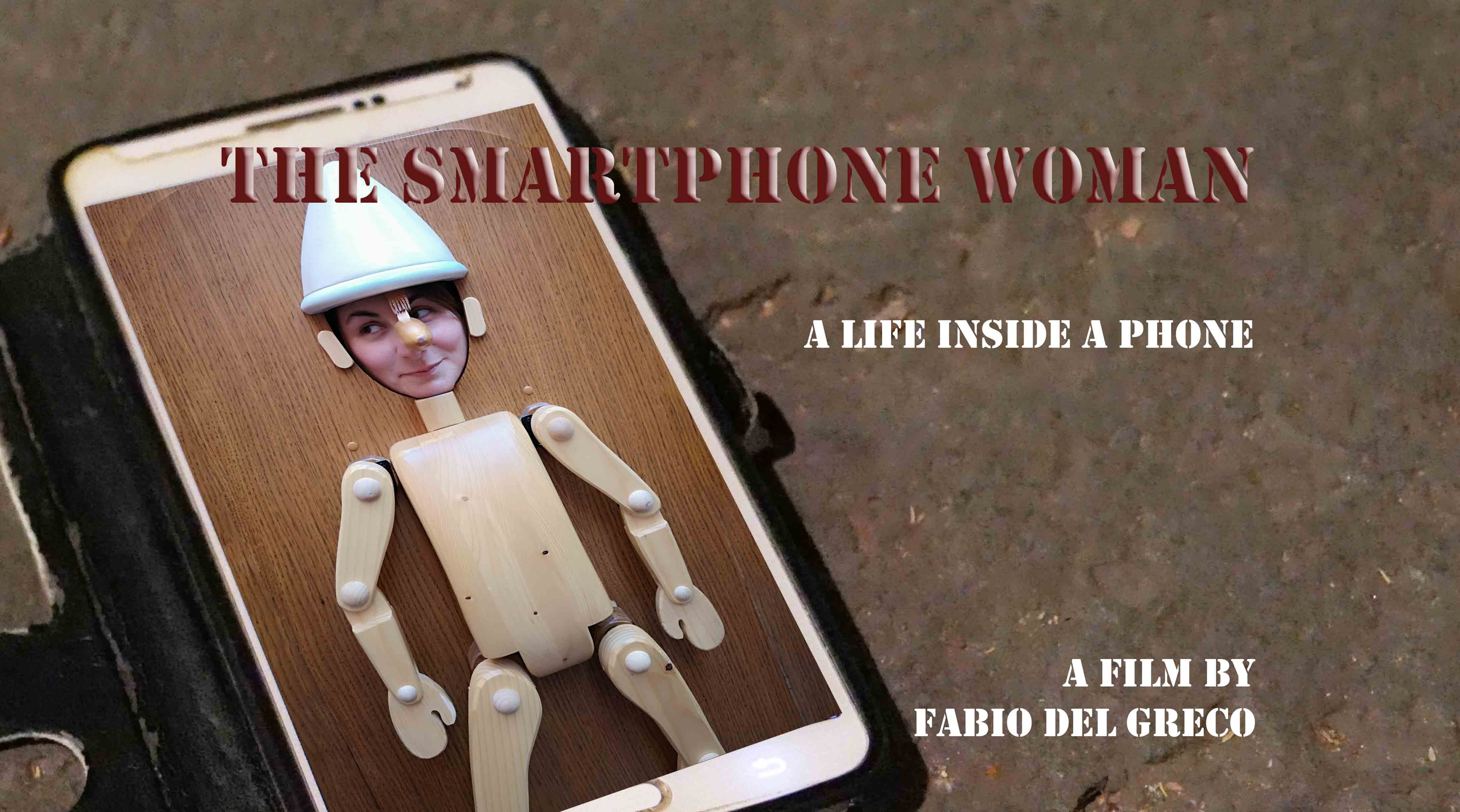
Drama, thriller, dark comedy, by Fabio Del Greco, Italy 2020.
On a bridge over the Tiber River, an elderly and severely ill man has decided to end his life, but an unusual discovery changes his mind: he comes across a lost smartphone. Intrigued, he decides to return home and watch the videos contained within it. On the screen, a series of videos unfold, telling the story of a woman who has emigrated from southern Italy to Rome to work as a teacher in schools and her struggles with integration in a social reality she cannot fully grasp.
"The Smartphone Woman" is a realistic tale of a woman's life and her complex relationship with an "infernal" city. It portrays the challenges she faces, her connection to her origins, the social discomfort she discovers in the outskirts, and the eerie presence of the ghosts of ancient Roman empire. Fabio Del Greco employs a fragmented style, using pieces of "real life" shot with the smartphone, to construct a narrative that ambiguously oscillates between fiction and truth. This creates a captivating exploration of the discomfort and alienation within the bustling city, contrasting with the peaceful village life from which the protagonist hails. The film is constructed with a variety of heterogeneous characters and situations, an emotional kaleidoscope, weaving between evenings of exploration in the Eternal City and daily struggles. Realistic smartphone-shot videos are alternated with a narrative thread reminiscent of film noir and, ultimately, surrealism in the finale. On screen, a succession of grotesque characters unfolds, representing the director's vision of a tumultuous humanity. The film's potency lies in the emotion it manages to convey and in the protagonist's naive perspective. "The Smartphone Woman" is a must-see for enthusiasts of independent and experimental cinema.
LANGUAGE: italian
SUBTITLES: English, French, German, Portuguese, Spanish
Illich’s Diagnostic: When Tools Begin to Own Their Users
Tools for Conviviality was written at a particular hinge in history, when the postwar consensus about technological progress had not yet fully cracked but was developing its first visible fractures. The year matters. The oil shock came in October 1973, the same year of publication, and suddenly the industrial world was sitting in long queues at petrol stations, confronting in the most mundane way imaginable the fact that the systems they depended on could also hold them hostage. Illich was not writing as a prophet of collapse but as a diagnostician of a structural condition that had already arrived. His central claim was precise and disturbing in equal measure: every tool, every institution, every system of production exists on a spectrum, and past a certain threshold of scale and efficiency, it stops serving the person who uses it and begins producing the opposite of its stated purpose. He called this counterproductivity, and he meant it clinically, not metaphorically.
The hospital that generates more illness than it cures. The school that produces more ignorance than it transmits — not by failing in its mission, but by succeeding at a mission that was never quite what was advertised. Illich had worked in Latin America through the 1960s, in Cuernavaca, where he watched development agencies arrive with the confident machinery of modernization and leave behind populations more dependent, more disoriented, more dispossessed of their own competence than before. That experience gave his theory its texture, its refusal of abstraction. He was not describing a theoretical future failure; he was describing what he had watched happen to people he knew, in specific places, on specific dates.
The concept he built around this observation was conviviality, a word he deliberately recovered from its ordinary usage — the warmth of a shared meal, the ease of people together — and elevated into a technical term. A convivial tool, for Illich, is one that remains responsive to the intention of its user, that amplifies human capacity without substituting for it, that can be understood, repaired, modified, and refused. A counterproductive tool is one that has crossed what he called the second threshold, where the logic of the system overrides the logic of the person. At that crossing, something quietly inverts. The tool no longer serves; it drafts.
What makes this diagnostic still capable of landing with physical force fifty years later is that Illich was not warning about a future possibility but naming a mechanism that had already embedded itself in the architecture of daily life so thoroughly that it had become indistinguishable from nature. The difficulty was not that people failed to notice. The difficulty was that there was no position outside the system from which to notice it, no moment in the day not already structured by the very tools under examination. The highway you sit on was also the only way home.

The Counterproductivity Threshold

You are sitting in traffic on a road built to eliminate traffic. The lane you occupy is one of eight, and the city expanded outward precisely because those eight lanes made expansion imaginable. You have been here forty minutes. The cyclist passed you eleven minutes ago.
Ivan Illich called this the counterproductive phase, and he meant something structurally precise by it — not merely diminishing returns, not the ordinary frustration of a system under strain, but the moment at which an institution begins actively generating the harm it was designed to cure. The American urban highway network is among the cleanest examples available. Transportation systems past a certain threshold of speed and infrastructure density do not move people faster; they reorganize settlement patterns until the distances requiring coverage grow proportional to the speeds supposedly conquering them. André Gorz, working alongside Illich in the early 1970s, calculated that the average American male spent roughly 1,600 hours per year either driving, maintaining, insuring, paying for, or earning money to pay for his car — and when those hours were divided against the miles actually traveled, the effective speed collapsed to under six miles per hour. Roughly what a person walks. The machine designed to transcend the human body had reproduced its limits at enormous cost.
The medical parallel runs deeper and is harder to accept because it implicates something that feels categorically different from traffic. Illich’s “Medical Nemesis,” published in 1974, introduced the term iatrogenesis — from the Greek iatros, physician, and genesis, origin — to name the illness that medicine itself creates. By the early 1970s, studies in the United States and United Kingdom were showing that somewhere between one in five and one in four hospital patients experienced an adverse event directly caused by clinical intervention. A 1999 report by the U.S. Institute of Medicine estimated that medical errors alone killed between 44,000 and 98,000 Americans annually — a figure larger than deaths from motor vehicle accidents in several of those years. Illich’s argument was not that doctors are incompetent or malicious. It was structural: a system organized around the medicalization of every human condition — birth, aging, grief, anxiety, dying — necessarily generates the need for more intervention to manage the damage produced by prior intervention. The threshold is crossed when the institution’s survival depends on maintaining the pathology it claims to treat.
The structure of the trap is always the same. A tool that solves a problem at low intensity creates dependency. Dependency expands the tool’s scale. Scale crosses a threshold after which the tool replicates the original problem, now at a magnitude the original condition never reached. And because the institution has by this point colonized the imagination of the people it serves — because they can no longer picture the problem being addressed any other way — the response to institutional failure is always more institution.
You are still in traffic. The light has changed twice.
Convivial Tools and the Spectrum of Use
Your hands already know something your resume does not. There is a moment, familiar to anyone who has taught themselves a physical skill outside any formal context, when the knowledge stops being information and becomes gesture — the wrist angle that finally holds, the breath that times itself, the eye that stops calculating and simply sees. Nobody certified that moment. No institution recorded it. It happened in a garage, or a kitchen, or at a table at two in the morning, and it belongs entirely to the person who lived it.
This is precisely what Ivan Illich, writing in Tools for Conviviality in 1973, was trying to protect. His definition of a convivial tool is deceptively simple: an instrument that remains under the control of the person using it, that expands rather than narrows what that person can do independently, and that does not require a credentialed intermediary standing between the user and the outcome. The tool serves the person. The relationship is not reversed. A bicycle is his most cited example — it amplifies human movement without demanding that the rider submit to a timetable, a ticket, a route determined elsewhere, a license that takes years to acquire. A hand drill, a written language learned outside school, a plot of land that produces food without requiring an agronomist’s signature: these belong to the same family. What they share is not simplicity in the technical sense, but what Illich calls use-value that remains in the hands of the user.
The opposite end of the spectrum is what he calls radical monopoly, and it is here that the analysis sharpens into something almost uncomfortable to sit with. Radical monopoly is not the dominance of one brand over its competitors. It is something structurally deeper: the condition in which a particular kind of tool or system eliminates the very possibility of alternatives to itself. The private automobile, for Illich, is the clearest modern example. Not because it defeats public transport in the market, but because once a city is built around car infrastructure — the distances, the zoning, the highway geography, the absence of sidewalks in entire districts — walking or cycling cease to be real options. The choice disappears not through prohibition but through design. The environment itself becomes the mandate. You do not feel forced. You simply have no practical alternative, and the feeling of freedom you experience when you turn the key in the ignition is real, and it is also the precise form your captivity takes.
Illich was writing before the internet reshaped every category he worked with, but the diagnostic holds. Consider what happens when a person tries to learn something — a language, a craft, a body of historical knowledge — without institutional enrollment. The knowledge is available. The materials exist. The learning happens. And yet something about that process remains socially illegible, professionally invisible, structurally unrecognized. The institution has not prohibited self-teaching. It has simply made its own certification so thoroughly load-bearing for employment, for status, for access to further resources, that the knowledge acquired outside it carries a permanent asterisk. The tool of formal education has not merely competed with informal learning; it has redesigned the terrain so that informal learning requires a kind of courage or eccentricity that should, by rights, be entirely ordinary.
What Illich is mapping is not a moral failing in individuals but a structural threshold — a point at which any tool or system, however useful in its original form, crosses into a territory where it begins reproducing the conditions of its own necessity. Beyond that threshold, the tool no longer serves the user’s purposes. The user serves the tool’s expansion. The spectrum he draws is not a comfort. It is a diagnostic instrument, and it has the particular discomfort of tools that work.
Radical Monopoly: The Disappearance of the Alternative
You stop at a crossroads in a mid-sized city and realize you cannot walk to the destination three kilometers away — not because you lack legs, but because the infrastructure makes it genuinely impossible. The sidewalk dissolves into a highway ramp. There is no pedestrian crossing. The road was designed with the assumption that no one would ever need to cross it on foot. The car did not merely win a competition against walking. It eliminated walking as a category of viable choice.
This is what Illich meant by radical monopoly, and it is a more devastating concept than it first appears. It is not about a corporation controlling market share. It is not about Standard Oil or Microsoft. It is about the moment a dominant tool restructures the entire environment of a domain so thoroughly that alternatives become not just inconvenient but literally inconceivable. The hospital does not simply compete with home recovery — it redefines illness as something that happens in hospitals, attended by specialists, requiring institutional intervention. The school does not compete with informal learning — it redefines knowledge as something certified, sequenced, and externally validated. The car does not compete with the bicycle — it redesigns cities until the bicycle becomes dangerous, eccentric, or both.
The distinction Illich draws here is precise and deliberate. A commercial monopoly can theoretically be broken by regulation or competition. A radical monopoly cannot be broken by introducing a rival product, because the monopoly does not operate at the level of products. It operates at the level of possibility itself — at the level of what gets built, what gets funded, what gets counted, what gets imagined when someone says the word “transportation” or “healing” or “learning.” By 1973, when Tools for Conviviality was published, Illich had watched this process accelerate for two decades across the industrialized world and, crucially, across the developing nations that were being persuaded to import its logic wholesale.
The intellectual pressure behind this diagnosis came from a direction Illich rarely named explicitly but never escaped. Jacques Ellul had argued in 1954 that technique — the totality of methods rationally arrived at and having absolute efficiency in every field of human activity — had ceased to be a tool humans wield and had become the environment humans inhabit. Technique for Ellul was self-augmenting, self-justifying, indifferent to human ends. It did not serve goals; it colonized them. Illich absorbed this and sharpened it into something more surgical: not the abstraction of technique, but the concrete moment when a specific tool crosses a threshold and begins producing the opposite of its original purpose, while simultaneously making that original purpose unthinkable without itself.
There is a shadow in this that belongs to a different Ivan. Tolstoy’s dying magistrate lies in a room that has been decorated exactly as rooms are supposed to be decorated, attended by doctors doing exactly what doctors are supposed to do, surrounded by people performing exactly what grief is supposed to perform — and he cannot find a single person who will speak to him plainly about the fact that he is dying. The tools are all working correctly. The social machinery is functioning precisely as designed. And that is precisely what is killing him — not the cancer, but the inability of the world around him to offer him anything outside its own script. The monopoly in that room is not commercial. It is existential. It has swallowed even the language in which dying might be acknowledged.
Illich read that story not as a parable about one man but as a structural diagnosis. The machinery of modern life — medical, educational, logistical — does not merely fail people at the margins. It fails them at the center, at the moment of their most fundamental needs, because it has made every alternative to itself disappear so quietly that no one remembers there was ever anything else to disappear.
A vision curated by a filmmaker, not an algorithm
In this video I explain our vision
The Professional as Gatekeeper

You sit across the desk from someone who holds a piece of paper that determines what happens to your body next. The room is arranged so that this feels natural. The desk is wide. The chair you occupy is slightly lower. The framed certificates on the wall are not decorations — they are arguments, made in advance, before you open your mouth. Whatever you say about your own pain, your own history, your own sense of what is wrong, will be received as data to be interpreted by someone whose authority to interpret it was granted by an institution you never entered. You leave with a prescription or without one, but either way you leave having been processed rather than heard.
Illich saw this arrangement not as a failure of bedside manner but as the structural logic of professionalism itself. In Tools for Conviviality, published in 1973, and more sharply in Medical Nemesis the following year, he argued that the modern professions had accomplished something extraordinary: they had persuaded entire populations that specific forms of human need — healing, learning, justice, meaning — could only be legitimately met by certified specialists. The result was not merely dependency but something more corrosive: the systematic atrophying of the capacity to meet those needs without institutional mediation. People did not simply come to rely on doctors. They came to distrust their own bodies. They did not simply hire lawyers. They came to feel that their own sense of right and wrong was legally irrelevant.
Eliot Freidson, whose Profession of Medicine appeared in 1970 and whose later work Professionalism: The Third Logic extended the argument, reached a structurally similar conclusion from within mainstream sociology. Freidson was not a radical in Illich’s register, but his meticulous analysis of how professional associations secure monopoly control over a domain of practice — licensing boards, credentialing systems, peer review structures that effectively police entry — describes the same mechanism Illich was naming from the outside. The difference is that Freidson saw this as an empirical fact about social organization, while Illich saw it as a moral catastrophe.
Foucault enters here not as an ally of either but as a complicating pressure. His account of biopower, developed most fully in the first volume of The History of Sexuality in 1976 and in his College de France lectures on the birth of biopolitics, describes how the modern state came to administer life itself — population, health, reproduction, risk — through the bodies of individuals. The medical profession in this reading is not merely a guild protecting its market share. It is a node in a network of governance that produces the very categories through which people understand themselves as subjects: the patient, the deviant, the at-risk individual, the mentally ill. What looks like a service is simultaneously a form of inscription.
These three analyses do not converge into a single argument. Freidson would resist Foucault’s dissolution of the individual practitioner into an anonymous structure of power; Illich would resist both Freidson’s relative acceptance of professionalism as reformable and Foucault’s indifference to the concrete vernacular alternatives Illich believed were still possible. But they share a diagnostic object — that moment in the consultation room, or the classroom with the red pen descending on the page, or the legal office where a client is gently informed that their intuition about justice has no standing in the relevant statute.
The teacher’s red pen is worth pausing on. It does not only correct. It redefines the activity of writing as something requiring correction from above. The student who internalizes this does not simply learn grammar. They learn that their native relationship to language is inadequate, that the text they produce is always already in need of professional assessment before it can be considered complete. This is what Illich meant by counterproductivity operating at the level of subjectivity — not just that the institution fails to deliver what it promises, but that it succeeds in producing a person who cannot imagine delivering it themselves.
The Political Topology of Conviviality
You drive under a bridge every day without thinking about it. The clearance height is a fact, like weather, like the color of the sky. It does not occur to you that someone decided on that number, that the decision was made with a specific kind of person in mind, and that person was not you if you arrived by bus.
Robert Moses, the urban planner who reshaped New York through roughly four decades of unchecked authority, built the overpasses on the parkways leading to Long Island beaches at a height that prevented public buses from passing beneath them. The beaches were there. The road was there. The buses could not fit. The poor, who disproportionately depended on public transit and who were disproportionately Black, were architecturally excluded from a public amenity. No law said they could not come. The concrete said it instead, and concrete does not appear in legislative records.
Langdon Winner named this with surgical precision in his 1980 essay “Do Artifacts Have Politics?” — the argument that technologies and built environments are not neutral instruments waiting to be used well or badly by whoever picks them up, but that they encode, at the moment of their design, specific distributions of power, specific assumptions about who the user is, specific visions of what social life should look like. Winner’s claim was not merely that powerful people use tools to serve their interests, which would be obvious. His claim was structural: the politics are baked into the artifact itself, so that once the artifact is sufficiently embedded in daily life, dismantling the politics requires dismantling the thing, not just reforming the institution that built it.
Illich arrives at the same topology from a different angle. For him, the tool is not simply a site where politics happen to be stored. The tool is a proposition about human beings — about what they are capable of, what they need, who has the authority to provide it. A hospital that requires credentialed specialists to manage every interaction with the body is not just an organizational choice. It is a claim about the body: that it is fundamentally opaque to its owner, that understanding it requires years of technical formation unavailable to most people, that the relationship between a person and their own physical existence is properly mediated by an institution. The tool does not argue this claim in language. It enacts it every time someone enters and feels, despite themselves, incompetent.
This is why Illich insists that tools for conviviality must be politically legible — not in the sense that they come with explanations, but in the sense that they do not require expertise to understand how they constrain you. A bicycle is legible. You can see how it works, modify it, repair it with modest skill, and understand immediately what it demands of the road and what the road must provide. A highway system is not legible in this sense. It is a total environment that you inhabit without having designed it, without being able to alter it, without having voted on the assumptions it encodes about speed, land use, the subordination of walking to driving, the distribution of noise and pollution by neighborhood.
The reader who drives that highway every morning is not simply using a tool. They are living inside an argument that was settled before they were born, by engineers and planners and capital flows and municipal bond structures that never asked for their consent. Illich’s point is that this is political life as most people actually experience it: not as deliberation, not as choice, but as the accumulated weight of decisions crystallized into concrete and steel and institutional protocol, presenting themselves as the neutral furniture of reality.
The bridge height is not a number. It is a sentence, written in a language most people were never taught to read.
What Remains When the Tool Withdraws

She is repairing a shirt. Not because she cannot afford a new one, not because she is making a statement, but because the shirt fits well and the tear is small and her hands know what to do. The needle moves through fabric the way a practiced thought moves through a problem — without announcing itself, without requiring approval. Someone watching might feel a faint unease, the kind that surfaces when something familiar has become strange. When did this become illegible? When did the closed loop of a hand completing what a hand had broken become something that needed explanation?
Ivan Illich would have recognized that unease immediately, and named it. In Tools for Conviviality, published in 1973, he argued that industrial tools cross a threshold — he called it the second watershed — beyond which they begin to produce the opposite of their stated purpose. Medicine generates iatrogenic disease. Education manufactures ignorance of everything it does not certify. Transportation colonizes time rather than freeing it. But the subtler damage is what happens to the person standing on the other side of that threshold: not merely that they receive less, but that they lose the internal architecture that would have allowed them to imagine receiving differently. The tool does not just replace the skill. It replaces the desire that would have called the skill into being.
This is what makes Illich’s analysis structurally different from ordinary critiques of technology. He was not mourning efficiency lost to machines. He was describing how a certain kind of tool, scaled past human proportion, dismantles the very faculty by which a person recognizes their own needs. Herbert Marcuse, writing a decade earlier in One-Dimensional Man, had traced how advanced industrial society flattens the capacity for negation — the ability to imagine a different order. Illich located where that flattening happens in the body, in the hands, in the practiced gesture that is no longer practiced because the tool has made it redundant and then made redundancy feel like liberation.
The woman with the needle is not practicing a political philosophy. She is doing something her grandmother did without thinking, something her daughter may never learn, something that in fifty years may exist only as a workshop one pays to attend. That migration — from embedded competence to scheduled recreation — is itself a kind of measurement. It tells you how far the second watershed has receded into the past and how completely the new shoreline has been naturalized.
What remains when the convivial tool is allowed to persist, or when someone reaches back for it, is not nostalgia and not primitivism. It is something closer to what the psychologist Mihaly Csikszentmihalyi spent decades documenting: the specific quality of absorption that occurs when a person’s skill meets a task of matching difficulty, when neither boredom nor anxiety intrudes, when the self disappears into the action rather than supervising it. Csikszentmihalyi called it flow, and he found it in surgeons and chess players and rock climbers and potters and, with striking frequency, in people doing exactly the kind of slow, manual, unhurried work that industrial modernity has reclassified as either hobby or poverty.
Illich’s wager was that this quality of engagement is not incidental to human life but constitutive of it — that a society organized around tools which systematically prevent it is not a society that has solved the problem of human labor but one that has quietly abandoned the human being at the center of the problem. The shirt is being repaired. The needle moves. Outside, the city continues at its registered speed, and the gap between those two tempos is not picturesque or nostalgic or ironic. It is the distance between a question that has been answered by substitution and a question that remains, still open, still requiring the particular intelligence of a hand.
🔧 Tools, Society, and the Limits of Modern Systems
Ivan Illich’s Tools for Conviviality stands at the crossroads of political philosophy, social critique, and the ethics of technology. The articles below explore kindred thinkers who grappled with alienation, community, the nature of power, and the human costs of industrial civilization — essential companions to Illich’s radical vision.
Karl Marx and Alienation: Economic and Philosophical Manuscripts
Karl Marx’s concept of alienation, developed in his Economic and Philosophical Manuscripts, forms a crucial backdrop to Illich’s critique of industrial tools that sever human beings from meaningful work and self-determination. Where Marx locates alienation in the relations of production, Illich extends this insight to the very design of modern institutions and technologies. Together, these two thinkers construct a powerful indictment of systems that subordinate human flourishing to efficiency and output.
GO TO THE SELECTION: Karl Marx and Alienation: Economic and Philosophical Manuscripts
Tönnies’s Community and Society: Analysis
Ferdinand Tönnies’s foundational distinction between Gemeinschaft and Gesellschaft — organic community versus impersonal association — resonates deeply with Illich’s longing for convivial, human-scale tools that foster genuine social bonds. Tönnies feared that industrial modernity was dissolving the warm fabric of communal life into cold contractual relations, a concern that Illich would later translate into a concrete program for institutional reform. Reading Tönnies alongside Illich illuminates the sociological roots of the crisis that Tools for Conviviality seeks to address.
GO TO THE SELECTION: Tönnies’s Community and Society: Analysis
Putnam’s Bowling Alone: Analysis
Robert Putnam’s Bowling Alone documents the dramatic decline of social capital and civic participation in late twentieth-century America, offering empirical weight to Illich’s earlier theoretical warnings about the erosion of conviviality. Putnam traces how institutional and technological changes have atomized individuals, replacing cooperative life with passive consumption — a trajectory Illich had diagnosed decades before. The two works together chart both the philosophical origins and the measurable social consequences of a world stripped of convivial tools.
GO TO THE SELECTION: Putnam’s Bowling Alone: Analysis
Mass Social Homologation Today
The essay on mass social homologation confronts the same cultural flattening that Illich warned against when he argued that counterproductive institutions ultimately produce standardized, dependent human beings rather than autonomous ones. As modern tools and media increasingly shape desire, identity, and behavior along uniform lines, the convivial ideal of diverse, self-determined communities becomes ever more urgent. This article provides a contemporary cultural lens through which Illich’s critique of industrial civilization can be reread and renewed.
GO TO THE SELECTION: Mass Social Homologation Today
Discover Independent Cinema on Indiecinema
If these ideas about freedom, technology, and human community have stirred something in you, Indiecinema’s streaming platform offers a curated selection of independent films that dare to ask the same urgent questions. From radical documentaries to visionary fiction, you’ll find cinema that resists homologation and celebrates the convivial spirit Illich dreamed of. Explore Indiecinema and let independent film expand your thinking beyond the page.
👉 EXPLORE THE CATALOG: Watch Indie Films in Streaming
A vision curated by a filmmaker, not an algorithm
In this video I explain our vision

