
The Arrival of a Different Grammar
You are sitting in a lecture hall in Chicago, September 1893, and a man in saffron and ochre walks to the podium and addresses the crowd as “Sisters and brothers of America.” The room erupts before he has said anything of substance. Something has already happened — not in the content of the words but in their grammar, in the assumption buried inside them. He has not said “ladies and gentlemen.” He has not organized the room by social convention. He has addressed something prior to distinction, and the audience, without fully understanding why, has responded to that prior thing with a force that surprises even them. Swami Vivekananda had not yet explained a single concept from the Upanishads, and the rupture had already begun.

What broke open in that moment was not a theological disagreement. It was something more structural, more intimate. The Western mind arriving at Vedantic thought for the first time does not encounter a different set of answers to familiar questions. It encounters a different set of questions entirely — questions so foreign to its inherited framework that they initially appear to be mysticism, evasion, or poetry dressed as philosophy. The Mandukya Upanishad, one of the shortest and most devastating texts in the Sanskrit canon, opens by asserting that everything is Brahman, that consciousness is not a product of the world but its precondition. This is not a metaphor. It is a direct ontological claim, and it dismantles the Cartesian architecture that had organized Western thought since the seventeenth century with surgical indifference.
René Descartes had built the modern Western self on a specific foundation: the thinking subject as the starting point of all certainty. Cogito ergo sum — I think, therefore I am. This sentence did not merely establish a logical proof. It established a direction. Consciousness, in this framework, is always consciousness of something external. The self is the observer, the world is the observed, and the gap between them is where knowledge lives. Three centuries of Western epistemology, psychology, and even political theory were constructed inside that gap. When Vedanta arrives and states that the observer and the observed are not two things but one appearing as two, it does not add a new room to this house. It removes the floor.
The difficulty is not intellectual. Most educated Westerners who encountered Vedantic texts in the nineteenth century — through Schopenhauer’s reading of the Oupnek’hat, the Latin translation of the Upanishads that arrived in Europe in 1801 and which he kept on his desk alongside his manuscript of The World as Will and Representation — could follow the logic well enough. Schopenhauer recognized in the concept of Maya, the veil of illusory individuation, a precise resonance with his own notion of the principium individuationis, the principle that makes each person experience themselves as a separate island of will and suffering. He called the Upanishads the consolation of his life and death. But even Schopenhauer folded the Vedantic insight back into a Western framework of pessimism and renunciation. He used it as confirmation rather than confrontation. The rupture was softened at the point of contact.
This softening is almost automatic, almost protective. The mind under genuine philosophical pressure tends to translate the foreign concept into a dialect it already speaks, neutralizing the strangeness and recovering its equilibrium. What Vedanta actually demands — not as a spiritual practice but as a logical proposition — is the suspension of the assumption that the self doing the reading is the kind of thing it believes itself to be. Not the suspension of selfhood as a moral exercise in humility, but as a first principle of inquiry. The grammar of the subject changes before the content of any sentence can be understood. And that is a disorientation that no amount of intellectual preparation entirely prevents.
I Am Nothing
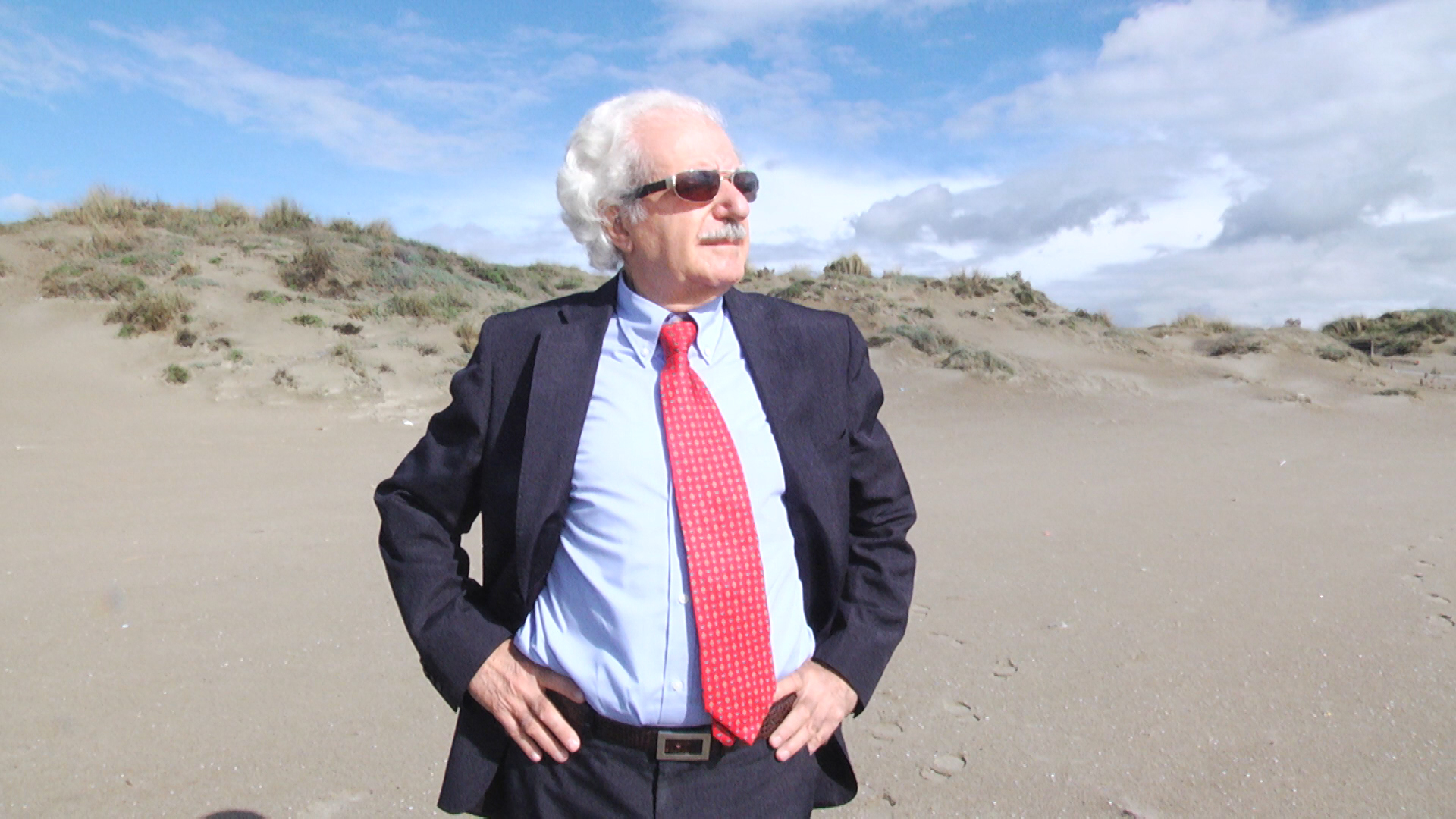
Drama, thriller, by Fabio Del Greco, Italy, 2015.
The story revolves around Vasco, a Roman builder who, at the age of 74, enjoys a life of absolute comfort. His human parable takes a dramatic turn when a mysterious encounter leads him to an ambush. Having survived, but marked by a long coma, Vasco wakes up with a new sensitivity, developing an intimate and poetic bond with nature. This new relationship with the world around him leads him to deeply explore himself, in an internal and external journey. through Italy, the United States and India, in search of a higher meaning and a cure. In parallel, the threat of a planetary cataclysm adds an epic dimension to the story.
I Am Nothing explores universal themes such as time, memory, oblivion and the connection with nature. Fabio Del Greco creates an existential drama full of food for thought. The director skillfully combines different visual materials, mixing archive images with nature photographs and dreamlike visions. This visual experimentation translates into an editing that captures the viewer's attention, guiding him through a cycle of creation and destruction. The sequences that alternate the buildings, Vasco's pride, with Indian landfills and natural landscapes create a hypnotic rhythm, underlining the beauty and fragility of life. Vasco's existential journey is a hymn to transformation and rebirth. The evolution of the protagonist, from unbridled luxury to the rediscovery of purity, represents a powerful metaphor on the meaning of life and the need to reconnect with authentic values. Io sono nulla stands out for its ability to combine introspection and visual experimentation, offering a suggestive and engaging narration. It is a film that invites us to reflect on the human condition, on our relationship with power and nature, and on the possibility of finding ourselves through change. A work that leaves its mark and lends itself to multiple readings.
LANGUAGE: Italian
SUBTITLES: English, Spanish, French, German, Portuguese
Swami Vivekananda and the 1893 Shock
You are sitting in a gilded hall in Chicago, September 1893, surrounded by clergy, theologians, and curious onlookers who have gathered under the assumption that the world’s religions will politely compare notes and confirm, in their various ways, the supremacy of the civilization hosting the event. The World’s Columbian Exposition has already spent months celebrating American industrial and moral progress. The Parliament of the World’s Religions is its spiritual annex — a showcase, not a reckoning. Then a thirty-year-old monk from Calcutta walks to the podium and addresses the audience as “Sisters and Brothers of America,” and the room erupts in applause for two full minutes before he has said anything of substance, because something in that greeting has already undone the expected hierarchy without anyone being able to articulate why.
What Vivekananda did at Chicago was not diplomacy. Scholars of religion like Arvind Sharma, writing in his 2000 study on the comparative encounter between Hinduism and the West, have noted that Vivekananda’s address did not present Vedanta as one option among many — it presented it as the logical framework within which all other options could be understood. This is a fundamentally different posture. The Western theological tradition, rooted in what the philosopher Charles Taylor would later call “exclusive humanism,” had organized religious difference as a ladder: Christianity at the summit, other traditions as rungs below, arranged by proximity to what Europeans recognized as rational monotheism. Vivekananda arrived with a different geometry entirely. His speech did not climb the ladder. It dissolved it.
The intellectual move was precise and it drew on the Advaita Vedanta of Adi Shankaracharya, the eighth-century philosopher whose non-dualist synthesis had argued that the apparent multiplicity of the world — including the multiplicity of religions — was a function of perception operating at a limited register. To say, as Vivekananda said that day, that “all religions are true” was not the ecumenical pleasantry it sounded like to Western ears. It was a philosophical claim with teeth: that Christianity’s insistence on its own exclusivity was itself a symptom of Maya, of the mind’s inability to perceive the unity beneath differentiation. He was not including Christianity in a generous embrace. He was diagnosing it.
The audience could not fully process this in real time. The applause continued. American newspapers called him the “cyclonic monk” and described his presence as mesmerizing, which is the language people use when they have been moved without being transformed. The Protestant clergymen who had organized the Parliament had expected to be broadened. They were instead being told, in precise philosophical language, that their framework for understanding truth was structurally inadequate — not wrong in its conclusions but wrong in its method of arriving at conclusions. John Henry Barrows, the Presbyterian minister who chaired the Parliament, later wrote warmly of Vivekananda while also making clear that he saw Vedanta as a sophisticated but ultimately incomplete answer to the question Christianity had already solved. The condescension is so well-mannered it almost disappears.
What did not disappear was the effect on the American public who encountered Vivekananda’s lectures in the years that followed. Between 1893 and 1896, he traveled, taught, and founded the Vedanta Society in New York, drawing audiences from the educated urban class who were experiencing what the sociologist Robert Bellah would much later, in 1985’s Habits of the Heart, identify as a crisis of American individualism — a hunger for transcendence that institutional Christianity, entangled as it was with Gilded Age morality and social conformism, could no longer reliably feed. These were people not looking for India. They were looking for a way out of a self that had started to feel like a cage, and Vivekananda handed them a philosophy that said the cage was never real to begin with.

What Schopenhauer Actually Borrowed
You are reading a philosophy book published in Frankfurt in 1818, and the author is telling you something that feels like it was always true — that beneath every perception, every thought, every flicker of desire, there runs a single blind force he calls the Will, impersonal and insatiable, indifferent to the individual lives it animates. The argument feels radical, Western, modern. What you are not told, what the footnotes partially conceal and the prose texture absorbs without announcement, is that Arthur Schopenhauer kept a Latin translation of the Upanishads on his desk every night of his working life, called it the most profitable and sublime reading possible in the world, and structured the central architecture of his thought directly on what he found there.
The translation in question was the Oupnek’hat, a Latin rendering produced by Anquetil-Duperron in 1801 from a Persian intermediary version commissioned by the Mughal prince Dara Shikoh in 1657. Schopenhauer annotated his copy obsessively. The doctrine of Maya — the veil of illusion that makes the individual perceive themselves as separate from the ground of being — enters his system almost structurally intact, reframed as the principium individuationis, the principle of individuation through which the Will disguises its unity behind a theatre of separate selves. The Upanishadic tat tvam asi, that art thou, the declaration that the self and the universal are identical, becomes in Schopenhauer the ethical foundation for compassion: one suffers in the other because at the level of the Will, they are not other. The content migrates with remarkable fidelity. The vocabulary changes. The attribution does not follow.
This is not a scandal in the crude sense. Schopenhauer was not concealing his sources out of malice — he cited the Upanishads with genuine reverence in ways that were extraordinary for a European thinker of his era. The problem is structural. European philosophy as an institutional practice had already decided, before Schopenhauer was born, that its lineage ran from Athens to Rome to the Renaissance to Kant, and that anything originating east of Constantinople was either theology, mythology, or proto-philosophy waiting to be properly formalized by Western reason. When a concept enters that lineage, it is naturalized. It sheds its origins the way an immigrant sheds an accent under enough social pressure. By the time Friedrich Nietzsche read Schopenhauer in the 1860s and built his own architecture partly against him, the Indian substratum had already become invisible, absorbed into what felt like an autonomous European intellectual development.
What makes this particularly precise as a historical mechanism is that Schopenhauer himself understood something the institutional narrative did not want to accommodate: that the Vedantic tradition had solved certain problems of consciousness and selfhood with a sophistication that predated and arguably exceeded the Greek formulations that European philosophy treated as its singular inheritance. The Brihadaranyaka Upanishad, composed somewhere between the eighth and sixth centuries BCE, contains phenomenological observations about the nature of the witnessing self that would not be matched in Western philosophy until Edmund Husserl’s work on intentionality in the early twentieth century — and even then, the matching is approximate. Schopenhauer was not borrowing from a primitive tradition and elevating it. He was encountering a rival philosophical civilization and translating its insights into a language that his own civilization could receive without having to acknowledge the source’s full standing.
The deeper distortion lies in what that translation cost. When Maya becomes principium individuationis, something shifts: the Indian concept carries within it an entire cosmological and ethical framework in which liberation from the illusion is not merely a philosophical conclusion but a practice, a way of dying into the universal. Schopenhauer retains the metaphysics and amputates the soteriology, producing a system of radical pessimism where the recognition of the Will’s nature leads not to liberation but to aesthetic contemplation and ascetic resignation — which is, to put it plainly, what happens when you take a map designed to show you the way out and frame it as decoration on the wall of the room you cannot leave.
Transcendentalism as Selective Reading
You are reading the Upanishads, but you are reading them wrong — and the wrongness is doing something to you that correctness never could. This is not a confession of failure. It is the mechanism by which American thought in the nineteenth century discovered a philosophy it was constitutionally incapable of receiving whole, and transformed its misunderstanding into a minor religion of the self.
Ralph Waldo Emerson encountered the Bhagavad Gita in 1845 through Charles Wilkins’s 1785 English translation, a rendering so mediated by Enlightenment rationalism and colonial administrative anxiety that what arrived on the page had already been scrubbed of its most disruptive implications. Wilkins, employed by the East India Company, was not interested in producing a philosophically faithful document — he was interested in producing a legible one, legible to men who believed that reason was universal and that Indian texts, properly decoded, would confirm it. What Emerson received, then, was not Vedanta. It was Vedanta passed through a filter designed to make Indian thought safe for European categories.
The specific epistemological catastrophe this produced was the collapse of the distinction between Atman and the empirical self. Advaita Vedanta — as systematized by Adi Shankaracharya in the eighth century, most rigorously in his Brahmasutra Bhashya — insists that the recognition of Atman as Brahman is precisely the annihilation of the individual subject, not its apotheosis. The self does not expand to become the universe; it is revealed to have never existed as a separate entity in the first place. This is not a romantic idea. It is a violent one, and it was precisely this violence that the Transcendentalists could not metabolize, because it would have required them to demolish the very concept of individual genius on which their entire literary and moral project depended.
Emerson instead produced what might be called the Americanization of non-duality: a vision in which the Over-Soul preserved, even celebrated, the individual as the privileged site of cosmic reception. His 1841 essay on the Over-Soul reads the dissolution of boundaries as an expansion of personal consciousness rather than its negation — a reading that would have been unrecognizable to Shankara, and that transformed a philosophy of radical impersonalism into the theological foundation for American exceptionalist selfhood. Henry David Thoreau’s two-year experiment at Walden Pond, which he described in 1854 as a kind of ascetic practice, borrowed the vocabulary of renunciation while maintaining every structural condition of the autonomous Western subject: private property, literary ambition, the cultivation of a distinctive voice. Renunciation, in the Vedantic sense encoded in texts like the Mundaka Upanishad, is not a temporary retreat for the purpose of self-discovery. It is an ontological reorientation that makes self-discovery impossible as a category.
What makes this misreading generative rather than merely wrong is that it produced something with its own internal coherence and genuine force — a body of thought that changed how Americans related to interiority, to nature, to the authority of institutions. The distortion was not random noise. It was structurally determined by what the receiving culture needed and what it could bear to hear. Every translation is also a negotiation between the text and the terror it might produce if received without alteration. The Transcendentalists were not intellectually dishonest men. They were men encountering a philosophy designed to undo the very instrument — the reasoning, individuated self — that they were using to read it. The encounter could only end in productive misunderstanding, because the alternative was a silence that American literary culture in the 1840s had no form for holding.
What travels across that distance between one epistemology and another is never the idea itself. It is always the idea’s shadow, cast at an angle determined by the light source of the receiving world, falling across ground that reshapes it before it can be named.
The Theosophical Distortion Machine
You are standing in a drawing room in New York, 1875, and a woman with extraordinary eyes is telling you that the ancient sages of India confirmed everything you already suspected — that matter is illusion, that the soul migrates through lifetimes, that there exists a hidden brotherhood of masters governing humanity’s spiritual evolution from somewhere in Tibet. You feel the thrill of recognition. That thrill is the first sign that something has gone wrong.
Helena Petrovna Blavatsky and Henry Steel Olcott founded the Theosophical Society in that same year, and the organization they built was not a philosophical institution but an apparatus of translation — one that systematically converted the rigorous, often ruthless intellectual machinery of Advaita Vedanta into something a Victorian drawing room could absorb without discomfort. The difference between translation and distortion is precisely this: translation preserves the resistance of the original material, while distortion removes it. Blavatsky’s monumental Isis Unveiled in 1877, and later The Secret Doctrine in 1888, borrowed Sanskrit terminology with the confidence of someone who had never been obligated to sit with a living tradition and be corrected by it. Terms like maya, karma, and atman were lifted from their philosophical contexts — where they carried precise logical weight within systems of argumentation stretching back to Adi Shankaracharya’s eighth-century commentaries on the Brahma Sutras — and redeployed as atmospheric furniture, decorative concepts that gestured toward depth without requiring any.
What Vedantic philosophy actually demands is epistemological confrontation. Shankara did not offer consolation. He argued, with the precision of a logician, that the empirical self you take yourself to be is a superimposition upon pure consciousness — a case of mistaken identity as fundamental and as correctable as confusing a rope for a snake in dim light. This is not mysticism in the Western romantic sense. It is a sustained logical operation, developed through commentary traditions and dialectical debate, that requires the student to dismantle the very cognitive apparatus they are using to understand it. The Theosophical packaging removed this demand entirely. It replaced the discipline of knowing with the pleasure of believing.
Victorian Britain and America were experiencing what the historian Alex Owen documented in The Place of Enchantment, published in 2004, as a crisis of meaning produced by scientific materialism on one side and institutional Christianity’s declining authority on the other. Into this vacuum, Theosophy inserted what might be called spiritual exoticism — the idea that the East possessed secrets which the West had lost or never earned, secrets accessible not through sustained philosophical practice but through initiation, through the right books, through proximity to figures like Blavatsky herself, who positioned her own person as a conduit. The result was a spiritual economy in which India functioned not as a civilization with living intellectual traditions but as a reservoir of mystical energy available for Western extraction.
The damage this caused was layered. For Western seekers, it created a template of engagement with Indian thought that prioritized atmosphere over argument, feeling over rigor, and the exotic over the examinable. For Indian thinkers navigating colonialism, it produced a peculiar double bind: Theosophy claimed to validate Hinduism while simultaneously ventriloquizing it, speaking on its behalf to a global audience that would now arrive with expectations shaped by Blavatsky rather than by Vyasa. When Swami Vivekananda traveled to Chicago in 1893 to address the Parliament of the World’s Religions, part of what he was doing — whether he articulated it this way or not — was attempting to reclaim the microphone from people who had never possessed the philosophy they were broadcasting.
The machinery was already running, though. By the time genuine Vedantic thought reached Western audiences through more disciplined channels, it had to compete with a version of itself that was easier, warmer, and entirely willing to confirm whatever the audience had already decided it believed.
A vision curated by a filmmaker, not an algorithm
In this video I explain our vision
Psychology Meets Non-Self

You are sitting across from your therapist, and she asks you to describe yourself. You begin with your name, your profession, your relationships, the wound from childhood that explains the wound from last year. You build a structure, careful and load-bearing, and when you are finished, you feel briefly coherent — held together by the story you have just told. What neither of you questions is the premise underneath all of it: that there is a self to describe, a continuous interior entity that your words are pointing toward. That premise is so old in the Western tradition it no longer feels like a premise. It feels like a floor.
Carl Jung spent decades constructing one of the most elaborate maps of that interior entity the twentieth century produced. His 1921 work Psychological Types, followed by the later development of the individuation process, proposed that psychological health meant integrating the fragmented parts of the psyche into a unified whole — the Self, capitalized, a kind of luminous center around which the personality could organize itself. When Jung traveled to India in 1937 and encountered Vedantic thought through conversations with scholars affiliated with the Ramakrishna Mission, something structurally strange happened. He recognized in the concept of Atman — the innermost principle, the ground of consciousness — a formal resemblance to his own Self. He drew the comparison publicly, enthusiastically, and then quietly, almost immediately, pulled back from its implications. What he had stumbled toward was not a confirmation of his system but its potential demolition.
The Vedantic position, particularly as articulated through Adi Shankaracharya’s eighth-century non-dualist framework, does not locate a sovereign self at the center of experience. It locates the absence of one. Atman is not a refined or integrated psychological subject — it is the recognition that the subject-object structure of ordinary consciousness is itself the confusion. Swami Vivekananda had made this point with uncomfortable directness at the 1893 Parliament of the World’s Religions in Chicago, telling an audience accustomed to the grammar of personal salvation that the individual soul seeking union with God is already a conceptual error. The self you are trying to perfect is the same self that is generating the problem. Jung heard this and translated it into his own vocabulary, which is precisely what made the encounter philosophically inconclusive. Translation is also a form of neutralization.
What the depth psychology tradition could not fully absorb was the Vedantic claim that awareness is not a property of a subject but the condition within which subjects appear. William James had gestured toward this in his 1904 essay “Does Consciousness Exist?”, proposing that consciousness might not be a substance but a function — and then spent the remainder of the essay trying to rescue the personal self from that opening. The pressure to preserve individuality was not merely philosophical. It was cultural and economic: the entire architecture of Western modernity, from Protestant salvation to liberal political theory to the psychoanalytic consulting room, rests on the irreducible individual as its foundational unit. A framework that treats the individual as a grammatical convenience rather than an ontological fact does not integrate easily into that architecture. It threatens the architecture.
This is why the mid-century dialogue between Vedantic scholars and Western psychologists produced so much productive-sounding exchange and so little genuine confrontation. D.T. Suzuki, working in an adjacent tradition, noted in his exchanges with Erich Fromm that the Western therapeutic goal of a healthy ego and the contemplative goal of ego-dissolution are not two roads to the same destination. They are oriented in opposite directions. Fromm’s 1960 collaboration with Suzuki, Zen Buddhism and Psychoanalysis, circled this tension without resolving it, which is perhaps the honest thing to do with a contradiction that runs this deep. What you call integration, another tradition calls a more sophisticated form of the original entrapment — and neither side has yet found a language in which that disagreement can be held without one of them becoming the translation of the other.
The Counterculture Pipeline and Its Costs
You are standing in a record shop in 1968, and the cover of a newly released album stares back at you with Sanskrit lettering, a photograph of a bearded man in white robes, and the implicit promise that enlightenment is available at the same price as a hamburger. The shop owner does not know what the letters mean. You do not either. That is not incidental to the transaction — it is the transaction itself.
What entered American counterculture in the 1960s was not Vedanta. It was the desire for Vedanta, which is an entirely different substance. The demand preceded any serious encounter with the material, and wherever demand precedes supply in a culture organized around consumption, what fills the gap is not the thing itself but its most marketable silhouette. Maharishi Mahesh Yogi arrived in the United States in 1959, and by 1968 he had appeared on the cover of Time magazine, taught the Beatles in Rishikesh, and transformed a form of mantra meditation derived loosely from the Shankara tradition into a globally licensed product with a fixed fee structure. Transcendental Meditation was, by the early 1970s, generating revenues in the tens of millions of dollars annually. The mechanics were ingenious: the practice was stripped of its theological scaffolding, rebranded as a stress-reduction technique with measurable neurological effects, and sold to a population that wanted transformation but distrusted doctrine. This was not a corruption of something pure — it was the logical output of a specific cultural appetite meeting a specific commercial intelligence.
What gets lost in that exchange is not merely content but orientation. The Advaita Vedanta that Adi Shankaracharya systematized in the eighth century was not a method for reducing cortisol. It was a rigorous philosophical demolition of the assumption that the individual self is real in the way it believes itself to be. The Vivekachudamani, attributed to Shankara, contains passages of such unsparing intellectual severity that they demand not relaxation but a willingness to have one’s entire cognitive architecture dismantled. The counterculture wanted the dismantling but expected it to feel good, and that expectation fundamentally altered what it was willing to receive.
The ashram proliferation of the 1970s made this dynamic structural. From Swami Muktananda’s Siddha Yoga centers to the communities organized around figures who would later be exposed for financial and sexual exploitation of followers, the American ashram operated as a hybrid institution that borrowed the external grammar of monastic renunciation while remaining embedded in the logic of the spiritual marketplace. Philip Goldberg’s 2010 work American Veda documents this proliferation with scholarly care, noting that by 1977 there were over two hundred organizations in the United States offering some form of Vedanta-adjacent teaching. The sheer density of supply reveals that what was being sold was belonging and certainty, dressed in the vocabulary of dissolution and doubt.
There is something structurally perverse in a culture importing a philosophy of non-attachment through the mechanisms of intense attachment — to teachers, to communities, to the identity of being someone who has seen beyond identity. Sociologist Lorne Dawson, writing on new religious movements in the 1990s, observed that the very populations most drawn to traditions emphasizing ego dissolution tend to reconstitute their ego around the practice of dissolution. The seeker becomes a new social category, as defensible and as marketed as any other. By the time Ram Dass published Be Here Now in 1971 — a book that sold over two million copies and became the primary vector through which a generation encountered Vedanta-adjacent ideas — the tradition had been refracted through LSD, through grief, through a Harvard professor’s public breakdown, into something genuinely moving and genuinely incomplete.
What remains from that decade is not a transmission but a residue: a widespread intuition in Western consciousness that ordinary experience conceals something larger, that the self is somehow negotiable. That intuition is not wrong. But an intuition is not a practice, and a residue is not a root, and the distance between those two things is precisely where the next generation of seekers found themselves standing without a map.
The Untranslatable Remainder
You are in a seminar room in Cologne or perhaps Chicago — it doesn’t matter — and a professor of comparative religion is explaining the concept of maya to a room of graduate students who have all read the right books. Someone raises a hand and asks whether maya is essentially the same as Plato’s cave, and the professor pauses just long enough to reveal that this is the question they have been dreading since the course began. The comparison is not wrong, exactly. It simply starts from the wrong place, which is a different kind of error.
The Platonic cave is a story about knowledge withheld — shadows on a wall, prisoners who have not yet turned around. It presupposes that reality is somewhere else, fully formed, waiting to be discovered by the philosopher willing to climb toward the light. The entire architecture of Western epistemology since then has been built on that vertical axis: below is error, above is truth, and the task is ascent. When translators in the nineteenth century, Max Müller prominent among them, carried the Upanishads into European languages, they inherited this architecture without questioning it, and so maya became “illusion” — the shadows mistaken for substance — because that was the closest drawer available in the Western cabinet. But maya in Advaita Vedanta does not describe a realm of false appearances positioned beneath a truer one. It describes the cognitive mechanism by which a mind constituted through differentiation experiences unity as multiplicity. It is not that the world is wrong. It is that the instrument doing the perceiving is itself the distortion, and the instrument cannot perceive its own distortion because the distortion is the condition of its perceiving at all.
This is the crack in the floor of every translation project. The Western philosophical subject — from Descartes’ res cogitans through Kant’s transcendental unity of apperception to the sovereign individual of liberal political theory — is built on the premise that there is a self doing the knowing, a stable locus of consciousness that can, in principle, correct its errors and arrive at cleaner understanding. Adi Shankara, writing in the eighth century his commentaries on the Brahma Sutras and the principal Upanishads, was not offering a corrective to this self. He was questioning whether it existed in the form the question assumes. The Mandukya Upanishad’s analysis of the four states of consciousness — waking, dreaming, deep sleep, and turiya — does not provide a ladder the self can climb. It progressively dismantles the climber.
What makes this structurally untranslatable is not vocabulary. Scholars have spent two centuries building glossaries, and the glossaries are impressive. What cannot cross is the pragmatic implication: that the one reading the translation is precisely the entity the text identifies as the problem. Western metaphysics, even at its most skeptical — even in Hume’s bundle theory, even in the later Wittgenstein’s dissolution of the inner theater — never quite arrives at the position that the question “who am I?” is not a question awaiting a better answer but a question that generates its own confusion by being asked. The neurologist Antonio Damasio spent decades in the 1990s and 2000s showing that the unified self is a narrative the brain constructs retrospectively, not an agent doing the constructing. This finding caused considerable philosophical excitement in the West, as if it were a discovery. In the tradition Shankara was working within, it was the starting point, not the destination.
The remainder — what survives every act of cultural translation unreduced — is not a doctrine or a cosmology. It is the discomfort of being told that the very framework you are using to evaluate the idea is the thing the idea is about, and that no refinement of the framework will resolve that, because refinement is itself the habit being described.
🌅 Where East Meets West: Philosophy Across Borders
Vedanta’s journey into Western consciousness is one of the most fascinating intellectual migrations in modern history. From Emerson’s transcendentalist borrowings to Hesse’s literary pilgrimages toward the soul, the exchange between Indian philosophy and European-American thought reshaped art, religion, and culture in profound ways. These related articles trace the key figures and ideas that formed the bridges between two worlds.
Ralph Waldo Emerson: Life and Works
Ralph Waldo Emerson stands as the most direct conduit through which Vedantic ideas entered American intellectual life, drawing deeply from Hindu scriptures such as the Upanishads and the Bhagavad Gita. His concept of the Over-Soul resonates powerfully with the Advaita Vedanta notion of Brahman as the universal underlying consciousness. Understanding Emerson is essential to grasping how Eastern spirituality transformed Western philosophical and literary tradition.
GO TO THE SELECTION: Ralph Waldo Emerson: Life and Works
Swami Vivekananda: Life and Works
Swami Vivekananda was perhaps the single most influential figure in bringing Vedanta to Western audiences, most famously through his electrifying address at the 1893 Parliament of the World’s Religions in Chicago. His articulation of universal religion and the harmony of faiths captivated Western intellectuals hungry for alternatives to orthodox Christianity. This article offers a comprehensive look at his life, mission, and the lasting imprint he left on both Indian and global spiritual thought.
GO TO THE SELECTION: Swami Vivekananda: Life and Works
Hesse’s Siddhartha: Analysis
Hermann Hesse’s Siddhartha is one of the most celebrated Western literary responses to Vedantic and Buddhist thought, tracing a young Indian’s spiritual journey toward self-realization and liberation. Hesse drew directly on his deep engagement with Hindu and Eastern philosophy to craft a narrative that resonated with Western readers seeking inner transformation. The novel remains a landmark of cross-cultural spiritual literature and a testament to Vedanta’s power to inspire artistic imagination far beyond its origins.
GO TO THE SELECTION: Hesse’s Siddhartha: Analysis
American Transcendentalism: History and Thought
American Transcendentalism represents the first major philosophical movement in the West to systematically engage with Vedantic and Hindu sacred texts, with figures like Emerson and Thoreau finding in ancient Indian wisdom a confirmation of their own intuitions about nature, consciousness, and the divine. The movement’s emphasis on the immanence of the sacred and the unity of all being directly mirrors core Vedantic teachings on Brahman and Atman. This article maps the history and thought of a movement that served as the essential intellectual bridge between India’s ancient philosophy and the modern Western mind.
GO TO THE SELECTION: American Transcendentalism: History and Thought
Explore the Infinite on Indiecinema
The dialogue between Eastern wisdom and Western imagination continues to unfold on screen in ways that no textbook can fully capture. On Indiecinema, you will find a curated selection of independent films that explore spirituality, consciousness, and the great philosophical questions that Vedanta and its Western interlocutors have always placed at the center of human life. Join us and let independent cinema take you further.
👉 EXPLORE THE CATALOG: Watch Indie Films in Streaming
A vision curated by a filmmaker, not an algorithm
In this video I explain our vision

