
The Boy Who Burned Before He Bloomed
You are nine years old and already you cannot sleep. Not because of hunger or fear, though both visit the narrow lanes of North Calcutta with enough regularity to be considered neighbors. You cannot sleep because something in the dark of your room presses against the inside of your skull like a question that has no grammar yet, no words shaped for it, only a pressure, a hum, the feeling that the walls of the world are thinner than everyone around you pretends.

Narendranath Datta was born in 1863 into a Calcutta that was performing two plays simultaneously on the same stage, and the actors from each production kept stumbling into each other’s scenes. The city had become the administrative capital of British India — a place where gas lamps lit streets named after English lords while Sanskrit recitation echoed through courtyards a hundred meters away. His father Vishwanath was a successful attorney, fluent in Persian and English, drawn to the rational skepticism of the European Enlightenment and comfortable hosting conversations in which religion was treated as a quaint inheritance rather than a living force. His mother Bhuvaneshwari was something else entirely — a woman who had prayed for a son and claimed Lord Shiva had answered, a woman in whose voice the old stories moved like weather rather than literature. The boy grew up eating at both tables and digesting nothing cleanly.
This was not unusual in Bengal in the 1870s. What the British colonial education system had constructed — through the Macaulay Minute of 1835, which explicitly aimed to produce Indians who were English in taste and intellect — was an entire generation suspended between inherited cosmologies and imported epistemologies. By the time Narendranath entered the Metropolitan Institution in Calcutta, he was already fluent in the kind of Western philosophy that arrived in Indian classrooms as a series of confident assertions: that reason was the highest faculty, that empirical verification was the only reliable method, that anything which could not be measured was, at best, poetry. Herbert Spencer was fashionable. John Stuart Mill was practically scripture. The young man read them with genuine hunger, not as a performance of colonial aspiration but because the arguments were, by their own internal logic, compelling.
And yet. The body knows things before the mind finds language for them. There is a particular kind of restlessness that rationalism produces in people who were not built to be satisfied by it — not a rejection of reason, but an excess of it, reason turning back on itself and finding the hole at its own center. By the time Narendranath was seventeen and enrolled at the General Assembly’s Institution under the Scottish missionary William Hastie, he had already moved through enough philosophy to recognize that every system he encountered closed itself around its own assumptions like a fist. Hastie himself, in an almost accidental act of intellectual generosity, would read from William Wordsworth and speak of the poet experiencing something like trance in nature — and mention, almost in passing, a man in Dakshineswar who reportedly lived inside such states permanently. The name Ramakrishna entered the young man’s awareness not as a theological concept but as an anomaly that the existing frameworks could not process.
What is extraordinary about Narendranath at this stage is not his brilliance, though he was measurably exceptional — his Calcutta University contemporaries recalled his memory as almost disturbing in its precision, and he reportedly read an entire volume of the Encyclopaedia Britannica and retained it. What is extraordinary is the specific quality of his discomfort. He was not looking for comfort. He was not looking to resolve the tension between the rational and the ecstatic by choosing one and dismissing the other. He was looking, with the kind of urgency that has no patience for patience, for something that could hold both without flinching.
That search would cost him more than he could have calculated at seventeen.
I Am Nothing
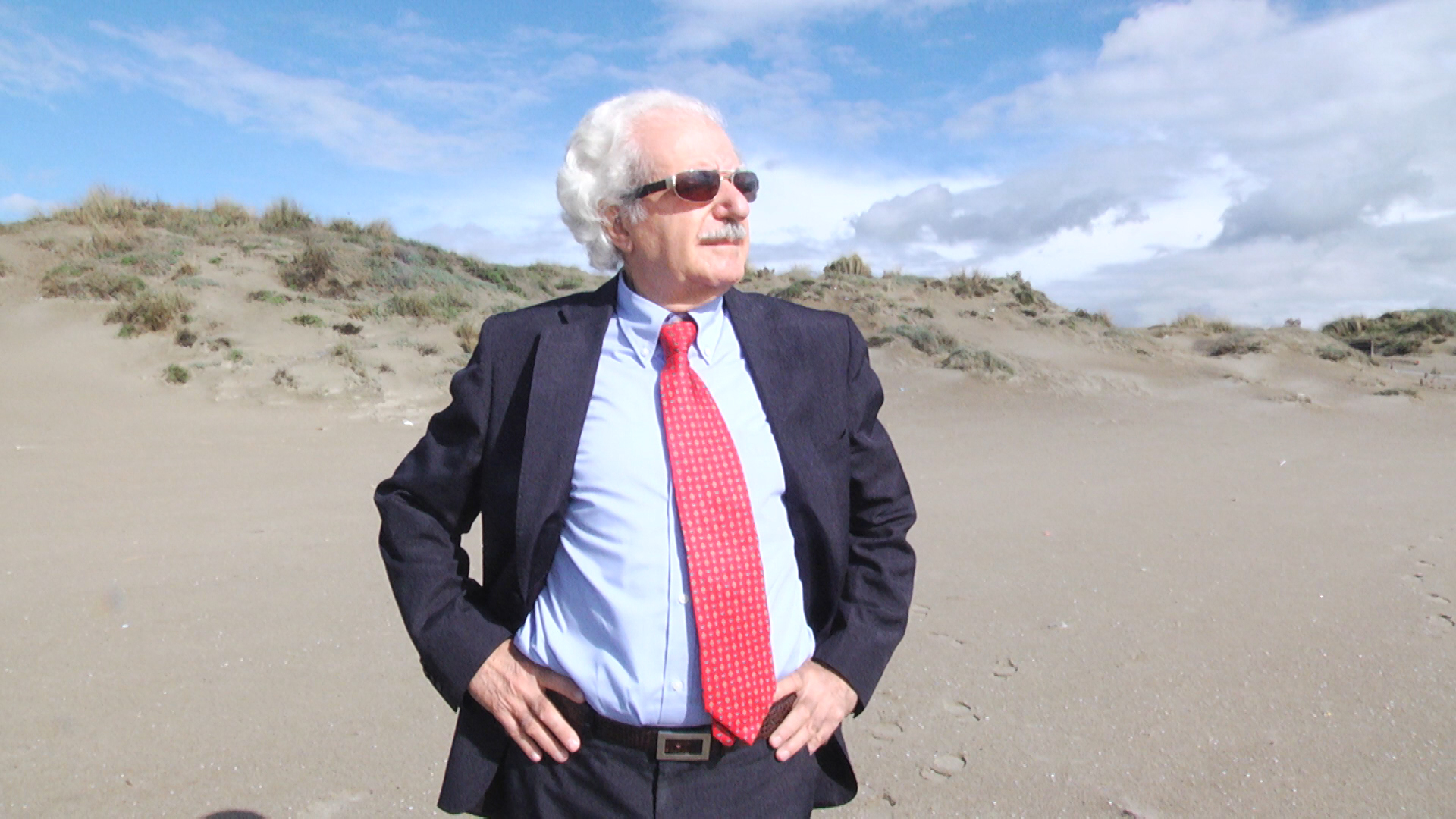
Drama, thriller, by Fabio Del Greco, Italy, 2015.
The story revolves around Vasco, a Roman builder who, at the age of 74, enjoys a life of absolute comfort. His human parable takes a dramatic turn when a mysterious encounter leads him to an ambush. Having survived, but marked by a long coma, Vasco wakes up with a new sensitivity, developing an intimate and poetic bond with nature. This new relationship with the world around him leads him to deeply explore himself, in an internal and external journey. through Italy, the United States and India, in search of a higher meaning and a cure. In parallel, the threat of a planetary cataclysm adds an epic dimension to the story.
I Am Nothing explores universal themes such as time, memory, oblivion and the connection with nature. Fabio Del Greco creates an existential drama full of food for thought. The director skillfully combines different visual materials, mixing archive images with nature photographs and dreamlike visions. This visual experimentation translates into an editing that captures the viewer's attention, guiding him through a cycle of creation and destruction. The sequences that alternate the buildings, Vasco's pride, with Indian landfills and natural landscapes create a hypnotic rhythm, underlining the beauty and fragility of life. Vasco's existential journey is a hymn to transformation and rebirth. The evolution of the protagonist, from unbridled luxury to the rediscovery of purity, represents a powerful metaphor on the meaning of life and the need to reconnect with authentic values. Io sono nulla stands out for its ability to combine introspection and visual experimentation, offering a suggestive and engaging narration. It is a film that invites us to reflect on the human condition, on our relationship with power and nature, and on the possibility of finding ourselves through change. A work that leaves its mark and lends itself to multiple readings.
LANGUAGE: Italian
SUBTITLES: English, Spanish, French, German, Portuguese
The Colonial Mind and the Sanskrit Wound
You sit in a classroom in Calcutta in 1875, reciting Milton and memorizing the dates of English monarchs, and nobody tells you that the room itself is a technology. The benches, the English primers, the teacher’s careful correction of your accent — none of it presents itself as an act of conquest. It presents itself as an opportunity. This is how the most effective forms of power operate: not by announcing themselves as force, but by arriving as gift.
Thomas Babington Macaulay wrote his Minute on Indian Education in February 1835 with a clarity of purpose that embarrasses most modern apologists. He was not subtle. He stated plainly that the goal was to form “a class of persons, Indian in blood and colour, but English in taste, in opinions, in morals, and in intellect.” The document succeeded not because it was secretly implemented but because it was implemented openly, framed as benevolence, received by a colonized class eager for social mobility. By 1857, English-medium institutions proliferated across Bengal, producing exactly what Macaulay envisioned: a stratum of Indians who could administer the empire on its behalf, who found their own classical traditions either inaccessible or embarrassing.
Narendranath Datta — the young man who would later be known as Vivekananda — entered this system and excelled within it with genuine ferocity. He studied at the General Assembly’s Institution in Calcutta under the Scottish missionary William Hastie, absorbed Spencer, Hume, Mill, and Comte, and became fluent in the empiricist tradition at a moment when that tradition was actively being used to delegitimize the metaphysical frameworks of his own civilization. He was not a passive victim of this process. He was, by every measure, one of its most successful products. And this is exactly the wound: not that colonialism excluded him, but that it included him so thoroughly that the exclusion operated from the inside.
The historian Partha Chatterjee, in The Nation and Its Fragments published in 1993, identified the peculiar double bind of the Bengali educated class — the bhadralok — who internalized the epistemological framework of their colonizers while simultaneously being barred from the political and social equality that framework promised. You could master Locke, but you could not vote. You could quote Bentham, but you could not govern. The intellectual tools you were given were precisely calibrated to produce aspiration without access. What this manufactured was not simply frustration but a deeper cognitive fracture: a self that thought in borrowed categories and could not entirely locate itself in them.
What made Vivekananda’s crisis singular was that Sanskrit was still alive in his household. His father Vishwanath Datta was a progressive attorney who recited Persian poetry and read English novels; his mother Bhuvaneshwari Devi kept the devotional rhythms of a Hindu household intact. The child moved between these registers daily, and the tension was not experienced as contradiction but as cohabitation — until the English education sharpened one blade so precisely that it began to cut the other. By the time Vivekananda encountered the question of God’s existence as an undergraduate, he was asking it in a conceptual language — empirical, evidentiary, suspicious of the unverifiable — that the Upanishadic tradition had never required and never feared, because that tradition had approached the same question through an entirely different cognitive architecture. The colonized mind does not simply acquire new tools. It comes to experience its original tools as primitive, as insufficient, as shameful in ways the colonizer never needed to specify.
What Vivekananda would spend the next two decades doing — and this is the thing that cannot be reduced to either nationalism or spirituality — was attempting to reconstruct a mode of knowing that the English classroom had taught him to distrust, using precisely the analytical rigor that classroom had installed in him. He had been made into a particular kind of thinking instrument, and he turned that instrument on the hand that built it.

Ramakrishna and the Unbearable Answer
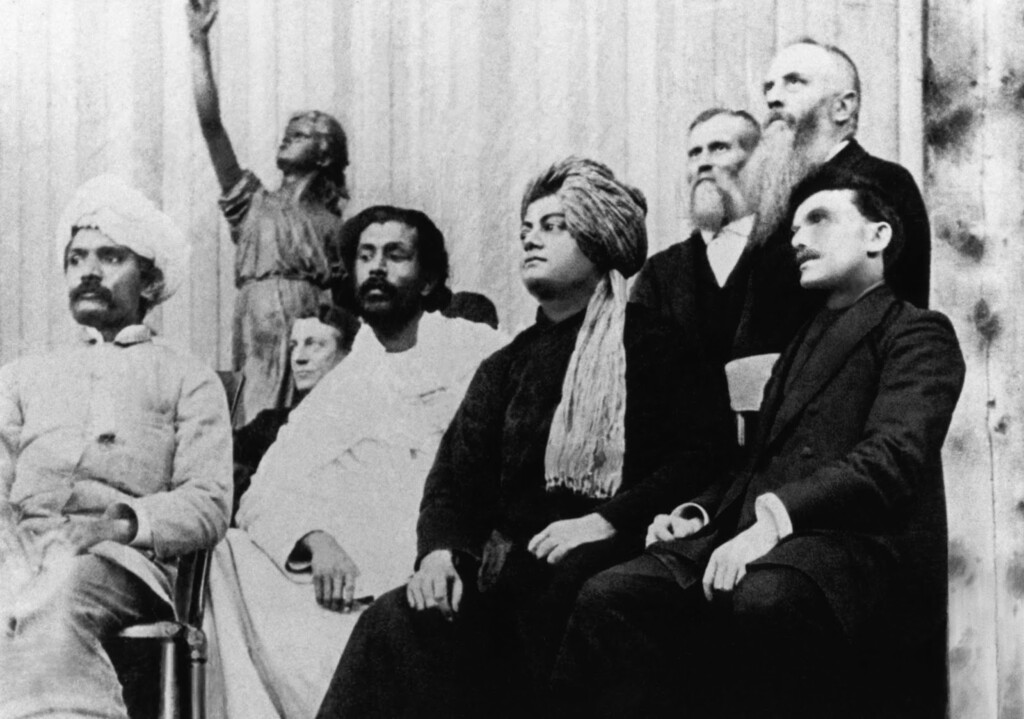
You arrive at the temple with a list of prepared questions. You are nineteen, you have read John Stuart Mill, you believe that the universe owes you a coherent answer if you press hard enough, and you are about to meet a man who cannot give you one — not because he lacks intelligence, but because he operates entirely outside the dimension in which your questions were formed. Ramakrishna Paramahamsa, the priest of Dakshineswar who wept at the feet of a goddess until the stone bled light, who fell into trances mid-sentence and returned minutes later without noticing the interruption, had no university degree, no philosophical system, no apologetic framework. Narendranath Datta, who would later carry Indian thought to the West under a different name, walked into that meeting armed with Brahmo Samaj rationalism and walked out structurally altered in a way he would spend years refusing to admit.
What happened between them was not conversion. Conversion implies that one worldview defeated another cleanly. What actually occurred was something far more unsettling: the young rationalist encountered a category of evidence he had no instrument to measure. William James, writing in 1902 in The Varieties of Religious Experience, identified this as the central epistemological crisis that mystical states produce in empirically trained minds. James argued that such states carry what he called “noetic quality” — they deliver what feels to the experiencer like genuine knowledge, structured and specific, not merely emotional weather. The problem for a mind formed by Mill is not that mystical experience exists, but that it refuses to be filed under hallucination without remainder. Something always escapes the dismissal.
Narendranath reportedly demanded that Ramakrishna prove God’s existence — not metaphorically but demonstrably, the way a scientist demands a repeatable result. Ramakrishna’s response was to touch him, and what followed was described by Narendranath himself as a temporary dissolution of the boundary between his body and the room, a sensation of the floor, the walls, and his own skin becoming a single continuous substance. He rejected it. He went home. He came back. This cycle repeated across months, and what makes it philosophically significant is not the eventual acceptance but the initial refusal — the fierce, trained, honest refusal of an educated mind that knew exactly what it was supposed to think about such experiences.
James noted that the noetic authority of mystical states does not compel assent even in the person who undergoes them, which is precisely what makes them so corrosive to tidy epistemology. They are not arguments. They do not come equipped with premises. They arrive as conclusions without a visible chain of reasoning, and the mind trained to evaluate chains of reasoning is left holding something it cannot verify and cannot entirely discard. The encounter at Dakshineswar was a collision between two forms of knowing that shared no grammar — not a dialogue, because dialogue requires a common metalanguage, and these two men did not have one.
What the young rationalist could not have anticipated was that the illiterate mystic was also watching him, selecting him, with a kind of discriminating intelligence that operated by entirely different criteria. Ramakrishna reportedly told his disciples that Narendranath was something rare — a mind capable of carrying the full weight of non-dual experience without losing the capacity to function in the world. This was not flattery. It was a diagnostic. The mystic was identifying a specific cognitive architecture: the ability to hold contradiction without resolving it prematurely, to live in the tension between what the senses confirm and what direct experience insists upon. Most people collapse that tension in one direction or the other. They either dismiss the experience or abandon the critical faculty. Narendranath, for a long and agonizing stretch of years, refused to do either, which made him miserable, and which was probably the whole point.
The Wandering Years and the Knowledge of Hunger
You arrive somewhere with nothing. No letter of introduction, no caste credential that travels, no institutional seal behind your name. The village does not know what to do with you, and that uncertainty is itself information — raw, unprocessable by any library. This is where Narendranath Datta, who had taken the monastic name Vivekananda after the death of his teacher Ramakrishna in 1886, began to walk. Not metaphorically. Literally across the subcontinent, on foot and by third-class rail when someone gave him the fare, sleeping in dharamshalas and on temple floors, eating when fed and not eating when not. For seven years, between 1886 and 1893, he moved through India as a body without institutional shelter — and that condition, usually described as spiritual apprenticeship, was in fact a brutal education in how power organizes space.
Pierre Bourdieu, writing in The Logic of Practice in 1980, argued that a social field is not merely a backdrop against which agents perform — it is a structured set of positions that actively shapes what can be perceived, said, or done within it. The field exerts pressure on every body that enters it, and crucially, that pressure is felt differently depending on whether the body carries capital — economic, cultural, symbolic — or arrives stripped of it. Vivekananda arrived stripped. What this meant, concretely, was that the same country revealed itself to him as multiple incompatible countries layered over one another, each visible only from a particular position of deprivation. A man with credentials moves through India and sees temples, philosophy, hospitality. A man without them moves through India and sees the machinery underneath.
What the machinery looked like: in Rajputana he encountered princely courts where feudal patronage had calcified into performance, where the intellectual traditions were decorative objects maintained to flatter rulers. In Tamil Nadu he witnessed the lived architecture of untouchability — not as a social problem described from outside but as a daily regulation of bodies in space, determining who could enter which street, which well, which threshold. In Bengal he had already seen famine’s arithmetic, the structural famines of the 1870s and 1880s that killed between six and ten million people under a colonial administration that, as Mike Davis documented in Late Victorian Holocausts, continued exporting grain from starving provinces to meet trade obligations. Vivekananda did not observe these facts as a researcher. He was hungry in the proximity of them.
Hunger is epistemologically specific. It does not produce romanticism. It produces a kind of lateral attention — an inability to look away from the organizational facts of who eats and who does not, who commands and who absorbs — because those facts are no longer abstract when they regulate your own body. The philosophical formation Vivekananda had received under Ramakrishna had been intense and interior, a world of states, visions, and metaphysical argument conducted largely within Bengal’s educated classes. The wandering years cracked that formation open and forced it against something harder. He arrived in Kanyakumari, the southernmost tip of the subcontinent, in late 1892, reportedly swimming to a rock offshore and sitting there for three days. Whatever interior event occurred on that rock, it was not separable from seven years of walking through a country that had shown him, with great precision, what it had done to its own people and what had been done to it from outside.
This is the knowledge that Bourdieu’s framework names but cannot fully contain, because Bourdieu is interested in how fields reproduce themselves — how agents internalize their position and act accordingly. Vivekananda’s trajectory was toward something that refused internalization: a refusal to accept the terms of any single field as final, whether the field of colonial modernity with its hierarchy of civilizations, or the field of Hindu orthodoxy with its hierarchy of castes and texts. Both fields had pressed against him. Neither had produced capitulation. What they produced instead was a specific kind of anger — not personal, not reactive, but analytical, searching for a frame large enough to hold what he had seen.
Chicago 1893: The Applause Trap
You are standing in the Hall of Columbus on the morning of September 11, 1893, and the man who walks to the podium is thirty years old, wearing a saffron robe and a turban, and he has never spoken before an audience of this scale in his life. He opens his mouth and addresses seven thousand people as sisters and brothers, and the hall erupts for two full minutes before he has said a single consequential thing. That applause is the most dangerous thing that will ever happen to him.
The Parliament of the World’s Religions was not a neutral stage. It was organized by a committee of Protestant ministers in Chicago who believed, with total sincerity, that gathering the world’s faiths under one roof would demonstrate the evolutionary superiority of liberal Christianity — the mature religion that had, in their framework, arrived at the capacity for tolerance, while others were still climbing. John Henry Barrows, the Presbyterian clergyman who chaired the event, wrote afterward that the Parliament had shown Christianity to be “the crown of all religions.” The applause for Vivekananda was not a disruption of this framework. It was its most sophisticated expression.
Edward Said‘s argument in Orientalism, published in 1978, is not simply that the West misrepresented the East. It is that representation itself — even admiring representation — is an act of power, because it positions one party as the knower and the other as the known. The Western audience that rose to its feet in Columbus Hall was not receiving a challenge. It was receiving a confirmation: here was the spiritual East, exotic and ancient and warm, offering its wisdom freely to the rational West that had the generosity to listen. Every word Vivekananda spoke about the universality of the divine was heard through this filter, which transformed a radical non-dualist critique of Christian exclusivism into evidence that all paths lead to the same tolerant, liberal destination — which happened to be the destination the audience had already chosen.
What makes this machinery so difficult to dismantle is that it produces genuine pleasure on both sides. Vivekananda was not naive. He understood the room. His letters from Chicago describe calculating exactly how to present Vedanta in terms an American Protestant could absorb, choosing illustrations from the Bible, softening the harder edges of Advaita’s assault on the individual self. He was a brilliant translator. But translation into the master’s conceptual vocabulary is never a neutral act — it always costs something in the crossing. The version of Hindu philosophy that became famous in 1893 was already a negotiated artifact, shaped partly by Vivekananda’s own genius and partly by the gravitational pull of what a Chicago audience could metabolize without discomfort.
The numbers are instructive. Vivekananda gave seventeen addresses over the seventeen days of the Parliament. American newspapers reproduced fragments, mostly the ones that emphasized unity, brotherhood, and the harmony of religions. The addresses where he attacked Christian missionary activity in India, where he described the colonial hunger beneath the civilizing mission, received almost no coverage. The press was not suppressing him deliberately. It was simply selecting the Vivekananda that fitted the available category: the noble Eastern sage come to enrich the West’s spiritual pantry. The confrontational Vivekananda, the one who had watched his country’s people starved and humiliated in the name of Christian charity, was invisible not because he was silent but because the audience had no category in which to place him.
This is the trap that fame always builds for the voice it chooses to amplify. Visibility and legibility are not the same thing. To be seen by a million people through a distorting lens is not influence — it is a form of controlled disappearance. The man in the saffron robe became, in the American imagination, a symbol of Eastern spirituality’s compatibility with Western progress, which is almost the precise opposite of what he had crossed an ocean to argue.
A vision curated by a filmmaker, not an algorithm
In this video I explain our vision
Vedanta as a Philosophical Weapon

You are sitting in a lecture hall in New York, the year is 1895, and a man in ochre robes is telling you — a Gilded Age American raised on Protestant self-reliance and social Darwinism — that you are already divine. Not metaphorically. Not as spiritual encouragement. Literally, structurally, ontologically divine, and your failure to act from that recognition is the only sin that exists.
The shock of that claim lands differently depending on what you carry into the room. If you arrived believing in original sin, the architecture of your guilt just collapsed. If you arrived believing that some human beings are constitutionally inferior — by race, by birth, by caste — the architecture of your social order just collapsed alongside it. Vivekananda was not offering a new religion. He was detonating the metaphysical foundations on which two entirely different systems of human hierarchy rested, simultaneously, using the same philosophical lever.
That lever was his reading of Advaita Vedanta, the non-dualist tradition most rigorously formulated by Adi Shankaracharya in the eighth century, which holds that the individual self and ultimate reality are not two separate things that might one day be united, but have never been separate at all. The apparent multiplicity of the world — persons, objects, distinctions of rank and kind — belongs to a realm of superimposition, maya, a functional veil rather than an ontological truth. Vivekananda absorbed this framework through his years with Ramakrishna and then did something that would have scandalized many traditional Advaitins: he socialized it. In Raja Yoga, published in 1896 following his Columbia University lectures, and in Jnana Yoga, compiled in 1899, he argued that if every self is identical with Brahman, then every act of treating another human being as lesser is not merely morally wrong but philosophically incoherent — a category error performed with violence.
This is where the double-edged quality of his thought becomes impossible to ignore. Western audiences heard him affirm the unity of all humanity and assumed he was ratifying their liberal humanism, perhaps in exotic dress. He was not. He was indicting their materialism as a spiritual pathology, arguing in the Jnana Yoga lectures that the West’s reduction of the human being to economic function and sensory appetite was not progress but a particularly sophisticated form of bondage, one made more dangerous by its comfort. He told audiences in Detroit and London that the civilization most proud of its advancement was the one most thoroughly enslaved to matter.
Meanwhile, back in India, those who expected him to simply sanctify Hindu tradition found him equally uncomfortable. The caste system, in his reading of Advaita, was not a divine arrangement but a grotesque contradiction — a society claiming Vedantic inheritance while systematically denying the divinity of millions born into lower jātis. He said this plainly and repeatedly, and the Brahmin establishment heard it as an attack, because it was. He wrote to a disciple in 1894 that a nation which grinds the poor under the name of religion is not following religion at all but worshipping the devil. The non-dualism was not mystical retreat from politics. It was the most direct possible critique of a social order built on the fiction that some souls are closer to Brahman than others.
What made the philosophical move genuinely radical — and genuinely disruptive to anyone who tried to claim him — was its refusal to offer a compensatory identity to replace the ones it dissolved. Western materialism could not be cured by Eastern spirituality imported as a lifestyle. Hindu casteism could not be redeemed by nationalist pride. The framework he was working inside demanded that you give up the hierarchy, not rebrand it. The diagnosis was structural, and every tradition in the room was implicated, which is why every tradition found reasons to misread him, selectively quote him, or simply look away from the parts that cut closest to the bone.
The Contradiction He Never Resolved
You have heard the sermon a hundred times, in different rooms, under different names: that the divine lives in every human being without exception, that no soul is lesser, that the light burning in the peasant and the light burning in the priest are the same fire. You have nodded. You have perhaps felt something shift in your chest. And then the sermon ends, and the building it was delivered in reasserts itself — its hierarchies, its gatekeepers, its rules about who may enter which room and in what posture.
Swami Vivekananda preached exactly this universalism with a ferocity that made Victorian England uncomfortable and colonial India briefly unrecognizable to itself. His addresses at the Parliament of the World’s Religions in Chicago in 1893 drew on the Advaita Vedanta tradition to insist that all paths lead to the same truth, that human consciousness is identical in its deepest nature with the divine ground of being. The audience, expecting Oriental mysticism they could patronize, received instead a philosophical challenge they could barely parse. He was not offering a supplement to Western thought. He was undercutting its foundations.
And yet. In 1897, returning to India, he founded the Ramakrishna Math and Mission — a monastic institution organized around precisely the hierarchical structures that institutionalized religion had always used to manage, contain, and ultimately domesticate spiritual energy. Novices. Senior monks. Chains of authority. Rules of conduct. The same architecture that had enclosed every other attempt to keep transcendence portable. The organization did remarkable humanitarian work — schools, hospitals, famine relief — but the frame holding that work was not the radical horizontality his theology implied. It was a vertical institution in horizontal clothing.
Simone de Beauvoir, writing in The Ethics of Ambiguity in 1947, described bad faith not as simple hypocrisy but as something subtler and more structural: the refusal to acknowledge the full weight of one’s own freedom, the tendency to take refuge in roles, systems, and fixed identities precisely to avoid confronting the open and unresolved nature of existence. Bad faith, in her framing, is not a personal failing — it is a gravitational pull that operates on everyone, including those most committed to liberation. The serious person, as she called them, is the one who invests absolute value in a cause, a system, a project, and in doing so forecloses the very ambiguity that makes genuine ethical life possible. Vivekananda was, by almost any measure, a serious person in this precise sense.
The question of women makes the structural blindness visible with almost painful clarity. He wrote and spoke of women’s spiritual equality with a directness unusual for his time and place, insisting that India could not rise while half its population remained in subjugation. He envisioned a women’s Math alongside the men’s. He corresponded with women disciples — Margaret Noble, who became Sister Nivedita, among them — with an intellectual respect that was not merely performative. But the institutional structure he built remained male-dominated, and the women’s monastic order he imagined took decades after his death in 1902 to materialize in any formal sense, inheriting the same organizational logic he had established for men. The vision preceded the structure. The structure outlasted the vision.
What this reveals is not a flaw unique to Vivekananda but a pattern embedded in the relationship between prophetic thought and institutional form. A theology that names every human being as divine is theologically incompatible with any structure that makes some human beings more authoritative than others in matters of the spirit. The moment you appoint a head monk, you have introduced a contradiction that no amount of philosophical sophistication can dissolve from within the institution itself. The walls do not announce themselves as walls. They present as floors — as the necessary ground on which the work of liberation is supposed to stand.
Whether the man saw the floor and chose it anyway, or never quite looked down at what was holding him up, is a question his writings do not answer cleanly.
What the Legacy Consumed
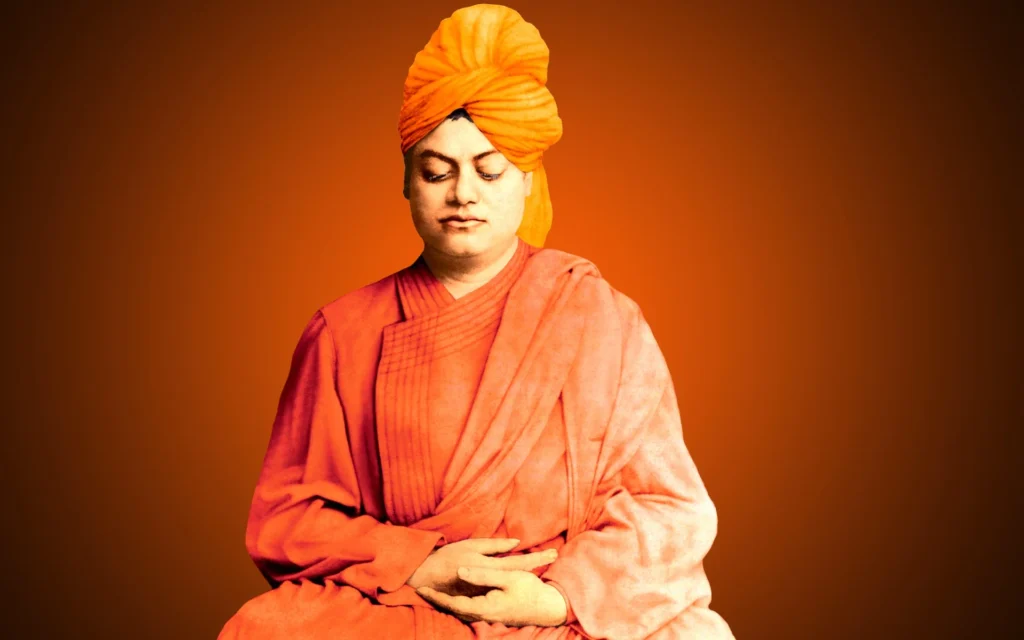
You are standing in front of a government building in Kolkata — a mural, freshly painted, ten feet tall. The face is serene, the gaze upward, the ochre robe flowing with a kind of theatrical perfection no human being ever quite achieves in life. Below the image, a quote has been selected, cleaned of its original grammar, and printed in a font designed to suggest eternity. Nothing about it unsettles. Everything about it reassures. That is precisely the problem.
Vivekananda died on the fourth of July, 1902, at Belur Math, aged thirty-nine. He had predicted his own early death with the matter-of-fact tone of someone who had already taken his own measure and found the measurement sufficient. What he could not have predicted — what no thinker ever fully anticipates — is the specific quality of silence that institutions impose after death. Not erasure. Something more surgical.
Roland Barthes, writing in Mythologies in 1957, identified the essential mechanism with the precision of a diagnostician. Myth, he argued, does not destroy history. It does not deny that something happened or that someone lived. It empties the event of its historical substance — its contradictions, its dirt, its unresolved tensions — and replaces the emptied form with a meaning that serves the present. The sign is hollowed out and refilled. What remains looks exactly like the original. It carries the same name. It occupies the same cultural space. But it has been made safe.
By the 1920s, the Hindu nationalist movement had already begun recruiting Vivekananda’s image for a project he would have recognized with deep discomfort. His insistence that Vedanta was a universal philosophy — structurally incompatible with ethnic or religious exclusion — was quietly set aside. What remained was the posture: the strength, the assertion of Hindu pride against colonial condescension, the demand that India stop apologizing for itself. These were real elements of what he had said. But extracted from the philosophical framework that gave them meaning and constraint, they became something else entirely. They became available.
After 1947, the newly constituted Indian state performed a second operation. Vivekananda was nationalized — absorbed into the official pantheon of founding spirits alongside figures whose politics were often sharply opposed to his own. His portrait entered government offices. His birthday, January 12th, was declared National Youth Day in 1985 by Rajiv Gandhi’s administration, an act of commemoration so complete it rendered him inert. The radical Vedantin who had told the Parliament of the World’s Religions in Chicago in 1893 that all religions were equally true — a statement that scandalized orthodox Hindu opinion at home — was now being honored by the very institutional orthodoxies he had spent his life unsettling.
What myth consumes first is always the danger. The ideas Vivekananda held that made powerful people nervous — his contempt for caste as practiced, his argument that cooking food for a starving man was a more genuine act of worship than any temple ritual, his refusal to treat national identity as spiritually meaningful — these are not suppressed in any crude sense. They exist in his collected works, eleven volumes published by the Advaita Ashrama, fully accessible to anyone. But they exist there the way a tiger exists in a painting: recognizable in every detail, incapable of doing what a tiger does.
The institutions built in his name — the Ramakrishna Mission, established in 1897, now operating hospitals, schools, and relief organizations across dozens of countries — have done genuine and measurable good in the world. That is not in question. What is in question is the relationship between institutional survival and intellectual fidelity, because these two things have never, in the entire history of human thought, remained aligned without effort, conflict, and cost.
The dangerous ideas of any thinker are dangerous precisely because they have no natural constituency — because the people who would benefit from them most have not yet been organized, and the people who control the organization have the most to lose from them. So the question is not whether Vivekananda’s thought survived him. The question is which parts of it were allowed to, and who exactly made that decision.
🌿 Paths of the Spirit: Mystics, Seekers, and Sacred Thought
Swami Vivekananda’s life and teachings stand at the crossroads of Eastern spirituality, Western philosophy, and the universal search for meaning. These related articles trace the deeper currents of mysticism, consciousness, and spiritual transformation that echo across cultures and centuries.
Jiddu Krishnamurti: the Man Who Refused to Be God
Jiddu Krishnamurti renounced the messianic role thrust upon him by the Theosophical Society, choosing instead to teach a radical, institution-free path to self-knowledge. Like Vivekananda, he confronted the tension between organized religion and genuine inner awakening, insisting that truth could not be handed down but only discovered through direct experience. His life raises profound questions about authority, freedom, and the nature of spiritual liberation.
GO TO THE SELECTION: Jiddu Krishnamurti: the Man Who Refused to Be God
The Theosophical Society: History, Principles and Influence on Western Culture
The Theosophical Society, founded in 1875, created a unique space where Eastern and Western esoteric traditions could meet and transform one another. Vivekananda’s landmark appearance at the 1893 Parliament of Religions unfolded within this same climate of cross-cultural spiritual curiosity that Theosophy had helped cultivate. Understanding the Society’s history illuminates the broader world that received Vivekananda’s message with such enthusiasm.
GO TO THE SELECTION: The Theosophical Society: History, Principles and Influence on Western Culture
Meister Eckhart: Life and Mystical Philosophy
Meister Eckhart‘s mystical philosophy, rooted in the Christian tradition, resonates deeply with the Vedantic thought that Vivekananda carried to the West. Both thinkers explored the dissolution of the ego into an ultimate, formless ground of being—whether called Godhead or Brahman. Their parallel insights reveal how mystical experience transcends doctrinal boundaries and touches a shared human depth.
GO TO THE SELECTION: Meister Eckhart: Life and Mystical Philosophy
Universal Consciousness
The concept of Universal Consciousness sits at the very heart of Vivekananda’s Vedanta philosophy, which taught that individual awareness is ultimately one with the infinite divine ground. This article explores how that idea has traveled through philosophy, spirituality, and contemporary thought, finding new expressions in modern culture. It offers an essential companion for anyone seeking to understand the lasting impact of Vivekananda’s vision on the global conversation about mind and reality.
GO TO THE SELECTION: Universal Consciousness
Discover the Cinema of the Spirit on Indiecinema
If these themes of inner transformation, mystical search, and the quest for meaning resonate with you, Indiecinema’s streaming platform offers a curated selection of independent and documentary films that explore spirituality, consciousness, and the deeper dimensions of human experience. Dive into a cinema that dares to ask the questions that matter most.
👉 EXPLORE THE CATALOG: Watch Indie Films in Streaming
A vision curated by a filmmaker, not an algorithm
In this video I explain our vision

