
The Morning You Decided the World Was Wrong
You wake up one morning and the whole arrangement feels wrong. Not catastrophically wrong, not in any way you could explain to the person sleeping next to you or to your employer or to the bank that holds your mortgage. Just wrong in the way a sentence is wrong when every word is technically correct but the meaning has collapsed somewhere between the writing and the reading. The coffee is hot. The news is on. Someone is explaining something urgent about something that will be forgotten by Thursday. And you sit there with this absolutely unreasonable certainty that you were not built for this, that somewhere between childhood and now a substitution was made, that the life you are living belongs to a version of you that agreed to terms you never actually read.

This feeling has a history. That is the first thing worth understanding. What you experienced that morning — that sudden, almost physical revulsion at the gap between your inner life and the world’s demands — is not a symptom of ingratitude or immaturity or the particular neurosis of people who read too much. It is one of the most consequential intellectual impulses in the history of Western thought. It built a literary tradition. It reshaped how an entire civilization conceived of the individual. It arrived, with unusual force and unusual articulation, in New England in the 1830s, carried by a group of thinkers who were, by most external measures, doing perfectly fine and who nonetheless woke up with exactly that feeling and decided to take it seriously.
What they built from it was Transcendentalism, and it remains, despite the academic varnish that has been applied to it over nearly two centuries, one of the most viscerally alive philosophical movements America has ever produced. Not because it solved anything. Not because it offered a coherent system or a program of reform or a set of instructions. But because it started from the inside. It started from the nerve-level conviction that something essential in the human being exceeds every category society has prepared for it, and that this excess is not a problem to be managed but a truth to be followed.
Ralph Waldo Emerson, who became the movement’s gravitational center, wrote in his journals in 1832 that he could no longer administer the Lord’s Supper with any honesty. He was twenty-nine years old, recently widowed, and apparently successful by every available measure. He resigned his ministry anyway. Not in anger, not in dramatic protest, but with the quiet, devastating certainty of someone who has simply stopped being able to pretend. What he walked out of that day was not just a church. It was the entire architecture of inherited belief, the idea that meaning could be delivered to you from outside, pre-assembled, requiring only your compliance. He walked toward something he could not yet name, which is exactly the condition of everyone who has ever sat at a kitchen table on an ordinary morning and felt the world tilt.
The feeling precedes the philosophy. This matters enormously. Transcendentalism was not a doctrine that people adopted after being persuaded by arguments. It was a recognition that followed an experience, an attempt to think rigorously about something that had already happened in the body, in the chest, in the sudden strange silence of a mind refusing its own routine. Henry David Thoreau, who would later spend two years and two months living beside Walden Pond not as an experiment in deprivation but as an insistence on reality, described it as the terror of discovering that most of what passes for life is simply the accumulated weight of what other people have decided life should be.
That terror is the emotional DNA of the entire movement. Before the essays, before the lectures, before the journals that historians would spend generations annotating, there was just that morning. The one where the world looked suddenly, irreversibly wrong.
Eve of the Irises

Documentary, by Isabel Russinova, Rodolfo Martinelli Carraresi, Italy, 2026
Eva of the Irises is a historical biographical docu-film about the scientist Eva Mameli Calvino, a botanist and pioneer of environmentalism in Italy, mother of the writer Italo, born in Sassari in 1886. The film, based on a multidisciplinary approach that combines several genres—such as theatre, documentary, cinema, and research—moves between memories, reflections on life, as well as the goals and missions the scholar still wished to achieve.
The multifaceted artistic sensibility of Isabel Russinova is expressed across many fields, from writing to acting, from directing to civic engagement, and finds one of its highest expressions in the docu-film Eva of the Irises, created with Rodolfo Martinelli Carraresi. The film blends scientific rigor and poetic refinement to portray the extraordinary figure of the botanist Eva Mameli Calvino, mother of Italo Calvino but above all an independent protagonist of 20th-century scientific culture. It is told through a combination of archival materials, interviews, and evocative staging capable of elegantly and profoundly conveying her intense human and professional story.
LANGUAGE: Italian
SUBTITLES: English, Spanish, French, Portuguese
New England, 1836: A Room Full of Dissatisfied Men
The meeting happens in a parlor, not a lecture hall. There is no podium, no institutional sanction, no curriculum. There are men — and soon, crucially, women — who cannot sit still inside the answers they have been given. They are not rebels in any theatrical sense. Several of them are ordained ministers. Some have just returned from Germany, where they encountered Kant and Schelling and felt something crack open inside their previous certainty. They come back to Massachusetts and find that the old containers no longer hold.
This is Concord, 1836, and the dissatisfaction in that room is not a mood. It is a philosophical crisis wearing the clothes of a theological one.
The Transcendental Club — they called it that only half-seriously, and their enemies called it that with contempt — begins meeting informally that same year, gathering figures like Frederic Henry Hedge, George Ripley, and Amos Bronson Alcott around a shared feeling more than a shared doctrine. What unites them is not what they believe but what they can no longer believe: the thin, cautious rationalism of Unitarian orthodoxy, which had itself been a revolt against Calvinist severity but had settled into something equally suffocating — a religion of decorum, of measured sentiment, of God as a well-behaved hypothesis. They want something that burns. They are not getting it from Andrews Norton, the so-called Unitarian Pope of Harvard Divinity School, who treats religious feeling the way a banker treats loose cash: with suspicion.
And then, in September of that same year, a thirty-three-year-old former minister publishes a small book, barely ninety pages, that almost nobody reads immediately and that changes everything slowly. Nature is not a manifesto. It does not argue in the way arguments are supposed to argue. It opens with a question — why should we not have a poetry and philosophy of insight and not of tradition? — and never fully closes it. Emerson has already resigned his pastorate at Boston’s Second Church four years earlier, unable to continue administering communion as a ritual he found hollow. The book is what happens when someone refuses the ritual and goes looking for the original fire.
What Emerson is pushing against has a specific philosophical architecture. John Locke‘s empiricism — the idea that the mind is a blank slate, that all knowledge derives from sensory experience, that the universe reveals itself only through patient accumulation of observable fact — had become by the early nineteenth century the commonsense epistemology of educated Anglo-American culture. It was tidy. It was useful. It was also, to Emerson and the circle forming around him, spiritually catastrophic. Because if the mind is only a receptor, only a surface upon which experience writes its lessons, then there is no inner light, no self-generating intuition, no access to truth that does not pass through the gate of the measurable. God becomes, in that framework, a logical inference. And a God who is merely inferred is not a God who can save anyone from anything.
They turn instead to what they are reading from across the Atlantic — not just Kant’s insistence that the mind actively structures experience rather than passively receiving it, but Coleridge’s distinction between Reason and Understanding, the former being the faculty of spiritual and intuitive truth, the latter being merely the analytical, calculating intellect. Samuel Taylor Coleridge publishes Aids to Reflection in 1825, and it lands in New England like a translation from a forgotten language that these people realize they have always spoken. Victor Cousin’s French eclecticism, Carlyle’s thunder from Scotland, the Sanskrit texts filtering in through Orientalist scholarship — all of it arrives into a room full of people who needed permission to trust what they already felt.
The publication of Nature is that permission, given in prose.

Emerson’s Wager and the Self That Contains Everything
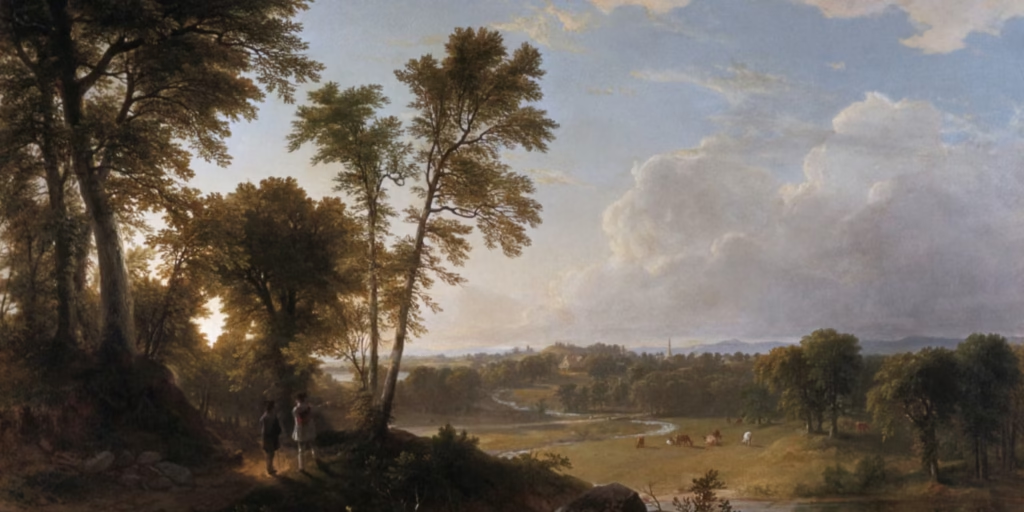
There is a moment when you stop repeating what you were taught and something underneath begins to speak. Not loudly. Not with the grammar of doctrine. It arrives the way light shifts in a room when a cloud passes — the same room, but suddenly you see the furniture differently, the walls, the distances between things. Emerson had that moment not as a mystic revelation but as an intellectual crisis that nearly destroyed his career, and what he did with it was stake everything on the possibility that the individual human consciousness is not a receiver of divine truth but its source.
The Divinity School Address of 1838 was not a polite disagreement. When he stood before the graduating class at Harvard and told them that historical Christianity had mistaken the man Jesus for the principle Jesus embodied — that to worship the person was to miss entirely the living fire he was pointing toward — the institution reacted as institutions always do when someone names the mechanism behind the curtain. He was not invited back to speak at Harvard for nearly thirty years. The polite word for what happened is estrangement. The accurate word is exile.
What Emerson was wagering, against everything his culture had arranged to prevent such a bet, is that the soul is not individual in the diminished sense we mean when we say individual today — small, separate, defended. He called it the Over-Soul, and the concept arrives in the 1841 Essays with the force of something recovered rather than invented. His argument is that what you call your deepest intuition is not yours alone. It is the place where the personal dissolves into something that has always been speaking through human beings and will continue to speak long after you have finished being afraid of what it is saying. William James, who came after him and built an entire psychology around the varieties of religious experience, recognized in Emerson not a theologian but a diagnostician of something prior to theology — the raw experience before the institution arrives to name and contain it.
Self-reliance, which has been so thoroughly domesticated by American individualism that it now reads like an advertisement for personal branding, was in Emerson’s hands something far more dangerous. It was not permission to do what you want. It was an obligation to refuse what you don’t actually believe, even when what you don’t believe is the social architecture holding you in place. The conformity he was diagnosing in 1841 — the man who adjusts his expressed opinions to the room, who remembers what he said last week and feels obligated to repeat it, who mistakes consistency for integrity — is not a historical curiosity. You have watched this happen at a dinner table. You have done it yourself.
Ralph Waldo Emerson understood, with the precision of someone who had genuinely felt it, that most human beings experience their own deepest perceptions as suspect. Not because the perceptions are wrong. Because they arrive without institutional endorsement. Because no one else in the room seems to be having them. And so the person quietly folds the perception away, files it under private strangeness, and continues with the conversation. He called this a betrayal. Not of some abstract ideal but of the only thing that makes thought possible in the first place — the willingness to trust what you actually see.
The provocation that got him exiled from polite Cambridge still makes certain rooms uncomfortable. Not because it is extreme. Because it is precise. The discomfort is not intellectual. It is the specific discomfort of someone who has just been seen doing something they hoped no one noticed, and the thing they were doing was choosing the opinion that costs them least.
The Lost Poet

Drama, by Fabio Del Greco, Italy, 2024.
Dante Mezzadri wants to see an old friend, nicknamed the Iguana, whom he has lost sight of for many years, and who has managed to turn their shared youthful passion for poetry into a job, becoming a famous writer and poet. The man escapes from his bourgeois life and his wife to live homeless on the Roman coast, printing and trying to sell his poetry collections. At night he sleeps in a park of old carnival floats, inside a papier-mâché tank, and waits for the opportunity to meet his old friend, who however never shows up for appointments in the places they frequented when they were young, now in ruins. Dante's poetry books do not interest anyone and to support himself he is forced to "change product": he starts selling the infamous "cannibal pill" on behalf of young drug dealers, a new drug that sells like hot cakes and causes sensory and consumerist ecstasy. However, he realizes that this powerful drug is very dangerous for those who take it, he comes into conflict with his ethical conscience and throws all the pills into the sea. However, the dealers want to collect their money.
Shot over a period of 2 years, the film is a reflection on the cultural and artistic rubble of the society in which the protagonist lives, in an increasingly mechanized, consumerist and arid world. Dante Mezzadri is yet another human being who has renounced his inspiration and his creativity, but unlike many he is not willing to give his life to a system that distances him from his true identity. The physical world around him, however, seems constructed in such a way that it seems impossible to escape from this "invisible cage". The enthusiasm of the people he meets is ignited only by sensory gratification, by unreal visions of personal affirmation and success, by "metaverses" that offer an escape into an illusory and destructive reality. The poet's house on the coast, where he met with his friends as a young man, is just a pile of abandoned rubble. What happened to all those who wanted to become poets and ended up becoming something else? Are there internal forces with which that house can be "rebuilt"?
LANGUAGE: Italian
SUBTITLES: English, Spanish, French, German, Portuguese
Thoreau’s Two Years and the Violence of Simplicity
On the morning of July 4, 1845, Henry David Thoreau drove the first stake into the ground at the edge of Walden Pond, and if you look at that date carefully, you understand immediately that nothing about what followed was innocent. Independence Day. The choice was not accidental, and Thoreau was not a man who made accidental choices.
You probably know the story in its sanitized version: the young philosopher retreats to the woods, builds a small cabin, grows beans, watches the seasons, writes a masterpiece. What that version erases is the violence embedded in the gesture. Because what Thoreau was doing was not escaping civilization. He was performing a surgical amputation of the economic self, cutting away every layer of identity that had been constructed through consumption, habit, and the slow accumulation of social obligation. And surgery, even when chosen, leaves scars.
The cabin cost him twenty-eight dollars and twelve and a half cents to build. He recorded the expense to the penny, and that precision is itself a kind of argument. He was not fleeing accounting. He was turning accounting into a weapon against the life that accounting normally produces. Ralph Waldo Emerson, on whose land the cabin sat, had already theorized in “Self-Reliance” in 1841 that society everywhere is in conspiracy against the manhood of every one of its members. Thoreau took that sentence literally, physically, and went to live its consequences.
But here is what the myth of Walden consistently refuses to examine. Think of a man you may have known, or perhaps recognized partially in yourself, who one day abandons the apartment, the salary, the relationship, the routine, and moves somewhere stripped down and raw — the countryside, a van, a rented room with nothing on the walls. In the first weeks there is a sensation that resembles freedom so closely that the two become indistinguishable. He sleeps better. He reads. He notices the quality of afternoon light. And then, gradually, almost imperceptibly, the performance begins. He starts to curate his simplicity. He arranges the bare room with the same care he once arranged the furnished apartment. He talks about his choice at every opportunity. The absence of things becomes a thing. The renunciation becomes a possession, arguably the heaviest one he has ever carried.
Thoreau was not immune to this trap, and “Walden,” published in 1854 after seven years of revision, is in places more a literary construction than a document of raw experience. He compressed two years into one for narrative coherence. He walked to his mother’s house in Concord for meals often enough that historians have gently noted the fact. The solitude was real but not total, the poverty chosen but not absolute. This does not diminish what he wrote. It complicates it, which is more interesting.
What Walden actually excavates, beneath its pastoral surface, is the question of whether any act of simplification can be fully separated from the social theater it claims to reject. The sociologist Thorstein Veblen would argue forty-four years later, in “The Theory of the Leisure Class” in 1899, that even conspicuous abstention from consumption functions as a status signal, that the man who ostentatiously refuses luxury is still playing a game of social distinction, merely inverting its rules. The monk and the minimalist are both performing for an audience, even when the audience is only the self.
Thoreau sensed this danger. There is a passage in “Walden” where he writes that a man is rich in proportion to the number of things he can afford to let alone. The sentence is beautiful and it is also slightly self-congratulatory in a way that he seems to know and cannot quite help. He is proud of his renunciation. And the moment renunciation becomes a source of pride, you are no longer free of the economy you fled. You have simply opened a new account in a different currency.
The Body in the Woods: Nature as Epistemology, Not Metaphor
You have walked into a forest before thinking about it. Not decided to walk, not consulted anything — simply found yourself already moving between trees, your breath adjusting to the damp air, your feet reading the uneven ground before your mind registered the irregularity. Something in you was already knowing before you named what you knew. This is not a poetic observation. For the Transcendentalists, it was the central epistemological claim of their entire project.
Emerson wrote in Nature in 1836 that “the mind is a part of the nature of things,” not a separate apparatus peering at the world through windows of sense and reason, but a participant in the same tissue as bark, stone, and moving water. This was not pantheism dressed in New England clothes. It was a direct assault on the Lockean inheritance that had organized American intellectual life — the notion that the mind receives impressions passively from an exterior world, accumulates them, and constructs knowledge upward from sensation toward abstraction. Emerson inverted the hierarchy. The abstraction was the problem. The sensation was already the arrival.
Thoreau took this literally. When he moved to Walden Pond in July 1845, spending two years and two months in deliberate residence, he was not performing a retreat from civilization as theater. He was conducting an experiment in what the body could learn when institutional mediation was stripped away. He measured the pond’s depth with a fishing line. He tracked the dates of ice formation across multiple winters. He mapped the shoreline on foot. These were not romantic gestures. They were epistemological acts — claims that direct physical contact with place generates a form of knowing that no library, no sermon, no inherited text could replicate or replace. The body moving through physical space was, in his hands, a philosophical instrument as precise as any Cartesian method, and more honest, because it could not pretend to have escaped its own location.
What they were doing, without the vocabulary that would come later, was phenomenology. Edmund Husserl would spend the first decades of the twentieth century dismantling the Cartesian split between the knowing subject and the known world, arguing in Ideas I in 1913 that consciousness is always already intentional — always reaching toward something, never sealed inside itself. Maurice Merleau-Ponty would push further, insisting in Phenomenology of Perception in 1945 that perception is not a mental event that happens to require a body, but a bodily event through which a world becomes possible. The hand touching bark does not report to a brain that then decides what bark is. The hand already knows. The Transcendentalists arrived at this conclusion through pine needles and pond ice, sixty years before the European tradition assembled the formal architecture to say it.
William James, who had absorbed Emerson not as philosophy but as atmosphere — the air of Boston drawing rooms and Harvard corridors in the 1860s — carried this somatic epistemology into pragmatism. His insistence, sharpened in Pragmatism in 1907, that truth is not a static correspondence between idea and reality but a process of verification that happens in experience, in action, in the friction of the living body against circumstance, is Transcendentalism translated into a system. James was not borrowing. He was inheriting something that had already become the shape of a certain American mind.
A man watches the same pond for seven consecutive winters, noting that the ice does not form on the same date twice, that the depth varies with the season’s rainfall, that the color of the water at noon differs from the color at dusk. He is not gathering data toward a conclusion he already holds. He is allowing the place to instruct him in what questions are worth asking. This is the epistemological wager at the heart of Transcendentalism: that the world, encountered directly and bodily, is not raw material for thought but thought’s most rigorous teacher.
Mystery of an Employee

Drama, thriller, by Fabio Del Greco, Italy, 2019.
Someone wants to control the life of the employee Giuseppe Russo: the products he buys, his political and religious faith, his private life, even his dreams. But he will do anything to escape control and find his true self. Giuseppe is a man of around 45, married, with a stable job and a home of his own. His life flows seemingly peacefully when he meets a mysterious tramp who gives him some old VHS video cassettes. Giuseppe begins to see video tapes in which he is filmed in some moments of his life since he was a child, then as a teenager and as a young man. Who shot those videos that he remembers nothing about? Giuseppe has the strange sensation of being constantly observed and begins to investigate what is happening. Through his investigation of him, he begins to rediscover his true identity and become aware of who he truly is.
Employee's Mystery is a film that highlights the danger of social control and shows a society where everyone is constantly monitored and conditioned in their deepest selves. The film is also an analysis of human nature and identity. Fabio Del Greco, who plays Giuseppe, gives an engaging performance. Equally good is Chiara Pavoni, in the role of Giada Rubin and Roberto Pensa in the role of the tramp. Employee's Mystery is a film that addresses important themes in an original way, a psychological thriller that keeps the viewer glued to the screen until the end: a metaphor for contemporary society, in which people are increasingly monitored and conditioned by the media and technologies . It is a courageous and provocative work, which addresses important themes in an original way.
LANGUAGE: Italian
SUBTITLES: English, Spanish, French, German, Portuguese
A vision curated by a filmmaker, not an algorithm
In this video I explain our vision
Margaret Fuller and the Transcendentalism They Tried to Contain

You already know her name, even if you have never read a single line she wrote. You have absorbed her absence. You have moved through a tradition that cited Emerson, Thoreau, and Alcott as its pillars while Margaret Fuller stood at the center of that same intellectual world, editing the very journal that gave the movement its public voice, and yet somehow receded into a footnote that history polished until it shone with the comfortable luster of the exceptional woman who almost made it.
She did not almost make it. She made it entirely, and the machinery around her worked overtime to ensure that making it meant something smaller for her than it did for the men beside her.
Fuller edited The Dial from its founding in 1840 through 1842, not as a courtesy appointment but as the person who held the intellectual architecture of the publication together, soliciting essays, writing criticism of a quality that her contemporaries acknowledged in private while they hedged in public. When Emerson eventually took over the editorship, the transition was treated in the historical record as a natural succession, as though the journal had been waiting for its rightful steward. The grammar of that succession tells you everything. A man inheriting what a woman built is rendered, in the dominant narrative, as order being restored.
Then came Woman in the Nineteenth Century in 1845, an expansion of her 1843 Dial essay “The Great Lawsuit,” and here is where the philosophical contradiction embedded in Transcendentalism became impossible to ignore, even if most of the movement’s celebrants have spent a hundred and eighty years successfully ignoring it. The book argued that the very principles Emerson had enshrined in “Self-Reliance” in 1841 — the sovereignty of individual conscience, the refusal of conformity, the direct apprehension of truth unmediated by institutional authority — applied to women with the same logical force they applied to men. Fuller was not adding a feminist supplement to Transcendentalist thought. She was pointing out that if Transcendentalism meant what it said, then the social position of women was not a cultural custom to be negotiated but a philosophical obscenity to be dismantled.
The response was not engagement. It was the particular cold shoulder that intellectual communities reserve for the person who has used the community’s own premises against it. Emerson, who genuinely admired Fuller and said so in letters that historians have quoted with some frequency, nonetheless described her work in terms that consistently emphasized her personality over her ideas, her vitality over her rigor. He feminized her intellect in the act of praising it, which is one of the more efficient instruments of containment ever devised. Simone de Beauvoir, writing more than a century later in The Second Sex in 1949, would name this mechanism precisely: the reduction of woman to immanence while man claims transcendence. The irony that this dynamic operated at the heart of a movement literally named for transcendence is not subtle. It is almost aggressive in its visibility, which is perhaps why it required such sustained collective effort not to see it.
Fuller drowned in a shipwreck off Fire Island in 1850 at thirty-nine, returning from Italy where she had been covering the revolutionary uprisings of 1848 as a foreign correspondent for the New-York Tribune, another role that had no comfortable category for a woman to occupy. Her manuscript on the Roman Republic was lost with her. What remained was subject to the editorial control of others, including Emerson himself, who shaped her posthumous Memoirs in 1852 in ways that softened her radicalism into eccentricity, her philosophical force into emotional intensity.
The question her life forces into the open is not whether she belonged to Transcendentalism. She helped invent it. The question is what it means that the same logic of sovereign selfhood could simultaneously liberate one person and, handed to another, become the very measure of how far outside the category of valid philosophical subject that other person was presumed to fall.
The Shadow Side: Individualism as Escape from the Social
There is something you notice, reading Walden carefully, that the admirers rarely mention. Thoreau spent one night in jail for refusing to pay his poll tax — one night, after which a family member, likely his aunt, paid the debt without his consent and he walked out the next morning. He returned to Walden Pond. He went huckleberry picking. The inconvenience had lasted less than twelve hours, and from it he built one of the most celebrated arguments for civil disobedience in the American canon. There is genius in “Resistance to Civil Government,” genuine and unquestionable. But there is also something worth naming: a man who could afford to treat the state as a philosophical provocation, because the state was never going to destroy him.
This is not a minor biographical detail. It is the pressure point where Transcendentalism’s deepest contradiction becomes visible. The movement that declared the individual soul sovereign over all external authority, that insisted on the primacy of inner transformation, that found the divine in the solitary walk through autumn woods — this same movement had a persistent and uncomfortable tendency to aestheticize the very conditions it claimed to resist. Poverty became simplicity. Structural injustice became an invitation to self-examination. The suffering of others became, in the wrong hands, a mirror for one’s own spiritual development.
Emerson’s relationship to abolitionism is the longer and more painful version of the same problem. He was not indifferent — he eventually delivered powerful antislavery addresses, particularly after the passage of the Fugitive Slave Act in 1850 forced even the most contemplative among the Concord circle to confront what looking away actually cost. But for years prior, his response to the organized abolitionist movement had been marked by a fastidious distance. He found the reformers shrill, their methods inelegant, their collective energy somehow spiritually inferior to the lone individual working on his own consciousness. Stanley Cavell, in his long engagement with Emerson across works like The Senses of Walden and Conditions Handsome and Unhandsome, reads this not as simple moral failure but as a structural consequence of Emerson’s perfectionism — the philosophical conviction that the self must always be in the process of becoming, that conformity to any fixed program, even a just one, risks the soul’s self-betrayal. Cavell finds this worth defending, and not without reason. But he is also honest enough to see what it costs.
What it costs is exactly what Cornel West has spent decades naming. West’s critique of American individualism, developed across Race Matters and Democracy Matters and running through his reading of the Pragmatist tradition, identifies in Transcendentalism a recurring evasion: the transformation of political questions into existential ones. When the problem is slavery, or racial terror, or the organized dispossession of entire communities, the invitation to look inward is not neutral. It is a way of relocating the crisis from the structure to the individual, from the system to the soul — which means, in practice, leaving the structure intact while congratulating the soul for its sensitivity. West does not dismiss the Transcendentalist legacy wholesale; he is too serious a reader for that. But he insists that its beautiful language of self-reliance carried, from the beginning, the weight of a specific social position. Self-reliance is a different proposition depending on whether the self in question has a legal status, a protected body, an inherited name.
A man walks out of jail after one night and goes huckleberry picking. The image is luminous, almost pastoral. And it is exactly that luminosity — that ease with which lived experience becomes metaphor, difficulty becomes texture, proximity to injustice becomes material for thought — that asks to be looked at steadily, without the consolation of admiration.
The Afterlife That Never Ended
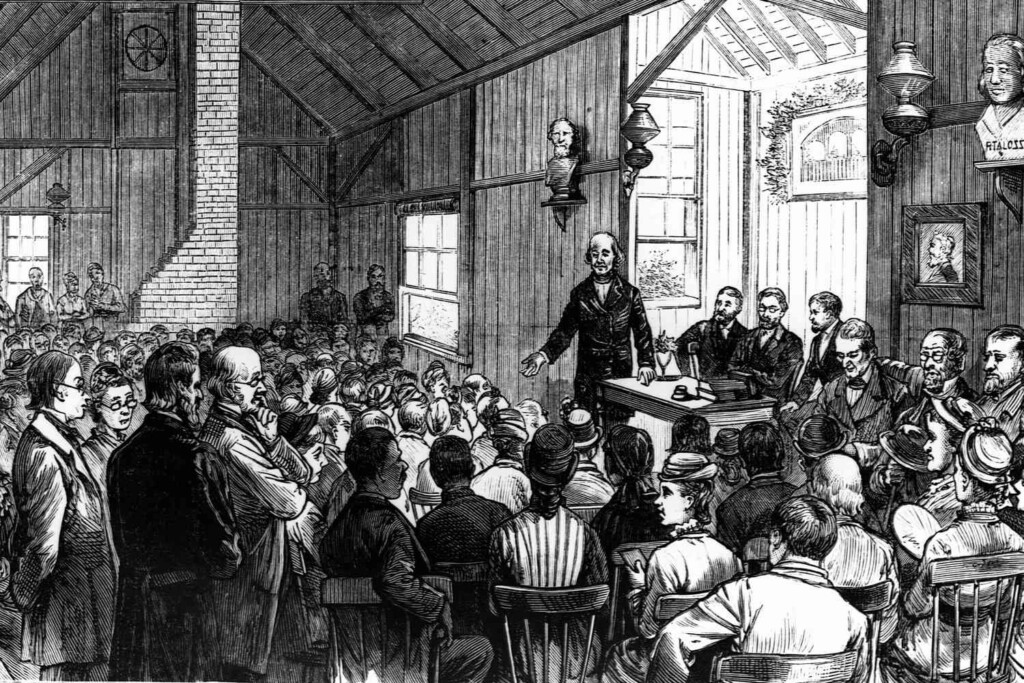
There is a man sitting in a coffee shop right now, somewhere between his second oat milk latte and a podcast about stoic morning routines, who genuinely believes he is a nonconformist. His tote bag carries a quote about self-reliance. His phone contains an app that prompts him, three times daily, to journal about his authentic inner life. He has never read Emerson, but he has absorbed Emerson entirely, the way you absorb a grandparent’s cadence without ever having heard them speak.
This is the strange afterlife of Transcendentalism: not a death, not even a transformation, but a kind of infinite metabolic conversion, where the most radical proposition of nineteenth-century American thought — that the individual soul is its own sovereign authority — became the operating system of consumer identity, the grammar of self-optimization, and the theological backbone of industries worth trillions of dollars.
The first mutation happened fast. By the 1950s, the Transcendentalist hunger for open roads and unmediated experience had migrated into the bodies of young men who drove cross-country with no destination, typed their confessions onto single continuous scrolls, and treated restlessness itself as a spiritual practice. The ecstasy of moving, of refusing to settle, of finding God in the ordinary American landscape of diners and hitchhikers and jazz — this was Emerson’s oversoul dressed in denim and exhaust fumes. The philosophical structure was identical: distrust institutions, trust the self, treat experience as revelation. What had changed was only the costume.
Then came the 1960s, and the costume became a movement, and the movement became a market. Herbert Marcuse, writing in One-Dimensional Man in 1964, had already diagnosed the mechanism with surgical precision: advanced industrial society possesses the extraordinary ability to absorb its own negation, to transform dissent into a product, to sell the image of liberation while deepening the structures that require liberation in the first place. The counterculture did not destroy conformity. It provided conformity with a new wardrobe. Transcendentalism, which had originally demanded a break from the market society of antebellum America, became the spiritual justification for a new kind of market society, one organized around authenticity as a purchasable quality.
The Silicon Valley iteration is perhaps the most spectacular example of this transformation. The mythology of the disruptive founder — the visionary who drops out of institutions, follows an inner calling, reshapes reality through sheer force of individual perception — is structurally a Transcendentalist narrative. It borrows Emerson’s insistence that genius is self-trust, Thoreau’s refusal of inherited obligation, the whole vocabulary of spiritual independence and creative sovereignty. What it removes is the critique of wealth, the suspicion of industrialism, the genuine willingness to live outside the economy rather than to win it. The result is a philosophy of rupture deployed entirely in service of accumulation.
The wellness industry completes the circuit. Mindfulness, breathwork, vision boards, the language of aligning with your true self — all of it descends, however distantly, from the Transcendentalist conviction that inner life is the primary reality and that attending to it is a moral act. William James, who understood the tradition better than almost anyone and who mapped its psychological dimensions in The Varieties of Religious Experience in 1902, warned that the religion of healthy-mindedness could become a form of spiritual bypassing, a way of curating one’s consciousness while leaving the world entirely untouched. The warning was not heeded. The industry grew. By some estimates, the global wellness economy exceeded four trillion dollars annually by the early 2020s, every dollar of it denominated, at least in part, in the currency of self-discovery.
What you are left with is the genuine question that Emerson never quite answered and that no one since has had the courage to press to its conclusion: whether the self you are so urgently invited to invent was ever yours to begin with, or whether self-invention is simply the most elegant architecture for a cage that asks you to decorate your own bars.
🌿 Kindred Spirits: Philosophy, Nature, and the Inner Life
American Transcendentalism did not emerge in a vacuum — it drew from a deep well of philosophical inquiry, spiritual seeking, and artistic vision shared across centuries and cultures. These related articles illuminate the broader landscape of thought that resonates with the Transcendentalist impulse to find meaning beyond the material world.
Epicurus: Life and Philosophy
Epicurus built a philosophy centered on the pursuit of tranquility, friendship, and a life lived in harmony with nature — ideals that echo strongly through the Transcendentalist writings of Emerson and Thoreau. Like the Transcendentalists, he urged his followers to look inward and to simplify existence rather than chase worldly ambition. Understanding Epicurean thought enriches our reading of the self-reliant, nature-attuned spirit that defines American Transcendentalism.
GO TO THE SELECTION: Epicurus: Life and Philosophy
Universal Consciousness
The concept of Universal Consciousness sits at the very heart of Transcendentalist belief, from Emerson’s Over-Soul to Thoreau’s meditations at Walden Pond. This article explores how the idea of a shared, all-encompassing spiritual intelligence has appeared across cultures, philosophies, and mystical traditions throughout history. Reading it alongside Transcendentalist texts reveals just how deeply this movement participated in a global conversation about the nature of mind and spirit.
GO TO THE SELECTION: Universal Consciousness
Heidegger’s Being and Time: Guide to Reading
Heidegger’s monumental work Being and Time grapples with questions of existence, authenticity, and dwelling in the world that find surprising parallels in the Transcendentalist tradition. Both Heidegger and the Transcendentalists called on individuals to resist conformity and to encounter the world with radical openness and presence. This guide to reading Being and Time offers essential philosophical context for anyone wishing to trace the deeper roots of existential self-inquiry.
GO TO THE SELECTION: Heidegger’s Being and Time: Guide to Reading
Botany: History and Scientific Meaning
Botany was not merely a science for the Transcendentalists — it was a spiritual practice, a way of reading the divine language written into every leaf and root. Thoreau’s journals overflow with meticulous botanical observations that he understood as meditations on the soul of nature itself. This article on the history and scientific meaning of botany reveals how the study of plant life became inseparable from the Transcendentalist quest for unity between the human and the natural world.
GO TO THE SELECTION: Botany: History and Scientific Meaning
Explore the Cinema of Ideas on Indiecinema
If these philosophical horizons have stirred something in you, Indiecinema is the streaming platform where thought meets image. Discover a curated selection of independent and documentary films that explore consciousness, nature, spirituality, and the enduring search for meaning — films that the Transcendentalists themselves might have called a window onto the Over-Soul.
👉 EXPLORE THE CATALOG: Watch Indie Films in Streaming
A vision curated by a filmmaker, not an algorithm
In this video I explain our vision

