
The Laboratory of Desire
You are forty-three years old and you have not been touched in eight months. Not because you are monstrous, not because you are cruel, not because you have done anything categorically wrong. You are simply average — average face, average body, average salary — and the market, which now governs intimacy with the same ruthless precision it applies to real estate and equity portfolios, has priced you out. You scroll. You swipe. You perform the small digital rituals that promise connection and deliver instead a granular, daily confirmation of your own expendability. Michel Houellebecq understood this before most sociologists had the vocabulary for it, and when Les Particules élémentaires appeared in France in 1998, it did not merely cause a scandal. It named something that was already happening to millions of people who had no name for it.

The novel follows two half-brothers, Michel and Bruno, born of the same catastrophically self-absorbed mother and raised in near-total emotional isolation. Michel becomes a molecular biologist, brilliant and essentially asexual, existing at a remove from human wanting that reads less like peace than like a wound that has simply gone numb. Bruno is the inverse: consumed by sexual hunger, humiliated by it, dragged through the late-twentieth-century landscape of erotic possibility — nudist camps, swingers’ resorts, the entire apparatus of liberation — and left more diminished at every turn. Together they constitute a single diagnosis, distributed across two bodies.
What Houellebecq grasped, with a coldness that his critics mistook for misanthropy, was that the sexual revolution of the 1960s had not dismantled hierarchy. It had privatized it. Before, the distribution of erotic capital was regulated — imperfectly, often brutally — by institutions: marriage, religion, community expectation. These structures were coercive, frequently unjust, and they are worth no one’s nostalgia. But they enforced a kind of floor. They guaranteed most people some minimum access to intimacy, to physical continuity with another human being, not because desire was equally distributed but because the rules of the game constrained its most predatory expressions. When those structures collapsed, what replaced them was not freedom in any philosophically meaningful sense. What replaced them was a market.
The economist Tyler Cowen and others have mapped how deregulated markets consistently concentrate their benefits at the top of any distribution while dispersing costs across the middle and the bottom. Houellebecq’s contribution was to apply this logic to the body. In a liberalized sexual economy, the attractive, the young, the socially fluent, the wealthy accumulate options at an accelerating rate. The average accumulate rejection. The ugly, the old, the anxious, the poor discover that liberation has liberated them into a new and particularly merciless form of scarcity. Bruno’s degradation across the novel is not a personal failure. It is a systemic outcome, as predictable as the hollowing of a rust-belt town after manufacturing relocates.
This was the provocation that made French literary culture convulse. Houellebecq was accused of being reactionary, of mourning a patriarchal order, of reducing women to objects. Some of those criticisms contain partial truths that deserve serious engagement. But the most uncomfortable thing the novel does is not its treatment of women — it is its treatment of ordinary men, which refuses the usual consolations. Bruno is not a villain. He is not even particularly sympathetic. He is a man shaped by forces he cannot see, wanting things the culture told him he was now entitled to want, and discovering that entitlement without access is its own form of torment. Houellebecq does not ask you to pity him. He asks you to recognize the structure that produced him, which is considerably more disturbing, because that structure did not end in 1998.
Crazy World
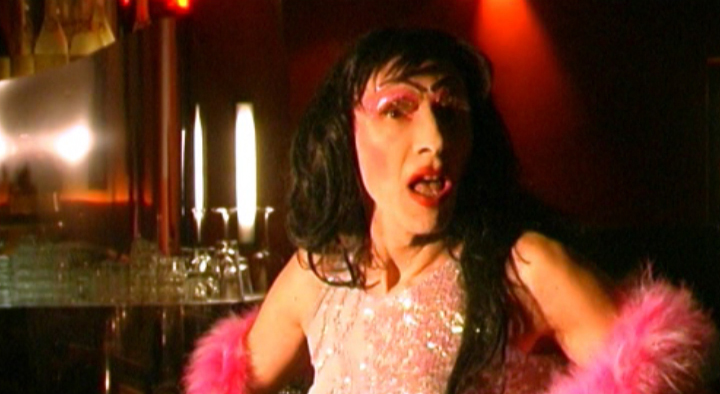
Drama, thriller, by Fabio Del Greco, Italy, 2010.
Luca is poor and works, precariously, as a waiter. He lives a problematic relationship with his girlfriend, and his life is full of doubts. One day Luca meets Chiara, a friend who had studied philosophy with him at university. She has realized her dream of opening a night and is now well-off. Luca leaves everything behind and starts a relationship with Chiara. He manages the nightclub with her and, thanks to the cocaine and call girls sold to politicians, he gets out of his hard economic situation. But Chiara does not manage to obtain the contract for an old furnace, so she blackmails Saverio, a member of the Parliament. Chiara owns a video in which Saverio has sexual intercourse with a transsexual.
LANGUAGE: Italian
SUBTITLES: English, French, Spanish, German, Dutch, Portuguese.
May 1968 and Its Orphans
You are sitting in a room full of people who all believe they chose to be there. The music was selected by an algorithm that learned your preferences from your past behavior. The conversations feel spontaneous, personal, electric — and yet everyone in that room is performing the same approximate version of liberation, the same catalogue of desires that were handed to them decades before they were born, wrapped in the language of authenticity.
Michel Djerzinski and Bruno Clément, the two half-brothers at the center of Houellebecq’s 1998 novel, did not fail at life because they were weak or unlucky. They failed because they inherited a world that had been stripped of the structures that make continuity between people possible — and that stripping had been performed in the name of setting them free. Their mother, Janine, abandons both children in separate acts of erasure to chase the communes, the orgies, the spiritual tourism of the 1960s counterculture. She is not a monster in Houellebecq’s rendering. She is a true believer. That is the more devastating accusation.
The counterculture did not arrive as a conspiracy. It arrived as a feeling — the feeling that the post-war bourgeois settlement, with its suburban houses and its managed marriages and its rigid gender scripts, was a kind of slow asphyxiation. That feeling was not wrong. But Christopher Lasch, writing in 1979 in The Culture of Narcissism, identified something that the participants could not see from inside: the revolution in personal life did not replace one social order with a freer one. It replaced a social order with the market. Every bond that was severed in the name of self-realization created a vacancy, and that vacancy was filled not by authentic individual expression but by consumption, therapy, competitive self-improvement — by the apparatus of a society that profits from people who cannot rely on each other.
Lasch’s argument was precise and uncomfortable: the narcissistic personality structure he diagnosed was not selfishness in the ordinary sense. It was a defensive formation produced by a culture that had made dependency shameful and commitment a sign of failure. The person who cannot attach, who moves from partner to partner, from belief to belief, from identity to identity, is not free. They are injured in a specific historical way. Bruno, whose sexual desperation reads in the novel as grotesque and almost comic, is this injury wearing a human face.
What Houellebecq understood, and what made the novel scandalous to readers who had lived through May 1968 as participants rather than orphans, is that the generation that proclaimed liberation was not liberated — it was evacuated. The communal experiments it celebrated dissolved within years because they had no grammar of obligation, no mechanism for binding people to each other when desire cooled. What remained after the dissolution was not the individual in full flower. What remained were children raised by grandparents, adolescents in boarding schools, people who would spend the rest of their lives unable to locate the emotional center of gravity that had been missing since before they could name it.
The ideological sleight of hand that Houellebecq traces is the transformation of a sociological catastrophe into a personal virtue. To be unattached became sophisticated. To need people became weakness. The therapeutic culture that rose from the ruins of the family — the encounter groups, the self-help literature, the entire apparatus of emotional self-management — reframed isolation as interiority and loneliness as an invitation to self-discovery. By the time Bruno is sitting in a New Age retreat in the 1990s, surrounded by people performing the language of connection, the original wound is so thoroughly institutionalized that no one in the room even thinks to ask who inflicted it, or when, or why the bill was sent to children who had not yet been born when the check was signed.

Bruno and Michel as Diagnostic Twins

You have met someone like Bruno at a party — not the loudest person in the room, but the most exhausting, the one whose hunger is so visible it repels the very thing it reaches for. He talks about women the way a starving man talks about food: obsessively, technically, with a precision that has long since crossed over from desire into something clinical and defeated. He is not enjoying himself. He has not enjoyed himself in years. He is performing the motions of a man who believes enjoyment is still theoretically available to him, and that performance has become indistinguishable from his personality.
Bruno Clément, in Houellebecq’s novel published in French in 1998, is constructed as the terminal case of a particular Western pathology — the man who accepted the 1960s promise that liberation through pleasure was not only possible but obligatory, and then discovered that the promise had been written in disappearing ink. He pursues sex with a desperation that is inseparable from self-loathing, cycles through erotic fantasies that grow more elaborate as actual intimacy recedes, and ends in a psychiatric institution not because he broke from the social contract but because he followed it too faithfully. The sexual revolution told him his desires were legitimate and their satisfaction was the measure of a life. He believed it entirely. The institution that follows is Houellebecq’s punchline, and it is not a gentle one.
What makes the diagnostic structure of the novel so precise is that Michel is not Bruno’s moral opposite — he is his philosophical mirror, distorted along a different axis. Where Bruno drowns in appetite, Michel has amputated appetite altogether. He is a molecular biologist, calm, bloodless, producing work that will eventually contribute to the possibility of human cloning and the supersession of the species. His detachment is not wisdom. It is the same wound wearing a different face. The Enlightenment project, in its fully secular and materialist form, promised that reason applied rigorously enough would produce not only knowledge but a livable world. Michel has internalized that promise without ever noticing that it left no room for the question of whether the life produced is worth living.
Philip Rieff, in The Triumph of the Therapeutic published in 1966, described what he called the psychological man — the successor to the religious man and the political man — whose organizing principle is not salvation or civic virtue but the management of his own inner states. Bruno is Rieff’s psychological man in total collapse, having found that inner states cannot be managed from within desire alone. Michel is something Rieff did not quite anticipate: the post-therapeutic man who has simply deleted the inner states as a category, who has moved so far into abstraction that the question of his own suffering barely registers as data worth processing.
Houellebecq is not interested in assigning blame to either figure. The novel’s structural coldness — its flat, almost sociological prose, its refusal of redemptive arc — functions as a formal argument that these are not individual failures but systemic outcomes. Auguste Comte, whose positivist sociology in the nineteenth century tried to replace theology with the science of human organization, would have recognized Michel as his ideal type and been horrified to see what that type looks like from the inside: a man who has optimized himself into functional near-nonexistence. The science that was supposed to free humanity from superstition and suffering has produced, in Michel, a kind of elective numbness indistinguishable from what medieval theologians called acedia — the soul’s refusal of its own joy.
The two brothers share a mother who abandoned them both for the culture of self-realization, and that biographical symmetry is not accidental. Houellebecq places the source of the wound in the same place for both men, then watches them run in opposite directions until they each hit a different wall, at roughly the same speed.
The Molecular Turn Against Meaning
You are sitting in a lecture hall sometime in the mid-1990s, and a man at the front is explaining that your longing for transcendence is a reproductive strategy. Not a metaphor. A mechanism. The ache you feel when you look at someone across a crowded room, the grief that arrives unbidden at four in the morning, the sense that your life ought to amount to something beyond mere metabolic persistence — all of it reducible, according to the man with the chalk, to the optimization of allele frequencies across successive generations.
Houellebecq did not invent this argument. He found it already written in the scientific literature and understood immediately that it was the most corrosive material available to a novelist who wanted to demolish something. The Elementary Particles, published in France in 1998, borrows the vocabulary of molecular biology and Darwinian selection not to popularize science but to deploy it as a kind of acid bath for Romantic interiority. The novel’s narrator periodically steps back from the misery of its two half-brothers, Michel and Bruno, to offer passages of clinical detachment that read like pages torn from a biology textbook — passages about chromosomal recombination, about the thermodynamic logic of cellular decay, about the cold arithmetic of natural selection operating on human behavior with the indifference of weather. The prose never apologizes for the shift in register. That refusal to apologize is the point.
Edward O. Wilson’s Sociobiology, published in 1975, had already done the intellectual damage years before Houellebecq arrived to narrate the wreckage. Wilson argued, across 697 pages of dense synthesis, that human social behavior — altruism, aggression, pair bonding, aesthetic preference, religious impulse — could be explained through the same evolutionary framework applied to insects and birds. The public controversy was immediate and fierce precisely because the argument was coherent. Critics from Stephen Jay Gould to feminist philosophers understood that if Wilson was right, then a significant portion of what liberal humanism had called freedom was actually programming. Houellebecq absorbed this not as a scientist but as someone who recognized in it the perfect instrument for literary devastation. His fictional biologist Michel Djerzinski pursues a project of genetic reengineering that would abolish sexual reproduction entirely — not as dystopian horror but as logical conclusion, the mercy killing of a species too damaged by its own desire-architecture to survive itself.
What makes this strategy more than mere provocation is its historical targeting. The Romantic tradition from Schiller through Keats through the entire Sturm und Drang mythology had insisted that desire was ennobling, that longing was the signature of a consciousness reaching beyond its material conditions toward something genuinely higher. This was not merely an aesthetic claim — it underwrote political philosophies, educational systems, therapeutic models, the entire post-1968 cultural assumption that liberation meant the free expression of authentic inner life. Houellebecq’s molecular determinism lands directly on that assumption and dissolves it. If desire is not transcendence but mechanism, then the sexual liberation championed by the generation of Bruno and Michel’s absent parents was not freedom. It was a particularly cruel form of false advertising — telling people that following their drives would lead them somewhere meaningful, when in fact the drives have no destination, only repetition.
Bruno is the proof of this in the novel’s most uncomfortable register. His obsessive sexuality does not make him free or vital or alive in any Lawrentian sense. It makes him frantic, humiliated, dependent, and finally broken in a way that no amount of clinical language can fully sanitize. The biology explains him completely, which is precisely what leaves no room for dignity. A man fully explained by his genome and his cortisol levels is not a tragic figure in any classical sense — tragedy requires the possibility of having chosen otherwise, and the molecular framework that Houellebecq erects with such cold precision forecloses that possibility before the curtain rises.
Schopenhauer in the Supermarket
You are standing in a supermarket aisle at nine in the evening, flooded by the particular nausea of too many choices and none of them what you actually wanted. The shelves are infinite and somehow everything on them is the same thing in different packaging. You do not leave. You keep looking. This is not a failure of will — it is will in its purest form, doing exactly what it has always done, which is perpetuate itself without arriving anywhere.
Arthur Schopenhauer argued in The World as Will and Representation, published in 1818, that the fundamental substance of existence is not reason, not God, not progress, but a blind, striving force he called the Will — an undifferentiated drive that has no object and no satisfaction, that creates desire precisely to sustain itself through the suffering desire generates. The individual human being is not the subject of this process but its instrument. You do not want things because they will fulfill you. You want things because wanting is what the Will uses to keep itself in motion. Fulfillment would be the death of it. Schopenhauer understood this as a cosmic tragedy.
Houellebecq understands it as a business model. What separates the two is roughly one hundred and seventy years of industrial capitalism learning how to harness that tragedy as infrastructure. Michel Djerzinski and Bruno Clément move through a France that has taken Schopenhauerian mechanics and given them a product catalogue. The libido is not merely suffering in Houellebecq’s hands — it is suffering that has been studied, segmented by demographic, and sold back to the sufferer at a premium. The novel was published in 1998, the same decade that saw the French advertising industry reach peak expenditure on what sociologists were calling the economics of aspiration, a model that explicitly required the consumer to remain dissatisfied in order to keep consuming. Not as a side effect. As the intended outcome.
Bruno’s entire erotic life is a case study in this architecture. He does not pursue women — he pursues images of women that advertising culture spent decades constructing and saturating the visual field with, images calibrated to be just achievable enough to sustain belief and just unachievable enough to sustain hunger. The philosopher Jean Baudrillard had already described in The Consumer Society in 1970 how consumer desire is never aimed at the object but at the difference between objects, meaning it can never be resolved because differences are infinite and always renewable. Bruno lives inside that infinity without having any name for it. He experiences it as personal failure, as something wrong with his body, his face, his history — which is precisely how the system requires it to be experienced.
Michel’s path is colder and in some ways more honest. He exits desire rather than chase it. His retreat into molecular biology is not transcendence but anaesthesia, a decision to operate at a level of abstraction where the Will cannot reach. Schopenhauer reserved his highest ethical praise for exactly this posture — the ascetic, the saint, the mind that turns away from striving — but Schopenhauer was writing before the twentieth century discovered that indifference too can be manufactured and marketed, that the aesthetic of detachment, of ironic distance, of not wanting, has been packaged into lifestyle identities sold in the same supermarket. The Will metabolizes its own negations.
What Houellebecq adds to Schopenhauer that Schopenhauer could not have added himself is the total absence of any outside. Schopenhauer’s ascetic still had the possibility of genuine renunciation, a real exit, a silence that was not a product. The novel forecloses this. There is no position from which desire can be authentically refused, because refusal has already been incorporated, aestheticized, given a price point. The emptiness Michel inhabits is indistinguishable from a kind of lifestyle. And a lifestyle, by definition, is something you can lose.
A vision curated by a filmmaker, not an algorithm
In this video I explain our vision
The Body as Failed Currency

You are at a naturist camp somewhere in the south of France, and the freedom promised by the removal of clothing turns out to be nothing more than the removal of concealment. Bodies stand in full daylight without the mercy of fabric, and what is revealed is not liberation but a taxonomy of decay. The older bodies sag and mottle under the sun. The younger ones catch eyes, generate gravitational fields, become the silent currency around which every social interaction reorganizes itself. Nobody says this aloud. The ideology of the place insists that nudity dissolves hierarchy, that skin equalizes. But the hierarchies do not dissolve — they clarify. What clothes had obscured, sunlight makes precise.
Houellebecq places Michel and Bruno in exactly this environment not to celebrate sensuality but to demonstrate that the human body, once it enters the social field, immediately becomes subject to a logic of valuation it did not choose and cannot escape. Bruno watches the young women with a hunger that is also a verdict on himself. His own body, aging and unremarkable, is already losing whatever exchange value it briefly possessed. He is not outside the economy looking in — he is inside it, and he is depreciating. The camp does not offer an escape from consumer society’s measuring gaze. It is that gaze distilled to its purest, most merciless form, stripped of the soft filters that ordinary dressed life provides.
Jean Baudrillard, writing in 1970 in The Consumer Society, argued that the body had become the finest, most precious of consumer objects, subject to the same processes of investment, management, and anxiety as any other commodity. What Baudrillard identified was not merely that people purchased things for their bodies — creams, regimens, surgeries — but that the body itself had been internalized as a possession, something to be maintained against depreciation, optimized for exchange, displayed with the strategic intelligence one would bring to any capital asset. The self became its own portfolio manager. Youth was not experienced as vitality but as a period of maximum liquidity before the long slide toward obsolescence.
What Houellebecq adds to this framework is cruelty, which Baudrillard was too sociological to quite deliver. He shows not just the structure of the economy but the precise texture of losing within it — the specific quality of Bruno’s desire, which is simultaneously real and pathetic, a hunger that the market has manufactured and then ruled inadmissible. The novel does not treat Bruno’s suffering as neurosis or personal failure. It treats it as the inevitable output of a system that trained him to want what it simultaneously made conditional, scarce, and increasingly out of reach as he aged.
The naturist sequences also accomplish something more disturbing than mere social critique: they expose how thoroughly the body has been colonized as a site of meaning. When flesh is supposed to speak directly, without the mediation of fashion or costume, it speaks the language of value anyway. Age reads as loss. Symmetry reads as worthiness. There is no body that simply exists outside of these readings, no way to stand unclothed in a social space and not immediately transmit a position in the hierarchy. The utopian dream of nakedness as innocence turns out to be a fantasy sustained only by never actually removing one’s clothes in front of strangers.
Michel, by contrast, barely registers his own body as an instrument of anything. His near-asexuality reads in this context not as deficiency but as an inadvertent exit from the economy entirely. He has no stake in attractiveness because he has ceased to compete. But Houellebecq refuses to make this peaceful — Michel’s exemption from the market of desire is also an exemption from human connection, from the particular warmth that only wanting and being wanted can produce, however distorted the economic forms that warmth takes.
Genetic Salvation as Nihilism’s Logical End
You are standing in a laboratory that no longer smells of anything. The researchers who work there have no memory of longing, no residue of grief, no biological compulsion toward another body. They are, by every measurable standard, content. And if you feel, reading this, a faint nausea rather than relief, that reaction is precisely the data point the novel has been building toward for three hundred pages.
What Michel Djerzinski engineers at the end of the novel is not a solution. It is the implementation of a logic that was always present in the Enlightenment project but that polite intellectual tradition refused to follow to its terminus. The dream of reason was never simply the dream of understanding suffering — it was always, beneath its humanitarian vocabulary, the dream of eliminating the conditions that make suffering possible. René Descartes, separating mind from body in the Meditations of 1641, handed Western thought a framework in which the body became the problem to be managed rather than the site of meaning. What Michel does is complete the Cartesian program: he removes the body’s capacity to generate the irrational, the uncontrollable, the erotic — and calls this liberation.
The posthuman species Houellebecq conjures is clonal, asexual, engineered for equanimity. It has solved desire by abolishing it. This is not dystopia in the traditional literary sense — there is no authoritarian enforcement, no surveillance architecture, no boot stamping on a human face. The horror is subtler and more philosophically precise: it is a world that has genuinely achieved what utilitarian ethics demanded. Jeremy Bentham’s felicific calculus, the 1789 framework in which pleasure is maximized and pain minimized as the supreme moral arithmetic, arrives at exactly this endpoint if you follow it without flinching. A being that cannot suffer is a being whose utility function has been permanently optimized. Bentham would have no objection. That is what makes the conclusion so difficult to dismiss as mere provocation.
Michel’s act is structurally indistinguishable from annihilation because the continuity it preserves is purely biological — genetic material, cellular architecture — while everything that constituted human experience, including its devastation, has been erased. There is no phenomenological thread running from the old species to the new one. What survives is a substrate, not a subject. This is the philosophical sleight of hand Houellebecq performs in plain sight: he presents extinction dressed in the language of evolution, and asks whether you can tell the difference.
What Houellebecq understands — and this is where the novel escapes the category of mere polemic — is that Michel is not a villain. He is a man who loved his brother, who could not save him, who watched the entire architecture of modern freedom produce Bruno’s wreckage over and over, in every Western city, in every decade since 1968. The solution he designs comes from genuine despair, not from cold indifference. This is what separates the novel’s argument from simple misanthropy: it locates the catastrophic logic inside compassion itself, inside the sincere desire to stop the bleeding. The most dangerous ideas are not the ones that emerge from cruelty but the ones that emerge from exhaustion with suffering combined with sufficient technical capability to act.
The epilogue, written from the perspective of the posthuman species looking back at their human predecessors, carries a tone of serene, almost tender pity. They regard us the way we regard animals caught in traps of their own biology — sympathetically, from a safe distance, with no possibility of genuine identification. And it is in that distance that Houellebecq buries the final charge: if you feel that their pity is a loss rather than a gain, if something in you insists that the trap was also the meaning, then you already know what the novel has been arguing, and you already know you have no clean answer to it.
What the Novel Refuses to Forgive
You are reading a novel about broken men, and at some point you realize you have been deciding, quietly, which of their failures you are willing to excuse.
The controversy that erupted around Michel Houellebecq’s 1998 novel was immediate and structurally revealing. Feminist critics, prominent among them those writing in the pages of Le Monde and Libération, identified the book’s treatment of women — aging bodies catalogued with clinical disgust, female desire rendered either absent or predatory — as straight misogyny dressed in the costume of literary intelligence. Others, including writers like Frédéric Beigbeder and a significant portion of the Anglophone critical establishment that received the English translation in 2000, insisted the novel was a diagnosis, not a prescription, that Houellebecq was documenting a pathology he himself inhabited, not endorsing it. Both camps were wrong in the specific way that makes an argument impossible to resolve: they were both right about the surface and blind to what lay beneath it.
The text does not defend Bruno’s gaze. It does not ask you to find it beautiful or just. What it does, with considerable precision, is make that gaze structurally legible — rooted in a childhood where his mother chose her own freedom over his survival, in a culture that promised infinite satisfaction and delivered only comparison, in a libidinal economy where desire had been thoroughly marketized by the time he reached adulthood. Sociologist Eva Illouz, in her 2012 study “Why Love Hurts,” traced exactly this architecture: the way consumer capitalism transforms intimacy into a site of competition and evaluation, producing subjects who appraise rather than encounter. Bruno is not an aberration. He is an accelerated version of something widely distributed.
The readers who condemn the novel for misogyny are performing a moral reflex that the novel anticipated and built into its trap. To call it misogynistic and close it is to refuse the diagnosis, to protect yourself from the implication that the pathology is not located in one fictional man but in a set of historical conditions that include you. The readers who celebrate it as unflinching truth-telling fall into the other jaw of the same trap, using the word “diagnosis” to launder their own comfort with the contempt on the page, dressing acquiescence as intellectual courage. What the novel actually refuses to forgive is the reader’s need to land somewhere clean.
This is where Houellebecq’s method becomes genuinely unpleasant in a way that has nothing to do with sex or bodies. He denies you the stable position from which moral judgment is usually issued. Michel Djerzinski’s trajectory — abandonment of human connection, retreat into pure scientific abstraction, culminating in the biological abolition of individual desire altogether — is presented not as tragedy but as logical conclusion. If the problem is the self, the self capable of suffering and causing suffering, then the solution the novel proposes is the elimination of that self as a category. Philosopher Peter Sloterdijk, in his 1983 “Critique of Cynical Reason,” described cynicism as the dominant ideology of late modernity: an enlightened false consciousness that sees through illusions and yet continues to function within them. The novel does not offer cynicism as exit. It offers extinction.
What you consider unforgivable about this book tells you something you may not have wanted to know. If the female characters’ reduction offends you most, you are protecting a conception of dignity you believe literature should honor. If the coldness of the scientific resolution strikes you as the real violence, you are revealing that you still believe the self is worth preserving despite all the evidence the novel marshals against that belief. If you find yourself defending the novel’s right to be brutal, you are showing what you have decided suffering is for.
The novel does not hate women. It does not love men. It has decided, with the patience of a system rather than the heat of a person, that the entire arrangement was always going to end here.
🧬 Fragments, Flesh, and the Fractured Modern Self
Michel Houellebecq’s The Elementary Particles tears apart the myth of sexual liberation and exposes the biological and existential loneliness at the core of late-capitalist humanity. These related articles trace the same fault lines — alienation, desire, social critique, and the search for meaning in a world stripped of transcendence.
Annie Ernaux: Life and Works
Annie Ernaux shares with Houellebecq a merciless sociological gaze trained on the body, desire, and class — though she wields it as autobiographical scalpel rather than satirical sledgehammer. Her work excavates the shame and yearning encoded in French provincial life, making her an essential companion to The Elementary Particles. Both writers force literature to confront what polite culture prefers to suppress.
GO TO THE SELECTION: Annie Ernaux: Life and Works
Karl Marx and Alienation: Economic and Philosophical Manuscripts
Marx’s concept of alienation — the estrangement of the worker from labor, from others, and from the self — haunts every page of Houellebecq’s novel, where sexual and emotional disconnection mirrors the logic of commodity exchange. The Elementary Particles can be read as a fiction of alienation pushed to its biological extreme, where even reproduction becomes obsolete. Understanding Marx’s Economic and Philosophical Manuscripts illuminates the structural despair beneath Houellebecq’s provocations.
GO TO THE SELECTION: Karl Marx and Alienation: Economic and Philosophical Manuscripts
Albert Camus: Life and Philosophical Thought
Albert Camus confronted the absurd — the collision between humanity’s hunger for meaning and the universe’s indifferent silence — with a defiant humanism that Houellebecq deliberately inverts and darkens. Where Camus imagined rebellion as dignity, Houellebecq imagines extinction as solution. Reading Camus alongside The Elementary Particles reveals just how radical and bleak Houellebecq’s departure from existentialist hope truly is.
GO TO THE SELECTION: Albert Camus: Life and Philosophical Thought
Eribon’s Returning to Reims: Analysis
Didier Eribon’s Returning to Reims is a key text for understanding the class wounds and social resentment that fuel so much of contemporary French literature, including Houellebecq’s fiction. Like Houellebecq, Eribon is interested in the bodies and lives that mainstream republican culture renders invisible or shameful. His sociological self-analysis provides a crucial political and emotional context for the rage simmering through The Elementary Particles.
GO TO THE SELECTION: Eribon’s Returning to Reims: Analysis
Discover Cinema That Asks the Same Hard Questions
If Houellebecq’s novel unsettles you with its cold dissection of modern life, Indiecinema’s streaming catalog offers films that pursue the same uncomfortable truths — stories about desire, solitude, and the fragile meaning we build against the void. Explore independent cinema that refuses easy consolation, only on Indiecinema.
👉 EXPLORE THE CATALOG: Watch Indie Films in Streaming
A vision curated by a filmmaker, not an algorithm
In this video I explain our vision

