
The Stranger at the Counter
You are standing at a counter, waiting. Maybe it is a coffee shop, maybe a post office, it does not matter. Your hand is resting on a surface that is neither warm nor cold. Someone in front of you is completing a transaction you cannot see. Behind you, a door opens and closes, opens and closes, letting in small bursts of outside air. You are not thinking about anything in particular. You are simply there, suspended in the middle of a gesture that has no name yet, and then — for no reason you can identify — you notice your own hand. You notice the specific weight of standing. You notice that your jaw is slightly clenched, that you have been breathing in a shallow rhythm for perhaps the last ten minutes, that you are performing, with extraordinary precision, the role of a person waiting. And for three or four seconds — before the line moves, before the moment dissolves back into the ordinary — you feel something close to vertigo. Not fear exactly. Something quieter and stranger than fear. A sudden, sourceless sense that none of this is self-evident. That the entire architecture of the moment — the counter, the transaction, the bodies arranged in their patient sequence — is something you are participating in without having chosen it, without understanding it, without knowing what it is for.

That sensation you have felt before. You have felt it standing in a supermarket aisle studying the side of a cereal box for longer than necessary. You have felt it in the middle of a conversation at a party when the words coming out of your mouth seemed to belong to someone performing you. It arrives without warning, leaves without explanation, and in its wake there is a faint residue of embarrassment, as if you had almost said something inappropriate. You do not have a name for it. Most people never find one. Albert Camus did, and the name he gave it cracked European thought in two.
He called it the absurd, but the word is almost too clean, too philosophical in its modern usage, to carry what he actually meant. What he meant was precisely that sensation at the counter. The collision — sudden, physical, unreasonable — between the human need for clarity and the world’s complete indifference to providing any. Not a concept. A lived temperature. He described it in 1942 in The Myth of Sisyphus as the confrontation between the human call for coherence and the universe’s unreasonable silence, and he was not describing an intellectual problem. He was describing what happens to a body when the scaffolding of habit briefly fails. The French philosopher and phenomenologist Maurice Merleau-Ponty had already begun theorizing in those same years, in his Phenomenology of Perception, that human existence is always first and foremost a bodily inhabiting of the world, never a mind floating above it. Camus approached the same territory from the opposite direction, not through academic phenomenology but through literature, and through what one might call an almost physical honesty about the cost of being conscious.
He was born in Mondovi, Algeria, in 1913, the son of a man who died in the First World War before Camus was old enough to form a memory of him, the son of a woman who was partially deaf, almost illiterate, and worked as a cleaning woman to keep them both alive. Poverty was not an abstraction in his childhood. It was a texture. And perhaps it is from that texture — from having lived in a body that could not afford to aestheticize its own discomfort — that his philosophy draws its particular, unglamorous authority. The absurd, in Camus, was never an idea someone arrived at from a comfortable chair. It was something the body already knew.
Don Barry: A Quixotic Exploration
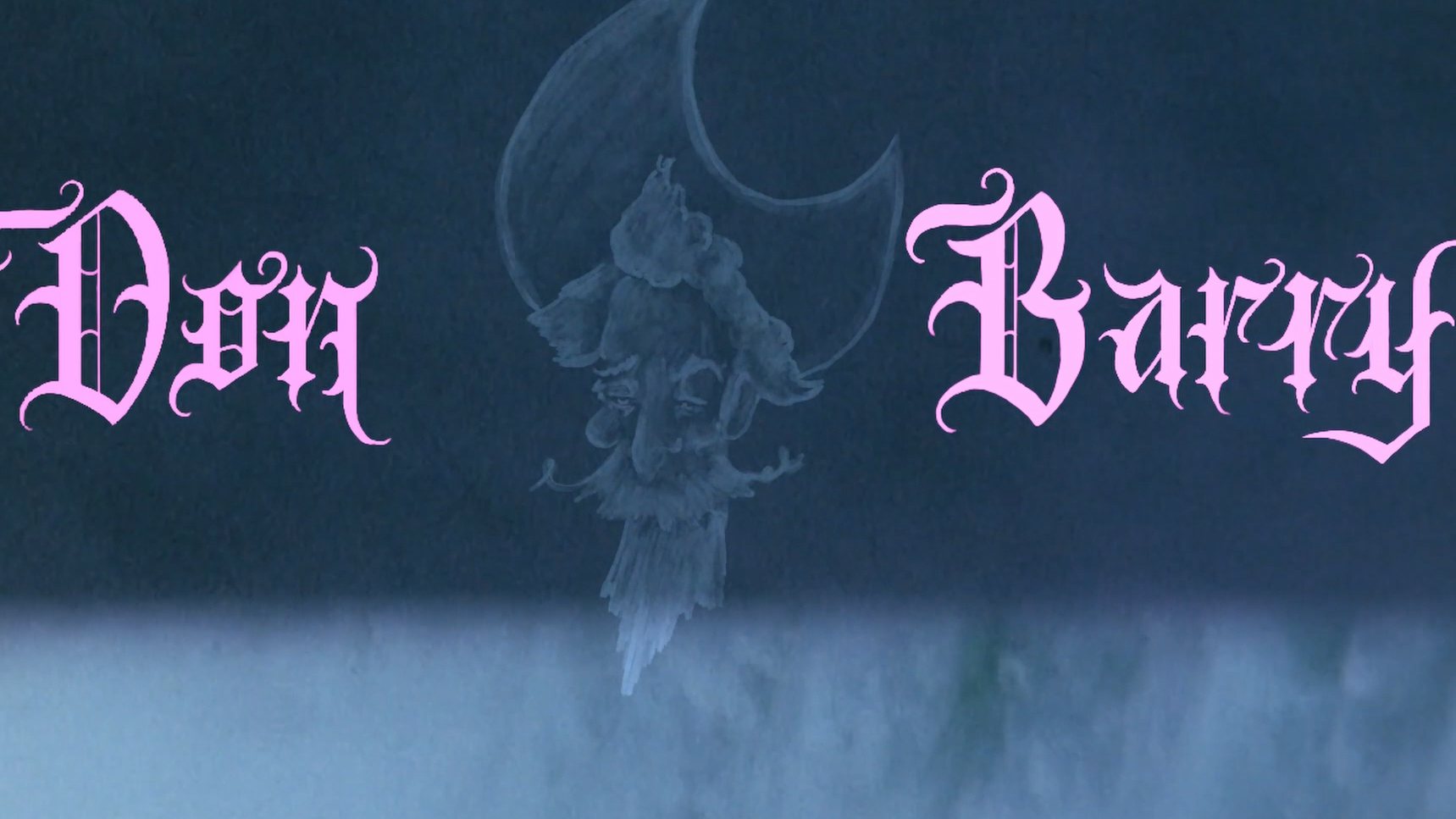
Docufiction, Experimental, by Paul Smart, Mexico, 2026.
Don Barry: A Quixotic Exploration is a debut feature that places the biography of an eighty-year-old experimental filmmaker and artist, Barry Gerson, within the metanarrative of Miguel de Cervantes’ Don Quixote. Don Barry was filmed in the city of Guanajuato during the 51st edition of the Cervantino Festival, as well as during the vibrant Day of the Dead celebrations held in the city’s UNESCO-listed tunnels. The film honors the director’s long friendship with artist Barry Gerson, drawing inspiration from Cervantes’ Don Quixote. Paul Smart’s directorial choices create something new that celebrates life and goes beyond conventional storytelling. A search for magic in our real lives. A moving film about the meaning of life, art, and death. Not to be missed.
Paul Smart is a proud outsider filmmaker with a long history of film screenings. In the 1980s, he emerged in New York’s vibrant youth art scene, working in theater production and later filmmaking, before retreating to rural upstate New York, in the Catskill Mountains, where he made a living writing and screening independent films in old parish halls for rural audiences, many of whom had never seen a film.
LANGUAGE: English
SUBTITLES: Spanish, French, German, Portuguese
Oran, Mondovi, and the Sea That Shaped Everything
There is a particular kind of knowledge that enters through the skin before it reaches the mind. You know it if you have ever stood in relentless heat with nothing between you and the sun, if you have watched someone you love move through the world in silence not from wisdom but from the simple absence of words given to them. This is not metaphor. This is curriculum.
Camus was born on November 7, 1913, in Mondovi, a small colonial settlement in eastern Algeria, to a father who died at the Battle of the Marne before his son turned one and a mother who was partially deaf, could barely read, and cleaned other people’s houses for wages that left almost nothing. The family moved to Belcourt, a working-class district of Algiers, where he grew up in a two-room apartment with his grandmother, his uncle, and the permanent presence of economic precariousness. Not the romantic poverty that writers sometimes confuse with authenticity, but the grinding, structurally produced kind that closes options before a child is old enough to understand what options are.
Hannah Arendt, writing in The Human Condition in 1958, made the distinction that most intellectual histories ignore: that thought does not descend from ideas to circumstances, but rises, always, from the specific weight of a life actually lived. What she called the vita activa — the irreducible fact of being a body among other bodies, laboring, acting, speaking in a particular place — is not the context for thinking. It is the thinking. The poverty of Belcourt, the silence of Catherine Camus who could not read the books her son would write, the blazing Algerian light that made abstraction feel obscene: these were not obstacles Camus overcame on his way to philosophy. They were the philosophy.
Tuberculosis arrived when he was seventeen, diagnosed in 1930, and with it something that no amount of university training manufactures: an intimate, daily familiarity with the contingency of existence. The body as a fact that can simply stop. Most Western philosophy, from Descartes forward, has conducted its operations in implicit denial of this — the thinking subject positioned as if it had no lungs, no hunger, no fever. Camus’s thought never had that luxury, and this is not incidental to the positions he reached. It is their precise origin.
The Mediterranean itself was not scenery. He swam in it, lay under its sun with an almost physical greed, and wrote about that physicality with a directness that still unnerves readers who have been taught that serious thought must maintain a distance from pleasure. In an early essay he described the sea and the bodies of young men on the beaches of Algiers with an unselfconscious sensory intensity that sits uneasily beside the canonical image of the austere existentialist. But this is the point. The absurd, as a philosophical position, is not born in libraries. It is born in the recognition that the body wants to persist and the world offers no guarantee, that the light is genuinely beautiful and life is genuinely finite, and that these two facts coexist without resolution. You do not reach that recognition by reading about it.
His teacher Louis Germain, who recognized his ability and fought to keep him in school when the family’s poverty threatened to pull him out, remains a figure Camus returned to publicly, most famously in the letter accompanying his Nobel Prize in 1957. The gratitude was not sentimental. It was precise: this specific man, in this specific place, made a particular future possible. Camus understood that intellectual life is not a meritocracy that rewards talent from neutral ground. It is a series of accidents, interventions, and structural conditions that most people who reach the stage never turn around to acknowledge.
The sun, the silence, the sick lungs, the unread books. Not background. Foundation.

Absurdity Is Not a Thought, It Is a Tuesday Morning
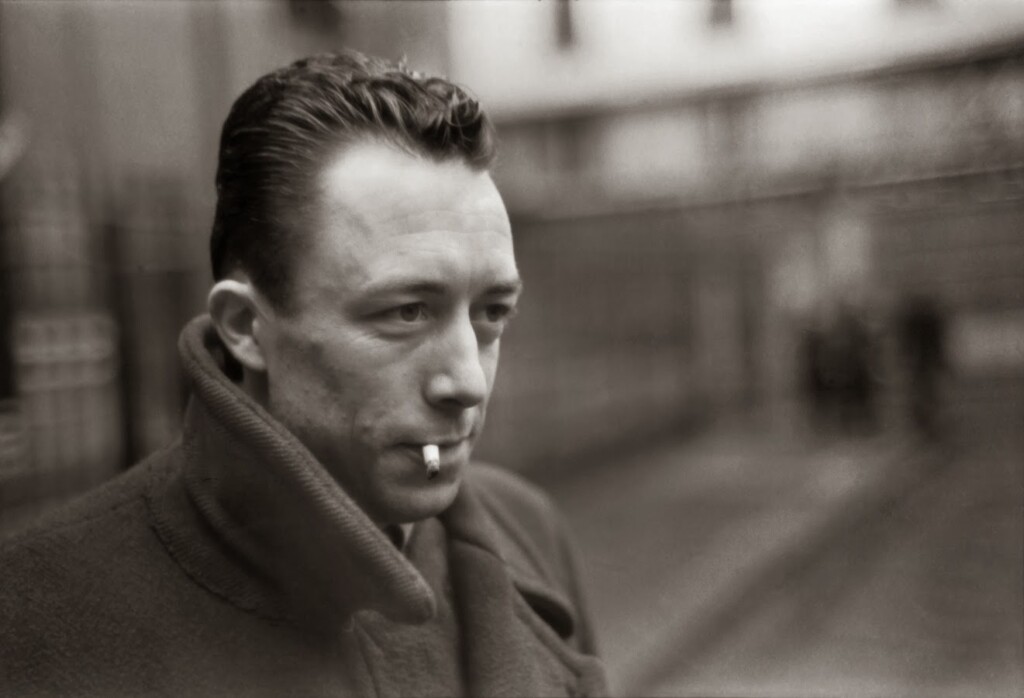
There is a man at a bus stop. You have seen him — you may even be him — standing at the same corner every morning at 7:42, watching the same sequence of traffic lights cycle through their colors, lifting the same paper cup of coffee to his lips at the same interval, nodding at nobody in particular. He is not performing a ritual. He is not being ironic. He is simply doing what is done, with the full weight of his seriousness applied to it, and that seriousness is the most unsettling thing about him. Not the repetition. The seriousness.
This is where Camus begins — not in a library, not in a lecture hall, but in that crack of recognition between the human being who needs the world to mean something and the world that receives that need with absolute, unbreakable silence. The absurd is not a philosophical position one adopts after careful reading. It is a Tuesday morning when the question of why you are doing any of this surfaces without warning and refuses to sink back down. It is the moment in which the machinery of ordinary life, which runs so efficiently precisely because it never asks itself why it runs, suddenly becomes visible as machinery.
Camus was meticulous about what he meant. The absurd does not reside in the human being alone, nor in the world alone. It lives in the confrontation between the two — in what he called the confrontation between the human need and the unreasonable silence of the world. Remove either term and the absurd dissolves. A person without the need for clarity would not feel it. A world that answered would not produce it. It is relational, which makes it inescapable in a way that purely internal states never are. You cannot think your way out of a relationship.
Kierkegaard saw the same abyss and jumped. His leap of faith — the decision to affirm meaning precisely because reason cannot supply it, to embrace the absurd religiously — was for Camus the great philosophical evasion of the twentieth century’s inheritance. To leap is to solve the problem by abandoning the terms of the problem. Camus found this not courageous but dishonest, a form of philosophical suicide dressed in the clothes of transcendence. The thinker who leaps has simply decided that the silence of the world is not silence but a voice he has chosen to hear in a language he has chosen to learn. Camus refused this. He refused it with a rigor that cost him every comfortable exit.
This is also where he parts from Sartre, though the two are so frequently collapsed into a single European intellectual mood that the distinction gets lost. Sartre’s existentialism begins with the same godless universe but moves quickly toward the project of the self, toward radical freedom as the irreducible human condition, toward the idea that existence precedes essence and that this is, ultimately, a liberating truth. For Camus, this move happens too fast. It installs a new metaphysics — freedom, authenticity, the project — in the place recently vacated by God. It replaces one meaning-structure with another. Sartre answers the silence. Camus insists on sitting with it.
The man at the bus stop lifts his coffee cup again. The light changes. He does not look up. There is nothing wrong with him, and there is nothing right with him either. He has not solved anything. He has simply continued, and in the continuing there is something that resembles dignity and something that resembles tragedy and something that is neither, because tragedy at least implies an audience who understands what has been lost. The world that surrounds him has no such understanding to offer. It simply goes on cycling through its colors, indifferent with a completeness that no human indifference could ever match.
The Lost Poet
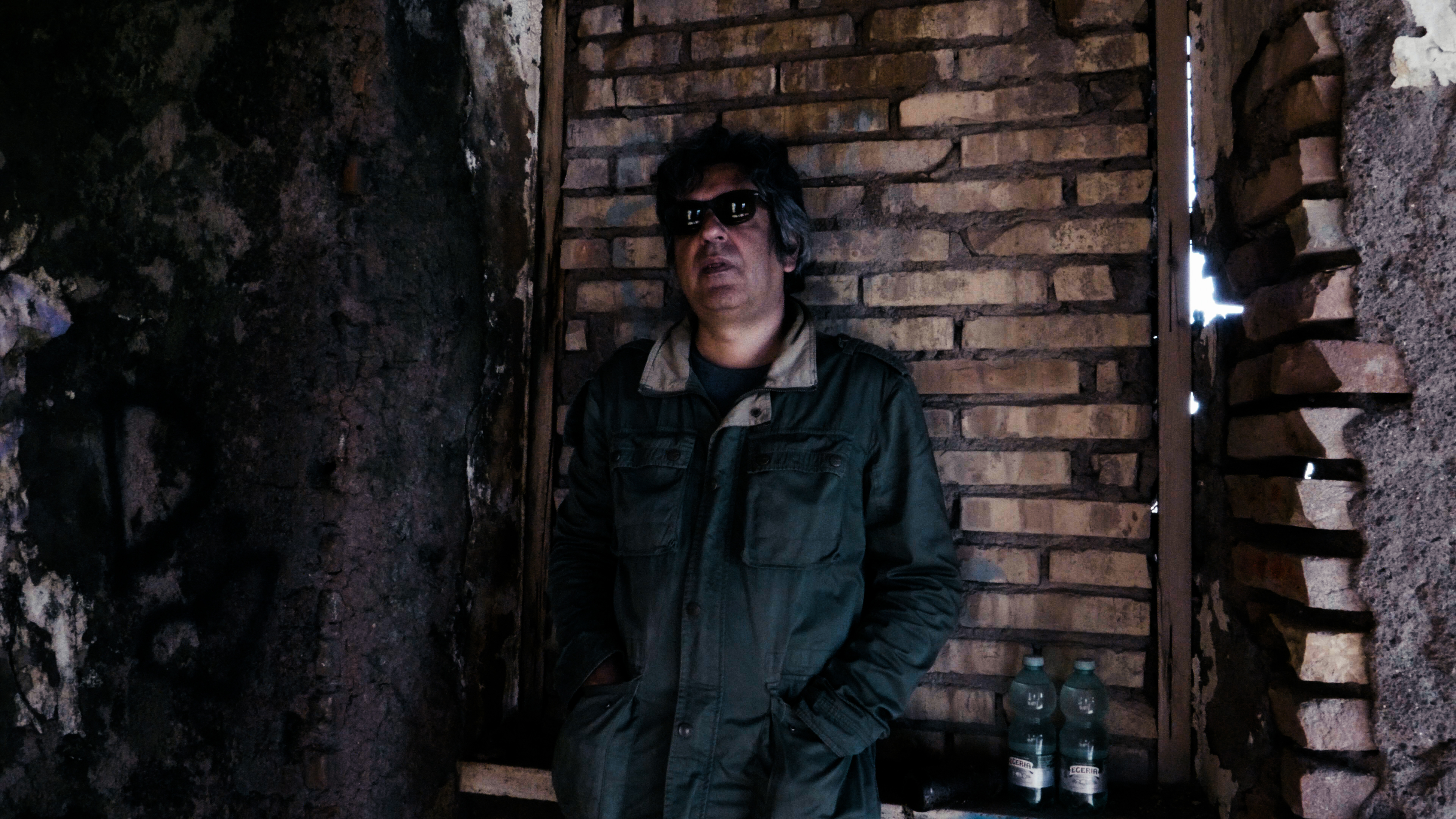
Drama, by Fabio Del Greco, Italy, 2024.
Dante Mezzadri wants to see an old friend, nicknamed the Iguana, whom he has lost sight of for many years, and who has managed to turn their shared youthful passion for poetry into a job, becoming a famous writer and poet. The man escapes from his bourgeois life and his wife to live homeless on the Roman coast, printing and trying to sell his poetry collections. At night he sleeps in a park of old carnival floats, inside a papier-mâché tank, and waits for the opportunity to meet his old friend, who however never shows up for appointments in the places they frequented when they were young, now in ruins. Dante's poetry books do not interest anyone and to support himself he is forced to "change product": he starts selling the infamous "cannibal pill" on behalf of young drug dealers, a new drug that sells like hot cakes and causes sensory and consumerist ecstasy. However, he realizes that this powerful drug is very dangerous for those who take it, he comes into conflict with his ethical conscience and throws all the pills into the sea. However, the dealers want to collect their money.
Shot over a period of 2 years, the film is a reflection on the cultural and artistic rubble of the society in which the protagonist lives, in an increasingly mechanized, consumerist and arid world. Dante Mezzadri is yet another human being who has renounced his inspiration and his creativity, but unlike many he is not willing to give his life to a system that distances him from his true identity. The physical world around him, however, seems constructed in such a way that it seems impossible to escape from this "invisible cage". The enthusiasm of the people he meets is ignited only by sensory gratification, by unreal visions of personal affirmation and success, by "metaverses" that offer an escape into an illusory and destructive reality. The poet's house on the coast, where he met with his friends as a young man, is just a pile of abandoned rubble. What happened to all those who wanted to become poets and ended up becoming something else? Are there internal forces with which that house can be "rebuilt"?
LANGUAGE: Italian
SUBTITLES: English, Spanish, French, German, Portuguese
The Plague and the Body Politic
The streets empty in stages. First the cafés, then the markets, then the sound of children. The gates of the city close not with drama but with paperwork — a memo, a signature, a regulation that nobody quite voted for and nobody quite refused. The rats came first, dying in the gutters, and the bureaucrats noted them in ledgers and continued stamping other documents while the morgues filled. A doctor moves through these streets not because he believes in anything grand but because the sick are there and he is trained to treat the sick. It is the most unromantic form of courage imaginable, and it is the only kind that actually works.
This was Camus writing in 1947, two years after emerging from the underground press, and what he was building was not an allegory in the literary sense but a report. He had spent years as editor of Combat, the clandestine Resistance newspaper, writing editorials under Nazi occupation from 1944 onward when discovery meant arrest and arrest meant something worse. He had watched his city — Paris, by then adopted as his city — administered by men who kept the trains running and the files organized while the logic of extermination operated in parallel. He understood, viscerally, that catastrophe does not announce itself. It is administered.
Susan Sontag, writing in 1978 in Illness as Metaphor, argued that every epidemic in Western history has been turned into a moral narrative — that disease gets weaponized as metaphor to punish the sufferer for some suspected deficiency of character, class, or behavior. Tuberculosis became romantic suffering for the sensitive soul. Cancer became the repressed anger of the emotionally blocked. The disease is never just the disease; it becomes a verdict. Sontag was writing about her own cancer diagnosis and the extraordinary burden of metaphor that came with it, the implicit suggestion that she had somehow authored her own illness through insufficient feeling. What she theorized with brilliant systematic anger in those pages, Camus had already practiced in fiction thirty years earlier.
The doctor in that sealed city refuses, with absolute consistency, to make the plague mean anything. He does not see it as punishment, as divine test, as purification, as political metaphor. He sees it as a biological fact producing suffering, and suffering requires response. This deliberate stripping of moral symbolism is not cynicism — it is, paradoxically, the most ethical position available. Because the moment you allow the epidemic to carry symbolic weight, you begin making decisions about who deserves treatment, who brought it upon themselves, whose death carries more narrative significance. The bureaucrats keeping their offices open while the bodies accumulate are not monsters. They are people who have allowed administrative normalcy to become a form of moral anesthesia.
Camus had watched this happen in real time. The occupation of France required not primarily soldiers but paperwork — the Vichy regime’s collaboration functioned through census records, deportation lists, property confiscations that moved through official channels with all the mundane gravity of tax filings. Hannah Arendt would later articulate this in Eichmann in Jerusalem in 1963 as the banality of evil, but Camus had already felt it from inside, had written against it in Combat while it was occurring, and had built his plague city as a monument to the specific texture of that experience: the way catastrophe becomes normalized, domesticated, absorbed into routine.
What the sealed city reveals is not the worst of human nature. It reveals the structure. The gates close and what remains is the bare machinery of how a society actually distributes care, decides whose survival is logistically convenient, and chooses what to count. A priest preaches that the plague is judgment. The doctor keeps making his rounds. These are not equally defensible positions, and Camus knew it, and the city keeps dying either way while the papers get stamped.
The Rebel Who Refused Both Altars
There is a dinner, and someone across the table is speaking calmly about necessity. The word they keep using is necessity. A distant country, a specific decade, a number of deaths that sounds enormous until it is folded into the grammar of historical progress, at which point it becomes almost elegant. You are listening. You cannot find the precise flaw in the argument. The logic holds together the way a cage holds together — every bar in its correct place, the whole structure sound, and something living trapped inside it.
This is exactly the atmosphere Camus walked into when he published L’Homme révolté in 1951. Maurice Merleau-Ponty had already laid much of the philosophical groundwork for what respectable left-wing intellectuals were permitted to think. In Humanism and Terror, published in 1947, Merleau-Ponty had constructed an argument that was genuinely sophisticated and genuinely monstrous in equal measure: that revolutionary violence could not be judged by the moral standards of the present because history itself was the only court with jurisdiction. The Moscow Trials were not obviously crimes. They were ambiguous. They required interpretation within the dialectical movement of class struggle. To condemn them prematurely was to misunderstand the nature of historical time. The argument was not crude. That was precisely what made it so dangerous.
Camus recognized the structure immediately, not because he was politically naive but because he understood how the consolation of abstract time functions as an anesthetic for concrete suffering. In L’Homme révolté, he traced this logic back to its roots with something close to archaeological patience — through Hegel’s absorption of the individual into the World Spirit, through Marx’s transposition of that absorption into material history, through the point where rebellion, which begins as a cry of recognition between human beings, transforms into revolution, which begins to consume the same bodies it originally rose to protect. The rebel says: there is something in me that matters, and that thing matters in you too. The revolutionary, once theory has completed its work on him, says: there are things that matter more than you.
The break with Sartre in the pages of Les Temps Modernes in 1952 was not a quarrel between two difficult men, though it was also that. It was the moment when the central fault line of twentieth-century European thought became impossible to paper over. Francis Jeanson‘s review of the book was dismissive and slightly contemptuous. Camus’s reply was addressed not to Jeanson but directly to Sartre — Monsieur le Directeur — and it vibrated with a specific kind of controlled fury that belongs to someone who has watched a friend choose the cleaner conscience of system over the messier obligation of actual people. Sartre’s response was long, brilliant, and in certain passages almost deliberately cruel. He accused Camus of armchair moralism, of refusing the genuine difficulty of political commitment, of preferring purity to engagement.
What Sartre called purity, Camus called simply the refusal to lie about what a corpse is. This is not a rhetorical formula. It is the exact center of the disagreement. If historical materialism produces a framework in which certain deaths become necessary, become investments in a future justice, then the philosophical task — for Sartre and for Merleau-Ponty and for the entire tradition they were drawing on — is to think rigorously inside that framework. For Camus, the framework itself was the problem. Not because history is unreal, but because the moment you grant history the authority to redeem individual suffering retroactively, you have handed a blank check to whoever currently speaks in history’s name.
Back at the dinner table, the person with the calm voice has moved on to dessert. The argument is still sitting there in the air between you, intact, internally consistent, and you feel something in your stomach that philosophy has not yet given you the words for.
A vision curated by a filmmaker, not an algorithm
In this video I explain our vision
Algeria, the Silence, and the Wound That Never Closed

There is a man standing at a window, looking out at a city he loves with the kind of love that bypasses thought entirely. The light falls in a particular way. The smell of the streets enters through the gap in the glass. Everything he is — his earliest hunger, his first sense of beauty, the precise quality of his mother’s silence — is contained in what he sees. And somewhere below, in the streets he is not quite looking at, something is burning.
This is not a failure of intelligence. Camus was not a stupid man. He was one of the sharpest moral minds of the twentieth century, capable of diagnosing bad faith and self-deception in others with surgical precision. But there is a particular blindness that comes not from ignorance but from love, and it is, in many ways, more total than any other kind. What you have built yourself from cannot be seen as a structure. It can only be felt as ground.
Algeria was his ground. Not metaphorically. The physical country — its coast, its heat, its poverty, its specific Mediterranean light — was the substrate of everything he thought and wrote. He was born there in 1913, to a family so poor that his mother, nearly deaf and unable to read, cleaned other people’s houses. This is not background detail. This is the material of his philosophy. Absurdism did not emerge from a comfortable French apartment. It emerged from a childhood in which deprivation was so ordinary it barely registered as unfairness, because the alternative to deprivation was simply unimaginable. And so when the country that formed him became a battlefield, when Algerian independence moved from political abstraction to armed struggle, Camus found himself unable to choose. Unable, or unwilling — and the distance between those two words is the wound.
At the Nobel Prize ceremony in Stockholm in December 1957, a young Algerian student confronted him directly, pressing him to take a public stance on independence. His response became one of the most debated sentences he ever uttered: that he believed in justice, but he would defend his mother before justice. It has been read charitably, as the confession of a man torn beyond the reach of political language. It has been read uncharitably, as the admission that his humanism had a border drawn around European settlers. Both readings are correct. That is the problem.
In the same years that Camus fell into increasing silence on Algeria, Frantz Fanon was writing with the opposite urgency. Born in Martinique, trained as a psychiatrist, working in Algerian hospitals where he treated both French soldiers and the torture victims they created, Fanon arrived at conclusions Camus could not follow. His 1961 work argued that colonial violence was not an aberration to be mourned and moderated — it was the foundational grammar of the entire system. Humanist appeals for moderation, for dialogue, for the preservation of lives on both sides, were not neutral positions. They were, structurally, positions that preserved the arrangement. Fanon understood that the colonized subject did not need Europe’s humanism extended to include him. He needed Europe’s humanism exposed as the ideological skin stretched over an economic skeleton.
Camus never read the colonial situation this way, and it is worth sitting with the cost of that. Not to condemn him — condemnation is easy and changes nothing — but to recognize what his silence revealed about the architecture of his thought. A humanism built from the experience of poverty within a colonial structure, but never turned to examine that structure, remains a humanism with a blind wall. The love that built it is real. The beauty he found in that coast is real. And the people whose dispossession made that coast available to him to love in precisely that way — they are also real, and they were watching him not answer.
The Sun, the Sea, and the Ethics of the Body
There is a moment, standing waist-deep in cold seawater, when thought simply stops. Not because you have disciplined it, not because you have meditated or prayed or reasoned your way into stillness, but because the cold is too immediate, too insistent, too entirely here. The body takes over. The skin speaks louder than the mind. And in that brief suspension, neither despair nor hope has any purchase on you. You are simply a creature in water, under light, alive.
Camus knew this moment not as a vacation from philosophy but as philosophy itself. What is least discussed in his work, what tends to be bracketed as youthful lyricism or Mediterranean sentimentality, is in fact the most radical position he ever took. In Nuptials, written in 1938 when he was twenty-four, and again in Summer, published in 1954, he did not retreat from the absurd into pleasure. He proposed something far more difficult: that the body’s joy, its capacity for sun and salt and desire, constitutes a form of knowledge that no transcendence can improve upon. To stand on the beach at Tipasa and feel the heat press against your shoulders is not to forget the question of meaning. It is to answer it with your skin.
This is where Camus diverges not only from existentialist despair but from any philosophy that treats the body as a vehicle for something higher. He refuses transcendence in both directions simultaneously, which is a harder refusal than it sounds. Refusing heaven is common enough. But refusing to make suffering into a monument, refusing to aestheticize pain into profundity, refusing to treat the body’s pleasures as merely compensatory — that is rarer, and it requires a kind of philosophical courage that tends to be mistaken for shallowness.
Spinoza understood something structurally similar when he argued, in the Ethics of 1677, that joy increases the body’s power to act, while sadness diminishes it. For Spinoza, an ethics that begins from joy is not a lesser ethics but the only coherent one, because it works with the actual constitution of a living being rather than against it. Camus never cited Spinoza systematically, but the resonance is not accidental. Both thinkers are working against a tradition that treats the body as an obstacle to wisdom rather than its very medium.
What makes this position newly legible — and more verifiable than either man could have demonstrated — is the work Antonio Damasio began publishing in 1994 with Descartes’ Error. Damasio’s argument, rooted in decades of neurological research, is that reason does not operate independently of bodily sensation. Emotion and feeling are not distortions of rational thought; they are its infrastructure. Patients with damage to the regions of the brain that process bodily states lose not only their emotional lives but their capacity to make coherent decisions. The body is not a distraction from clear thinking. It is where thinking becomes possible at all. Camus was tracking this biological reality half a century before the vocabulary existed to name it, writing about the intelligence of heat and cold and physical desire with an exactness that reads, in retrospect, less like poetry and more like observation.
The man standing in cold water, not thinking about meaning, is not failing at philosophy. He is practicing it at the level where it actually operates. The cold makes him present in a way that no argument can. The clarity he feels is not ignorance of the absurd; it is the absurd met on its own terms, answered not with doctrine but with sensation. Camus called this the noon-thought, the moment of full light when neither illusion nor nihilism is bearable and what remains is simply the world, pressing against you, real.
And what remains, after that pressure, is the question of whether you were willing to feel it.
January 4, 1960, and the Unfinished Manuscript
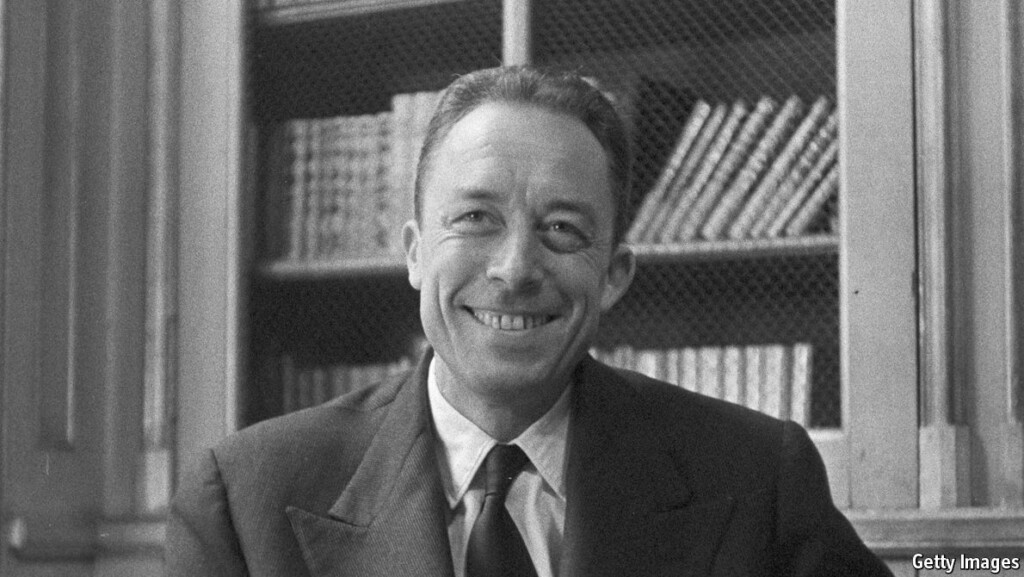
The road was icy that January morning, the kind of cold that makes the air feel brittle and exact. Michel Gallimard was driving, and somewhere along the RN5 near Villeblevin, the car left the road and wrapped itself around a tree with the sudden finality that has no drama in it, only physics. Camus died at forty-six. In his coat pocket, a train ticket, unused — he had changed his plans at the last moment, accepting the lift instead. In his briefcase, one hundred and forty-four handwritten pages of a novel he had been calling Le Premier Homme, the first man, which his daughter Catherine would finally bring to publication in 1994, thirty-four years after the mud of that roadside had swallowed the morning.
There is something almost unbearably literal about an unused ticket. It is the material residue of a choice that cannot be revised, and it belongs to no philosophy, no system, no argument. It simply sits there, the way facts do when they have stopped being instructive and become merely true. Sartre, who had quarreled with Camus for years over precisely the question of whether history could justify suffering, said after the accident that there was something indecent about this death — not tragic in the Greek sense, but absurd in the Camusian one, which is to say: without the consolation of meaning, without the architecture of necessity.
The manuscript in the briefcase was attempting something Camus had not quite managed before. He was writing back toward his own origin — toward the poor streets of Belcourt in Algiers, toward his mother who was partially deaf and nearly mute, toward a childhood that existed entirely outside the categories that European intellectual life had built to understand human experience. The sociologist Pierre Bourdieu, who was himself from a similar world of provincial French poverty, would later argue in La Distinction, published in 1979, that the deepest violence of class is not economic but epistemological — it is the violence of not appearing in the language that counts, of living a life for which the culture has no adequate notation. Camus was trying to write that notation. He was trying to find the words for a humanity that had no ideas about itself, that simply lived and suffered and occasionally, briefly, felt the sun.
This is where the unfinished question lives, not in the accident but in the pages. The question is whether a humanism that has genuinely relinquished God, progress, and historical destiny — not replaced them with irony or aesthetics, but actually let them go — can sustain itself without collapsing into either the warm falseness of consolation or the cold permission of cruelty. Dostoevsky believed, and stated it with the bluntness of a man who had faced a firing squad and been pardoned at the last moment, that without God everything is permitted. Camus spent his entire adult life arguing the opposite: that it is precisely without God that nothing is permitted, that the absence of transcendent justification makes each act of cruelty more inexcusable, not less, because there is no court of appeal, no redemptive arc, no history moving toward justice to absorb the cost of present suffering.
But the manuscript was not finished. The argument had not been completed. And what the one hundred and forty-four pages suggest, in their rawness and their tenderness toward a mother who could barely speak, is that Camus may have been moving toward something that could not be argued at all — something that could only be rendered, placed on the page with the patience of a man who knows that the truth of a life is not its conclusion but its texture, its specific weight, the way light falls on a particular street in a particular city in a year that is already almost gone.
The ticket remained unused. The page remained unturned. And the question he was living toward has the peculiar dignity of all questions that are not answered because the person who was asking them was the only one who could.
🌀 Absurdity, Rebellion & the Search for Meaning
Albert Camus spent his life confronting the silence of the universe with unflinching lucidity, asking whether human existence can hold meaning in the face of the absurd. His philosophical journey resonates deeply with other thinkers and artists who refused easy answers and chose instead the difficult path of authentic inquiry. The following articles explore kindred spirits and intellectual landscapes that illuminate the world Camus inhabited.
Hannah Arendt: the Philosopher Who Unmasked the Banality of Evil
Hannah Arendt, like Camus, dedicated her philosophical life to understanding the human condition under the shadow of totalitarianism and moral collapse. Her concept of the ‘banality of evil‘ echoes Camus’s own confrontation with indifference and the absurdity of historical violence. Together, their works form a powerful meditation on responsibility, freedom, and what it means to remain human in inhuman times.
GO TO THE SELECTION: Hannah Arendt: the Philosopher Who Unmasked the Banality of Evil
Jiddu Krishnamurti: the Man Who Refused to Be God
Jiddu Krishnamurti‘s radical rejection of all external authority and organized belief systems places him in surprising dialogue with Camus’s existential revolt. Both thinkers insisted that genuine freedom could only emerge from direct, unmediated confrontation with one’s own existence. Their parallel calls to strip away illusion and live with clear-eyed awareness make their philosophies deeply complementary.
GO TO THE SELECTION: Jiddu Krishnamurti: the Man Who Refused to Be God
Must-See Movies About the Meaning of Life
The question of life’s meaning stands at the very heart of Camus’s philosophical project, from The Myth of Sisyphus to The Stranger. This curated selection of films explores the same terrain through the language of cinema, asking whether joy, dignity, or purpose can be wrested from a universe that offers no guarantees. For those moved by Camus’s thought, these films offer a powerful and visceral continuation of the inquiry.
GO TO THE SELECTION: Must-See Movies About the Meaning of Life
Deep Movies that Make You Think
Camus believed that true thought must disturb, unsettle, and ultimately transform the one who dares to think it. The films gathered in this collection share that same unsettling depth, refusing comfortable resolutions in favor of honest reckoning with existence. Watching them is an act of philosophical courage that Camus himself would have recognized and applauded.
GO TO THE SELECTION: Deep Movies that Make You Think
Discover Independent Cinema on Indiecinema
The philosophical restlessness that drove Camus finds its natural companion in independent cinema, where filmmakers dare to ask the same unanswerable questions without flinching. On Indiecinema, you will find a carefully curated streaming library of films that confront the absurd, celebrate revolt, and honor the stubborn dignity of human existence. Join us and let the screen become your next philosophical encounter.
👉 EXPLORE THE CATALOG: Watch Indie Films in Streaming
A vision curated by a filmmaker, not an algorithm
In this video I explain our vision

