
The Man Who Was No One
You open the trunk and the smell hits you first — paper, dust, something faintly medicinal, the accumulated breath of a man who spent thirty years writing in rooms no one visited. There are over twenty-five thousand documents inside: poems, philosophical fragments, letters never sent, astrological charts, dramatic texts in three languages, business correspondence written for other people’s companies under other people’s names. The trunk is wooden, battered at the corners, entirely ordinary. It sat in a rented room in Lisbon at 17 Rua Coelho da Rocha for years after its owner died on November 30, 1935, at the age of forty-seven, of liver failure almost certainly related to his drinking, in the Hospital de São Luís. He had published one book of poetry in English, Antinous, and one major collection in Portuguese, Mensagem, which won a secondary prize in a nationalist literary competition he had partly entered to fill out the required number of submissions. Almost no one in Portugal knew his name. The trunk stayed closed.

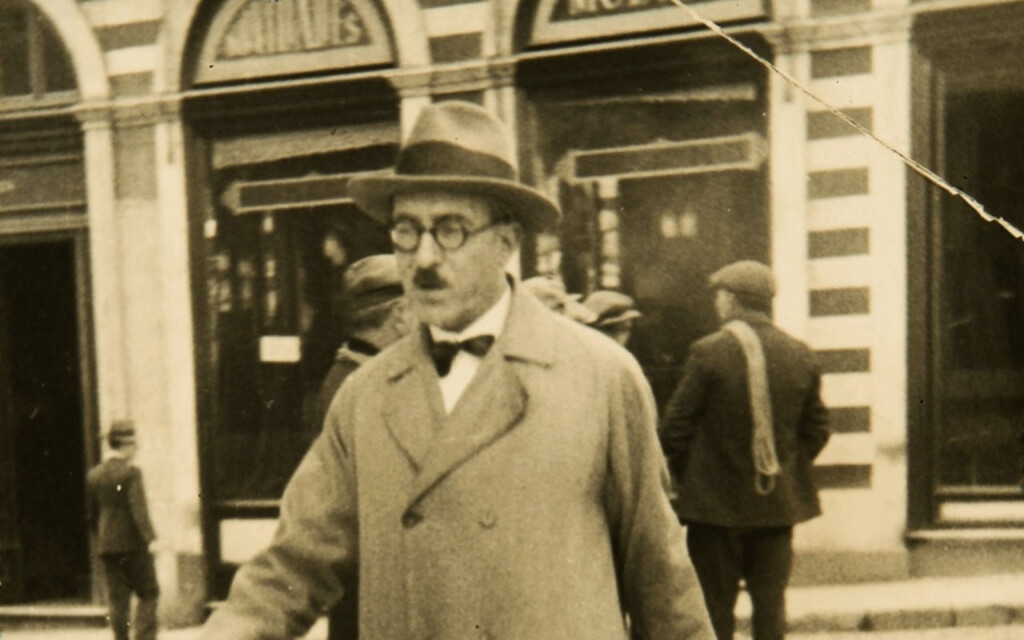
What you are looking at, in that battered box, is one of the most radical experiments in literary selfhood ever conducted — and it was conducted in absolute silence, in obscurity, by a man who worked as a commercial translator and foreign correspondent for Lisbon trading firms, who ate badly, drank excessively, dressed in a dark suit and a felt hat, walked the same streets of the Baixa district with the mechanical regularity of a ghost haunting its own routine. Fernando Pessoa — the name itself means “person” in Portuguese, a linguistic joke so perfect it feels invented — spent his life systematically dismantling the idea that a writer is someone who expresses themselves. He did not express himself. He expressed the absence of himself. And into that absence he poured a literature of extraordinary, unsettling density.
The philosophical stakes of this are not decorative. When the American psychologist William James published The Principles of Psychology in 1890, he proposed that the self is not a unified thing but a stream — a continuous flow of consciousness that creates the retrospective illusion of a single, stable identity. Pessoa, who read voraciously in English and French and was more formed by British empiricism than by any Portuguese intellectual tradition, seems to have taken that dismantling further than James intended. He did not merely acknowledge the multiplicity of the self theoretically. He institutionalized it. He invented what he called heteronyms — not pseudonyms, not masks in the theatrical sense, but fully autonomous persons, each with a biography, a physical appearance, a philosophy, a writing style entirely distinct from the others. Alberto Caeiro was born in Lisbon in 1889, died young of tuberculosis, had almost no formal education, and wrote poetry of an almost violent simplicity about the pure sensory presence of things. Ricardo Reis was educated by Jesuits, was a classicist of rigorous pagan conviction, and eventually went into exile in Brazil. Álvaro de Campos was an engineer, had studied in Glasgow, traveled to the Orient, and wrote sprawling modernist odes of urban delirium. These three, and the semi-heteronym Bernardo Soares who compiled what would become The Book of Disquiet, were not characters in a novel. They reviewed each other’s work. They disagreed philosophically. Campos wrote a furious poem attacking Caeiro’s disciples. Pessoa himself existed among them as one voice among several, diminished by his own creations.
This is not the behavior of a man who wanted to be known. And yet the trunk existed. The manuscripts were kept, dated, organized in an approximate and sometimes chaotic way, but kept. Which means somewhere inside the architecture of radical self-erasure there was a counterforce — something that insisted the work would eventually be read, that the silence was not the final answer, that the man who was no one had nonetheless left behind a body of evidence so vast it would take the rest of the twentieth century to excavate it.
The Kempinsky Method

Drama, by Federico Salsano, Italy 2020.
The introspective imaginary road movie of a man in the maze of his own mind, his memories of his youth, his never dormant passions and contradictory truths. The road is made of water, the destination is falsely unknown. His traveling companions are three mysterious men, projections of his imagination and of different aspects of his personality: the perennial melancholy, the crazy creative, the introverted child. He is also followed by a female presence that tells the umpteenth human story. At a certain point of the crossing he decides to abandon the boat and his ghosts of him diving into the sea and arrives swimming on a deserted beach, naked, with a small Pinocchio puppet closed by a padlock.
In this splendid film life is like a long sea voyage and the human being is a small creature confronting immensity. Sometimes the ocean is calm, other times there are terrible storms. Sometimes we are captains of a boat with a well-defined route, other times we are shipwrecked in search of a land in which to save ourselves. But despite the long journey and the movement in physical space, there are other questions that resonate in the mind: who are these men I travel with? What is the mystery of this immense mass of water that seems to be made of my memories? You can circumnavigate the whole world but the main question always remains the same: who am I really?
LANGUAGE: italian
SUBTITLES: english, spanish, portuguese, german, french
A Biography Built on Erasure
You already know what a poet’s life is supposed to look like. There are the formative ruptures, the exile chosen or suffered, the love affairs that become mythology, the slow public recognition or the dramatic refusal of it. The life is supposed to rhyme with the work, to explain it, to give the reader a map. Fernando Pessoa, born in Lisbon on June 13, 1888, offered none of this, and the absence was not accidental.
His father, Joaquim de Seabra Pessoa, died of tuberculosis in 1893, when Fernando was five. The grief is not recorded in any letter or notebook with the weight we might expect. What follows is a childhood in Durban, South Africa, where his mother remarried a Portuguese consul and the boy was educated in English at Durban High School, excelling in a language that was not native to his blood or his city. He won the Queen Victoria Memorial Prize for English composition in 1903. He was fifteen. The prize is real, documented, almost absurd in its specificity — and yet it illuminates nothing about the interior life we want to access. It is a fact without a wound attached to it, and facts without wounds are useless to biography.
He returned to Lisbon in 1905 and largely never left again. Not in the way that matters. He did not seek Paris, did not attempt London, did not perform the ritual expatriation that so many modernists understood as the price of seriousness. He stayed, worked as a commercial translator and correspondent for Lisbon trading firms, writing business letters in English and French for companies that needed a man who could operate between languages. He was competent, unremarkable, punctual enough to keep the work. This is the entire professional record. There are no dismissals, no scandals, no episodes of spectacular poverty or aristocratic patronage. The sociologist Erving Goffman spent much of his career demonstrating how individuals manage the impressions they project to others, how performance and self-presentation structure every social encounter. Pessoa refused the performance entirely. He gave the social world so little to work with that the world, obligingly, ignored him.
This refusal operated at every scale. He did not marry. He had one significant relationship, with Ophelia Queiroz, a woman he met at a Lisbon office in 1920 and corresponded with in a register so strange — sometimes tender, sometimes ventriloquized through his heteronym Álvaro de Campos — that the letters themselves destabilize any attempt to read them as straightforward romantic documents. The relationship ended, resumed briefly in 1929, and ended again. No children. No household. He lived in rented rooms, moved between addresses, accumulated manuscripts in a trunk that would only be opened and catalogued seriously after his death in November 1935. The trunk contained approximately 27,543 items. Fragments, drafts, letters never sent, texts in three languages, entire philosophical systems partially assembled. A life’s work produced in near-total invisibility.
What is striking is that this invisibility reads, in retrospect, not as failure but as method. The philosopher Giorgio Agamben, writing on potentiality, observed that the capacity not to do something — not to actualize a possibility — can carry more ontological weight than any act of creation. Pessoa’s biography is a sustained exercise in withheld actualization. He did not become the public intellectual, the celebrated poet, the expatriate modernist, the tragic lover. He withheld all of it, and the withholding produced a kind of negative pressure that the work now fills completely.
The life, examined closely, is almost aggressively uneventful. And the aggression is the point. A life that refuses to dramatize itself is not a quiet life. It is a philosophical position taken against the very idea that a self must be legible, consistent, narratable — that a person owes the world a story about who they are.

The Heteronyms as Philosophical Rupture
You sit down to write a letter and realize, halfway through the second sentence, that you do not know who is signing it. Not in the trivial sense of choosing a tone or a register, but in the deeper, more unsettling sense that the hand holding the pen does not belong to a single continuous person. Most people suppress that vertigo immediately and finish the letter. Fernando Pessoa let it swallow him whole.
What emerged from that swallowing was not a collection of pseudonyms. A pseudonym is a mask worn by someone who knows exactly where their face is. What Pessoa constructed between approximately 1914 and his death in 1935 was something structurally different: three complete human beings, each with a distinct biography, a distinct physical bearing, a distinct metaphysical posture toward existence. Alberto Caeiro was born in Lisbon in 1889, grew up in the Ribatejo, had almost no education, and wrote poetry that refused to think — poetry that looked at a stone and saw only a stone, achieving by radical simplicity what centuries of mysticism had failed to reach through complexity. Ricardo Reis was a Latinist, a monarchist, a man who had studied with the Jesuits and carried Horace in his bones, writing odes of such precise, cold beauty that they seemed to arrive from a civilization already extinct. Álvaro de Campos was an engineer educated in Glasgow, a man who had traveled to the Orient, who wrote in long explosive lines that seemed to inhale the entire industrial century and scream it back out in a state of simultaneous ecstasy and collapse.
William James, writing in his 1890 Principles of Psychology, proposed that a man has as many social selves as there are individuals who recognize him — that identity is not a core but a field of relational performances, each one real, none of them complete. It was a radical observation for its moment, and it disturbed the philosophical establishment precisely because it threatened the Cartesian subject at its foundation. But James still believed in a thinker behind the thinking, a self that moved between its multiple social expressions the way an actor moves between roles. He described multiplicity; he did not dismantle singularity. Pessoa looked at that same evidence and drew the only conclusion James had stopped short of: there is no actor. There is no backstage. The roles are all there is, and they do not belong to the same theater.
This is not a poetic gesture or a literary affectation. It is a philosophical position with consequences that most professional philosophy has still not fully absorbed. The heteronyms do not illustrate Pessoa’s inner conflicts — they are not projections of his desires or his repressions, not the id and the superego wearing period costumes. Each one contradicts the others on questions of fundamental importance. Caeiro dismisses metaphysics entirely; Campos devours it with a hunger that borders on self-destruction; Reis disciplines it into stoic resignation. They cannot be reconciled because they were never meant to be unified. Pessoa once wrote, in a letter to Adolfo Casais Monteiro in January 1935, that on the eighth of March 1914 he had gone to a high chest of drawers and begun writing standing up, as if in a trance, and in that standing position had produced over thirty poems. Caeiro had arrived. What Pessoa described was not inspiration. It was colonization.
The distinction matters because colonization implies a prior vacancy — a self porous enough, hollow enough, to be occupied by something that arrives from elsewhere and sets up permanent residence. Every literary tradition before Pessoa had assumed that the author was the house. Pessoa discovered, or perhaps simply admitted, that he was the address, and that several entirely incompatible tenants had been living there simultaneously, each convinced the building was his alone.
Caeiro’s Brutal Innocence
You are standing in a field. Not metaphorically. There is grass. There is a sun. The sun does not symbolize anything. The grass does not represent renewal or the passage of time or the indifference of nature to human suffering. The grass is grass. If that sentence produces in you a faint unease, a sense that something is being withheld, then you have already identified the problem Alberto Caeiro was constructed to diagnose.
Caeiro arrived in Fernando Pessoa’s imagination on March 8, 1914 — a date Pessoa himself described as triumphal, the day he stood at a high chest of drawers and wrote thirty-some poems in a standing row, as if taking dictation from a stranger. The resulting collection, “The Keeper of Sheep,” does not read like Portuguese modernism or like any modernism. It reads like an act of conceptual violence performed in the quietest possible voice. Caeiro is a young man from the Ribatejo who dies of tuberculosis before accomplishing anything. He has almost no education. He tends sheep. He thinks nothing.
That last clause is not a dismissal of his intelligence. It is his entire philosophical position. Caeiro does not think about what he sees — he insists, with a persistence that becomes almost aggressive across the forty-nine poems of the sequence, that thought itself is a disease contracted by people who cannot tolerate the fact that existence requires no commentary. “I don’t have a philosophy, I have senses,” he writes, and the reader trained in the Western tradition of interiority tends to read this as modesty, as pastoral charm, as the literary performance of simplicity. That reading is wrong. It is also a reflex of self-protection.
What Caeiro is actually doing belongs to a lineage that the philosophical tradition has always treated with profound discomfort. Ernst Mach, in “The Analysis of Sensations” published in 1886, argued that the self was not a unified experiencing subject but a bundle of sensations with no fixed center — a position so destabilizing that William James spent years trying to recover something salvageable from it. Caeiro does not recover anything. He accepts the dissolution entirely and then removes even the concept of sensation as something that needs to be theorized. He does not analyze his senses. He has them. The sheep are sheep. The river is water moving. The sky has no opinion about what happens beneath it.
The violence of this position becomes visible when you notice what it dismantles. Interpretation is not merely an intellectual habit — it is the primary mechanism by which human beings sustain meaning across time. When something hurts, we ask why it happened. When something is beautiful, we ask what it means that we find it beautiful. These questions are not philosophical luxuries. They are the architecture of a livable interior life. Caeiro refuses the architecture entirely, not out of nihilism, which would still be a metaphysical position, but out of something more radical: a refusal to grant that the question deserves to be asked. He does not say the world is meaningless. He says meaning is a category error applied to things that simply are.
This is why readers who encounter Caeiro in a literature course tend to move through him quickly, filing him under naïve naturalism and returning to the heteronyms they find more hospitable. Ricardo Reis offers Latin formalism. Álvaro de Campos offers modernist anguish. These figures confirm that interiority is real, complex, worth examining. Caeiro does something else. He looks at a stone and reports that it is a stone and feels nothing missing in that encounter. Most readers do not flee Caeiro because he is simplistic. They flee him because he is demanding in a way that cannot be answered by reading more carefully, thinking more deeply, or accumulating more interpretive sophistication. His demand is that you stop.
Campos and the Body That Cannot Stop
You are standing on a dock somewhere in Lisbon and the ships are leaving and something in your chest is tearing open not with sadness but with a violent, almost obscene desire to be every sailor on every vessel simultaneously, to be the rope and the engine and the salt and the scream of the horn, to dissolve into the industrial sublime until there is nothing left of the self that started wanting in the first place.
That experience — that particular species of annihilation through excess — is what Álvaro de Campos inhabits as his permanent address. Of all the heteronyms Pessoa constructed, Campos is the one who cannot be still. He is the naval engineer educated in Glasgow, the man who has seen industrial Britain and returned to Portugal carrying a wound made of velocity and noise. In the “Ode Triunfal” of 1914 and the “Ode Marítima” of 1915, Campos doesn’t merely write about the modern world — he hurls himself into it like someone who suspects impact will finally produce the sensation of being real. The poems are extraordinary in their length and volume, running through dozens of stanzas in what feels less like verse and more like a body seizing. He wants to be the machines. He wants to be the prostitute and the pirate and the murdered sailor decomposing on some anonymous ocean floor. The hunger is not metaphorical. It is constitutional.
What makes this philosophically precise rather than merely theatrical is how it inverts a diagnosis that Georg Simmel had already delivered eleven years before “Ode Triunfal” appeared. In “Die Großstädte und das Geistesleben,” published in 1903, Simmel argued that the metropolitan individual develops a blasé attitude not from laziness or poverty of feeling but from its opposite — from the sheer overstimulation of urban life forcing the nervous system to protect itself through numbness. The modern city produces a man who has been so relentlessly bombarded by difference and novelty that he can no longer register it. His defenses work too well. He becomes smooth, unreachable, efficient, and secretly hollow. This is not a character flaw Simmel is describing; it is an adaptive mechanism, the mind’s circuit-breaker tripping to prevent total collapse.
Campos refuses to trip the circuit. Where Simmel’s metropolitan type survives modernity by learning not to feel it fully, Campos insists on feeling it completely, which means he is perpetually on the edge of disintegration. His ecstatic identification with machinery, with colonial violence, with the brute fact of industrial power is not celebration — it is a man pressing a live wire against his own skin to confirm he still has a nervous system. The “Ode Marítima” runs to nearly five hundred lines, and its oscillations between euphoria and collapse, between the desire to absorb everything and the terror of being absorbed, trace the exact shape of a consciousness that will not accept the anesthetic that civilization is quietly offering.
There is something almost clinical about what this reveals. Campos understands, at some level below articulation, that the numbness Simmel describes is not neutral — that it costs something, that the man who can no longer be moved by the departure of a ship has not achieved serenity but has instead agreed to a slow amputation. His violence of response, his deliberate excess, his willingness to write himself into degradation and frenzy are acts of refusal. They are ugly and sometimes embarrassing to read precisely because embarrassment is one of the things that the blasé attitude permanently eliminates.
The body Campos cannot stop is not a symbol of freedom. It is a body that has chosen a particular kind of damage over a particular kind of safety, and what it leaves behind in these poems is less a philosophy than a record of the transaction — the full, brutal accounting of what it costs a self to remain permeable to the world that is trying, with considerable force, to make it stop feeling.
A vision curated by a filmmaker, not an algorithm
In this video I explain our vision
The Book of Disquiet as Anti-Monument

You find a trunk after someone dies. Inside, not a manuscript but a problem — thousands of loose pages, undated, unordered, some in ink, some in pencil, some crossed out and rewritten in margins so narrow the words seem to be fleeing the page. No table of contents. No author’s instructions. No ending. The trunk belonged to Fernando Pessoa, and what the pages contained was not a book in any conventional sense but rather the evidence that a book — a closed, bounded, internally coherent artifact — was precisely the wrong shape for what he needed to say.
The Book of Disquiet, assembled by editors for the first time in Portuguese in 1982, more than four decades after Pessoa’s death in 1935, has since been published in dozens of editions that differ from one another in fundamental ways: in the ordering of fragments, in the selection of which passages to include, in the identity they assign to its narrator. Some editions attribute it to a semi-heteronym named Bernardo Soares, an assistant bookkeeper in Lisbon, a figure of deliberate mediocrity. Others absorb it more loosely into Pessoa’s general consciousness. The disagreement is not editorial carelessness — it is the text itself refusing to settle, forcing every reader and every publisher to become a co-author whether they want to be or not.
What Pessoa understood, and what most writers suppress in themselves in order to produce publishable work, is that the experience of interiority does not accumulate into anything. It does not build toward revelation. The mind does not progress from confusion to clarity in the way that narrative structure demands. William James, in his Principles of Psychology published in 1890, described consciousness as a stream — not a series of discrete states but a continuous, undivided flow that the act of introspection inevitably falsifies by freezing it into nouns. Pessoa took this seriously enough to make it structural. Each fragment of the Book is a momentary crystallization, and the moment it hardens into permanence it is already a lie about what consciousness actually does.
The cultural pressure to organize a life into a coherent story is not neutral. The psychologist Dan McAdams, in work developed through the 1990s and into the 2000s, argued that identity in modern Western culture is fundamentally narrative — that we construct stable selves by selecting episodes from memory and arranging them into a story with a protagonist who persists and grows. This is not a description of something natural. It is a description of a very specific cultural demand, one that makes certain lives legible and others pathological. The Book of Disquiet is pathological by this standard, and that is precisely its argument.
Soares, if we name him, works in an office on Rua dos Douradores. He does not travel, does not pursue ambition, does not transform. He watches rain on cobblestones. He drinks bad coffee. He writes sentences about the sensation of existing without quite believing that he exists. This is not poverty of material — it is the deliberate refusal of the biographical arc, the insistence that a human being does not have a plot. Pessoa spent his adult life building an elaborate system of alternative identities, and then, in this text, created a figure so stripped of distinction that his very anonymity becomes a kind of negative theology — a self defined entirely by what it declines to become.
Every published edition of the Book is, in a precise sense, an act of betrayal. The editors who order the fragments, who draw lines between sections, who decide which pages belong and which are merely notes — they are imposing the coherence the text was structured to deny. And yet the betrayal is also inevitable, which is part of what Pessoa seems to have known. The trunk was left accessible. The pages were preserved. He did not destroy them. He handed the problem forward, into time, to people who would be unable to resist solving it — and then be wrong.
Lisbon as Accomplice
You walk the Baixa district of Lisbon at the turn of the twentieth century and almost nothing announces itself as the site of a literary revolution. The streets are still shaped by Pombaline reconstruction, rigid and geometric after the 1755 earthquake, a city that built itself back from catastrophe with the logic of a bureaucratic grid. The trams groan past the Alfama. The river is enormous and indifferent. The cafés fill with men who argue about football and colonial administration and the slow embarrassment of an empire that has been contracting since the Napoleonic wars left Portugal economically prostrate and politically dependent on British goodwill. This is not Paris in 1910, not Vienna, not London. There is no equivalent of the Café de Flore generating manifesto culture, no Bloomsbury drawing room, no Robert Musil arguing with a hostile editor about the manuscript of a thousand-page novel. There is Lisbon, peripheral, dampened by what historians of Iberian culture have called saudosismo institutionalized — a national mood that had calcified nostalgia into political theology, mourning the Age of Discovery as a permanent emotional posture rather than a historical fact.
Pessoa understood this atmosphere not as a limitation but as a kind of negative freedom. When the major modernist centers generate their revolutions, they do so under the pressure of audience, rivalry, and market. Pound needed an adversary. The Zurich Dadaists needed one another. Every manifesto is written partly to win something, to seize territory in a conversation already in progress. Pessoa had almost none of that. The literary journal Orpheu, which he co-founded in 1915 with Mário de Sá-Carneiro and which scandalized the Lisbon cultural establishment with its two published issues before collapsing due to lack of funds, was not a beachhead in a larger war. It was a flare fired into fog. The scandal it caused was local, brief, and fundamentally unserious — the Portuguese press mocked it, one newspaper suggesting its contributors belonged in a psychiatric institution, but no sustained critical debate followed. There was simply no infrastructure for one. And so Pessoa was left alone with his project in a way that Eliot, publishing in London in the same decade, editing and being edited, translating and being translated, simply was not.
What isolation produces, when the mind is capable of sustaining it, is not provincialism but a peculiar kind of extremity. The sociologist Norbert Elias, writing about the civilizing process in 1939, observed that the margins of a social formation often preserve or generate behaviors that the center has already regulated away. Applied to literary culture, the principle is brutal: when you are far enough from the modernist mainstream that its implicit rules cannot reach you, you are also free from its self-imposed ceilings. Pessoa did not need his heteronyms to be legible to a Parisian or London readership. Alberto Caeiro’s flat pastoral nihilism, Álvaro de Campos’s industrial sublime, Ricardo Reis’s neoclassical stoicism — none of these personas had to resolve into something marketable or canonically coherent. They could contradict one another without apology. The trunk that remained in his room at Rua Coelho da Rocha, the famous baú containing over twenty-seven thousand documents, letters, fragments, and manuscript pages discovered after his death in November 1935, was not an archive awaiting publication. It was a mind that had operated without the discipline of external reception, which is another way of saying it had operated without the vanity that reception always introduces.
The political climate tightened around him without ever quite becoming his primary subject. Salazar’s Estado Novo consolidated power formally in 1933, two years before Pessoa died, and the censorship apparatus that would define Portuguese intellectual life for the next four decades was already assembling itself. But authoritarianism, for Pessoa, was less a political crisis than a confirmation of something he had understood about identity long before any regime demanded it of him — that the self presented to the state, to the street, to the employer, is always already a fiction someone else commissioned.
What the Trunk Indicts
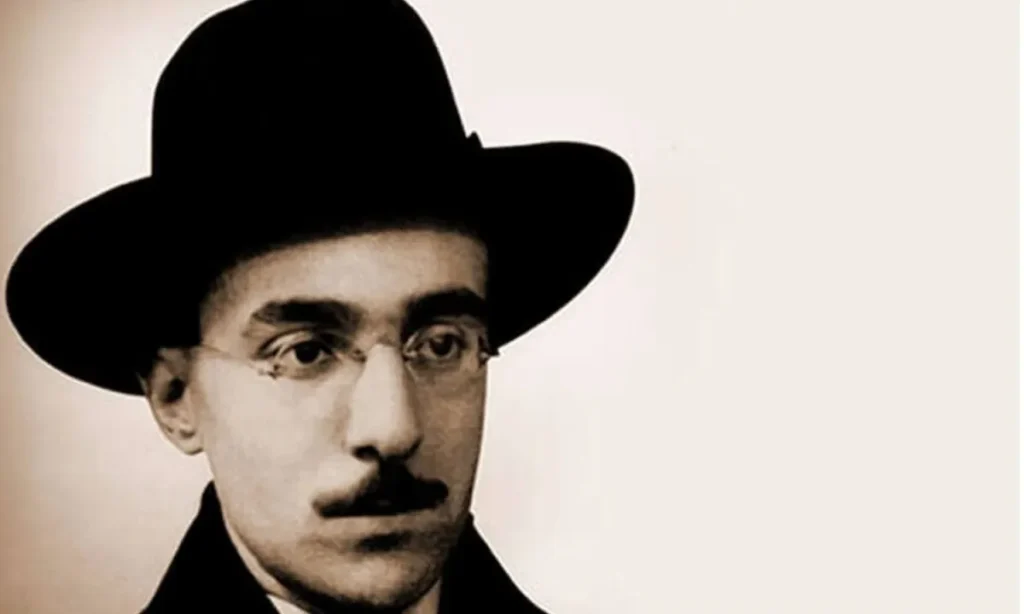
You find the trunk after the funeral. It sits in the corner of a Lisbon apartment that smelled of tobacco and solitude, and inside it there are 27,000 manuscript fragments — poems, philosophical treatises, unfinished novels, letters never sent, notes on astrology, drafts of drafts of drafts — the accumulated sediment of a man who published almost nothing in his own lifetime and yet never stopped writing. The sheer volume is not the shock. The shock is that none of it was hidden. He simply wrote and placed the pages inside the trunk and continued writing. There was no audience implied, no posterity addressed, no romantic gesture toward a future that would understand him. There was only the act itself, sealed and repeated.
Walter Benjamin argued in 1935 that what mechanical reproduction destroys is not the object but its aura — that quality of singular, unrepeatable presence embedded in a work when it exists in one place, at one time, for witnesses who must travel to it. The aura, for Benjamin, was inseparable from the social ritual of encounter: the painting in the museum, the audience in the theater, the reader turning a specific page at a specific hour. What he could not have anticipated is that Pessoa inverted the logic entirely. The manuscripts in the trunk had no aura precisely because they had never been submitted to the ritual of recognition. And yet they were not diminished. They were, in some structural sense, free of the corruption that recognition introduces — the adjustment of language toward reception, the softening of edges for the sake of legibility, the slow accommodation of the self to the shapes an audience is willing to hold.
The narrative that frames Pessoa’s obscurity as tragedy belongs to a cultural mythology that can only evaluate a life backwards, using posthumous fame as the measure of what was real. By that logic, Van Gogh’s paintings became serious only when they began to sell, and Kafka’s novels became literature only when Max Brod disobeyed instructions. What this mythology conceals is the assumption that creation requires ratification — that the work is incomplete until someone else has confirmed it exists. This is not an innocent assumption. It is the mechanism through which markets regulate artistic production, through which institutions decide what counts as culture, and through which individual consciousness is trained to distrust its own activity unless it returns an echo.
Pessoa’s heteronyms — those fully realized alter egos with distinct biographies, philosophies, and stylistic signatures, among them Alberto Caeiro, Ricardo Reis, and Álvaro de Campos — were not personas constructed for publication. They were operative fictions that allowed him to think thoughts his own name could not sustain. The sociologist Erving Goffman, writing in The Presentation of Self in Everyday Life in 1959, described social identity as fundamentally performative, oriented toward an audience whose reactions shape and constrain the self being performed. Pessoa bypassed the audience entirely. The heteronyms were not performances for others. They were structures of genuine cognitive multiplicity that happened to produce text, the way a body produces heat — not as output but as consequence.
The 27,000 fragments do not read like a monument to neglect. They read like evidence of a man who solved, perhaps accidentally, the central philosophical problem of modern authorship: whether the act of writing is fundamentally communicative or fundamentally constitutive. Whether you write to reach someone, or whether writing is what makes you real to yourself regardless of whether it reaches anyone at all. Pessoa kept writing long after it was clear that Lisbon’s literary circles would not absorb him, long after Orpheu collapsed, long after his contemporaries found other lives. The trunk was not a statement. It was not a wager on posterity. And the question it leaves open — whether a work needs a witness to fully exist — is one that every person who has ever written something and then hesitated before sending it already knows how to answer, without being able to say so plainly.
🌀 Masks, Voices, and the Fractured Self
Fernando Pessoa, the poet of heteronyms and infinite identities, invites us to explore the deepest labyrinths of selfhood and literary creation. These related articles trace the philosophical and literary currents that run parallel to his fragmented vision of the human condition, from existential absurdity to the stream of consciousness that dissolves the unified self.
Stream of Consciousness in Literature and Cinema
The stream of consciousness technique, explored by writers from Virginia Woolf to James Joyce, finds one of its most radical expressions in Pessoa’s own prose and poetry. This article examines how the literary rendering of inner thought as a continuous, uninterrupted flow reshaped modern fiction and anticipated postmodern fragmentation of identity. Understanding this tradition illuminates why Pessoa’s Book of Disquiet reads less like a diary and more like a mind unraveling itself on the page.
GO TO THE SELECTION: Stream of Consciousness in Literature and Cinema
Albert Camus: Life and Philosophical Thought
Albert Camus and Fernando Pessoa share a profound meditation on the absurdity of existence and the impossibility of finding stable meaning in a chaotic world. This article traces Camus’s philosophical itinerary through the myth of Sisyphus and the figure of the stranger, both emblems of a consciousness at odds with reality. Reading Camus alongside Pessoa reveals two great European minds who confronted the void with lucidity rather than despair.
GO TO THE SELECTION: Albert Camus: Life and Philosophical Thought
Virginia Woolf: Life and Works
Virginia Woolf, like Pessoa, dismantled the conventional notion of a unified self and explored identity as something fluid, multiple, and perpetually in process. This article examines her life and major works, showing how her narrative experiments transformed the interior life into literary landscape. The parallels between Woolf’s Mrs. Dalloway and Pessoa’s heteronymic universe are striking: both writers insist that the self is never singular, never finished.
GO TO THE SELECTION: Virginia Woolf: Life and Works
Hesse’s Steppenwolf: Analysis
Hermann Hesse’s Steppenwolf presents a protagonist torn between multiple inner selves, much like Pessoa’s heteronyms embody distinct and irreconcilable personalities. This article analyzes the novel’s exploration of the divided self, bourgeois alienation, and the search for authenticity in a fragmented modern world. Hesse and Pessoa, writing in the same turbulent European era, arrived at surprisingly convergent visions of what it means to be many people at once.
GO TO THE SELECTION: Hesse’s Steppenwolf: Analysis
Discover Cinema that Asks the Same Questions
If Pessoa’s restless questioning of identity and reality resonates with you, Indiecinema is the streaming platform where independent and art-house cinema continues that same exploration. Discover films that dare to look inward, challenge narrative conventions, and celebrate the complexity of the human spirit — just as Pessoa did on the page.
👉 EXPLORE THE CATALOG: Watch Indie Films in Streaming
A vision curated by a filmmaker, not an algorithm
In this video I explain our vision

