
The Debtor Who Mapped a World
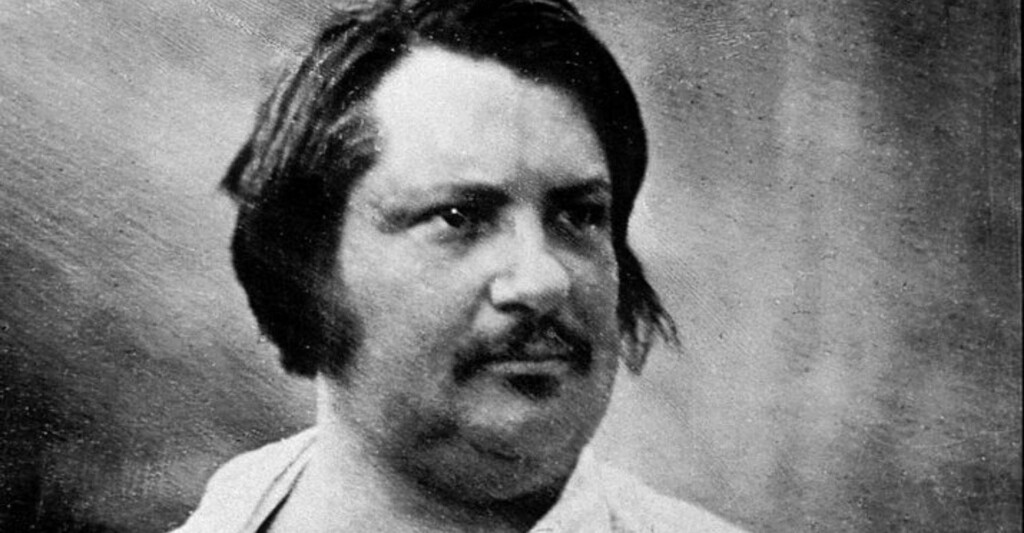
You wake before dawn not because you are disciplined but because the creditors come during daylight hours. The candles are already burning when you sit down — not for atmosphere, not for romance, but because the dark outside means you still have a few hours before the world remembers you owe it something. The coffee is black and wrong and there is too much of it, and you write anyway, because writing is the only mechanism you have that converts time into money fast enough to stay one step ahead of the men who will otherwise come to your door with legal documents and the particular cruelty of the entirely justified. This is not a metaphor for creative struggle. This was the operational reality of Honoré de Balzac’s life for nearly three decades, and every sentence he ever published was written inside that pressure, shaped by it the way a river is shaped by the rock it cannot stop moving against.

Balzac was born in Tours in 1799 into a family that was comfortable enough to give him ambitions and insufficient to fund them. By his mid-twenties he had already failed as a speculative printer, a type-founder, and a publisher, accumulating debts that would follow him across his entire adult life like a second shadow. At one point his liabilities exceeded 100,000 francs — a figure that would take an ordinary Parisian laborer forty years to earn. He never fully escaped. He died in 1850, still in debt, in the house he had spent years trying to furnish to impress a Polish noblewoman who had made him wait nearly two decades before agreeing to marry him. The marriage lasted five months before he was gone. What this biography contains is not the pathos of a genius undone by weakness, but something more precise: the portrait of a man for whom financial catastrophe was not incidental to his art but structural to it.
The sociologist C. Wright Mills argued in 1959, in The Sociological Imagination, that the central task of anyone trying to understand human behavior is to locate the intersection between personal trouble and public issue. Balzac did this before Mills had the vocabulary for it — not as a theoretical exercise but as a survival mechanism. Writing under the weight of personal financial ruin, he found himself uniquely positioned to see what others preferred not to: that money was not merely a practical concern in nineteenth-century French society but the animating force beneath every social performance, every marriage negotiation, every act of apparent generosity or apparent cruelty. His debt made him an involuntary anthropologist of capitalism at the exact moment capitalism was consolidating its grip on the French imagination.
Between 1829 and his death, Balzac produced roughly ninety novels and novellas, gathered under the collective title La Comédie Humaine — a project he conceived as a systematic study of French society in all its registers, from the Parisian banking houses to the provincial drawing rooms where old money calcified into social rigidity. The sheer volume is staggering, but the more important fact is its internal architecture. He understood, by 1842 when he wrote the preface to the collected edition, that he was not writing individual books but a single book with thousands of characters who recurred across different volumes, aging and changing and sometimes dying off-page, exactly as people do in actual cities. Eugène de Rastignac appears as a hungry young provincial in one novel and as a cynical cabinet minister in another. The world he built had the density of accumulation, not the tidiness of invention.
What drives a man to build a world? Not inspiration. Not genius in the comfortable, giftedness sense. Something closer to the experience of someone who has looked at reality so hard and for so long, under conditions of such sustained duress, that they begin to see its actual structure rather than its decorative surface.
A Better Life
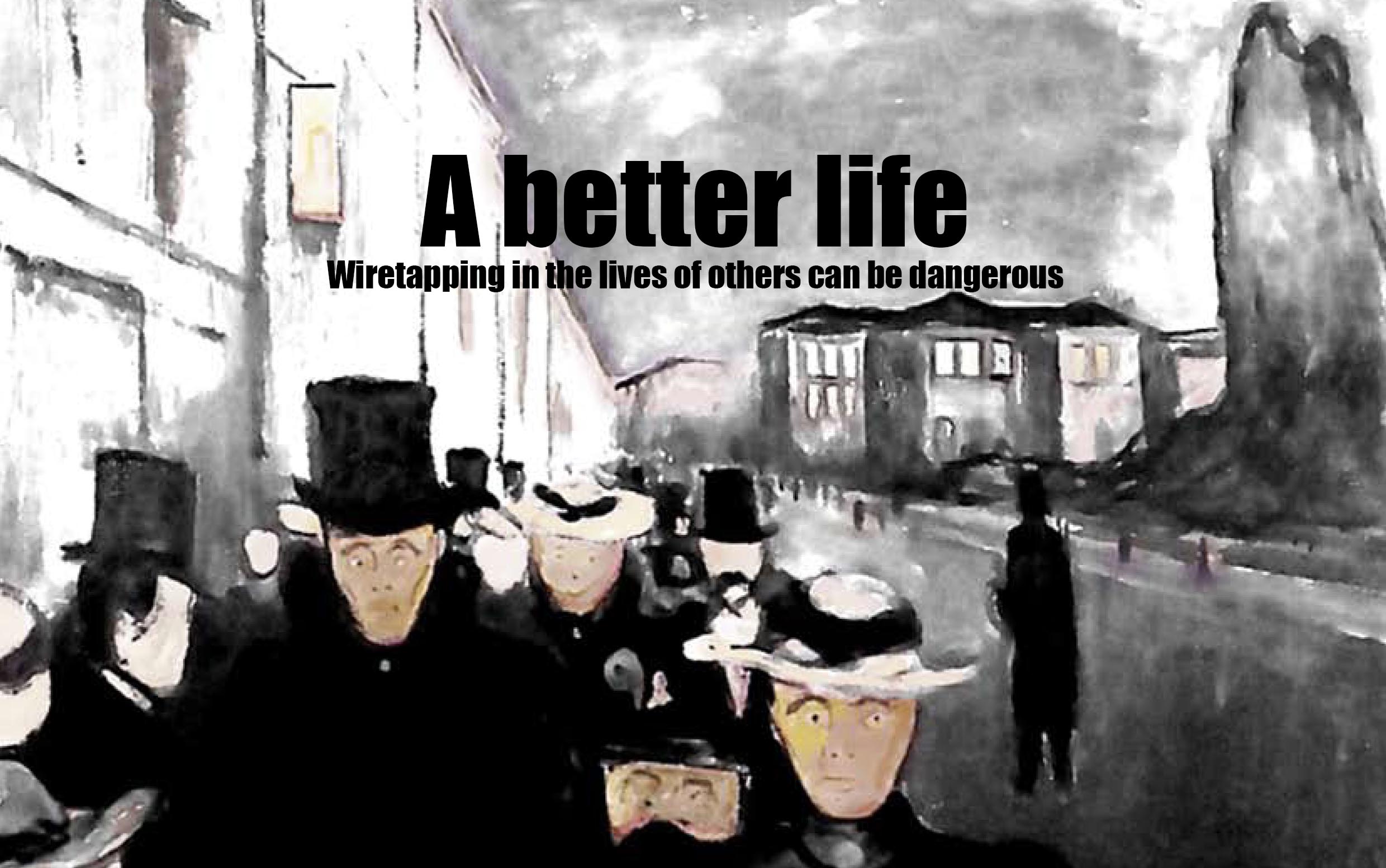
Drama, thriller, by Fabio Del Greco, Italy, 2007.
Rome: Andrea Casadei is a young investigator specializing in audio wiretapping who conducts investigations commissioned by husbands betrayed by their wives, or by parents worried about what their children are doing outside the home. But what interests him most is understanding the human soul, listening to casual conversations in the streets, knowing what people think. He often meets in Piazza Navona with his friend Gigi, a frustrated street artist obsessed with success at all costs, with whom he shares a passion for wiretapping. Shocked by the mystery of the disappearance of Ciccio Simpatia, another street artist common friend, Andrea decides to abandon the commissioned works to seek a better life and reflect on his own and others' existence. He will meet the actress Marina and with a bug he will slowly enter her life until he discovers her most unthinkable secrets. The film deals with an important theme of contemporary Western society: the lack of love. The mysterious and tormented figure of Marina is reflected in a gloomy and soulless Rome.
Director Fabio Del Greco declared about his film: "Perhaps this film is a reflection on the art of observing, of listening, in short, of what one does when one leaves the real world to tell about it. Perhaps he wants to talk about the subtle relationship between the mirages of success touted by today's society, power and the most authentic human relationships.A 'dark cloud' hangs over the city: it is engulfing everyone in a sort of indistinct, uniform mass, where everyone thinks the same things, where everyone they are more alone. Where is the truest part that makes us unique? Maybe you can try to intercept it only secretly."
LANGUAGE: Italian
SUBTITLES: English, Spanish, French, German, Portuguese, Dutch.
Paris as a Living Organism
You are walking through a city that does not know it is being dissected. The streets have names, the buildings have addresses, the people have professions — but underneath all of that, something is being catalogued with the cold precision of a man who has decided that human society is not a moral drama but a biological fact. Honoré de Balzac began assembling La Comédie Humaine in earnest during the 1830s, and by the time death interrupted him in 1850, he had completed ninety-one works — novels, novellas, analytical studies — that were never meant to be read as separate fictions. They were meant to be read as a single organism breathing.
The intellectual architecture behind this ambition was not born in a library of literature. It was born in a lecture hall of natural science. Georges Cuvier, the French naturalist whose Recherches sur les ossements fossiles of 1812 demonstrated that entire species could be reconstructed from a single bone, had established something philosophically explosive: that structure reveals function, that the part contains the logic of the whole, that classification is not a bureaucratic convenience but the deepest form of knowledge available to a mind confronting complexity. Balzac read this and did not see zoology. He saw a method that could be stolen and applied to the arrondissements of Paris, to the notaries and the bankers and the kept women and the failed poets crowding its streets. If Cuvier could look at a femur and tell you how an extinct creature moved through its world, then Balzac could look at a man’s overcoat, his debt, his ambition, and tell you exactly where he stood in the social food chain and how long he had before it consumed him entirely.
What made this diagnostic act so ruthless was its refusal of sentimentality as an analytical tool. The Scenes of Private Life, the Scenes of Provincial Life, the Scenes of Parisian Life, the Philosophical Studies — these divisions within La Comédie Humaine were not aesthetic categories. They were taxonomic. Balzac was mapping the pressure systems of a society that had swallowed the Revolution, digested Napoleon, and arrived at the July Monarchy of 1830 still hungry, still sorting its inhabitants by money rather than by blood, which turned out to be a crueler sorting mechanism than aristocratic birth had ever managed. The old hierarchy at least gave failure a dignified name. The new one simply called it debt.
The recurring character was the instrument through which this taxonomy became visceral rather than theoretical. Eugène de Rastignac appears first as a naive law student in Père Goriot, published in 1835, and migrates through dozens of subsequent works, aging, hardening, accumulating compromises with the precision of compound interest. Vautrin, the criminal mastermind who functions as a kind of dark philosopher of the social order, resurfaces across multiple novels not because Balzac was lazy with invention but because he understood that certain forces in a society do not disappear — they simply change their costume. This cross-pollination of characters across texts was Balzac’s proof that Paris was not a backdrop but an actor, that the city exerted pressures on its inhabitants the way an ecosystem exerts pressure on its species, shaping behavior, pruning weakness, rewarding adaptation with survival and punishing idealism with ruin.
There is something almost clinical in the way he handles money specifically. In Balzac’s Paris, capital does not merely exchange hands — it determines consciousness. A character’s capacity for love, loyalty, even perception shifts according to their proximity to financial security or collapse. César Birotteau, the perfumer who bankrupts himself through vanity and real estate speculation in 1837, is not a moral lesson about pride. He is a case study in how a particular species of bourgeois optimism becomes its own predator under the specific atmospheric conditions of post-Napoleonic commercial Paris. Cuvier would have recognized the logic immediately.

The Invention of Realism’s Trap
You are watching someone you know walk into a party. You have seen them in the morning, unshaven, anxious, rehearsing what they will say. Now they enter the room and something rearranges itself behind their eyes, a kind of shutter closes, and a different person emerges — fluent, confident, desired. You recognize both versions. What you may not have asked is which one is performing and which one is paying.
Balzac asked it with the precision of a forensic accountant. When literary history assigned him the label of realism, it did something quietly catastrophic to the work: it framed his novels as documentation, as though he were a camera pointed at nineteenth-century Paris rather than a surgeon pointing a blade at the tissue underneath. The distinction matters enormously. A camera records surfaces. What Balzac was doing, across the nearly ninety interlocked novels and stories he called La Comédie Humaine between 1830 and 1848, was mapping the invisible circuitry that made surfaces cohere — the system by which money translates into posture, posture into reputation, and reputation back into money. This is not description. It is diagnosis.
Georg Simmel, writing in The Philosophy of Money in 1900, argued that modern capitalism does not merely change what people value — it changes the structure of valuing itself, replacing qualitative human bonds with quantitative equivalences. Balzac reached the same conclusion sixty years earlier through the instrument of character. Eugène de Rastignac, the young provincial who arrives in Paris in Le Père Goriot, published in 1835, does not simply want success. He wants to understand the grammar of a city that speaks exclusively in the language of appearances, and he is talented enough to learn it fast. His education is not sentimental. It is transactional. He watches, he calculates, and he begins to trade — not in goods but in himself, in the controlled display of ambition dressed as charm.
What makes Rastignac philosophically unbearable rather than merely cynical is that he is not wrong. The city he reads so accurately is exactly as he reads it. Paris in 1835 is a place where the social contract has been quietly replaced by a credit system, where every interaction carries a rate of interest, where even grief has a market value. Jean-Joachim Goriot, the ruined pasta merchant who has liquidated his entire fortune for two daughters who will not acknowledge him in public, is the novel’s proof of concept. His love is absolute, and his love is, in economic terms, catastrophically illiquid. He has converted everything — capital, dignity, body — into an asset that pays no return. He dies in a boarding house that smells of rancid fat while his daughters attend a ball. The arithmetic is not cruel. The arithmetic is the cruelty.
This is where the trap embedded in what we call Balzac’s realism becomes fully visible. The trap is not simply that society is brutal. It is that the mechanism for producing brutality runs through intimacy itself. Goriot’s love is not corrupted by capitalism from outside — it is expressed through the logic of capitalism from within. He gives because giving is how he asserts his worth, how he maintains a connection that would otherwise cost nothing and therefore mean nothing to those who receive it. He has internalized the very system that destroys him, and this is not a failure of character. It is the system working as designed.
Honoré de Balzac was born in Tours in 1799 to a family that was itself entangled in the anxieties of social climbing, and he spent much of his adult life in a debt so spectacular — at certain points exceeding one hundred thousand francs — that his writing schedule of sometimes eighteen consecutive hours was less a creative discipline than a financial survival strategy. He did not observe the machinery of money and ambition from a comfortable distance. He lived inside it, which is precisely why he could render it without sentimentality, without the condescension of a man who has never been afraid of the bill arriving.
Born into the Wrong Century
You are eight years old and you have not seen your mother in three years. She has not forgotten you — that would require you to have mattered enough to be forgotten. She has simply filed you, the way one files a document that complicates an inheritance, in a place where your noise cannot reach her dinner table.
Honoré de Balzac was born on May 20, 1799, in Tours, into a France still vibrating from the shock of its own reinvention. The Revolution had just finished devouring its children; Napoleon was weeks away from seizing power; the bourgeoisie was learning, with remarkable speed, to behave like the aristocracy it had beheaded. His father, Bernard-François Balzac, was a self-made administrator from peasant stock who had remade his surname to sound noble and his ambitions to sound respectable. His mother, Anne-Charlotte-Laure Sallambier, was twenty-two years younger than her husband, coldly beautiful, and entirely uninterested in the boy she had produced. Honoré was dispatched to a wet nurse almost immediately after birth, then, at seven, packed off to the Collège de Vendôme, a boarding institution run by Oratorian priests, where he would remain for six consecutive years without a single family visit.
This is not metaphor. The Collège de Vendôme operated on a philosophy of near-total enclosure. Letters were monitored, contact with the outside world was rationed, and boys who broke rules were confined to cells the institution called, without apparent irony, alcoves. Balzac spent time in those alcoves reading everything he could carry inside — theology, philosophy, novels, whatever the school’s small library would surrender. His teachers later noted that he seemed less like a child being punished than a naturalist collecting specimens. What was being formed in those years of institutional silence was not a wound in the sentimental sense, not the romantic orphan nursing his hurt, but something far more dangerous: a systematic attention to the gap between what people say and what they want, between the face a household presents and the transactions occurring behind it.
The philosopher Erving Goffman, in The Presentation of Self in Everyday Life, published in 1956, argued that all social interaction is performance, that the self is not expressed but staged. Balzac arrived at this conclusion empirically, through childhood, a century before the sociological vocabulary existed to name it. A boy who has been managed rather than loved learns early that tenderness has a price, that every gesture of warmth is also a bid for something — status, loyalty, control. He does not become cynical in the cheap sense. He becomes precise. He learns to read the room the way a card player reads a table, not to cheat but because the alternative is to be cheated.
This biographical architecture explains something criticism has never fully resolved about the Comédie Humaine: why its domestic scenes are so electrically uncomfortable, why a dinner party in a Balzac novel feels more dangerous than a battlefield in most other writers. When Eugène de Rastignac arrives at the Maison Vauquer in Père Goriot, published in 1835, what he encounters is not simply poverty — it is a precise social ecosystem in which every object, every meal, every condescension carries the weight of a negotiation. Balzac does not describe that boarding house. He autopsies it. The landlady’s face is read like a contract. The other lodgers are assessed like investments. Intimacy, in that world, is never innocent — it is always already entangled with what it costs and who is paying.
Anne-Charlotte-Laure outlived her son. She survived to read his fame and, by several accounts, remained largely unmoved by it. There is no record that Balzac ever resolved his feelings about her into something clean. What he did instead was convert the unresolvable into method — and populate an entire civilization with people who love each other the way his mother loved him: functionally, conditionally, with one eye always on the door.
The Productive Failure of the Printing Press
You walk into a print shop in 1826 Paris and you believe, with the specific arrogance of a twenty-six-year-old who has already survived on bread and water in a garret on the rue Lesdiguières, that you understand how the world works. Balzac did not just believe this — he staked everything on it, investing in a printing house on the rue des Marais-Saint-Germain with borrowed money from his family and a partner named André Barbier, convinced that the industrial production of text was the mechanism by which a man of intelligence could finally convert his mind into wealth.
The press did not cooperate. Within two years, Balzac had hemorrhaged roughly 100,000 francs — a sum that, in the monetary context of the July Monarchy’s approaching dawn, represented not merely a personal catastrophe but a structural education in what capital actually does when it moves through a business that underestimates overhead, overestimates demand, and confuses the glamour of production with the grinding logic of distribution. He had expanded recklessly into type-founding, acquiring another failing enterprise and compounding the exposure. Creditors materialized. His mother, Laure Sallambier, was implicated in the debt. The printing house folded. The type-foundry was absorbed. What remained was a man who had personally operated the machinery of mid-industrial capitalism and been broken by it before he was thirty.
Karl Marx, writing decades later in the first volume of Das Kapital in 1867, would describe the extraction of surplus value as something that happens largely invisibly, in the space between what a worker produces and what the owner retains. Balzac did not have Marx’s vocabulary, but he had something Marx never possessed: the firsthand experience of being simultaneously the exploiting party and the one being destroyed by the same logic. He had employed workers he could not pay. He had watched the gap between the price of paper and the price of a printed page collapse under the weight of delays, spoilage, and the indifference of the market. He had felt the system from the inside, not as a theorist but as a debtor.
This is precisely what made the debt formative rather than merely ruinous. The 100,000 francs he owed — a figure he would spend the rest of his life failing to repay — never allowed him the luxury of abstracting money into metaphor. When he wrote César Birotteau in 1837, tracing the arc of a perfumer destroyed by speculation and the cruelty of credit, he was not imagining a social type. He was rendering a mechanism he had personally survived, with the precision of someone who still owed money to real people with real addresses. The novel’s financial architecture, its meticulous account of how a bankruptcy unfolds week by week, creditor by creditor, humiliation by humiliation, carries the weight of lived accounting.
The sociologist Pierre Bourdieu argued in The Rules of Art, published in 1992, that the literary field in the nineteenth century constituted itself partly through a rejection of the economic field — that writers positioned themselves as noble precisely by pretending to stand outside the logic of commerce. Balzac’s failure made that pretension impossible for him. He could not romanticize the separation between art and money because money had physically chased him through the streets of Paris for two decades. He wrote at night, in a monk’s robe, drinking coffee by the pot, not because he was cultivating a mythology of suffering but because his creditors could not reach him before dawn and the pages were the only instrument he had to generate the liquidity he owed. The Human Comedy was not composed against the background of financial pressure — it was composed as a direct response to a specific number, accruing interest, held by specific institutions and individuals who knew his name.
What the printing press taught him was that capital does not care about intention.
A vision curated by a filmmaker, not an algorithm
In this video I explain our vision
Women, Letters, and the Architecture of Desire

You write to her before you have met her. The letter goes east, into Poland, into a country that is not quite a country anymore — partitioned, occupied, erased from the map since 1795 — and it lands in the hands of a woman you know only through her handwriting, her syntax, the particular way she arranges a sentence when she wants to say something true. This is 1832. Ewelina Hańska has written to Balzac anonymously, signing herself l’Étrangère, the Stranger. He responds. And then something begins that will last seventeen years and produce, by conservative estimate, nearly two thousand pages of correspondence — a body of prose comparable in density and ambition to entire novels he was simultaneously constructing for the rest of the world.
What Roland Barthes diagnosed in A Lover’s Discourse in 1977 — that the lover’s primary suffering is not rejection but absence, and that language fills the structural void left by the body that is elsewhere — describes exactly the mechanism that powered this exchange. Hańska was, for most of their correspondence, unreachable. Her husband, Wacław Hański, was alive. She was bound to an estate in Ukraine, to a social position, to a life that had no room for a debt-ridden Parisian novelist who worked through the night and owed money to half the publishers in France. And so she remained at a distance that made her perfect: close enough through language to be real, far enough in geography and circumstance to remain ideal. Balzac wrote to a woman he could construct sentence by sentence, paragraph by paragraph, revising her in his imagination with the same ruthless care he gave his characters.
He met her for the first time in Neuchâtel in September 1833 — briefly, chaperoned, electrically charged — and then she was gone again, back into the east, back into the letters. This is what makes the correspondence something other than simple romantic documentation: the meetings were too rare and too short to anchor the relationship in the ordinary friction of presence. What anchored it was prose. Balzac described his financial disasters to her, his ambitions, his physical deterioration, his coffee-fueled nights, his plans for La Comédie Humaine with the same precision he might use to draft a character study. He performed himself for her. Not dishonestly — the suffering was real, the exhaustion was real — but performatively, with full awareness that the page was a stage and that she was reading a version of Honoré de Balzac that he had chosen to send her.
This is where the letters stop being private documents and become, in the most serious sense, literary production. When Balzac wrote to Hańska about his vision of a unified human comedy — a systematic account of French society covering every type, every class, every moral condition — he was not reporting a plan to a friend. He was narrating the self of a great writer into existence, constructing the identity that the work required. The letters and the fiction were not parallel projects. They were continuous with each other, two registers of the same obsessive enterprise: the fabrication of a coherent self from the chaos of lived experience.
Wacław Hański died in 1841. Nine years passed before Balzac and Ewelina actually married, in March 1850, at Berdychiv, in a ceremony that took place while Balzac was already gravely ill with the heart condition that would kill him five months later. He had written toward her for nearly two decades, had organized entire years of his imagination around her existence, and what he finally arrived at — the house prepared in Paris, the furniture chosen, the domestic life assembled in anticipation — was less a marriage than the conclusion of a manuscript.
The Body Eating Itself
Somewhere around three in the morning, a large man in a white monk’s robe sits at a writing desk in Paris, the candles already half-consumed, and reaches for another cup of coffee — not the first, not the tenth, closer perhaps to the fortieth or fiftieth of that single session, the grounds so dense the liquid is nearly black paste. He does not pause to consider his health. He considers a sentence. This was not an occasional excess or a period of crisis but a sustained, deliberate, almost military regimen that Balzac maintained across decades, beginning work at midnight after a few hours of early sleep, writing until noon or beyond, producing in some stretches eighty pages in a single week. The numbers are not metaphorical. Stefan Zweig, reconstructing the life in his 1920 biographical essay, estimated that Balzac produced somewhere in the range of ninety-seven novels and novellas across roughly twenty productive years, the majority of that output manufactured under conditions that would be classified today as severe chronic sleep deprivation combined with stimulant dependency. The body was being used as an instrument. The instrument was being worn to its functional limit.
What this portrait usually becomes, in the hands of literary mythology, is a story about passion — the artist consumed by his art, the romantic sacrifice at the altar of creation. That reading is a sedative. It makes the suffering decorative and the method heroic, which conveniently avoids the actual question the life raises: what was being produced under those conditions that could not have been produced otherwise, and why does a society organized around comfort and distraction make that kind of clarity so structurally expensive to achieve?
Balzac’s project in La Comédie Humaine was not primarily imaginative in the sense of invented. It was observational in the sense of ruthless. He was cataloguing the mechanisms by which bourgeois society actually operated — the way debt functioned as a form of social control, the way marriage was a financial instrument poorly disguised as an emotional one, the way ambition corroded the people who carried it most purely. Père Goriot, published in 1835, does not present a sentimental portrait of paternal love destroyed by ungrateful daughters. It presents the precise economic logic by which affection becomes leverage, and the precise social architecture that makes a man’s value to his children inversely proportional to his financial ruin. That kind of vision does not emerge from comfort. It emerges from sustained, pressurized contact with the actual texture of how people behave when money is involved, which is always.
The philosopher and sociologist Georg Simmel, writing in The Philosophy of Money in 1900, argued that the penetration of monetary logic into every domain of social life produces a specific kind of psychological numbing — people learn not to see the transactional nature of their relationships because seeing it clearly would make ordinary life unbearable. Balzac saw it clearly. He saw it in his own life, drowning in debts that by the 1840s had accumulated to the equivalent of several million euros in modern terms, pursued by creditors, writing under financial pressure so constant it became indistinguishable from his natural atmosphere. The debt was not incidental to the vision. The debt was part of the method of seeing.
By 1848 the body was failing in ways that could not be attributed to a single cause — heart disease, the effects of the coffee, the accumulated damage of decades of nocturnal labor, possibly the lead-based paint he had used obsessively to decorate his house in Passy. He married Ewelina Hańska in March 1850, the Polish noblewoman he had pursued by letter for nearly eighteen years. He died in August of the same year, five months after the wedding, unable to walk without assistance, nearly blind. Victor Hugo visited him the night before his death and found him unrecognizable.
The question that does not resolve itself easily is whether the clarity cost the life, or whether the clarity was the life, and the body simply ran the full length of what it had been asked to carry.
What He Saw That We Still Refuse To
You are standing in a room full of people who all seem to know something you don’t. The clothes are right, the posture is right, the names dropped are the right names, and somewhere beneath the performance runs a current of mild terror that someone will notice the gap between what is projected and what is real. This is not a historical feeling. It is Tuesday.
Balzac spent the better part of four decades anatomizing exactly this condition, and what makes him genuinely unsettling is not his productivity — though writing somewhere between eighty and ninety interconnected novels and stories before dying at fifty-one is its own kind of indictment of excuses — but his refusal to treat the gap between appearance and substance as a moral failure. For Balzac, it was the architecture of modern life itself. In La Comédie humaine, begun in earnest after 1830 and structured as an almost scientific taxonomy of French society, social identity does not precede performance. It is produced by it, retroactively, the way a signature on a bill of exchange creates the fiction of solvency long enough for solvency to sometimes become real.
The economic mechanism here is precise and not metaphorical. Balzac understood credit as a technology of becoming, not merely of borrowing. When Eugène de Rastignac arrives in Paris with nothing but ambition and a presentable face, his entire strategy rests on making the performance of arrival credible enough to generate the actual resources arrival requires. The logic is circular and the circle is the point. What Georg Simmel would later theorize in The Philosophy of Money in 1900 — that money abstracts social relations until trust itself becomes the only real currency — Balzac had already novelized from the inside, from the position of the person running on borrowed time and borrowed identity, feeling the weight of the debt as a physical sensation in the chest.
The reason this continues to land is not that Balzac was prophetic in the sense of seeing something that would later arrive. It is that what he saw had already been in place long enough to be structural, and what is structural does not resolve. Guy Debord wrote in 1967 that in societies organized around spectacle, being has been replaced entirely by appearing, and appearing has been replaced by merely seeming to appear — a progression Balzac would have recognized not as a future catastrophe but as a description of the Faubourg Saint-Germain circa 1835. The distance between a nineteenth-century Parisian dandy maintaining position through strategic debt and a contemporary person curating a life they cannot afford for an audience they do not know is not a distance of kind but of scale and speed.
What remains genuinely difficult to accept — and this is where Balzac stops being comfortable reading — is his insistence that the people trapped inside this system are not its victims in any simple sense. They are its enthusiasts. Vautrin, the escaped convict who functions as the Comédie humaine’s most lucid theorist of power, does not offer liberation from the performance. He offers a more honest relationship to its rules. His argument, delivered with the patience of someone who has already paid the price for naivety, is that the social order is a game everyone is playing and only fools and hypocrites pretend they are not playing it. The scandal is not that some people cheat. The scandal is that the game is the only game and refusing to acknowledge its terms does not exempt you from its consequences.
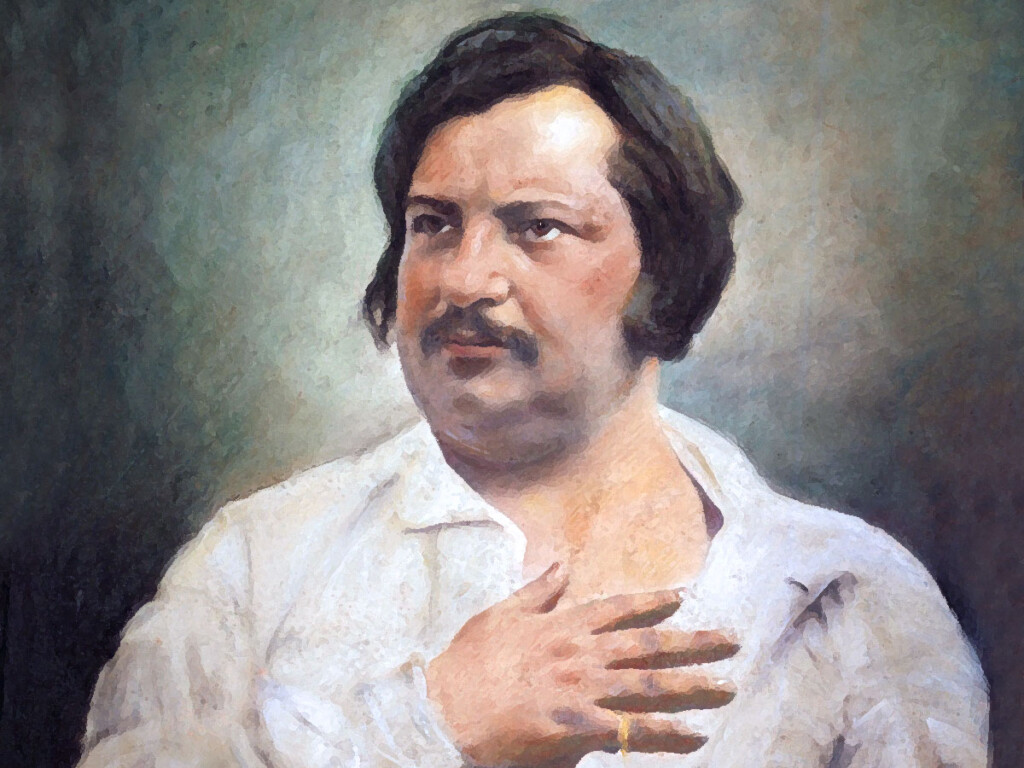
Balzac died in 1850, in debt, his body destroyed by decades of coffee and compulsion, having built a monument to a world that has never stopped being legible because it has never stopped being true.
📚 The Labyrinth of Literary Giants
Honoré de Balzac spent his life constructing an immense literary architecture — La Comédie Humaine — a sprawling maze of interconnected characters and social worlds. Like several of his literary descendants, Balzac was obsessed with the hidden structures beneath human reality. The following articles explore writers who shared his fascination with time, identity, and the infinite corridors of human experience.
Marcel Proust: Life and Works
Marcel Proust, like Balzac, devoted his life to an all-encompassing literary project aimed at capturing the totality of a society. Both writers built vast novelistic cathedrals in which memory, class, and desire intertwine endlessly. Proust’s monumental cycle echoes Balzac’s ambition to make the novel a mirror held up to an entire civilization.
GO TO THE SELECTION: Marcel Proust: Life and Works
Jorge Luis Borges: Life and Works
Jorge Luis Borges shared with Balzac a passion for constructing intricate literary worlds that reflect the complexity of human consciousness. Where Balzac mapped the social labyrinth of nineteenth-century France, Borges charted infinite philosophical and metaphysical mazes. Both writers understood that fiction is ultimately an architecture of the mind.
GO TO THE SELECTION: Jorge Luis Borges: Life and Works
Jorge Luis Borges and the Labyrinth of Identity
Borges’ exploration of identity through labyrinthine narratives offers a fascinating counterpoint to Balzac’s realist universe, where characters perpetually lose and reinvent themselves across dozens of novels. The notion that identity is never fixed but always in transit runs through both authors’ works like a hidden thread. This article illuminates how the maze of self-knowledge haunted literature long before and after Balzac.
GO TO THE SELECTION: In Search of Lost Time by Proust: Analysis
The Voyage as a Metaphor in Literature
The journey as a metaphor is deeply embedded in Balzac’s fiction, where characters travel not only across the French provinces but through treacherous social landscapes. This article examines how literary travel functions as a symbolic structure, connecting Balzac’s restless heroes to a broader tradition of transformative voyages. Understanding this metaphor enriches our reading of the ambitions and failures that populate La Comédie Humaine.
GO TO THE SELECTION: The Journey as a Metaphor in Literature
Discover More on Indiecinema
If these literary worlds have sparked your curiosity, Indiecinema streaming invites you to explore a rich selection of independent films inspired by great literature and the art of storytelling. From intimate character studies to bold experimental narratives, Indiecinema is the place where cinema meets the depth of the written word. Join us and let the screen become your next great novel.
👉 EXPLORE THE CATALOG: Watch Indie Films in Streaming
A vision curated by a filmmaker, not an algorithm
In this video I explain our vision

