
The Labyrinth Before the Man
You walk into a room that should have walls. Every library has walls — that is the first lie they tell you when they hand you a card and show you to the stacks. But here the shelves extend beyond the point where your eye can confirm they stop, and the silence is not the silence of emptiness but of something so full it has ceased to make sound. You pull a book from the nearest shelf. It opens to a page in a language you do not recognize but whose alphabet seems, disturbingly, almost familiar. You put it back. You reach for another. It is the same book. You are not sure you have moved.

There is a specific terror in this experience that has nothing to do with darkness or confinement. It is the terror of sufficiency — the realization that the world contains more meaning than any single life could metabolize, and that knowledge, pursued far enough, does not clarify existence but multiplies its ambiguity exponentially. Most civilizations have built their educational institutions on the premise that learning is emancipatory, that to know more is to become more free. What Jorge Luis Borges spent his entire literary career demonstrating, with the surgical patience of someone who had read everything and concluded nothing was settled, is that this premise is one of the more elegant deceptions the human mind has manufactured for its own comfort.
Borges was born in Buenos Aires on August 24, 1899, into a household already saturated with books. His father, Jorge Guillermo Borges, was a lawyer and aspiring writer who possessed a library in English that his son would later describe as the central fact of his childhood — not the streets of Palermo, not the political upheavals of early twentieth-century Argentina, but the room with the books. By the age of nine, Borges had translated Oscar Wilde‘s “The Happy Prince” into Spanish well enough that it was published in a local newspaper under circumstances that led several readers to assume it was the work of his father. The boy was already disappearing into the archive, already learning that authorship is a more unstable category than signatures suggest.
What makes this biographical detail genuinely unsettling rather than merely precocious is what it anticipates about the nature of creativity itself. The psychologist Lev Vygotsky, writing in the late 1920s and early 1930s on the relationship between thought and language, argued that the inner voice through which humans construct meaning is itself borrowed — assembled from the voices of others, internalized and then mistaken for one’s own. Borges did not need the theoretical framework. He was living its consequences before the theory existed. The translated sentence that passes as original work is not plagiarism; it is the baseline condition of human expression wearing an honest face for once.
His eyesight began deteriorating in his thirties, a hereditary condition that would leave him almost entirely blind by the time he became director of the National Library of Argentina in 1955 — a position of supreme irony so theatrical it seems invented, except that it wasn’t. He once noted that God had simultaneously given him eight hundred thousand books and the darkness in which to not read them. But the joke contains a diagnosis. The library was never truly accessible, not even when his eyes worked. The sheer volume of human recorded thought is not a resource available to a single consciousness; it is an environment that consciousness moves through partially, selecting and misreading and forgetting, constructing what it calls understanding from a fraction of a fraction of what exists.
The ancient Library of Alexandria, before its destruction — a destruction that was not one event but a slow bureaucratic erasure spanning centuries — was estimated to have held between four hundred thousand and seven hundred thousand scrolls. Scholars traveled from across the Mediterranean world to access it and left, by most accounts, more confused about the boundaries of knowledge than when they arrived. The library did not answer questions. It demonstrated how many questions had already been asked and abandoned.
The Kempinsky Method

Drama, by Federico Salsano, Italy 2020.
The introspective imaginary road movie of a man in the maze of his own mind, his memories of his youth, his never dormant passions and contradictory truths. The road is made of water, the destination is falsely unknown. His traveling companions are three mysterious men, projections of his imagination and of different aspects of his personality: the perennial melancholy, the crazy creative, the introverted child. He is also followed by a female presence that tells the umpteenth human story. At a certain point of the crossing he decides to abandon the boat and his ghosts of him diving into the sea and arrives swimming on a deserted beach, naked, with a small Pinocchio puppet closed by a padlock.
In this splendid film life is like a long sea voyage and the human being is a small creature confronting immensity. Sometimes the ocean is calm, other times there are terrible storms. Sometimes we are captains of a boat with a well-defined route, other times we are shipwrecked in search of a land in which to save ourselves. But despite the long journey and the movement in physical space, there are other questions that resonate in the mind: who are these men I travel with? What is the mystery of this immense mass of water that seems to be made of my memories? You can circumnavigate the whole world but the main question always remains the same: who am I really?
LANGUAGE: italian
SUBTITLES: english, spanish, portuguese, german, french
Buenos Aires as a Wound That Thinks
You are nine years old and you speak English before you speak like your neighbors. Your father hands you books in a language that belongs to an ocean you have never crossed, and outside the window Buenos Aires hums with a borrowed confidence it has not yet earned. That gap — between the library and the street, between the accent your family performs and the city’s actual throat — is not an eccentricity of Borges’s childhood. It is the founding wound of his entire intellectual architecture.
Buenos Aires in the early twentieth century was not simply a city. It was an argument, one that had been losing its own case for decades. By 1910, when Argentina celebrated its centenary of independence with a ferocity that looked suspiciously like anxiety, the country had already imported more than three million European immigrants in under thirty years. The city’s elite responded to this demographic flood not with openness but with intensification — a doubling down on European cultural prestige as a marker of class distance. To quote Sarmiento, to read Spencer, to furnish your drawing room with French furniture: these were not pleasures but performances of a threatened distinction. The Borges family participated in this theater, and young Jorge absorbed its rules before he understood they were rules.
His paternal grandmother was English. His father, Jorge Guillermo Borges, was a lawyer with frustrated literary ambitions who read him Keats and Shelley in the original. The family’s home library in Palermo contained more English and Spanish classics than anything that could be called Argentine, and this was not unusual among families of their social register — it was the point. Culture, in that milieu, was a form of border control. What you read announced who you were not, and the city pressing its face against your window, the Italian fruit vendors, the Spanish anarchists, the gauchos dissolving into myth at the edges of the pampa, were precisely what refined reading was designed to keep at a cognitive remove.
What makes Borges genuinely strange, rather than merely privileged, is that this displacement never resolved into comfort. He did not arrive at cosmopolitanism. He arrived at vertigo. The philosopher José Ortega y Gasset visited Buenos Aires in 1916 and observed that Argentine intellectuals suffered from what he called a crisis of horizon — they could see Europe clearly and their own continent not at all. Borges spent years in Geneva and then in Seville during his adolescence, and when he returned to Buenos Aires in 1921, he did not come back to a home. He came back to a problem he now had to solve in prose. The ultraismo he had absorbed in Spain, a poetic movement that rejected sentimentality in favor of pure image, became his first tool — but he wielded it not to celebrate the modern city, as Whitman had celebrated Manhattan, but to excavate the specific, melancholy strangeness of streets that wanted to be somewhere else.
His early poetry collections, Fervor de Buenos Aires in 1923, Luna de enfrente in 1925, and Cuaderno San Martín in 1929, are documents of a man trying to make the local visible to himself for the first time. The effort is tender and also slightly desperate. He writes about patios, about the edges of the city where the buildings stop and the flat land simply continues without apology, about the color of the evening in neighborhoods no European guidebook would mention. But the tenderness does not dissolve the underlying problem. A man who must decide to love his city has already conceded that loving it is not automatic — that it is, in fact, an act of will performed against some competing gravity.
That gravity had a name: the suspicion, never fully buried, that Buenos Aires was a stage set rather than a civilization, and that everyone performing on it — including him — knew this at some level they refused to reach by daylight.

Blindness, Inheritance, and the Library of Babel
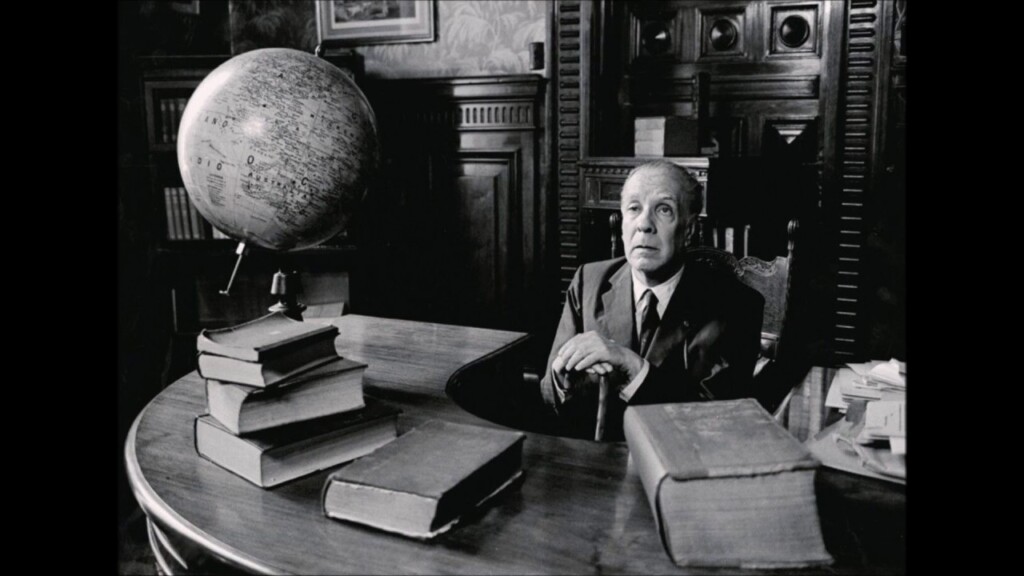
You are standing in a building that contains every book ever written, every book that could be written, every combination of letters that has ever existed or will exist — and you cannot see a single page. This is not a thought experiment. This is what Jorge Luis Borges lived from 1955 onward, when he was appointed director of the National Library of Argentina at the precise moment his hereditary blindness, the same condition that had consumed his father before him, finally closed the last aperture of usable vision. The cruelest symmetry in Argentine literary history was also its most generative paradox: the man given command over nearly a million volumes could no longer read one.
The blindness was not sudden. It arrived the way certain inheritances do — announced in advance, impossible to fully believe until it is already there. Borges had watched his father’s sight deteriorate and had known, with the particular dread of genetic foreknowledge, that his own eyes were operating on borrowed time. This is worth sitting with. He wrote for decades under a private deadline that had nothing to do with publishers or critics. Every sentence he committed to paper during his thirties and forties carried the quiet pressure of a man who knew the light was running out. What looks like maximalist density in his earlier prose — the compression, the recursive labyrinths, the refusal to waste a clause — may be less a stylistic choice than a form of rationing.
By the time he was directing the library from its grand neoclassical building on Mexico Street in Buenos Aires, the text had migrated entirely inward. He composed by dictation and by memorization, holding entire poems and stories in his head before releasing them to another person’s hands. This forced a structural change in what literature could even be. A sighted writer revises against the page, which means the page remains a corrective external authority. Borges, denied that authority, had to make the interior version perfect enough to transmit — which means he had to trust that memory, shaped and reshaped in the dark, was the real text, and the written version merely its deposit. The distinction is not trivial. It inverts every assumption about what writing is for.
The philosopher Henri Bergson, writing in Matter and Memory in 1896, argued that memory is not storage but action — that what we call remembering is actually the mind pressing the past into the shape of present need. Borges arrived at something structurally similar through the body rather than through theory. When memory is your only archive, it does not simply record; it selects, compresses, and transforms according to the pressure of the moment of recall. Every story he dictated after 1955 had already been processed through that living, distorting mechanism. The unreliable narrators, the false encyclopedias, the texts that claim to contain everything but prove only their own incompleteness — these were no longer metaphors about knowledge. They were accurate descriptions of how he actually worked.
What blindness gave him, paradoxically, was a kind of liberation from the tyranny of the visible text. The Argentine tradition he had inherited — its Europeanized literary culture, its anxieties about originality and influence — depended heavily on the authority of printed sources, on footnotes, on demonstrable erudition. Borges had always destabilized that culture by inventing sources and citing nonexistent books with the confidence of a scholar. After 1955, the invented and the remembered became genuinely indistinguishable to him, not as a philosophical game but as a daily cognitive reality. The Library of Babel, published in Ficciones in 1944, had been written before the full darkness fell — but it reads, from the other side of that threshold, like a man who already knew what was coming: the total library, infinite and unnavigable, its reader finally unable to distinguish the real book from the imagined one, and beginning to suspect the distinction never mattered.
Ficciones and the Forgery of Reality
You are reading a book that was written before the book existed. Not metaphorically — literally, structurally, in the way the sentences arrange themselves around an absence and ask you to fill it with your own credulous machinery. This is what Borges accomplished in 1944 with Ficciones, and the reason most readers miss the assault is that it arrives dressed as erudition, as playfulness, as the harmless game of a blind librarian in Buenos Aires who simply loved labyrinths.
Pierre Menard does not translate Don Quixote. He rewrites it, word for word identical to Cervantes, and Borges’ narrator insists with academic solemnity that Menard’s version is richer, more subtle, more contemporary — because meaning is not in the text but in the reader’s relationship to context, to time, to the authority they project onto a page. The story runs barely a few pages and it detonates the entire edifice of literary interpretation, historical attribution, and the cult of original genius. Every museum, every archive, every footnoted biography is performing the same act of ventriloquism that the narrator performs over Menard’s non-existent pages: constructing significance through the ceremony of attention rather than through anything intrinsic to the object itself.
The encyclopedia of Tlön does something structurally more dangerous. It begins as a fictional document — scholars have invented an entire planet, its physics, its language, its idealist philosophy — and then Borges inserts a detail almost in passing: objects from Tlön have begun appearing in the real world. Not as a supernatural event but as an epistemological one. By 1944, Tlön’s invented logic is colonizing academic disciplines and rewriting encyclopedias. The story ends with the narrator retreating to translate a seventeenth-century work he knows no one will read, while the world reorganizes itself around a fiction that has achieved critical mass. What Borges understood, with a precision that sociologists would not articulate until decades later, is that consensus reality is not discovered but manufactured — and that the manufacturing requires only enough institutional repetition to cross the threshold where questioning it feels eccentric. The philosopher Nelson Goodman would argue in Ways of Worldmaking in 1978 that there is no single world, only versions, each constructed through symbolic systems. Borges had already dramatized the process, and crucially had shown its political anatomy: the people building Tlön are not madmen but academics, bibliographers, a millionaire, a secret society working across generations. Reality-forgery is an organized project.
The garden of forking paths arrives last in the collection and completes the philosophical architecture with a violence the other stories achieve only conceptually. A Chinese spy in wartime England must transmit a single piece of information — the name of a city — and does so by murdering a man whose surname is that city’s name. The act will be reported in the newspaper. The message travels inside fact. But the story is also about a novel written by the spy’s ancestor, a novel that contains every possible version of every event simultaneously, a labyrinthine structure in which characters choose all paths at once rather than one. The forking paths are not a metaphor for quantum physics, though physicists have borrowed the image. They are a diagram of how history is narrated: we receive the single line that survived the editorial process of power, and we call it what happened. The paths that were not taken, the versions that were suppressed or simply not written down, do not vanish — they become the negative space inside the authorized account, pressing against it.
Ficciones was published in Buenos Aires during the years when Perón’s rise was reorganizing Argentine public life around myth, spectacle, and the performance of national identity. Borges watched a population absorb a constructed reality and call it truth. He had already written the anatomy of exactly that process, and almost nobody noticed, because it looked like fiction.
Time as the Real Villain
You are reading this sentence at a specific moment you will never recover. That is not a metaphor — it is the central wound that Jorge Luis Borges spent his entire literary career pressing on, with the patience and precision of someone who has decided that comfort is a form of intellectual cowardice. Born in Buenos Aires in 1899, he grew up bilingual in a house full of books, and by the time he published Ficciones in 1944, he had already developed a relationship with time that was less philosophical position and more something closer to an obsession that had found its formal instrument.
Arthur Schopenhauer argued in The World as Will and Representation, first published in 1818, that time is not a feature of reality but a feature of perception — a grid the mind imposes on experience rather than a river that carries us forward. The will, for Schopenhauer, is timeless and brutal, forever cycling through the same hungers without accumulation or growth. What we call history, personal or collective, is the will wearing different costumes. Borges absorbed this and did something Schopenhauer never quite dared: he turned it into narrative structure. In “The Garden of Forking Paths,” published in 1941, the very form of the story enacts the argument — not as allegory but as mechanism. The reader follows a linear plot that is simultaneously undermining its own linearity, so that by the end, causality feels less like a law and more like a superstition maintained by people who need their lives to mean something in sequence.
J.W. Dunne’s An Experiment with Time, published in 1927, proposed that past, present, and future coexist simultaneously, and that dreams occasionally pierce the membrane between them. Borges reviewed this work and took from it not Dunne’s quasi-scientific optimism but its darker implication: if all moments exist at once, then the self that imagines it is moving through time is experiencing a particularly elaborate fiction. The story “A New Refutation of Time,” written between 1944 and 1946, takes this seriously enough to be genuinely unsettling rather than merely clever. Borges describes walking through a specific neighborhood in Buenos Aires and experiencing the physical sensation of having stepped into 1918 — not as memory, not as imagination, but as ontological repetition. He knows the argument is absurd. He makes it anyway, because the absurdity is the point.
What Borges understood, and what his contemporaries largely refused to examine, is that the belief in personal continuity — the conviction that the person who began reading this paragraph is meaningfully connected to the person who will finish it — is not a fact but a narrative we impose retroactively. William James had gestured toward this in The Principles of Psychology in 1890 when he described consciousness as a stream, but even James preserved the metaphor of flow, of forward motion, of a self that persists through its own current. Borges removes the riverbed entirely. In “The Circular Ruins,” a man dreams another man into existence, only to discover at the story’s end that he himself is someone else’s dream. The horror is not supernatural — it is the horror of recognizing that the ground of selfhood is always borrowed from somewhere you cannot locate.
This is why his fiction feels like a trap rather than an entertainment. Readers who come to Borges expecting the pleasures of the labyrinth — the aesthetic delight in complexity for its own sake — often miss the violence embedded in the structure. The labyrinths are not ornamental. They are arguments about what happens to a person who finally accepts that no thread leads out, that the Minotaur at the center is not a monster waiting to be slain but simply the realization that you have been walking in circles and calling it
A vision curated by a filmmaker, not an algorithm
In this video I explain our vision
The Political Body He Refused to Fully Inhabit

You are standing in a receiving line, shaking the hand of a man whose government has made people disappear. Your face is composed. You tell yourself you are there for the literature, for the recognition, for something that transcends the moment’s ugliness. Everyone in the room with any conscience knows this is a lie, but no one says it aloud, because the lie has been agreed upon collectively, the way all social fictions are maintained — through the silent, distributed labor of people who prefer their own dignity to the truth.
Borges accepted the Grand Cross of the Order of Merit from Augusto Pinochet in 1976, the same year the Chilean junta was consolidating a program of torture and forced disappearance that would eventually account for more than three thousand confirmed deaths and tens of thousands of cases of documented abuse. He met with Jorge Rafael Videla in Argentina that same year, shortly after the military coup that inaugurated the Dirty War — a period in which somewhere between ten thousand and thirty thousand people were killed or disappeared by state forces, their bodies thrown from aircraft into the Rio de la Plata. Borges described Videla to the press as a gentleman. He used that word. A gentleman.
What makes this worth examining is not the moral failure in isolation — history is dense with artists who made shameful accommodations with power — but what the failure reveals about a particular intellectual posture that Borges had cultivated across decades. He had built an aesthetic philosophy predicated on the idea that literature operates in a register beyond politics, that the labyrinth of the text exists at a remove from the labyrinth of history. This was not naivety. It was a position, and positions have consequences. When Hannah Arendt wrote in The Origins of Totalitarianism in 1951 that the political is not a domain the intellectual can simply elect to vacate, she was describing precisely the trap Borges walked into — the belief that transcendence is neutral, when transcendence deployed at the right moment, in the right company, is one of the most effective endorsements power can receive.
His anti-Peronism, which was genuine and sometimes courageous, had been a politics he was willing to inhabit when it cost him relatively little and aligned with his class instincts. He was the product of an Argentine oligarchy that viewed Perón’s populism with aristocratic revulsion. When the Peronists removed him from his position at the Miguel Cané Municipal Library in 1946 and appointed him inspector of poultry and rabbits in what was transparently a humiliation, Borges resigned and spoke out. That resistance was real. But it was also legible within the logic of his social world — opposition to Perón was, for men of his formation, something close to a reflex.
What happened with Pinochet and Videla required something different: it required confronting not populist vulgarity but the violence of the very class whose refinement Borges had always aestheticized. The generals wore suits. They read, some of them, or claimed to. They represented an order that felt, in the texture of its self-presentation, closer to Borges’s interior landscape than the crowds Perón had mobilized. And so the machinery of transcendence activated itself, smoothly and without apparent effort, and Borges became a man who accepted honors while corpses were being processed.
The philosopher Jean-Paul Sartre, who refused the Nobel Prize in Literature in 1964 precisely because he believed the award would transform him into an institution and institutions into instruments of power, understood something Borges either could not or would not: that the intellectual who claims to stand above politics has already chosen a side. The stance of elevation is not a position outside the conflict. It is a contribution to it, dressed in the language of art.
The Aleph and the Terror of Total Knowledge
You crouch beneath the stairs in a cellar in Buenos Aires, in the dark, your head at a specific angle, and then you see it — every point in space simultaneously, without superimposition, without confusion, the ocean and the desert and the face of a woman you loved and the face of a woman you never met and every coin ever minted and every act of cruelty ever performed in private, all of it present at once, none of it filtered, none of it sequential, none of it yours to choose or refuse. You do not emerge enlightened. You emerge ruined in a way that has no clinical name, carrying a totality that the human architecture of selfhood was never designed to hold.
The Aleph, published in 1949, is consistently received as one of Borges’s most dazzling metaphysical performances, and that reception is precisely the misreading he seems to have anticipated and even engineered. Readers arrive expecting wonder and find it, because wonder is the easier emotion, the one that lets them close the book and return intact to their sequential lives. But the story’s narrator, a vain and mediocre poet named Carlos Argentino Daneri, is not transformed by his access to the Aleph — he is confirmed in his grotesque ambition, producing a poem so exhaustive it becomes worthless, a map at 1:1 scale. Borges had read Lewis Carroll‘s 1893 meditation on the absurdity of a map that perfectly represents the territory, and he understood that total representation does not illuminate reality; it replaces it with something heavier than what it describes.
What makes the story function as horror rather than marvel is the specific detail that the narrator cannot be certain, afterward, whether what he saw was real or suggested — whether the Aleph beneath the staircase was genuine or a performance by a man protecting his real estate. This epistemological wound is not resolved. The possibility that total knowledge was itself a kind of theatre, staged by a narcissist to impress a rival, transforms the cosmological into the domestic and the sublime into the pathetic. William James, in his 1902 Varieties of Religious Experience, documented dozens of mystical encounters characterized by what he called noetic quality — the absolute conviction, during and after the experience, that genuine knowledge had been transmitted. Borges surgically removes that conviction. His narrator is left not with noetic certainty but with its structural opposite: the permanent suspicion that even the vision of everything might have been nothing.
The self that would need to survive an encounter with totality is the same self built from limitation, from not-knowing, from the particular sequence of choices made possible only because the other choices were unavailable. Simone Weil, writing in the early 1940s in her notebooks collected posthumously as The Need for Roots, argued that attention — genuine, spiritual attention — requires the annihilation of the ego that performs the attending. She meant this as a path toward the sacred. Borges takes the same structural logic and strips it of consolation: if genuine vision requires the dissolution of the seer, then omniscience is not a gift delivered to a person but the condition that makes personhood impossible.
This is why the story ends not in revelation but in forgetting. The narrator’s memory of the Aleph begins to fade almost immediately, and he cannot determine whether this is mercy or further evidence of his own inadequacy. He is left with the residue of having seen everything and retained nothing stable, which is indistinguishable, functionally, from having seen nothing at all. The terror Borges located in total knowledge was not the terror of what might be revealed — the cruelties, the failures, the accumulated weight of human history seen simultaneously — but the terror of what the act of seeing would require you to surrender in order to sustain the vision even for a single unbounded moment.
What the Mirrors Refused to Show
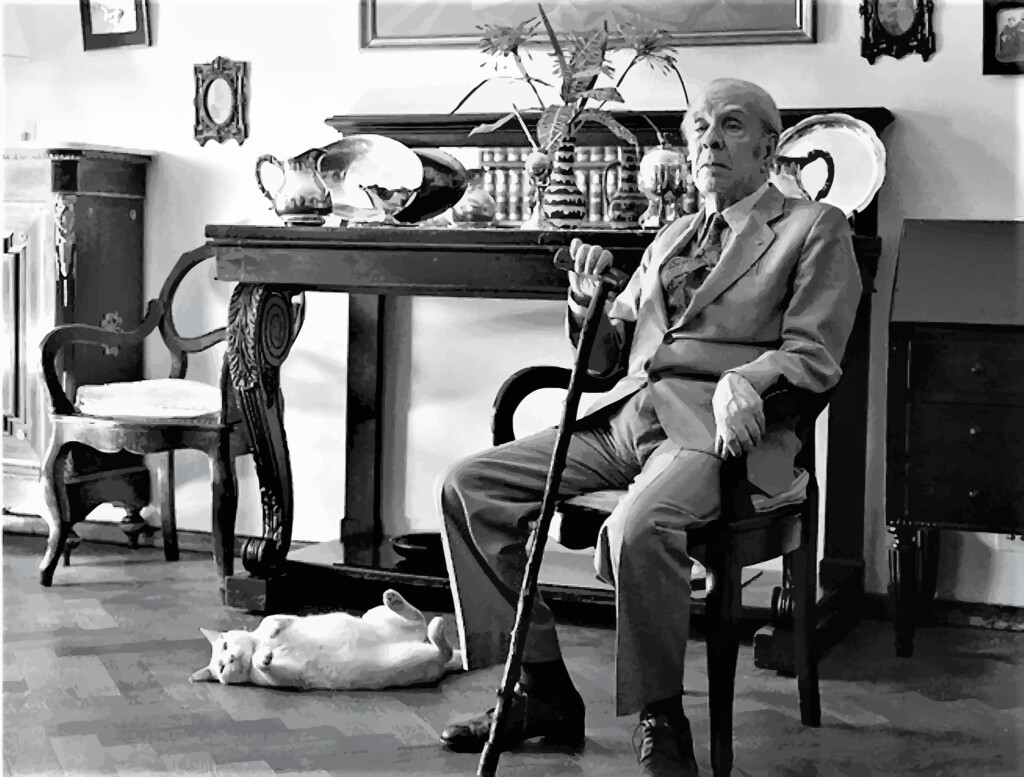
You are standing in front of a mirror, and for a fraction of a second — before recognition kicks in, before the brain performs its familiar stitching — you do not know who that is. The face looking back is just a face. The moment lasts less than a heartbeat, and then the machinery of selfhood reassembles itself and you think: me, of course, obviously, who else. But Borges never trusted that reassembly. He wrote about it in “Mirrors,” in “The Fauna of Mirrors,” in the late poem where he confesses that mirrors have always horrified him, not because they distort but because they duplicate — they insist on the existence of another version of you that you cannot verify and cannot control.
This was not a private neurosis dressed in literary clothing. It was a precise philosophical claim. If there is a you on this side of the glass and a you on that side, then the boundary between original and copy dissolves, and with it the entire architecture of personal identity. Borges lived with declining vision for most of his adult life, eventually losing his sight entirely by his fifties, and the irony was not lost on him: the man most obsessed with the problem of the mirror was slowly granted relief from it. But blindness did not solve the philosophical problem. It only relocated it inward, where the doubling continued without any surface to blame.
What Borges was circling, in the language of labyrinths and library corridors and dreaming men who dream other men, was a problem that analytic philosophy would not fully name until 1984, when Derek Parfit published Reasons and Persons and argued, with clinical precision, that personal identity is not a deep fact about the world. Parfit demonstrated through a series of thought experiments — the branching case, the teleportation case, the gradual replacement of neurons — that what we call the self is a convenient fiction, a narrative we impose on a stream of loosely connected psychological states. There is no moment at which the self is located. There is no substance being preserved across time. The entity that wakes up tomorrow sharing your memories is not you in any metaphysically robust sense; it is simply the next episode in a story that has been running long enough to feel continuous.
Borges arrived at this conclusion through entirely different means — through Schopenhauer, through the Kabbalists, through Berkeley’s idealism and its terrifying implication that objects cease to exist when no one perceives them — and he arrived there decades earlier, in the Buenos Aires of the 1940s, writing fictions that staged the breakdown of identity not as tragedy but as a kind of vertiginous comedy. The hero of “The Circular Ruins” spends years dreaming another man into existence and learns at the end that he himself is someone else’s dream. The joke lands like a blow, because the story has made you identify with the dreamer, and the identification is precisely what gets destroyed.
What neither Borges nor Parfit resolved — what neither could resolve, because it may be constitutionally unresolvable — is what follows from the dissolution. If the self is a fiction, it is a fiction that suffers. It is a fiction that fears death, that grieves, that stands in front of a mirror at three in the morning and feels the cold of the tile through its feet. Parfit himself said that accepting the unreality of personal identity should be liberating, that it loosened the grip of self-interest and made altruism more rational. Borges never claimed liberation. He kept returning to the mirror, kept pressing the problem like a tongue against a broken tooth, as though the discomfort itself were the only honest response to a question that refuses every answer.
The glass gives you back a face, and you call it yours, and that act of naming is the oldest and most unexamined habit in the human repertoire.
🌀 Lost in the Labyrinth: Infinite Minds and Infinite Texts
Jorge Luis Borges spent his life constructing literary labyrinths where identity, time, and reality blur into one another. The writers and works gathered here share his obsession with the self as a maze without exit, and with fiction as a mirror that multiplies rather than clarifies. Exploring these connections is an invitation to wander further into literature’s most vertiginous corridors.
Jorge Luis Borges and the Labyrinth of Identity
Few essays cut closer to the heart of Borges’s universe than an exploration of his lifelong preoccupation with identity as an unstable, labyrinthine construct. Just as Borges questioned whether the author and the man share the same soul, this article unpacks the philosophical architecture behind that very doubt. It is essential reading for anyone wishing to understand how Borges turned selfhood into an infinite regress of mirrors.
GO TO THE SELECTION: Jorge Luis Borges and the Labyrinth of Identity
Pirandello’s One Nobody and One Hundred Thousand: Analysis
Pirandello’s novel is one of the twentieth century’s most daring interrogations of personal identity, following a man who discovers that the self is not a fixed point but a shifting fiction. This thematic obsession places Pirandello in direct dialogue with Borges, who likewise treated the ‘I’ as a convenient illusion draped over an unfathomable void. Reading the two together reveals a shared modernist conviction that the individual is always, at heart, a character in someone else’s story.
GO TO THE SELECTION: Pirandello’s One Nobody and One Hundred Thousand: Analysis
Proust’s In Search of Lost Time: Analysis
Proust’s monumental novel transforms memory into a labyrinth as intricate and disorienting as any Borgesian library, where each recollection opens onto further corridors of lost time. Both writers understood that consciousness itself is a kind of infinite text, forever rewriting and misreading its own past. This analysis of Proust’s masterwork illuminates the deep structural kinship between involuntary memory and Borges’s circular, self-referential narrative worlds.
GO TO THE SELECTION: Proust’s In Search of Lost Time: Analysis
The Journey as Metaphor in Literature
The journey as a literary metaphor is perhaps the oldest framework through which writers have explored identity, fate, and the unknowable. This article traces how the road, the quest, and the labyrinth function as overlapping archetypes across centuries of storytelling, providing a rich context for understanding why Borges made the maze his central symbol. Borges understood that every journey inward is also a journey without a guaranteed return.
GO TO THE SELECTION: The Journey as Metaphor in Literature
Discover More on Indiecinema
The themes that animate Borges’s work — identity, illusion, the infinite, the labyrinthine nature of reality — are also at the very heart of independent cinema’s most daring explorations. On Indiecinema, you will find a curated streaming universe of films that dare to ask the same questions Borges posed on the page. Step through the screen and lose yourself, beautifully, in the cinema of the possible.
👉 EXPLORE THE CATALOG: Watch Indie Films in Streaming
A vision curated by a filmmaker, not an algorithm
In this video I explain our vision

