
The Cork-Lined Room
You are lying in a room that does not want the world inside it. The walls are padded with cork — not metaphorically, not as a decorative gesture, but literally: thick panels of cork fixed to every surface, absorbing sound the way a wound absorbs pressure. The curtains are drawn at all hours. The fumigation candles burn against the asthma, against the dust, against the simple fact of air moving too freely. You have not left this apartment on the Boulevard Haussmann in days, possibly weeks. Time does not behave normally here. It never did.

This was the actual working environment of Marcel Proust for much of the period between 1909 and 1919, the decade in which he produced the structural core of À la recherche du temps perdu — a novel that would eventually run to approximately 1.5 million words across seven volumes, beginning with Du côté de chez Swann in 1913 and completed only posthumously with Le Temps retrouvé in 1927, five years after his death at fifty-one. The cork room at number 102 has become one of literature’s most romanticized images: the fragile genius retreating from a hostile world to retrieve beauty from memory. That image is a comfortable lie, and it serves a specific cultural function.
The lie works because it allows us to separate creation from the conditions of its production. It lets us believe that great art emerges from pure interiority, from some suffering so refined it transcends ordinary circumstance. What it conceals is more unsettling: Proust was not escaping the world. He was engineering its replacement. The cork lining was not passivity but technology — a deliberate apparatus for controlling sensory input the way a laboratory controls variables. He slept through the day and wrote through the night, consuming café au lait and croissants delivered by the Ritz hotel kitchen at hours no restaurant was open, spending the fortune inherited from his mother Jeanne Weil, who had died in 1905 and whose death functioned as both biographical rupture and narrative permission. The room was not a refuge. It was a machine.
Walter Benjamin, writing in his 1929 essay “Zum Bilde Prousts,” understood something about this that most readers resist: that the Proustian enterprise was not the recovery of time but the construction of a particular kind of artificial eternity. Benjamin saw in Proust not a man overwhelmed by involuntary memory but one who had made a total wager — staking his biology, his social life, his body’s ordinary rhythms against a single act of aesthetic capture. The madeleines and the tilted cobblestones are not accidents; they are the visible surface of a methodology that required the systematic destruction of normal temporal experience. You do not accidentally manufacture 1.5 million words. You build a room that makes forgetting impossible.
What disturbs about this, once you see it clearly, is how thoroughly it inverts the story Western culture tells about artistic suffering. The myth insists on passivity: the artist receives, endures, transmits. It grants suffering a kind of innocence. But Proust’s cork-lined existence was aggressive, calculated, and socially violent in its own quiet way — a total appropriation of other people’s time, energy, and emotional availability in service of a project they could not yet read. His housekeeper Céleste Albaret, who managed his nocturnal existence for the last eight years of his life and later described it in her 1973 memoir Monsieur Proust, was not serving a fragile invalid. She was staffing an operation. The tenderness she felt was real; so was the structure she maintained, which bore closer resemblance to a controlled experiment than to a sickroom.
The question the cork room actually poses has nothing to do with Proust’s health. It asks what you are willing to seal out in order to hear what is already inside you.
The Kempinsky Method

Drama, by Federico Salsano, Italy 2020.
The introspective imaginary road movie of a man in the maze of his own mind, his memories of his youth, his never dormant passions and contradictory truths. The road is made of water, the destination is falsely unknown. His traveling companions are three mysterious men, projections of his imagination and of different aspects of his personality: the perennial melancholy, the crazy creative, the introverted child. He is also followed by a female presence that tells the umpteenth human story. At a certain point of the crossing he decides to abandon the boat and his ghosts of him diving into the sea and arrives swimming on a deserted beach, naked, with a small Pinocchio puppet closed by a padlock.
In this splendid film life is like a long sea voyage and the human being is a small creature confronting immensity. Sometimes the ocean is calm, other times there are terrible storms. Sometimes we are captains of a boat with a well-defined route, other times we are shipwrecked in search of a land in which to save ourselves. But despite the long journey and the movement in physical space, there are other questions that resonate in the mind: who are these men I travel with? What is the mystery of this immense mass of water that seems to be made of my memories? You can circumnavigate the whole world but the main question always remains the same: who am I really?
LANGUAGE: italian
SUBTITLES: english, spanish, portuguese, german, french
A Body as Archive
You are already familiar with the room. Not the one you sleep in now, but the one you return to in memory — sealed, slightly airless, where the window stays shut because outside is the enemy. Marcel Proust spent the better part of four decades living inside variations of that room, and the cork-lined walls of his boulevard Haussmann apartment were not an eccentricity but a medical necessity pressed into architectural form. His asthma, first documented clinically in 1880 when he was nine years old, never left him. It changed registers, deepened, occasionally relented, and then returned with renewed authority. Most accounts treat this as context, as biographical coloring. That is the first error.
Friedrich Nietzsche, in On the Genealogy of Morality published in 1887, described ressentiment as the inward turn that occurs when a being is blocked from externalizing its force — when action is denied, the accumulated energy does not dissipate but transforms, becomes something else entirely, something more corrosive and more precise. Nietzsche was writing about morality and power, but he had identified a mechanism that applies with unsettling accuracy to the physiology of chronic illness. When the body cannot move freely into the world, the world is forced to move into the body. Perception compensates. It does not console — it sharpens into something almost predatory.
Proust was not a passive sufferer cataloguing his symptoms. He was a man whose respiratory system had been conducting a decades-long negotiation with reality, and what emerged from that negotiation was a mode of attention so granular it borders on the hallucinatory. The famous involuntary memory, the madeleine dissolved in tea, the uneven paving stones, the stiff napkin — these are not literary devices imported from elsewhere. They are the cognitive signature of a person who has spent years horizontal, deprived of continuous external stimulation, forced to become an archaeologist of sensation because sensation arrives intermittently and therefore lands with disproportionate weight. The ill body does not experience time as a steady current. It experiences it in ruptures, in contrasts between confinement and rare exposure, and this is precisely the temporal structure that organizes all seven volumes of In Search of Lost Time.
Between 1909 and 1922, Proust wrote almost exclusively at night, often between one and five in the morning, fueled by coffee and croissants brought to his bedside, his notebooks filled in a handwriting that deteriorated as the years and the illness progressed. By 1922 he weighed under fifty kilograms. His housekeeper Céleste Albaret, who cared for him during the final decade, described how he would refuse food for days then suddenly demand a specific dish from his childhood with an urgency that had nothing to do with hunger as such. The body was not background. It was the instrument through which the entire architecture of recovered time was being constructed and simultaneously destroyed.
There is a philosophically serious argument to be made — and Proust himself makes it obliquely in The Captive, the fifth volume — that health is a form of amnesia. The functioning body moves through experience efficiently, burning it as fuel, leaving little residue. Illness interrupts that efficiency. It forces residue. The German poet Rainer Maria Rilke, writing in his 1910 novel The Notebooks of Malte Laurids Brigge, arrived at a related idea from a different angle: that suffering is a form of accumulation, a building up of interior material that eventually demands form. Proust’s asthma was not metaphor. It was mechanism — a literal slowing of throughput that caused experience to sediment rather than pass.
What the archive contains, then, is not nostalgia. It is something colder and more structural: the record of a perceptual apparatus that was never allowed to be casual about the world, because the world could at any moment become unbreathable.

The Lie of Voluntary Memory
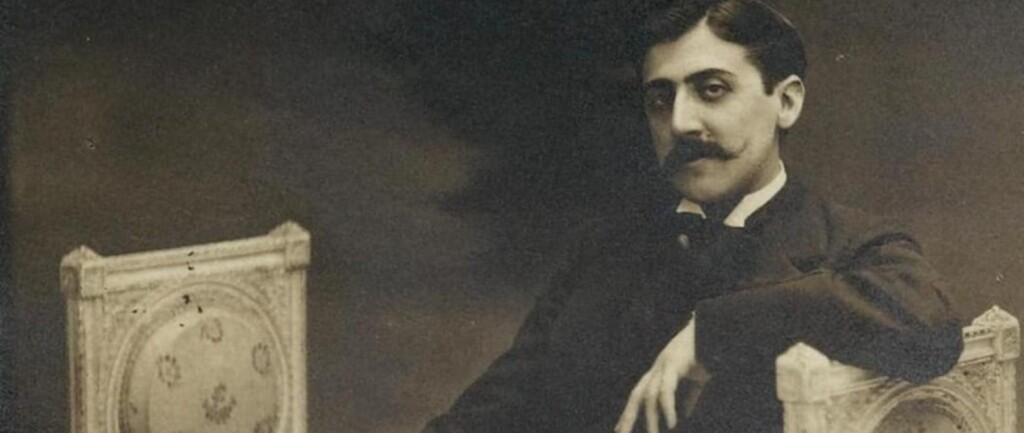
You are sitting at a table, a small cake dissolving on your tongue, and for a moment the present collapses entirely. What floods back is not a fact or a name but a texture — the specific weight of Sunday mornings in a house that no longer exists, a quality of light that no photograph ever captured, a sensation of being held by time rather than moving through it. You do not retrieve a memory. Something retrieves you.
This is the experience Marcel Proust constructs across the seven volumes completed between 1913 and 1927, and the Western literary imagination has been so seduced by its warmth that it has consistently misread what the architecture actually argues. The madeleine dipped in lime-blossom tea, encountered early in Swann’s Way, has become cultural shorthand for the beautiful return of the past — proof, somehow, that what we have lived is never truly gone, only waiting. But Proust’s novel is not a guarantee. It is a prolonged and rigorous investigation into why that belief is almost certainly false.
The distinction he draws between voluntary and involuntary memory is not sentimental. Voluntary memory — the deliberate effort to recall, the act of sitting down and trying to picture your grandmother’s kitchen — produces only an illustration, something assembled from generalities, a composite that resembles the original the way a police sketch resembles a face. It is useful and dead. What involuntary memory delivers, by contrast, arrives without effort and without warning, triggered by sensory coincidence, and its violence lies precisely in the fact that it bypasses the editing intelligence. The narrator does not decide to feel Combray again. His body decides for him. The distinction is between the archive and the ambush.
Frederic Bartlett, working at Cambridge and publishing his findings in Remembering in 1932, was doing with psychology what Proust had been doing with prose. His famous experiments demonstrated that memory is not retrieval but reconstruction — subjects who were asked to recall a Native American folk story after varying intervals did not reproduce what they had read; they reproduced a version shaped by their existing cultural schemas, their expectations, their subsequent experiences. Memory, Bartlett concluded, is not a storehouse. It is a process of imaginative reconstruction performed under the influence of everything that has happened since the original event. The past does not wait intact. It is continuously rewritten by the present that returns to it.
Proust’s narrator, who believes he has recovered Combray, has in fact produced Combray. The seven volumes are not a reclamation project but a creation myth, and the most unsettling implication threaded through the later books — Time Regained, published posthumously in 1927, the same year as Bartlett’s initial lectures on the subject — is that the narrator recognizes this. The work of art he resolves to write at the novel’s close is not an act of faithful preservation. It is an acknowledgment that fidelity to the past is impossible and that transformation is the only honest response to experience.
This matters beyond literature because the cultural use of Proust has been precisely to license a certain kind of nostalgic certainty — the idea that the self has a retrievable core, that identity is something that can be recovered rather than perpetually negotiated. The madeleine has been recruited into a politics of the authentic, a reassurance that underneath the confusion of the present there is a stable, feeling self waiting to be touched back into life. But the novel that contains the madeleine also contains Albertine, who shifts identity across thousands of pages without ever resolving into a knowable person, and a narrator whose most intimate convictions about his own past are shown, repeatedly and without mercy, to be projections dressed as memories.
What Proust actually gives you is not your lost time returned but the precise sensation of believing it has been, which is a different and considerably more disturbing gift.
Salons as Battlefields
You arrive late to a dinner party and the hostess receives you with a smile so calibrated it communicates, without a single audible syllable, that your tardiness has been noted, registered, and filed permanently against you. No one in the room acknowledges what just happened. That is precisely the point.
Norbert Elias, in his 1969 study of Louis XIV’s Versailles, demonstrated that the rituals governing court life were not decorative excess but operational machinery. The geometry of who stood where, who bowed first, who received a glance from the king and who did not — these were not formalities draped over power; they were the substance of power itself. Prestige was not something you brought to the court; it was something the court continuously manufactured and revoked, and the manufacturing process required constant participation. To absent yourself was already to lose ground. To participate without sufficient mastery of the unspoken grammar was to expose yourself as someone who needed to be tolerated rather than welcomed. Elias called this a social pressure so total it shaped the physical comportment, the nervous systems, and the psychological interiors of those who lived within it.
Proust did not observe this world from outside it. He moved through the salons of the Faubourg Saint-Germain with a hunger that was partly social ambition, partly scientific fascination, and partly the particular anguish of someone who understands the mechanism consuming him. He attended the gatherings of Madeleine Lemaire, of Geneviève Straus, of the Countess Greffuhle. He watched how a single cutting remark from the right mouth could effectively end a reputation that had taken decades to construct. He watched how certain families maintained their elevation through the performance of effortlessness — the aristocratic art of appearing not to try, of treating the elaborate architecture of exclusion as though it were simply the natural order of things. And he took notes, not in any literal journalistic sense, but in the way a surgeon takes notes while also being the patient.
What the Recherche does with this material is something no sociology of manners had managed before: it renders the violence internal. When Swann finds himself gradually uninvited, when the Duchess of Guermantes withholds recognition from someone who desperately needs it, the cruelty is never named by those perpetrating it. It disperses into atmosphere, into timing, into the particular texture of a pause before a response. The reader understands the blow has been delivered before any character openly acknowledges it. This is Elias’s self-erasing violence made literary form, made structure, made breath on a page.
There is something additionally precise about the fact that Proust was Jewish, asthmatic, homosexual, and bourgeois — four categories that the aristocratic world of the late Third Republic treated with varying degrees of conditional tolerance. The Dreyfus Affair, which runs like a fault line through the novel’s social world and through Proust’s own biography, forced a moment in which the invisible grammar of exclusion became briefly, scandalously legible. Families fractured. Salons split. People who had shared the same dinners for twenty years discovered they had been operating under entirely different assumptions about who belonged and on what terms. Proust was not a neutral witness to this. He signed Émile Zola‘s petition in 1898 at a moment when doing so was not without social cost.
What makes the Recherche irreducible to any sociology, however rigorous, is that Proust was also in love with what he anatomized. The Guermantes name retained its magic for Marcel the narrator even as Marcel the intelligence understood the machinery producing that magic. He documented the precise mechanism by which illusion is generated and was never entirely cured of the illusion. That doubleness — the simultaneous autopsy and seduction — is not a contradiction he resolves, and the reader who expects resolution has misread what kind of book they are holding.
Desire That Cannot Name Itself
You are reading a love story in which the pronouns are lying to you, and you know it, and you keep reading anyway.
Proust spent years revising the manuscripts that would become the Albertine cycle — the volumes centered on captivity, flight, and grief — and scholars who examined his notebooks in the Bibliothèque nationale found something that the published text had systematically erased: a young man named Alfred, a chauffeur, a cyclist, someone whose physical presence in the drafts carries a directness that the final prose buries under feminine grammatical architecture. Alfred Agostinelli, Proust’s secretary and obsession, died in a seaplane crash in May 1914 over the Mediterranean, and the grief that followed was not merely biographical fuel. It was a structural crisis that forced Proust to solve an engineering problem no novelist had faced in quite the same way: how do you write desire you cannot name without falsifying the emotional truth that makes the writing worth doing at all?
The Third Republic’s social regime was not a dictatorship of explicit prohibition so much as a machinery of inference and implication. The trials of Oscar Wilde in 1895 — their transcripts reprinted in French newspapers, their outcome translated into a social lesson that crossed the Channel with remarkable efficiency — established the cost of visibility with a precision no law needed to spell out. What Proust understood, perhaps before he understood it intellectually, was that silence is not the absence of language but a pressure that bends every sentence around what cannot be said. The displacement was therefore not cowardice dressed as art. It was a formal consequence of living inside a grammar that had no place for him.
Albertine Simonet arrives in the novel as a girl on a bicycle at Balbec, and she accumulates around her a possessive anxiety so extreme, so architecturally total, that jealousy in the Proustian sense becomes something different from its ordinary meaning. Jealousy here is not the fear of losing a beloved to a rival. It is the epistemological terror of another consciousness that cannot be fully known, a consciousness that carries inside it a whole erotic history that the narrator can never verify, audit, or contain. The genius of the transposition is that the impossibility of knowing becomes more radical, more structurally plausible, precisely because what the narrator suspects Albertine of desiring — other women — is something he himself cannot publicly claim to understand from the inside. The jealousy feeds on a double concealment.
Eve Kosofsky Sedgwick, writing in Epistemology of the Closet in 1990, identified the late nineteenth and early twentieth centuries as the period in which Western culture installed the homo/heterosexual binary as a master term through which identity itself would henceforth be organized and policed. Proust was not simply caught in this structure. He was writing from inside its most acute pressure point, at the moment of its consolidation, and the grammatical displacement of Alfred into Albertine is not a betrayal of that pressure but its most precise record. The architecture of jealousy in the novel is the shape that suppression takes when it is handled by a mind too honest to pretend the suppression is not happening.
What remains is a text that knows more than it says and says more than it knows. The narrator’s obsessive interrogations of Albertine’s past, his installation of her in his apartment like a specimen under glass, his grief when she leaves and his continued grief when she dies — all of this carries an affective weight that exceeds the heterosexual frame the prose has constructed. The reader senses an additional pressure behind every sentence, a meaning that the text is generating without being able to name it, and that sensation of something almost-named, perpetually deferred, is not a flaw in the novel’s design. It is the design.
A vision curated by a filmmaker, not an algorithm
In this video I explain our vision
Time as the Real Antagonist

You are reading a sentence right now, and by the time you reach its final word, the beginning of it is already gone — not stored somewhere retrievable, but genuinely absent, replaced by the sensation of having just read something whose precise texture you can no longer access. This is not a failure of attention. This is time doing exactly what it does, and the fact that it disturbs you slightly is proof that you expected something different from it.
Henri Bergson, whose 1896 “Matter and Memory” arrived in French intellectual life like a quiet detonation, argued that consciousness does not experience time as a sequence of discrete instants but as a continuous flow he called durée — duration, lived and indivisible, where past and present interpenetrate without clean boundary. Bergson was Proust’s cousin by marriage, and the biographical proximity has tempted generations of scholars into a comfortable genealogy: Proust the novelist as Bergson the philosopher translated into prose, the madeleine scene as durée made edible and narrative. The alignment is seductive precisely because it is partially true, and partial truths are the most effective traps available to criticism.
What Bergson’s durée promises is continuity — the self as a river whose waters are always moving but always recognizably the same river. Memory, in this model, is not retrieval but re-immersion; the past is not dead but merely submerged, available to consciousness when the current slows. The consolation embedded in this framework is real and deliberate: Bergson was writing against the mechanistic atomism of nineteenth-century psychology, against the idea that inner life could be dissected into measurable units. His philosophy is, at its structural core, a defense of the self’s coherence across time.
Proust’s novel, across its approximately 1.5 million words published between 1913 and 1927, does something categorically more violent. The Marcel who encounters Albertine in Balbec is not the continuous substrate of the Marcel who mourns her disappearance years later — he is, in the novel’s own insistence, a different person who happens to share a name and a body with the earlier one. Proust does not dissolve the boundaries between past and present to reveal an underlying unity; he dissolves them to reveal that there is no underlying unity, only a succession of selves who are strangers to each other and who cannot fully grieve each other because they cannot fully recognize each other. The involuntary memory triggered by the madeleine is not a homecoming — it is a visitation from someone who no longer exists, and its emotional force derives precisely from that impossibility.
This is where the novel cuts against its supposed philosophical source. Bergson’s durée requires that the self persist through its changes as a kind of living continuity. Proust’s architecture requires that it does not — that time is antagonistic not because it erases experience but because it multiplies the experiencer until the original is untraceable. The grief Marcel feels for his grandmother, described in one of the novel’s most formally devastating passages, does not arrive at the moment of her death but more than a year later, when a specific physical gesture accidentally recalls her presence. The delay is not a psychological curiosity; it is the structural argument. The self that loved her was not the self present at her dying, and that self was not the self capable of mourning her, and the chronological distance between these figures is precisely what makes loss irreversible rather than merely painful.
Philosophers tend to treat time as a problem to be resolved — through duration, through phenomenological reduction, through the eternal return. The novel as a form has no such obligation, and Proust understood that the specific power available to fiction was the power to let time remain unresolved, to follow a consciousness across decades and demonstrate not its coherence but the widening gap between who it was and who it has become, with no promise that the distance means anything at all.
What the Dreyfus Affair Revealed
You are at a dinner party sometime in 1899, and the name Dreyfus has just been spoken by someone near the window. Watch what happens to the room. Not the arguments — the bodies. Someone sets down their glass with excessive care. Two people near the fireplace find something urgent to examine in the middle distance. A hostess smiles at no one in particular and pivots the conversation toward the weather with a precision that has nothing accidental about it. The name has functioned not as a word but as a geological event, rearranging the seating chart of the soul.
This is precisely what Hannah Arendt identified in 1951 when she turned her forensic attention to what the Dreyfus Affair actually was beneath its surface noise. In The Origins of Totalitarianism, she argued that the case was not a miscarriage of justice that was eventually corrected, but a rehearsal — a dry run for the catastrophes that would follow in the next century. The French state had not merely wrongly convicted a Jewish artillery officer of treason in 1894. It had revealed that the machinery of modern political life could be turned entirely against truth when truth became socially inconvenient, and that the educated classes would choose the cohesion of their social world over the demands of reality without even experiencing this as a choice. The acquittal in 1906 did not refute her argument. It confirmed it by arriving so late, after so much deliberate institutional obstruction, that it functioned as a kind of autopsy rather than a correction.
Proust had watched all of this with the particular attention of someone who belonged, uncombinatedly, to every side at once: half-Jewish, fully Catholic-educated, embedded in the aristocratic salons that were tearing themselves apart over the Affair, personally convinced of Dreyfus’s innocence in a milieu where that conviction was socially ruinous. He did not put this into his novel as political content. He did something far more disturbing. He encoded it into the grammar of how social reality is constructed and maintained, making it impossible to read a salon scene in In Search of Lost Time without feeling the exact mechanism by which collective perception is manufactured, distributed, and enforced.
What Proust understood, and what takes seven volumes to demonstrate fully, is that ideology does not operate through ideas. It operates through elegance, through timing, through the raised eyebrow and the withheld invitation. The Guermantes do not defend anti-Dreyfusard positions with arguments — they simply radiate a temperature that makes the opposite position feel not wrong but vulgar, unformed, the opinion of someone who does not quite understand how the world works. This is what makes their power so complete and so invisible: it never declares itself. It simply is, the way gravity is, and the social climber who contradicts it does not feel politically defeated but personally insufficient.
The Affair itself appears in the novel episodically, refracted through individual responses rather than narrated as history. What we see is not the case but the cases it made: the cases it made of people, the way it sorted them into their truest selves by demanding a position they had never anticipated being forced to take. Charles Swann, dying, becomes a Dreyfusard with the late, almost serene conviction of someone who has stopped needing the approval of rooms. The Duchess of Guermantes performs her loyalties with the unconscious expertise of someone for whom social survival has become indistinguishable from moral reasoning. These are not characters who have opinions about the Affair. They are characters whose relationship to their own capacity for self-deception is illuminated by it the way a lamp held close to a face shows every line.
Arendt argued that the true horror of the Affair was that the French bourgeoisie looked at antisemitism and found in it not a threat but an entertainment, a social charge that made salons crackle with energy. Proust had already drawn this portrait from the inside, and it looked exactly like a very good party.
The Unfinished Sentence
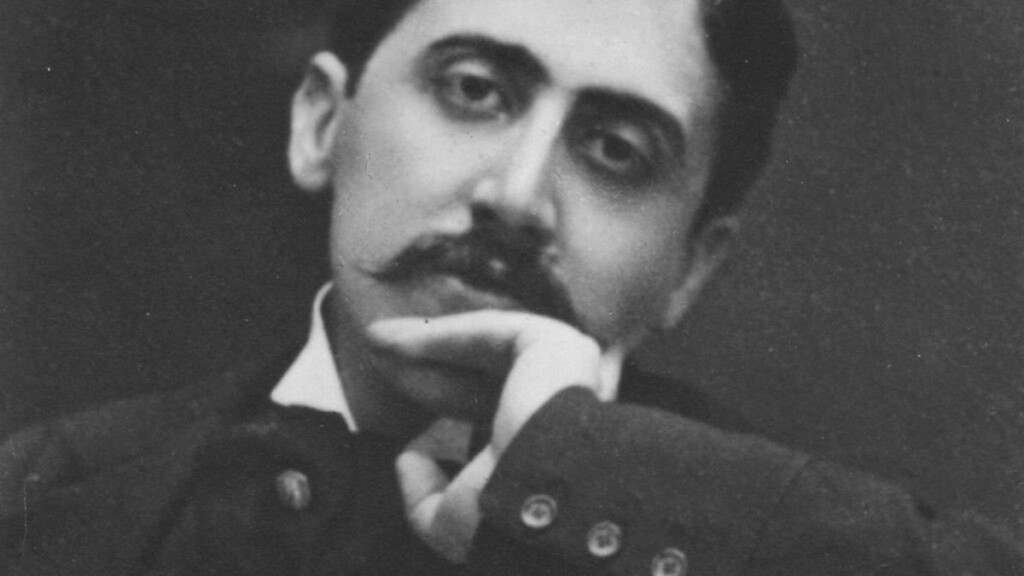
You are reading a book whose last pages were written by a dying man who could not see them. In November 1922, Marcel Proust dictated corrections and additions to his secretary Céleste Albaret from a bed he rarely left, his cork-lined room thick with medicated fumigations, his handwriting on manuscript pages growing so erratic in those final months that editors after his death would spend decades arguing over what he actually intended. He died on the eighteenth of that month, at fifty-one, of pneumonia complicated by the obsessive refusal to be treated in ways that might interrupt his work. The final three volumes of In Search of Lost Time — Sodom and Gomorrah’s concluding sections, The Captive, The Fugitive, and Time Regained — existed in states ranging from heavily revised typescript to barely legible handwritten drafts. His brother Robert, a surgeon with no literary training, prepared them for publication. Which means the architecture you believe you have read is partly a construction raised by hands that were not his.
This is not merely a biographical footnote. It is the structural condition of the entire enterprise. Proust had conceived of his novel as a cathedral, a word he used himself in his correspondence, and he meant it technically: a medieval cathedral is never finished in any absolute sense, its additions and repairs and reconstructions spanning centuries without betraying any single authorial moment. But a cathedral, unlike a sentence, does not require syntactic closure to hold. When a sentence stops before its predicate arrives, something collapses that no subsequent stone can repair. And Proust’s sentence — the longest sustained fictional sentence in European modernism, the one that began roughly in 1909 and was still being revised the morning he died — stopped before he could close it with the full authority he intended. What we read as resolution in Time Regained, that famous crystalline moment where the narrator understands that lost time can be recovered through art, may be precisely the passage Proust had not yet finished refining into what he actually meant.
Walter Benjamin, writing in 1929 in his essay “The Image of Proust,” argued that Proust’s work is not about memory but about forgetting — that the famous involuntary recollections are not recoveries but inventions, fabrications dressed in the emotional costume of the past. If Benjamin is right, then the incompleteness is not incidental to the project but internal to it. A work premised on the radical instability of what we believe we remember cannot, by its own logic, arrive at a stable terminus. To finish it cleanly would have been to betray its governing epistemology. The drafts, the variants, the passages Robert Proust smoothed over without understanding their jagged intention — these are not failures of completion. They are the form taking its argument seriously to the end.
And yet we read it as though it were finished. We read it as though the famous madeleine passage were polished to its final state, as though the jealousy sequences in The Captive represent exactly the weight Proust intended, as though Time Regained delivers a genuine philosophical arrival rather than a draft of one. This collective willingness to receive an incomplete object as whole is not a reading error — it is something far stranger. It reveals that what we call a finished work of literature is always partly a social agreement, a consensus reached between editors, publishers, scholars, and readers who need the thing to cohere more than the author, in the end, was able to make it cohere. Every book is finished by its readers in ways the writer cannot control and often would not sanction.
Proust spent his life trying to recover something he understood, at some level, was unrecoverable — and produced, in that attempt, the longest and most intimate record of a mind refusing to accept that limitation, right up to the moment the mind stopped, leaving the sentence open in a way no one has had the honesty to leave it since.
🌀 Time, Memory, and the Modern Inner Life
Marcel Proust’s monumental work In Search of Lost Time stands as one of literature’s deepest explorations of memory, consciousness, and the passage of time. The articles below trace the intellectual and literary currents that run closest to Proust’s world — from the philosophy of involuntary memory to the stream of consciousness technique and the inner lives of his contemporaries.
Henri Bergson: Life and Works
Henri Bergson‘s philosophy of duration and memory forms one of the most direct intellectual backgrounds to Proust’s literary project, and their shared Parisian world made the connection almost inevitable. Bergson’s insistence that true time is lived and felt rather than measured by clocks resonates throughout every page of In Search of Lost Time. Understanding Bergson is, for many readers, the key that finally unlocks Proust’s vision of consciousness.
GO TO THE SELECTION: Henri Bergson: Life and Works
Bergson’s Matter and Memory: Time and Consciousness
Bergson’s Matter and Memory is the philosophical text most often cited alongside Proust’s novel, as both works wrestle with the paradox of how the past survives and resurfaces within the present. In this book Bergson argues that memory is not a simple archive but a living force that constantly shapes our perception of reality. Reading this analysis alongside Proust reveals how literary form and philosophical argument can mirror one another almost perfectly.
GO TO THE SELECTION: Bergson’s Matter and Memory: Time and Consciousness
The Interior Monologue in Literature: History and Theory
The interior monologue as a literary technique is inseparable from the modernist revolution that Proust helped ignite, transforming the novel into an instrument for capturing the fluid, associative movement of thought. This article traces the history and theory of a form that sought to reproduce consciousness on the page, moving from early experiments to its full flowering in the twentieth century. Proust, Joyce, and Woolf all drew on this technique to create works that feel less like stories told and more like minds observed.
GO TO THE SELECTION: The Interior Monologue in Literature: History and Theory
Virginia Woolf: Life and Works
Virginia Woolf, like Proust, devoted her fiction to the texture of inner experience, the weight of memory, and the way time dissolves and reconstitutes itself within a single mind. Her life and works offer a fascinating parallel to Proust’s project, sharing his commitment to stream of consciousness and his distrust of purely external narrative. Comparing the two writers illuminates the broader modernist ambition to remake the novel as a vehicle for psychological truth.
GO TO THE SELECTION: Virginia Woolf: Life and Works
Discover the Cinema of the Inner World on Indiecinema
If Proust’s meditation on time and memory has moved you, independent cinema offers its own labyrinthine journeys into consciousness, loss, and the hidden life of the mind. On Indiecinema you will find a curated selection of films that share Proust’s slow, luminous gaze — works that trust the viewer enough to let silence and image do what words alone cannot. Step inside and let the screen become another kind of remembrance.
👉 EXPLORE THE CATALOG: Watch Indie Films in Streaming
A vision curated by a filmmaker, not an algorithm
In this video I explain our vision

