
The Young Man Arrives in Paris
You step down from the carriage onto cobblestones still wet from the morning, and the city does not look up. That is the first thing no one tells you about Paris — or about any capital that has ever functioned as the gravitational center of a civilization’s ambitions. It does not receive you. It continues. The horses keep moving, the vendors keep shouting prices into the cold air, the facades of the buildings along the rue du Faubourg Saint-Honoré present themselves with the absolute indifference of things that have already been looked at by ten thousand pairs of burning eyes before yours. You are carrying manuscripts in a leather satchel. You have been told, by people who love you and therefore cannot see you clearly, that you are a genius. You believe them. This is not vanity exactly — it is something more structurally dangerous. It is a self-conception that has never been tested by any force strong enough to deform it.

Honoré de Balzac published Lost Illusions between 1837 and 1843, in three parts that together constitute perhaps the most precise sociological autopsy of ambition ever written in a European language. It is not a cautionary tale in the moralistic sense — that framing would insult it. Balzac was not interested in warning anyone. He was interested in mechanism, in the hidden architecture beneath the visible surface of social life, in what Pierre Bourdieu would later call, drawing partly on Balzac himself, the field — that structured space of positions in which agents compete not merely for money but for the symbolic capital that money can only partially purchase. When Lucien Chardon, who will rename himself Lucien de Rubempré in an act of aristocratic self-invention, arrives in Paris from Angoulême in 1821, he is not simply a young man seeking fortune. He is a unit of provincial energy entering a system designed to convert that energy into something useful for the system, and then discard the converter.
What Balzac understood, with the ferocity of someone who had himself failed spectacularly at business and law before finding his terrain, is that the city does not contain the thing you came looking for. The city contains only the operations by which people like you are processed. The salons Lucien enters, the journalists he befriends, the actresses he falls in love with — none of these are the culture he imagined from Angoulême. They are the machinery that manufactures the appearance of culture, and the appearance is what circulates, what has value, what can be traded. The manuscripts in his satchel are real, in the sense that they represent genuine labor and genuine feeling. But they enter a market in which authentic feeling is simply one raw material among others, less reliably profitable than flattery or speed.
There is a precise moment in the novel when Lucien encounters the newspaper world of the Palais-Royal arcades, that glassed-over commercial space where booksellers, pamphleteers, and opinion merchants operated in the 1820s with the frantic energy of a stock exchange. Balzac describes this milieu with an accuracy that reads less like fiction than like ethnography — because it is ethnography, conducted by a man who had watched careers made and destroyed by column inches, who understood that by 1820 the press had become not a vehicle for ideas but an industry for producing the social reality in which ideas either gained traction or died. Lucien does not understand this yet. He still believes that talent rises by its own gravity, that the relationship between quality and recognition is roughly proportional. This belief is not naïveté in the pejorative sense. It is the specific ideology that provincial educational systems — and most educational systems — install in their most gifted students, because it keeps those students producing, keeps them feeding the machine with their best work, right up to the moment the machine shows them what it actually runs on.
A Better Life
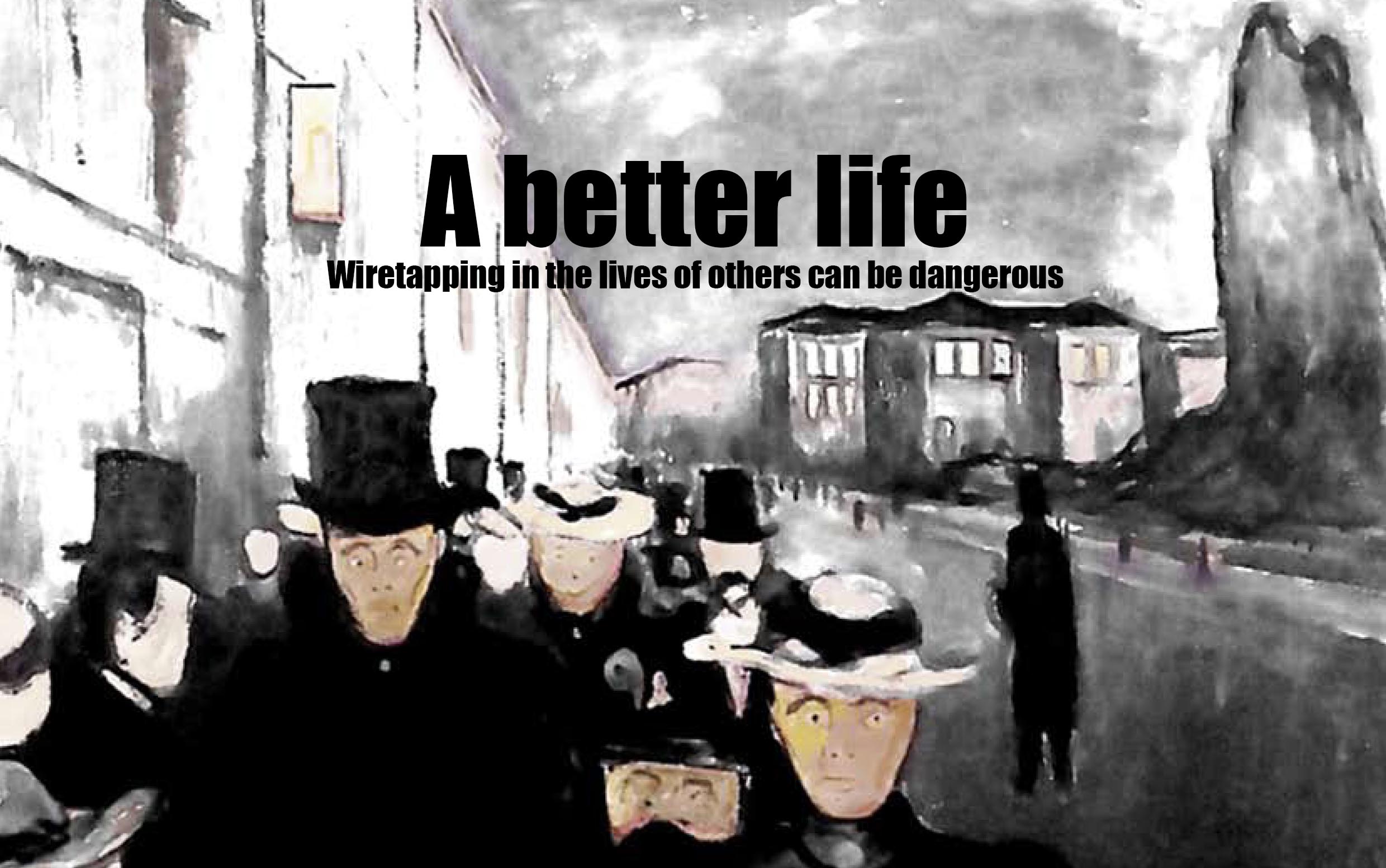
Drama, thriller, by Fabio Del Greco, Italy, 2007.
Rome: Andrea Casadei is a young investigator specializing in audio wiretapping who conducts investigations commissioned by husbands betrayed by their wives, or by parents worried about what their children are doing outside the home. But what interests him most is understanding the human soul, listening to casual conversations in the streets, knowing what people think. He often meets in Piazza Navona with his friend Gigi, a frustrated street artist obsessed with success at all costs, with whom he shares a passion for wiretapping. Shocked by the mystery of the disappearance of Ciccio Simpatia, another street artist common friend, Andrea decides to abandon the commissioned works to seek a better life and reflect on his own and others' existence. He will meet the actress Marina and with a bug he will slowly enter her life until he discovers her most unthinkable secrets. The film deals with an important theme of contemporary Western society: the lack of love. The mysterious and tormented figure of Marina is reflected in a gloomy and soulless Rome.
Director Fabio Del Greco declared about his film: "Perhaps this film is a reflection on the art of observing, of listening, in short, of what one does when one leaves the real world to tell about it. Perhaps he wants to talk about the subtle relationship between the mirages of success touted by today's society, power and the most authentic human relationships.A 'dark cloud' hangs over the city: it is engulfing everyone in a sort of indistinct, uniform mass, where everyone thinks the same things, where everyone they are more alone. Where is the truest part that makes us unique? Maybe you can try to intercept it only secretly."
LANGUAGE: Italian
SUBTITLES: English, Spanish, French, German, Portuguese, Dutch.
The Machinery of Literary Glory
You arrive in Paris with a manuscript under your arm and a name no one has heard yet, and within a week you understand that the city does not care about what you have written. It cares about who will say you have written it well, and at what price, and in which publication, and whether that publication’s political patrons that month find it convenient to appear generous toward new talent.
Balzac understood this not as cynicism but as mechanism. The Parisian press of the 1820s he anatomized in Lost Illusions was not a corruption of some purer literary ideal — it was the literary world in its actual, operating form, and had been for at least a generation. The Restoration, which returned the Bourbon monarchy to power after 1815, produced a press landscape of violent fragmentation: royalist sheets, liberal organs, Catholic periodicals, and independent ventures that were independent only in the sense that they could be bought by whoever arrived with the larger envelope. The Minerve française, which ran from 1818 to 1820 and published figures like Benjamin Constant and Stendhal, represented one pole of this ecosystem — genuinely combative, intellectually serious, and financially precarious enough that it lasted barely two years before collapsing under the combined pressure of official hostility and insufficient subscriptions. Its short life was instructive. Seriousness, in that market, was a liability.
What replaced seriousness was the machinery Balzac rendered with almost ethnographic precision: the paid review, the planted notice, the manufactured controversy staged between two papers that shared a financial backer. Lucien de Rubempré, the novel’s provincial poet arriving in Paris in 1821 with genuine talent and catastrophically naive expectations, discovers that the review pages of the major journals are not critical spaces but advertising surfaces. A publisher does not send a book to a critic. He sends money to an editor, who assigns the notice to a writer who may or may not have read the work and who understands implicitly that his continued employment depends on the warmth of his praise. The entire apparatus functions not despite the readers’ trust but because of it — because the audience still believes, in 1821, that a notice in a respected paper reflects an honest judgment.
The sociologist Bernard Lahire, in his 2006 study La condition littéraire, documented how the mythology of pure literary vocation has consistently masked the material conditions under which writing is actually produced and distributed. But Balzac was doing this analysis in fiction a century and a half earlier, and doing it with a specificity that academic sociology rarely permits itself. He names the rates. He describes the tiered economy in which a front-page article costs more than a paragraph buried near the advertisements, in which a retraction can be purchased almost as easily as the original notice, in which a newspaper’s declared political allegiance is a business position rather than a conviction — held until a more profitable allegiance becomes available.
This last detail carries a particular brutality. The ideological newspapers of the Restoration were not hypocritical in any simple moral sense. They operated within a system where political position was one product among several, priced according to demand, and the readers who consumed them as sincere expressions of belief were participating in their own deception by choosing to. Balzac does not present this as scandal. He presents it as the air his characters breathe, unremarkable until someone like Lucien arrives who still believes the air should taste different.
What makes the novel devastating rather than merely satirical is that Lucien does not remain naive. He learns the system. He becomes, for a time, competent within it — writing the attacks and defenses he is paid to write, understanding that his signature means nothing beyond its commercial utility. The knowledge does not liberate him. It simply makes him a smaller, more efficient version of everyone around him, and the question the novel begins to press, quietly, is whether that transformation was avoidable or whether Paris was always going to produce exactly this.

Talent as Social Currency
You are handed your first acceptance letter and something dies in the room, though you cannot name it yet. The thing that dies is the version of yourself who made the work without knowing whether it would be wanted.
Lucien de Rubempré arrives in Paris carrying manuscripts the way a person carries a private religion — with the absolute conviction that the object’s value lives inside it, is sealed there, requires no external confirmation. What Balzac stages in the novel’s central movement, with a sociological precision that would not be matched until Bourdieu’s work on cultural fields more than a century later, is the moment that conviction collides with the logic of the market and shatters into something the character can no longer recognize as himself. The poetry does not change. The words remain identical. What changes is the framework through which every other person in Paris assigns it meaning, and that framework is not aesthetic — it is economic.
Marx, writing in 1844 in the Economic and Philosophic Manuscripts, described a process he called estrangement from the product of labor: the worker pours life into an object, and the moment that object enters the circuit of exchange, it acquires a life of its own that is indifferent to and finally hostile toward its maker. He was writing about factory workers in Manchester, but the logic applies with a surgical precision to the literary marketplace Balzac was anatomizing in real time — the Paris of the 1820s, where literary journals multiplied, where publishers like Dauriat operated less like patrons and more like speculators, and where a poem’s worth was settled not by its internal coherence but by its potential to sell issues. What is devastating about Lucien’s trajectory is not that he fails to understand this immediately. It is that he understands it perfectly, adapts to it completely, and still cannot protect himself from what the adaptation costs.
The confusion between intrinsic worth and exchangeable value is not a mistake the naive make. It is a trap the intelligent walk into with full visibility, because the market is not irrational — it offers real rewards, real recognition, real social elevation, and these feel indistinguishable from the validation the artist originally sought. When Lucien begins writing journalism, begins sharpening his prose to wound rather than illuminate, begins calculating the political valence of a review before he calculates its honesty, he is not betraying some pure former self. He is responding to incentive structures that are coherent and consistent and that work. The salary arrives. The invitations arrive. The social doors open. Only in retrospect does the process reveal itself as an exchange in which the deeper cost was never itemized.
What Balzac grasps that most moralistic readings of his novel miss is that talent functions in society not as a fixed quantity but as a social relation. Its value is not determined at the moment of creation but at the moment of circulation, and whoever controls the conditions of circulation controls what talent means. In the Paris of Lost Illusions, that control belongs to editors, salonnières, aristocratic patrons, and the anonymous readership of the boulevard press. Lucien is not exploited because he is weak. He is exploited because he is exceptional — his facility with language makes him maximally useful to systems that have no interest in what language, at its most serious, is for.
There is a character in the novel, barely a secondary figure, who continues writing poetry that no one reads and who appears to suffer no particular crisis of identity because of this. Balzac gives him almost no pages. That proportion is the argument. The one who remains uncorrupted by the market is also the one the novel cannot follow, because the novel, too, is a commodity, and its form requires drama, which requires the exchange, which requires someone willing to sell.
The Mentor as Predator
You arrive in Paris with a manuscript under your arm and the absolute certainty that the manuscript is good. You have read enough to know what good is, and you have written something that meets that standard, and so the city will recognize you. This is not naivety — it is a logical deduction from premises you were taught to hold as axioms.
What Stéphane Lousteau does to Lucien de Rubempré is not seduction in any simple sense. He does not lie to him. He does not install false beliefs where true ones existed. He takes Lucien to a theater, introduces him to the machinery behind the curtain — the paid reviews, the manufactured reputations, the critics who attack books they have never opened in exchange for money from rival publishers — and he says, plainly, that this is how it works. The corruption is not transmitted like a disease. It is revealed like a landscape that was always there, simply obscured by the angle from which Lucien had been looking.
Pierre Bourdieu, writing in The Rules of Art in 1992, argued that the literary field is not a neutral space in which talent floats freely until recognized. It is a structured field of force, governed by competing forms of capital — economic, symbolic, social — and the rules of this field are never posted anywhere. They are acquired through proximity to those who already hold position within it. The mentor’s function, in Bourdieu’s framework, is not to teach technique but to transmit a practical sense of the game, what he called illusio — the shared, largely unconscious investment in the stakes of the field, the belief that the game is worth playing on its own terms. Lousteau does not give Lucien illusio. He gives him a second illusio to replace the first: instead of believing in pure literary value, Lucien will now believe in the mechanisms that manufacture literary value. The trap is identical in structure. Only the content has changed.
What makes this so difficult to locate as harm is that Lousteau is entirely correct in his descriptions. The Paris literary world of the 1820s that Balzac anatomizes in Lost Illusions — published across three volumes between 1837 and 1843 — was precisely as mercantile as Lousteau claims. Newspapers like Le Corsaire and La Pandore operated on exactly the transactional logics he describes. Reviews were bought. Careers were assembled through social networks before they were ratified by readers. Balzac knew this from the inside, having worked as a printer, publisher, and journalist before he became the novelist we remember, accumulating debts that would shadow him until his death in 1850. His diagnosis of the field was not a metaphor. It was testimony.
The mentor-as-predator dynamic works precisely because it is wrapped in the gift of accuracy. The person who shows you how power actually functions — who strips away the official story and replaces it with the operational reality — positions themselves as your liberator. You feel, in that moment, that you are finally seeing clearly. What you do not yet perceive is that the person offering this clarity has a stake in your disillusionment, that your transition from idealist to cynic is itself a form of recruitment into a system that requires new participants to sustain itself. Lousteau needs Lucien to understand the game because a Lucien who still believes in pure literary merit is useless to the network Lousteau inhabits.
The initiated are always initiating. This is not a conspiracy — it requires no coordination, no shared intention. It is simply the structural consequence of a field that reproduces itself through the conversion of newcomers, each of whom must be made to feel that they have finally seen through the illusion, without ever being told that what they are seeing through into is another illusion with different furniture.
Provinciality as a Permanent Condition
You rehearse your accent before you enter the room. Not consciously — it happens somewhere below decision, in the throat, in the slight compression of vowels you learned to be ashamed of before you even knew shame had a grammar. You are not lying. You are simply performing the version of yourself that the room will accept, and the tragedy is that you have been practicing this performance for so long that you can no longer locate the original beneath it.
This is not merely Lucien Chardon’s condition when he arrives in Paris. It is the structural logic of what Balzac constructs around Angoulême itself, a city that functions in Lost Illusions not as a place of origin but as a permanent interior weather. The provinces, in Balzac’s architecture, are never simply geographical. They are an epistemological position — a way of knowing oneself as secondary, peripheral, insufficient — and that position travels. Lucien does not escape Angoulême by boarding a carriage. He carries its entire hierarchical grammar inside him, and Paris does not liberate him from it. Paris simply gives that grammar a new set of conjugations.
Simone de Beauvoir, writing in 1949 in The Second Sex, described a mechanics of subordination that operates independently of any specific social category. Her argument was not only that women were defined as Other relative to a masculine universal, but that the internalization of that otherness produces a subject who learns to see herself through the eyes of the center — who measures her own value by standards she did not generate and cannot fully meet. The subordinated identity, de Beauvoir showed, does not simply suffer exclusion. It actively participates in the work of its own diminishment, performing competence, elegance, wit, and belonging for an audience whose approval it has been trained to regard as the only legitimate verdict. What makes this mechanism devastating is its invisibility to the one performing it. The performance feels like aspiration. It feels like growth. It is experienced as becoming, when it is structurally closer to disappearing.
Lucien’s social climbing in Paris follows this logic with uncomfortable precision. Every adaptation he makes — the clothes, the name, the literary alliances, the calculated abandonment of David Séchard — is framed internally as advancement, as the shedding of limitations. But each shed limitation is also a shed self. He does not arrive at a more authentic Lucien on the other side of these erasures. He arrives at a more legible one, more readable to the dominant center, more acceptable to the salons and editorial offices that hold the power to confer existence. The self that sought recognition has been quietly replaced by the performance that earns it.
What Balzac grasps, and what makes the novel more diagnostic than moralistic, is that this substitution is not a personal failure of Lucien’s character. It is what the structure demands. The provinces produce subjects who understand themselves as lacking, and the capital produces institutions that confirm and monetize that lack. The ladder exists not to be climbed but to be believed in, because the belief keeps the climber oriented toward the center and away from any valuation system that might originate from themselves. A man who has internalized his own provinciality will never stop climbing, because the height he is climbing toward was defined by someone else and recedes at exactly the speed of his approach.
There is something almost geometrically cruel about this. Angoulême is not a wound that Paris heals. It is the lens through which Paris is perceived, and a lens cannot examine itself. Lucien looks at the capital and sees the proof of everything he was told he lacked back home, which means that home has never actually been left — it has simply been given a grander stage on which to confirm its original judgment of him, dressed now in journalism and aristocratic drawing rooms rather than provincial gossip and unpaved roads.
A vision curated by a filmmaker, not an algorithm
In this video I explain our vision
The Illusion That Is Never Lost

You have watched someone fail completely — watched them lose the money, lose the friends, lose the city — and then heard them explain it all back to you as proof of their superiority. The explanation is seamless. Every betrayal becomes confirmation that they were too original for the room. Every closed door becomes evidence of a mediocre world defending itself against genuine talent. Nothing in the structure of the defeat actually defeats them, because the defeat has been quietly absorbed into the fantasy that generated the ambition in the first place. This is not delusion in any clinical sense. It is something more ordinary and more durable than that.
Sigmund Freud, writing in 1908 in his essay “Creative Writers and Day-Dreaming,” proposed that the engine of imaginative life is not memory but wish — specifically, the wish for recognition, for erotic success, and for the vindication of the self against a world that has not yet properly seen it. What Freud observed was that the fantasy does not require fulfillment to survive. It requires only continuation. The dreamer does not abandon the scenario when it fails to materialize; they revise the timeline, relocate the obstacle, rename the enemy. The wish persists structurally intact beneath whatever rubble the real world deposits on top of it. Lucien de Rubempré does not stop wanting to be recognized after Paris humiliates him. He relocates the site of future recognition to a different social theater, a different patron, a different woman who might finally reflect him correctly back to himself.
What makes Balzac’s novel something more than a bildungsroman about provincial naivety is precisely this: the education Lucien receives does not educate him in the way the genre promises. He learns the mechanics of the literary marketplace, the corruption of criticism, the transactional nature of aristocratic hospitality — and none of it touches the original fantasy. The fantasy is not a hypothesis he holds about the world, which evidence might eventually falsify. It is a structure of desire that precedes his experience of the world entirely, and therefore cannot be revised by it. By 1837, when Balzac completed the second part of the novel, he had watched enough young men arrive in Paris from the provinces to understand that the city did not destroy their illusions so much as give those illusions new costumes to wear.
There is something almost thermodynamic about this process. The energy of the original wish is conserved through each apparent defeat, converted rather than dissipated. Humiliation does not reduce the narcissistic charge — it amplifies it, because now the self has a grievance, and grievance is one of the most efficient fuels fantasy has ever found. The young man who was dismissed becomes, in his own internal narrative, the young man who was feared. The poet whose manuscript was rejected was rejected not because it was weak but because it was dangerous. Every wound becomes a credential. This is not mere vanity; it is a cognitive architecture so stable under pressure that failure actively reinforces it.
The novel’s real cruelty is that Balzac renders this architecture with complete sympathy and complete lucidity simultaneously. He does not mock Lucien. He does not position the reader above him. He builds the character with sufficient interiority that the reader inhabits the fantasy even while watching it function as a trap. And this is the formal achievement that no amount of sociological reading of the novel fully accounts for: Balzac makes you complicit in the illusion before he shows you its mechanism. You have already wanted what Lucien wants before you understand what wanting it costs. The lost illusions of the title are the illusions that other characters lose — the ones visible from the outside. The one that is never lost is the one that has no name because the person holding it cannot see it as an illusion at all.
Balzac’s Own Trap
You are reading a man who spent twenty years building the most comprehensive social autopsy in the history of French literature, and who spent those same twenty years doing everything his own characters were supposed to warn you against. Honoré de Balzac wrote somewhere between two thousand and two thousand five hundred pages of the Comédie humaine between 1830 and 1850, producing ninety-one completed novels and stories that mapped every stratum of post-revolutionary French society with the precision of a geological survey. He did this while carrying debts so catastrophic that creditors regularly sent men to his door, forcing him to work through the night under candlelight, sometimes producing forty or fifty pages before dawn, sustained by coffee so strong it reportedly damaged his heart. The machine that diagnosed a civilization’s delusions was running entirely on the fuel of its own delusions.
Consider what he actually wanted. Not literary immortality in the abstract sense — something far more embarrassing and specific. He wanted a title. He wanted to be received in salons as an equal by people whose great-grandparents had been received there. He signed letters “de Balzac,” attaching the aristocratic particle to a name that had no hereditary claim to it whatsoever. His father was a civil servant from the Touraine named Bernard-François Balssa, who had himself changed the family name to Balzac upon moving to Paris. The son then added the “de.” This is not a footnote. This is the entire novel happening off the page, in real time, in the author’s own handwriting.
He launched a printing business in 1825 that collapsed within three years, leaving him with debts exceeding one hundred thousand francs — the equivalent of several decades of ordinary income. He then invested in a type foundry. That failed too. Then a publishing venture. He approached each commercial enterprise with the same logic Lucien de Rubempré brings to Paris: the conviction that intelligence, ambition, and sheer force of will could override structural realities that had crushed thousands of people before him. He understood, at the level of prose, exactly how these structures worked. He mapped their cruelty with pitiless clarity. And then he walked directly into them.
The philosopher Georg Lukács, writing on the historical novel in 1937, identified something in Balzac that other critics had softened into paradox: that his conservative monarchist politics and his devastating realist exposures of aristocratic society were not contradictions to be reconciled but a single unified vision — a man who genuinely loved a world he could not help but destroy on the page. Lukács called it an involuntary realism, the truth escaping through the ideological body of the work despite the author’s explicit intentions. But what Lukács did not fully pursue was the biographical dimension of that same involuntary logic — the way Balzac’s personal life was not a contradiction of his literary intelligence but an extension of the same psychological architecture he spent his life examining.
He spent the last seventeen years of his life conducting a correspondence with Ewelina Hanska, a Polish countess of genuine aristocratic lineage, whom he eventually married in 1850, five months before his death. The marriage was the culmination of everything — the title, the estate, the social legitimation he had been manufacturing through language for three decades. He died before he could inhabit any of it. His mother, who had never believed in him, was at his bedside. Victor Hugo, who came to visit that evening, wrote that Balzac’s face in death still carried an expression of unfinished effort.
The question is not why a man of such intelligence failed to escape the trap he drew with such precision. The question is whether the precision itself required the entrapment — whether you can only see a mechanism that clearly from inside it, with the gears already turning.
What the Novel Cannot Say
You are reading this, which means you have already betrayed something. The act of picking up a novel, of following a character through two volumes of ambition and collapse, is itself a form of social appetite — you want to know how the story of wanting is seen, how it ends, whether the wanting was worth it. Balzac knew this about his reader, and he built the trap accordingly.
The structural silence at the center of Lost Illusions is not a gap Balzac failed to fill. It is a hole he could not see because he was standing inside it. Every figure in the novel — Lucien de Rubempré burning for literary glory, David Séchard grinding toward industrial invention, the journalists who sharpen their cynicism into a kind of professional dignity, even the minor characters who sneer from the margins — every one of them is oriented toward a gaze. They want to be seen correctly, seen fully, seen at last. The difference between them is only in the currency they have chosen for recognition: some want applause, some want money, some want the cold respect of those who have stopped wanting applause. But the economy is the same. The social eye is never absent from the text; it is the text’s atmosphere, the medium through which every action becomes legible.
Charles Taylor argued in Sources of the Self, published in 1989, that modern identity is constitutively dialogical — that we define ourselves through the languages and frameworks we share with others, not in isolation from them. This is not a pathology he describes but a condition. The self is always, already, addressed to something outside itself. What Balzac dramatizes across nine hundred pages is this condition operating at its most ferocious intensity, when the frameworks of recognition are visibly corrupt and the subject still cannot stop submitting to them. Lucien knows that the literary world is a market for lies. He publishes the lies anyway. The knowing does not constitute an exit.
What the novel structurally cannot accommodate is a character who looks at all of this — the journalism, the salons, the poetry as commodity, the love that is also an audition — and simply turns away, not in defeat, not in wounded pride, but in genuine indifference. Not the performed indifference of someone who has decided that withdrawal is itself a statement legible to others, but something more radical: a subject for whom the social gaze registers as noise rather than signal, irrelevant rather than threatening. Balzac cannot write this character because his entire narrative machinery requires desire to be socially legible. Remove the hunger for recognition and there is no plot, no rising action, no fall. The novel as a form, at least in its nineteenth-century realist mode, is a machine for rendering interiority in terms of its social consequences. A character who genuinely does not care cannot be rendered — they can only be gestured at, briefly, as a kind of saint or madman, before the plot moves on.
The narrator himself is not outside this. Balzac’s famous irony, that panoramic cold intelligence that surveys Parisian society like a naturalist examining a specimen, is still a performance of mastery for a reader. The detachment is offered up. The seeing is itself a bid for recognition — here is a man who sees more clearly than the world he describes, who stands above the vanity fair with a steady enough eye to name it. Even the critique of recognition-hunger is delivered in a form that solicits admiration.
This may be the deepest thing literature has never been able to say about itself: that the making of meaning, the shaping of experience into narrative, is inextricable from the desire to be understood by another consciousness, and that a life genuinely indifferent to that understanding would be not only unspeakable but, in some rigorous sense, unwritable — and the question that remains is whether such a life, if it exists, is a form of freedom or simply the one condition language was never built to reach.
📚 Ambition, Illusion & the Literary Labyrinth
Balzac’s Lost Illusions traces the arc of a young man seduced by ambition and crushed by the machinery of Parisian society. To fully grasp its themes of disenchantment and identity, one can journey through companion works that explore similar labyrinths of the self. The articles below offer precisely that deeper cartography.
Jorge Luis Borges: Life and Works
Jorge Luis Borges devoted his life to constructing literary labyrinths that mirror the illusions and traps Balzac so masterfully depicted in his Comédie Humaine. Understanding Borges’s life and obsessions enriches our reading of any novel where reality and ambition become a hall of mirrors. His work stands as a direct philosophical echo of Lucien de Rubempré’s lost path.
GO TO THE SELECTION: Jorge Luis Borges: Life and Works
Jorge Luis Borges and the Labyrinth of Identity
Borges’s meditation on identity and the labyrinth offers a striking parallel to Balzac’s portrait of a young poet swallowed by the corrupt machinery of Paris. In both visions, the self is constantly refracted and ultimately dissolved by external forces and social illusion. This article illuminates the deeper metaphysical stakes hidden within Balzac’s realist narrative.
GO TO THE SELECTION: Jorge Luis Borges and the Labyrinth of Identity
Marcel Proust: Life and Works
Marcel Proust, like Balzac, was a supreme cartographer of French society and the treacherous allure of ambition and memory. Exploring Proust’s life and works reveals how deeply Balzac’s shadow falls across modern French literature, particularly in the treatment of social climbing and disillusionment. Reading both authors together creates a panoramic vision of the French literary soul.
GO TO THE SELECTION: Jorge Luis Borges and the Labyrinth of Identity
In Search of Lost Time by Proust: Analysis
In Search of Lost Time is perhaps the most monumental literary response to the Balzacian world, transforming social observation into a quest for time itself. This analysis of Proust’s masterpiece sheds essential light on how illusions — social, romantic, and artistic — are constructed and then mercilessly dismantled. The resonances with Lost Illusions are profound and illuminating for any serious reader.
GO TO THE SELECTION: In Search of Lost Time by Proust: Analysis
Discover More on Indiecinema
The themes of ambition, disillusionment, and the search for identity explored in these literary works find powerful cinematic echoes in independent film. On Indiecinema streaming, you can discover bold, auteur-driven works that carry this same spirit of depth and uncompromising vision. Dive in and let independent cinema expand your literary journey even further.
👉 EXPLORE THE CATALOG: Watch Indie Films in Streaming
A vision curated by a filmmaker, not an algorithm
In this video I explain our vision

