
The Man Who Forgot His Own Face
You stand before the mirror in the morning and something shifts. Not the face — the face is the same, the same asymmetry around the left eye, the same jaw you inherited from someone you no longer speak to — but something behind it, something in the quality of your own attention, refuses to settle. You are looking at yourself, yes, but you are also watching yourself look. And in that watching there is a third observer, quieter and more unsettling, who watches the watching. You have been doing this your entire life. You have been so practiced at it that you stopped noticing the vertigo. This morning, for reasons you cannot name, the vertigo returned.

The question that the mirror actually poses — and that you were trained from childhood to deflect by reaching for the toothbrush — is not “what do I look like?” It is something more corrosive: which one of these is me? The one performing the looking, or the one being looked at? The one who chose this shirt to signal something to the world today, or the one who resents having to signal anything at all? You leave the bathroom without answering, because the bathroom offers no answers, because the entire architecture of daily life is engineered to carry you past that question before it can open fully. Coffee. Keys. The door closing behind you.
Jorge Luis Borges knew this vertigo from the inside, and he spent roughly half a century turning it into literature rather than pathology. Born in Buenos Aires in 1899, he grew up bilingual, moving between Spanish and English in a household where the library was as real as the kitchen, possibly more so. His father, Jorge Guillermo Borges, was a lawyer and amateur philosopher who went nearly blind in middle age — a fate the son would inherit, losing his sight progressively until, by his fifties, he could no longer read the books that had formed him. What is extraordinary is not that Borges responded to this loss with grief but that he responded to it with a kind of metaphysical acceleration. A man who could no longer see his own reflection had very little reason to pretend that the reflection had ever been stable.
The essays collected in Otras Inquisiciones in 1952 represent one of the most concentrated attempts in twentieth-century literature to dismantle the assumption that a self is a coherent, continuous thing. Borges does this not through argument in any conventional philosophical sense but through a technique closer to demonstration: he arranges ideas, literary references, and logical paradoxes in such a way that the ground beneath the reader’s concept of identity simply gives way. By the time you realize what has happened, you are already falling. He borrowed from Schopenhauer’s insistence that the individual will is an illusion generated by a universal, impersonal force; he borrowed from the pre-Socratic fragments, from Norse mythology, from the Kabbalah; and he stitched these together not into a synthesis but into a kind of epistemological wound that refuses to close.
What made this possible — what made Borges capable of seeing what most writers cannot — was not genius in the romantic sense, not some thunderbolt of individual inspiration, but a very specific experience of doubleness that began in childhood and never resolved. He was not one person who later developed a complicated theory of identity. He was, from the beginning, a person who experienced himself as at least two, and who had the unusual honesty and intellectual courage to take that experience seriously rather than suppress it in the interest of social legibility. The man who would eventually write a short story in which a character named “Borges” is observed with cold detachment by a narrator who refuses to be that character — that split was not a literary device. It was a report from the mirror. It was the toothbrush reaching for itself across an empty bathroom, and finding nothing to hold.
The Kempinsky Method

Drama, by Federico Salsano, Italy 2020.
The introspective imaginary road movie of a man in the maze of his own mind, his memories of his youth, his never dormant passions and contradictory truths. The road is made of water, the destination is falsely unknown. His traveling companions are three mysterious men, projections of his imagination and of different aspects of his personality: the perennial melancholy, the crazy creative, the introverted child. He is also followed by a female presence that tells the umpteenth human story. At a certain point of the crossing he decides to abandon the boat and his ghosts of him diving into the sea and arrives swimming on a deserted beach, naked, with a small Pinocchio puppet closed by a padlock.
In this splendid film life is like a long sea voyage and the human being is a small creature confronting immensity. Sometimes the ocean is calm, other times there are terrible storms. Sometimes we are captains of a boat with a well-defined route, other times we are shipwrecked in search of a land in which to save ourselves. But despite the long journey and the movement in physical space, there are other questions that resonate in the mind: who are these men I travel with? What is the mystery of this immense mass of water that seems to be made of my memories? You can circumnavigate the whole world but the main question always remains the same: who am I really?
LANGUAGE: italian
SUBTITLES: english, spanish, portuguese, german, french
Borges and the Library That Swallowed Argentina
You grow up inside two languages before you understand that most people only inhabit one. In the Borges household on Calle Serrano in the Palermo district of Buenos Aires, English arrived first — not as a foreign tongue learned at school but as the domestic atmosphere itself, the language of the nursery, of the books stacked along the walls of his father’s library, of the grandmother who read him Keats and Stevenson before he could read anything himself. Spanish came second, almost like an adoption. This is not a biographical footnote. It is the structural fact that made Jorge Luis Borges constitutionally incapable of belonging entirely to any single literary tradition, any single national identity, any single self. He was born in 1899 into a country that was still performing the anxious theater of becoming a nation, and he arrived already split at the root.
His father, Jorge Guillermo Borges, was a lawyer who wanted to be a writer and never quite became one — a wound that sons inherit in ways neither party can name. The elder Borges introduced his son to philosophical idealism early, to Berkeley and to Schopenhauer, and more importantly to the conviction that the world of the mind was more real, more solid, more trustworthy than the noisy and corrupt world outside the window. Buenos Aires in the early twentieth century was not an abstraction. It was a city of brutal immigration pressures, of political violence, of the particular South American brand of machismo that demanded men perform a kind of fearless physicality that the young Borges, shy, myopic, obsessively literary, could not and did not wish to embody. He retreated into books not as escape but as counter-reality — a place where he could be more fully real than reality permitted.
By the time Argentina’s political convulsions caught up with him directly, Borges had already published the essays collected in Inquisiciones in 1925, the poetry of Fervor de Buenos Aires, and was assembling the peculiar fiction that would eventually make him legible to the entire world. When Juan Perón’s government removed him from his minor municipal library post in 1946 — offering him, with bureaucratic contempt, the position of poultry inspector at a public market — Borges resigned immediately. The insult was political but it landed on something deeper: the equation between his sense of self and the institutional world of books had been formally violated. He understood then that the library was not merely where he worked. It was the architecture through which he understood what a self could be.
In 1955, after Perón’s fall, the new government appointed Borges director of the Biblioteca Nacional — an appointment that arrived simultaneously with the near-total loss of his sight. He could feel the building around him, its floors of some 900,000 volumes, the accumulated mass of human thought organized into corridors he could no longer navigate visually. He gave speeches in which he described this coincidence with what sounded like philosophical equanimity, citing the irony with a scholar’s detachment. But equanimity is sometimes the face that devastation learns to wear in public. A man who had constructed his entire sense of existence around the act of reading — not casual reading but the kind of obsessive, total immersion in which the boundary between the reader and the text genuinely dissolves — was now surrounded by the largest collection of readable objects in his country and could access none of them without the mediation of another human voice. The books were still there. He was still there. The connection between them had been severed at precisely the moment the world formally recognized him as their guardian.
This is not metaphor because Borges himself refused to let it become one. He kept working. He dictated. He memorized. He gave the loss no symbolic dignity it had not earned through sheer, grinding dailiness.

The Fictional ‘I’ as Philosophical Weapon

You are already doing it right now, assembling a continuous thread between the person who woke up this morning and the person reading these words, insisting quietly to yourself that they are the same — that there is, beneath the accumulation of moods and positions and reversals, something stable enough to call a self. You have probably never questioned this too seriously, because the alternative is genuinely vertiginous.
When Borges published Ficciones in 1944, he did something that looked like a literary game but operated as a philosophical ambush. He presented fictions within fictions, authors within authors, and repeatedly placed a character named Borges at the center of narratives whose narrator is not quite him — or perhaps not quite not him. The splitting is surgical and deliberate. There is the Borges who writes, who has a biography and a public face and a name on covers; and there is the I who experiences, who wanders through dreams and libraries and impossibilities, who cannot fully claim that name. The seam between them is never sealed. Borges does not present this as a tragedy of fragmentation. He presents it as the actual condition of anyone who has ever tried to sign their name and mean it.
What makes this more than aesthetic provocation is that the philosophical tradition was moving, entirely independently, toward the same rupture. Derek Parfit spent much of the 1970s working through a problem that most people instinctively refuse to follow to its conclusion: that personal identity, examined rigorously, dissolves. In Reasons and Persons, published in 1984, he argued that what we call a continuous self is better understood as a series of overlapping psychological connections — memories, intentions, beliefs — without any further fact underneath that binds them into a unified entity. There is no soul-substance, no irreducible Cartesian core. There is a river of mental states, and the name you give to the river is a convenience, not a discovery.
The discomfort this produces is not abstract. Parfit noted that most people, once they truly absorbed his argument, moved through something like grief before arriving at a strange lightness. The self you have been defending, accommodating, narrating — the one for whose sake you have made compromises and held grudges and delayed gratification — turns out to be a kind of fiction maintained by the act of remembering. The coherence of your identity is not stored anywhere. It is constructed moment to moment, retroactively, through the stories you tell about the chain of selves that preceded this one.
Borges understood this not as a conclusion to be reached but as an atmosphere to be inhabited. What Parfit arrived at through rigorous analytic argument, Borges had been circling in prose that felt like it was playing — except that the play was never innocent. When the narrator in one of his fictions acknowledges that the other Borges is the one to whom things happen, to whom literary fame accrues, while the I merely drifts through the encounter with existence, Borges is not being coy. He is naming the gap that every conscious person crosses and re-crosses without noticing: the gap between the self as experienced and the self as narrated.
The narrative self is always a retrospective construction, stitched together after the fact to create the impression of someone who has been present all along. This is not a pathology. It is the ordinary mechanism of consciousness. The coherence you feel is real enough as a feeling — but the object that feeling points to, the unified person persisting through time, is assembled from fragments that do not, on their own, add up to a whole. Borges made the seam visible. Once you have seen it, the question is not whether your identity is fictional, but what kind of fiction it is, and who, exactly, is doing the writing.
How Cultures Manufacture the Continuous Self
You rehearse the story of yourself every morning before you leave the house. Not consciously, not with malice, but with the practiced efficiency of someone who has performed the same role so many times that the costume feels like skin. The tone you adopt with your boss differs from the one you use with your mother, which differs again from the voice that emerges at two in the morning when no audience is present — except that there is always an audience, even then, because the internalized observer never sleeps. You have learned to manage impressions the way a theater company manages a season: with repertoire, with timing, with the calculated suppression of whatever material would unsettle the paying crowd.
Erving Goffman mapped this architecture with forensic patience in 1959, arguing in The Presentation of Self in Everyday Life that social interaction is not the expression of a pre-existing self but its continuous manufacture. The self, for Goffman, is not a cause but an effect — a residue left behind by performed exchanges, not a sovereign entity that precedes them. What we call identity is the accumulated impression management of a lifetime, the sedimented result of ten thousand negotiations between what we wanted to project and what the room would accept. This should be unsettling. It mostly is not, because the performance has been running so long that we have forgotten the curtain ever went up.
The deeper question is not psychological but historical: who built the theater? The notion that each person contains a singular, bounded, continuous self is not a universal human intuition. It is a specific invention, with a dateable origin and an identifiable motive. Western modernity after the eighteenth century required the individual as its fundamental unit — not because philosophers discovered that individuals existed, but because emerging market economies needed a legal subject who could own property, sign contracts, bear debt, and be held accountable across time. The Enlightenment framing of human dignity was simultaneously a juridical and economic architecture. John Locke‘s Second Treatise of Government, published in 1689, tied selfhood directly to property and labor in ways that were less a description of human nature than a design specification for a new kind of social machine.
The individual, once invented, became retroactively naturalized. By the nineteenth century, Romantic culture had transformed what was essentially a legal fiction into a spiritual absolute — the unique soul, the authentic inner life, the genius who must express what no one else could. Philosophers like Wilhelm Dilthey argued that the human sciences required a hermeneutics of individual experience precisely because the individual had become the irreducible unit of historical meaning. The tools we built to study human life assumed the very entity those tools helped construct. The map kept being mistaken for the terrain it had drawn.
Other cultures organized the problem differently and arrived at entirely different solutions. The Confucian self is constituted relationally, defined not by what it contains but by the network of obligations it sustains — child to parent, subject to ruler, friend to friend. There is no selfhood prior to or outside these relationships; the self is the intersection, not the origin. Buddhist traditions across South and Southeast Asia went further still, treating the persistent self as the primary cognitive illusion — not a truth to be expressed but a habit to be dissolved. These are not primitive approximations of a Western insight. They are rival architectures, built on different assumptions about what a human being fundamentally is.
What Borges understood, writing from the southern edge of the Western tradition in the mid-twentieth century, was that every architecture of selfhood is also a prison. The Aleph, published in 1949, contains a point in space from which all other points are simultaneously visible — a figure for the kind of consciousness that has escaped sequential, bounded, individuated experience. The horror embedded in that story is not the vastness of what the character sees. It is the realization that the seeing subject, the one who looks, is the last structure left standing.
The Labyrinth Is Not a Metaphor — It Is Infrastructure
You present your passport at the border and something quietly fundamental occurs: a document confirms that you exist. Not that you are a person, not that you have a history, a voice, a fear of the dark — but that a state has previously recorded your coordinates and now another state can verify them. The confirmation runs in one direction only. The machine reads you; you do not read the machine.
The modern passport as a mass instrument of identification is younger than most people assume. Before the First World War, most people in Europe and the Americas crossed borders without documents. The systematic issuance of standardized travel documents became a global norm only after the League of Nations passport conferences of the early 1920s, codified largely between 1920 and 1926. What this means is that for the overwhelming majority of human history, identity was not a problem that required administrative infrastructure to solve. You were known by those who knew you, and that was sufficient. The moment states began producing identity at scale — assigning numbers, issuing papers, building registries — they simultaneously produced a new kind of anxiety: the anxiety of a person who cannot prove themselves to a system that has decided proof is required.
Zygmunt Bauman, writing in Liquid Modernity in 2000, made an observation that cuts cleanly: the obsessive contemporary question of “who am I?” is not a timeless philosophical puzzle but a problem that modern societies manufacture and then sell back to the people they manufactured it for. Pre-modern communities did not produce identity seekers because identity was not in question — it was assigned at birth by family, guild, church, land, and it held. The destabilization of those structures did not liberate people into pure selfhood; it dissolved the scaffolding and left individuals to do, privately and perpetually, the work that entire social institutions used to perform. The labyrinth was not always there. It was built.
The Social Security number, introduced in the United States in 1936 as an administrative tool for tracking retirement contributions, became within decades the primary identifier for credit, taxation, medical records, and legal status. Its function was never to reflect who you are but to make you findable — to ensure that when a system needs to locate a person, it can do so without ambiguity, without the mess of human particularity. The number does not describe you. It replaces you in every context where description would be inconvenient.
What the digital turn did was not invent this logic but accelerate it past any previous threshold of granularity. Algorithmic profiling systems now construct identity from behavioral residue: the sequence in which you click, the hour at which you abandon a purchase, the particular hesitation before a search. Cambridge Analytica’s harvesting of Facebook data — approximately 87 million users profiled without consent, used as a behavioral targeting instrument in 2016 — was not an anomaly in the system. It was the system functioning at higher resolution than people had previously been shown. The profile that emerges from that process is not you. It is a statistical prediction of your next move, dressed in the language of selfhood.
The labyrinth, then, is not a place you enter to discover yourself. It is the condition under which you are required to keep moving so that you remain locatable. Every corridor is a checkpoint. Every turn produces a data point. The architecture is not designed around your interiority — it is designed around the needs of whoever is tracking your position. Theseus carried a thread to find his way out; the contemporary version of that myth has the thread belonging to someone else, and the question of whether Theseus ever wanted to leave is never raised, because the system has no mechanism for processing that particular kind of inquiry.
A vision curated by a filmmaker, not an algorithm
In this video I explain our vision
Second Scene: The Man Who Cannot Prove He Exists
He sits across from a woman who has not looked up from her screen in four minutes. The fluorescent light above makes everyone in the room look like they have already been processed, already reduced to something administrative. He has a folder on his lap — photocopies of photocopies, a birth certificate from a country whose consulate no longer answers, a letter from an organization that vouches for him in a language the woman at the desk does not read. He has been told to come back three times. Each time, something is missing. Each time, the something that is missing is different.
What the institution is asking him for, in its procedural grammar, is proof that he is continuous. Not that he exists now, in this chair, with this folder, with this particular exhaustion visible in the way he holds his shoulders — but that he has existed in an unbroken chain of documented moments stretching back to a point where the state first recorded him. Identity, in this architecture, is not a present fact. It is an archive. And if the archive has gaps — because of war, because of flight, because of a fire in a municipal building in 2003, because records were kept in a script that no one in this office can parse — then the archive is incomplete, and the incomplete archive casts doubt not on the system’s capacity to recognize, but on the person’s right to be recognized.
This is the trap that John Locke inadvertently built into Western legal identity when he argued, in the Essay Concerning Human Understanding in 1689, that personal identity rests on the continuity of memory. It seemed generous at the time — liberating identity from the body, from blood, from hereditary class. But what Locke could not have anticipated was that institutions would translate his philosophical intuition into a requirement for documentation, and that documentation is never neutral. It is always produced by someone with power over someone with less. The man in the chair has memories. He remembers exactly who he is. The institution cannot process memory. It can only process paper.
By 1954, Hannah Arendt had already traced this catastrophe in The Origins of Totalitarianism, pointing out that stateless people — and there were hundreds of thousands of them in postwar Europe, people whose nations had dissolved or expelled them — were the living proof that human rights, as then conceived, were not universal. They were civil rights, which meant they belonged to citizens, which meant they belonged to states, which meant that anyone without a state had no rights in any operative sense at all. The paradox was almost elegant in its cruelty: the moment a person most needed the protection of rights, when they had lost everything including nationality, was the precise moment they ceased to qualify for them.
What the man with the folder is experiencing is not a bureaucratic inconvenience. It is the exposure of a structural fiction — the fiction that identity is something a person possesses independently, prior to institutional recognition, and that the institution merely confirms what already exists. The opposite is closer to the truth. The institution produces the categories, the forms, the definitions of what counts as proof, the thresholds of legibility. It constructs the self it then demands to see. And when someone arrives whose self was constructed elsewhere, in a different system, in a different language, or was disrupted before it could be fully constructed at all, the institution does not recognize a failure of its own logic. It registers an absence. It sees someone who, in the only sense the system can comprehend, is not quite there.
The woman at the desk is not cruel. That is the part that is almost impossible to explain to anyone who has not sat in that chair. She is following a procedure that was designed, presumably, to protect something. And the procedure is working exactly as designed. That is precisely what is wrong with it.
Memory as Colonization
You sit across from someone you have known for twenty years and they tell you about a fight the two of you had, one that changed everything between you, and you have no memory of it at all. Not a trace. You search inward with genuine effort and find nothing, and yet they describe your words, your tone, the color of the room, the exact cruelty of what you said. One of you is wrong, and the frightening part is that neither of you is lying.
Elizabeth Loftus spent decades building the empirical case for something that feels like an assault on the self. Her research, accumulating through the 1970s and 1980s and reaching a particular precision in her 1995 studies on the misinformation effect, demonstrated that memory is not a recording system but a reconstruction process — each act of remembering is also an act of rewriting. Subjects who witnessed a filmed accident and were later asked leading questions about a yield sign they had never seen would, within days, sincerely remember the yield sign. The memory did not feel inserted. It felt original. It felt like theirs. What Loftus exposed was not a flaw in certain vulnerable minds but a structural feature of all human cognition: the past is not stored, it is rebuilt, and every rebuilding carries the fingerprints of the present moment doing the rebuilding. The self you believe yourself to be, the continuous person with a coherent history, is in part a confabulation you generate fresh each time you reach backward into time.
Borges understood this not as pathology but as condition. In “Funes the Memorious,” written in 1942, he constructed a man who forgets nothing — who perceives every instant with total fidelity, retains every sensation in its full particularity, and is consequently unable to think, unable to sleep, unable to move with any ease through the world. Ireneo Funes lies in his dark room crushed under the weight of an unbearable completeness. The story is usually read as a meditation on the limits of language or the impossibility of abstraction. But read it more slowly and something uglier surfaces: Funes is not wise. He is not even fully conscious in the way we romanticize consciousness. He is paralyzed by the illusion of perfect continuity. The story is not a fantasy about what pure memory would feel like — it is a diagnosis of what identity without selective forgetting actually is. Not depth. Not authenticity. Suffocation. The self requires erasure the way a sentence requires silence between words. What you forget is not lost material; it is the negative space that makes the shape of you possible at all.
The problem deepens when the individual scale gives way to the collective one. Paul Connerton, in How Societies Remember published in 1989, argued that social groups do not transmit memory through archives or texts alone but through the body, through repeated physical rituals that encode belonging and historical continuity into gesture, posture, ceremony, and habit. A nation stands for an anthem. A family gathers at a table on a specific day. A church moves through the same liturgical sequence for the hundredth year. These repetitions feel like remembering, feel like honoring what is real and prior, but Connerton’s point is more corrosive than mere performance theory: the repetition does not reproduce a past event, it produces the past event retroactively, installing a shared origin that never existed as cleanly as the ritual now insists it did. The founding moment that a society returns to in ceremony is often a mythology crystallized by the returning, not a fact preserved by it. Collective identity is not recalled — it is rehearsed into existence, and the rehearsal eventually becomes indistinguishable from the thing it was meant to commemorate.
Which means every time you tell the story of who you are, you are not reporting — you are composing, under constraints you did not choose, in a language you inherited, toward an audience whose judgment you have already internalized as your own inner voice.
The Name That Outlives the Person
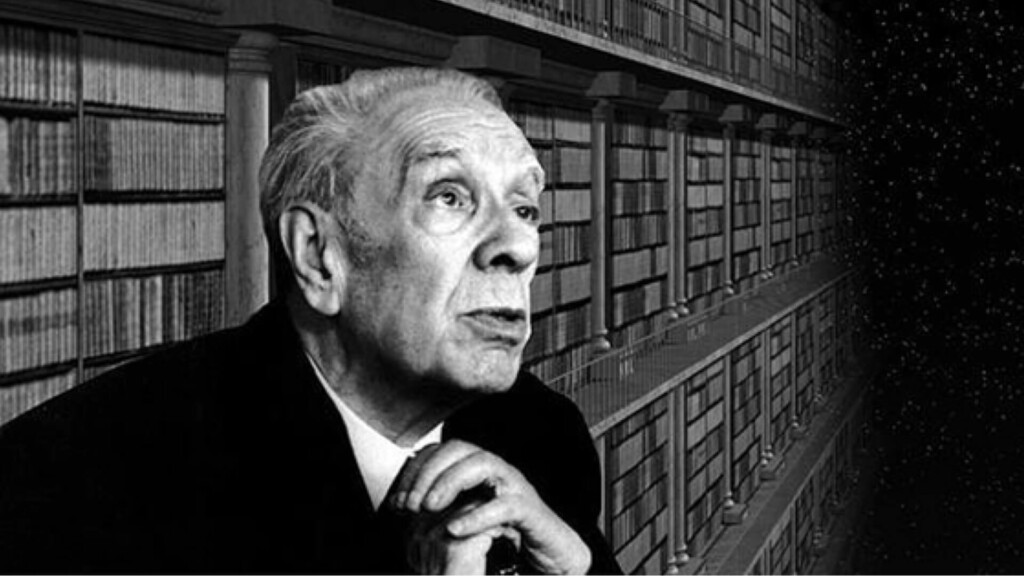
You stand in a university bookstore somewhere — Buenos Aires, Paris, Tokyo, it does not matter — and you find his name on a spine, and you feel, without quite being able to justify it, that you are in the presence of something larger than a book. That feeling is not literary. It is devotional. The name has already done its work before you open the cover.
Jorge Luis Borges died in Geneva in June 1986, having spent his last months in voluntary exile from the country that had made him and unmade him in equal measure. He was eighty-six years old, nearly blind for decades, and had outlived most of the people who had known him as simply a man. What remained — what had already, in some sense, replaced him before the biological fact caught up — was a construction of extraordinary density: a writer translated into thirty-five languages, cited by Umberto Eco in his theoretical work on semiotics and the open text, invoked by Michel Foucault in the preface to The Order of Things as the laughter that shattered all the familiar landmarks of thought, admired by Italo Calvino as the master of the literature that thinks rather than merely narrates. These are not marginal endorsements. They are the architecture of a monument, and monuments do not breathe.
What happens to identity when it becomes institutional is not simply that it grows larger than the person. Something more precise occurs: the institution begins to speak on behalf of the person, to adjudicate what counted and what did not, to select which contradictions are permissible and which must be quietly suppressed. The Borges taught in seminars is a Borges purified of his political embarrassments, his public support for military regimes, his failure to receive the Nobel Prize in part because the Swedish Academy found him politically compromised. The curriculum does not require that information. It requires the labyrinths and the mirrors and the infinite library, and it receives them as timeless objects, severed from the living context of a man who was also frightened, also vain, also wrong about things that mattered enormously to people who suffered for them.
There is a peculiar violence in canonization that we rarely name as violence. The sociologist Pierre Bourdieu spent a significant portion of his career — particularly in The Rules of Art, published in 1992 — describing how the literary field produces not just reputations but the very criteria by which reputations are measured, ensuring that the field’s own logic appears natural rather than constructed. What Bourdieu mapped structurally, Borges embodied personally: the process by which a writer’s actual biography is gradually consumed by the symbolic function assigned to it. By the time doctoral theses began appearing that treated his work as a premonition of hypertext theory and digital architecture, the man who had memorized Anglo-Saxon poetry in a Buenos Aires library was no longer necessary to the argument. The name had become fully operational without him.
This is where the question turns genuinely strange and refuses to settle. Every person who achieves any degree of cultural transmission faces, in miniature, the same transformation Borges faced in extremity: the name, once released into the world, begins to accumulate meanings that the person never chose and cannot revoke. Your name, repeated in enough contexts, in enough tones, by enough different kinds of people, starts to describe someone you may not recognize. Identity might not be something you construct and maintain. It might be something that is constructed around you, with your participation at first, then without it, then in spite of everything you actually were.
Whether that process constitutes a form of survival or a form of erasure dressed in the costume of immortality is a question Borges himself would have recognized — and would have refused, with characteristic precision, to answer.
🌀 The Labyrinth of Self: Identity, Text, and Infinite Mirrors
Borges built his labyrinths not from stone but from language, identity, and the vertiginous doubling of the self. These related articles trace the same corridors: the endless reflexivity of narrative, the fragmentation of personal identity, and the philosophical weight of the maze as metaphor. Each path leads inward, and inward again.
The Labyrinth of Knossos: History and Myth of the Minotaur
The Labyrinth of Knossos stands as the archetypal image of the maze in Western culture, a place where identity is tested against the monstrous and the unknown. Borges drew directly from this mythological architecture to construct his fictional spaces of infinite recursion. Understanding Knossos means understanding the blueprint behind every corridor Borges ever invented.
GO TO THE SELECTION: The Labyrinth of Knossos: History and Myth of the Minotaur
Eco’s The Name of the Rose: Meaning and Analysis
Umberto Eco‘s ‘The Name of the Rose‘ is perhaps the most Borgesian novel ever written by someone other than Borges himself, featuring a labyrinthine library that mirrors the architecture of forbidden knowledge. Eco acknowledged his deep debt to the Argentine master, weaving together semiotics, medieval mystery, and the terror of infinite textual proliferation. The novel is an extended meditation on what it means to read, to search, and to lose oneself inside meaning.
GO TO THE SELECTION: Eco’s The Name of the Rose: Meaning and Analysis
The Double in Literature: From Dostoevsky to Stevenson
The figure of the literary double — from Dostoevsky’s haunted protagonists to Stevenson’s divided gentleman — maps directly onto Borges’s obsession with fractured and multiplied identity. Borges himself appears as a character in his own stories, questioning whether the man who writes and the man who lives share the same selfhood. This article explores the long tradition of doppelgänger literature that Borges both inherited and radically transformed.
GO TO THE SELECTION: The Double in Literature: From Dostoevsky to Stevenson
The Literary Fantastic: Todorov and the Theory of the Fantastic
Tzvetan Todorov‘s theory of the fantastic provides one of the most rigorous critical frameworks for understanding how literature like Borges’s unsettles the boundary between the real and the impossible. The hesitation Todorov describes — the reader’s suspension between rational and supernatural explanations — is precisely the vertiginous space Borges inhabits in every story. Reading Todorov illuminates why Borgesian fiction produces its characteristic sense of dread and metaphysical wonder.
GO TO THE SELECTION: The Literary Fantastic: Todorov and the Theory of the Fantastic
Discover Cinema That Thinks in Labyrinths
If Borges’s infinite corridors have awakened your appetite for stories that refuse easy exits, Indiecinema is the streaming destination for you. Our catalog gathers independent and auteur films that explore identity, reality, and narrative with the same philosophical daring that Borges brought to the page. Step inside — the maze awaits.
👉 EXPLORE THE CATALOG: Watch Indie Films in Streaming
A vision curated by a filmmaker, not an algorithm
In this video I explain our vision

