
The Weight You Carry Without Knowing Its Name
Something goes wrong — the job falls through, the relationship ends badly, the diagnosis arrives on an ordinary Tuesday — and before you have finished processing the fact of it, a voice inside you has already begun its audit. You scroll back through your recent weeks looking for the invoice, the specific act or omission that might explain what is now sitting on your chest. You did not treat that person well. You cut corners. You said the thing you knew would wound. The misfortune arrives and the mind, almost before it registers pain, begins constructing a ledger. You were not raised in a monastery in Bodh Gaya. You have never studied the Pali Canon. And yet the logic is already running in you, fluent and automatic, as if it were installed at birth.

This is not exotic doctrine. It is something far older and more adhesive than any formal system of belief — it is a cognitive reflex so deeply embedded in human moral psychology that it persists across cultures, religions, and centuries of secular rationalism. What the Sanskrit word karma names, from its root kri meaning to act or to do, is not primarily a metaphysical claim about reincarnation. It is, at its earliest stratum, a description of a relationship between action and consequence that human beings seem constitutionally unable to stop perceiving. The Rigveda gestures toward it. The Upanishads, composed roughly between 800 and 200 BCE, begin to give it philosophical architecture. But the intuition precedes the architecture by millennia, and it refuses to disappear even when the architecture is torn down.
What is striking about the classical formulation, as it develops through the Brihadaranyaka Upanishad’s stark declaration that one becomes good by good action and bad by bad action, is not that it offers comfort. It is that it offers causality in a domain where causality is otherwise unbearable. The alternative — that suffering arrives without reference to conduct, that the universe does not track your choices — is a proposition the mind resists with extraordinary force. Social psychologist Melvin Lerner spent much of the 1960s and 1970s documenting what he called the just-world hypothesis, the deeply entrenched human tendency to believe that people get what they deserve. In his 1980 work The Belief in a Just World, he showed that this belief is not a product of religion but a structural feature of how human beings maintain psychological stability. Karma, in this light, is not an import from the East. It is a name placed on something the Western mind was already doing without admitting it.
Yet the philosophical tradition that developed karma as a rigorous concept was doing something far more demanding than validating that reflex. The early Brahminic framework tied karmic consequence to ritual action, to the precise performance of sacrifice and duty within a caste-ordered cosmos. By the time the renunciant movements of the sixth and fifth centuries BCE began pushing against that framework — the Jains with their doctrine of karma as actual physical matter that accretes on the soul, the Buddhists with their radical revision of what it even means to have a self that accumulates anything — the concept had already fractured into competing architectures, each one internally coherent, each one incompatible with the others in its deepest premises. The word remained. What it pointed to kept shifting, kept being sharpened against a different set of questions.
And this is the thing about a concept that survives twenty-five centuries of philosophical pressure: it does not survive because it is simple. It survives because it touches something that refuses to stay quiet — a suspicion, not quite articulable, that what you do and what happens to you are not entirely unrelated, even when every empirical instrument you own tells you the connection is invisible.
Ugetsu
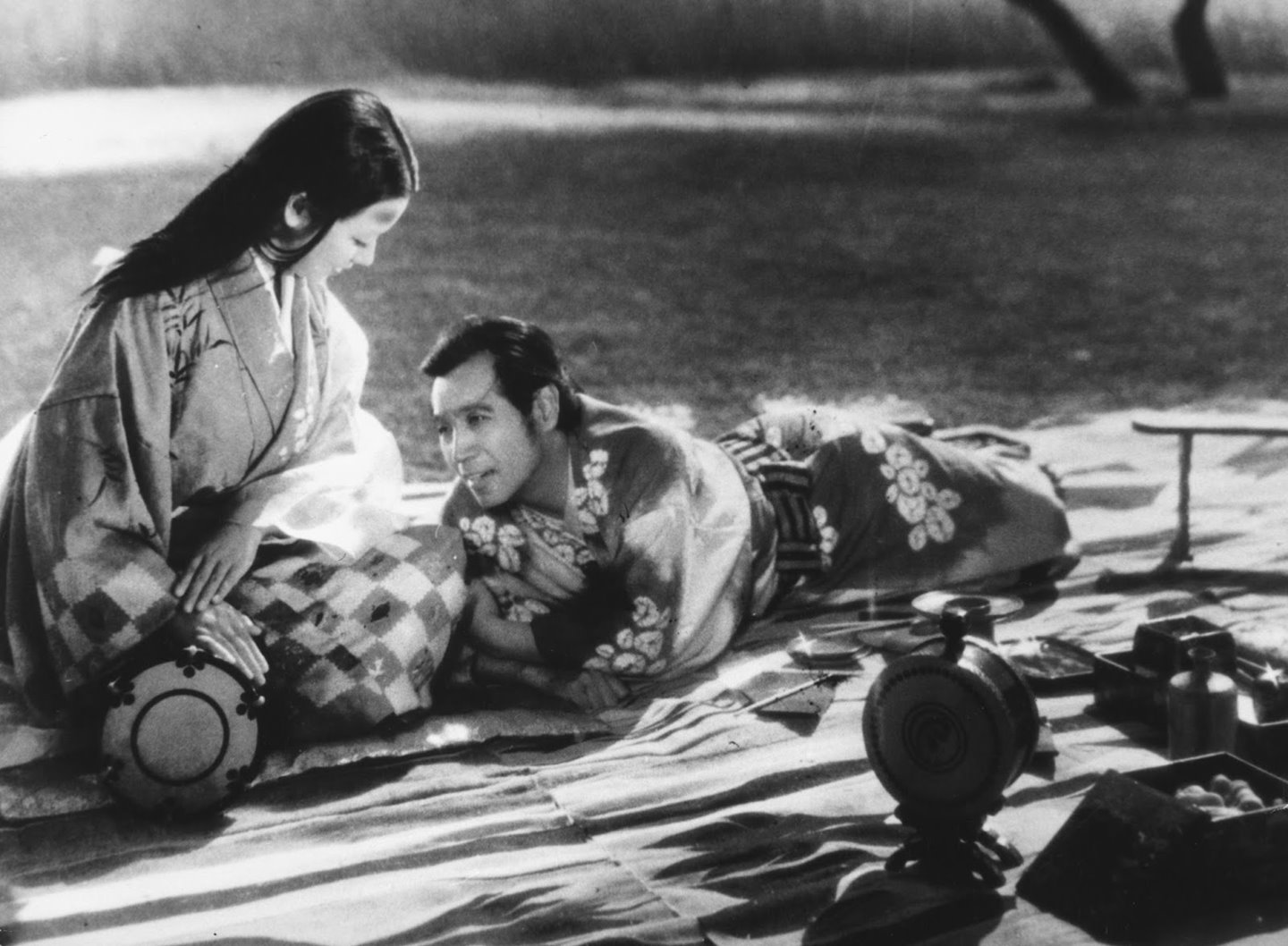
Drama, fantasy, by Kenji Mizoguchi, Japan, 1953.
Japan, late 16th century: the potter Genjurō and his brother Tobei live with their wives Miyagi and Ohama in a village in the Omi region; Genjurō, convinced that he can earn a lot of money by selling his goods in the nearby city, goes to the county of Omizo with Tobei, who joins him with the sole purpose of being able to become a samurai. Back home with a good income, the two work hard to make even more money; Tobei, increasingly obsessed with the ambition of becoming a samurai, needs the money to buy an armor and a spear while Genjurō, overcome by greed, tries to cook a batch of crockery with his brother in just one night. Legend and innovation of cinematic language, a wonderful world next to a brutal and cruel world. Mystery film that opens a discourse with the invisible planes of existence, ghosts and forays into the fantastic, made by Kenji Mizoguchi in a Japan still frozen by the two atomic bombs dropped on Hiroshima and Nagasaki. Fundamental work by Mizoguchi, recognized as one of the greatest expressions of the Seventh Art. A lofty lesson in directing that creates wonder with a dramatic tale of greed and lust for possession. A woman who is a tempting demon and a wife abandoned to a fate of war and misery, Mizoguchi uses the camera to enter "another world".
Food for thought
According to ancient Eastern traditions there are other non-physical planes beyond the physical plane. The etheric plane envelops the physical body, gives it vital energy and acts as an intermediary with the higher levels. Beyond the etheric plane there is the astral plane where entities may exist that have not been able to resign themselves to the loss of their body and wander in search of sensations. They are what are commonly referred to as "ghosts". These entities are looking for bodies that have unbalanced etheric planes to "hook up" to in order to experience sense satisfaction through them.
LANGUAGE: Japanese
SUBTITLES: English, Spanish, French, German, Portuguese
Before It Was Yours, It Was a Cosmic Accounting System
You are standing in a field somewhere in the Gangetic plain, roughly 1500 BCE, watching a priest feed oblations into a fire that is not merely burning wood but allegedly holding the universe together. The ritual is called yajna, and the word karma, in this moment, means nothing more and nothing less than the act itself — the precise physical deed of pouring, chanting, positioning the body at the correct angle to the flame. There is no moral weight attached to it yet. There is only technique, and the terrifying conviction that technique performed incorrectly will unravel something cosmological.
The Rigveda, the oldest layer of Sanskrit literature, compiled somewhere between 1500 and 1200 BCE, uses karma almost exclusively in this mechanical sense. It refers to the action performed in sacrifice, the doing that sets cosmic forces in motion. The hymns addressed to Agni, the fire deity, and to Indra are not prayers in the modern devotional sense — they are operational instructions, the ancient equivalent of engineering specifications. The priest who memorized and executed them was not seeking grace. He was applying force to a system that ran on precise inputs. Karma was the input.
What makes this genealogy so disorienting is that the moral universe we now associate with karma — the ledger of merit and demerit, the invisible accounting of every intention — was nowhere present in its earliest usage. The Brahmin priest performing sacrifice was not accumulating good karma in any ethical sense. He was discharging a technical obligation that kept the rta, the cosmic order, functioning. Rta is a concept the Vedic texts treat as something close to a physical constant, a structural principle of the universe that ritual action maintains and violations of ritual protocol genuinely damage. The idea that a bad intention could corrupt this system had not yet been invented.
The Upanishads, composed roughly between 800 and 400 BCE, introduce the first seismic conceptual rupture. Texts like the Brihadaranyaka Upanishad and the Chandogya Upanishad begin asking a question the Vedic ritualists never posed: what happens to the person after the sacrifice? The earlier literature was concerned with cosmic mechanics, not individual continuity. But the Upanishadic sages — figures like Yajnavalkya, whose dialogues in the Brihadaranyaka remain among the most intellectually violent exchanges in the history of philosophy — began insisting that the self, the atman, carries something forward through death. And what it carries is the residue of karma, now understood not merely as ritual act but as the accumulated force of all deliberate action across a lifetime.
This is the moment karma becomes biographical rather than purely cosmological. The Chandogya Upanishad, in its fifth chapter, describes how the soul after death rises with the smoke of the funeral pyre, travels through various cosmic stations, and returns to earth in a new body shaped by what it has done. Those of good conduct, the text specifies with remarkable directness, will be reborn into a pleasant womb — a Brahmin, a Kshatriya, or a Vaishya — while those of foul conduct will enter the womb of a dog, a pig, or an outcast. This is not yet the refined ethical psychology of later Buddhism. It is still structured around the social hierarchies of varna, the caste system, and the logic of purity and pollution that governed Brahminical life.
The personalization of karma, in other words, arrived already contaminated by the social order it encoded. What appeared to be a metaphysical discovery about the relationship between action and consequence was simultaneously a legitimation engine for existing hierarchies. The person born into suffering was not a victim of circumstance — they were, within this framework, the author of their own condition, having written it in a previous existence they could not remember and could not contest.

The Buddha’s Radical Surgery on the Concept
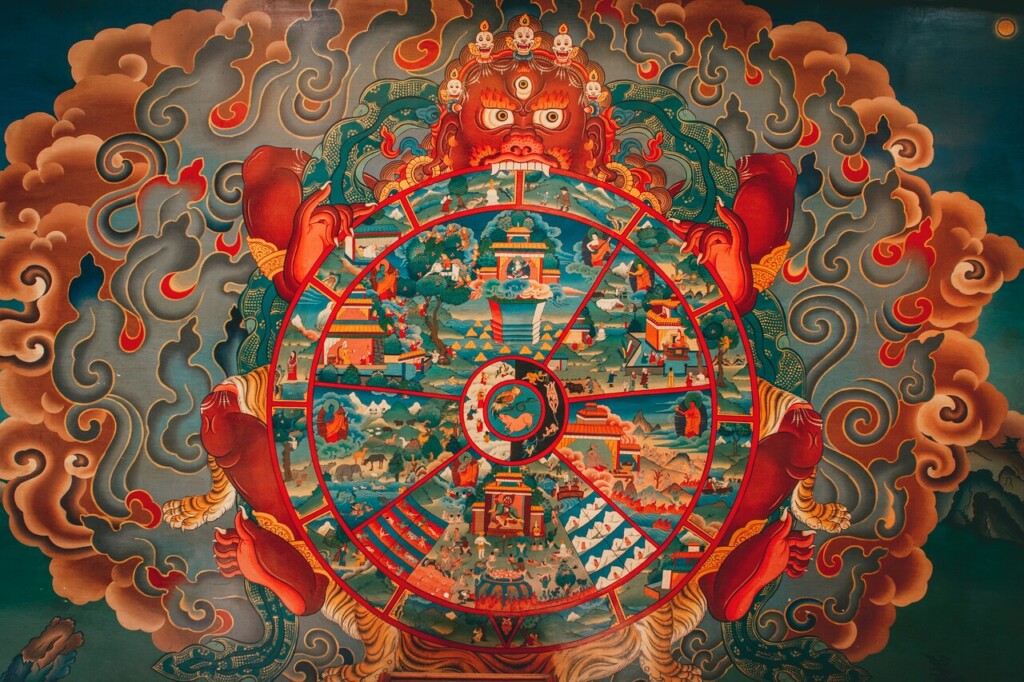
You are sitting with a group of people who all agree, quietly and without saying so, that the right gesture performed at the right moment will protect them. The offering placed correctly, the word spoken in the prescribed sequence, the body positioned before the flame according to inherited instruction — these are not superstitions in their minds but technologies, reliable as gravity. The universe, they have been taught, responds to form.
What the Buddha did to that worldview was not a refinement. It was closer to a demolition carried out with surgical precision, leaving the word karma standing while gutting everything that had given it its Brahminic weight. The Pali Canon, assembled across centuries after his death but understood to preserve his earliest teachings, records him in the Majjhima Nikaya making a statement that would have sounded, to a fifth-century BCE Indian ear trained on the Vedas, like a controlled explosion: cetanaham bhikkhave kammam vadami — monks, it is intention that I call karma. Not the fire ritual. Not the caste duty performed with formal correctness. Not the priest’s syllable landing in the right acoustic register. The act inside the act, the motion that precedes the hand.
This relocation changed everything about what it means to be responsible. In the older Brahminic architecture, karma accumulated through contact — through proximity to the right substances, the right lineages, the right ceremonial structures. Purity was partly topographical. You could inherit it, lose it through the wrong meal, restore it through correct procedure. The consequence lived in the outer world and could be managed from the outer world. What the Buddha’s formulation imposed was a complete interiorization: the consequence now lived where you could not hand it to a priest to neutralize. No ritual could reach inside the moment of choosing and change its moral charge after the fact. The confession booth of early Buddhism, if such a thing can be said to exist, was the quality of awareness brought to the instant before action — and it was open only once, in real time, without appeals.
This is not a comfortable inheritance for anyone who has ever wanted their behavior to be separable from their intentions. The literature of moral philosophy has worked hard, particularly since Kant’s Groundwork for the Metaphysics of Morals in 1785, to think rigorously about the relationship between will and act. But the Buddhist formulation predates that project by over two millennia and arrives at something more unsettling: not merely that intention matters morally, but that it is the only thing that matters karmically. The person who performs a generous act from vanity and the person who performs an identical act from genuine compassion are not doing the same thing — not in the register the Buddha was measuring. The outer identicalness is irrelevant. The universe, in this framework, is not watching your hands.
The practical consequence of this move was a democratization with violent implications for the caste structure that karma had previously supported. If ritual status and birth lineage no longer accumulate or deplete karma, then the Brahmin performing the sacrifice incorrectly at heart and the outcaste acting from genuine care are not in the positions the social hierarchy would assign them. The Anguttara Nikaya records the Buddha explicitly refusing the idea that birth determines spiritual standing, a position that reads as philosophical in translation but would have registered as social dynamite in its original context. The entire justification for inherited hierarchy rested on a model of karma that his redefinition had just removed from under it.
What is harder to absorb, even now, is that this framework demands a quality of self-knowledge that most ethical systems do not require. You cannot comply with it behaviorally. There is no checklist for cetana, no external audit of whether your volition was clean, no institution empowered to certify that the motive preceding your action was free from self-interest disguised as virtue.
Reincarnation as Social Architecture
You are born into the wrong body, the wrong family, the wrong street, and before you have learned a single word, the system has already written your explanation: you chose this. Not in any language you remember, not in any moment you can locate, but in some prior existence whose ledger has now come due. The debt precedes the debtor. This is not metaphor. This is theology functioning as architecture.
The fusion of karma with varna in the Dharmashastra tradition — that vast body of Sanskrit legal and ethical literature codified most influentially in the Manusmriti, composed roughly between 200 BCE and 200 CE — accomplished something that brute political power rarely manages cleanly: it made hierarchy feel like justice. The Manusmriti’s second chapter is explicit. Birth into a lower caste is not accident or violence; it is consequence. The soul has arrived at precisely the station it merited. Suffering, in this framework, is not inflicted from outside. It is authored from within, across time, by the sufferer themselves. The oppressor disappears from the equation entirely. What remains is a debtor and a debt.
What B.R. Ambedkar understood in 1936, in what was prepared as a speech and circulated as a text after the Hindu Mahasabha cancelled the invitation to deliver it, was that this was the specific genius of the system’s cruelty: it rendered itself unanswerable. His Annihilation of Caste is not primarily an economic or political argument. It is a diagnosis of a theological mechanism. Ambedkar identified that reforming the social behavior of caste Hindus was insufficient as long as the sacred texts authorizing that behavior remained authoritative. You cannot argue with a man about fairness when his religion has already told him that your position is the outcome of your own moral history. Protest becomes ingratitude. Rebellion becomes further evidence of a soul insufficiently purified to understand its own situation.
The mechanism produces a particular kind of epistemic closure that has no equivalent in secular systems of oppression. Feudalism could be attacked by pointing at the lord. Wage exploitation could be attacked by pointing at the owner. But when the oppressive structure is located inside the metaphysical biography of the oppressed, the pointing finger curves back. This is why Ambedkar eventually concluded that the problem was not amendable from within Hinduism, and why in October 1956, months before his death, he led approximately six hundred thousand Dalits in a public conversion to Buddhism in Nagpur — a Buddhism, critically, that he had reconstructed in his 1957 posthumous The Buddha and His Dhamma to excise exactly the elements of rebirth cosmology that could be redeployed to rationalize existing suffering.
The theological move that Ambedkar identified — suffering as self-authored — is not unique to this tradition in its logic, but it achieves a particular density of function in the Dharmashastra synthesis because it operates simultaneously at the cosmic scale and the intimate scale of daily humiliation. A Dalit woman denied water from an upper-caste well in a village in Maharashtra in 1920 is not experiencing the residue of someone else’s decision. She is, within the operative theology, experiencing the residue of her own. The social is absorbed entirely into the karmic. The political evaporates. What is left is a spiritual problem that belongs exclusively to the person it is destroying.
Sociologists studying what Pierre Bourdieu called the internalization of objective conditions — the way the dominated come to experience their domination as natural, even self-produced — would recognize the structure immediately, but Bourdieu’s Distinction, published in 1979, was tracking this in the soft violence of cultural taste. The Dharmashastra version does not work through taste or preference. It works through cosmological certainty, across lifetimes, with the full authority of sacred scripture behind it. The dominated do not merely prefer their position. They have been told, across generations, that their position is their autobiography.
Jainism’s Materialism and the Body as Moral Sediment
You are sitting very still, but you are not clean. According to a philosophical tradition that predates the common era by several centuries, every flicker of anger, every surge of desire, every moment of careless inattention has left a physical residue on you — not metaphorically, not symbolically, but as actual matter, fine and adhesive, coating the luminous substance of what you are. This is not a metaphor struggling to become theology. This is a fully articulated metaphysics, worked out with systematic rigor in the Tattvartha Sutra, composed by the Jain thinker Umasvati around the second to fifth century CE, a text so precise in its ontology that it reads less like scripture and more like a manual for an operation no surgeon has ever performed.
The Jain universe is populated by two irreducible categories: jiva, the living soul, and ajiva, everything that is not soul. Karma belongs to ajiva. It is pudgala — matter, the same substance that constitutes rocks, breath, and light, differentiated only by the extreme subtlety of its particles. When a person acts with passion — with kasaya, the sticky residue of anger, pride, deceit, or greed — these karmic particles are drawn toward the soul and adhere to it. The soul does not generate karma through intention alone; intention opens the pores, so to speak, but it is the passion accompanying the act that causes the actual physical bonding. This distinction matters enormously, because it severs the Jain framework from any system that would locate moral consequence purely in the interior life. The body is not the prison of the soul in some loosely Platonic sense. The body is the accumulation of the soul’s own moral history made dense and visible.
What makes this framework genuinely destabilizing for a modern reader is not its strangeness but its literalism. Western moral philosophy from Kant forward has labored to purify ethics from the contamination of the physical — to locate moral worth in intention, in the rational will, in the purely mental act of choosing. The Tattvartha Sutra performs the exact inverse operation. It insists that intention without passion produces no karmic bondage at all, but that passion without physical austerity cannot be undone by mental resolve alone. The accumulated matter must be burned off. This is the meaning of tapas in the Jain context — not penance as punishment, not asceticism as self-hatred, but a thermodynamic process of purification in which the heat of physical discipline actually dislodges karmic particles already bonded to the soul.
Mahavira, the twenty-fourth tirthankara of the Jain tradition, is said to have practiced austerities so extreme that he stood motionless for hours, accepted whatever weather fell on his body, fasted for periods that stretched across weeks, and pulled out his own hair rather than cutting it, because cutting requires the use of an instrument that might harm unseen life. These are not performances of devotion. They are procedures. The logic is material: if karma is substance, then liberation — moksha — requires that the soul become entirely free of karmic matter, lighter than anything the physical world can hold, capable of rising to the apex of the universe where liberated souls, called siddhas, reside in motionless omniscience. By the year 1000 CE, Jain philosophical schools had produced elaborate taxonomologies of karmic types — eight major categories, with subcategories governing everything from the duration of a lifespan to the configuration of a body to the capacity for knowledge itself.
What this architecture reveals is a moral geology. The self you inhabit is not a neutral vessel temporarily housing choices. It is a stratigraphy — layer upon layer of acted passion pressed into matter, some of it deposited in lives you have no memory of, shaping the very instrument through which you now attempt to think your way free.
A vision curated by a filmmaker, not an algorithm
In this video I explain our vision
Western Appropriation and the Flattening of a Philosophy

You have probably used the word at least once this week without registering what you were doing. Someone cut you off in traffic, or a colleague took credit for your work, and you said it with a quiet satisfaction that felt almost righteous: karma will sort it out. The word landed like a small comfort, a cosmic guarantee that the ledger would eventually balance itself, and you moved on with your day entirely unbothered by the weight the concept once carried in the traditions that produced it.
What happened between ancient Pali manuscripts and that casual utterance is not simply a matter of translation loss. It is an act of philosophical amputation so thorough that the surviving fragment bears almost no functional relationship to the original body. The decisive surgery was performed in the nineteenth century, most consequentially by Helena Petrovna Blavatsky, whose The Secret Doctrine, published in 1888, became arguably the most influential single act of Eastern doctrinal importation into Western popular consciousness. Blavatsky was not a scholar in any academic sense the word would recognize. She was a synthesizer of the highest theatrical order, weaving Sanskrit terminology, Tibetan references she claimed came from hidden mahatmas, and European occultist frameworks into a cosmological system that felt ancient precisely because it borrowed the vocabulary of genuine antiquity. Karma arrived in her pages stripped of its entanglement with liberation, with the problem of rebirth as suffering, with the soteriological machinery of renunciation and insight that gave the doctrine its original urgency. In its place she installed something far more agreeable to the Victorian drawing room: a principle of moral compensation operating across lifetimes, ensuring that virtue would eventually be rewarded and wickedness punished, not by a personal God, which would have been too orthodox, but by an impersonal cosmic law, which felt scientific and spiritual simultaneously.
The timing was not accidental. Victorian progressivism needed a metaphysics that could accommodate both Darwin’s developmental logic and the moral intuitions of a society reluctant to abandon providential order. Karma as Blavatsky rendered it answered both demands. It was evolutionary, since souls advanced through successive incarnations toward higher states, and it was just, since no act went unaccounted for in the cosmic ledger. What it was not was soteriologically terrifying. In the Pali Nikayas, the problem karma posed was precisely the horror of the mechanism itself: every intentional act seeds future becoming, and future becoming means future suffering, which means the goal is not to accumulate good karma but to arrest the entire process. The Theosophical version inverted this completely. Karma became something you wanted to produce in the right quantities and qualities, a spiritual currency to be managed rather than a chain to be dissolved.
The sociological consequence of this inversion became visible within decades. By the early twentieth century, karma had migrated into self-help frameworks, first in American New Thought movements and later through the vast infrastructure of wellness culture that calcified in the 1970s and 1980s. Ralph Waldo Trine’s In Tune with the Infinite, published in 1897, already treated karma-adjacent ideas as tools for personal prosperity and psychological resilience. The concept was no longer pointing toward the cessation of grasping; it was being deployed to justify and optimize the very structures of desire it had originally diagnosed as the problem. You did not abandon the self to escape the wheel. You curated the self more carefully so the wheel would treat you better.
What this produced in practical cultural terms was a morality without accountability. If karma operates across lifetimes invisible to any living witness, it becomes impossible to falsify and therefore impossible to argue with. It provides the emotional satisfaction of justice without requiring any institutional mechanism, any confrontation, any structural change in the conditions that generated the original harm.
What Karma Does to Empathy
You pass a man sleeping in a doorway on a January night, his coat too thin, his shoes split at the sole, and something moves in you — not quite pity, not quite recognition, but a pull toward him that feels almost physical. Then a thought arrives, quiet and dressed like wisdom: he must have done something to end up here. The thought does not announce itself as cruelty. It arrives as explanation, and you keep walking.
Melvin Lerner spent decades trying to understand why that thought exists, and what it costs us. His 1980 work The Belief in a Just World documented what he called a fundamental delusion — the need to believe that people receive what they deserve and deserve what they receive. Lerner’s subjects, when confronted with images of innocent suffering, did not respond with sustained compassion. They responded by retroactively constructing guilt. They found fault in the victim. The mind, faced with arbitrary pain, manufactures moral cause because arbitrary pain is existentially unbearable. What karmic logic does is give that manufacture a theological chassis. It transforms a psychological defense mechanism into a metaphysical certainty.
The ethical damage is not incidental. When suffering becomes evidence of prior wrongdoing — in this life or a previous one — the entire structure of solidarity collapses at its foundation. Solidarity requires the premise that suffering can be undeserved, that circumstance is not verdict, that the person in front of you is not receiving what they earned but what the world has done to them. Remove that premise and compassion becomes, at best, a kind of charitable condescension toward someone working off their own debt — a debt you had no hand in creating and cannot share. At worst, intervention itself becomes theologically suspect, a disruption of the moral economy rather than a response to another person’s humanity.
This is not a theoretical problem confined to ancient texts. Studies conducted in India in the early 2000s on attitudes toward Dalit communities found that karmic attribution — the belief that caste position reflects accumulated spiritual merit or demerit — continued to function as a legitimizing framework for social exclusion even among educated urban respondents who explicitly rejected caste discrimination in abstract terms. The belief and the behavior operated on separate registers. People could denounce untouchability as a practice while simultaneously holding an ambient conviction that spiritual history had something to do with where a person stood. The logic of karma here was not a conscious ideology. It was atmospheric, the kind of assumption you don’t notice because it never rises to the level of an argument.
What makes this especially difficult to disentangle is that karmic thinking in many of its Buddhist articulations was explicitly designed to cultivate compassion. The Bodhisattva ideal in Mahayana Buddhism rests on the recognition that all sentient beings have at some point been your mother, your child, your most beloved companion — and therefore all suffering is intimate, all beings are kin. This is a radical demand for universal empathy. But the same metaphysical architecture that makes all beings kin also makes all suffering, on some level, instructive. And once suffering is instructive, it belongs to the one suffering. The witness becomes a spectator of someone else’s curriculum.
The philosopher Charles Taylor, writing in Sources of the Self in 1989, traced the genealogy of what he called moral frameworks — the background assumptions that make certain responses to others feel natural and others feel forced or inappropriate. Karmic logic functions as exactly this kind of framework: invisible, load-bearing, shaping what feels like a reasonable response before the reasoning begins. The man in the doorway is already partially explained before you have asked a single question about the city that built the doorway, the economy that thinned his coat, the systems that moved through his life like weather.
The Causality That Cannot See Itself
You have spent your whole life inside a story about why things happen to you, and the story has always arrived already assembled — handed to you by the household you were born into, the language that shaped your first categories of cause and consequence, the emotional logic you inherited before you had words for any of it.
The epistemological problem at karma’s core is not merely technical. It is structural, and it runs deeper than most of its critics have been willing to follow. The doctrine does not simply claim that moral causality operates across lifetimes — it claims this in a register that is definitionally inaccessible to ordinary perception. In the Pali canon, the Buddha himself identified kammavipaka, the ripening of action, as one of the four acinteyya — the unthinkables, the things that cannot and should not be subjected to rational inquiry because the attempt to do so leads only to madness or useless proliferation of thought. This is not a footnote. It is a structural admission built into the doctrine’s own architecture: the causal mechanism that the entire ethical framework depends upon is simultaneously declared off-limits to investigation. The system protects itself from refutation by placing its engine behind a wall it labels sacred.
David Hume, writing in the Treatise of Human Nature in 1739, demolished the commonsense assumption that causality itself is ever directly observable. What we perceive is sequence, contiguity, and a habit of mind that fuses them into necessity. Karma extends this problem into a dimension Hume never needed to address: the causes that explain present suffering are located in actions performed in lives that, by definition, the sufferer cannot remember. The result is a causal chain whose first links are epistemologically unavailable to the person whose life it is supposed to explain. The doctrine does not explain your suffering — it explains why your suffering cannot be explained to you, and then asks you to find that explanation satisfying.
What sustains a framework under these conditions is not evidence but something closer to what the sociologist Émile Durkheim, in The Elementary Forms of Religious Life published in 1912, identified as the social effervescence produced by shared belief — the way collective affirmation generates a kind of felt truth that stands independent of any verifiable content. Karma does not survive because it can be confirmed. It survives because the community of believers produces, through its very practice of believing, the emotional texture that makes the doctrine feel self-evident. Doubt becomes a moral failure before it can become an intellectual position.
The philosopher Karl Popper argued in The Logic of Scientific Discovery in 1934 that any framework immune to falsification is not producing knowledge — it is producing something else, something that may be culturally powerful and psychologically real but that cannot be called a causal explanation in any meaningful sense. Karma is not simply unfalsified; it is structured to make falsification impossible. A good outcome confirms the system. A bad outcome confirms the system. Suffering confirms it. Justice confirms it. The doctrine has achieved what every closed system dreams of: a total hermeneutic, a grammar in which every sentence you could produce confirms the language itself.
And yet the people who live inside this grammar are not deceived in some simple way. They are doing something real — reaching for coherence in a world that distributes its cruelties without legible pattern, trying to inhabit a moral universe rather than a merely physical one. The hunger behind karma is not irrational. What is worth examining, slowly and without contempt, is the price extracted by any system of meaning that must, in order to remain intact, convince you that the questions you cannot answer are the questions you should stop asking.
🔄 Cycles of Action, Soul, and Rebirth
Karma is not merely a moral bookkeeping system — it is a profound philosophical architecture linking action, consequence, and the nature of the self across lifetimes. To truly understand karma, one must explore the spiritual traditions, thinkers, and texts that gave it shape and meaning across centuries.
Hesse’s Siddhartha: Analysis
Hesse’s Siddhartha is one of Western literature’s most luminous encounters with Indian spiritual philosophy, tracing a young man’s path through desire, renunciation, and enlightenment. The novel weaves karma into every choice Siddhartha makes, showing how actions accumulate and shape the soul’s trajectory. It remains an essential literary gateway into the lived experience of karmic thought.
GO TO THE SELECTION: Hesse’s Siddhartha: Analysis
Osho: Life and Spiritual Thought
Osho’s radical reinterpretation of Eastern spirituality placed karma at the center of individual awakening, stripping it of moralistic rigidity and reimagining it as a dynamic flow of consciousness. His teachings challenged followers to move beyond inherited guilt and mechanical cause-and-effect thinking toward a more immediate, meditative understanding of action. Osho’s life and thought offer a provocative counterpoint to classical karmic doctrine.
GO TO THE SELECTION: Osho: Life and Spiritual Thought
Sri Aurobindo: Life and Works
Sri Aurobindo developed one of the most sophisticated philosophical syntheses of karma within his vision of integral yoga and evolutionary consciousness. For Aurobindo, karma was not a trap but a transformative engine driving the soul toward ever higher manifestations of the divine in matter. His work bridges Vedantic tradition and modern thought in a way that redefines karmic law as spiritual possibility.
GO TO THE SELECTION: Sri Aurobindo: Life and Works
Buddhism and 3 Documentaries to Understand it
Buddhism stands as one of the two great pillars of karmic philosophy, refining and radically transforming the concept inherited from the Vedic tradition. This curated selection of documentaries offers an accessible yet deep entry point into Buddhist teachings on intention, action, and the liberation from the cycle of conditioned existence. Watching these films alongside philosophical study opens a richer, more experiential understanding of karma in practice.
GO TO THE SELECTION: Buddhism and 3 Documentaries to Understand it
Explore the Cinema of the Soul on Indiecinema
If these themes of karma, consciousness, and inner transformation resonate with you, Indiecinema’s streaming catalog offers a carefully curated selection of independent and art-house films that explore the deepest questions of existence. From meditative spiritual journeys to radical philosophical provocations, discover cinema that does not merely entertain but genuinely transforms. Join Indiecinema and let the screen become a mirror for your inner world.
👉 EXPLORE THE CATALOG: Watch Indie Films in Streaming
A vision curated by a filmmaker, not an algorithm
In this video I explain our vision

