
The Arrested Revolutionary
You are sitting in a cell in Alipore Jail in 1908, and the British Empire has decided you are dangerous. Not dangerous in the way a soldier is dangerous, or even a bomb-maker, though the prosecution will try to make that case. Dangerous in the way that only ideas are dangerous — the kind that do not need a body to keep spreading once they have been released. The cell is small, the monsoon heat is indecent, and outside the walls the machinery of the largest empire in human history is grinding through the paperwork required to hang you. Your name is Aurobindo Ghose. You are thirty-five years old. You have been a scholarship student at King’s College, Cambridge, a civil servant who deliberately failed the riding examination so the colonial administration would reject him, a professor of English literature in Baroda, and, most recently, the most electrifying political voice in Bengal. Now you are a prisoner awaiting trial for seditious conspiracy, and something that has nothing to do with any of those identities is beginning to happen to you in the silence.

The trial lasted a year. When it concluded in May 1909, Aurobindo was acquitted — the prosecution’s case collapsed partly because Chittaranjan Das, his defense counsel, delivered an argument so devastatingly methodical that it became one of the celebrated legal performances in the history of Indian jurisprudence. But the acquittal is the least interesting thing about that year. What happened inside the cell is what changes the shape of everything that comes after. Aurobindo would later describe sustained experiences of inner silence, of a consciousness that seemed to withdraw from the ordinary surface of the mind and encounter something he would spend the next four decades trying to name with precision. The political prisoner entered; something else walked out.
It is too easy, and ultimately dishonest, to read this as a story of trauma sublimated into mysticism — the broken revolutionary retreating into the interior because the exterior proved too costly. That reading flatters us. It lets us keep our categories intact: the pragmatic world of action on one side, the consolatory world of spirit on the other. What Aurobindo actually argued, with increasing philosophical rigor across thousands of pages, was that this division is itself the primary cognitive error of modern civilization. His thirty-volume collected works, including the foundational philosophical text The Life Divine published in its complete form in 1940, constitute a sustained attack on the assumption that consciousness is a byproduct of matter rather than its ground. This is not mysticism in the sense of vagueness. It is a metaphysical claim with structural consequences for everything — politics, evolution, the meaning of historical suffering.
The colonial encounter made this argument urgent in a specific way. Aurobindo had watched the Bengal Partition of 1905 split a population along lines drawn by administrators in London who understood the territory primarily as a revenue problem. He had watched the moderate politics of the Indian National Congress produce petitions that the empire received with the same attention it gave to minor complaints from provincial councils. He had written, in the journal Karmayogin and before that in Bande Mataram, that a freedom movement which accepted the colonizer’s framework of rationality and procedural petition had already conceded the most important ground. The colonized, he argued, were not simply politically subordinated — they had been taught to experience their own inner life as something primitive, superstitious, requiring correction by Enlightenment standards that were themselves a particular cultural arrangement dressed as universal reason. The cell in Alipore was, among other things, the place where he stopped accepting that arrangement.
What emerges from this collision is not a saint, and not a failed politician who found God as consolation. What emerges is something harder to categorize and therefore harder to dismiss.
I Am Nothing
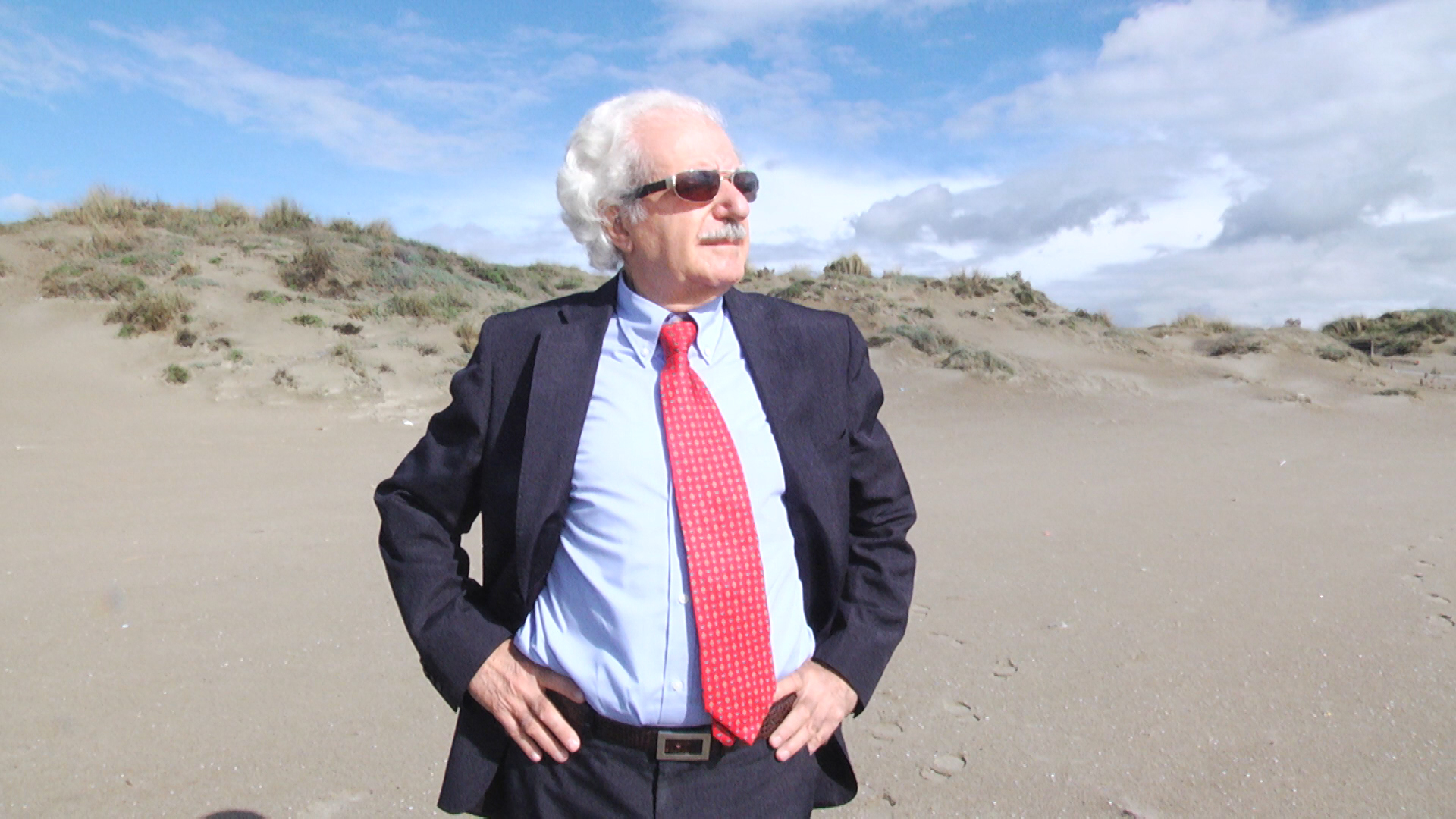
Drama, thriller, by Fabio Del Greco, Italy, 2015.
The story revolves around Vasco, a Roman builder who, at the age of 74, enjoys a life of absolute comfort. His human parable takes a dramatic turn when a mysterious encounter leads him to an ambush. Having survived, but marked by a long coma, Vasco wakes up with a new sensitivity, developing an intimate and poetic bond with nature. This new relationship with the world around him leads him to deeply explore himself, in an internal and external journey. through Italy, the United States and India, in search of a higher meaning and a cure. In parallel, the threat of a planetary cataclysm adds an epic dimension to the story.
I Am Nothing explores universal themes such as time, memory, oblivion and the connection with nature. Fabio Del Greco creates an existential drama full of food for thought. The director skillfully combines different visual materials, mixing archive images with nature photographs and dreamlike visions. This visual experimentation translates into an editing that captures the viewer's attention, guiding him through a cycle of creation and destruction. The sequences that alternate the buildings, Vasco's pride, with Indian landfills and natural landscapes create a hypnotic rhythm, underlining the beauty and fragility of life. Vasco's existential journey is a hymn to transformation and rebirth. The evolution of the protagonist, from unbridled luxury to the rediscovery of purity, represents a powerful metaphor on the meaning of life and the need to reconnect with authentic values. Io sono nulla stands out for its ability to combine introspection and visual experimentation, offering a suggestive and engaging narration. It is a film that invites us to reflect on the human condition, on our relationship with power and nature, and on the possibility of finding ourselves through change. A work that leaves its mark and lends itself to multiple readings.
LANGUAGE: Italian
SUBTITLES: English, Spanish, French, German, Portuguese
Cambridge, Empire, and the Making of a Double Mind
He arrives at King’s College, Cambridge, at the age of twelve — not as a student yet, but as a boy being prepared, shaped, pressure-formed into the administrative instrument his father had already decided he would become. Rajnarayan Ghose had sent his son to England precisely to scrub away every trace of India: no Bengali, no Hindu custom, no cultural memory that might interfere with the machinery of imperial service. The boy who would later translate the Upanishads from Sanskrit with the precision of a surgeon had been deliberately starved of Sanskrit. This was not an accident of colonial education. It was its central design.
The Indian Civil Service examination was, by the 1880s, the most competitive meritocratic gate in the world — or at least that is what the British called it when they wanted to appear fair. In 1853, the year the system was opened nominally to Indians, fewer than one in fifty candidates passed. The examination tested Greek, Latin, mathematics, and English literature with a thoroughness that assumed a particular kind of mind: one that had been marinated in Western civilization for long enough to mistake it for civilization itself. Aurobindo passed every classical subject with distinction. He placed in the top tier of the Greek paper. He then deliberately missed the required horse-riding examination, which disqualified him from the ICS entirely. He had mastered the gate and then walked away from it — which suggests he understood, at some level, that passing through it would have meant a different kind of disappearance.
What colonial education produces, when it works as intended, is a person who is genuinely bilingual not just in language but in loyalty — someone whose aesthetic pleasure, moral instincts, and intellectual reflexes have been colonized even while the body remains marked as other. Frantz Fanon described this mechanism in Black Skin, White Masks in 1952 as the psychic violence of a culture that teaches the colonized to desire their own erasure. But the psychic split Fanon diagnosed as wound, Aurobindo would spend the next thirty years converting into a kind of double vision — the capacity to move between conceptual worlds without being owned by either.
His reading at Cambridge was voracious and promiscuous in the best sense: Shelley, Goethe, Dante, but also the early Italian nationalist Mazzini, whose writings on national consciousness and collective spiritual will struck him with the force of personal revelation. This is not incidental. Mazzini argued in the 1840s that nationality was not ethnicity but a people’s mission — a collective spiritual vocation that could not be administered into existence or reasoned away. For a young Indian man being trained to administrate his own people into submission, this was an explosive idea to carry quietly through Cambridge’s stone corridors.
Between 1884 and 1892, Aurobindo also encountered the Greek tragic poets with an intimacy that would mark every piece of political writing he produced in the following decade. Aeschylus in particular gave him a vocabulary for historical suffering that was neither sentimental nor nihilistic — the idea that catastrophe moves toward something, that what is broken open by violence might be broken open toward meaning. He would not use this idea philosophically for years. It would first show up as prose, as journalism, as incitement — but it was formed here, in a cold English room, with a text two and a half thousand years old.
The fracture his father had engineered did not produce the obedient servant it was meant to. It produced something far more dangerous: a man who could read power from inside its own language, who had been handed the tools of empire and had, in the years of apparent compliance, been quietly deciding what to build with them instead.

The Bengal Partition and the Grammar of Resistance
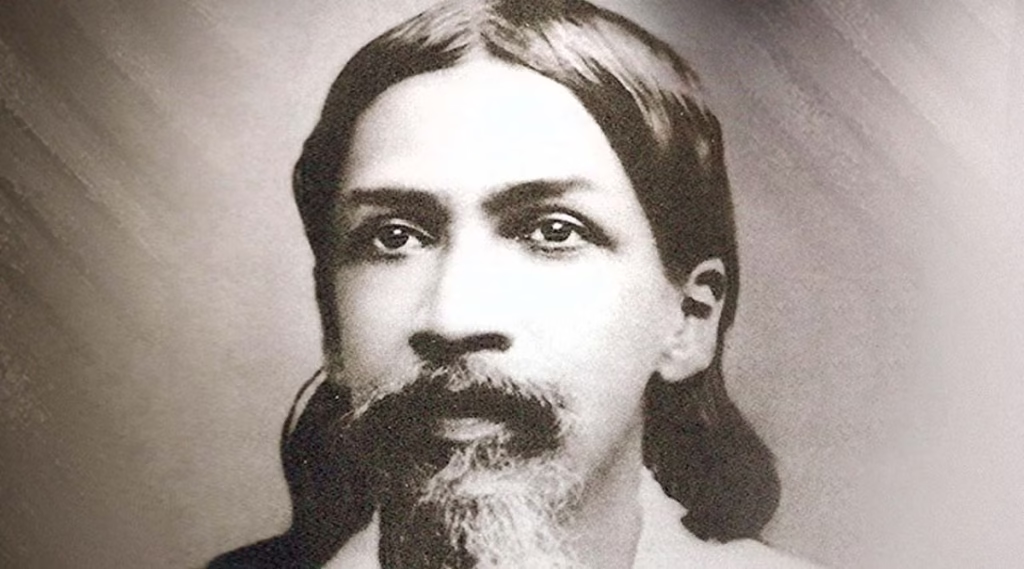
You are standing at the edge of a crowd in Calcutta in 1905, and the air carries something that has no clean English translation — not quite rage, not quite grief, a third thing that bureaucracies are constitutionally incapable of naming. Lord Curzon has just divided Bengal along a line that was presented as administrative efficiency but functioned, with surgical precision, as a fracture along communal fault lines. Seventy-eight million people split across a boundary drawn in London offices, by men who had never heard the specific silence of a Bengali monsoon. What Curzon called rationalization, those standing in that crowd called what it was: a punishment dressed as paperwork.
Aurobindo had already been moving toward a position that the moderate wing of the Indian National Congress found alarming. The Congress, founded in 1885, had spent two decades submitting petitions, drafting resolutions, requesting — always requesting. Bal Gangadhar Tilak had begun insisting that mendicancy was not a political strategy, but it was Aurobindo who gave that instinct its full philosophical architecture. He did not argue that the British were cruel. He argued something structurally more devastating: that Indians had accepted the premise that British rule was the operating system within which all negotiation must occur, and that this acceptance was itself the deepest form of colonization. The demand for reform, in his reading, was still a demand made in the colonizer’s language, within the colonizer’s frame, by people who had already surrendered the most important argument before entering the room.
Through the pages of Yugantar and later Karmayogin, Aurobindo developed a vocabulary that the colonial administration could recognize only as sedition because sedition was the only category available to it. The British legal apparatus of 1907 was not equipped to process the distinction between violent insurrection and civilizational refusal. When Aurobindo wrote that Swaraj was not a transfer of administrative power but the recovery of a people’s right to exist on their own terms, within their own conceptual universe, the Raj heard a call to riot. What he had actually articulated was closer to what Frantz Fanon would name half a century later in The Wretched of the Earth — the idea that decolonization is not primarily political but ontological, a reconstitution of a self that empire had systematically unmade. The Raj could arrest a man for inciting violence. It had no legal instrument for arresting a man for insisting that a civilization remember itself.
The 1908 Alipore bomb case made this confusion institutional. Aurobindo was charged as a conspirator following his brother Barin’s involvement in the Muzaffarpur bombing. He spent a year in Alipore jail awaiting trial. The prosecution’s difficulty was symptomatic: the evidence was thin, but the real problem was that Aurobindo’s actual radicalism was not stored in any document they could produce in court. It was stored in an argument — that passive resistance, Swadeshi economics, and national education were not tactics but a grammar, a complete alternative syntax for how a people could organize their relationship to power and to themselves. His lawyer, Chittaranjan Das, secured his acquittal, but the state’s confusion about what it had been trying to prosecute never fully resolved.
What the British misread as chaos was in fact extreme legibility — a coherent, internally consistent program whose logic was simply not translatable into the administrative categories the empire used to manage dissent. The confusion ran deeper than politics. When a civilization that has defined governance as control encounters a movement that defines liberation as self-knowledge, it is not facing a rebellion. It is facing a different epistemology entirely, and epistemologies cannot be sentenced, cannot be deported, cannot be made to
The Silence That Reorganized Everything
You are placed, without warning, inside a cell in Alipore Central Jail, Calcutta, in the spring of 1908. The British colonial administration has charged you with sedition and conspiracy to wage war against the Crown. The evidence is a cache of letters, a printing press, a political network that stretched from Bengal to London. Outside, witnesses are being prepared, prosecutors are sharpening their arguments, and the entire apparatus of imperial law is assembling itself to make an example of you. Inside, something entirely different is happening.
Aurobindo spent nearly a year in that jail before his acquittal in May 1909, and what he reported from that period confounds every clean narrative we prefer to tell about political radicalism. He described hearing, in deep meditation, the voice of Swami Vivekananda — who had been dead since 1902 — instructing him in the nature of the higher mind across eleven days of sustained dialogue. It would be easy, almost irresistible, to dismiss this as the psychological resource of a man under extreme duress, the mind manufacturing guidance where none was available. But that dismissal moves too quickly past something philosophically uncomfortable: the rupture Aurobindo underwent in Alipore was not a breakdown. It produced work. It reorganized an entire metaphysical architecture. Breakdown and breakthrough are often announced with the same symptoms, and the distinguishing factor is what gets built afterward.
What makes Alipore structurally significant is that it represents a particular kind of crisis that Western political philosophy has never adequately theorized: the moment when a person of intense public agency is forcibly removed from action and discovers that the interiority they had been ignoring is not a private annex to their political self but the ground on which that self was standing all along. Hannah Arendt, writing in The Human Condition in 1958, drew her famous distinction between the active life and the contemplative life as if they inhabited separate registers of human experience. What Aurobindo’s Alipore year refuses is exactly that partition. The contemplative rupture did not replace the political identity — it revealed that the political identity had been, from the beginning, a surface manifestation of something that had not yet been named.
This is where The Life Divine, which Aurobindo began developing conceptually during and immediately after his imprisonment and which appeared in serial form in the journal Arya from 1914 to 1919, refuses to behave like a philosophical treatise. Most systematic philosophy begins with a problem cleanly stated, a procedure for addressing it, and a conclusion that closes the inquiry into a usable form. The Life Divine begins instead with a condition: the unresolved tension between the human animal’s insistent materiality and its equally insistent sense that matter is not the whole account of what it is. Aurobindo does not resolve this tension early and then build upon the resolution. He drives the tension deeper, holds it longer, and refuses the escapes that both Western rationalism and conventional Eastern renunciation had historically offered.
The renunciation escape, in particular, he treated as a philosophically dishonest move. The Advaita tradition as commonly received suggested that the world’s multiplicity was illusion and that liberation meant detachment from the phenomenal entirely. Aurobindo read Shankara with precision and care — his commentaries demonstrate that — but he concluded that interpreting Maya as cosmic falsehood rather than as a limited mode of the real was a misreading that had cost Indian thought several centuries of productive engagement with the concrete. If the world was not real enough to be transformed, then transformation was not a spiritual category, only an individual exit strategy.
And an exit strategy was precisely what the British expected him to reach for, in one form or another — either the legal submission of a man who had calculated his risks incorrectly, or the inward withdrawal of a mystic who had renounced the struggle as illusion. He offered neither, which is what made him genuinely difficult to categorize, and therefore genuinely difficult to contain.
Pondicherry and the Architecture of Integral Yoga
You arrive at the harbor before dawn, carrying almost nothing, and the colonial authorities who have been watching you for three years do not yet know you are gone. By the time they understand what has happened, the man they wanted to silence has already crossed into French-administered territory, and the machinery of British surveillance has lost its jurisdiction. What looks like escape is something more precise than that — it is the deliberate removal of a mind from the conditions that would have consumed it.
Aurobindo reached Pondicherry in April 1910 and did not leave for the remaining forty years of his life. To the British Indian press and to many of his former revolutionary colleagues, this was abandonment. The nationalist movement was entering one of its most volatile phases; the man who had electrified Calcutta audiences with the doctrine that swaraj was not a political preference but a spiritual absolute had apparently chosen meditation over mobilization. The accusation carried real weight. But it rested on an assumption about what constitutes action that Aurobindo had already decided was philosophically untenable.
The assumption is that impact requires physical presence in the contested space — that the agitator in the street and the thinker in the room are operating on different planes of reality, the first doing something real, the second doing something decorative. This is not a neutral position. It is a specific metaphysics, one that privileges the visible and the immediate, and it has been used with remarkable consistency throughout history to delegitimize intellectual labor that does not produce results on the timeline power can recognize. The British administration understood this perfectly: they imprisoned thinkers not because they feared the pamphlets themselves but because they understood that concentrated thought, given enough time, becomes a different kind of force entirely.
What emerged from those Pondicherry decades was not the work of a man resting. The Life Divine, developed across hundreds of pages of the journal Arya between 1914 and 1921, is a systematic attempt to resolve what Aurobindo saw as the foundational error of both Western materialism and Vedantic renunciation — the assumption that matter and spirit are antagonists, that one must be sacrificed for the other to be real. He drew on Heraclitus and Hegel, on the Upanishads and on Henri Bergson‘s then-recent L’Evolution Creatrice of 1907, and pushed through all of them toward a position none of them quite reached: that evolution is not merely biological but ontological, that consciousness itself is the medium through which the universe is still being constructed, and that the human being is not the final term of that process but an instrument of its continuation.
The Synthesis of Yoga, running alongside The Life Divine in the same journal, did something philosophically rarer still — it refused the sectarian architecture of Indian spiritual practice, the demand that you choose between the path of knowledge, the path of devotion, and the path of action as though they were incompatible technologies. Aurobindo’s argument was that this division was historical, not necessary, a product of specific cultural emphases rather than the structure of consciousness itself. The implication was quietly devastating for every tradition that had built its authority on the claim to exclusive access.
And then there is Savitri, the poem he worked on from the 1910s until his death in 1950, expanding it across decades into nearly twenty-four thousand lines, the longest poem in the English language by a single author. It takes the compressed episode from the Mahabharata in which the woman Savitri argues with Yama, the god of death, and wins back her husband’s life, and stretches that argument across a cosmological canvas that encompasses the structure of time, the nature of suffering, and the precise mechanism by which love might constitute a form of knowledge that death cannot answer.
The question the British never quite asked was whether forty years of that kind of labor might be doing something to the territory they thought they still controlled.
A vision curated by a filmmaker, not an algorithm
In this video I explain our vision
The Supramental and the Scandal of Optimism

You are reading a philosophy book in a comfortable chair, and somewhere around page two hundred you realize the author has already decided that consciousness ends at the point where language becomes precise. The assumption is not argued — it is architectural. It holds up the entire structure without ever being named, which is exactly how the most dangerous assumptions work.
Sri Aurobindo noticed this in 1914, when he began serializing what would become The Life Divine in the pages of Arya, and what he was diagnosing was not a error in Western philosophy but a constitutional limitation — the rational mind examining itself and concluding, with perfect logical consistency, that nothing exists beyond the instrument doing the examining. The supramental was his name for the territory that this conclusion had preemptively foreclosed. It was not mysticism in the retreat-from-the-world sense. It was an evolutionary claim: that the rational intellect is not the terminus of consciousness but a middle station, as far from what precedes it as from what follows, and that history has been building, however violently and obscurely, toward a mode of awareness capable of unifying existence and knowledge without the perpetual friction between them.
The scandal here is not metaphysical. It is that Aurobindo was an optimist in an era that had agreed, with considerable philosophical sophistication, that optimism was naive. Nietzsche had proposed the Übermensch as a response to the death of God, but the response was fundamentally tragic — an individual straining against mass mediocrity, a will asserting itself against entropy. The horizon was heroic but narrow, one exceptional consciousness burning brighter before the same darkness. What Aurobindo proposed was categorically different: not a superior individual but a new mode of being that the entire species was being drawn toward, not by willpower but by the logic of involution and evolution — consciousness descending into matter in order to re-ascend through increasingly complex forms. The difference is not one of optimism versus pessimism. It is a difference in what evolution is understood to be for.
Teilhard de Chardin arrived at something structurally similar through Catholic paleontology, tracing in The Phenomenon of Man, published posthumously in 1955, a convergence of consciousness toward an Omega Point where complexity and interiority reach a kind of culmination. The Vatican suppressed it. What neither Teilhard’s defenders nor his critics often acknowledge is that Aurobindo had already mapped this terrain decades earlier, from an entirely different civilizational starting point, without the theological scaffolding and without the anthropocentric assumption that the endpoint of consciousness would look anything like what human beings currently find comfortable or familiar. The supramental is not a reward. It is a transformation so complete that the organism undergoing it cannot recognize itself in what it becomes.
This is precisely what makes the theory philosophically difficult rather than spiritually reassuring. When Aurobindo writes in The Life Divine about matter as involved spirit and spirit as evolved matter, he is not offering a consolation. He is dissolving the binary that Western philosophy has treated as its load-bearing wall since Descartes separated res cogitans from res extensa in 1641. Three centuries of epistemology, three centuries of the hard problem of consciousness, three centuries of the mind-body debate — Aurobindo’s position is that the debate was always a category error, that consciousness was never separate from matter but present within it as potential, the way heat is present in wood before the friction begins.
The Mother, the Ashram, and the Sociology of Discipleship
You are standing in a courtyard in Pondicherry sometime in the 1930s, and the woman walking toward you has already decided something about you that you have not yet decided about yourself. Mirra Alfassa arrived in 1920 from Paris via Tlemcen, carrying a biography that defied easy categorization — born in 1878 to an Egyptian mother and a Turkish father, trained in occultism, drawn through Theon’s cosmic philosophy and her own interior experiments toward a man she believed she had already met in a dream before setting foot on Indian soil. When she finally stood before Aurobindo, both of them reportedly recognized something that exceeded the grammar of introduction. She would stay. Eventually she would govern.
What followed the founding of the Sri Aurobindo Ashram in 1926 is a case study in something that sociology has never quite finished processing: the precise mechanism by which a philosophy designed to dissolve the ego becomes the architectural blueprint for an institution that demands the ego’s submission to a hierarchy. Max Weber, in his 1922 Economy and Society, identified the routinization of charisma as the inevitable fate of movements built around exceptional individuals — the moment the living fire gets administered, scheduled, and distributed in controlled portions. What happened in Pondicherry was not a corruption of the teaching. It was its most faithful social expression, which is perhaps the more disturbing observation.
The Mother took administrative control with a rigor that surprised people expecting mystical vagueness. She organized work, assigned tasks, managed finances, arbitrated disputes, and presided over a community that by the 1940s housed hundreds of disciples from across Europe and India. The ashram was genuinely experimental in ways that deserve acknowledgment — it operated outside caste, mixed nationalities and classes at shared tables, gave women positions of real authority decades before Indian law required it. And yet the devotional economy that structured daily life operated on a currency of proximity. To receive a personal glance from the Mother during the morning darshan was interpreted as spiritual transmission. To be assigned a task she personally supervised was a form of grace. Distance from her physical presence was experienced as spiritual diminishment. The geometry of salvation had been mapped onto the geometry of a courtyard.
Pierre Bourdieu spent much of his career demonstrating that fields of cultural production reproduce social hierarchies even when their explicit content is egalitarian. The ashram was not unique in this — every spiritual community from the medieval monastery to the twentieth-century commune has generated its own internal stratifications, its own aristocracies of devotion. What made Pondicherry particular was the philosophical ambition against which this sociology played out. Aurobindo had argued in The Life Divine, published in its final form in 1940, that the transformation he sought was not personal transcendence but the divinization of collective life itself — matter, body, society reorganized from within. The ashram was the proof of concept. And the proof of concept required management.
Disciples who questioned the Mother’s decisions sometimes found themselves reinterpreted as spiritually resistant, their doubt reclassified as ego obstruction rather than legitimate inquiry. The teaching had provided a perfect instrument for this: if the ego is the source of all distortion, then criticism emanating from a self is structurally suspect. This is not a trap unique to Aurobindo’s circle — it appears wherever the dissolution of ego becomes institutional doctrine — but the sophistication of the philosophical vocabulary made it unusually airtight. You could not argue your way out because the very impulse to argue had already been named as the problem.
The Mother lived until 1973, outliving Aurobindo by twenty-three years, and during that time she elaborated the teaching into territories he had not publicly mapped, including her final years of bodily experimentation in near-total isolation, convinced she was working directly on cellular matter. What she was also working on, whether she recognized it or not, was the question every institution eventually confronts: what survives the founder’s body, and who decides.
Savitri as Civilizational Argument
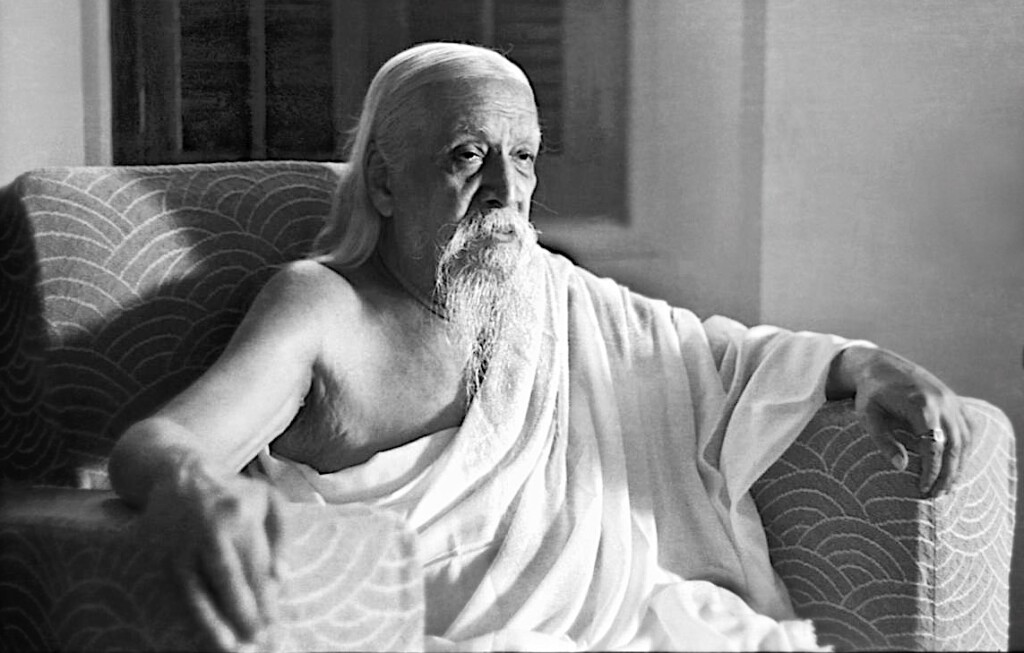
You sit with the book open and realize, somewhere around the third hour, that what you are reading does not want to be understood the way you understand things — it wants to reorganize the instrument doing the understanding.
Savitri is not a devotional text in any sense the word devotion usually carries. It is not an act of worship directed upward, toward an abstraction waiting beyond the world. The poem, which Aurobindo revised continuously from the early 1900s until the final weeks before his death in December 1950, eventually accumulated more than 24,000 lines — making it one of the longest poems in the English language, longer than Paradise Lost and the Iliad combined — and what it does across that extraordinary length is refuse, with methodical patience, every available exit from the problem of existence. You cannot leave through mysticism. You cannot leave through materialism. You cannot leave through the renunciation that Indian philosophical tradition sometimes offers as its highest gift. The poem seals every door and asks you to remain inside the burning room.
The central epistemological provocation is this: that matter and spirit are not opposites requiring reconciliation but a single reality at different intensities of self-realization. This is not a metaphor. Aurobindo meant it with the precision of a metaphysician, and the poem performs it structurally — the verse itself attempts to carry, at the level of sound and rhythm, an experience that analytical prose cannot transmit. He was drawing on his reading of the Rig Veda, on the tradition of Tantra that refused the body’s abjection, on Henri Bergson‘s concept of creative evolution, and reshaping all of it into something that Western philosophy had no category for: a rigorous insistence that the earth is not a staging ground for escape but the very site where consciousness completes its journey into itself.
This places Savitri in direct confrontation with two dominant civilizational postures simultaneously. Western modernity, since at least Descartes’ 1637 Discourse on the Method, had been steadily constructing a world in which matter is inert substance available for manipulation and spirit, if it exists at all, is a private hallucination. The result was a civilization of extraordinary technical power and extraordinary inner vacancy. But the Eastern counter-position — the tradition summarized in Shankara’s Advaita, in the Upanishadic gesture of turning away from the phenomenal world as maya — offered an exit that Aurobindo found equally disabling. To declare the world illusory is to abandon it, and abandonment dressed as enlightenment is still abandonment.
What the poem insists on instead is a kind of courage that has no comfortable name. The myth it rewrites is the Mahabharata story of Savitri and Satyavan — a woman who argues Death itself into returning her husband — but Aurobindo transforms the argument with Death into something philosophically precise: a case made not for individual survival but for the transformability of earthly existence as such. Savitri does not plead. She reasons. And the reasoning she performs is that consciousness has not yet finished what it began when it entered matter, that the evolutionary movement identified in 1914 across Aurobindo’s journal Arya is still incomplete, that to accept death as the final word is to mistake a stage for a conclusion.
The uncomfortable residue the poem leaves — and it does leave residue, the way certain experiences leave a changed chemistry rather than a memory — is not spiritual inspiration. It is something more destabilizing: the suspicion that the dismissal of the earth, in all its suffering and density and evolutionary incompleteness, as unworthy of serious metaphysical investment might be the most consequential cowardice a civilization can practice, dressed so long in the language of realism that we have forgotten it is a choice.
🌀 Paths of Inner Light and Spiritual Transformation
Sri Aurobindo’s life and works stand at the intersection of Eastern spirituality, evolutionary philosophy, and the quest for an integral transformation of human consciousness. The articles below trace parallel journeys through mysticism, esoteric tradition, and the philosophy of the spirit, offering readers a richer context in which to place Aurobindo’s vision of the divine life.
Rudolf Steiner and Anthroposophy: A Guide to Modern Esoteric Thought
Rudolf Steiner developed Anthroposophy as a rigorous spiritual science seeking to unite the inner life of the human being with a direct knowledge of supersensible worlds. Like Sri Aurobindo, Steiner believed that the evolution of consciousness is not merely biological but fundamentally spiritual, and that humanity is called to participate actively in that evolution. His pedagogical, medical, and artistic applications of this philosophy make him one of the most comprehensive esoteric thinkers of the twentieth century.
GO TO THE SELECTION: Rudolf Steiner and Anthroposophy: A Guide to Modern Esoteric Thought
Jiddu Krishnamurti: the Man Who Refused to Be God
Jiddu Krishnamurti was chosen by the Theosophical Society as the vehicle of a World Teacher, yet he dramatically renounced that role and spent his life urging individuals to seek truth without any authority, guru, or organized religion. His radical insistence on direct, unmediated awareness resonates deeply with Aurobindo’s emphasis on the individual soul’s direct relationship with the divine. The comparison between the two thinkers illuminates the tension between structured spiritual paths and the sovereign freedom of consciousness.
GO TO THE SELECTION: Jiddu Krishnamurti: the Man Who Refused to Be God
Meister Eckhart: Life and Mystical Philosophy
Meister Eckhart stands as one of the most daring mystics of the Western tradition, teaching that the soul must empty itself entirely to discover the divine ground that underlies all existence. His concept of the Godhead as a dynamic, overflowing unity finds unexpected echoes in Aurobindo’s notion of the Supermind as the creative source of all manifestation. Reading Eckhart alongside Aurobindo opens a profound dialogue between medieval Christian mysticism and modern Integral Yoga.
GO TO THE SELECTION: Meister Eckhart: Life and Mystical Philosophy
Universal Consciousness
The concept of Universal Consciousness has been explored across cultures, philosophies, and spiritual traditions as the ground from which individual awareness arises and to which it may return. Sri Aurobindo placed this idea at the very center of his Integral Yoga, arguing that the evolution of life on Earth is driven by a descent of higher consciousness into matter. This article provides an essential philosophical and cultural map for understanding what thinkers across the ages have meant when they speak of a single, all-encompassing awareness.
GO TO THE SELECTION: Universal Consciousness
Discover the Cinema of the Spirit on Indiecinema
If these paths of inner transformation have stirred something in you, Indiecinema streaming is the place to continue the journey. Our curated selection of independent and spiritual cinema brings to the screen the same questions that Aurobindo, Eckhart, and Krishnamurti devoted their lives to exploring. Step into the labyrinth of consciousness — a film is waiting for you.
👉 EXPLORE THE CATALOG: Watch Indie Films in Streaming
A vision curated by a filmmaker, not an algorithm
In this video I explain our vision

