
The First Touch of Invisible Light
You walk into a field at noon in July, the sun hammering the grass flat and pale, the sky that particular saturated blue that painters have always fought over. You raise the camera. You press the shutter. And what comes back at you on the screen is not the world you are standing in — it is something older, stranger, a place that exists just beneath the surface of the visible: the grass is burning white, almost phosphorescent, as if lit from within by something the sun only hints at. The sky has collapsed into a near-black, dense and mineral, the kind of darkness you associate with deep water or the hour before a storm, not with noon in July. The clouds, if there are any, sit in that black like objects carved from bone. You are still standing in the same field. Your eyes report the same blue, the same pale green. But the camera has just shown you that you have never actually seen this place.

Infrared photography does not stylize the world. It does not filter or reinterpret. It records a frequency of light that has always been present, always striking every surface you have ever looked at, always bouncing back into the space around your face — and your visual system has been systematically, physiologically trained to ignore it. The human eye is sensitive to electromagnetic radiation in a band roughly between 380 and 700 nanometers. Infrared light begins where that band ends, from approximately 700 nanometers stretching toward 1000 nanometers in the near-infrared range accessible to modified cameras. The gap between what you see and what exists is not metaphorical. It is measurable in nanometers. It has a number.
The physicist Max Planck, whose work on blackbody radiation in 1900 laid the theoretical foundation for quantum mechanics, understood that all matter emits radiation as a function of its temperature — and that most of this emission falls outside the human visual range entirely. Every warm body, every surface absorbing sunlight, every living thing metabolizing energy is broadcasting information into the electromagnetic spectrum, and almost none of it is visible to the organism that has spent sixty thousand years believing its senses were comprehensive. The eye did not evolve to see everything. It evolved to see enough. These are radically different things.
What a converted camera does — one whose internal hot-mirror filter has been removed or replaced to allow infrared wavelengths to reach the sensor — is refuse that evolutionary compromise. The sensor, now unblocked, registers what the retina discards. Chlorophyll in living plant cells reflects infrared radiation with extraordinary intensity, which is why healthy vegetation in infrared imagery glows with that hallucinatory white luminescence, while a dead or painted approximation of green remains dark. The foliage is telling the truth about its own biology. The sky scatters infrared less efficiently than it scatters visible blue light, which is why it renders almost black in infrared captures — the Rayleigh scattering that gives you that painter’s blue simply does not apply at 720 nanometers. The physics is not performing an aesthetic effect. The physics is performing itself, without apology, for any instrument willing to record it.
William Herschel discovered infrared radiation in 1800 by passing sunlight through a prism and placing thermometers beyond the red end of the visible spectrum. The thermometer in the dark registered heat. There was energy in the invisible. He published his findings and called the phenomenon calorific rays before the terminology was refined, but the discovery itself was a rupture: the visible was not the complete. Herschel’s thermometer was the first instrument to testify that the eye has a blind side — not a defect, not a failure, simply a boundary that no one had thought to question because no one had yet built anything capable of standing outside it.
A Spectrum Decided by Convention
You have been told, since childhood, that the rainbow contains all the colors there are. Someone held your hand in a science classroom, pointed at a prism scattering light across a white wall, and the implicit lesson was not merely optical — it was ontological. This is the world, the gesture said. What you see is what exists.
In January of 1800, a German-born astronomer working in England dismantled that assumption with a thermometer. William Herschel, already famous for his 1781 discovery of Uranus, was studying sunlight through colored filters when he noticed something that refused to fit the established picture: the temperature continued to rise as he moved his instrument past the red end of the visible spectrum, into a region where no light appeared to exist at all. Heat without color. Energy without visibility. He had not invented infrared radiation — it had always been there, warming every surface the sun touched, radiating from every living body, traveling through space in vast quantities that human eyes simply never registered. What Herschel discovered was that human perception had been quietly mistaken about the boundaries of the real.
The philosophical weight of this moment tends to get absorbed by the history of physics, filed under “electromagnetic spectrum” and forgotten as a curiosity. But the implications run much deeper than wavelength tables. Immanuel Kant had argued, just thirteen years earlier in the Critique of Pure Reason, that human cognition does not passively receive reality but actively structures it through the filters of perception and cognition — that what we call experience is always already shaped by the apparatus doing the experiencing. Herschel’s thermometer gave that argument a physical demonstration. The eye is not a neutral window. It is a highly specific instrument with a remarkably narrow operational range, covering roughly 380 to 700 nanometers of a spectrum that extends, in both directions, for billions of times that width.
What makes this culturally significant rather than merely technical is the speed at which scientific knowledge of that limitation failed to disturb the social certainty built upon it. Knowing, intellectually, that there is more to light than you can see did not and does not change the lived assumption that seeing constitutes knowing. Language itself resists the correction: to see through something, to shed light on a problem, to illuminate an argument — every metaphor of understanding is a metaphor of vision, and that vision is always implicitly the narrow human kind. Societies have historically prosecuted, marginalized, and institutionalized people who claimed to perceive what others could not, not because the claims were always false, but because the consensus model of reality had no room for unofficial input. The visible spectrum became not just a biological fact but a social contract.
There is a term in the sociology of knowledge — introduced by Karl Mannheim in his 1929 work Ideology and Utopia — for the way groups of people share frameworks that feel like neutral observation but are in fact socially constructed positions. He called it the sociology of knowledge precisely because what counts as knowledge, what registers as real, is never separable from the community enforcing those standards. Applied to perception itself, the principle becomes almost vertiginous: entire civilizations built their epistemologies, their legal systems, their aesthetic traditions, on the assumption that human eyesight was a sufficient and representative instrument for reality. No culture formally voted on this. No committee decided that the infrared and ultraviolet would be excluded from the official map. The exclusion happened through the simple repetition of a shared biological limitation, mistaken over millennia for a complete picture.
Infrared photography does not resolve this problem. It simply makes the error visible in a way that is harder to dismiss than a thermometer reading — because it produces an image, and images speak to the very faculty that has been doing the misleading all along.

The Politics of Perception
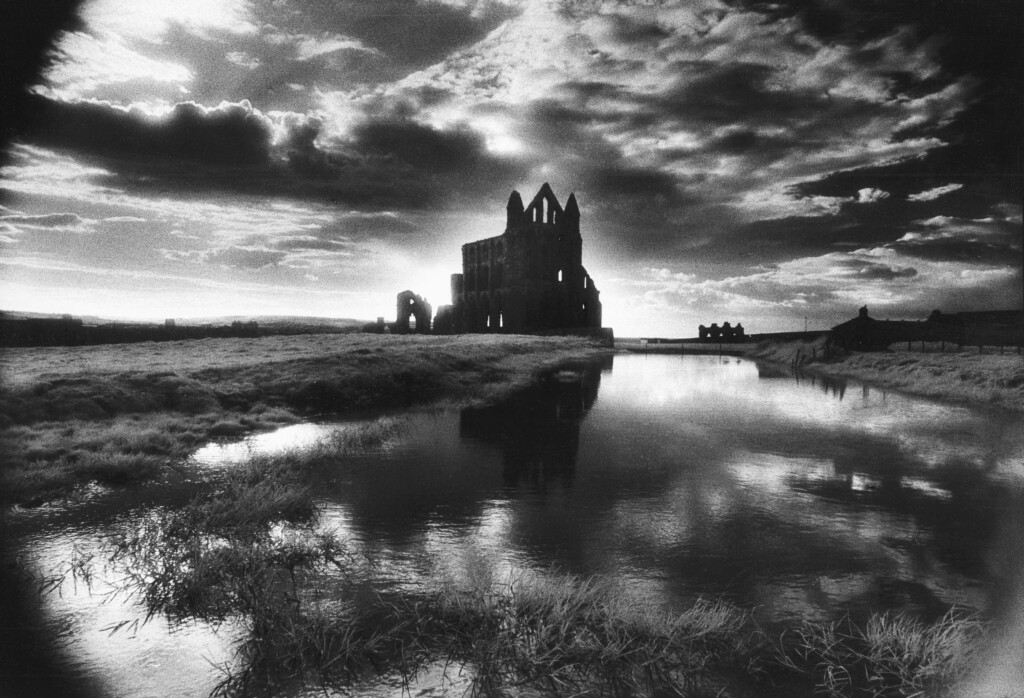
You are standing in a forest you have walked through a hundred times, and the photograph someone hands you shows you a place you have never been. The trees are white. The sky is black. The grass burns like snow. Nothing in the image is false — the light recorded there was genuinely present, the photons struck the film with absolute indifference to your expectations — and yet your brain refuses the image as real. That refusal is not aesthetic. It is political.
Maurice Merleau-Ponty argued in his 1945 Phenomenology of Perception that the body is not a passive receiver of sensory data but an active, historically conditioned interpreter — a lived instrument shaped by repetition, culture, and social expectation into something that feels like pure, unmediated contact with the world. The eye does not simply open and receive. It has been trained, over years of shared visual culture, to prioritize certain wavelengths, to suppress others, to organize the incoming chaos of electromagnetic radiation into a grammar that a community of other trained eyes will ratify as correct. What you call seeing is mostly an act of recognition, and recognition is always already a form of forgetting.
This is where photography does something that painting and drawing cannot quite replicate. A painter who chooses to render a field in alien tones has made a conscious aesthetic decision, and the viewer processes that decision as expression, as style, as personal vision. But a camera operating in the near-infrared spectrum around 720 to 850 nanometers makes no such decision. It simply records what is there. The mechanical neutrality of that act strips the viewer of their usual defense: they cannot dismiss the image as someone’s interpretation. The strangeness has no author to blame. It arrives as evidence.
Sociologists of knowledge, particularly those working in the tradition that Barry Barnes and David Bloor consolidated in the Edinburgh School’s strong programme during the 1970s, demonstrated that categories of the real are not discovered but negotiated — maintained by communities of practice that share instruments, training, and professional incentives to see the same things. Radiologists learn to read tumors in grayscale shadows that a layperson looks at without comprehension. A sommelier perceives structural distinctions in fermented grape juice that register to the untrained palate as a single undifferentiated warmth. Vision is not a biological constant. It is a competence, distributed unequally, maintained by institutions, and revocable by any instrument that refuses to honor the consensus.
Infrared photography is such an instrument. Chlorophyll in living plant cells reflects near-infrared radiation with extraordinary intensity — a phenomenon that agricultural remote sensing has exploited since the 1930s in aerial surveys designed to detect crop health and disease before the naked eye could register any change. What the farmers standing in those fields could not see, the film saw with brutal clarity: which plants were already dying, which were stressed, which would fail before the next harvest. The visible spectrum had been concealing an emergency. The emergency was not new. Only the visibility was.
What becomes uncomfortable is not the strangeness of the infrared image but the implication it carries about every ordinary photograph you have ever trusted. If the spectrum of light your eye ignores contains information this structurally significant — if a dying forest looks healthy to the naked eye while burning white in frequencies you cannot access — then the confidence with which you have moved through visual experience starts to feel less like knowledge and more like a gentleman’s agreement between your nervous system and a world that agreed, for a while, to behave within the narrow band you were trained to monitor. Merleau-Ponty called the body a “motor intentionality” — a system that reaches toward the world with preformed expectations and receives back only what those expectations are designed to catch.
The infrared photograph does not expand your vision.
Chlorophyll, Skin, and the Betrayal of Surfaces
You walk into a forest and your eye reads it as green. Every instinct confirms this. The canopy overhead, the undergrowth at your feet, the whole cathedral of living matter — green, saturated, absolute. Photograph that same forest with a camera modified to record near-infrared wavelengths, and the trees become white. Not grey. Not pale. White, blazing, almost incandescent, as though the forest has been caught doing something it never intended anyone to see.
The reason is chlorophyll. Leaves absorb red and blue visible light for photosynthesis but they reflect near-infrared radiation at roughly 700 to 1300 nanometers with extraordinary intensity — a phenomenon plant biologists call the red edge, a sharp reflectance spike that agricultural satellites have exploited since the Landsat program began systematically imaging vegetation in 1972. The green the eye perceives is almost incidental to what the leaf is actually doing with light. What infrared photography captures is not a stylized version of the forest but a more complete account of its energetic behavior, one that the entire architecture of human vision was simply not built to receive.
Skin behaves differently, and more unsettlingly. Near-infrared penetrates the epidermis and scatters within the dermis before reflecting back, bypassing the melanin that governs how we read each other’s faces under ordinary light. The result is that skin tones in infrared photography converge toward a shared luminosity — not because difference disappears, but because the particular signals that visible light uses to sort and classify human bodies are no longer operative. Infrared cameras used in certain medical imaging contexts exploit this same penetration depth to visualize subcutaneous vascular structures, veins becoming visible beneath skin that appears opaque to the naked eye. The body, under this wavelength, does not conceal its interior the way it normally performs concealment.
Erving Goffman spent most of his career — from The Presentation of Self in Everyday Life in 1959 through Frame Analysis in 1974 — arguing that social interaction is fundamentally theatrical, that what we call a person is largely a managed impression assembled for a particular audience. The unsettling thing about infrared is not that it proves him right but that it operates as a literal demonstration of the mechanism he was describing. A surface that reads as one thing under the conditions for which it was optimized reveals itself as something structurally different the moment those conditions change.
Synthetic fabrics make this point with almost comic bluntness. A black polyester shirt, opaque and authoritative under visible light, can become semi-transparent under near-infrared wavelengths because the polymer fibers that absorb and block visible light do not interact with longer wavelengths the same way. Cotton behaves differently. Wool behaves differently again. Two garments that appear identical to the eye — same color, same weight, same apparent density — may register at opposite ends of the infrared tonal scale. The clothing, which was performing a specific visual role, simply stops performing it. What was a costume becomes a material fact.
This is not a minor technical curiosity. The entire system of cues through which we navigate public space — reading health, age, status, ethnicity, the hundred instantaneous assessments that precede conscious thought — depends on a specific band of the electromagnetic spectrum. Step outside that band, and the cues that felt like perception reveal themselves as interpretation, contingent and constructed rather than given. The physicist would say you have simply changed your measurement instrument. What shifts is not reality but the layer of reality you were measuring. And for most of human history, that layer was the only one available, which made it very easy to mistake it for the whole.
The camera modified for infrared does not lie. It does something more disorienting than lying — it tells a different truth, about the same object, at the same moment, using the same physics, simply tuned to a frequency the body was never equipped to trust.
The Camera as Epistemological Instrument
You have walked past the same oak tree five hundred times and believed, with the casual certainty of the habitual, that you knew it — its rough bark, its seasonal shedding, the particular shade of green it offered in July. Then someone hands you a print made with infrared film, and the tree is white, almost luminous, burning against a sky turned black as coal, and something in your cognitive furniture quietly collapses.
Susan Sontag argued in 1977, in On Photography, that the camera does not reproduce the world so much as it generates a new relationship to reality — that every photograph is less a capture than a proposition, a claim staked on behalf of a particular way of seeing. The photograph teaches you to see photographically, which means it teaches you to see selectively, to frame, to exclude, to privilege the frozen instant over the living duration. This was already a epistemological scandal at the time: the most trusted document in modern culture was, at its root, an argument rather than a mirror.
Infrared photography does not merely extend this problem — it detonates it from within. When a sensor or a film emulsion registers radiation at wavelengths between 700 and 1200 nanometers, it is not revealing a hidden layer of the same world the eye sees. It is making visible an entirely different physical event, one that has no corresponding human sensory apparatus, no evolutionary history in perception, no cultural grammar built up over millennia to interpret it. Chlorophyll in living plant tissue reflects infrared radiation with extraordinary intensity, which is why foliage renders white or silver in these images. But knowing the mechanism does not neutralize the strangeness — it deepens it, because it confirms that the world was always doing this, silently, in every direction, and nothing in your perceptual inheritance gave you a single clue.
The documentary impulse rests on a foundational assumption: that the observer and the observed share the same basic register of existence, that what the camera sees is a more precise or more permanent version of what the eye sees. Ethnographers in the 1920s and 1930s carried cameras into the field as instruments of neutral witness. Forensic photographers built courtroom arguments on the premise that the lens was incorruptible. The entire epistemic authority of photojournalism — its claim on your conscience, its power to generate outrage or grief — depends on this shared register. Infrared tears the contract open and leaves the terms scattered.
What the infrared image documents is not the scene before the lens but the exact location where human certainty runs out. The threshold is not metaphorical. It is measurable in nanometers, a physical boundary built into the biology of the eye, the architecture of the retina, the evolutionary pressures that shaped mammalian vision for survival in visible-light conditions and nothing beyond. Everything past 700 nanometers is not darkness — it is a fully populated, energetically active domain that simply fell outside the narrow window that natural selection considered sufficient. The camera, aimed into that domain, is not an extension of the eye. It is a prosthetic for a sense the species never developed.
This is where the instrument becomes genuinely philosophical. The telescope extended vision across distance; the microscope extended it across scale. Both operated within the same spectral band the eye already trusted, expanding its range without challenging its authority. Infrared photography does something more structurally disruptive — it reveals that the authority itself was provisional, that the seen world was always a curated subset, and that the curator was not reason or culture or ideology but biology. Edmund Burke wrote in 1757, in A Philosophical Enquiry into the Origin of Our Ideas of the Sublime and Beautiful, that the sublime produces astonishment precisely because it exceeds the mind’s capacity to contain it.
A vision curated by a filmmaker, not an algorithm
In this video I explain our vision
The Second Scene: The Archive That Sees Through Walls

A man sits alone in a room with no windows, sometime in the late 1960s, staring at a photograph that was taken from seventy thousand feet above a forest that does not exist. The trees are there — he can see them, neat and symmetrical, arranged in the kind of pattern that living forests never quite manage. But the tonal values are wrong. In infrared, healthy chlorophyll-rich vegetation reflects near-infrared radiation with an almost aggressive brightness, appearing luminous and white on orthochromatic film. The painted canvas draped over steel and concrete does no such thing. It absorbs where it should reflect. It stays dark. The camouflage, designed to fool every human eye that might glance upward from a reconnaissance aircraft, fails completely against a wavelength the designers either forgot or chose to ignore.
This is not a minor tactical embarrassment. During the Cold War, American and Soviet intelligence programs invested enormous resources in what analysts called “camouflage detection” using infrared-sensitive aerial film, a technology that had been quietly maturing since World War II when the Allies discovered that German forces were using painted burlap and fake foliage to conceal armor and artillery positions in France. The problem with fake vegetation was always spectral, not visual. A human painter mixing green pigments works entirely within the visible spectrum, matching hue and saturation to real leaves. But living plant matter is not green in any simple sense — it is a complex biological machine that happens to reflect green light while absorbing red and blue, and which simultaneously floods the near-infrared band with reflected energy as a byproduct of its cellular structure. No paint replicates this. The biology is irreducible.
What infrared imagery did to military deception was structurally similar to what a lie detector claims to do to a nervous system — it bypassed the surface performance and read something the performer had no conscious access to. Except infrared actually works. By the early 1970s, the United States Geological Survey was running the Earth Resources Technology Satellite program, and the imagery coming back from ERTS-1, launched in 1972, contained multispectral data including near-infrared bands that could distinguish not only fake vegetation from real, but stressed vegetation from healthy vegetation, shallow water from deep, and irrigated farmland from dryland agriculture at continental scale. The earth, read in infrared, became a document full of annotations it had never intended to make.
The deeper unsettlement in all of this is not that governments were hiding things — they always have, always will — but that the landscape itself became an accomplice to deception and then an unwilling witness against it. Forests were recruited. Mountains were implicated. The ground was asked to perform innocence over installations designed to end cities. And for a while, it performed adequately, because the available sensors were confined to the same narrow band of reality that human evolution had equipped the eye to navigate. The moment the sensor range expanded, the landscape’s testimony changed entirely. It had never been lying, precisely. It had simply been answering the wrong question.
Roland Barthes wrote in Camera Lucida, published in 1980, that photography is a certificate of presence — it says “this has been,” with a certainty no other medium can produce. Infrared imaging extends that certificate into domains of presence the subject never consented to declare. The installation hidden beneath painted nets was present. The stressed crop field concealing a drought the government had not announced was present. The body heat of a crowd dispersed before journalists arrived was present. The image did not create these facts. It simply refused the agreement — usually tacit, often institutionally enforced — that only visible evidence counts as real.
What you understand looking at an infrared satellite photograph of a camouflaged military site is that deception has a spectral profile, and that the universe does not particularly honor the conventions under which it was constructed.
False Color and the Ideology of Naturalism
You open an image and something in you recoils before your mind has time to form a reason. The grass is white. The sky is dark in a way that feels bruised rather than stormy. The leaves glow as though lit from within by a fever. Your first instinct is to call it fake, manipulated, unreal — and that instinct is not innocent. It arrives dressed as aesthetic judgment, but underneath it is a defense of consensus.
The word “false” in false color is not a technical descriptor, despite how clinical it sounds. It is a verdict. It presupposes a tribunal of correct colors, a legitimate palette against which infrared rendering has been measured and found guilty of deviation. But no photograph has ever shown you the world as it is. Every color image you have accepted as natural is the product of dye couplers, sensor filters, white balance algorithms, and decades of film stock engineering calibrated not to biological vision but to market preference. Kodak’s color scientists in the 1950s ran consumer tests and tuned their emulsions toward a specific result: skin tones that white American consumers found flattering, greens that matched a suburban lawn on a Saturday afternoon. The “natural” look of a photograph is a technology that learned to disguise itself as perception.
Roland Barthes, in his 1957 collection on the hidden grammars of everyday life, described a precise operation by which culture passes itself off as nature. What is historical, contingent, constructed — the result of specific choices made by specific people with specific interests — arrives in consciousness already wearing the face of the obvious. It is not presented as one option among others. It presents itself as the only way things could possibly be. The anxiety infrared photography produces is not aesthetic. It is the particular discomfort that follows when something culturally constructed is suddenly visible as constructed, when the disguise slips and you catch a glimpse of the machinery behind the stage.
This is why the resistance to false color is so disproportionate to the actual experience of looking. Nobody protests that a thermal imaging scan of a city block makes the heat of human bodies orange and the cold glass of windows blue. Nobody demands that an X-ray respect the color conventions of skin. The violence of infrared lies precisely in its placement inside the aesthetic register of photography — it uses the same frame, the same lens, the same aperture, and yet it refuses to deliver the perceptual contract the medium has trained you to expect. It is the refusal that disturbs, not the image itself.
Photographers who have worked extensively in infrared report a consistent social dynamic: the images that generate the most hostility are not the most abstract or experimental, but the ones that are almost recognizable. A forest that looks nearly like a forest, except the foliage is luminous white and the shadows fall like lead — these images disturb more than pure abstraction because they do not allow the viewer the easy exit of “that’s art.” They sit in the uncanny space where recognition and wrongness coexist. Sigmund Freud located the uncanny not in the monstrous or the alien but in the familiar made strange — the thing that should be recognizable but has been turned slightly, like a face seen at an angle that reveals it as a mask.
The charge of fakeness leveled at infrared images would be more honest if it were leveled universally — at every image that has been color-graded, every sky that has been selectively darkened in post-production, every portrait run through a preset that makes the shadows warmer and the highlights cooler in imitation of a film stock that itself imitated a version of reality someone once decided to sell. The selective outrage is the tell. We do not object to images that lie in ways we have already agreed to call truth.
What the Eye Protects You From
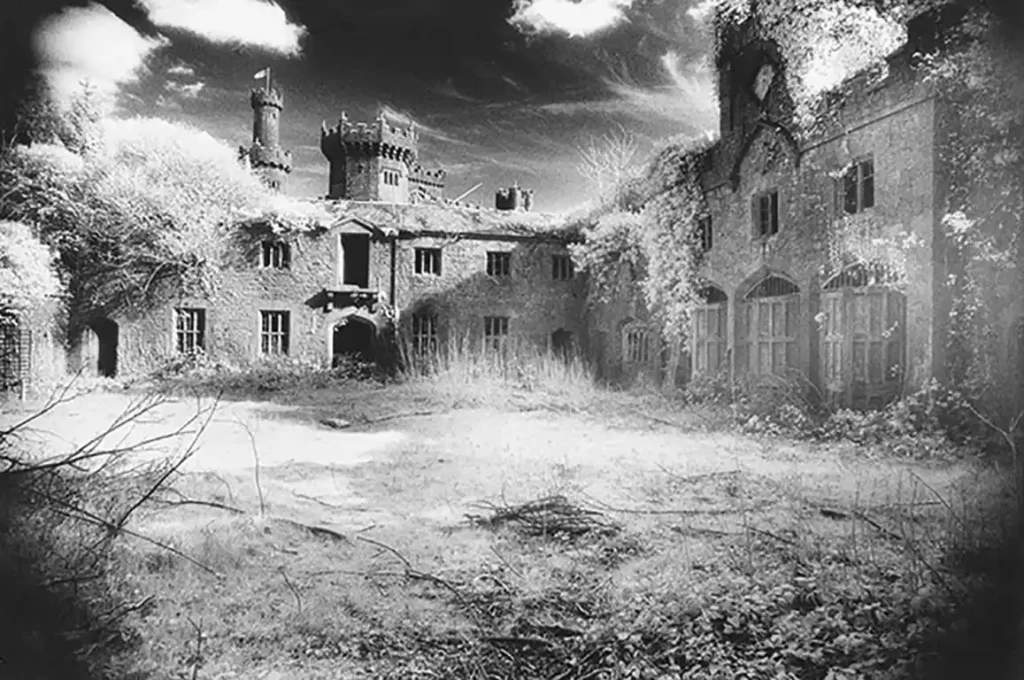
You pick up a photograph taken in infrared and something in your body reacts before your mind does. The grass is white. The sky is almost black. The shadows fall in the wrong directions. Your nervous system registers the image as wrong before you have the language to say why, and that wrongness is diagnostic — it tells you something precise about the kind of machine your vision actually is.
The eye did not evolve to see the world. It evolved to survive it. This distinction, which sounds like a philosophical nicety, is in fact the most concrete fact about human perception available to us. David Marr, in his 1982 work Vision, argued that the visual system is not a recording device but a computational problem-solver, extracting just enough structured information from the environment to guide action. The operative word is enough. The electromagnetic spectrum runs from radio waves through microwaves, infrared, visible light, ultraviolet, X-rays, and gamma rays. Human vision is responsive to a band roughly between 380 and 700 nanometers — a sliver so narrow it constitutes less than one ten-trillionth of the full spectral range. Everything outside that corridor is not hidden from you by some external force. It is hidden from you by your own biology, which made a wager millions of years ago that what lay outside that band was not worth the metabolic cost of processing it.
The philosopher Markus Gabriel, in his 2015 work Why the World Does Not Exist, pushed further: what we call reality is always a field of sense, a frame that makes certain things visible and renders others structurally invisible. He was not talking about physics. He was talking about the architecture of meaning. But the parallel holds at the level of photons. The retina does not fail to see infrared — it actively excludes it. There is no passive ignorance here. The filtering is structural, constitutive, built into the tissue of seeing itself, and it has been running so long you experience its output as neutral reality rather than as a heavily edited version of something vastly larger.
Infrared photography does not add anything to the world. It removes the filter. A converted full-spectrum camera with an infrared-pass filter at 720 nanometers is not a more powerful instrument than the human eye — it is a differently calibrated one, responsive to wavelengths of light that are physically present in every scene you have ever walked through, illuminating every face you have ever looked at, falling across every ordinary landscape you have ever dismissed as known. The white foliage in those images is not a distortion. It is chlorophyll, fluorescing with infrared energy it has been absorbing and reflecting all along, invisible to you not because it was absent but because your visual cortex was never contracted to report it.
This is where the photograph becomes philosophically uncomfortable in a way that transcends optics. If the eye operates as a survival filter rather than a truth-seeking organ, and if that filter was installed in you before language, before culture, before any form of consent, then the question of what else has been filtered becomes genuinely vertiginous. The neurologist Antonio Damasio demonstrated in Descartes’ Error, published in 1994, that emotion and bodily state are not interruptions to rational perception — they are constitutive of it, shaping what registers as salient before any conscious evaluation begins. The body is already voting on what counts as real before you arrive at the scene. Infrared photography makes this visible in the literal sense: here is a channel of physical information your organism agreed, without asking you, to discard.
The question that remains is not whether other such agreements exist. They demonstrably do, at the level of neurology, culture, language, and history. The question is whether becoming aware of one of them — the optical one, the most visceral, the one made of light — changes anything about how you stand inside the others.
🌿 Seeing the Invisible: Light, Vision and Hidden Worlds
Infrared photography reveals a world that exists just beyond the threshold of human perception, transforming familiar landscapes into otherworldly visions of luminous foliage and darkened skies. This capacity to pierce beyond surface appearances connects to a broader cultural and philosophical fascination with the unseen — with layers of reality that ordinary sight cannot access. The articles below explore this same impulse across art, science, and thought.
Light in Painting: History and Symbolism
Light is not merely a physical phenomenon — in the history of painting it has carried theological, psychological, and metaphysical weight, shaping how artists construct meaning through illumination and shadow. From the divine radiance of Byzantine gold grounds to the charged darkness of Caravaggio’s chiaroscuro, painters have used light to suggest what lies beyond visible reality. Infrared photography, in its own way, continues this ancient dialogue between seeing and knowing.
GO TO THE SELECTION: Light in Painting: History and Symbolism
Bill Viola: Life and Video Art
Bill Viola built his entire artistic practice around the idea that video and light can reveal dimensions of human experience that ordinary sight and language fail to reach. His immersive installations use slow motion, infrared imaging, and luminous water to probe birth, death, and spiritual transformation. His work stands as one of the most powerful artistic parallels to infrared photography’s mission of unveiling the hidden life beneath surfaces.
GO TO THE SELECTION: Bill Viola: Life and Video Art
Video Art: History and Main Artists
Video art emerged as a medium committed to questioning what the camera sees and what it conceals, challenging the assumed transparency of the photographic image. Artists like Nam June Paik and Wolf Vostell used electronic image-making to expose the artificiality of visual representation and open new perceptual territories. Understanding this history deepens appreciation for any photographic practice — including infrared — that deliberately departs from mimetic vision.
GO TO THE SELECTION: Video Art: History and Main Artists
Phenomenology of Nature: Husserl and Merleau-Ponty
Phenomenology, as developed by Husserl and later Merleau-Ponty, places the lived body and its perceptual limits at the center of philosophical inquiry, insisting that what we see is always shaped by what we are capable of seeing. Merleau-Ponty’s reflections on perception remind us that human vision is never neutral or complete, but always partial and embodied. Infrared photography makes this philosophical truth viscerally apparent, forcing us to confront the arbitrariness of the visible spectrum we call normal.
GO TO THE SELECTION: Phenomenology of Nature: Husserl and Merleau-Ponty
Discover Cinema That Sees Beyond the Surface
If infrared photography awakens your appetite for visions that transcend ordinary perception, Indiecinema is the streaming platform where independent and art cinema take you further. Explore films that experiment with light, image, and reality in ways that no mainstream screen would dare. Join Indiecinema and let your eyes learn to see what they never knew they were missing.
👉 EXPLORE THE CATALOG: Watch Indie Films in Streaming
A vision curated by a filmmaker, not an algorithm
In this video I explain our vision

