
The Screen That Would Not Be Turned Off
You walk into the kitchen at two in the morning and the television in the living room is still on. No one left it on intentionally. It simply never got turned off, the way things in a house accumulate presence without anyone deciding they should. The blue light moves across the ceiling in patterns you recognize without watching, voices speaking to no one, images cycling through their appointed rounds. You stand in the doorway for a moment and feel something you cannot name — not quite unease, not quite familiarity. Something closer to the sensation of being observed by something that has no eyes.

This is where video art begins. Not in a gallery, not in a manifesto, not in the theoretical language that accumulated around it like sediment after the fact. It begins in that doorway, in that moment when the image refuses to perform its usual function of delivering content and instead simply insists on existing, cycling, repeating, watching back.
The television set arrived in American homes at a rate that still staggers the imagination when you look at the numbers clearly: in 1948, fewer than one percent of American households owned one. By 1955, that figure had crossed sixty percent. By 1965, the set was not merely present in nearly every home but had reorganized the architecture of the living room around itself, the sofa angled toward it, the chairs repositioned, the hearth psychologically replaced. Guy Debord, writing in 1967 in The Society of the Spectacle, understood this reorganization as something more than furniture. The spectacle, he argued, is not a collection of images but a social relation between people mediated by images — and once you see that, you cannot stop seeing it. The television in the empty room is not passive. It is doing something to the space, to the silence, to whoever walks in.
The artists who would eventually be called video artists did not begin by wanting to make art. They began by wanting to interrupt. They wanted to put their hands inside the machine, to disturb the signal, to make the screen do something it was not supposed to do — not deliver content cleanly but crack open, stutter, reveal its own mechanics, its own violence. Nam June Paik, working in the early 1960s, physically altered television sets, placing magnets against the cathode ray tube to warp the image into something the broadcast engineers in their control rooms had never sanctioned. This was not aesthetics in the decorative sense. This was refusal. Marshall McLuhan had declared in 1964 that the medium is the message, meaning that the form of a communication technology shapes consciousness more profoundly than any content it carries. Paik understood this not as a theoretical proposition but as a practical problem that required practical sabotage.
What distinguishes video art from cinema, from television, from the moving image in its commercial and narrative forms is precisely this adversarial relationship to its own medium. Cinema asks you to forget you are watching. Television asks you to keep watching without quite thinking about what you are watching. Video art — at its most honest, at its most uncompromising — refuses both requests. It makes you aware of the screen as a surface, of time as a material that can be stretched and compressed and looped back on itself, of your own body sitting in front of an image that was made to make you uncomfortable with your own passivity.
The philosopher Giorgio Agamben wrote about the gesture as something distinct from action — gesture is the exhibition of mediality, the making visible of the means themselves. Video art, understood this way, is all gesture. It does not arrive somewhere. It does not tell you a story so that you can close the book and feel resolved. It holds up the screen and asks you to look at looking.
That television in the empty room is still on. It has always been on.
The Mirror and the Rascal
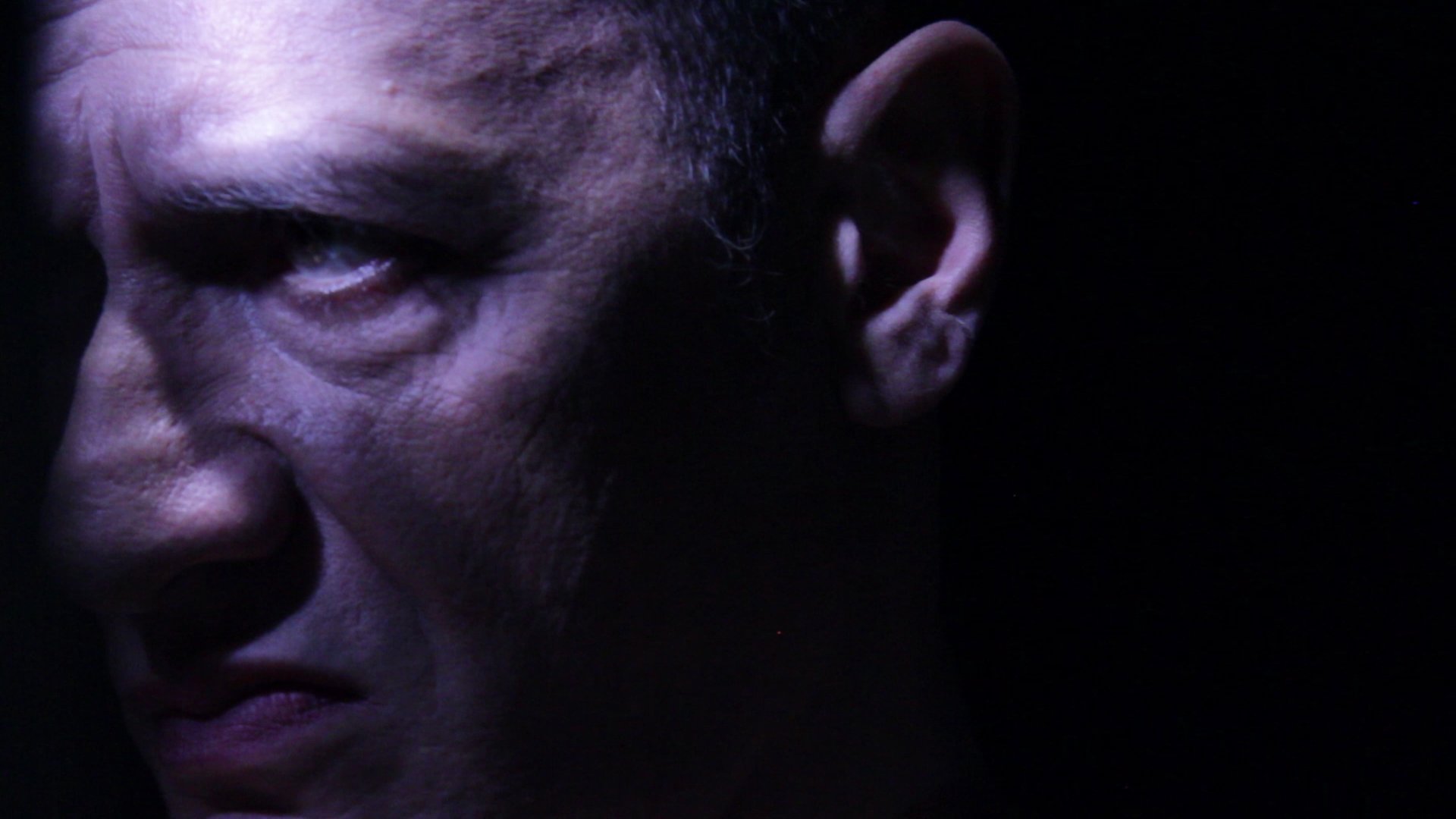
Drama film, by Valerio De Filippis, Italy, 2019.
The mirror and the rascal is an experimental film based on the tragedy "Richard III" by William Shakespeare. It tells the delirium of contemporary power in an author's reinterpretation of cinema, video art and music. The protagonist, Richard Duke of Gloucester, brother of King Edward IV, through a long series of crimes eliminates all the obstacles that stand between him and the throne of England.
Valerio de Filippis, a well-known painter who has been following his research path for a long time, investigating the relationship between light, corporeality and the psyche. The mirror and the rogue and the cinematographic equivalent of Valerio De Filippis' painting, his figurative style is in fact very recognizable looking at his paintings. But cinema is a new way where the artist can also be involved as an actor and performer, with an original mix between acting and singing. Staging the dark side of the human soul, the film is a surreal and disturbing interpretation of a great classic. The director says: "The first suggestion was musical: I was interested in transforming the text of Shakespeare's tragedy Richard III into notes. I love cinema and at a certain point I felt that the time had come to combine research on the image of painting to my love for cinema and music. When the film is finished I realize that I have remained faithful to painting: every frame of the film appears to me like a painting: the same light, the same colors, the same atmosphere ". The mirror and the rascal is a kind of psychoanalytic session that the painter does while hiding behind the mask of Richard III. Behind this ferocious and unscrupulous character we find a path of self-analysis by De Filippis, who is mainly interested in the more violent and turbid aspects. An experimental film in which, with great courage, the author gets involved completely, fragmenting the images in an unconventional montage, which is at the same time a flow of consciousness and spectacle.
LANGUAGE: English
SUBTITLES: Italian
Before the Camera Belonged to Everyone
Think of what it meant to see yourself on television in 1963. Not a reflection, not a photograph, but moving, speaking, existing in the medium that had already decided who counted as real. Television was not a window onto the world — it was a gatekeeping mechanism so naturalized that most people never thought to question it. The networks decided what a protest looked like, what a war looked like, what a family looked like. They decided whose face deserved to fill a screen and whose voice deserved amplification. For the overwhelming majority of Americans — Black citizens marching into police batons in Birmingham, students burning draft cards in Berkeley, women who had been told their interiority was a domestic matter — the camera was simply not theirs. It belonged to institutions, to corporations, to a class of professionals who translated reality into narrative and called that translation objectivity.
Then, in 1965, Sony released the Portapak, a reel-to-reel video recording system weighing roughly twenty pounds that a single person could carry on a shoulder. The price was steep — around fifteen hundred dollars, the equivalent of over thirteen thousand today — but compared to the cost of 16mm film equipment, professional processing, and broadcast infrastructure, it was a rupture. For the first time, the capture of moving image did not require institutional permission. You could record, rewind, watch, erase, record again, all without surrendering the footage to anyone. The loop was closed. The intermediary was gone.
Nam June Paik bought one of the first units available on the American market on the very day of its release, October 4, 1965, and that same evening recorded Pope Paul VI’s motorcade passing through New York City. He screened the footage that night at Café à GoGo in Greenwich Village. The gesture was not about the Pope. It was about the act itself — the seizure of the recording apparatus by someone who had no institutional mandate to use it. Paik, a Korean-born artist trained in music and deeply embedded in the Fluxus movement, understood immediately that the Portapak was not a tool for documentation. It was a philosophical provocation aimed at the entire apparatus of broadcast culture.
Walter Benjamin had written in 1935 that mechanical reproduction strips the artwork of its aura, its singular presence in time and space. But what Benjamin could not fully anticipate was the inversion: what happens when the technology of reproduction is placed in the hands of those the dominant culture has rendered auratic only in their absence, only as spectacle, only as object. The civil rights movement had already demonstrated, with brutal clarity, how images could mobilize or suppress, how the camera angle on a march could make nonviolent protesters appear threatening or martyred. Fanon, writing in 1961 in The Wretched of the Earth, described colonization as a project that required the colonized to see themselves through the colonizer’s eyes. Portable video offered, for the first time, a material counter to that.
This is not romanticism about technology. The Portapak did not liberate anyone by itself. What it did was lower, dramatically, the threshold of access to a medium that had functioned as a mirror only for those who already held power. The artists, activists, and communities who seized it in the late 1960s — from the video collectives forming in New York lofts to the Videofreex documenting the counterculture from a van traveling across America — were not experimenting for experiment’s sake. They were answering a question that the broadcast networks had answered for decades in the negative: who gets to show the world as they actually see it.
The question, once asked through a lens rather than a petition, proved impossible to un-ask.

Nam June Paik and the Television That Fought Back
There is a moment most people have had at least once — standing in front of a security monitor in a shop or a hotel lobby, watching yourself move on the screen with a delay of two or three seconds, and feeling something close to vertigo. Not because the image is wrong, but because it is almost right. You recognize the body, the jacket, the gesture. And yet something in you refuses the identification. That person on the screen is not quite you. Or rather, it is you seen from the outside, which means it is you as others see you, which means it was never really you at all.
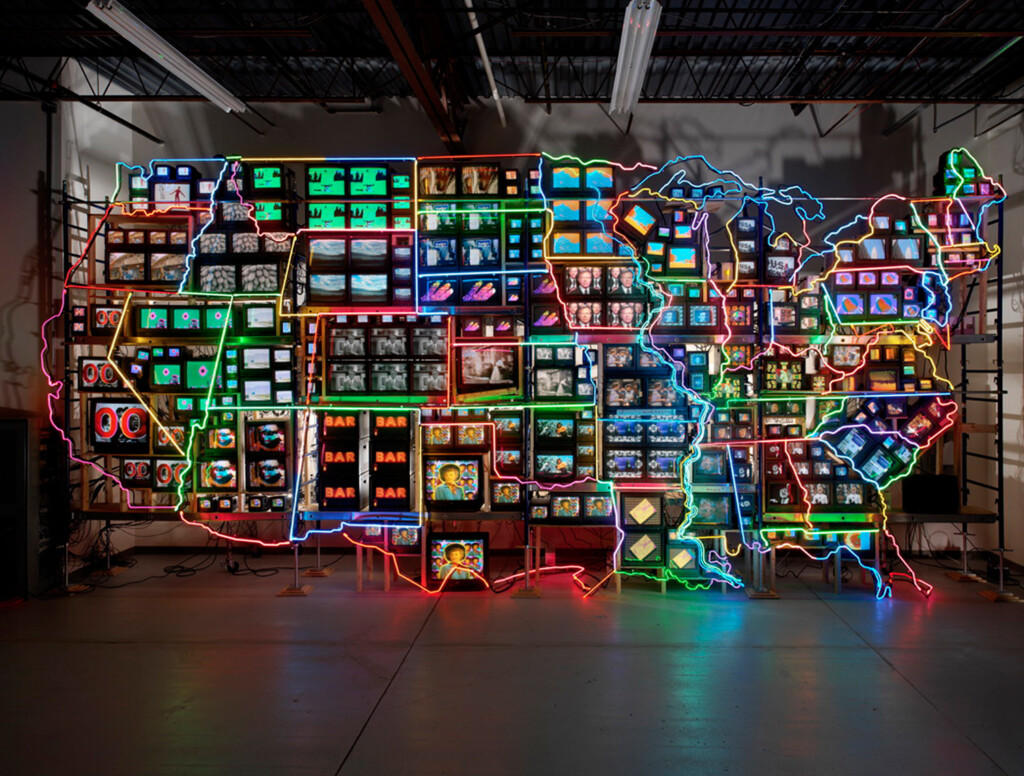
Nam June Paik understood this before most of the world had a television set in every room. Born in Seoul in 1932, trained as a musicologist in Tokyo and later in Germany where he fell into the orbit of the Fluxus movement and John Cage‘s philosophy of indeterminate sound, Paik arrived at video not as a technician but as someone who had spent years thinking about time, repetition, and the relationship between performer and audience. When he purchased one of the first Sony Portapak cameras available to consumers in 1965 — the year is significant, because consumer video recording was essentially newborn — he immediately turned it not toward the world but toward the screen itself. Magnet TV, made that same year, placed a large magnet atop a television receiver and let the magnetic field distort the broadcast image into swirling, organic forms, something between aurora borealis and intestinal tissue. The television was no longer a window. It was a body that could be touched, injured, transformed.
This was a philosophical act before it was an aesthetic one. Guy Debord had published The Society of the Spectacle only two years later, in 1967, arguing that modern social life had been replaced by its representation, that “all that was once directly lived has become mere representation.” Paik had already intuited this through his hands. You cannot watch a distorted broadcast without understanding, somewhere below language, that what you had always received as transparent transmission was always already a construction, a frame, a choice made by someone else before you ever sat down.
TV Buddha brings this into something more intimate and more disturbing. A small statue of the Buddha sits before a closed-circuit camera, watching its own image on a monitor in front of it. The circuit is total and self-enclosed. The Buddha watches itself watching itself, and nothing enters or exits. A man walks into a room one afternoon somewhere and finds himself suddenly unable to leave, not because the doors are locked but because his reflection has swallowed every direction. You watch someone in that situation and feel it in your sternum before you name it, that particular species of paralysis that comes from self-observation becoming so intense it evacuates the self entirely. The loop is not enlightenment. It is the simulacrum of enlightenment, the image of stillness substituting for stillness itself.
Marshall McLuhan had written in Understanding Media in 1964 that television was not a visual medium but a tactile one, that it involved the viewer’s nervous system in a way that required completion, participation, a reaching toward the screen to make sense of its low-definition image. Paik took this literally. He made the screen something you could reach toward and find reaching back, or reaching nowhere, or reaching only at itself. A woman sits in a hospital waiting room watching a mounted television play the same advertisement loop for the fourth time. She is not watching it. She is being organized by it, shaped into a waiting posture, held in suspension. Paik’s work names what she cannot.
He did not offer an alternative. He offered the wound made visible, which is something entirely different from a cure.
The Body as the Only Honest Screen
You are standing in a room alone, and someone is filming you. Not a photographer arranging your best angle, not a friend capturing a moment — a camera fixed on a tripod, indifferent, running continuously, recording everything you do whether it is interesting or not. At some point you stop performing. At some point your body simply is what it is, doing what bodies do when no one is curating them. That is the moment these artists were waiting for.
In the early 1970s, a man spent weeks in his studio allowing the camera to record him following his own shadow along a wall, pacing the same corridor until exhaustion became visible in the shoulders, the feet, the slight drag of a body wearing down. He was not making entertainment. He was conducting an experiment in the oldest scientific sense: isolating a variable, which in this case was the self, and observing what happened under controlled and merciless conditions. The camera did not applaud or recoil. It simply received.
Maurice Merleau-Ponty argued in his Phenomenology of Perception, published in 1945, that the body is not an instrument the mind uses but the very structure through which consciousness exists. We do not have bodies the way we have furniture. We are bodies, irreducibly, and all knowledge begins in that specific, mortal, located flesh. What the video artists understood — before they could have articulated it in these terms — is that the camera offered something no philosophy could: empirical evidence. The body caught on tape at hour three of a repetitive action is not the body you imagined yourself to have. It is the body you actually inhabit, which is a different and often alarming thing.
Michel Foucault, writing in Discipline and Punish in 1975, described how modern power operates not through direct coercion but through the internalization of surveillance. You behave as though watched even when no one is watching, because the structure of observation has been absorbed into the self. What these artists did was invert this dynamic with a kind of violent precision: they placed the watching apparatus inside the studio, turned it on themselves, and refused to look away. If surveillance produces docile bodies, then self-surveillance carried to its extreme produces something else — a kind of unbearable honesty that has nowhere to hide.
A woman stands still while another person circles her, and then the roles reverse, and then the distance between them collapses entirely, and then it becomes something neither of them fully controls. The camera records the exact moment when performance ends and something rawer begins — not emotion as theater, but physiology, the actual trembling of a body pushed past its social graces into whatever lives underneath. There is nothing narcissistic in this. Narcissism requires a flattering surface. The camera does not flatter. It records the asymmetry of a face, the gracelessness of a posture held too long, the slight animal fear that enters the eyes when the body has been reduced to pure presence.
The mirror has always been understood as an instrument of self-knowledge, but the mirror requires your cooperation. You position yourself before it, you choose the angle, you hold the expression. The video camera running unattended on a tripod does not require your cooperation and does not reward it. This is why it became, for a specific generation of artists working through the political and bodily upheavals of the late 1960s and early 1970s, not a tool of documentation but an epistemological device — a way of asking what you actually are, as opposed to what you have learned to present.
The body endures. It gets tired in ways the mind refuses to acknowledge. It sweats, flinches, loses its composure. On tape, these are not failures. They are data. And the artists who understood this earliest were not making art about themselves. They were making art about the intolerable distance between the self that narrates and the body that lives.
Joan Jonas, Ulrike Ottinger, and the Grammar of the Gaze
You know the feeling of being watched before you understand who is watching. It arrives in the body first, a slight recalibration of posture, a subtle awareness of edges, the way you become, without choosing to, a version of yourself constructed for an external eye. Women who came of age with a camera pointed at them, which is to say almost all women, know this recalibration as something so habitual it barely registers as a condition. It has simply been the weather.
Laura Mulvey named the weather in 1975. Her essay “Visual Pleasure and Narrative Cinema,” published in Screen, argued with clinical precision that classical Hollywood cinema had structurally encoded a male subject position into its very optics. The camera looked with desire, and the object of that desire was always the female form, fragmented, displayed, arrested in narrative so that the looking could take its time. The argument was not moralistic. It was architectural. The gaze was not a choice some directors made. It was grammar. And grammars, as any linguist will tell you, shape what can be said long before the speaker opens their mouth.
Jonas understood this architecturally too. In performances and recordings made in the early 1970s, she placed herself in front of the camera and then refused to give the camera what it wanted. A mirror appears, but it does not reflect reassuringly. The body moves across the frame and then out of it, leaving the shot empty, the gaze suddenly orphaned, pointed at nothing. There is something almost violent about that emptiness. The viewer reaches, and there is no surface to receive the reach. When she returned to the frame wearing a mask, or fragmenting her image through a second camera pointed at a monitor, the multiplication was not decorative. It was a structural argument: you cannot possess what you cannot unify.
What happened when a woman looked back through the camera with the same unblinking directness that the apparatus had always reserved for itself was something closer to a confrontation than an image. In a film shot in the mid-1970s in the Sahara, a woman rides through an immense and indifferent landscape dressed in clothes that belong to no historical moment anyone could comfortably name. The camera watches her with what feels like anthropological distance, but the distance keeps collapsing, because she does not perform discovery for the lens. She moves as if the camera’s presence is simply a fact she has already metabolized, like heat, like sand. The gaze cannot take root in her. Ottinger had understood that if the language of looking was gendered, you could not simply reverse its direction. You had to build a different syntax entirely, one in which the woman on screen was not a sign pointing toward male desire or female liberation as its mirror image, but simply an irreducible presence generating its own grammar.
The philosopher Luce Irigaray wrote in 1977, in “This Sex Which Is Not One,” that the feminine has always been defined as a lack within a system that needed exactly that lack to constitute itself. The video frame, in the hands of Jonas and Ottinger and those who worked alongside them, became a site where that lack was refused not by filling it with compensatory images of strength or beauty, but by making the frame itself legible as a construction, a built thing with walls that could be walked through.
A woman applies makeup to her face in extreme close-up, narrating the procedure in a flat, almost bureaucratic voice, listing the products, the strokes, the intended effects, as if she were reading from a technical manual. The intimacy of the image and the clinical distance of the narration create an unbearable friction. You feel, watching, that you are being shown something you have always known but agreed not to look at directly.
A vision curated by a filmmaker, not an algorithm
In this video I explain our vision
Bill Viola and the Image That Breathes

You are standing in a darkened room and nothing is happening. A woman’s face fills an enormous screen. She is not speaking. She is not reacting to anything you can identify. Her features are moving — almost imperceptibly, the way water moves when nothing disturbs it — and you realize, after a minute or two that feels much longer, that what you are watching is grief arriving. Not grief performed. Grief as a biological event, as something the body undergoes the way it undergoes fever. The slowness is not stylistic. It is the actual duration of the feeling.
This is what Bill Viola understood that almost no one else in the history of the moving image had the patience or the philosophical courage to pursue: that the camera, run at high speed and then played back at a fraction of its original rate, could reveal processes invisible to ordinary perception. Not slow motion as spectacle — not the frozen bullet, not the athlete caught mid-leap — but slow motion as phenomenology. The Passions series, produced between 2000 and 2002 and exhibited at the Getty Center in Los Angeles, drew explicitly on Northern Renaissance painting, on Dieric Bouts and Hans Memling, on the tradition of devotional images made to be looked at for a very long time by people who believed that sustained attention was itself a form of prayer. Viola was not interested in religion as doctrine. He was interested in religion as technology — as a set of practices developed over centuries for directing human consciousness toward states that ordinary life systematically prevents.
Television had done the opposite. Neil Postman argued in 1985, in a book that remains one of the most precise diagnoses of what electronic media had done to collective attention, that the average shot length on American television had collapsed to a matter of seconds, that the medium was constitutionally incapable of sustaining an argument or a silence, that it had rewired the expectation of how time behaves when images are present. You do not watch television. You are administered it. Viola’s work was a direct counter-administration. The Greeting, a ninety-second encounter between women in an outdoor plaza that he stretched to ten minutes, takes something so ordinary — two people greeting a third, a confidence exchanged, an atmosphere of secrecy and warmth — and submits it to a duration that makes you feel the air between the figures, the fabric of the dresses, the specific quality of afternoon light as a physical pressure on the skin.
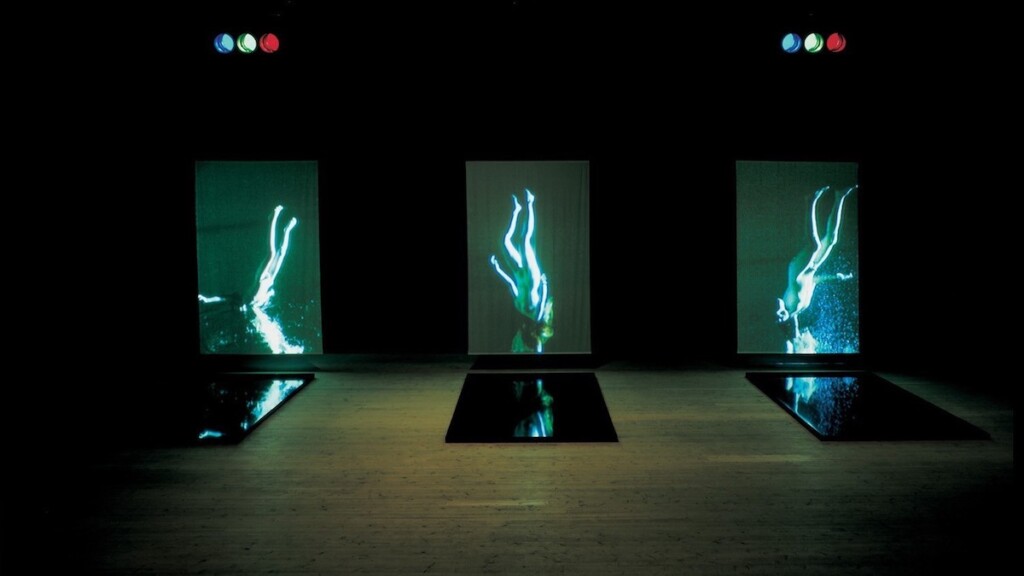
There is a triptych he made in 1992, filmed partly in a hospital room in the Vendée region of France where his mother was dying, and simultaneously in a different location where a woman was giving birth. The central panel holds a man submerged in water, suspended between the two outer panels, between arrival and departure, between the body entering the world and the body leaving it. No commentary. No music that tells you how to feel. Only the images and the silence and the terrible symmetry, which is not a symbol — or not only a symbol — but a fact about what it means to be a body in time. Maurice Merleau-Ponty spent his career arguing, most completely in the Phenomenology of Perception published in 1945, that consciousness is not something that happens inside the skull but something that happens in and through the body, through its engagement with duration, with surface, with weight. Viola made Merleau-Ponty visible.
What television destroyed was not the image. The image survived. What it destroyed was the condition under which images could be experienced rather than merely processed. Viola rebuilt that condition artificially, in gallery spaces, with black walls and controlled light, because the natural environment for that kind of attention no longer existed anywhere in the culture. The room you stand in is not a cinema. It is not a church. It is something the twentieth century had not previously needed a name for.
The Institution Swallows the Rebellion
There is a moment, somewhere in the late 1980s, when a museum guard stands in front of a glowing monitor mounted on a white pedestal, arms folded, watching visitors watch the screen. The work on display was made, originally, to be shown in a loft, or a community center, or broadcast into living rooms without anyone’s permission. Now it has a label beside it. An acquisition number. A climate-controlled vitrine of institutional air surrounding it like a second skin. The guard is paid to protect it. The irony is not lost on anyone. It is simply no longer considered relevant.
This is how the field consumes its dissidents, and Pierre Bourdieu described the mechanism with surgical precision in The Rules of Art, published in 1992, though the logic he traced had been operating for centuries. Every avant-garde gesture, he argued, follows a predictable arc: rupture, recognition, consecration. The field of cultural production has an extraordinary capacity to metabolize what threatens it, to transform negation into value, to turn the refusal of the market into an extremely marketable posture. What Bourdieu called the “field of restricted production” — art made for other producers, not for mass consumption — does not stand outside the economy. It operates according to its own economy, one that converts symbolic capital into financial capital with a time delay long enough to feel like independence.
Video art entered this cycle with a particular kind of violence, because its founding mythology was so explicitly anti-institutional. The people who carried cameras into the streets in the late 1960s were not naive about power. They understood that television was a machine of consensus. They understood that the museum was a machine of legitimation. They wanted neither. What they could not fully account for was the third machine: the one that processes refusal itself, that reads transgression as innovation, that prices rebellion according to its distance from the norm it attacked.
By the mid-1980s, major auction houses were beginning to develop frameworks for selling video works. Editions, certificates of authenticity, controlled duplication — the language of scarcity was retrofitted onto a medium whose entire premise had been infinite reproducibility. Walter Benjamin had warned, in 1935, that mechanical reproduction would destroy the aura of the artwork, that the copy would annihilate the original. What actually happened was more perverse: the market invented a new kind of aura, a legal and contractual aura, a numbered aura, and charged accordingly. A medium that was supposed to make art free made certain art extremely expensive.
The biennials absorbed what the galleries had already digested. Venice, São Paulo, Documenta — the international exhibition circuit became the primary theater of video art’s legitimacy from the 1990s onward, and with legitimacy came the architecture of prestige: the darkened room, the cushioned bench, the forty-minute loop that visitors experience for ninety seconds before moving to the next darkened room. There is a scene — not from any film, not from any documented event, but from the permanent condition of contemporary exhibition — where a work about surveillance is itself under surveillance, where a piece made to disturb the comfortable visitor is experienced by a comfortable visitor who nods, feels appropriately disturbed, and proceeds to the gift shop. The disturbance has been scheduled. It has a catalogue entry.
This is not cynicism about the artists. Many of them fought the institutionalization. Some refused it entirely. But the field does not require the artist’s complicity to complete the operation. Bourdieu was clear on this: the logic of the field operates behind the backs of the agents within it. You do not need to sell out. The field will sell you whether you consent or not, and sometimes the resistance itself becomes the selling point, the proof of authenticity that raises the price.
What does it mean, then, when the gesture of refusal becomes a collectible object?
The Algorithm as the New Broadcast Signal
You did not choose the next video. It began on its own, the way rain begins, without asking permission, and by the time you registered what you were watching you were already three seconds inside someone else’s reality. This is the landscape now: a continuous broadcast that no one programmed in the old sense of that word, shaped instead by systems that have learned your hesitations, your pauses, the precise millisecond at which your thumb slows before moving on. The algorithm knows you the way a very patient and completely indifferent entity knows you — not to understand you, but to keep you.
The pioneers who turned the television set against itself, who jammed the signal, who placed cameras in front of monitors to create infinite feedback loops exposing the narcotic quality of the medium, were operating inside a world where broadcast was scarce and therefore powerful. Nam June Paik needed to physically disrupt a cathode ray tube to make a point about technological possession. That disruption required effort, institutional access, a gallery willing to host the provocation. Today the disruption is everywhere and therefore nowhere. Every person with a phone is technically capable of what Paik did, and that universality has not liberated the critical gesture — it has dissolved it into background noise.
Walter Benjamin wrote in 1935 that mechanical reproduction strips the artwork of its aura, its singular presence in time and space. He imagined this as potentially democratizing, a way of returning art to the masses. What he could not have anticipated is that the abolition of aura would eventually abolish attention itself. When everything is reproducible at infinite scale, when a video made in a São Paulo favela and a video made in a Los Angeles studio and a video made by an artist interrogating the ethics of surveillance all arrive through the same interface with the same rectangular frame and the same autoplay logic, the critical content of each is processed through identical machinery. The medium does not merely carry the message anymore. The medium actively metabolizes the message into something the platform can monetize.
Guy Debord argued in 1967 that the spectacle is not a collection of images but a social relation among people mediated by images. Fifty-seven years later, that social relation has been intermediated again — this time by a layer of code that decides which images reach which people, not based on truth or quality or urgency but based on engagement probability. A video work that genuinely unsettles the viewer, that makes them uncomfortable enough to sit with that discomfort, is algorithmically disadvantaged compared to a video that produces a quick emotion and invites a quick share. The platforms have industrialized the very reflex that video art spent half a century trying to short-circuit.
And yet. There are artists working now who understand the algorithm as a material, the way Steina Vasulka understood the synthesizer as a material — something to be pushed against its own grain, exposed in its assumptions, made to reveal the logic it was designed to conceal. They create works that game engagement metrics to smuggle in duration. They build channels that mimic the aesthetic of amateur content to deliver something that cannot be consumed casually. They use autoplay itself as a formal device, so that the involuntary beginning of the next video becomes part of the artwork’s meaning. These are not simply aesthetic strategies. They are epistemological ones. They ask what it means to see deliberately in an environment engineered for the opposite.
The history of video art is a history of artists who took the dominant technology of seeing and refused to let it see for them. Whether that refusal still constitutes resistance when the dominant technology has become so intimate it lives in your pocket and knows when you cannot sleep, that is the question the form now carries without having answered it yet.
🎞️ Art, Image, and the Moving Eye
Video art did not emerge in a vacuum: it grew from a rich dialogue between visual arts, cinema, philosophy of perception, and avant-garde experimentation. These related articles trace the intellectual and aesthetic territories that shaped the history and practice of video art across decades.
The Relationship Between Painting and Cinema: History and Theory
The dialogue between painting and cinema is one of the most generative tensions in modern visual culture, and video art sits precisely at that intersection. This article explores how painters and filmmakers have influenced each other historically and theoretically, offering essential context for understanding video art’s visual grammar. From montage theory to chromatic composition, the exchange between the two media is both deep and enduring.
GO TO THE SELECTION: The Relationship Between Painting and Cinema: History and Theory
The Avant-Garde Cinema: Movies to Watch
The avant-garde cinema tradition is the direct ancestor of video art, sharing its commitment to breaking narrative conventions and challenging the viewer’s perception. This curated film selection introduces the key experimental works that pushed cinema beyond storytelling and into pure visual and sensory experience. Watching these films is an ideal companion to studying the pioneers of video art.
GO TO THE SELECTION: The Avant-Garde Cinema: Movies to Watch
Psychedelic Movies for One-Way Trips
Psychedelic cinema and video art share a common aesthetic ambition: to dissolve the boundaries of ordinary perception and transport the viewer into altered states of consciousness. This selection of psychedelic films highlights the visual strategies — looping, distortion, color saturation — that many video artists also adopted as core expressive tools. The overlap between these two worlds reveals a shared search for transcendence through the moving image.
GO TO THE SELECTION: Psychedelic Movies for One-Way Trips
The Unconscious and its Relationship With Cinema
Video art has long been fascinated by the unconscious, using the screen as a mirror for inner psychological landscapes that resist rational narration. This article examines how cinema has theorized and visualized the unconscious, drawing on psychoanalysis and surrealist aesthetics that deeply influenced video art pioneers like Bill Viola and Gary Hill. Understanding this relationship enriches any reading of video art’s most introspective and dreamlike works.
GO TO THE SELECTION: The Unconscious and its Relationship With Cinema
Discover Video Art and Experimental Cinema on Indiecinema
If these articles have sparked your curiosity about the visual and conceptual frontiers of moving images, Indiecinema is the ideal place to continue your journey. Our streaming platform is dedicated to independent and experimental cinema, including video art works and avant-garde films that you won’t find anywhere else. Come explore a world of images that think, provoke, and transform.
👉 EXPLORE THE CATALOG: Watch Indie Films in Streaming
A vision curated by a filmmaker, not an algorithm
In this video I explain our vision

