
The Screen That Holds You Still
You are standing in a darkened room and something is happening to your breathing. You did not plan for this. You walked in because the gallery was free, or because someone pulled you by the sleeve, or simply because the door was open and you were curious in that low-stakes way you allow yourself to be curious on a Tuesday afternoon. And now you cannot leave. Not because anything is blocking your exit, but because your body has made a decision your mind has not yet ratified.

On the screen in front of you, a figure moves through water with a slowness that feels impossible, almost hostile to the normal rhythm of perception. A man descends. Or rises. The distinction, at this speed, begins to dissolve. The image is so large it does not feel like a screen — it feels like a wall that has become temporarily transparent, a membrane between you and something that has always been on the other side. You are aware, suddenly, of the other people in the room. You are aware of your own face, which you suspect is doing something you would not permit in daylight.
This is the first thing that needs to be said about Bill Viola‘s work, and it has nothing to do with art history or video technology or the lineage of conceptual practice. It has to do with the specific embarrassment of being ambushed by your own emotional life in a public space. The work does not ask for your interpretation. It does not present itself as a puzzle to be solved or a statement to be decoded. It simply holds you there, in the dark, with yourself, and waits.
Viola has been making video art since the early 1970s, more than five decades of sustained, almost monastic attention to the same obsessions: birth, death, water, fire, the passage of the body through elemental states. By the time a major retrospective consolidates his career — as the one organized in Paris in 2014 did, drawing hundreds of thousands of visitors to the Grand Palais — the critical tendency is to absorb this work into a manageable narrative of influence and legacy. To talk about Nam June Paik, under whom Viola studied in the 1970s. To cite the Zen Buddhism Viola encountered in Japan between 1980 and 1981, the Sufi mysticism, the Christian iconography of Flemish painting. To explain the work. And explaining the work is a way of surviving it.
But survival is precisely what the work resists. The philosopher Gaston Bachelard, writing in The Poetics of Space in 1958, described how certain images bypass the intellect entirely and land directly in the body, in what he called the resonance of the imagination — a kind of reverberation that happens before thought, below language. Standing in front of a Viola installation is to experience that resonance in real time and to feel faintly betrayed by it, because you did not consent to being opened. You consented to looking at something. Those are not the same act.
The slow motion that defines so much of Viola’s visual language is not an aesthetic preference. It is a phenomenological instrument. When you extend the duration of a gesture — a body entering water, a face crossing from sleep to waking, a hand releasing something into air — you do not simply see it more clearly. You enter it. Time, at that scale, stops being a container for events and becomes the event itself. And the body standing in the gallery, the body that came in from the street with its grocery list and its low-grade anxieties and its practiced indifference to most of what the world offers, that body begins to remember something it did not know it had forgotten.
You are still standing there. You have been standing there for twelve minutes, though it feels like two, or forty.
The Mirror and the Rascal
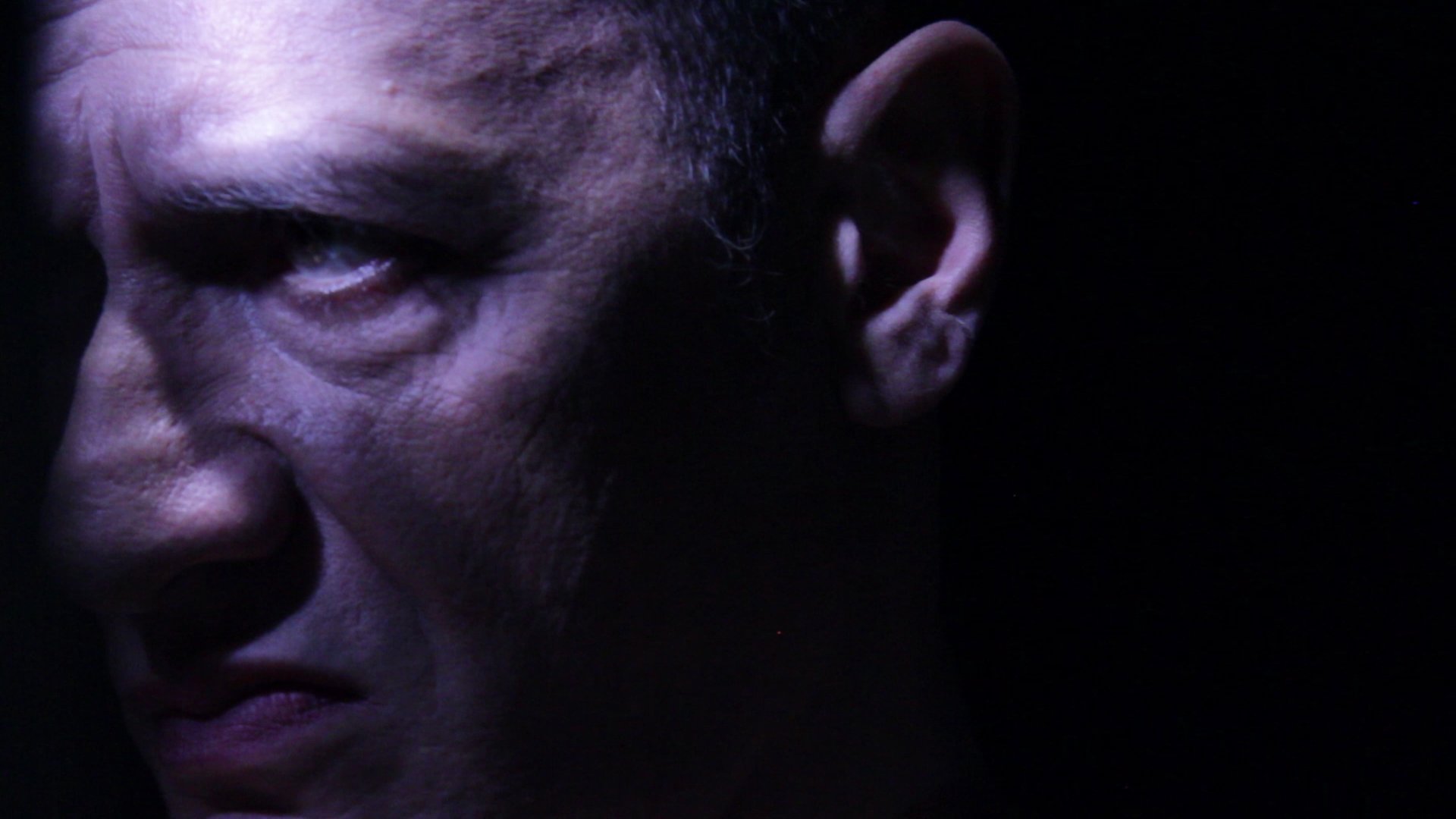
Drama film, by Valerio De Filippis, Italy, 2019.
The mirror and the rascal is an experimental film based on the tragedy "Richard III" by William Shakespeare. It tells the delirium of contemporary power in an author's reinterpretation of cinema, video art and music. The protagonist, Richard Duke of Gloucester, brother of King Edward IV, through a long series of crimes eliminates all the obstacles that stand between him and the throne of England.
Valerio de Filippis, a well-known painter who has been following his research path for a long time, investigating the relationship between light, corporeality and the psyche. The mirror and the rogue and the cinematographic equivalent of Valerio De Filippis' painting, his figurative style is in fact very recognizable looking at his paintings. But cinema is a new way where the artist can also be involved as an actor and performer, with an original mix between acting and singing. Staging the dark side of the human soul, the film is a surreal and disturbing interpretation of a great classic. The director says: "The first suggestion was musical: I was interested in transforming the text of Shakespeare's tragedy Richard III into notes. I love cinema and at a certain point I felt that the time had come to combine research on the image of painting to my love for cinema and music. When the film is finished I realize that I have remained faithful to painting: every frame of the film appears to me like a painting: the same light, the same colors, the same atmosphere ". The mirror and the rascal is a kind of psychoanalytic session that the painter does while hiding behind the mask of Richard III. Behind this ferocious and unscrupulous character we find a path of self-analysis by De Filippis, who is mainly interested in the more violent and turbid aspects. An experimental film in which, with great courage, the author gets involved completely, fragmenting the images in an unconventional montage, which is at the same time a flow of consciousness and spectacle.
LANGUAGE: English
SUBTITLES: Italian
Born Into the Age of the Electric Image
There is a photograph that does not exist but should: a small boy suspended beneath the surface of a lake, looking up at light refracting through green water, his mother watching from the shore not with terror but with something closer to wonder. No one took the picture. But the moment entered him completely, and everything he would make for the next fifty years carries its watermark.
Bill Viola was born in New York in 1951, which means he arrived into a world already drunk on television, already organized around the screen as the primary site of collective dreaming. Marshall McLuhan had not yet published Understanding Media — that would come in 1964 — but the transformation McLuhan would name was already underway, the electric image already rewiring the nervous system of Western culture before anyone had a vocabulary to describe what was happening. To be born in 1951 in America was to grow up inside a medium, the way previous generations had grown up inside a church or a field. The screen was not something you watched. It was something you inhabited.
The near-drowning happened when Viola was a child, at a lake in the Adirondacks. He fell in, or slipped in, the exact mechanics lost to the retelling, and what he saw looking up from beneath the surface was not darkness and panic but something luminous and immense, light broken into shifting geometric patterns, a world made entirely of refracted color and silence. His mother, rather than pulling him back into fear, told him it was beautiful. That single gesture — the redirection of terror toward beauty, the insistence that the underwater world was not the site of death but of vision — is not a metaphor in Viola’s work. It is the literal grammar of everything he has made. Gaston Bachelard, writing in Water and Dreams in 1942, argued that water is the element most deeply connected to the human unconscious, to dreams of origin and dissolution, to the imagination of death as passage rather than ending. Viola did not need to read Bachelard to know this. He had already been inside it.
He studied at Syracuse University through the early 1970s, in a program that was still trying to decide what art was supposed to be in a decade that kept dismantling the answer. It was there that video equipment became available to him not as a professional tool but as something stranger and more intimate — a way of recording time itself, of making the ephemeral material. The video camera did not freeze a moment the way photography did. It held duration. It kept the seconds alive in their own unfolding. For someone who had spent a childhood staring at water, at the way light moves rather than stands still, this was not a technical discovery. It was a recognition.
Nam June Paik appeared in his life the way certain teachers do — not so much as an instructor but as a permission. Paik, the Korean-American artist who had already been dismantling and reconstructing television sets since the early 1960s, who had placed magnets against cathode ray tubes to warp the image, who had understood that the television was not a window but a sculpture, showed Viola that the electronic image was not neutral, not a transparent carrier of content, but a substance with its own physical and metaphysical weight. The video art scene of the 1970s was operating on a conviction that is difficult to recover now: that the screen could be wrested from consumer culture and turned back toward something older and less comfortable, toward ritual, toward the body, toward the kind of slow attention that commercial television had systematically trained its audience to abandon.
Viola absorbed all of this without being consumed by it. He was already working from a place that preceded any movement or manifesto. He had already learned to breathe underwater.

Water, Fire, Earth, Air — and the Body That Cannot Escape Them
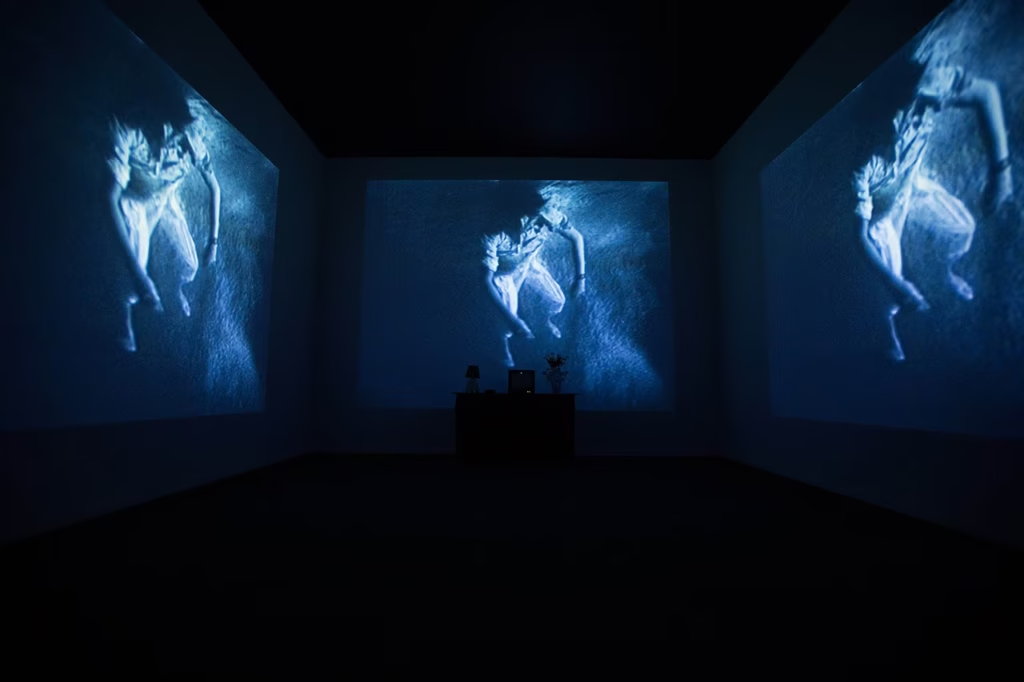
There is a moment you probably recognize without being able to place it exactly — standing at the edge of something, water or fire or open sky, and feeling the boundary between your skin and the world become suddenly uncertain. Not dissolving, not merging, but vibrating. The philosopher Gaston Bachelard spent years trying to name that vibration. In “Water and Dreams,” published in 1942, he argued that the classical elements are not metaphors we project onto the world but primary imaginative structures through which the world first becomes legible to us. We do not compare fire to passion; fire is where passion learned its grammar. We do not say water is like forgetting; water is the original texture of memory before memory had words.
Viola understood this before he could have theorized it. His work does not use water symbolically the way decorative art uses water — as a surface onto which meaning is painted. He uses it as an agent, a force that acts on bodies with the same indifference the ocean acts on shore. Watch a figure enter water slowly, frame by frame in extended time, and you will notice something happening in your own chest. Your breathing adjusts. A slight tightening, then a release. This is not empathy in the sentimental sense. It is your nervous system recognizing a physical condition it has been trained by evolution to monitor. Buoyancy, pressure, cold, the particular silence that water places around sound — these are not images your mind interprets. They are states your body remembers.
Bachelard distinguished between the imagination of clear water, which he associated with narcissism and self-reflection, and the imagination of deep or dark water, which he connected to something older and more dangerous — what he called the material imagination, the pull toward dissolution and origin. Viola works precisely at this fault line. A face seen through liquid distortion is still recognizable as a face, and that is what makes it unbearable. The recognition is the vertigo. You are watching someone who remains human while the element strips away everything that normally protects humanity from itself.
Fire operates differently in his work than water, and the difference is not aesthetic but physiological. Fire comes at you. Water receives you. In sequences where figures stand before or within flames — not consumed but suspended in proximity to consumption — the viewer’s body registers heat as threat even in a climate-controlled room watching a screen. This is the primitive logic Bachelard traced through his 1938 study “The Psychoanalysis of Fire,” where he argued that fire thinking precedes rational thinking, that our first philosophies were built around hearths, not libraries. Viola restores fire to this pre-intellectual register. He makes it impossible to think about fire while you are watching it. You can only endure it.
Earth in his visual language tends toward burial, toward the weight of soil and the postures of the fallen. Air tends toward breath held and released, toward the pause between states. What is remarkable is how systematically he cycles through all four without ever making the cycle feel like a taxonomy. There is no diagram. There is only a body — always a body — caught in conditions it did not choose, moving through what the elements permit.
Merleau-Ponty, whose phenomenology of the body Viola’s work seems to illustrate without ever having been commissioned to do so, wrote in “Phenomenology of Perception” in 1945 that the body is not in space the way an object is in a container. The body inhabits space, negotiates it, is shaped by it continuously. Viola’s elemental sequences make this visible by making it visceral. You watch a body submerge, and for a moment your own breath counts the seconds. The body on screen is testing something. You are testing the same thing, from the dry side of the glass.
Slowness as Violence Against the Comfortable Self
There is a moment — you have lived it — when someone’s face collapses. Not slowly, not with the dignity of controlled grief, but all at once, the architecture of composure giving way in a fraction of a second that you barely registered before it was already over, already replaced by the recovered expression, the cleared throat, the redirect. You saw it and you didn’t see it. Speed made you a bystander to something real.
This is precisely the violation that Viola commits against his audience. He takes that fraction of a second and stretches it across minutes. A man’s face, caught at the instant of receiving news — devastating or transcendent, the body cannot always tell the difference — becomes a landscape you are forced to traverse on foot when you expected to drive through. The muscles around his mouth begin a journey that will not arrive for three minutes. A tear forms at the inner corner of an eye and hangs there, swelling with the slow patience of a planet forming, before it begins its descent down a cheek that seems, at this speed, geological. You cannot look away because there is nowhere else to go. There is no cut, no relief, no next thing. You are held inside the duration of a human being’s undoing.
The technical fact matters here because it is not incidental but intentional in the most precise sense. Recording at three hundred frames per second, then playing back at thirty, Viola achieves a tenfold dilation of time. The camera has seen what no human nervous system can process. What you are watching is not slowness imposed on life but life revealed at a frequency that your biology has always been moving too fast to receive. The question this raises is uncomfortable: what else have you missed, not through inattention, but through the sheer velocity of your own existence?
Paul Virilio, writing in 1980 in The Aesthetics of Disappearance, made an argument that has aged into prophecy. Acceleration, he insisted, is not a feature of modernity but its governing ideology, the invisible theology beneath all visible systems. To move faster is to be more, to matter more, to exist more fully in the logic of the contemporary. Speed becomes the measure of relevance, and therefore slowness becomes a kind of social death — the fate of the elderly, the depressed, the contemplative, the dying. What Virilio understood was that disappearance is not the absence of things but their passage through perception too quickly to register. The world does not vanish; it simply outruns you.
Viola’s deceleration is not, then, an aesthetic preference in the way that a painter might prefer cool tones or a novelist might prefer short sentences. It is epistemological sabotage. It breaks the agreement you have made with modern time, the tacit contract by which you consent to process the world at a speed that keeps you functional and keeps you numb. When a tear takes four minutes to travel the length of a face, you are not watching art. You are being ambushed by duration, forced to sit inside a moment that culture has conspired to make uninhabitable.
The discomfort this produces is not aesthetic discomfort — not the mild resistance you feel before an abstract painting you cannot decode. It is something closer to the feeling of being caught. Because the face on the screen is not performing grief or joy or terror. It is simply a face, moving through time at the speed time actually moves, and you are suddenly aware that you have spent years moving too fast to witness anything — including yourself — completely. The slowness does not reveal the face. It reveals the speed at which you have been living, and what that speed has cost you in terms of what you have failed to see, failed to feel, failed to let arrive.
The Medieval Mystic in the Digital Machine
There is a moment in contemplative practice — in any tradition, in any century — when the practitioner stops trying to escape the world and starts paying attention to it with a ferocity that most people reserve only for emergencies. This is the thing that gets misunderstood about mysticism. It is not departure. It is the most violent form of arrival.
Viola arrived in Japan in 1980 with a video camera and what he later described as an almost desperate need to understand what images actually were. He stayed until 1981, studying Zen under Daien Tanaka, and the encounter reorganized something fundamental in how he understood time, attention, and the body. The lesson was not about emptiness in the vague Western sense. It was about duration as a practice — about looking at a thing long enough that the looking itself becomes the subject. When he returned, he carried Rumi’s line about the reed flute cut from the reed bed, crying from separation, as a kind of operating instruction. The longing is not a problem to be solved. The longing is the form.
Michel de Certeau, writing in 1982 in what remains the most rigorous account of Western mysticism as a historical and intellectual phenomenon, argued that the mystics of the sixteenth and seventeenth centuries were not evading reality but responding to a specific crisis — the fragmentation of a unified religious world — by pushing attention to its absolute limit. Mysticism, in de Certeau’s reading, is what happens when the ordinary coordinates of meaning collapse and someone refuses to look away. Meister Eckhart‘s insistence that God is found not above the world but in its deepest ground, John of the Cross mapping the dark night not as punishment but as the dissolution of false certainty — these are not consolations. They are descriptions of an epistemological emergency conducted with extraordinary precision.
Viola had read them. He cited them directly in interviews, in notebooks, in the preparatory materials for works that arrived in the early 1990s and changed the vocabulary of what video could do. In one work from 1991, a man sleeps. The camera watches him breathe for a night that feels geological. Images surface and dissolve — water, fire, a body submerged, light moving through darkness at the pace of tides rather than thoughts. Birth and death are not represented as events. They are presented as states that the living body is always already inside. The sleeping figure is not separate from the dying one. The breathing is the threshold. You watch it long enough and you begin to feel your own chest as something borrowed.
A year later, a triptych installed across three screens holds a woman in labor on one side, a body dissolving underwater in the center, and an elderly woman dying on the right. The three images play simultaneously, without synchronization, without hierarchy. You cannot watch all three at once. Your attention is forced to move, to choose, to abandon. And in that forced movement — in the impossibility of holding birth, dissolution, and death in a single gaze — Viola creates the condition the mystics wrote about: the moment when the self, trying to contain too much, loses its edges. The screens do not resolve into a unified meaning. They remain three separate times happening at once, which is precisely the condition of being alive that we spend most of our energy refusing to acknowledge.
Rumi’s reed cries because it has been cut from its origin and cannot return. But the crying is the music. The separation is not the obstacle to the song — it is the song. Viola builds his machines to reproduce that structure: the loss is not at the end of the work. It is the medium through which the work breathes.
A vision curated by a filmmaker, not an algorithm
In this video I explain our vision
What the Museum Does to Death

There is something almost comic about it, if you can hold the discomfort long enough to see it. You pay your entry fee, check your coat, walk through a lobby that smells of climate-controlled air and institutional carpet, and then you stand before a man drowning in slow motion, or a woman giving birth in fire, or a body dissolving back into water from which it never quite emerged. The guard stands twelve feet away. Someone’s phone buzzes. A child asks in a loud whisper what is happening to that person.
What is happening is that death has been made safe. What is happening is that the most radical subject matter in Viola’s entire body of work — the threshold, the passage, the dissolution of the self — has been submitted to the most powerful neutralizing machine that Western culture has ever constructed: the museum. Pierre Bourdieu spent years mapping this process. In The Rules of Art, published in 1992, he described how the cultural field operates not through overt censorship but through consecration, the slow institutional anointing that transforms transgression into heritage, danger into prestige. The white cube doesn’t reject what is unbearable. It absorbs it, frames it, and returns it to you as something you can consume at a comfortable distance while feeling improved by the experience.
When Viola represented the United States at the Venice Biennale in 1995 with Buried Secrets, the work carried its own structural irony inside the selection itself. Here was an artist whose entire practice questioned identity, national belonging, the myth of the coherent self, being installed as an official cultural ambassador. The American Pavilion. The flag outside. The institutional weight of being chosen. Bourdieu would have recognized the mechanics instantly: the field grants legitimacy, and in granting it, it also domesticates. The artist who speaks from the edge of consciousness becomes, by the logic of cultural consecration, a representative figure. Which means the edge gets moved a little further away.
In 2003, Going Forth By Day filled the Guggenheim Berlin with five large-scale projections across the museum’s atrium walls. The cycle was explicitly modeled on Egyptian funerary traditions, the soul’s journey outward, the community of the living and the dead moving through the same continuous space. The scale was overwhelming. The intention was immersive dissolution, the erasure of the boundary between viewer and image, between the living body in the room and the dying body on the wall. And it worked, partially, in the way that great art always works partially inside institutions — the encounter still lands, still cuts. But the retrospective format, the catalogue essays, the curated lighting, the guided tour times, all of it operates like a low-level anesthetic. You feel the wound; you just don’t bleed.
This is not Viola’s failure. It may not even be a failure at all. It is the central paradox of any art that takes mortality seriously and then asks permission to exist inside the structures that culture builds specifically to manage mortality at a safe remove. The museum is, among other things, a technology of grief containment. You go there to feel something about death without dying. You go there to practice the feeling from inside a building with emergency exits clearly marked.
What Bourdieu’s analysis cannot quite account for is the degree to which Viola seems aware of this trap and keeps building the work against it anyway. The installations resist reproduction. They resist the photograph you take on your phone because they are made of duration, and duration cannot be captured in a still frame. They resist the catalogue because what happens inside them is not about image but about time passing through the body. The resistance is not always successful. But the resistance is real.
Mirrors That Do Not Flatter
There is a moment you may recognize: you catch your reflection unexpectedly, in a shop window or a darkened screen, and for a fraction of a second you do not know who that person is. Then recognition floods back, the face reassembles into the familiar story, and you move on. But in that fraction of a second something true was visible. The image had not yet been claimed. It had not yet been made to confirm anything.
A man leans over still water. His face looks back at him with perfect fidelity, and then, almost imperceptibly, the surface begins to breathe. Not from wind. From something underneath. The reflection stretches, dissolves at the edges, the features pulling apart like taffy toward the depths, and what returns to him is not his face but something that was always inside it, some unresolved motion that the solid mirror never permitted. He keeps watching. He cannot look away precisely because what he sees is not monstrous but recognizable in a way that his bathroom mirror never allowed.
Jacques Lacan argued in 1949, in his essay on the mirror stage, that the infant’s first encounter with its own reflection is not a discovery but a misrecognition. The coherent image in the mirror is a fiction, an anticipation of unity that the body does not yet possess and will never fully achieve. What we call identity is built on that original lie: the persuasion that the image is the self, that the surface holds something stable, that duration does not threaten coherence. But the mirror stage does not end in infancy. Lacan understood it as a permanent structure of adult psychic life, the ongoing labor of making the image confirm what the ego needs to believe about itself.
Viola’s video panels refuse that labor. A woman stands before a wall of fire that does not consume her. She is entirely still, entirely present in the flames, and the fire moves through her the way time moves through a life: continuously, without drama, without the courtesy of a climactic moment. Nothing is resolved. She does not emerge transformed in any legible way. She simply stands in duration, which is the one thing the flattering mirror will never show you. The flattering mirror shows you a face. What Viola shows you is passage.
In the work completed in 2000 that brings together five figures in extreme emotional states, the faces become what Viola himself described as seismographs. Grief, terror, ecstasy, bewilderment, compassion move across these faces in such excruciating slow motion that the viewer begins to see not emotion but the architecture beneath emotion, the muscular and skeletal truth of what feeling does to a body when it is not being managed for social consumption. We spend our entire adult lives learning to compress these states, to show only their socially legible edges. To watch them unfold in full is almost unbearable not because they are foreign but because they are fluent. The body knows this vocabulary. It has simply been trained not to speak it aloud.
Two years later, a figure rises from water and stone in an image drawn from the iconography of resurrection, and yet what the piece refuses is the triumphalism that iconography usually delivers. The rising is slow. The witnesses’ faces do not fill with joy or awe in the way religious painting taught us to expect. They fill with something more honest: the kind of shock that precedes interpretation, the raw moment before the face knows what it is supposed to feel. Lacan might have called this the real breaking through the imaginary. What it looks like, in practice, is a face that has forgotten its own performance.
Bodies fall in slow arcs through darkness and no one catches them and the falling is neither tragic nor graceful. It is simply what falling looks like when you remove the narrative that was supposed to justify it.
The Image That Refuses to End
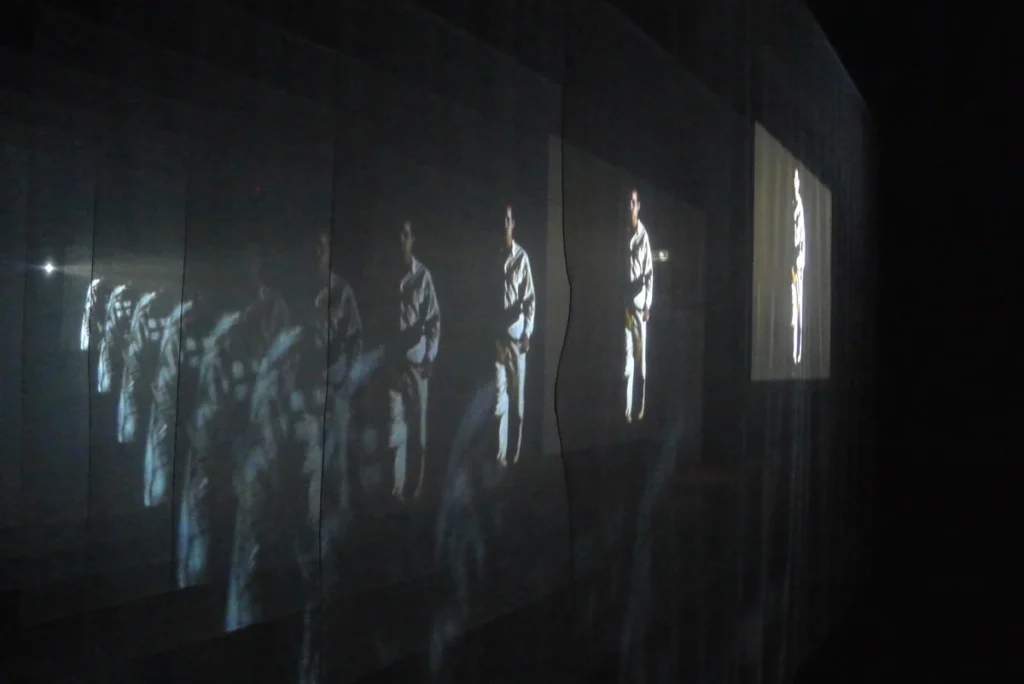
You walk out of the darkened room and the street hits you like something rude. The light is wrong — too indifferent, too fast — and the people passing carry their faces like closed doors. Something has shifted, though you cannot name it immediately, and the gap between what you just witnessed and what surrounds you now is not comfortable. It is not the pleasant disorientation of leaving a cinema. It is more unsettling than that, more intimate, as though the work you were inside has followed you out and refuses to stop.
This is not incidental to what Viola makes. It is the point.
His pieces do not conclude. They breathe, cycle, dissolve back into themselves — water rising and falling, a figure submerged and never quite surfacing, flames that consume without destroying. The structure is not a narrative arc but a lung. Watching them, you lose the thread of before and after, and what remains is duration itself, naked and insistent. He builds works that deny you the small mercy of resolution, and what feels at first like formal restraint reveals itself over time as a profound ethical stance. To offer closure would be to lie about experience. To wrap the image in an ending would be to falsify the texture of consciousness, which does not end, which carries its contradictions forward unresolved until the last possible moment.
Walter Benjamin, assembling his vast unfinished monument to the nineteenth century throughout the 1930s, described a particular kind of image that does not function like ordinary representation. The dialectical image, as he conceived it in the Arcades Project, is not an illustration of a thought. It is the place where contradictions are held in suspension rather than synthesized — where past and present collide in a charged standstill, producing something legible not through resolution but through tension. The image crystallizes precisely because it does not move toward a conclusion. It arrests. It holds. It demands that you remain inside the difficulty rather than pass through it to comfort.
Viola arrived at this structurally, intuitively, years before most of his contemporaries understood what the question even was. A man stands at the edge of a body of water and does not fall. A woman moves through grief at a speed so slow that grief becomes geological, becomes weather, becomes the atmosphere itself rather than an event within it. These are not metaphors waiting to be decoded. They are dialectical images in Benjamin’s precise sense — moments where the mortal and the infinite press against each other without either yielding, where the contradiction is the content, not a problem the work is trying to solve.
And so you stand on the pavement outside, and time is suddenly visible as the dimension it always was. This is what the street cannot tolerate — not your presence, but your altered perception of velocity. The faces moving past you are opaque in a way that suddenly feels like a fact rather than an accident. The light changes across a building’s surface and you notice it changing, which is not something you normally do, which means something has been briefly loosened in you, some habitual compression of attention that allowed you to move through the world at its preferred speed, taking in only what required immediate response.
Viola’s work operates precisely on this compression. It does not ask you to feel something specific. It asks you to slow down until feeling becomes possible again, until the image of a body in water is not a symbol of something beyond itself but is simply a body in water, carrying everything a body carries — its fear, its origin, its absolute fragility — in plain sight. The question he leaves in you is not a riddle to be solved but a register of attention you forgot you had, still open, still absorbing everything you pass.
🎥 Video Art, Time, and the Moving Image
Bill Viola’s work does not exist in isolation — it emerges from a rich tradition of artists who transformed the screen into a philosophical and spiritual instrument. Exploring the figures and movements that shaped video art helps illuminate what makes Viola’s practice so singular and enduring. These related articles trace the deeper roots and broader context of his artistic universe.
Nam June Paik: Life and Video Art
Nam June Paik is widely considered the founding father of video art, the artist who first understood the television screen as a sculptural and conceptual medium. His playful yet rigorous approach to technology and time laid the essential groundwork upon which Bill Viola and other video artists would build. Understanding Paik’s life and innovations is indispensable for grasping the full arc of video art as a discipline.
GO TO THE SELECTION: Nam June Paik: Life and Video Art
Video Art: History and Main Artists
Video art did not emerge from a single visionary but from a constellation of artists, movements, and technological shifts that redefined what a moving image could be. This article offers a comprehensive overview of the history and key protagonists of the genre, from its experimental origins in the 1960s to its presence in major museums today. It is an essential map for navigating the world to which Bill Viola so profoundly belongs.
GO TO THE SELECTION: Video Art: History and Main Artists
The Relationship Between Painting and Cinema: History and Theory
The dialogue between painting and cinema is one of the most fertile crossroads in the history of visual culture, and Bill Viola’s video installations draw deeply from this encounter. His work is saturated with references to Renaissance and Baroque painting, transforming the moving image into something closer to a sacred tableau. This article explores the theoretical and historical foundations of that conversation between the painted and the projected image.
GO TO THE SELECTION: The Relationship Between Painting and Cinema: History and Theory
Spirituality: Movies to Watch
Bill Viola’s art is inseparable from its spiritual dimension — his works meditate on birth, death, transformation, and the nature of consciousness with an intensity that transcends secular aesthetics. This curated selection of films about spirituality resonates directly with the themes that define Viola’s video practice, offering moving image works that share his contemplative depth. For viewers moved by Viola’s vision, these films open further doors into the cinema of the soul.
GO TO THE SELECTION: Spirituality: Movies to Watch
Discover Independent Cinema on Indiecinema
If Bill Viola’s exploration of time, consciousness, and the moving image has stirred something in you, Indiecinema is the streaming platform where that journey continues. Discover a curated selection of independent, avant-garde, and spiritually resonant films that share the depth and courage of artists like Viola. Stream on Indiecinema and let independent cinema transform the way you see the world.
👉 EXPLORE THE CATALOG: Watch Indie Films in Streaming
A vision curated by a filmmaker, not an algorithm
In this video I explain our vision

