
The Boy Who Watched Too Closely
You are standing at the edge of a window, small enough that the sill reaches your chin, and inside the room a woman is crying in a way that has no sound. Her shoulders move. Her hands press flat against her thighs as if she is trying to hold herself to the surface of the earth. She does not know you are there. You are perhaps seven years old, perhaps eight, and you understand nothing about what has happened inside that room, but you cannot move away. Something in the quality of her stillness between the tremors pins you in place. You are not watching her grief. You are watching the precise geometry of a human being trying to survive their own interior weather, and the difference between those two things will take you the rest of your life to articulate.

There is a kind of child who watches too closely. Not the one who stares out of rudeness or cruelty, but the one who stares because the face in front of them seems to contain a problem they are personally responsible for solving. These children grow up to become either clinicians or artists, and the border between those two vocations is thinner than either profession admits. What they share is the refusal to look away from the unresolved, the commitment to staying inside discomfort long enough to understand its structure rather than simply surviving it.
Satyajit Ray was born in Calcutta in 1921, into a family already drenched in cultural seriousness. His grandfather Upendrakishore Ray Chowdhury had been a writer, illustrator, and publisher of extraordinary range, the founder of a children’s magazine called Sandesh that treated its young readers as people capable of genuine intellectual encounter. His father Sukumar Ray died when Satyajit was two, leaving behind a body of nonsense verse in Bengali that has no real equivalent in any literature — surreal, structurally rigorous, philosophically playful — work that understood comedy as a form of epistemology rather than mere entertainment. To grow up inside that inheritance was not to receive a set of answers but to be handed a particularly sharp set of questions about what human perception is actually for.
What Bengal gave Ray was not simply culture. It was a specific tradition of looking, rooted in the reformist fervor of the nineteenth-century Bengal Renaissance, in which figures like Rabindranath Tagore had insisted that modernity and Indian identity were not opposites to be reconciled but dimensions of a single, unfinished inquiry. Tagore, who died in 1941, had already expanded what Indian artistic consciousness could hold — the particular, the intimate, the feminine interiority, the weight of a single afternoon. Ray absorbed this not as ideology but as permission. Permission to find the universal inside the radically local, to trust that a woman weeping in a specific room in a specific city in a specific decade was not a symbol of anything but was instead exactly herself, and that this exactness was the whole point.
He trained as a graphic designer at Visva-Bharati University in Shantiniketan, the experimental institution Tagore had founded, and the education was not incidental. A designer is trained to understand that the space between elements carries as much meaning as the elements themselves — that composition is an argument, that what you exclude determines what the included thing actually says. This turns out to be a precise description of how Ray would eventually construct a film frame, but before he made any films he spent years as a commercial artist in Calcutta, designing book covers and advertisements, learning that visual communication is always a form of persuasion whether or not you intend it to be.
The boy at the window does not know he is being formed. That is the condition of all serious formation: it disguises itself as ordinary experience, as waiting, as boredom, as the simple act of not being able to turn away from a face that contains more than it can express.
Thirsty
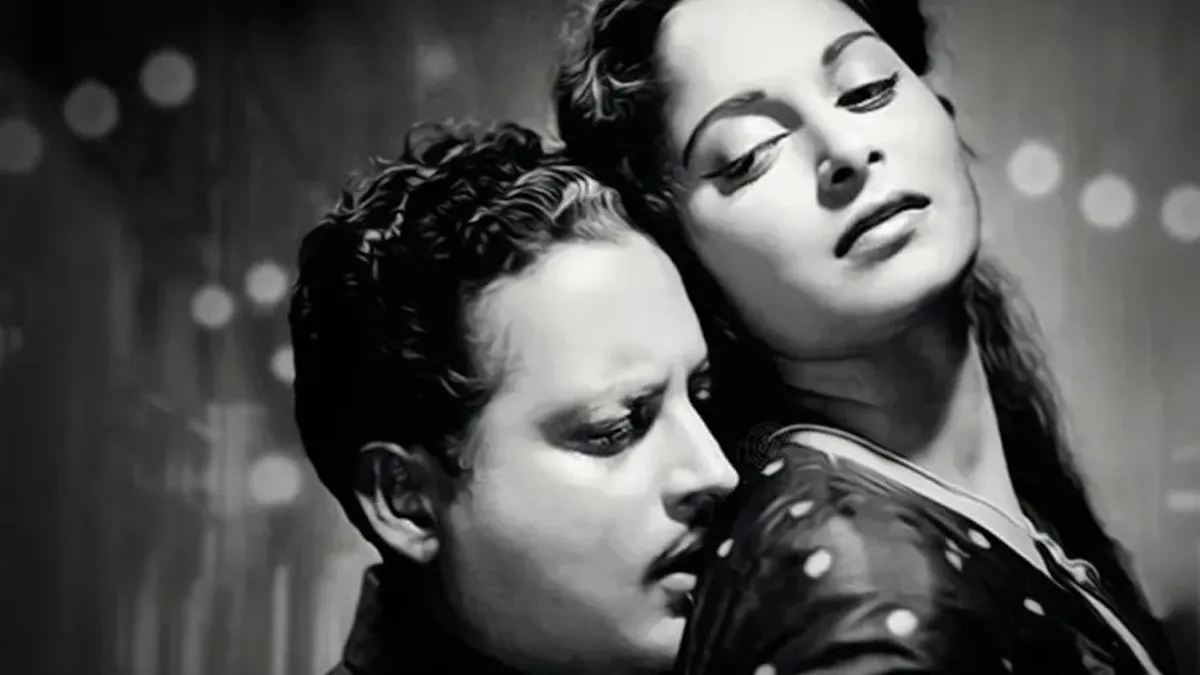
Drama, musical, by Guru Dutt, India, 1957
Thirsty is the heartbreaking story of Vijay, a young poet living in Calcutta who dreams of giving voice to the suffering and injustice of the world through his verses. Idealistic and sensitive, Vijay clashes with a society that despises his art because it is not profitable and does not cater to the tastes of the public. His brothers consider him a failure, the woman he loves leaves him for a marriage of convenience, and his poems are ignored by publishers. Only Gulabo, a prostitute with a pure heart, recognizes the beauty and truth of his words. When a misunderstanding leads everyone to believe Vijay is dead, his name and poetry suddenly become famous, exposing the hypocrisy of those who had previously rejected him.
Watching Thirsty means immersing oneself in a work that goes beyond melodrama, blending poetry, music, and imagery into a profound reflection on the human soul and the value of art. Guru Dutt, director and protagonist, creates one of the most intense and poetic films in world cinema, where black-and-white cinematography, expressive framing, and evocative lyrics produce an atmosphere of poignant melancholy. It is a film about the misunderstanding of the artist, pure love, and society’s hypocrisy, but also a universal critique of materialism and opportunism. Even today, Thirsty moves and provokes thought because it sincerely tells the story of the need to remain true to oneself in a world that measures people’s worth solely by their success.
LANGUAGE: Hindi
SUBTITLES: English, Spanish, French, German, Portuguese
Cinema as Colonial Inheritance
You are watching a film made in 1952, somewhere in the middle of a darkened hall in Calcutta, and the face on the screen does not look like yours. Not approximately unlike yours — categorically unlike yours. The light falls differently on it. The camera lingers differently on it. The entire grammar of shot and counter-shot has been constructed around the assumption that this face, white and Western, is where meaning lives, where interiority radiates outward and demands the audience’s identification. You are not the subject of this image. You are, at best, its backdrop.
This was not accidental. The cinema that arrived in colonial Bengal carried with it a set of invisible epistemological commitments as rigid as any legal statute. It arrived as a technology already saturated with the values of its inventors, a medium that had spent its first half-century learning to illuminate European and American faces as if illumination were their natural right. By the time Hollywood had codified its system of close-ups, reaction shots, and psychological interiority in the 1930s and 1940s, it had done so almost entirely in the service of a particular kind of subject: the individual whose inner life was legible, whose desires were worth following, whose grief warranted slow and careful attention. That subject had a geography, and it was not the Ganges delta.
Frantz Fanon understood this as a structural violence rather than a stylistic preference. Writing in 1961 in “The Wretched of the Earth,” he described how colonialism operated not merely through economic extraction and military force but through the systematic dismantling of the colonized subject’s sense of their own historical presence. The colonized world, in Fanon’s framework, is a world cut in two — not just politically but perceptually. One half produces meaning, agency, and the gaze. The other half receives it, is seen, is narrated, is rendered legible only through the interpretive frameworks of the colonizing culture. What cinema did was extend this division into the domain of desire itself: the colonized could learn to watch themselves through borrowed eyes, to find their own faces somehow insufficient, unremarkable, unworthy of the slow pan.
The Indian film industry before Ray was not ignorant of this trap — it had simply sprung it in a different direction. The dominant commercial cinema of the 1940s and early 1950s had developed its own grammar, but one largely organized around spectacle, song, melodrama, and archetypal emotion rather than the patient excavation of ordinary subjectivity. This was not a failure of sophistication. It was a response to a different audience contract, a different theory of what cinema was for. But it meant that the specific interiority of the Bengali peasant, the lower-middle-class widow, the child who has never traveled twenty kilometers from her village, remained cinematically uncharted territory. These lives existed outside the frame in two directions simultaneously: too ordinary for Indian melodrama, too foreign for Western realism.
What made the European neo-realist movement, particularly the work emerging from postwar Italy, so electrically useful for a filmmaker in Ray’s position was precisely its methodological rebellion against the glamorization of subject matter. When Vittorio De Sica followed a bicycle and a desperate father through the streets of Rome in 1948, he was not making a claim about Italy specifically — he was demonstrating that the camera could attach itself to precariousness, to unheroic ordinariness, and find there a dignity that classical Hollywood had reserved for exceptional protagonists. Ray absorbed this lesson not as imitation but as permission. Permission to treat Apu’s hunger as cinematically serious. Permission to let a woman’s silence occupy the center of a frame without filling it with explanation.
The colonial inheritance was not something Ray could simply refuse and walk away from — the medium itself, its lenses, its editing conventions, its very idea of what constitutes a scene, had been built elsewhere for other purposes.

Pather Panchali and the Scandal of Slowness
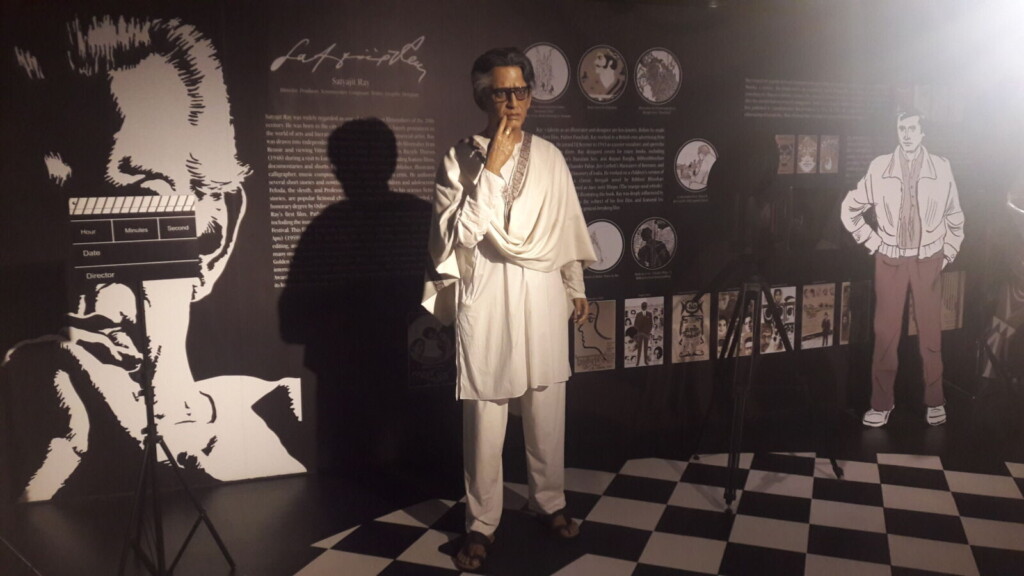
You watch a boy discover the world and nothing happens. A train cuts through tall grass. An old woman dies somewhere off to the side of the story. Rain falls for what feels like several minutes of screen time, and the camera does not cut away to show you what the rain means — it simply lets the rain be rain, which is to say, it lets time be time, which is something cinema almost never does.
What Satyajit Ray accomplished between 1952 and 1955 on approximately 150,000 rupees — a sum so inadequate that his wife Bijoya sold her jewelry to keep the production alive during its longest financing gaps — was not merely the making of a film. It was the construction of a new demand placed on the body of the viewer. To sit inside Pather Panchali is to consent to a rhythm that refuses the grammar of urgency entirely. Hollywood had already spent thirty years training audiences to expect that every scene must advance something, resolve something, or promise something upcoming. Even Italian neorealism, for all its commitment to the textures of poverty, maintained a narrative propulsive enough to carry you forward. Ray did something more radical and less comfortable: he asked you to stop moving.
Henri Bergson argued in 1889, in his Time and Free Will, that human consciousness habitually spatializes time — it breaks duration into measurable units because the alternative, actually feeling time pass as continuous and alive, is disorienting. Cinema had been colluding with this instinct since its invention, slicing experience into shots that served the plot’s hunger. Ray intuited, perhaps without the philosophical scaffolding but with the precision of someone who had spent years as a graphic designer and a reader of Bibhutibhushan Bandyopadhyay’s 1929 novel, that this collusion was a form of impoverishment. To show only what advances the story is to impoverish what a story is.
The film’s production history is itself a kind of argument. Because funding arrived in fragments — the West Bengal government’s final intervention in 1954 rescuing a project that had already consumed two years of interrupted shooting — the film was made in pieces, assembled across time rather than planned in advance. Actors aged visibly between sequences. The child Apu grew. The old woman Indir Thakrun, played by Chunibala Devi who was herself eighty years old, carried actual fragility in her bones into every scene she inhabited. What a controlled production budget and schedule would have smoothed over, poverty inadvertently preserved: the film looks like duration because it was built inside duration.
André Bazin, who died in 1958 just as Ray’s international reputation was solidifying, had spent the preceding decade arguing that deep-focus cinematography and long takes honored reality by refusing to impose editorial meaning upon it. But Bazin was still largely theorizing from European and American material. When Pather Panchali reached Western festival circuits — Cannes 1956, where it won Best Human Document — critics encountered something that made Bazin’s framework feel like a warm-up for the real argument. Ray’s slowness was not a stylistic position. It was an epistemological one. It insisted that to understand a life lived in scarcity, you could not skim it. You had to be made to feel its specific weight.
What no one said clearly enough at the time, and what the celebration of the film as a document of rural Indian poverty sometimes obscured, is that Ray was also quietly exposing something about the viewer’s own impatience. The discomfort audiences sometimes felt sitting with Durga’s aimless wandering or the long silences between family members was not discomfort with poverty. It was discomfort with the discovery that they had been trained to consume lives rather than witness them, to extract narrative value from human experience the way a machine extracts ore, leaving the actual texture of living untouched and unseen on the cutting room floor.
What the Western Gaze Could Not Afford to See
You watch a boy run through tall grass, and for a moment you forget what you are supposed to feel. The frame is so clean, so unhurried, that the mind reaches for the word “beautiful” before it has time to register what it is actually looking at — hunger, displacement, a child who has never owned a pair of shoes running toward something that will not save him. That instinct to aestheticize before you understand is not an accident of perception. It is a trained reflex, and the training happened long before you sat down to watch.
When André Bazin wrote admiringly about neorealism in the late 1940s, his critical apparatus was built around the idea that the camera, stripped of expressionist manipulation, could finally render the world in its ontological truth. His essays collected in What Is Cinema?, published posthumously in 1958 and 1962, treated the long take and the unadorned location shot as ethical instruments — ways of restoring to the image its natural ambiguity. What Bazin could not quite process, because his framework quietly assumed a European subject, was that in the hands of a filmmaker working inside colonial aftermath, that same ontological honesty carried a charge that had nothing to do with aesthetic neutrality. To show ordinary Bengali poverty without sentimentality, without the grammar of rescue or pity, was not a stylistic choice made in a vacuum. It was a political act conducted through form.
The distinction matters because the Western reception of Pather Panchali, when it arrived at Cannes in 1956 and won the prize for Best Human Document, almost immediately collapsed that distinction. Critics praised Ray’s restraint, his patience, his refusal of melodrama. What they were actually praising, without realizing it, was his refusal to make poverty legible to them on their own terms — and they mistook that refusal for a kind of beautiful passivity. They called it naturalism. They should have called it resistance.
There is a long history behind the spectacle of poverty as a genre. Since at least the mid-nineteenth century, documentary photography in Europe and America had built a visual economy around the suffering body — Lewis Hine’s child laborers, Jacob Riis’s tenement photographs published in How the Other Half Lives in 1890, the entire tradition of socially conscious imagery that showed the poor to the comfortable classes in exchange for the comfortable classes’ continued existence as the imagined audience. The poor were seen so they could be managed, reformed, or mourned at a safe distance. What this tradition required, structurally, was that the suffering body remain legible as suffering — raw, unbeautiful, an emergency.
Ray made poverty that did not declare itself an emergency. Apu and Durga move through their deteriorating world with a dignity that has nothing to do with nobility of spirit as a compensatory myth. Their movements are simply undefeated by the camera’s gaze, which refuses to position their material conditions as the whole truth of who they are. This is what destabilized Western critics even as they applauded: a cinematic language in which deprivation was real and visible and yet the human beings inside it were not reducible to their deprivation. The film did not ask you to save anyone. It did not perform its own moral urgency.
Susan Sontag, writing in Regarding the Pain of Others in 2003, observed that photographs of suffering generate a kind of compassion fatigue precisely because they position the viewer as spectator of a situation that pre-exists and will outlast them — the image becomes a way of having responded without having acted. Ray’s method short-circuits that mechanism entirely, not by refusing the reality of what he shows but by refusing the economy of feeling that normally organizes it. The viewer is given no position of exemption, no elevated vantage from which to register appropriate concern and then move on.
The Interior Life as Political Act
You are watching a woman read. Not performing reading, not decorating a scene with the prop of literacy — actually reading, her eyes tracking the page with that particular hunger that belongs only to people for whom books are a form of oxygen. Then she looks up, not at anyone, just into the middle distance of her own thinking, and in that pause between the text and whatever follows it, you understand you are watching a mind at work. This is 1964. This is Bengal. This is a woman whose husband barely notices she exists, and yet the camera refuses to treat her absence from his attention as her absence from the world.
Simone de Beauvoir argued in 1949, in a text that many people cite and fewer people finish, that the fundamental condition imposed on women by patriarchal culture is immanence — the state of being fixed in place, defined by one’s situation rather than by one’s projects, contained in the domestic and the cyclical rather than launched toward the open horizon of self-creation she called transcendence. The violence of this arrangement is not always brutal. Often it is architectural. It looks like a comfortable house. It looks like a man who means no particular harm. It looks like the absence of external prohibition alongside the thorough absence of any door to push open.
What Ray understood about Charulata — and what makes the film a philosophical provocation dressed in the clothes of a period drama — is that the danger to a woman’s interior life is most lethal when it arrives wearing the face of benign neglect. Her husband Bhupati is not a villain. He is something more culturally insidious: a man so absorbed in his intellectual and political commitments that he simply forgets to see his wife as someone who also has them. The camera’s insistence on her face in those moments of unwatched thought becomes an act of counterfactual witnessing. It shows us the person who would have existed fully if anyone in the room had bothered to ask.
The broader cinematic culture of Ray’s era — both in India and internationally — was not hostile to women on screen in any obvious, declared sense. It was something subtler and more effective: it was incurious about them. The female interior was regularly treated as either decorative or disruptive, a mood to be established or a crisis to be resolved, but rarely as a sustained site of cognition and desire that the narrative was obligated to follow with the same patience it granted male characters. Filmmakers who considered themselves progressive by the standards of their time were frequently reproducing this architecture without recognizing it as a structure at all — they simply thought that was what a story was.
Ray’s training under the influence of Jean Renoir, whose 1951 visit to India left a visible imprint on how Ray thought about observation and restraint, had given him a grammar of cinema that prioritized duration and interiority over incident. But what Ray did with that grammar was not simply aesthetic. It was ethical. He applied it to subjects whose inner duration had been systematically excluded from serious cultural attention, and in doing so he revealed something the culture preferred to leave invisible: that women’s subjectivity had not been absent from Indian life, only from its representations.
There is a particular sequence in which Charulata, alone in a garden, swings lazily on a wooden swing and then suddenly, with a kind of physical spontaneity that belongs to people who believe no one is watching, begins to move with genuine, uncalculated pleasure. Ray shoots this at a distance, with the long, unhurried patience of someone who thinks what he is watching is important. The political weight of that decision — to treat a woman’s private joy as something worth looking at carefully, without instrumentalizing it for the plot — had no real precedent in Indian cinema, and very few successors willing to match its commitment.
A vision curated by a filmmaker, not an algorithm
In this video I explain our vision
The Trap of the Universal Humanist Label

You have seen it happen at a dinner table where someone’s name is spoken with reverence and absolutely nothing specific follows. The reverence is the point. The name floats there, sanctified, untethered from any actual body of work, functioning as proof of the speaker’s breadth rather than as an encounter with a mind. This is precisely what Western film culture did with Satyajit Ray across the 1960s and 1970s, and the mechanism was not hostility but its opposite: a particular variety of embrace that requires the embraced to become legible on the embracer’s terms.
The label applied to Ray with extraordinary consistency across European and American critical circles was “universal humanist,” and it seemed, on its surface, like generous recognition. Pauline Kael used adjacent language; so did the programmers at the BFI and the retrospective curators in New York. What the term actually performed was a quiet amputation. To call an artist universal is to announce that you have successfully extracted the local irritants from their work, that you have found the part that does not require you to know anything you did not already know. The Apu Trilogy became, in this reading, a story about poverty in general, about boyhood in general, about the human condition as a category that happens to be set in Bengal the way a parable happens to be set in a garden. The specificity of the zamindar system’s collapse, the particular texture of Brahmin aspiration and its corrosion, the precise social grammar of 1920s rural Bengal — all of it dissolved into atmosphere, into mood, into something called sensitivity.
Edward Said, writing in Culture and Imperialism in 1993, described a structural pattern in how Western intellectual culture processes work from the colonized world: praise functions as a second-order containment when it strips the work of its political and historical coordinates and reframes it as a contribution to a universal library that the West happens to curate. The acclaimed work is admitted, but admitted on the condition that it confirm rather than disturb the host culture’s assumptions about what art is for. It does not enter the canon so much as it is absorbed into the canon’s immune system, rendered harmless by being rendered timeless.
Ray understood what was happening, and the evidence is sitting in plain sight inside his interviews and critical writings collected in Our Films Their Films, published in 1976. He was consistently more specific, more combative, and more diagnostic about Indian cinema and its social functions than his Western reception ever acknowledged. He wrote with forensic precision about the economics of the Bombay film industry, about the relationship between audience formation and colonial education, about the way a particular kind of melodrama served as ideological sedation. None of this analysis mapped onto the image of the serene humanist poet that festival culture had constructed. It was the work of a man who understood cinema as a political instrument even when he was making films of extreme formal restraint.
The deeper trap is that the humanist label made Ray’s Indianness simultaneously hypervisible and inert. He was celebrated as an Indian filmmaker in the same gesture by which his Indianness was made decorative — a set of images involving rivers and dust and women in saris that gave his universal themes their picturesque setting. This is the precise structure Said identified as the alibi of liberal imperialism: difference is not denied but curated, allowed to exist as texture while being denied existence as argument. Ray’s films were not arguments about a specific society in a specific historical crisis; they were feelings, they were images, they were proof that beauty transcends borders, which is another way of saying that the borders do not matter, which is another way of saying that what happened inside those borders does not require your sustained attention.
A Second Scene: The Jury Room in Cannes, 1956
You are sitting in a room where people are deciding what counts as human. The year is 1956, the festival is in its ninth edition, and the jury has just watched a film made for the equivalent of what a minor French production would spend on catering. The emotion in that room is not fabricated. Grown critics weep. Seasoned programmers who have spent their careers building defenses against easy sentiment find those defenses suddenly useless. Something has passed through the screen and landed in the body before the mind could intercept it. That physiological fact is real, and it matters. What also matters, and what nobody in that room has the apparatus to notice, is that the category they reach for to honor what they have seen — Best Human Document — is itself a confession.
The word “document” does the most damage. It arrives trailing an entire philosophy of what non-Western cinema is permitted to be. A document records. It bears witness to conditions. It offers the viewer the satisfaction of having been exposed to a reality they were not previously required to confront. Roland Barthes, writing in Mythologies just one year before this jury convened, described exactly this operation: the transformation of history into nature, of the particular into the universal, but only in one direction — outward from the European center, inward toward a periphery that can only be received as raw material. Pather Panchali, in the jury’s emotional framework, is raw material of extraordinary quality. The poverty of rural Bengal is not read as the consequence of a specific colonial economy that British extraction had spent two centuries constructing. It is read as the human condition, ancient and timeless, and the film is rewarded for how faithfully it delivers that timelessness to the viewer’s waiting conscience.
What the jury cannot process — not because they are cynical but because the cognitive tools are simply absent — is that the film is doing something structurally opposed to documentation. Ray had studied under Renoir, yes, but he had also spent years thinking about what Bibhutibhushan Bandyopadhyay’s 1929 novel was actually doing with time. The novel does not treat poverty as a backdrop for suffering. It treats duration itself as the subject: the way a family’s dissolution happens not in dramatic ruptures but in the slow erosion of small dignities, the way a child registers the texture of the world before she has language for loss. The film inherits this and pushes further. The famous sequence where Apu and Durga run through the field of white kaash flowers to see a train is not a metaphor for modernity arriving. It is a study in how joy and premonition occupy the same body simultaneously. European realism at that moment had no grammar for this — it was still organized around conflict, around the moment that changes everything, around the Aristotelian architecture of a turning point.
The jury in Cannes needed the film to be a discovery. Discovery requires a discoverer, and a discoverer requires a territory that did not previously exist on the map. The logic is geological: the thing was always there, but it required a Western eye to bring it into legibility. This is how recognition functions as a form of appropriation so refined it feels like generosity. The prize is genuine. The tears are genuine. The incomprehension is also genuine, and it operates at a level deeper than prejudice, deeper than bad faith — it operates in the very structure of what aesthetic categories are built to capture and what they are built, without knowing it, to exclude.
What Ray understood, and what no acceptance speech could have said in that room, is that being seen is not the same as being understood, and that a gaze which arrives already knowing what it is looking for will find exactly that, regardless of what is actually on the screen.
The Technical Vocabulary Nobody Borrowed

You have watched a film in which nothing happens, and yet something inside you has shifted irrevocably by the final frame. There is no score swelling beneath the grief, no cutaway to explain what a character is feeling, no musical cue arriving like a stage whisper to tell you this moment matters. The sound you hear is a ceiling fan, rain on a tin roof, the specific creak of a wooden chair that has been sat in ten thousand times. You leave the theater carrying a weight you cannot name, because nothing was done to manufacture it.
Ray’s editing in the Apu Trilogy operates on the logic of omission rather than accumulation. Where the dominant tradition of both Hollywood continuity editing and European art cinema used the cut to generate meaning through collision or contrast, Ray treated the cut as a site of restraint — a place where the film could refuse to explain itself. The death of Durga in Pather Panchali arrives and disappears in the space of an absence: we do not see it, we do not hear it described, we receive it only through the delayed, almost administrative grief of a father returning home to discover what the world has silently rearranged. This is not simply ellipsis as a stylistic preference. It is a structural argument about what cinema owes the audience, which is considerably less than cinema has typically offered.
What Ray understood about sound in 1955 — before Michel Chion had given academia the vocabulary to analyze it, before the Dolby era made sonic texture a selling point — was that diegetic noise carries the specific weight of a life being lived rather than performed. The particular ambient density of his frames, the way background sound was recorded and preserved rather than cleaned and sweetened in post-production, meant that his films existed in time the way rooms exist in time: continuously, indifferently, with no hierarchy between what is dramatically significant and what simply is. This is technically reproducible. Directors praised it, critics celebrated it, and virtually no one operating inside a studio system with access to resources actually adopted it, because ambient reality does not test well and does not sell.
The question of Ravi Shankar complicates the convenient narrative of Ray’s musical asceticism. The scores Shankar composed for the trilogy are not absent from the emotional architecture of those films — they are, in fact, intensely manipulative in the traditional sense, swelling and withdrawing with the precision of someone who understood exactly where the audience’s chest cavity was located. But their manipulation operates through a tonal and rhythmic logic that was entirely foreign to Western audiences trained on the harmonic conventions of European Romanticism. The emotional cues were present but illegible to the dominant market, which meant that Ray’s films were experienced as austere and restrained even when they were doing something very similar to what a Max Steiner score does — just in a language the critics could not consciously decode. The praise that followed was therefore praise for the wrong thing, admiration for a silence that was not actually silence.
When directors in Europe and North America claimed Ray’s influence in interviews throughout the 1970s and 1980s, what they were usually describing was a feeling rather than a practice. They had absorbed his moral seriousness, his patience with duration, his insistence on the face as the primary unit of cinematic meaning. These are not techniques. They are dispositions, and dispositions require no specific formal commitment to maintain. Adopting his actual methods — the deliberate suppression of non-diegetic emotional scaffolding, the preservation of acoustic reality, the cut that withholds rather than delivers — would have meant making films that behave differently from films audiences had been trained to receive, and the cinema that claimed to love Ray was never quite willing to pay that particular price.
🎬 The Gaze That Sees Beyond: Art, Vision & Soul
Satyajit Ray’s cinema was never merely a recording of images — it was a philosophical act, a way of seeing the world with precision, tenderness, and moral depth. The articles below explore the artistic, aesthetic, and cultural universes that resonate most deeply with Ray’s singular vision, from the poetics of Indian emotion to the revolutionary power of the photographic gaze.
Indian Aesthetics and Rasa: The Taste of Emotions in Art
Indian aesthetics rests on the ancient concept of Rasa — the distilled emotional essence that a work of art must evoke in its audience. Satyajit Ray was a master of this tradition, sculpting each frame so that grief, wonder, and tenderness could be tasted rather than merely seen. Understanding Rasa is indispensable for anyone who wishes to grasp the emotional architecture beneath Ray’s deceptively simple surfaces.
GO TO THE SELECTION: Indian Aesthetics and Rasa: The Taste of Emotions in Art
Susan Sontag and Photography: The Gaze as Power
Susan Sontag argued that the photographic gaze is never innocent — it carries power, ideology, and a hidden will to possess the world it records. Ray, trained as a graphic designer and deeply influenced by visual culture, understood this dynamic intuitively, crafting images that observe without exploiting and witness without reducing. Sontag’s framework offers a compelling lens through which to reread Ray’s ethical commitment to his subjects.
GO TO THE SELECTION: Susan Sontag and Photography: The Gaze as Power
Guru Dutt: The Poet Who Dreamed Beyond Bollywood
Guru Dutt stands alongside Satyajit Ray as one of the rare Indian filmmakers who transformed commercial cinema into an intensely personal and poetic statement. Both directors wrestled with the tension between artistic integrity and social recognition, and both paid a profound personal price for their uncompromising vision. Exploring Dutt’s melancholic universe illuminates the broader landscape of mid-twentieth-century Indian cinema in which Ray’s genius emerged.
GO TO THE SELECTION: Guru Dutt: The Poet Who Dreamed Beyond Bollywood
Calcutta in Indian Literature: A City of Contradictions and Dreams
Calcutta is not merely a backdrop in Ray’s films — it is a living character, pulsating with contradiction, colonial memory, and fierce modernity. The city’s labyrinthine streets, its intellectual cafés, and its crushing poverty all find their way into Ray’s lens with documentary honesty and lyrical grace. This article traces how Calcutta became the imaginative centre of one of the most distinctive literary and cinematic traditions in the world.
GO TO THE SELECTION: Calcutta in Indian Literature: A City of Contradictions and Dreams
Discover World Cinema in All Its Depth
If Satyajit Ray’s cinema has awakened in you a hunger for films that truly see the world, Indiecinema is the streaming platform built for you. Explore a curated selection of independent, world, and art-house cinema — films that challenge, move, and endure. Join Indiecinema and let the gaze of great directors change the way you see.
👉 EXPLORE THE CATALOG: Watch Indie Films in Streaming
A vision curated by a filmmaker, not an algorithm
In this video I explain our vision

