
The Moment Before the Tear Falls
You are sitting in a darkened hall, and the dancer has not yet moved. She stands at the edge of the stage with her eyes cast downward, her hands folded at her waist, and something in the stillness is already doing something to you. You did not expect this. You came perhaps because a friend insisted, or because the program seemed culturally enriching, or simply because the evening was free. You brought your ordinary self to an ordinary seat. And now, before a single gesture has been made, before the first drum strike cracks the air, you feel something shifting in your chest — not emotion exactly, not yet, but the atmosphere that precedes emotion the way pressure precedes weather.

Then she begins.
What happens next is not easy to account for. Her eyes move in a way that no Western theatrical tradition trained you to read, tracing invisible objects through invisible space, and yet you follow. Her hands carve shapes — the deer, the lotus, the wave — and you recognize them not with your mind but with something older. The percussion accelerates, and her feet answer, and suddenly you are not watching a performance so much as being saturated by one. A feeling rises in you that has no clean name in the language you think in. It is not sadness, though it resembles sadness. It is not joy, though there is something in it that feels like release. It is full in a way that your ordinary emotional vocabulary does not cover, and when the phrase “moved to tears” surfaces in your head you realize that for the first time in your life you understand what that phrase was reaching toward.
What you encountered in that hall has a name that is approximately two and a half thousand years old. Rasa — a Sanskrit word meaning juice, flavor, essence, taste — is the foundational concept of Indian aesthetic theory, and it describes precisely what happened to you: not the emotion depicted on stage, not the emotion the dancer felt while performing, but the emotion that arose in you as a third thing, a flavor that the art produced in the space between the performer and the perceiver. The philosopher Bharata Muni, writing in the Natyashastra — a treatise on the performing arts composed somewhere between 200 BCE and 200 CE, dense with technical instruction and metaphysical ambition — articulated this distinction with a precision that Western aesthetic theory would not approximate until Kant began asking questions about the sublime nearly two millennia later.
Bharata identified eight rasas: shringara, the erotic or the beautiful; hasya, the comic; karuna, the sorrowful; raudra, the furious; vira, the heroic; bhayanaka, the terrifying; bibhatsa, the disgusting; and adbhuta, the wondrous. Each rasa corresponds to a stable emotional state called a sthayibhava, a dominant feeling that lives in the human being not as a passing reaction but as a permanent psychological potentiality — something latent, waiting. The art does not create these states from nothing. It awakens them. The distinction matters enormously, because it shifts the entire weight of aesthetics away from representation and toward activation. The artwork is not a mirror showing you something outside yourself. It is more like a key turning in a lock you did not know you had.
What the West has struggled to articulate since at least Aristotle’s Poetics — why tragedy pleases, why depicting suffering produces something other than suffering in the audience — Bharata resolved not by dismissing the paradox but by naming the mechanism. The pleasure is not despite the sorrow. The sorrow, refined and aestheticized, transmuted through the precision of a trained performer, becomes the rasa: something tasted, something consumed, something that nourishes in ways that ordinary experience cannot.
Thirsty
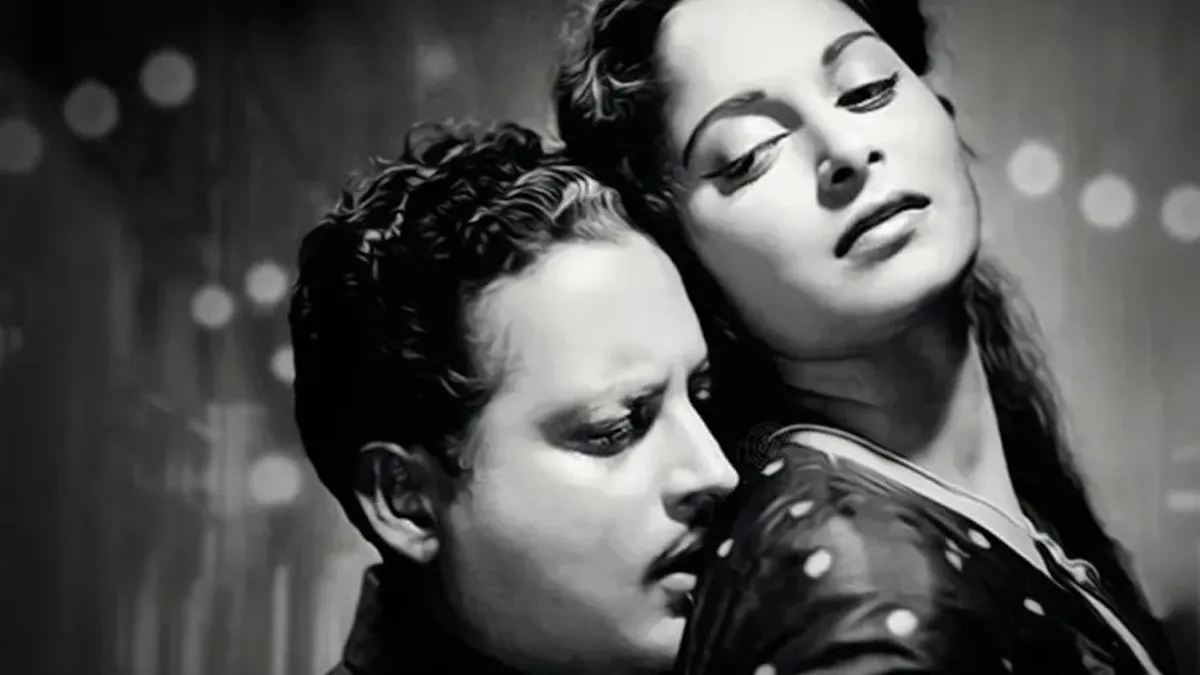
Drama, musical, by Guru Dutt, India, 1957
Thirsty is the heartbreaking story of Vijay, a young poet living in Calcutta who dreams of giving voice to the suffering and injustice of the world through his verses. Idealistic and sensitive, Vijay clashes with a society that despises his art because it is not profitable and does not cater to the tastes of the public. His brothers consider him a failure, the woman he loves leaves him for a marriage of convenience, and his poems are ignored by publishers. Only Gulabo, a prostitute with a pure heart, recognizes the beauty and truth of his words. When a misunderstanding leads everyone to believe Vijay is dead, his name and poetry suddenly become famous, exposing the hypocrisy of those who had previously rejected him.
Watching Thirsty means immersing oneself in a work that goes beyond melodrama, blending poetry, music, and imagery into a profound reflection on the human soul and the value of art. Guru Dutt, director and protagonist, creates one of the most intense and poetic films in world cinema, where black-and-white cinematography, expressive framing, and evocative lyrics produce an atmosphere of poignant melancholy. It is a film about the misunderstanding of the artist, pure love, and society’s hypocrisy, but also a universal critique of materialism and opportunism. Even today, Thirsty moves and provokes thought because it sincerely tells the story of the need to remain true to oneself in a world that measures people’s worth solely by their success.
LANGUAGE: Hindi
SUBTITLES: English, Spanish, French, German, Portuguese
Bharata’s Radical Claim
You are sitting in a darkened theater when the actor’s hands begin to move — not the restless fidgeting of a person in distress, but something deliberate and strange, the fingers curling in a precise grammar that your body reads before your mind does. You feel grief, or something adjacent to grief, something cleaner than your own grief has ever been. The man on the stage has not lost anyone. You have not lost anyone tonight. And yet the sensation is undeniably real, pressing against the inside of your chest like a second heartbeat.
Bharata Muni understood this gap — the space between what is displayed and what is felt, between the actor’s craft and the spectator’s transformation — and rather than explain it away, he built an entire aesthetic science around it. The Natyashastra, composed somewhere in the long corridor between 200 BCE and 200 CE, is one of the most systematically ambitious documents in the history of human thought about art. It runs to thirty-six chapters and addresses everything from stage architecture to the precise angle of a dancer’s wrist, but its philosophical core is concentrated in a single argument that most Western aesthetic theory would not arrive at independently for another fifteen centuries: art does not represent emotion, it produces a categorically different kind of experience that ordinary life cannot generate.
The distinction matters more than it first appears. Aristotle, working roughly in the same historical period, had framed the problem as one of imitation — mimesis — followed by catharsis, a purging of emotion that assumes the spectator arrives with existing emotional turbulence and leaves somewhat relieved of it. The model is hydraulic, almost medical. Bharata’s framework works from an entirely different premise. The spectator does not bring their private grief to be drained or their personal fear to be discharged. What happens in the aesthetic encounter is not therapeutic. It is epistemological. The spectator gains access, through the precise formal means of performance, to a mode of consciousness they cannot reach through lived experience, no matter how intense that experience becomes.
Bharata names this mode rasa, a Sanskrit word that carries within it the meaning of juice, flavor, essence, and taste simultaneously. The choice of a gustatory metaphor is not incidental. When you taste something, you are engaged in a process that is intimate and sensory but also curiously impersonal — the flavor of a mango does not belong to you, does not arise from your biography, does not require your suffering to exist. You receive it. Rasa functions the same way: it is not your sadness you experience during a performance of karuna, the rasa associated with sorrow and compassion, but sorrow as a flavor of being, distilled from all the particularities that make your own grief merely yours.
This is the move that Western aesthetics largely failed to make until the twentieth century began fracturing the sovereign subject. Bharata is essentially arguing that the highest function of art is to temporarily dissolve the boundary between the personal psyche and a larger, more universal emotional substrate — what he calls the sthayi bhava, the permanent or durable emotional state that underlies a given rasa. Eight such permanent states correspond to eight rasas in his original taxonomy: shringara for love and beauty, hasya for humor, karuna for compassion, raudra for fury, vira for heroic courage, bhayanaka for terror, bibhatsa for disgust, and adbhuta for wonder. Each rasa is not simply a feeling but a complete aesthetic world with its own colors, deities, presiding temperament, and formal requirements for how it must be evoked through the performer’s body.
What makes the framework radical is not the taxonomy itself but the claim embedded in it — that these states are not produced by depicting recognizable situations but by the precise convergence of what Bharata calls vibhava, anubhava, and vyabhichari bhava: the determinants, the consequents, and the transitory states that together create the aesthetic conditions for rasa to arise. The spectator does not identify with a character and borrow that character’s feelings. Something more impersonal and more complete occurs, something the text describes with the verb rasyate — to be tasted, in the passive, as if the emotion tastes the witness rather than the other way around.

The Eight Flavors and What They Unmask About You
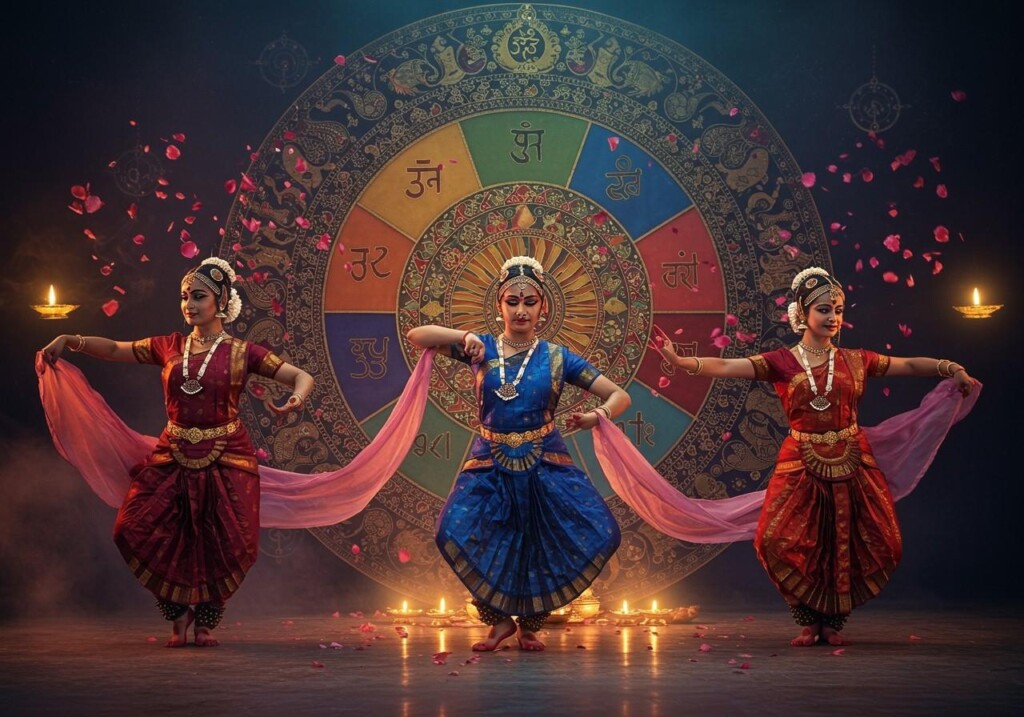
You are sitting in a darkened theater and something on stage makes your chest cavity open without warning. Not metaphorically. The sternum loosens, the breath shifts register, and for a moment you cannot tell whether what you are feeling belongs to you or to the figure moving in the light. That confusion is not a failure of critical distance. It is the entire point.
Bharata Muni, writing the Natyashastra somewhere between 200 BCE and 200 CE, identified eight fundamental flavors of aesthetic experience — not genres, not moods, not categories of content, but tastes in the most literal sense: something the body processes before the mind has finished forming its opinion. Shringara, the erotic, the luminous pull of beauty toward beauty. Hasya, laughter that destabilizes the social order even as it pretends to celebrate it. Karuna, grief so structured that it becomes a form of knowledge rather than a symptom. Raudra, fury as a cosmological force rather than a psychological dysfunction. Vira, heroic exaltation that is fundamentally about the dissolution of personal fear rather than its conquest. Bhayanaka, terror that reveals the porousness of the self. Bibhatsa, disgust that performs the boundary-work of identity, showing you precisely where your culture has drawn its lines of the tolerable. Adbhuta, wonder — the rasa that Western modernity arguably fears most, because it requires admitting that the world exceeds your frameworks.
What is radical about this list is not its contents but its premise. Each rasa is considered equally legitimate as aesthetic material. There is no hierarchy that places tragedy above comedy, or love poetry above war poetry, or the sublime above the grotesque. Aristotle’s Poetics, written roughly contemporaneously, had already begun performing the operation that would define Western art theory for two millennia: ranking forms by their moral seriousness, cordoning tragedy off as the highest achievement because it involves noble characters making grave errors. The consequence, centuries later, was an entire critical tradition that treated comedy as minor, the erotic as decorative, and disgust as beneath analysis — until Susan Sontag had to write Against Interpretation in 1966 to argue that sensory experience itself deserved attention, that what a work of art does to the body is not a distraction from its meaning but its primary vehicle.
Bharata had no need for that corrective because he never made the original error. The rasa of bibhatsa — disgust — receives the same structural analysis as shringara. The dominant emotional state, the vibhava or determinants that stimulate it, the anubhava or behavioral responses it produces, the vyabhichari bhava or thirty-three transitory emotions that flow through it: the entire theoretical apparatus applies without flinching. Disgust is not a failure of aesthetic refinement. It is one of the eight irreducible ways that art can make a human being encounter their own existence.
This matters beyond the academic, because what a culture excludes from serious aesthetic consideration is also what it excludes from serious self-knowledge. The long Western discomfort with raudra — with rage as a subject worthy of formal artistic treatment rather than something to be resolved into catharsis and discharged — left an entire emotional frequency undertheorized. Aristotle’s catharsis was, among other things, a management technology: you feel the dangerous emotions safely, in the controlled space of theater, and you leave purged, stabilized, ready to return to civic life. The rasa framework does not promise purification. It promises something stranger and less comfortable: rasasvada, the direct tasting of an emotion in its concentrated, transmuted form, which does not discharge it but deepens your acquaintance with it. You leave not emptied but more fully inhabited by what you already carried.
The person who finds bhayanaka intolerable in art — who cannot sit with aesthetic terror, who must resolve it immediately into safety or explanation — is revealing something precise about the boundary of their self-concept, the exact perimeter beyond which they cannot follow their own experience.
Abhinavagupta’s Dangerous Upgrade
You are sitting in a theater in tenth-century Kashmir, and something in the performance has stopped working the way you expected. The dancer’s hands move through a sequence you recognize, the drumming accelerates toward a resolution you can almost predict, and then — nothing. Not failure, not silence exactly, but a kind of fullness that refuses to be named by any of the eight emotional registers you inherited from Bharata. What you feel has no hunger in it. It is not the sweetness of love, not the electricity of heroism, not even the peace that follows grief. It is something prior to all of those, something that the existing vocabulary of rasa simply cannot metabolize.
Abhinavagupta registered this gap around 1000 CE and responded with a philosophical intervention so structurally aggressive that it effectively rewrote the grammar of Indian aesthetics from the inside. His Abhinavabharati, a vast commentary on Bharata’s Natyashastra, did not merely add a footnote. It performed a kind of surgical reversal on the entire edifice: what had been a taxonomy of emotions became, under his hands, a theory of consciousness. The ninth rasa he introduced, shanta — most inadequately translated as tranquility or serenity — was not simply another flavor appended to the list. It was the ground beneath the other eight, the condition of possibility without which no emotion could arise and to which all emotions, when fully experienced, secretly return.
The Shaiva non-dualism running through his thought, rooted in the Kashmir Shaivism of thinkers like Utpaladeva whose Ishvarapratyabhijna had argued that consciousness itself is the only real substrate of experience, meant that for Abhinavagupta the aesthetic encounter was never merely psychological. When a spectator is moved by a performance, something more radical than emotional recognition is occurring. The ordinary self — the self that walks into the theater worried about money or reputation or desire — gets temporarily dissolved. What remains is not emptiness but an expanded awareness that cannot be reduced to the individual’s private feelings, because it participates directly in what Abhinavagupta called the universal consciousness underlying all phenomena. Rasa, on this reading, is not what you feel. It is what remains when the one who feels has been briefly suspended.
This matters enormously for what it says about everyday perception and its structural poverty. Ordinary life, in Abhinavagupta’s framework, is defined not by presence but by obstruction — the ego’s incessant habit of filtering experience through self-interest, fear, and categorization. The aesthetic state cracks this filter open. A grief experienced on stage reaches the spectator as something purified of its particular causes; it no longer belongs to the character’s biography or to the viewer’s own wound, but arrives as grief in its essential nature, which is indistinguishable from the vibration of consciousness experiencing itself. This is why he insisted that sadharanikarana — the process by which particular emotions become universal during aesthetic reception — was not a metaphor but a metaphysical claim about what actually happens to subjectivity in the presence of great art.
The political danger embedded in this upgrade tends to be missed by readers who treat it as purely speculative theology. A framework that grants aesthetic experience the power to dissolve the boundary between self and world is not a framework that leaves social hierarchies intact. If the rasika — the cultivated perceiver capable of full aesthetic reception — achieves, however briefly, a state where the self’s constructed separateness relaxes, then every institutional mechanism that depends on that separateness for its authority begins to look contingent. Caste, ritual purity, the management of sacred access: all of these presuppose a self that can be ranked, polluted, or excluded. The moment consciousness is posited as the irreducible ground that precedes those divisions, the divisions themselves require a justification they have never actually possessed.
The Trap Western Aesthetics Built for You

You have been trained, without knowing it, to apologize for feeling too much in front of art. To keep a certain composure. To speak about a painting or a symphony in terms of form, structure, proportion — and to treat the trembling in your chest as a private embarrassment rather than the actual event the work was trying to produce.
This is not a natural disposition. It was constructed, and the construction has a name and a date. In 1790, Immanuel Kant published the Critique of Judgment and introduced what would become the governing doctrine of Western aesthetic legitimacy: the idea that genuine aesthetic experience requires disinterestedness, a pleasure entirely free of desire, need, or personal stake. The beautiful, for Kant, could only be apprehended by a subject who wanted nothing from it. Emotion, appetite, and bodily response were contaminants. What remained after stripping them away — that cool, detached, almost bureaucratic appreciation — was declared the universal form of taste. Any other response was classified as merely agreeable, a lower register of sensation unworthy of serious philosophical attention.
What rarely gets said in the lecture halls where this doctrine is still transmitted is that disinterested pleasure was not a description of how humans actually encounter art. It was a prescription for who counted as a proper subject of culture. The landed gentleman who could afford to contemplate without needing, the educated bourgeois whose body was disciplined enough to go quiet in front of a canvas — these were the implicit models. Pierre Bourdieu spent most of Distinction, published in 1979, demonstrating precisely this: that aesthetic distance is a class habitus dressed in the language of universality, that the capacity to bracket desire and affect in front of a work is the specific product of a particular kind of education and a particular economic insulation from necessity. The poor person who weeps at a melodrama is not failing to appreciate art correctly. They are simply failing to perform the right social distance from their own experience.
The body had to be disciplined out of the equation because the body is ungovernable, communal, and embarrassingly honest. It responds before the intellect can intervene. It does not distinguish between high and low culture when something genuinely moves it. And a system of cultural legitimacy that depends on hierarchy cannot afford to admit that a shepherd in Rajasthan in the ninth century, hearing a raga performed at dusk, might be having an aesthetic experience more philosophically coherent and more honest than a Parisian critic taking notes in an opera box. Abhinavagupta had already worked out, in his Abhinavabharati written around 1000 CE, that the capacity for rasa was not an aristocratic privilege but an activation of something already latent in the audience — sahridayata, the condition of being a sympathetic heart, which could be cultivated but was not owned by any class.
The asymmetry is staggering when you hold it still. A tradition that had developed a rigorous, differentiated, and empirically grounded account of emotional response as the primary medium of aesthetic meaning was producing texts at the same historical moment that Europe was still centuries away from even formulating the question. And when Europe did formulate it, the answer it institutionalized was the systematic removal of what Indian aesthetics had placed at the absolute center. This was not philosophical progress. It was a different set of anxieties producing a different architecture of legitimate feeling.
What the Western framework could never fully suppress, however, was the fact that people kept responding bodily and emotionally to art regardless of the doctrine. The history of Western aesthetics after Kant is partly the history of that suppression failing — Romanticism breaking through, then expressionism, then the entire twentieth-century project of art that wants to make you uncomfortable in your skin, that wants your nervous system involved.
A vision curated by a filmmaker, not an algorithm
In this video I explain our vision
A Scene in a Delhi Cinema Hall in 1975
The lights have not fully dimmed when the crying begins. A woman in the third row, a stranger to everyone around her, reaches into the folds of her sari for a handkerchief she already knew she would need before the film started. The man beside her, someone’s uncle in a pressed kurta, leans forward with his elbows on his knees, his jaw tightening in a way that men permit themselves only in the dark. On screen, a mother is being separated from her son by forces neither of them created and neither can stop — the oldest dramatic architecture in human storytelling — and the hall, all nine hundred seats of it, becomes a single breathing organism. This is not sentiment leaking from individuals. This is something conducted, something achieved collectively, the way a raga achieves something that no single note contains.
What is happening in that cinema in 1975 is not, despite every subsequent academic dismissal, the manipulation of a passive crowd by commercial machinery. The theorists of the Frankfurt School had already written their influential diagnosis: the culture industry administers desire, flattens difference, produces standardized emotional responses that function as social control. Theodor Adorno, writing in Dialectic of Enlightenment in 1944, was not wrong about Hollywood. But the framework traveled badly when applied wholesale to a context where the relationship between performer and witness had never been severed by the Cartesian cut between subject and object. In that Delhi hall, the audience does not receive an emotion produced elsewhere and injected into them. They complete it. The film presents the conditions — the stimulus, the situation, the formal cause — and the hall collectively generates the experience. The Sanskrit term for what the audience member brings is sahridaya, literally the one who shares the heart, and it describes not a passive viewer but a trained resonator, someone whose prior experience of grief, separation, and longing has been refined enough to recognize these states when they appear in artistic form and to inhabit them without being destroyed by them.
Bharata Muni, composing the Natyashastra somewhere between the second century BCE and the third century CE, understood the theatrical space as a site of transformation rather than representation. The text runs to thirty-six chapters and covers everything from the construction of the stage to the precise angle of a performer’s wrist, and the obsessiveness of that attention is not pedantry — it is the recognition that every formal element either assists or obstructs the arising of rasa. When the audience in that Delhi cinema weeps at the right moment and laughs thirty seconds later at a line of comic dialogue, they are not being emotionally manipulated through inconsistency. They are being moved through a carefully sequenced emotional landscape where each state intensifies the next, where karuna sharpens against hasya the way a high note sharpens against silence.
Colonial education had spent roughly a century telling educated Indians that this framework was primitive, that proper aesthetic theory was Kantian, that disinterested contemplation was the mark of cultivated taste. The irony is that the audiences who never received that education continued practicing rasa theory in the dark without knowing its name, while the universities producing English-language criticism were busy applying imported categories to art forms those categories were never designed to hold. The gap between institutional discourse and lived cultural practice became so wide that the vitality of one was taken as evidence of the vulgarity of the other. Popular Hindi cinema was dismissed as melodrama — a word that, in the Western critical vocabulary it was borrowed from, already carries the judgment that emotion has exceeded its proper container, that feeling has spilled beyond the rational banks that should contain it.
But the container was never the same container. The banks were drawn differently, by a different civilization’s negotiation with what art is for.
Vibhava, Anubhava, and the Architecture of Feeling
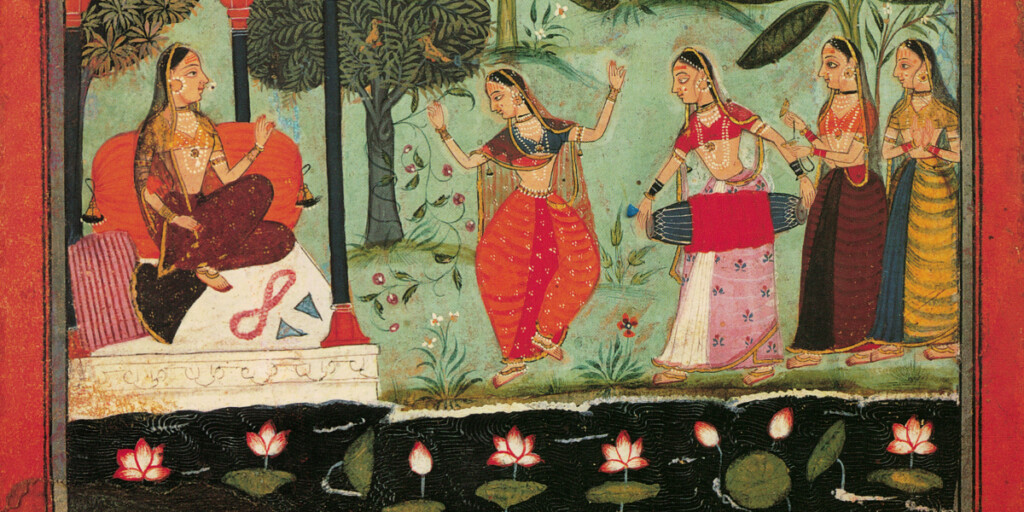
You are watching someone receive terrible news. Not hearing it — watching it. The shoulders drop before the face changes. The throat moves before the mouth opens. The hands, which had been perfectly still, begin doing something purposeless and small. What you are witnessing is not emotion. It is the body’s architecture of emotion, the involuntary grammar that precedes any conscious performance of feeling, and it was catalogued with extraordinary precision in the Natyashastra roughly two thousand years before any Western laboratory thought to measure it.
Bharata’s technical vocabulary was not decorative. When he distinguished vibhava from anubhava, he was making a cut that most contemporary psychology still fumbles. The vibhava is the stimulus — not the emotion itself, not the reaction, but the causal condition that sets the entire process in motion. A particular quality of moonlight. The smell of wet earth before monsoon. A letter found in a dead person’s handwriting. These are not symbols in Bharata’s framework. They are precise triggers, differentiated into alambana vibhava, the grounding object, and uddipana vibhava, the environmental amplifier that intensifies what is already moving. This separation between the anchor of feeling and the atmosphere that fans it is not mysticism. It is a phenomenological taxonomy that Paul Ekman’s cross-cultural emotion research in the 1960s and 1970s only partially approached, and from the far simpler direction of facial musculature alone.
The anubhava completes the other end of the circuit — not the origin of feeling, but its visible consequence, the physical manifestation that signals to an observer that an internal state is being inhabited. What makes Bharata’s treatment remarkable is that he classifies these bodily responses with the same rigor a biologist uses for taxonomy, distinguishing sattvikas, the involuntary somatic responses like hair standing on end, trembling, perspiration, loss of consciousness, from the deliberate gestural language of abhinaya. He understood, without the neuroscience to name it, that the body tells two different stories simultaneously: one it chooses to tell, and one it cannot help telling. Antonio Damasio would spend several hundred pages in Descartes’ Error, published in 1994, arguing that emotion is embodied and prior to cognition. Bharata had built an entire performance science around that premise in the second century CE.
Between the stimulus and the visible response, Bharata inserted a third structural layer that most affect theories collapse entirely: the vyabhicharibhava, the transient or accessory emotional states that move through a scene the way weather moves through a landscape. These are not primary moods. They are the thirty-three flickering states — anxiety, indolence, envy, weariness, apprehension — that rise and fall within a single emotional arc, giving it texture, contradiction, and duration. Where modern psychology tends to treat mixed or contradictory affect as interference or noise in the signal, Bharata treated it as the signal itself. The richness of an emotional experience was precisely its multiplicity, the way grief carries within it flashes of relief, the way desire is threaded through with shame, and Abhinavagupta in his Abhinavabharathi commentary, written around the tenth and eleventh centuries, formalized this as part of the rasa’s generative logic — that the audience’s unified aesthetic experience emerges from the dynamic interplay of these transient states, not in spite of their contradictions but because of them.
What Silvan Tomkins mapped as affect theory in the 1960s, what Brian Massumi refined in Parables for the Virtual in 2002, what the entire project of non-representational theory in cultural geography has been attempting to articulate since the 1990s — the primacy of intensity before meaning, the body’s registration before the mind’s interpretation — was already structurally present in a framework designed not for clinical observation but for the stage, for the actor who needed to understand not what emotion is philosophically but how it moves through a body in real time, and how a watching body catches what a performing body releases, before either of them has formed a single conscious thought about it.
What Gets Erased When a Tradition Is Translated
You are sitting across from someone who has just told you, with great enthusiasm, that Indian philosophy teaches us that art is about “universal feelings” — and you recognize the sentence immediately, not because it is wrong exactly, but because it has the specific texture of something that has been laundered. Something entered that sentence and did not come out the other side.
When Bharata’s Natyashastra was first systematically encountered by European scholars in the nineteenth century, the intellectual machinery already in place was built for a particular kind of extraction. Max Müller, working through the 1870s and 1880s on his monumental Sacred Books of the East series, established a template that would prove nearly impossible to escape: Sanskrit texts were philological objects first, living systems second or never. The result was that rasa, one of the most technically precise and philosophically aggressive concepts in any aesthetic tradition, was translated into a kind of elevated emotionalism — something like “flavor” or “mood,” a word you might use to describe the atmosphere of a room. The precision was not accidental loss. It was the condition of the concept’s admissibility into a discourse that needed the East to be spiritual, intuitive, and safely pre-rational.
What that operation quietly removed was the theory’s actual engine. The rasasutra — Bharata’s compressed Sanskrit formula, fewer than twenty syllables — does not say that art produces emotion. It describes a technical process by which the spectator’s ordinary psychological identity is temporarily suspended. Abhinavagupta, the Kashmiri philosopher who elaborated this in his Abhinavabharati commentary around 1000 CE, was explicit: rasa is not the recognition of an emotion you already carry. It is the experience of a state that has no personal owner. The individual who walks into the theater walks out diminished in a specific sense — the autobiographical self that usually mediates all experience has been, for the duration, dissolved. This is not metaphor. Abhinavagupta grounds it in a rigorous epistemology of consciousness, tantra, and the philosophy of recognition developed in the Pratyabhijna school. To translate it as “universal feeling” is not simplification. It is the replacement of a blade with a painting of a blade.
The post-colonial continuation of this problem is subtler and therefore harder to name. When twentieth-century Indian intellectuals began reclaiming rasa theory for their own academic writing, many did so through the very frameworks they had inherited from colonial education — Kantian aesthetics, Crocean expressivism, the vocabulary of “aesthetic distance” borrowed from Edward Bullough’s 1912 paper on psychical distance. Ananda Coomaraswamy, whose influence on twentieth-century aesthetics was enormous, brilliantly defended Indian art against Western condescension while simultaneously routing it through a Neoplatonic spiritual register that Abhinavagupta would not have recognized as his own project. The defense preserved the prestige of the tradition at the cost of its most unsettling thesis.
That thesis — that the purpose of art is not to communicate, not to represent, not to move you in the sense of confirming your emotional life, but to temporarily annihilate the subject who would be moved — has no comfortable home in any Western aesthetic theory. It cannot be absorbed into Aristotle’s catharsis, which still serves the individual’s psychological economy. It cannot be absorbed into Romantic expressivism, which depends on the artist’s and spectator’s subjectivity as the very medium of meaning. It sits outside the entire conversation about what art is for, not because it is mystical but because it is more structurally radical than the conversation is designed to accommodate.
What was translated, then, was a version of rasa compatible with existing answers to existing questions. What was not translated was rasa as a question that makes the existing questions obsolete — and that untranslated remainder is still sitting there, waiting, in a language most people who discuss it have never read.
🎨 Where Feeling Becomes Form: Art and the Senses
Indian aesthetics and the theory of Rasa invite us to reconsider how emotions are not merely expressed in art but tasted, lived, and transmitted through it. These related explorations trace parallel paths across cultures and centuries, asking how beauty, sublimity, and feeling interweave in the human experience of art.
Japanese Aesthetics: Wabi-Sabi Mono no Aware and Yugen
Japanese aesthetics offers a profound counterpart to the Indian theory of Rasa, with concepts like Wabi-Sabi, Mono no Aware, and Yugen evoking emotional resonance through impermanence, melancholy, and mystery. Like Rasa, these ideas position the artwork as a threshold between the sensory and the transcendent. Exploring both traditions side by side reveals a shared conviction that art’s deepest purpose is the cultivation of inner feeling.
GO TO THE SELECTION: Japanese Aesthetics: Wabi-Sabi Mono no Aware and Yugen
The Aesthetics of the Sublime: When Beauty Is Frightening
The Western aesthetics of the sublime shares a striking kinship with the more unsettling Rasas, particularly Bhayanaka (fear) and Adbhuta (wonder), in its insistence that great art can overwhelm and transform the perceiver. Philosophers from Burke to Kant sought to understand why encounters with vastness and terror produce a paradoxical pleasure, much as the Rasa theorists mapped the alchemy of emotion into aesthetic rapture. This article traces that tradition and opens a dialogue between Eastern and Western theories of overwhelming beauty.
GO TO THE SELECTION: The Aesthetics of the Sublime: When Beauty Is Frightening
Rabindranath Tagore: Life and Works
Rabindranath Tagore embodied the living tradition of Indian aesthetics, weaving Rasa theory into his poetry, music, and visual art with rare philosophical depth. His work in the Gitanjali breathes with Shringara (love) and Shanta (serenity), transforming devotional feeling into universal lyric experience. Understanding Tagore means understanding how the ancient Sanskrit aesthetic tradition found its most luminous modern voice.
GO TO THE SELECTION: Rabindranath Tagore: Life and Works
Herbert Marcuse and Art: The Aesthetic Dimension
Herbert Marcuse‘s vision of art as a space of liberation and sensory re-awakening resonates deeply with the Indian insistence that aesthetic experience carries emancipatory power. In The Aesthetic Dimension, Marcuse argued that genuine art disrupts the numbing of emotion produced by modern society, a claim that echoes the Rasa theorists’ belief that art restores the full spectrum of human feeling. Together, these perspectives suggest that the politics of beauty is inseparable from the politics of consciousness.
GO TO THE SELECTION: Herbert Marcuse and Art: The Aesthetic Dimension
Discover Cinema That Moves You on Indiecinema
If these reflections on emotion, beauty, and the transformative power of art have stirred something in you, Indiecinema is the place to take that feeling further. Our streaming platform curates independent and world cinema that speaks directly to the senses — films that, like the finest Rasa, leave a taste you carry long after the screen goes dark. Explore our catalog and let the next film find you.
👉 EXPLORE THE CATALOG: Watch Indie Films in Streaming
A vision curated by a filmmaker, not an algorithm
In this video I explain our vision

