
The City as Aesthetic Trap
You step off the vaporetto and the city does something to your balance. It is not the motion of the water still humming in your legs — it is something else, a slight wrongness in the geometry of the place, as though the streets were designed not to lead you anywhere but to fold you back into themselves. The facades are too close. The reflections on the canal surfaces repeat the architecture above with a fidelity that feels almost aggressive. Within twenty minutes of arriving, you have taken eleven photographs of the same bridge from slightly different angles, and you have not yet noticed that you have done this.

That sensation — the compulsive, slightly helpless recording of beauty — is precisely what Venice has been engineering for strangers for six centuries. The city does not welcome artists so much as it arrests them. There is a distinction worth insisting on here, because the romantic mythology of Venice as a muse, as a generous and inspiring feminine presence that unlocks creative genius, has long obscured something more troubling in the relationship. A muse gives. Venice takes — specifically, it takes the portion of the mind that interrogates, resists, and refuses. What remains is exquisitely sensitized but critically disarmed.
John Ruskin arrived in 1849 already a formidably systematic thinker, the author of the first two volumes of Modern Painters, a man who had built an entire moral architecture around the act of seeing. He spent years in Venice, produced thousands of drawings and daguerreotypes, and eventually published The Stones of Venice between 1851 and 1853, a work of staggering observational precision. But read the prose carefully and you find something unexpected beneath the scholarship: a man who cannot stop looking, who keeps returning to the same facades, the same mouldings, the same play of light on carved stone, as though repetition might finally crack open a meaning that keeps dissolving on contact. Ruskin did not master Venice. He was held by it, circling its surfaces with a devotion that bordered on compulsion. His later nervous collapse had many causes, but the years of Venetian looking — that relentless, unanswered demand the city makes on perception — were not innocent of them.
The philosophical problem embedded in this dynamic is one that Maurice Merleau-Ponty would have recognized immediately. In his 1945 Phenomenology of Perception, he argued that consciousness is not a neutral observer of the world but is always already entangled with it, shaped by the specific textures, scales, and rhythms of the environments it inhabits. Venice, on those terms, is not a neutral environment. It is one of the most aggressively structured sensory fields in human history — a place built, layer by layer over nine hundred years, with an almost unconscious genius for capturing human attention and holding it at the level of pure aesthetic surface. The narrowness of the calli forces the eye upward. The absence of wheeled vehicles removes an entire register of urban noise, creating a silence that makes every footstep, every echo off damp stone, every distant bell arrive with uncanny clarity. The water is everywhere, and water — being both mirror and obstacle, both invitation and refusal — produces in the nervous system a state of permanent, low-grade suspension.
Artists who come here intending to work quickly discover that the city has its own tempo, and that tempo has nothing to do with production. It is a tempo of absorption. J.M.W. Turner made four trips to Venice, in 1819, 1833, and 1840, and each visit produced not a coherent series of finished works but an explosion of sketches — hundreds of rapid watercolour studies, pages saturated with light and dissolution, as though he were trying to capture something that kept evaporating precisely as the brush touched paper.
Water as Epistemic Condition
You are standing on a surface that is not quite land and not quite water, and the city beneath your feet has been sinking, imperceptibly, for centuries — roughly two millimeters per year since systematic measurement began in the twentieth century, though the subsidence started long before anyone thought to record it. The sensation is not dramatic. It is quiet, and that is what makes it unbearable for the rational mind: the ground simply refuses to confirm itself.
This refusal was not merely geological. It was cognitive. The Renaissance had built its greatest intellectual achievement — linear perspective — on the philosophical premise that space is stable, measurable, and anchored to a fixed point of observation. Leon Battista Alberti, in De Pictura of 1435, described the painter’s task as the geometric conquest of visible reality, a grid thrown over the world to domesticate its chaos. The technique presupposed a painter standing still on firm ground, looking outward at a scene that held its shape. Venice denied every one of these conditions simultaneously.
Water moves. Light on water fractures, multiplies, refuses the clean angles that Florentine geometry demanded. The reflections of a palace on the Grand Canal do not obey the same vanishing point as the palace itself — they slide, shimmer, produce a second version of the world that contradicts the first without apologizing for it. For a painter trained in the Albertian tradition, this was not an aesthetic inconvenience. It was an epistemological provocation. The lagoon asked, quietly and relentlessly, whether seeing was ever the stable, sovereign act that the theorists of rational perspective had claimed.
Giorgione was the first to answer that question with his brush rather than his mouth. His figures dissolve into their atmospheric surroundings rather than standing clear against them; the famous unresolved tension of La Tempesta, painted around 1508, has generated centuries of iconographic debate precisely because the scene refuses to cohere into a readable narrative — the elements exist in a relationship that is felt before it is understood, if it is understood at all. Giorgio Vasari, writing in Le Vite in 1550, was visibly unsettled by Giorgione’s method, noting that he worked without drawings, composing directly on the canvas in a manner that struck the Florentine critic as dangerously improvised. What Vasari read as lack of discipline was in fact a different epistemology: knowledge arriving through sensation rather than through prior geometrical schema.
Titian absorbed this lesson and pushed it further across six decades of unrelenting production. The late paintings — the Pietà he left unfinished at his death in 1576, the flayed surfaces of his final self-portraits — are built from color relationships so complex that they generate their own internal light, independent of any depicted source. Infrared reflectography of canvases from his last two decades reveals almost no underdrawing: the composition emerged through the accumulation of pigment, through color thinking rather than line thinking. This was not old age loosening his hand. It was the mature consequence of living in an environment where the visible world was constituted primarily by light scattered across moving water, where atmosphere was not the space between objects but the very medium through which objects came into being.
There is a broader intellectual consequence here that extends beyond painting. Maurice Merleau-Ponty, in Phenomenology of Perception published in 1945, argued that the body is not a passive vehicle of consciousness but the very condition of perceptual experience — that what we know is always shaped by where and how we stand. Venice literalized this argument five centuries before it was articulated: the instability of its physical substrate forced its painters toward a perceptual honesty that stable ground permits its inhabitants to defer indefinitely, mistaking the solidity of their footing for the solidity of their knowledge.

The Myth of the Timeless City
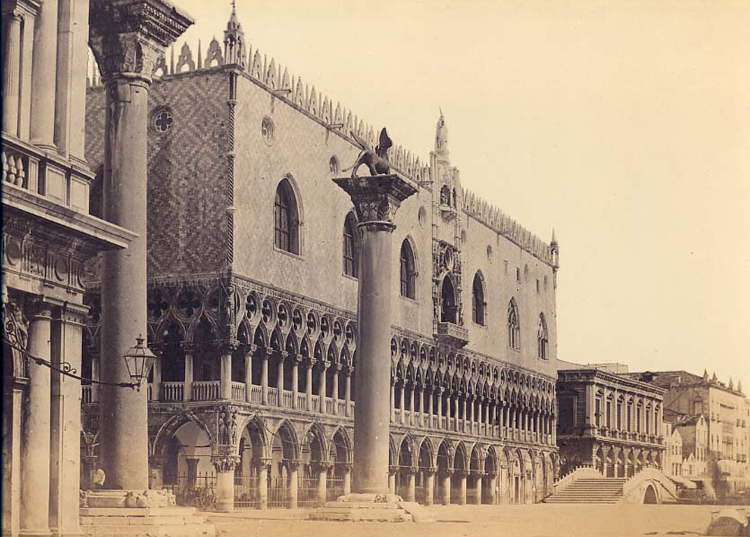
You have stood at the edge of a canal at dusk, water lapping against stone that looks as though it has always been exactly this worn, this green, this quietly collapsing, and you felt something that seemed like contact with permanence — as if the city were proof that some things simply endure. That feeling was not an accident. It was manufactured, over centuries, with considerable precision.
When the Serenissima fell to Napoleon in 1797, something strategically useful happened to Venice: it stopped being a political fact and became a cultural one. A city that had governed Mediterranean trade for five hundred years, that had maintained a republican oligarchy of startling sophistication, that had fielded fleets and negotiated empires, was suddenly available for rebranding. The Austrian administration that followed French occupation had little interest in Venice as a functioning civic organism. It was far more convenient as a monument. Taxes were adjusted, industries were discouraged, the shipbuilding tradition of the Arsenale was allowed to atrophy. A living city was being converted, through bureaucratic neglect, into a museum of itself — and the tourists, who began arriving in earnest after 1815, paid handsomely for the privilege of witnessing the exhibit.
John Ruskin arrived in 1849 and published the first volume of “The Stones of Venice” in 1851, a work so consumed by the aesthetics of decay that it could only see Venetian Gothic as magnificent precisely because it was dying. Ruskin was not describing Venice; he was embalming it. His moral architecture — the idea that organic imperfection in stone was the visible sign of a free worker’s soul — required Venice to remain broken, required the plaster to fall, the walls to bleed salt and damp, because restoration would destroy the very evidence his theory needed. He gave the ruin a sacred grammar, and painters and poets absorbed that grammar as if it were the city’s own language, rather than one man’s grief projected onto crumbling facades.
The economic logic underneath this aestheticization is worth examining without sentiment. By the mid-nineteenth century, Venetian authorities had understood that managed picturesque decay attracted more revenue than industrial modernization would have. The city’s administrators made choices — about which bridges to repair, which neighborhoods to let slide into photogenic disrepair, which canals to leave stagnant enough to smell of history — that were fundamentally promotional decisions. The ruin was curated. What painters like Turner rendered in luminous dissolving light was not timeless truth but the successful output of a destination-management strategy that predated the tourism industry’s self-awareness by a century.
Artists did not see this because the myth served them too well. Venice offered something that modernity, with its relentless pressure toward the new, could not: the permission to be late, elegiac, melancholic without apology. To paint Venice was to paint time itself as a subject, which conferred on the artist an instant philosophical gravity unavailable in Manchester or Chicago. The city’s apparent immunity to change was a mirror in which the painter’s own longing for permanence could be projected and then called objective observation. Claude Monet visited in 1908 and produced thirty-seven views that dissolve architecture into atmosphere — the buildings are almost irrelevant, what matters is the light, the shimmer, the sensation of something about to vanish. He was painting his own mortality and calling it Venice.
What makes this cultural fiction so durable is that it eventually colonized Venetian self-understanding as well. The city began to perform its own myth for an audience that would have felt cheated by anything else. Locals learned to see their home through the eyes of the visitors who paid to see it, which is one of the more disorienting psychological operations that tourism inflicts on inhabited places — the moment a community begins to experience its own existence as scenery, the myth has completed its deepest work.
Turner, Monet, and the Colonization of Light
You arrive in Venice for the first time carrying everything you’ve already decided about it. The bags are packed not with clothes but with expectations, aesthetic frameworks, half-formed metaphors absorbed from engravings you saw in London or Paris before you ever crossed the Alps. This is not a failure of imagination — it is how perception works when culture has preceded experience by several decades. Joseph Mallord William Turner arrived in Venice in 1819 with his sketchbooks and his already-formed Romantic vocabulary, and what he produced across three visits — culminating in the late oil paintings of the 1840s — tells us something extraordinary about the collision between a northern Protestant sensibility and a city that had spent centuries constructing itself as a theater of the senses.
Turner’s Venice dissolves. Buildings lose their contours, water refuses to stay separate from sky, human figures melt into atmospheric shimmer. This is not documentary failure. It is a precise philosophical position rendered in pigment. For a painter formed within a tradition that regarded excessive sensory pleasure with deep suspicion — the English Calvinist inheritance was not theological in Turner’s case but cultural, structural, embedded in what his contemporaries considered appropriate emotional register — Venice presented an almost unbearable problem. The city was too beautiful. It invited surrender to appearance, to surface, to ornament, to exactly the kind of visual seduction that Protestant aesthetics had spent two centuries disciplining out of public life. Turner’s response was to burn it. To dissolve Venice into light until it became less a city than a condition, less a place than a feeling, something one could be moved by without quite admitting that one had been seduced.
John Ruskin, who worshipped Turner and spent years in Venice producing the three volumes of The Stones of Venice between 1851 and 1853, understood this operation without fully naming it. His obsessive cataloguing of Gothic architectural detail — every capital, every arch, every carved Byzantine fragment — was simultaneously an act of love and an act of control. He needed Venice to mean something moral, to encode the righteous labor of medieval craftsmen against the moral corruption of the Renaissance. The city had to justify its beauty by hiding it inside a lesson. What Ruskin could not tolerate was beauty that simply was, that offered itself without ethical redemption, without pointing toward something higher than itself.
Claude Monet arrived in 1908, forty years after the Impressionist movement had already theorized exactly what he was about to paint. He was sixty-seven years old, his eyesight was beginning to fail, and he stayed for eleven weeks producing thirty-seven canvases, almost all of them sold before he had finished reworking them in his Giverny studio. The Venetian paintings Monet sent to the Bernheim-Jeune gallery in Paris in 1912 were received as revelation, but they were revelation of a very specific kind: they confirmed what French Impressionism had already claimed about the relationship between light and perception. Venice, for Monet, was proof. The Grand Canal, the Palazzo da Mula, the Doge’s Palace seen from the water — each became evidence for a theory of vision that had been constructed in Normandy and the Île-de-France, not on the Adriatic. He found in Venice the light he had brought with him.
What neither painter ever quite confronted was that the Venice they were dissolving into atmosphere had its own robust, unapologetic theory of painting — one that preceded both of them by three hundred years and had nothing whatsoever to do with anxiety about pleasure. Titian understood color as a physical substance, not a symbol of something else. Veronese filled ceilings with flesh and fabric and food without once asking whether this was spiritually permissible. The northern painters arrived, looked at this tradition, and translated it into a question about light — which was the only way their inherited categories allowed them to receive what Venice was actually offering.
The Serenissima's Calculated Seduction
You arrive in Venice with the sensation of having been expected. The canals arrange themselves too perfectly, the light falls at an angle that seems designed rather than meteorological, and somewhere between the Rialto and the Accademia you begin to suspect that your wonder is not spontaneous — that it has been, in some precise and ancient sense, manufactured for you.
Fernand Braudel, in his monumental 1949 study of the Mediterranean world, identified Venice not primarily as a city of beauty but as a city of information. The Republic maintained a network of diplomatic correspondents — the celebrated relatori — whose dispatches constituted what Braudel called the most sophisticated intelligence apparatus of the early modern world. What moved through Venice was not merely silk and spice but data: prices, political instabilities, the creditworthiness of distant rulers. The aesthetic dimension of the city was never separate from this infrastructure. It was, in the strictest economic sense, part of the product.
When the Republic invited foreign craftsmen to settle in the glassblowing workshops of Murano beginning in the thirteenth century, the gesture was not hospitality. It was sequestration. The artisans were granted privileges unavailable to ordinary citizens — their daughters could marry Venetian nobles — and in exchange they were forbidden, under penalty of death, from leaving the islands and carrying their techniques elsewhere. Openness as a mechanism of enclosure: the city absorbed talent the way a market absorbs competitors, converting them into assets it controlled. The painter Albrecht Dürer, who visited twice, in 1494 and again in 1505, wrote in letters to his friend Willibald Pirckheimer that in Venice he was considered a gentleman while at home he was a parasite. What he mistook for cultural enlightenment was the Republic’s centuries-old practice of pricing foreign genius at a premium precisely because it could be displayed as evidence of Venetian supremacy.
The economics of symbolic prestige work through a particular inversion: the city does not need to produce the art so long as it can claim the context in which art achieves meaning. Titian, born in Pieve di Cadore in the Dolomites, became Venetian in the eyes of history not because Venice made him but because Venice framed him — gave him patrons, a visual environment, and the specific quality of diffused lagoon light that his canvases then reflected back to the world as proof of Venetian civilization. The Republic was extracting a form of aesthetic rent long before the concept existed in economic theory.
This logic did not dissolve with the fall of the Republic in 1797 under Napoleon’s advance. It mutated, finding its most elaborate contemporary expression in an institution that presents itself as the opposite of commercial calculation. The Venice Biennale, founded in 1895 under the civic slogan “to the useful, to the beautiful,” was from its first edition a geopolitical instrument disguised as an arts festival. National pavilions — a structure that exists nowhere else in the art world — were introduced almost immediately, transforming aesthetic participation into a form of diplomatic representation. By 1914, fourteen countries had built permanent structures in the Giardini, each nation effectively paying for the privilege of staging its cultural identity on Venetian soil. The city collected not money but prestige, the accumulated symbolic capital of the world’s nations converging annually to legitimate a lagoon that was, by any infrastructure metric of the twentieth century, dying.
What the Biennale sells is precisely what the Republic always sold: the authority to confer significance. An artwork that passes through Venice does not merely exhibit — it is consecrated, inducted into a lineage whose value derives entirely from the accumulated belief that Venice matters. That belief is not natural. It was constructed, maintained, and priced across seven centuries with a commercial intelligence that Braudel spent a career trying to fully map, and which the city still operates with the quiet confidence of a monopoly that has never needed to advertise.
A vision curated by a filmmaker, not an algorithm
In this video I explain our vision
Exile, Displacement, and the Artist Who Cannot Leave

You arrive in Venice with a return ticket. Most people do. The date is printed, the obligation waiting at the other end is real, the life you temporarily vacated still hums with demands. Then something shifts — not dramatically, not with the force of revelation, but quietly, the way a fever changes the texture of a room. Two weeks become a month. You stop counting.
Henry James arrived in Venice in 1869 and wrote to his family with the faintly embarrassed excitement of a man surprised by his own capitulation. He returned repeatedly across four decades, and his notebooks from those stays — published posthumously, raw and unguarded in ways his fiction never quite allowed — reveal a writer who found in Venice not inspiration in the romantic sense but something more disturbing: a suspension of the ordinary resistance that makes writing possible. James was a man of fierce productive discipline, and yet the notebooks record a recurring pattern of days spent watching the light on the water, of intention accumulating without discharge, of sentences begun in his rooms and abandoned by afternoon. He wrote about this without sentimentality, almost clinically, as if documenting a medical condition. Venice, he noted, was the one place where he could not be certain whether the beautiful was feeding his work or slowly consuming it.
There is a distinction that almost no theory of artistic creativity takes seriously enough — the difference between stimulation and sedation. Most accounts of the creative environment emphasize the former: the new perception, the productive dissonance, the encounter with the unfamiliar that generates material. But Venice operates by a different mechanism entirely, one closer to what the psychoanalyst Christopher Bollas, writing in 1987 in “The Shadow of the Object,” called the “unthought known” — the category of experience that is registered completely but processed almost never, because its depth exceeds the capacity of conscious reflection to contain it. Venice floods the senses with a completeness that does not invite response so much as absorption. The artist becomes audience.
This is not a failure of character. It is a structural effect of a city that was itself, for centuries, a supreme work of art produced by collective will rather than individual genius — a place where the category of the author was dissolved into commerce, committee, and guild. The great buildings of Venice were not signed. The glassblowers of Murano, confined to their island by decree of the Venetian Republic from 1291 onward, were prohibited from leaving precisely because their knowledge was the city’s collective capital, not their private possession. Creativity here was always already expropriated, absorbed into an apparatus larger than any single maker. An artist arriving into that history does not simply visit a beautiful place — they enter an argument about whether the individual imagination is the primary unit of cultural production at all.
Ezra Pound died in Venice in 1972, after a decade of near-total silence that has never been fully explained by his biographers. He had returned to the city where he had published his first book in 1908 — “A Lume Spento,” eighty copies, printed at his own expense — and in that return completed a loop that had the shape of intention but the texture of defeat. His companion Olga Rudge reported that he spent hours each day sitting, looking at the water, refusing almost all visitors, occasionally whispering that he had said everything wrong. Not that he had left things unsaid — that he had spoken, and spoken badly, and that the weight of the misspoken was now simply too dense to push through. Whether Venice induced that silence or merely received it, the question cannot be cleanly resolved, and that unresolvability is itself a kind of answer about what the city does to a consciousness that brings its entire accumulated wreckage to its surface.
What the productive will encounters here is not an obstacle but a mirror — and the peculiar cruelty of mirrors is that they return nothing you can use.
Decay as Aesthetic Ideology
You arrive in Venice for the first time and something strange happens to you almost immediately: you find the peeling plaster beautiful. The water stains climbing the walls of a palazzo look, to your eyes, like brushwork. You photograph the moss, the cracked stone, the corroded iron of a gate hanging slightly off its hinge, and you feel, obscurely, that you are perceiving something profound — that you are seeing what ordinary tourists miss. What you do not notice, because the city has already begun to work on you, is that this perception has been engineered across centuries.
Turner spent weeks in Venice in 1833 and 1840 producing watercolors in which the architecture dissolves into atmospheric haze, where the boundary between stone and water and light becomes deliberately uncertain. What he was painting was not Venice as it existed for the people living inside it, but Venice as a sensation of beautiful impermanence. Ruskin, who arrived with his notebooks and his moral seriousness, published The Stones of Venice between 1851 and 1853 and performed an extraordinary sleight of hand: he turned structural deterioration into a theological argument, reading decay as evidence of honest craftsmanship, as the visible trace of human hands that would never be replicated by industrial production. By the time he was finished, rot had become righteousness. What Ruskin could not quite bring himself to examine was that the city he was elegizing was already being abandoned by its working population, that the very poverty enabling the picturesque was producing real human suffering he was converting into art criticism.
The conditioning accelerated through the twentieth century with a precision that looks, in retrospect, almost deliberate. Henry James called Venice “the most beautiful of tombs” and meant it as praise. Joseph Brodsky, who died wishing to be buried there and was, in 1996, wrote Watermark in 1992 as a hymn to the city’s “liquid light,” its quality of existing outside historical time. Each of these figures, brilliant and unimpeachable in their literary authority, was reinforcing an aesthetic framework in which the city’s physical collapse served as the condition of its transcendence — in which things falling apart were more beautiful than things functioning. The artist who absorbed this framework, consciously or not, became structurally incapable of demanding that Venice be maintained as a living city rather than preserved as a ruin.
There is a sociological mechanism at work here that Pierre Bourdieu would have recognized as a form of symbolic violence — the imposition of a vision of the world that serves the interests of those doing the looking at the expense of those being looked at. Venice’s permanent resident population fell from around 174,000 in the 1950s to fewer than 50,000 today, and that number is still descending. The causes are well documented: the flooding that makes ground-floor living unlivable, the conversion of apartments into tourist rentals, the collapse of affordable services, the disappearance of schools and hospitals scaled for actual residents rather than annual visitors. None of this is aesthetically interesting. None of it photographs well. The artist trained by two centuries of decomposition-worship arrives and sees sublime entropy; the family that can no longer afford to stay sees the end of a life that was theirs.
What makes this more than a simple case of myopia is that the aesthetic ideology actively required the human evacuation. A Venice still dense with workers, children, noise, political conflict, ordinary commerce — a Venice that insisted on its own present tense — would have been far more difficult to experience as a painting. The depopulation that feels to administrators like a crisis looked to the artistic imagination like a completion, the final stage in the long project of turning a city into a total artwork, one in which the last inconvenient witness to its own history was quietly asked to leave.
What the Canvas Does Not Show
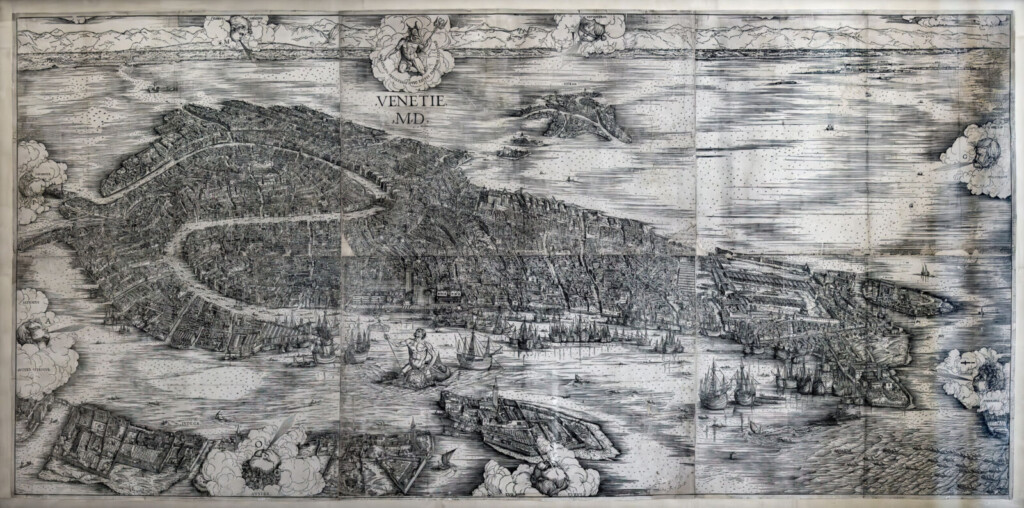
You have stood in front of a Canaletto and felt something close to longing — not for a place exactly, but for a world where light falls without consequence, where water carries gondolas instead of refuse, where stone facades hold no memory of rot or salt damage eating through their foundations from below.
That sensation is not accidental. It was engineered across centuries with the same precision applied to pigment and perspective. John Berger argued in Ways of Seeing, published in 1972, that every image is a record not only of what was seen but of what the seeing person chose to frame — and that the frame itself is always ideological, always the product of someone’s interest in showing the world a particular way. Venetian painting applied this logic long before Berger named it. The commissioners of those luminous canvases were the same merchant oligarchs whose wealth depended on a labor force that never appeared in the finished work. The gondoliers, the glass-blowers of Murano working in temperatures that destroyed their lungs by forty, the women in the lace workshops of Burano whose eyesight failed them before middle age — these bodies were structurally excluded from the visual record that would define Venice for the following five hundred years.
The flood is perhaps the most telling absence of all. Venice floods. It has always flooded. The acqua alta of November 1966 submerged the city under nearly two meters of water, destroying manuscripts in the Marciana Library, dissolving the lower frescoes of churches that had survived the fall of the Republic, pushing the permanent population — already declining — toward a threshold they would never fully recover from. Venetian artists over the centuries witnessed countless such events, walked through them, built their studios above them, and yet the iconographic tradition treats the lagoon as a mirror, not a threat. The water in Venetian painting is always serene. It reflects. It does not rise.
This is not negligence. It is the visual equivalent of a contractual clause. The patrons who funded the great decorative cycles of the Scuola Grande di San Rocco, who commissioned Titian and Veronese and Tintoretto, were investing in a specific mythology of Venetian permanence — the idea that the city floated not precariously but triumphantly, chosen by geography and Providence alike to be eternal. To paint the flood would have been to paint the vulnerability of the entire economic and theological fantasy on which the Republic’s self-image rested.
What is more unsettling is how completely subsequent artists, arriving from elsewhere with no stake in that original mythology, absorbed and replicated its omissions. Turner came to Venice in 1819 and again in 1833 and 1840, and he dissolved the city in atmospheric light that made it even more untethered from material reality than Canaletto had. Monet arrived in 1908 and produced thirty-seven canvases in which Venice becomes color field, surface, vibration — the city as pure sensation, stripped of every human body and every social fact. These were not failures of observation. Both men were ferociously attentive to the visible world. They were responding instead to the seductive grammar that Venice had already built into itself, a grammar that selects for beauty and systematically silences the conditions that produced it.
The love that artists have carried for Venice across these centuries is real — nobody performs that level of sustained devotion across five hundred years without genuine feeling. But it is a love built on a particular kind of not-looking, practiced so consistently and passed from painter to painter with such institutional reinforcement that it stopped feeling like a choice and became instead the natural shape of the subject itself. And now we call it one of humanity’s greatest artistic legacies, which it genuinely is, without ever pausing long enough to ask what had to remain invisible for so much beauty to become possible.
🎨 Venice, Art, and the Soul of Beauty
Venice has always been a city that seduces artists, writers, and dreamers with its impossible light and labyrinthine waters. From the great masters of painting to the literary pilgrims of the modern age, the lagoon city has served as both muse and mirror. Explore the cultural threads that weave through the ancient love between Venice and the creative spirit.
Venice in Literature: History and Imagination
Venice has inspired an extraordinary constellation of writers, poets, and novelists across the centuries, from Byron to Mann, Brodsky to Pound. This article traces the literary imagination of the city, exploring how its decaying beauty and melancholic atmosphere became a fertile ground for some of the greatest works in world literature. Venice in literature is never merely a setting — it is a state of mind, a symbol of time consuming everything it touches..
GO TO THE SELECTION: Venice in Literature: History and Imagination
Henry James and Venice: The Wings of the Dove
Henry James chose Venice as the stage for one of his most psychologically rich novels, The Wings of the Dove, where the city’s grandeur and shadow amplify the moral ambiguities of his characters. James saw in Venice a perfect metaphor for desire and decay, for the beauty that conceals corruption beneath its golden surface. His portrayal of the city remains one of the most penetrating literary encounters between an artist and a place.
GO TO THE SELECTION: Henry James and Venice: The Wings of the Dove
Ruskin’s The Stones of Venice: Analysis
John Ruskin’s monumental work The Stones of Venice remains one of the most passionate defenses of Gothic architecture and the spiritual meaning of craftsmanship ever written. Ruskin saw in the Venetian palaces and churches not mere stone but the moral expression of a civilization, arguing that beauty in art is inseparable from the dignity of the labor that creates it. His vision of Venice profoundly shaped how generations of artists, architects, and critics understood the relationship between aesthetics and ethics.
GO TO THE SELECTION: Ruskin’s The Stones of Venice: Analysis
Titian: Life and Works
Titian, born in the Venetian territories, became the supreme master of color in the history of Western painting, transforming the Venetian school into one of the most luminous artistic traditions of the Renaissance. His ability to render flesh, light, and fabric with extraordinary sensuality made him the favorite painter of popes, emperors, and princes across Europe. Understanding Titian means understanding Venice itself — a civilization that elevated sensory beauty to the level of spiritual revelation.
GO TO THE SELECTION: Titian: Life and Works
Discover the Art of Independent Cinema on Indiecinema
If Venice and its artists have stirred something in you — that longing for beauty, depth, and meaning — then independent cinema is waiting to take you further. On Indiecinema you will find films that share that same devotion to art and vision, works crafted with the same passion that drove painters and poets to the lagoon. Come and explore a streaming world where every film is a journey worth taking.
👉 EXPLORE THE CATALOG: Watch Indie Films in Streaming
A vision curated by a filmmaker, not an algorithm
In this video I explain our vision

