
The Body That Refuses to Disappear
You are standing in front of it and something is wrong. Not wrong in the way that disturbs or offends, but wrong in the way that a room feels wrong when someone has just left it — a residual warmth, a displaced air, the sense that presence has not fully departed. The paint is five centuries old. The woman depicted has been dead, if she ever lived at all, for longer than most civilizations have existed in their current form. And yet the flesh on that canvas refuses the decorum of distance. It insists. It presses forward through the varnish and the museum light and the particular silence of rooms where people whisper without knowing why.

This is what Titian does to you, and it is worth being honest about the discomfort before reaching for the admiration. Because the admiration comes easily, too easily, and it can become a way of not looking. You can say the word “masterpiece” and step back, and the stepping back is a relief, a small managed retreat from something that was asking more of you than you wanted to give.
The body in his paintings does not behave like painted bodies are supposed to behave. It does not perform its own beauty for your appreciation. It simply occupies space — warm, dense, self-contained, indifferent to your gaze even as it meets it. This is technically extraordinary, the result of a method so radical for its time that his contemporaries argued about whether it was genius or laziness, whether those loose, almost reckless brushstrokes at close range constituted mastery or its abandonment. Giorgio Vasari, who saw Titian work in his late period, noted with a mixture of awe and suspicion that he applied paint with his fingers as much as with his brush, smearing and dragging pigment across the surface until the colors bled into one another in ways that oil was not supposed to permit. At a distance, the flesh resolved. It cohered. It breathed. Up close it was almost violent in its materiality — thick ridges of lead white, glazes of red lake and smalt layered over months, sometimes years, forms that emerged not from drawing but from accumulated touch.
Maurice Merleau-Ponty, writing in the middle of the twentieth century about what painting actually does to a body that stands before it, argued that visual experience is never purely optical. The eye is attached to a body, and the body recognizes what it sees in terms of its own physical memory. When you look at a painted surface that replicates the weight and warmth of human skin with sufficient accuracy, you are not having an aesthetic experience in the detached, contemplative sense the Enlightenment invented. You are having something closer to an encounter. Your nervous system responds before your judgment arrives. This is why standing in front of certain canvases produces something that resembles unease, even among people who came expressly to admire them.
Titian was born, most historians now believe, around 1488 or 1490 in the mountain town of Pieve di Cadore, in what was then the territory of the Venetian Republic. He died in Venice in 1576, almost certainly of plague, at an age that would have been remarkable even by modern standards. That span — nearly ninety years of continuous production — means his work does not belong to a single moment or a single idea of what painting should do. He lived through the High Renaissance, the Reformation, the Counter-Reformation, the entire arc of Mannerism, and arrived at something in his final decades that looks less like a culmination than a dissolution, a willingness to let form come apart in order to find something beneath form.
But begin with the flesh, because it never goes away.
Don Barry: A Quixotic Exploration

Docufiction, Experimental, by Paul Smart, Mexico, 2026.
Don Barry: A Quixotic Exploration is a debut feature that places the biography of an eighty-year-old experimental filmmaker and artist, Barry Gerson, within the metanarrative of Miguel de Cervantes’ Don Quixote. Don Barry was filmed in the city of Guanajuato during the 51st edition of the Cervantino Festival, as well as during the vibrant Day of the Dead celebrations held in the city’s UNESCO-listed tunnels. The film honors the director’s long friendship with artist Barry Gerson, drawing inspiration from Cervantes’ Don Quixote. Paul Smart’s directorial choices create something new that celebrates life and goes beyond conventional storytelling. A search for magic in our real lives. A moving film about the meaning of life, art, and death. Not to be missed.
Paul Smart is a proud outsider filmmaker with a long history of film screenings. In the 1980s, he emerged in New York’s vibrant youth art scene, working in theater production and later filmmaking, before retreating to rural upstate New York, in the Catskill Mountains, where he made a living writing and screening independent films in old parish halls for rural audiences, many of whom had never seen a film.
LANGUAGE: English
SUBTITLES: Spanish, French, German, Portuguese
Venice as a Machine for Desire
Venice did not produce Titian the way a school produces graduates. It produced him the way a pressure system produces weather — through the accumulated force of specific conditions, specific hungers, specific contradictions that had been building for two centuries before he ever arrived from Cadore as a boy of perhaps nine or ten, somewhere around 1498, carrying nothing remarkable except eyes that would eventually change how Western painting understood the human body.
To understand what those eyes were trained on, you have to understand what Venice actually was at the end of the fifteenth century. Not the Venice of romantic mythology, not the city of gondolas and melancholy decay that Byron would later sentimentalize into a literary prop, but a functioning commercial empire of extraordinary brutality and sophistication. The Republic controlled trade routes that stretched from the Adriatic to the eastern Mediterranean, taxed silk and spice and slaves, maintained a navy that was essentially a state-owned corporation, and had developed over centuries a political theology in which the Doge was simultaneously the most powerful man in the city and its most carefully managed prisoner, his every gesture regulated by a council of patricians who understood that spectacle and power were not merely related but identical.
This is what the sociologist Richard Sennett, writing in The Fall of Public Man in 1977, identified as the Venetian paradox: a culture that had perfected the performance of public identity while simultaneously developing an extraordinarily precise economy of private desire. Venice was a city where surfaces were not superficial. They were the thing itself. The facade of the Ca’ d’Oro, completed around 1430, was not decoration over substance. It was the argument. What you showed was what you were, and the showing was a form of domination.
Into this environment came a trade in images that operated with the same logic as the trade in cloth. Giovanni Bellini, in whose workshop Titian would spend his formative years, had already understood that painting in Venice was not a devotional practice with commercial implications but a commercial practice with devotional packaging. Bellini’s madonnas are suffused with a tenderness so precisely calibrated it feels almost engineered, and in a sense it was — produced for a market of patrician households that wanted sanctity delivered at a particular emotional temperature, not too raw, not too cold. The Venetian collector was not seeking transcendence. He was seeking confirmation, the image as mirror of his own refined sensibility.
But Venice was also, relentlessly, a city of bodies. The census of 1509 counted roughly one hundred thousand inhabitants crowded into an island that covered less than three square kilometers of solid ground. Bodies were everywhere, inseparable, transacting constantly — in markets, in the narrow calli, on the bridges where the physical press of strangers was unavoidable. And Venice had institutionalized this bodily density in ways that would directly shape what Titian painted. The courtesan culture of the city was not a hidden underworld. It was a recognized economic category, taxed and regulated, with the most celebrated cortigiane oneste occupying a social position that intersected with the patronage networks of the nobility. These women were educated, often multilingual, patrons of poets and composers, and they sat for painters as themselves, not disguised as Venuses or allegories but as women whose beauty was their profession and their power.
What this meant for a young painter absorbing the city’s visual logic was that the human figure could never be purely symbolic. It was always also economic. It was always also political. The body in Venetian painting carried the weight of the market, the weight of desire as a productive social force rather than a private experience. Titian did not invent this understanding. He inherited it, sharpened it, and eventually pushed it to places that made his contemporaries in Florence and Rome deeply uncomfortable.

The Apprenticeship and the Theft of a Style
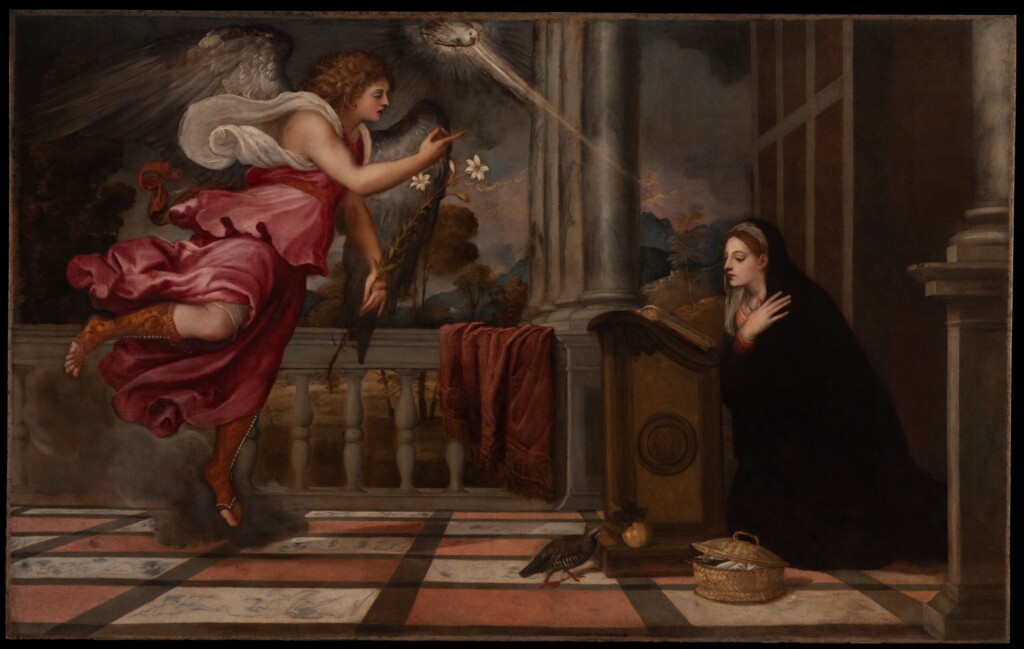
There is a particular kind of hunger that looks, from the outside, indistinguishable from admiration. You stand before someone older and more accomplished, you watch how they hold a brush, how they decide when a surface is finished, how they let silence accumulate in a painting until it becomes weight, and you absorb all of it with an attention so total it borders on aggression. This is not discipleship. It is something closer to a slow theft conducted in plain sight, sanctioned by the rituals of the workshop but driven by an appetite that the rituals were never designed to contain.
Titian entered the bottega of Giovanni Bellini sometime around 1497 or 1498, likely as a very young adolescent, arriving in Venice from Pieve di Cadore with whatever provincial formation he had already received and a capacity for observation that would define the rest of his life. Bellini was at that point the dominant force in Venetian painting, a man who had spent decades refining a visual language of luminous, oil-saturated devotion, the kind of painting where light does not illuminate objects so much as emanate from within them. To learn under Bellini was to learn that surface was theology, that the way pigment caught the afternoon light through a workshop window was itself a form of argument about the nature of the sacred.
But the more decisive encounter was with Giorgione. They worked alongside each other in the same years, two young painters orbiting the same gravitational center, and what passed between them was one of those exchanges so intimate and so charged that art history has spent centuries trying to untangle it. The philosopher Harold Bloom, writing in 1973 in The Anxiety of Influence, described the relationship between a young poet and his precursor as an act of creative misreading, a deliberate distortion through which the latecomer clears imaginative space for himself. Bloom was writing about poetry, but the dynamic he identified is visible in paint, in the way Titian absorbed Giorgione’s atmospheric sfumato and then quietly, systematically, made it do things Giorgione had never asked it to do.
There are works from this period that cannot be assigned with certainty to either hand. The Sleeping Venus, begun by Giorgione and completed by Titian after Giorgione’s death from plague in 1510, is perhaps the most famous site of this ambiguity, a painting where two sensibilities are fused so thoroughly that the seam is invisible. Scholars have argued for decades about which passages belong to whom. The question itself reveals something important: that becoming yourself as an artist sometimes requires passing through another person so completely that neither of you emerges unchanged.
What Titian took from Giorgione was not a technique but a mood, that quality of suspended time, of figures existing in a present tense that feels perpetually on the edge of dissolving. What he added was mass, urgency, a corporeal density that Giorgione’s dreamlike surfaces tended to dissolve away. The transformation was not improvement in any simple sense. It was a displacement, a reorientation of the same elements toward different ends. The psychoanalyst Donald Winnicott, in his later work on creativity, argued that genuine originality requires not the absence of influence but its digestion, the capacity to take in what belongs to another and metabolize it until it becomes something your body produces naturally. Titian’s early career is a long act of digestion, uncomfortable and not always visible from the outside, conducted inside the organism of a workshop where influence was the air you breathed and ambition was the thing you were not supposed to name.
By the time Bellini died in 1516, Titian had already been appointed his successor as official painter to the Venetian Republic, an appointment that confirmed what the paintings had been saying for years: that the student had not merely learned the style but had quietly, irreversibly, taken possession of it.
Power Sits for Its Portrait
There is a moment, repeated across decades and courts, when a man who controls the fate of millions sits very still and allows another man — a craftsman, technically a servant — to study his face with an intimacy no diplomat or general would ever be permitted. The stillness is not humility. It is the calculation of someone who understands that what happens in the next weeks will outlast every battle he has won.
Charles V understood this with unusual clarity. When Titian painted him in Augsburg in 1548, the Emperor was fifty-eight years old, exhausted by gout and by the impossible geometry of his empire, which stretched from the Castilian plateau to the mines of Peru. He had just defeated the Protestant princes at the Battle of Mühlberg the previous year, and he needed that victory to be permanent in a way that military victories never are. The portrait Titian produced shows him on horseback at dusk, armored, solitary, the landscape behind him the color of a bruise healing. It does not show triumph. It shows something more durable — inevitability. The man on the horse does not appear to have won. He appears to have always been there.
Hans Belting, in his foundational work Bild und Kult, argues that the image in Western culture has never been merely representation. The image is a site of presence, a place where the absent body is made to exert force on the living. What Belting traces through medieval cult images and relics, Titian was performing in secular oil paint. The portrait of Charles does not depict power. It enacts it. To look at the painting is to be placed in a specific relationship to the figure — subordinate, peripheral, outside the frame of decision. This is not accident. It is engineering.
Philip II, who inherited both the empire and the painter, used Titian with even greater systematic intent. Over roughly three decades of correspondence and commission, the relationship between the Spanish king and the Venetian painter produced not only the famous poesie — those mythological canvases of Danaë, Venus, Diana — but a sustained program of dynastic self-construction. Philip understood portraiture as infrastructure. When Titian’s images of him circulated to the courts of Europe, to potential allies and potential enemies, they were not sending a likeness. They were sending a claim. This is what sovereignty looks like. This is the body that commands.
Sociologists of power from Max Weber onward have analyzed the way authority requires constant performance and material support. Weber’s distinction between charismatic, traditional, and legal authority in Wirtschaft und Gesellschaft, published posthumously in 1922, identifies the perpetual problem of legitimacy: it cannot simply be declared, it must be believed. Titian was in the business of manufacturing belief. A small panel painting, traveling in a diplomatic pouch across the Alps, arriving at a foreign court, was doing work that a thousand soldiers could not do. It was making a distant prince present, alive, watching.
What makes this disturbing rather than merely interesting is the question of complicity. Titian was no propagandist in the crude sense. His intelligence was too fine, his observation too honest, for simple flattery to survive in his work. Look closely at the late portraits — the aged Philip, the faces of cardinals and merchants — and you find something else beneath the official surface: fatigue, doubt, the specific loneliness of men who have confused their position with their person for so long they can no longer tell them apart. Whether this was intentional resistance or simply the unavoidable consequence of a painter who looked too carefully, it leaves every portrait cracked open in a way the sitters might not have authorized if they had seen it coming.
The Mythology of the Naked Woman
There is a particular kind of looking that presents itself as admiration while functioning as possession. You have encountered it, probably, without naming it — the way certain gazes appraise rather than see, the way they flatten a living person into a surface that reflects the observer’s desire back at him undisturbed. Titian understood this mechanism with extraordinary precision, and he built an entire economy around it.
The reclining woman appears in his work with the regularity of a formula because it was, in fact, a formula — and formulas exist to produce reliable results. A woman lies on rumpled sheets or soft grass, her body arranged along a horizontal axis that corresponds exactly to the resting eye of a viewer standing before the canvas. She looks out at you, or she does not. When she does not look, her gaze drifts toward a servant, toward a window, toward some undefined middle distance, and her inwardness becomes part of the composition’s seduction — she is present for looking at, not for looking back. When she does look, as in the earliest and most celebrated of these reclining figures, the gaze is not confrontational but complicit, as if she has accepted and ratified the terms of the viewing arrangement. The dog sleeping at her feet is not a sentimental detail. It is a sign of domesticity, of tamed nature, of a wildness so thoroughly subdued it has learned to sleep.
John Berger, writing in 1972, identified the structural logic beneath this kind of painting with a directness that had eluded centuries of art history: the surveyed female is always conscious of being seen, and this consciousness is what transforms a woman into a nude. The distinction between naked and nude is not anatomical. It is relational. Nakedness is a state; nudity is a performance organized for a spectator. Berger observed that in the European tradition running through Titian and forward for four centuries, the principal protagonist of the painting is never the woman herself but the man looking at her — the patron who commissioned the work, the viewer who stands before it, the gaze that the entire composition has been architecturally arranged to gratify.
Laura Mulvey formalized this insight in 1975, when she introduced the concept of the male gaze as a structural property of visual representation rather than a matter of individual intention or malice. The gaze, she argued, is built into the apparatus — into the angles, the framings, the decisions about what is rendered in detail and what is left vague. In Titian’s nudes, the decision-making is systematic. The flesh is rendered with a sensory specificity — warm, yielding, lit from within by the famous Venetian tonalism — while the faces often recede into a generalized idealization that removes particularity, and with it, personhood.
The mythology that surrounds these works is itself part of the transaction. Calling a reclining woman Venus does not elevate her into the divine; it disguises a purchase as a prayer. The Danaë series, which Titian produced in multiple versions for different patrons across several decades, makes the transaction almost satirically legible. A woman receives a god in the form of golden rain, and a servant reaches out to catch the coins. Titian reportedly told a cardinal that this figure surpassed anything he had achieved before, because in her he had captured the natural. What he had captured, more precisely, was the perfect negotiation between availability and ideal distance — close enough to desire, remote enough to worship, owned without the complications of ownership.
The comfort readers have historically taken in calling these works timeless celebrations of beauty deserves examination rather than acceptance. Timeless is the word we use when we do not wish to ask: for whom, by whom, under what conditions, and at whose expense was this particular beauty produced and consumed.
A vision curated by a filmmaker, not an algorithm
In this video I explain our vision
Color as Argument
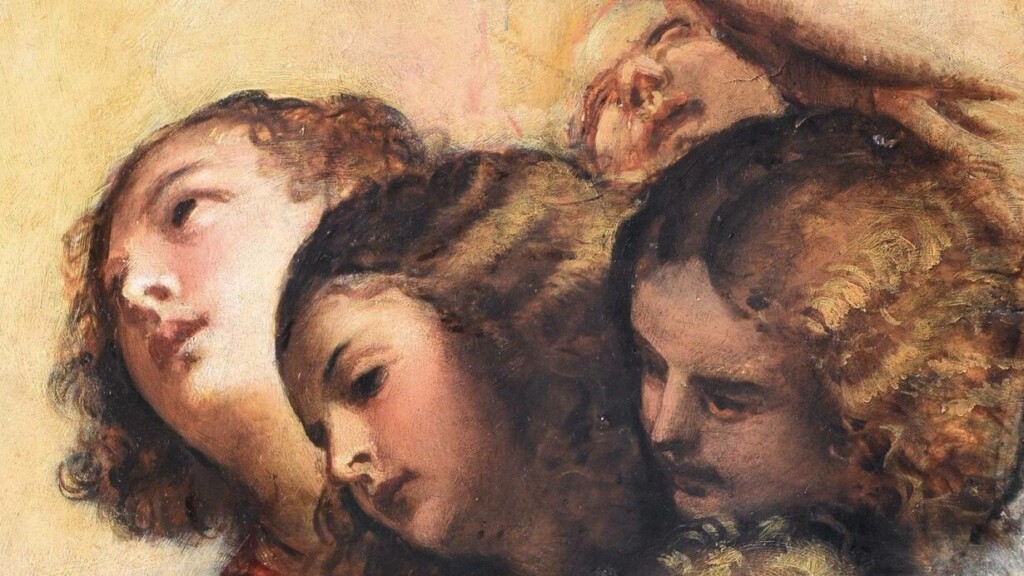
There is a particular kind of argument that cannot be made with words, or with lines drawn cleanly across a surface. It has to be felt through accumulation, through the slow deposit of one thing on top of another until the original intention is so buried beneath revision that what emerges is something the hand never planned. Titian understood this before anyone had a vocabulary to describe it. His contemporaries in Florence were still insisting that the skeleton of a painting was its drawing, that disegno — the intellectual armature, the proof of conceptual mastery — was what separated the painter from the artisan. Color, in that hierarchy, was cosmetic. It dressed the idea without constituting one.
Titian dismantled this entirely, and the dismantling was not a polemic. It was a practice. He worked in layers that contradicted each other, laid down glazes that simultaneously revealed and obscured what lay beneath, returned to canvases after weeks or months to rework passages that other painters would have considered finished. Giorgio Vasari, who visited him in Venice around 1566, described watching Titian apply paint with rags and fingers as much as with brushes, smearing pigment across surfaces in ways that looked, up close, like chaos. Distance resolved everything. Distance was the point. Titian was not painting objects. He was painting the condition under which objects become visible — which is always a condition of uncertainty, of light that arrives obliquely and retreats before you can fix it.
The philosopher Maurice Merleau-Ponty, writing in “The Visible and the Invisible” in 1968, argued that perception is never a clean transaction between a subject and a stable world. What we see is always already entangled with what we have touched, feared, desired. Vision is embodied. Titian’s colorito enacts this exactly. A shoulder in his late work is not a shoulder described; it is a shoulder felt, its warmth built up from vermilion and lead white and raw umber in proportions that no formula could replicate, adjusted by eye across sessions until the paint carries something the anatomy cannot explain. Flesh, in Titian, is an argument about the fact that bodies are mortal and luminous at once, that the same quality of light that makes skin beautiful is the quality that marks it as temporary.
The Venetian tradition gave him the materials for this. Venice had access to the finest pigments from trade routes that connected it to the Eastern Mediterranean and beyond — ultramarine from lapis lazuli arriving through Alexandria, vermilion from the cinnabar mines supplying the eastern markets. But what Titian did with these materials was not a refinement of Venetian technique. It was a philosophical departure. By the time he was painting his final works in the 1570s, approaching what would have been his late eighties or nineties — his birth year remains contested somewhere between 1488 and 1490 — the paint itself had become the subject. Surfaces left rough, contours dissolved into atmosphere, figures emerging from grounds as though they were being remembered rather than observed.
You can stand in front of one of those late works and feel genuinely unsettled, not by the subject matter, but by the refusal to resolve. The image is present and withheld simultaneously. This is not incompletion in the way that the word implies failure. It is incompletion as a statement about the nature of seeing: that nothing is ever fully given, that what we call reality is always partially constructed by the one who looks, that the painter who pretends otherwise — who draws the clean line and fills it with decorous color — is lying about the terms of experience. Titian was not lying. He was doing something far more difficult than mastery. He was remaining honest about the fact that light moves, that time passes through a painted surface the way it passes through a face, leaving traces no draftsman’s certainty could ever hold.
Old Age and the Dissolution of the Visible
There is a moment in the life of any maker when the hand stops obeying and begins, instead, to confess. Not the confession of weakness — though weakness is present, the fingers less certain, the eye less sharp — but something closer to the confession of a man who has spent ninety years constructing a version of the world and now, with very little time remaining, decides to take it apart from the inside.
Titian lived past ninety. The precise date of his birth remains disputed — somewhere between 1488 and 1490, scholars argue still — and he died in Venice in 1576, likely of plague, still working. That final fact is not incidental. It is the whole argument made flesh.
The late paintings do not look like anything that came before them, not even like his own earlier work. The surfaces dissolve. Brushstrokes that once built form now seem to unmake it, dragging pigment across the canvas in gestures that leave the image half-emergent, half-consumed. There is a man in agony being skinned alive, his face turned upward in an expression that sits exactly at the border between ecstasy and annihilation, the surrounding figures rendered in that trembling, almost atmospheric technique where nothing is quite solid, where the light itself seems to be decomposing. Art historians have spent decades arguing whether this represents Titian’s technical decline or his deliberate evolution. The question itself reveals the poverty of the framework. It assumes that dissolution must be failure.
Giorgio Agamben, writing on the remnant in his 1998 work Rime alla perduta gente and more precisely in The Time That Remains, developed the idea that what survives a process of destruction is not simply a leftover but a structural feature — the remnant is not what escapes the end but what makes the end legible. Titian’s late surfaces function precisely this way. What is left after the form dissolves is not absence. It is the trace of an intention, the record of a movement through paint that refuses to solidify into the definitive. The image becomes its own remnant.
Then there is the Pietà, his last painting, completed partially by a student after his death and intended, according to several accounts, as his own funerary monument. He painted himself into it — an old man kneeling, his face half in shadow, his hand reaching toward the dead Christ in a gesture that is simultaneously supplication and craft, prayer and work. The architectural niche behind the figures is incomplete. The surfaces are raw in places, the paint applied in thick, agitated strokes that look nothing like the smooth transitions of the Assunta or the luminous flesh of the Venus paintings. Walter Benjamin, in the Passagen-Werk and across his essays on allegory and history, argued for the dialectical image as the moment when past and present collide in a flash of recognizability — not a linear development but a sudden arrest, a now-time in which the historical object reveals itself fully. The Pietà is exactly this. It is not the culmination of a career understood as progress. It is a rupture, a place where time folds and the whole of a life becomes visible in its most unresolved form.
What Titian understood, or what his hands understood even if no language accompanied it, is that resolution is a form of lying. The finished surface, the perfected glaze, the image brought to seamless completion — these are beautiful, and he produced them for decades, and they are among the greatest achievements in the history of paint. But they are also a kind of covenant with the viewer that says: this is how things are. The late work breaks that covenant. It says instead: this is how things feel when you no longer have the time or the need to pretend otherwise.
What Survives the Painter
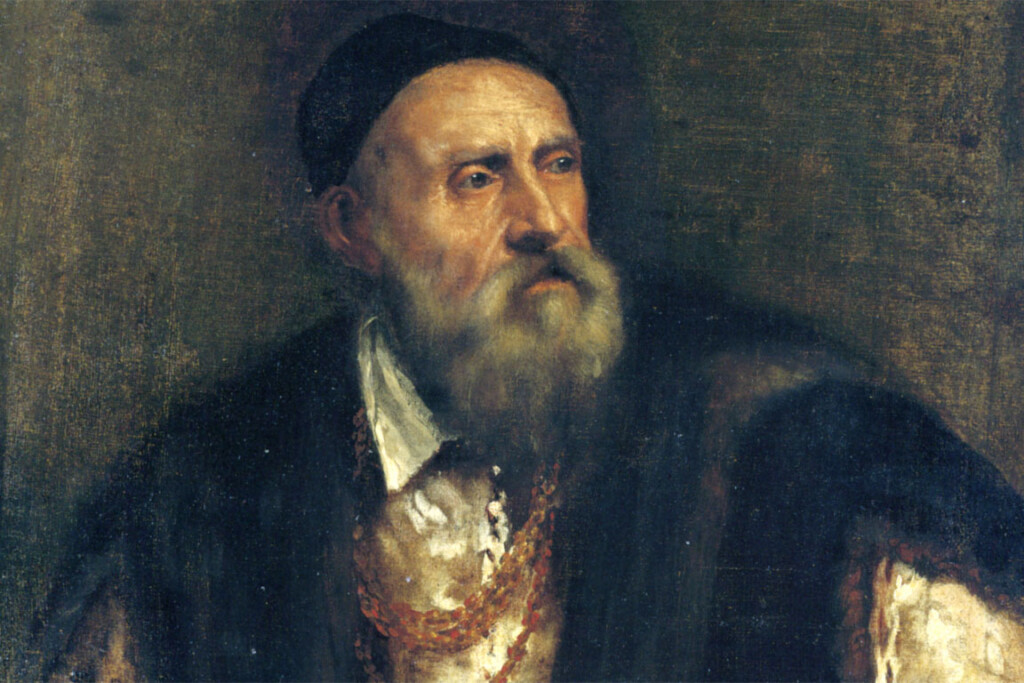
The copies came almost immediately. Before the paint was dry on some canvases, workshops across Venice were already producing versions, approximations, echoes — the Venuses multiplied, the portraits were replicated, the mythologies reproduced for patrons who could not afford the original but wanted proximity to whatever force lived inside it. This is not unusual in the history of art. What is unusual is how little the copies managed to capture, and how obvious that failure became the moment you stood before the original. Something refused to travel. Some voltage stayed in the source.
By the time the great national museums of Europe were consolidating their collections in the nineteenth century — the Prado reorganized, the National Gallery in London acquiring systematically, the Louvre expanding its encyclopedic ambitions — Titian had become a monument. And monuments, almost by definition, are things you walk past. The institutional frame performed a kind of neutralization: the paintings were lit, labeled, protected behind glass or rope, inserted into chronologies and stylistic taxonomies that made them legible and therefore, in some essential way, safe. Walter Benjamin, writing in 1935 in “The Work of Art in the Age of Mechanical Reproduction,” called this the destruction of the aura — the unique presence of a thing in the place it inhabits, the here-and-now of an original encounter. What he could not have predicted is how efficiently the museum itself, even before mechanical reproduction, could accomplish the same extinction simply through the ceremony of display.
Art history did the rest. The scholarship around Titian is vast, meticulous, and frequently brilliant — the catalogues raisonnés, the attribution debates, the technical analyses of his late glazing techniques and the evolution of his brushwork across seven decades. All of it necessary. All of it, in aggregate, producing something that looks like knowledge and functions like distance. You learn when a painting was made, for whom, at what price, in what political context, and the information accumulates until you are standing in front of flesh and seeing data. This is what institutions do to danger: they annotate it until it becomes a curriculum.
And yet. There is a man in a corridor of a great museum — you have been that man, or you have been that woman — who turns a corner expecting nothing and stops. Not because they recognize the painting from a textbook. Because something in it looked back. The late Titian, working in those final years when his hand trembled and his technique became what scholars politely call “summary” and what is actually something closer to raw transmission — those surfaces do not ask to be contemplated. They insist on something more uncomfortable than contemplation. Hans Belting, in “Likeness and Presence” published in 1990, argued that images have a history of power that precedes and exceeds their history as art — that they operated on bodies before they were aesthetic objects, that they were made to do something to the person standing before them. The museum reversed the arrow: it made the viewer the active agent, the interpreter, the one who brings meaning. But some paintings refuse this reassignment of roles.
What survives Titian is not his influence, though it is enormous — Velázquez copying him in Madrid, Rubens studying him obsessively, Manet rerouting him through modernity. What survives is something harder to name: a quality of presence in the paint itself that centuries of imitation, scholarship, and institutional custody have not managed to extinguish. A woman’s skin rendered in light and lead white and time still carries something that does not belong to history. You look at a body five hundred years gone and feel, briefly, watched — and the discomfort of that feeling is the most honest response you will ever have to the question of what painting is for.
🎨 Art, Beauty, and the Renaissance Spirit
Titian’s art did not emerge in a vacuum: it was nourished by a rich cultural world of patrons, philosophers, and fellow creators who shaped the visual language of the Renaissance and beyond. Exploring these connected threads reveals how painting, thought, and history intertwine across centuries. Dive into these related articles to deepen your understanding of the world that made Titian possible.
Alchemy in the Italian Renaissance
Renaissance Italy was not only a crucible of artistic genius but also of alchemical experimentation, where painters and thinkers often drew from the same well of Hermetic philosophy. This article explores how alchemy flourished in the courts and workshops of the Italian Renaissance, influencing everything from pigment-making to cosmological symbolism. Understanding this context enriches our reading of Renaissance painting, including Titian’s own mythological and allegorical works.
GO TO THE SELECTION: Alchemy in the Italian Renaissance
Giordano Bruno and the Hermetic Tradition
Giordano Bruno was one of the most radical thinkers of the Renaissance, weaving together Hermeticism, cosmology, and memory into a singular and dangerous philosophy. His ideas circulated in the same intellectual atmosphere that nourished Venetian art and culture during Titian’s lifetime. Exploring Bruno’s thought helps us grasp the deeper symbolic and philosophical currents running beneath the surface of Renaissance masterpieces.
GO TO THE SELECTION: Giordano Bruno and the Hermetic Tradition
Frida Kahlo: Life and Works
Frida Kahlo, like Titian, built a body of work deeply rooted in personal mythology, bodily experience, and cultural identity. This article examines her life and paintings, tracing how she transformed pain and passion into enduring visual poetry. Comparing her artistic journey with Titian’s offers a fascinating lens on how great painters across eras channel the human condition into timeless imagery.
GO TO THE SELECTION: Frida Kahlo: Life and Works
Diego Rivera: Life and Works
Diego Rivera was a titan of twentieth-century painting whose monumental vision of history and humanity echoes the grandeur found in Titian’s large-scale compositions and historical canvases. This article traces Rivera’s life and works, from his Mexican roots to his international fame as a muralist of extraordinary ambition. Exploring Rivera alongside Titian reveals the enduring power of painting as a vehicle for cultural memory and humanist storytelling.
GO TO THE SELECTION: Diego Rivera: Life and Works
Discover Independent Cinema on Indiecinema
If Titian’s world of beauty, myth, and human depth resonates with you, Indiecinema streaming is your next destination. Our curated catalog brings together the finest independent and arthouse films that share that same passion for profound visual storytelling. Join us and let great cinema move you the way great painting always has.
👉 EXPLORE THE CATALOG: Watch Indie Films in Streaming
A vision curated by a filmmaker, not an algorithm
In this video I explain our vision

