
The Architecture of Surrender
You are standing in water. Not wading through a flood, not caught in a sudden storm — standing, deliberately, in the middle of one of the most photographed public spaces on earth, and the water is at your ankles, and it is cold, and it has been here before, and it will be here again. Around you, tourists are lifting their phones above their heads to capture the reflection of the Basilica’s domes shimmering in the thin silver sheet beneath their feet. They are laughing. Beside them, a Venetian woman in her sixties crosses the square without altering her pace, rubber boots to the knee, a canvas bag in one hand, groceries inside. She does not look at the water. She looks through it, the way you look through a window you have stopped noticing.

This is the first lie Venice tells you: that the flooding is an event. It is not an event. It is a condition, a chronic negotiation between a city and the element it was built upon, dressed up in tourist brochures as spectacle and in engineering reports as crisis. The truth is stranger than either framing. Venice was not placed at the edge of water as a miscalculation later corrected by history. It was inserted into a lagoon with the full knowledge that the lagoon was not solid, not permanent, not trustworthy. The original settlers of the fifth and sixth centuries, driven from the mainland by Lombard invasions, drove millions of wooden stakes — primarily alder and oak, species that petrify rather than rot when deprived of oxygen — into the silted floor of the Adriatic shallows. They built not on land reclaimed from water but on wood submerged in it. The city’s foundation is not stone. It is an act of transformation, organic matter converted by anaerobic pressure into something close enough to permanence to bet a civilization on.
That bet has always had a time limit, and everyone who has looked closely at Venice has known it. When John Ruskin arrived in the 1840s to compile what would become The Stones of Venice, published in three volumes between 1851 and 1853, he was not documenting a living city so much as performing a kind of forensic grief. His central argument, stated with the controlled melancholy of someone who has already accepted a death, was that Venice represented the highest achievement of Gothic and Byzantine architectural synthesis in the Western tradition — and that this achievement was already decomposing beneath his pencil as he sketched it. Ruskin understood, with uncomfortable clarity, that beauty of this particular kind is inseparable from entropy. The marble facing the Doge’s Palace, the carved capitals he measured and catalogued with obsessive precision, the polychrome stone of the Basilica’s facade — none of it was stable. All of it was sinking, cracking, absorbing salt, exhaling itself slowly into the air it had displaced for centuries. He was not mourning a future loss. He was identifying a present condition that the city’s admirers were collectively choosing not to name.
What Ruskin saw in the stones, and what most visitors continue not to see in the water, is that Venice operates on a logic of sustained aesthetic denial. The city is extraordinarily beautiful in the way that certain terminal things are beautiful — with a clarity that only arrives when the ordinary future has been removed from the equation. The gondola, the palazzo, the flooded piazza: none of these are symbols of eternity. They are symptoms of a refusal to acknowledge that the negotiation struck with the lagoon in the sixth century was never going to hold indefinitely, that water does not make agreements, that it simply returns, every year, a few centimeters higher than the last.
Studio 2091
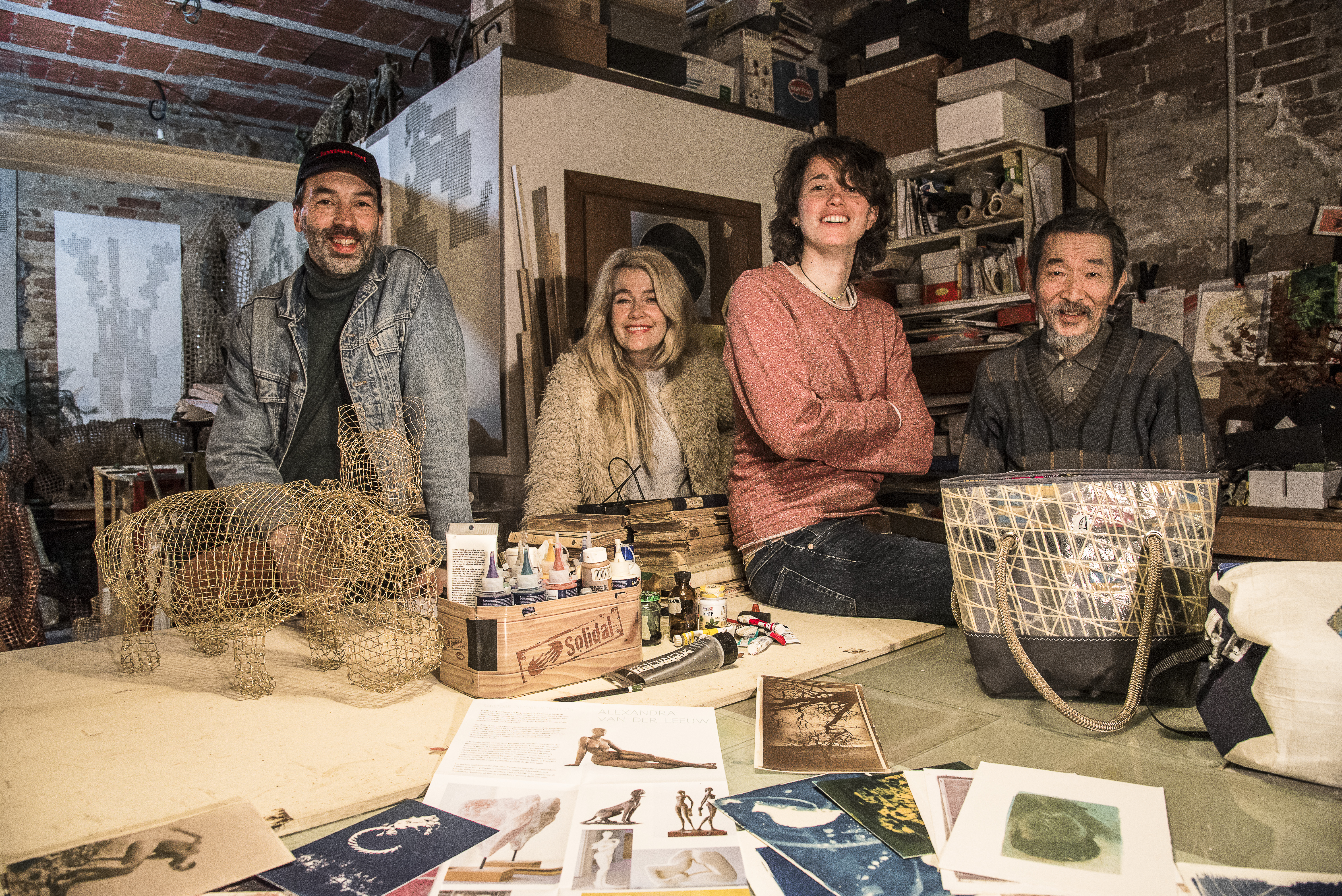
Documentary, by Naù Germoglio, Italy, 2020
In a former warehouse on the ground floor of the civic number "2091", in the district of “Santa Croce” in Venice, two sculptors, a craftswoman and an alchemist-photographer work together. It is a 65 square meters space with two windows overlooking a small canal. It is called "STUDIO2091" and it is a unique example of creative co-working space where there is no wifi connection, the cellphones work very bad, there are no tables for meetings, nor computers.
His "tenants" carry out only manual activities related to art and crafts. Each of them has a different reason to live in Venice, a beautiful and unique city, yet expensive, problematic, overrun by mass tourism and high tide. The photographer-alchemist Andrea Buffolo, who was born in Switzerland,is the only one who has spent almost all his life in the historical center of Venice. Japanese sculptor Masaru Kashiwagi chose to live in Venice 35 years ago, because he considers it the only city in the world perfect for an artist; the craftswoman Camilla Morelli was born and raised in Valtellina ( a valley in the Lombardy region of northern Italy), and although she grew up in the mountains, she chose to live in Venice to enjoy the proximity to the sea; the Dutch painter and sculptor Alexandra Van der Leeuw lives on the island half of the year carrying on a family tradition. The four protagonists of the documentary film chose to live in Venice because here,and only here, they succeed in being themselves, realizing themselves and feeling free.
SUBTITLES: English, Spanish, French, German, Portuguese
Acqua Alta as Political Instrument
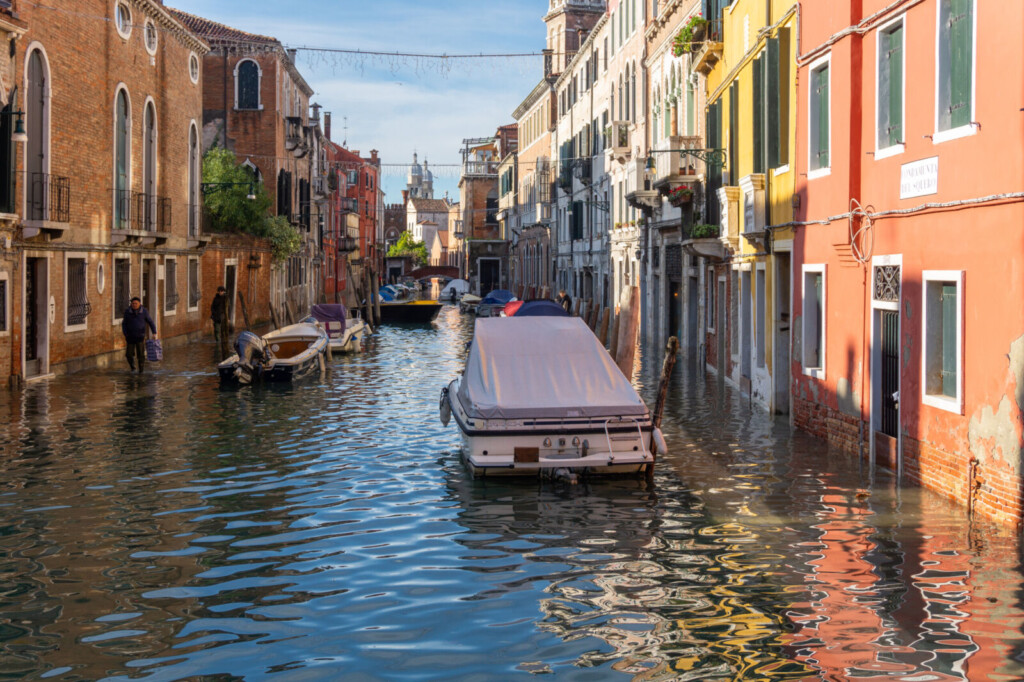
You are standing in the Piazza San Marco in November 2019, water at your shins, watching a municipal worker in rubber waders adjust a metal walkway while a group of tourists photograph him as though he were an attraction. Nobody in the square looks surprised. The flooding has been happening long enough that the city has built an entire choreography around it — the raised platforms, the waterproof boots sold on every corner, the tide-warning sirens that residents have learned to interpret like birdsong. The emergency has been domesticated so thoroughly that it no longer reads as emergency at all. That is precisely the point.
The Republic of Venice understood centuries before modern political theory that water could be administered as power. Beginning in the 1500s, the Magistrato alle Acque — the hydraulic authority established formally in 1501 — undertook massive engineering diversions of the Brenta and Piave rivers, not merely to protect the lagoon’s ecological balance but to demonstrate sovereign command over nature itself. The Serenissima did not simply respond to flooding; it staged its response as political theater, proof that the Republic’s governance extended even to the behavior of the sea. Control over the waters was inseparable from control over the population that depended on them. What looks like civic infrastructure is often, at its deepest layer, a demonstration of who holds the authority to decide what counts as normal.
Giorgio Agamben, in his 2003 work “State of Exception,” traces how governments throughout the twentieth century discovered that emergency powers, once declared, tend to become permanent structures. The exception does not resolve the crisis — it institutionalizes it, because a crisis that ends also terminates the extraordinary authority invoked to manage it. Applied to Venice, this logic becomes almost grotesquely legible. A city that is perpetually flooding is a city perpetually in need of intervention, perpetually subject to emergency decrees, perpetually available as a site for the exercise of powers that ordinary democratic procedure would constrain. The water does not threaten governance — it enables it.
The MOSE project crystallizes this with a precision that almost seems designed to prove the theory. Approved in principle in 1994, contracted in 2003, the system of mobile flood barriers at the lagoon’s three inlets consumed approximately 5.5 billion euros before becoming even partially operational in October 2020. During those intervening decades, investigations by the Venice prosecutor’s office uncovered a network of bribery, kickbacks, and political financing that implicated mayors, ministers, officials of the Consorzio Venezia Nuova — the private consortium that held the monopoly on all lagoon protection works — and members of nearly every major Italian political party. A 2014 anti-corruption sweep led to over thirty arrests. The project had become what economists call a “rent-seeking” mechanism of extraordinary efficiency: the permanent crisis of flooding provided the permanent justification for contracts that were, in practice, instruments of political finance. Venice flooded; money flowed; the flooding continued.
What makes this pattern so difficult to see clearly is that the mythologization of Venice’s relationship with water provides genuine emotional cover. The city is beautiful. The flooding is, in certain lights, genuinely poignant — the marble pavements sheened with water, the reflections doubling the facades. John Ruskin spent three years in the 1840s documenting this beauty in obsessive architectural detail, producing “The Stones of Venice” between 1851 and 1853, a monument to a city he believed was dying. His grief was real. But grief, too, can function ideologically: a city that exists primarily as an object of mourning is a city whose actual political economy becomes invisible beneath the patina of loss. You weep for Venice, and while you weep, the contracts are signed.

Tourism, Decay, and the Commodification of Ruin
You arrive in November, boots already in your bag, and when the sirens sound at dawn you feel something close to excitement. The water rises through the grates, spreads across the piazza in a thin silver sheet, and you reach for your phone before you reach for your coat. The photograph you take will perform a particular kind of grief — aestheticized, weightless, shareable — and it will receive more engagement than anything you have posted in months, because ruins, when they are beautiful enough, function as a form of flattery for the person witnessing them.
Guy Debord argued in 1967 that modern society had replaced lived experience with its representation, that the spectacle was not a collection of images but a social relationship between people mediated by images. Venice is perhaps the most complete territorial realization of that thesis anywhere on earth. The city no longer produces much of anything — no significant fishing industry, no manufacturing, no functioning civic life scaled to actual human density. What it produces, with extraordinary efficiency, is the image of itself: lagoon light on baroque facades, the photogenic catastrophe of water where pavement should be, the sensation of witnessing something that is ending. Thirty million visitors per year consume that image, and the consumption is the mechanism of the ending.
The demographic collapse is not metaphor. In 1950, roughly 175,000 people lived on the island. The number fell through every subsequent decade with the regularity of a tide that never fully retreats: 120,000 by 1980, 70,000 by 2000, fewer than 50,000 today, with projections suggesting the permanent resident population could effectively vanish within a generation. Each departing family leaves an apartment that earns more as a short-term rental than it ever could as a home. The economic logic is airtight and annihilating. The market does not fail here — it succeeds perfectly, which is the problem.
What makes this particular hollowing out so difficult to oppose is that it has been aestheticized into virtue. The tourist who photographs the flood believes sincerely that they are bearing witness, that their presence constitutes a form of caring. The acqua alta has been absorbed into the product. Travel agencies market November as the authentic season, the one where you see Venice as it really is, which means the one where the water comes. Disaster has been repackaged as access to the genuine, and the genuine has been priced accordingly. A hotel room during a significant flood event costs more than during dry weather, not less. The market has assigned a premium to the experience of watching something drown.
Sharon Zukin documented this process in other cities — the way that the aesthetics of decay attract capital, which then eliminates the decay along with everything that made the neighborhood worth aestheticizing in the first place — but Venice operates at a scale and with a completeness that makes other examples look provisional. There is no next neighborhood to gentrify. The island is the island. When the last pharmacist closes because the rent has become untenable and the last school shuts because there are no longer enough children, what remains is not a city experiencing economic pressure but a city that has become a set, maintained at enormous expense so that the image of a city can continue to be sold to people who have never known what a city actually feels like from the inside.
The residents who remain describe a specific psychological condition that does not yet have a clean clinical name — something between mourning and the particular rage of watching your home be admired to death, of having the evidence of your displacement treated as picturesque by the people displacing you.
Sediment, Memory, and the Geology of Forgetting

You find him on his knees on the third floor of a palazzo off the Cannaregio, pressing tesserae of Venetian terrazzo into a bed of lime mortar with the flat of his palm, reading the floor the way a blind man reads a face. The supplier who provided this specific aggregate — crushed Botticino marble mixed with a pinkish Verona stone — closed his warehouse in 2019. The craftsman sourced the remaining stock from a relative’s garage in Mestre. He works without hurry, without apparent irony, replicating a pattern laid in 1743 by hands whose names no archive preserved, for a building that the municipality’s own demographic projections suggest will sit uninhabited within three decades as the resident population of Venice proper, which stood at 174,000 in 1951, continues its arithmetic collapse toward a number that demographers are beginning to describe not as decline but as erasure.
What the craftsman is doing is not delusional. It is something more structurally interesting than that: it is the physical expression of a civilization’s refusal to synchronize its sense of time with the time actually operating on its body. Fernand Braudel, writing in 1949 his monumental study of the Mediterranean world, introduced the concept of the longue durée — the idea that history operates simultaneously on multiple temporal registers, and that the one most consequential is not the register of events, of battles and treaties and individual decisions, but the slow geological register of climate, geography, and material constraint. Braudel’s argument was that human societies systematically misread these deep rhythms, not out of stupidity but out of a structural incapacity to perceive processes that unfold across centuries. What feels like stability is often just slowness. The ground beneath a city does not announce its intentions.
Venice is subsiding at approximately two millimeters per year through a combination of natural sediment compaction and the legacy of mid-twentieth century industrial extraction — the artesian wells drilled across the Porto Marghera industrial zone drew groundwater from the lagoon’s substrate at a rate that caused measurable ground loss of roughly twelve centimeters between 1950 and 1970 alone. The wells were capped in 1975 after the damage became impossible to ignore, but the sediment does not recover. Meanwhile the Adriatic is rising. These two vectors — the city descending, the sea ascending — are not metaphors. They are measurements. And yet the infrastructure of daily Venetian life has been built, maintained, restored, and celebrated in a mode that treats both vectors as temporary inconveniences rather than the terminal arithmetic they represent.
There is a particular form of cultural memory that functions not as knowledge transmitted across generations but as a practiced ignorance encoded in stone and habit. Every restored facade, every freshly repointed brick, every tessera pressed into lime mortar participates in this encoding. The city does not forget its floods; it commemorates them with plaques on walls marking the high-water lines of exceptional acqua alta events — 1966, 1979, 2019 — but commemoration is the opposite of reckoning. A plaque fixes a crisis in the past tense. It transforms a warning into an exhibit. The 1966 flood, which reached 194 centimeters above sea level and prompted international alarm, became within a decade the founding trauma of a conservation movement whose primary effect was to preserve Venice as it existed rather than to interrogate whether existence in that precise form remained viable.
The geologist reads strata the way the craftsman reads a floor: as information about time compressed into material. Both are performing a kind of translation between registers that do not naturally communicate. What the geological record of the Venice lagoon shows, in the sediment cores extracted by researchers from the Institute of Marine Sciences in the early 2000s, is a shoreline in continuous motion across millennia — land becoming water becoming land, the boundary never fixed, always negotiated by forces indifferent to whatever human settlement happened to occupy the margin at any given moment. The Venetians did not build on stable ground. They built on the pretense of stability, which is a different engineering problem entirely, and one whose solution requires tools that no craftsman’s hands can supply.
Destiny as a Cultural Construct
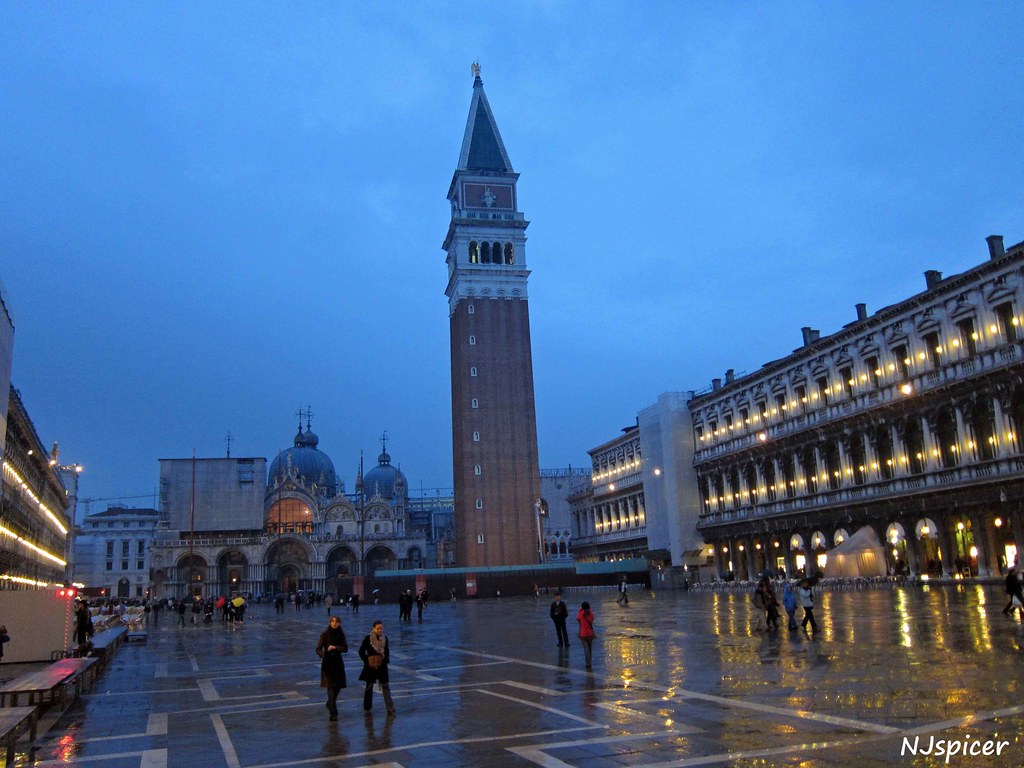
You have heard it said so many times it no longer sounds like an argument: Venice is eternal, Venice is fragile, Venice is dying, Venice is irreplaceable. Each of these statements arrives wrapped in the grammar of fate, as though the city were a geological formation slowly receding into the sea by forces that precede human memory and will outlast human intention. But stand for a moment at the edge of a flooded campo in November, your boots inadequate, the water cold and brownish, rising past the stone steps of a church that has been sinking at a measurable rate since the early twentieth century — and ask yourself whether what surrounds you is fate or the accumulated residue of ten thousand decisions made by people with names, budgets, and political incentives.
The word destiny, when applied to cities, performs a specific ideological function. It converts what is historically contingent into what is cosmically necessary, and in doing so it releases every living agent from the burden of accountability. This is not a recent invention. The Venetian Republic, across nearly a thousand years of calculated commercial and diplomatic maneuvering, cultivated its own myth of providential exceptionalism with extraordinary discipline — the city born from the sea, protected by Saint Mark, chosen by history. That mythology was always, in part, a governance technology: it made the city’s survival feel ordained rather than engineered, which meant that its decline could equally be framed as something other than failure.
Hannah Arendt, in her 1958 work The Human Condition, drew a distinction that cuts directly through this kind of mystification. She separated fate — the domain of what simply occurs, what befalls us, what we inherit — from action, which she defined as the only genuinely human faculty capable of interrupting a predetermined sequence. Action, for Arendt, is not problem-solving or management. It is the introduction of something radically new into a situation that would otherwise continue on its existing trajectory. The tragedy she identified is that action is the rarest thing in political life precisely because it requires acknowledging that the current trajectory is a choice, not a destiny, and that acknowledgment carries an enormous and uncomfortable weight of responsibility.
What has happened in Venice over the past century fits this diagnosis with uncomfortable precision. The MOSE flood barrier system, conceived in the 1980s, approved in 1994, and only partially operational by 2020 — decades late and billions of euros over its original budget, corroded by corruption scandals that led to dozens of arrests in 2014 — represents neither fate nor action in Arendt’s sense. It represents the simulation of action: the appearance of intervention without the underlying willingness to confront the structural choices that made intervention necessary. The city’s population has fallen from around 175,000 residents in 1950 to fewer than 50,000 today. That figure is not a natural disaster. It is the arithmetic result of tourism policy, property economics, municipal infrastructure decisions, and a political culture that found it more convenient to mourn Venice than to govern it.
What makes this genuinely difficult to sit with is not the cynicism of institutions, which is banal and well-documented across every contemporary democracy. What is difficult is the deeper question it opens about collective imagination: whether a civilization is structurally capable of choosing to let something it has consecrated as eternal actually end, not through neglect, not through disaster, but through a lucid, deliberate, adult decision that some configurations of human life have a natural conclusion — and that prolonging them artificially forecloses the energy, attention, and resources that might generate something else entirely, something not yet named, not yet mourned, not yet turned into a postcard.
A vision curated by a filmmaker, not an algorithm
In this video I explain our vision
🌊 When Cities Live and Die by Water
Venice is not merely a city built on water — it is a city in perpetual dialogue with its own dissolution. The articles gathered here explore the cultural, literary, and philosophical dimensions of places marked by time, flooding, and the weight of memory. Together they form a labyrinth of reflections on beauty, fragility, and the stubborn persistence of human civilization.
Venice in Literature: History and Imagination
Venice has inspired writers, poets, and dreamers for centuries, becoming one of the most mythologized urban spaces in world literature. From Henry James to Thomas Mann, the city’s canals and shadows have served as mirrors of desire, decay, and transcendence. To understand Venice’s acqua alta is to understand why this city has always been read as both paradise and premonition.
GO TO THE SELECTION: Venice in Literature: History and Imagination
Ruskin’s The Stones of Venice: Analysis
John Ruskin dedicated his monumental work to deciphering the stones of Venice as moral and aesthetic documents of a civilization in decline. His argument was not merely architectural: he believed that the way a society builds and preserves its spaces reveals its deepest values. Ruskin’s Venice is a city whose very erosion by water becomes a lesson in humility and the ethics of memory.
GO TO THE SELECTION: Ruskin’s The Stones of Venice: Analysis
Venetian Legends and Ghosts of the Lagoon
Beneath the splendor of palaces and carnival masks, Venice harbors a vast invisible world of legends, restless spirits, and lagoon myths. These stories are not mere folklore — they are the symbolic language through which inhabitants have historically made sense of floods, plague, and the ever-encroaching sea. The ghosts of the lagoon are, in many ways, the city’s oldest and most honest cartographers.
GO TO THE SELECTION: Venetian Legends and Ghosts of the Lagoon
UNESCO Cultural Heritage: History and Meaning
UNESCO’s engagement with cultural heritage raises urgent questions about what we choose to save, and for whom, when nature and time conspire against human creation. Venice stands at the center of global debates on preservation, tourism, and the tension between living culture and museum-ification. Understanding UNESCO’s framework helps illuminate the complex politics behind every sandbag placed against the rising tide.
GO TO THE SELECTION: UNESCO Cultural Heritage: History and Meaning
Discover Cinema That Dares to Look at the World Differently
If these reflections on Venice, water, and the fragility of civilization have stirred something in you, Indiecinema streaming is the place to continue the journey. Our catalog gathers independent and auteur films that explore time, place, memory, and the beauty of what is at risk of disappearing. Come and watch the world through a different lens — one that never looks away.
👉 EXPLORE THE CATALOG: Watch Indie Films in Streaming
A vision curated by a filmmaker, not an algorithm
In this video I explain our vision

