
The Critic as Cultural Authority
You are standing in a gallery in London, 1910, and you do not know what you are looking at. The paintings on the wall — Cézanne, Gauguin, Van Gogh, Matisse — bear no resemblance to anything hanging in the Royal Academy down the street, and the crowd around you is unsettled in a way that feels almost physical, a collective vertigo. Roger Fry has arranged this exhibition, titled it “Manet and the Post-Impressionists,” and in doing so has not merely curated a show but issued a verdict: this is what matters now, and your discomfort is evidence of your inadequacy, not of the paintings’ failure.

What Fry understood, with a precision that had less to do with aesthetic sensitivity than with social engineering, was that confusion could be converted into authority. His 1920 collection of essays, “Vision and Design,” did not simply argue for a new way of seeing; it constructed a new gatekeeping apparatus dressed in the neutral language of form. Significant form, the phrase he developed alongside Clive Bell, claimed to identify something universal and transhistorical in visual art — a quality accessible to pure perception, stripped of narrative, of sentiment, of everything that made art legible to people who had not been educated at Cambridge. The elegance of this maneuver is nearly architectural: by defining aesthetic value as a function of formal relationships rather than subject matter or emotional association, Fry and Bell simultaneously democratized the vocabulary of criticism and narrowed the actual entry point to near-invisibility.
Bell’s 1914 book “Art” made this structure explicit, even if Bell himself never acknowledged what he was doing. When he wrote that the average person approaches a painting through “its gesticulatory element” — meaning its story, its human content — and that only the cultivated perceiver could strip away that noise to encounter pure aesthetic emotion, he was encoding a class hierarchy into a theory of perception itself. The capacity to see correctly was not described as a privilege; it was described as a faculty. This is the precise mechanism by which cultural power naturalizes itself: it stops appearing as power and starts appearing as eyesight.
Pierre Bourdieu, working half a century later with the empirical weight of survey data gathered across France in the 1960s, demonstrated in “Distinction” (1979) that aesthetic preferences track socioeconomic position with a fidelity that no theory of natural taste can survive. What people call their instinctive response to beauty turns out to be a learned competence, absorbed through years of institutional exposure, familial transmission, and class-coded education. Fry and Bell were not discovering a universal grammar of form; they were producing the conditions under which their own trained responses could appear universal. The formalist vocabulary they invented was less a description of art than a technology of legitimation.
What makes this history difficult to dismiss is that the criticism produced by these figures was not dishonest in any simple sense. Fry’s engagement with Cézanne was genuine, his perceptual intelligence real, his prose often startling in its clarity. The problem is not that he was lying but that he was unaware of the social coordinates of his sincerity. He experienced his responses as self-evident because he had been formed by institutions — the Slade, the Burlington Magazine, the Bloomsbury Group’s interlocking networks of influence — that made those responses feel inevitable. The social machinery was invisible to him precisely because it had worked so well, and criticism as a discipline inherited this blind spot as a founding condition.
By the time the Museum of Modern Art opened in New York in 1929, the formalist template had crossed the Atlantic and was being institutionalized at a scale Fry could not have anticipated. The critic was no longer a writer with opinions; the critic was an architect of perception itself, shaping what a culture agreed to call serious, difficult, and finally, modern.
Formalism and Its Hidden Politics
You are standing in a gallery in 1948, and the painting in front of you has done something unprecedented: it has refused to pretend it is a window. The canvas is flat, the paint is thick, and the work insists on its own surface with a kind of aggression that earlier art had spent centuries disguising. What you are experiencing feels like liberation — like art has finally told the truth about itself. What you cannot yet see is that this apparent honesty is one of the twentieth century’s most sophisticated ideological maneuvers.
Clement Greenberg published “Avant-Garde and Kitsch” in Partisan Review in 1939, and by the time the Cold War had hardened into institutional reality, his critical framework had become something closer to doctrine. His central argument — that each medium must purify itself by exposing its own conditions, that painting’s proper destiny was the acknowledgment of flatness — presented itself as a formal discovery, almost scientific in its logic. Medium determined meaning. The reduction was total. What a painting was about was what it was made of, and any gesture toward narrative, symbol, or external reference was a regression, a contamination. This was not presented as a preference or a cultural position. It was presented as the direction of history itself.
The violence of that move is difficult to overstate. By locating artistic legitimacy exclusively within formal self-referentiality, Greenberg effectively quarantined art from politics, from social urgency, from anything that might connect the canvas to the world outside the gallery. Social realism — the visual language of labor movements, of anti-fascist resistance, of artists who believed representation carried moral weight — was reclassified not as a different set of values but as inferior craft, kitsch, propaganda. The hierarchy was aesthetic but its effects were deeply political, and the timing was not incidental.
Between 1950 and 1967, the Congress for Cultural Freedom, largely funded through covert CIA channels, actively promoted American abstract expressionism across Europe and Latin America as evidence of the creative freedom that liberal democracy permitted and Soviet collectivism could not. This was documented in Frances Stonor Saunders’s 1999 work “The Cultural Cold War,” which traced how institutions, journals, and international exhibitions were quietly coordinated to position New York as the new capital of Western civilization. Greenberg’s formalism, with its insistence that great art transcended politics entirely, provided the perfect theoretical cover. Art that claimed to mean nothing beyond its own materiality could not be accused of ideology — which made it the most ideologically useful art imaginable.
What gets erased in that operation is the actual biographical and political texture of the artists being canonized. Jackson Pollock had worked under muralist Thomas Hart Benton, had been shaped by Mexican social painting, had passed through a period of explicit political engagement. The formalist reading of his drip paintings — as pure gesture, pure pigment, pure American energy — required amputating that history. The artist was reborn as a phenomenon of medium, not a person embedded in specific social conditions, and the criticism that celebrated him shared in that act of biographical laundering.
The deeper philosophical problem is that formalism smuggled in a metaphysics while denying it had one. The claim that medium is the only legitimate site of meaning is itself a claim about meaning — a position in aesthetics, in epistemology, in the theory of what art is for. When Michael Fried, Greenberg’s most rigorous inheritor, argued in “Art and Objecthood” in 1967 that work which acknowledged the viewer’s presence committed a kind of theatrical dishonesty, he was not describing art’s nature but enforcing a particular vision of what serious consciousness looks like — enclosed, self-sufficient, indifferent to the contingency of being watched. That vision had a cultural home, and the culture that produced it was not standing outside history.

The Avant-Garde as Institutional Product
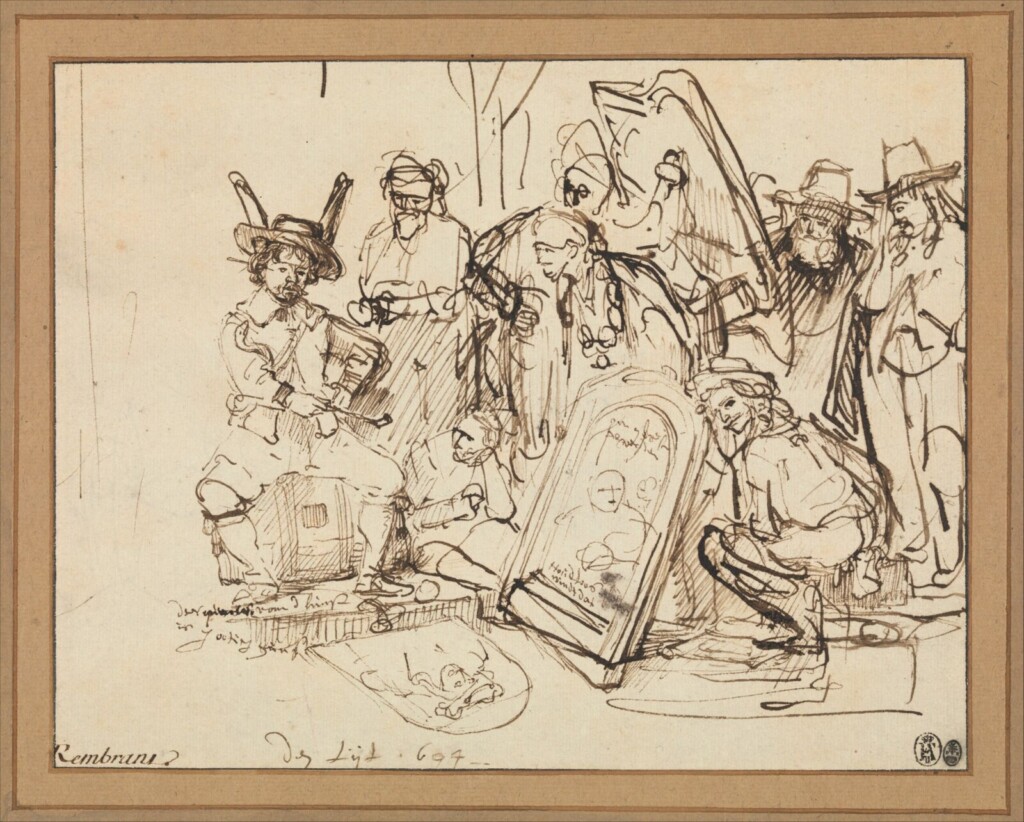
You are standing in a gallery on 57th Street, sometime in 1952, and the painting in front of you is enormous, aggressive, wet-looking, as though it arrived before the painter did. Someone nearby says the word “act” and you understand immediately that what you are looking at is not a finished object but a record of a man’s struggle against something — against himself, against painting, against the very idea of making a picture. You feel the authority of that word settle over the canvas like a verdict.
Harold Rosenberg published “The American Action Painters” in ARTnews in December 1952, and what he produced was not strictly criticism — it was mythology in journalistic form. His central proposition, that the canvas had become “an arena in which to act,” transformed the physical evidence of painting into a philosophical event, a biographical crisis frozen at the moment of its resolution. This was seductive precisely because it moved the grounds of judgment away from the object and toward the gesture, away from what could be seen and toward what could be narrated. Rosenberg was a man who understood that in modern culture, the story about the work often travels faster, and further, than the work itself.
The difficulty is that this narrative of heroic rupture — the solitary artist annihilating inherited form in the privacy of a downtown studio — required an audience to witness the annihilation. And an audience, once assembled, brings with it the entire apparatus of taste, value, and acquisition. Leo Castelli opened his gallery on East 77th Street in 1957, and within a decade the transgressive energy that critics had coded as anti-institutional had become the primary engine driving one of the most efficient art markets in history. The rebellion had not failed; it had been purchased. Jackson Pollock’s drip paintings, which once seemed to many observers like a deliberate assault on everything a painting was supposed to be, were fetching prices that confirmed their place inside the very hierarchy they appeared to reject.
Pierre Bourdieu, writing in The Rules of Art in 1992, identified this dynamic with uncomfortable precision: the field of cultural production generates its own economy of distinction, in which the posture of refusal — the avant-garde’s defining gesture — accumulates symbolic capital that converts, with remarkable efficiency, into economic capital. The artist who claims to stand outside the system is already performing a role the system has scripted. What looks like resistance is often a form of product differentiation, and the critic who narrates that resistance is the copywriter working for a brand that does not acknowledge it is a brand.
What makes this more than a cynical observation is the sincerity involved. Rosenberg was not a fraud. The painters he wrote about were not cynics. Franz Kline mixed house paint with commercial black and worked on newspaper pages because he was poor and committed, not because he was developing a marketable aesthetic. The tragedy — if that word applies — is structural rather than personal. The institutional machinery does not require bad faith to function; it requires only that the vocabulary of transgression remain available for circulation, and that critics keep producing fresh versions of the heroic story. Every generation of art writing since 1952 has needed its own rupture, its own moment when everything before was declared finished and something genuinely new was said to have arrived, usually in New York, usually in a building that charged admission.
The avant-garde, understood historically, is less a series of aesthetic revolutions than a recurring narrative format — one that the gallery system, the auction house, and eventually the museum learned to anticipate, to schedule, and to monetize. By the time a movement acquires a name, it has already been processed by the institutions that name it, which means the critical act of naming is also an act of capture, however unintentional, however passionate the critic who holds the pen.
European Genealogies and Their American Discontents
You are standing in a gallery in 1969, and the wall text beside the painting is longer than anything the painter ever wrote. It quotes Frankfurt, it invokes dialectics, it uses the word “negation” three times in four sentences, and it tells you nothing about why you cannot look away from the canvas. The language arrived from Europe with all its urgency intact, crossed the Atlantic in the luggage of exiled intellectuals fleeing fascism, and was unpacked in seminar rooms where it gradually lost its relationship to any actual political danger.
Walter Benjamin wrote “The Work of Art in the Age of Mechanical Reproduction” in 1935, in exile, broke, watching European culture being conscripted into fascist spectacle. When he described the decay of aura — that singular, unrepeatable presence of an authentic object in a specific place and time — he was not offering museums a vocabulary for their acquisitions catalogues. He was describing a historical rupture that carried genuine stakes: the possibility that reproducibility could either democratize art or be weaponized by propaganda, and that the difference between those outcomes was a political question, not an aesthetic one. By the time American critics were deploying “aura” in the late 1960s and into the 1970s, the term had been laundered into a kind of melancholy connoisseurship, a way of making originality sound philosophically respectable rather than a mechanism for interrogating who controls the means of cultural production.
Theodor Adorno’s “Aesthetic Theory,” published posthumously in 1970 after years of revision, carried an even more stubborn resistance to assimilation. For Adorno, the value of genuine art lay precisely in its refusal — its refusal to be beautiful on demand, to be useful, to reconcile the contradictions of the society that produced it. The autonomous artwork, in his account, preserved the memory of suffering by refusing to make suffering palatable. This was not a theory designed for the catalogue of a retrospective at a major American institution with corporate sponsorship. It was a theory in which the museum itself, as a bourgeois institution that transforms everything it touches into property and prestige, was already part of the problem. American critical discourse absorbed the formal vocabulary of negative aesthetics while quietly evacuating the institutional critique that gave it its teeth.
The mechanism of this evacuation was not conspiracy but infrastructure. When scholars like Clement Greenberg built an influential critical language around formalism and autonomy through the 1940s and 1950s — his 1939 essay “Avant-Garde and Kitsch” remains the document that best illustrates the ambition — they were working within institutions that had specific material interests in separating aesthetic value from social analysis. The Museum of Modern Art, founded in 1929 and expanding its authority throughout the postwar decades, needed a critical language that could justify its collecting decisions as something other than the preferences of wealthy trustees. European theory, stripped of its revolutionary genealogy, provided exactly that: a discourse rigorous enough to sound objective, flexible enough to be applied to almost anything the institution already valued.
What younger critics encountered when they arrived in American universities during the 1960s was therefore a peculiar ghost: a critical tradition that still used the language of negation and historical materialism but had been decoupled from the political conditions that generated those concepts. The Frankfurt School had developed its thinking inside the experience of a specific catastrophe — the failure of the European left, the rise of authoritarian culture industries, the destruction of the very public sphere that enlightenment thought had imagined as the ground of rational debate. Transplanted into a context of postwar American institutional prosperity, those same concepts became tools for credentialing aesthetic judgments rather than instruments for understanding how culture participates in its own domination. The critique of the culture industry became, with a particular irony that Adorno would have recognized instantly, a product of the culture industry.
Feminist Interventions and the Gendered Gaze
You are standing in a museum — let’s say sometime in the early 1970s — and the plaques beside the paintings read like a roll call of a club you were never invited to join: Rembrandt, Velázquez, David, Courbet. You assume this is simply what greatness looks like. You assume the archive is neutral, that history selected these names the way gravity selects falling objects, through force alone, through the irresistible weight of quality. This assumption is not naive. It has been engineered.
In 1971, Linda Nochlin published “Why Have There Been No Great Women Artists?” in ARTnews, and the question itself was the argument. She refused to answer it on the terms in which it was posed, which meant refusing to go searching for overlooked female Leonardos hiding in attic collections. What she did instead was forensic: she examined the institutional conditions of artistic production — the exclusion of women from life-drawing classes, from guild apprenticeships, from the entire pedagogical infrastructure that transformed raw talent into recognized genius. The category of genius, she showed, was not a description of inner fire but a social permission slip, issued selectively, withheld systematically. The art world had not failed to notice great women artists. It had organized itself precisely to prevent them from existing in the form it would recognize.
What Nochlin opened, others had to deepen, because the danger with any institutional critique is that it gets absorbed as a plea for inclusion — more women in the museums, more women on the walls — without touching the epistemological architecture that built the museum in the first place. Griselda Pollock, particularly in “Vision and Difference” published in 1988 and in the co-authored “Old Mistresses: Women, Art and Ideology” from 1981, pushed the problem into more uncomfortable territory. She was not interested in recovering forgotten female artists so they could be slotted into the existing canon. She was interested in the canon as a symptom, as evidence of how looking itself had been gendered, how the entire apparatus of art history — its categories, its periodizations, its notion of what counts as significant subject matter — had been constructed from a position it never acknowledged as a position. The Impressionist city, for example, that celebrated world of modernity and flanerie, was available to male painters as a space of sovereign observation precisely because women’s access to that same urban space was chaperoned, constrained, and socially surveilled. Paintings that looked like celebrations of freedom were, looked at differently, maps of differential mobility.
This is where feminist art criticism became something more than a corrective. It became a methodological destabilization. John Berger had already suggested in “Ways of Seeing” in 1972 that the nude in Western painting encoded a relationship between an implied male spectator and a displayed female body — that the woman in the painting was aware of being watched, that her self-consciousness was part of the image’s structure. But Berger’s analysis, sharp as it was, remained somewhat structural, somewhat external to the machinery of criticism itself. What Pollock and her contemporaries pursued was the deeper claim: that the critic, the historian, the theorist who claimed to speak universally about aesthetic value was always already positioned, always already gendered, always already inside a set of investments he had the institutional luxury of calling objectivity.
The word “universal” had functioned in art criticism the way it functions in most disciplines that have shaped themselves around a particular subject — as a mask worn by the particular that has won enough power to stop explaining itself. When Clive Bell in 1914 argued for “significant form” as the criterion of aesthetic value, or when Clement Greenberg built his entire critical edifice on medium specificity and formal self-sufficiency, neither felt obliged to ask whose perceptual experience was being elevated to law, whose mode of attention was being treated as the transparent window onto art’s essential nature.
A vision curated by a filmmaker, not an algorithm
In this video I explain our vision
Postmodernism and the Collapse of Evaluative Criteria

You are standing in a gallery in lower Manhattan sometime in the late 1980s, reading a wall text beside a photograph of a photograph of a consumer product, and the label explains that the work “interrogates the simulacral logic of late-capitalist image production through a strategic appropriation of commodity fetishism.” You read it twice. You understand each individual word. And yet the sentence produces in you something close to the experience of hearing a foreign language spoken with perfect familiarity by everyone around you except yourself.
This was not an accident. The critical language that colonized the art world in the final two decades of the twentieth century was constructed, with considerable intellectual rigor, precisely to resist easy comprehension. Its architects were serious thinkers responding to a genuine epistemological crisis: the collapse of the modernist belief that art could be evaluated against stable, universal criteria of form, progress, and aesthetic value. What Clement Greenberg had built — a hierarchy ascending from kitsch to high art, governed by medium-specificity and the self-critical logic of painting — was not simply challenged. It was treated as a symptom of the very ideological structures that serious thought was obligated to dismantle.
Jean Baudrillard’s “Simulacra and Simulation,” published in French in 1981, gave critics a vocabulary for describing a cultural condition in which images no longer referred to any underlying reality but only to other images. The distinction between original and copy, which had organized aesthetic judgment since at least the Renaissance, simply evaporated. If Sherrie Levine photographed Walker Evans’s photographs of Depression-era sharecroppers and exhibited those photographs as her own work, the question “but is it good?” became not merely difficult to answer but logically incoherent — because the evaluative framework that would have generated the question had already been dissolved by the act itself. Criticism faced a strange recursion: it was being asked to judge work that had been made to render judgment impossible.
The journal October, founded in 1976 by Rosalind Krauss and Annette Michelson, became the primary institutional channel through which Derridean deconstruction entered anglophone art discourse. Derrida’s insistence in “Of Grammatology” — published a decade earlier, in 1967 — that meaning is never present but always deferred, always contaminated by the trace of what it excludes, translated into criticism as a permanent license to read any artwork against itself, to locate in it the suppressed contradictions that its surface appearance worked to conceal. This was intellectually powerful and genuinely destabilizing. It was also, by structural necessity, a mode of writing that required its reader to have already absorbed a specific theoretical canon before a single sentence could begin to signify.
What collapsed was not criticism itself but the possibility of a shared critical public. The nineteenth century had sustained art criticism as a form of public address — Baudelaire writing his Salon reviews for readers who attended the same exhibitions and argued about them in cafes. Even the more technical discourse of early formalism assumed an educated general reader willing to be challenged. October’s prose assumed a reader who had already read Lacan’s “Écrits,” already worked through the semiological tradition from Saussure to Barthes, already internalized the theoretical frameworks as preconditions rather than as arguments to be made. The distance between this critical language and the experience of standing in front of an actual artwork became not incidental but constitutive — the gap was where the intellectual work happened, or was supposed to happen.
What this produced, practically, was a bifurcation of the art world so severe that it created two entirely parallel systems of valuation operating simultaneously without meaningful contact. The market valued work through auction prices and collector status, entirely indifferent to theoretical legitimacy. The academy validated work through the density and sophistication of the discourse it could generate, entirely indifferent to any viewer who arrived without the correct theoretical preparation. An artist could be simultaneously worthless in one system and canonical in the other, and no critical apparatus existed any longer that was capable of adjudicating between them.
The Market as the Final Critic
You are standing in a white-walled room at Art Basel Miami Beach, December 2007, and the work in front of you is a spot painting — circular, mechanically repeated, industrially produced — and the price on the small card beside it is $1.4 million. You do not feel moved. You do not feel unmoved. You feel, with a clarity that surprises you, that the number itself has become the experience, that the aesthetic transaction has already occurred somewhere else, between other parties, and that your presence in this room is essentially ceremonial.
This is not a failure of taste. It is the logical endpoint of a transformation that began, with accelerating force, in the early 1980s, when the auction house stopped being a clearinghouse for estates and became a theater of cultural authority. In November 1987, Van Gogh’s Irises sold at Sotheby’s for $53.9 million, a world record that was covered not in arts pages but on front pages, with the same register of language used to report stock market surges. The category had shifted. Aesthetic value and financial value, which criticism had spent a century trying to hold in productive tension, collapsed into each other, and the collapse was reported as a triumph.
Charles Saatchi understood before most critics what this meant in practice. His systematic acquisition of young British artists in the late 1980s and early 1990s — purchasing work in bulk directly from degree shows, storing it, then exhibiting it under the galvanizing label of the 1997 Sensation exhibition at the Royal Academy — demonstrated that a single collector with sufficient capital could manufacture critical consensus faster than any journal. The reviews followed the money, not the other way around. Rosalind Krauss had argued in October magazine that criticism needed to resist the art market’s tendency to reduce objects to their exchangeability, but by the time Sensation opened, that argument felt like a letter written to a city that had already been evacuated.
What replaced critical authority was not ignorance but a different epistemology entirely. The economist Olav Velthuis, in his 2005 study Talking Prices, documented how gallerists and collectors had developed an elaborate symbolic language around pricing — one in which a high price did not merely reflect demand but actively produced meaning, signaling seriousness, historical weight, institutional staying power. The price tag had become hermeneutic. It told you how to look, how long to linger, what to feel entitled to not understand. Difficulty, once the domain of critical exegesis, was now monetized as a premium.
Art fairs accelerated the sensory logic of this shift in ways that were architectural before they were ideological. The fair format — hundreds of booths, thousands of works, a viewing experience calibrated to the rhythm of a trade show — made sustained looking not just impractical but socially awkward. You moved, you photographed, you noted. The work that stopped you was the work large enough or strange enough or expensive enough to interrupt the flow. Clement Greenberg had staked his entire critical project on the idea that quality revealed itself through sustained, educated, bodily attention. The fair made that attention structurally impossible, and nobody particularly mourned it.
The critics who survived this period did so largely by becoming participants in the system they might once have judged. They wrote catalogue essays for the collectors who bought the artists they championed. They sat on prize juries whose shortlists were already shaped by gallery representation and fair presence. Dave Hickey, one of the few voices willing to say this plainly, wrote in Air Guitar in 1997 that the art world had become a credentialing machine in which beauty had been replaced by virtue and virtue by market position — and was rewarded for the observation with a MacArthur Fellowship and subsequent irrelevance, which is perhaps the most precise symbol the period produced.
Digital Fragmentation and the Dissolution of Critical Voice
You open an art review on your phone while waiting for a coffee, scroll past the first two paragraphs because the image loads slowly, and by the time the barista calls your name you have already formed an opinion you will repeat at dinner as though it were your own.
This is not a failure of attention. It is the structural outcome of a system designed to produce exactly this: the sensation of having engaged with something without the cost of actual engagement. When Walter Benjamin wrote in 1936, in “The Work of Art in the Age of Mechanical Reproduction,” that technological reproduction strips the artwork of its aura, he could not have anticipated that the reproduction would eventually reproduce the critic as well — flattening the considered voice into a reaction, compressing months of looking into a paragraph optimized for shareability. The algorithmic logic of digital platforms does not reward depth; it rewards velocity and frictionlessness, which are the precise opposites of what serious critical thinking has always demanded.
The promise made in the early 2000s was democratization. Suddenly anyone could publish. Suddenly the gatekeepers — those editors at Artforum, those curators of critical taste who had controlled which voices reached the public — would be circumvented. What happened instead was not the disappearance of hierarchy but its multiplication into thousands of competing micro-hierarchies, each governed by follower counts, engagement metrics, and the invisible editorial hand of recommendation engines. Pierre Bourdieu had mapped the sociology of cultural distinction in 1979, showing how aesthetic judgment functions as a form of class reproduction; the digital era did not dismantle that mechanism, it merely privatized it, distributing the gatekeeping function across a decentralized network where the criteria for entry became visibility itself rather than expertise.
The consequences for art criticism specifically were structural, not merely stylistic. The long review — the kind Clement Greenberg could publish in Partisan Review, the kind that took three thousand words to work through a single painter’s formal problem — became economically unviable almost overnight. Digital advertising models monetize pageviews, and pageviews are generated by volume, not by the sustained argument that keeps a reader inside a text for twelve minutes. Publications that had existed for decades collapsed or gutted their critical sections between 2008 and 2015, a period when American newspaper art criticism lost an estimated two-thirds of its full-time staff positions. What remained was the hot take, the listicle, the aggregated opinion dressed as analysis.
Meanwhile a new figure emerged: the influencer-critic, whose authority derives not from a body of argued positions but from proximity to institutions, from attendance at openings, from the visual grammar of a well-curated feed. This figure is not dishonest — the performance is entirely transparent — but the form itself forecloses certain kinds of thinking. To hold an ambivalent position, to say that a celebrated artist is significant but also deeply compromised, to sustain a nuanced negative judgment over time, requires a stability of platform and a tolerance for friction that social media architecturally discourages. The cost of disagreement in an attention economy is the loss of the audience you disagree with, and so the system selects continuously for consensus dressed as discovery.
What this produces in the viewer is not ignorance but something more insidious: the feeling of being critically informed while the actual critical faculty atrophies from disuse. Theodor Adorno argued in “Minima Moralia” in 1951 that the culture industry manufactures not false consciousness but false autonomy — the sense of choosing freely within a set of options that have already been curated to foreclose genuine alternatives. The digital art world did not invent this condition, but it perfected the delivery mechanism, making the managed experience feel indistinguishable from the open one, until the discipline that once required a lifetime of looking to practice is offered, pre-assembled, in the time it takes to drink a coffee that has already gone cold.
🎨 Gazes That Transform: Art, Criticism, and Meaning
Art criticism does not merely describe works — it constructs entire worlds of meaning, shaping how culture sees itself across time. These articles explore the intellectual landscapes, philosophical frameworks, and key figures that made twentieth-century criticism one of the most dynamic arenas of thought.
Ernst Gombrich: Life and Works
Ernst Gombrich revolutionized the way we understand art history by shifting focus from stylistic periods to the psychology of visual perception. His magisterial ‘The Story of Art’ remains one of the most widely read introductions to art in the world. Understanding his thought is essential to grasping the empirical and humanist strand of twentieth-century art criticism.
GO TO THE SELECTION: Ernst Gombrich: Life and Works
Aby Warburg: Life and Works
Aby Warburg was one of the most singular and visionary minds in the history of art studies, developing a deeply original approach to the survival of classical antiquity in Renaissance imagery. His concept of ‘Pathosformeln’ — emotional formulas that migrate across time — opened entirely new pathways for visual cultural analysis. His unfinished ‘Mnemosyne Atlas’ remains a haunting monument to the idea that images carry memory across centuries.
GO TO THE SELECTION: Aby Warburg: Life and Works
Bernard Berenson: Life and Works
Bernard Berenson defined the role of the connoisseur in modern art criticism, blending aesthetic sensitivity with rigorous attribution methods that shaped the museum world for generations. His writings on Italian Renaissance painters established a critical vocabulary still in use today. His complex relationship between aesthetic judgment and the art market also raised enduring questions about the independence of critical thought.
GO TO THE SELECTION: Bernard Berenson: Life and Works
Erwin Panofsky: Life and Iconology
Erwin Panofsky elevated iconology into a systematic discipline, giving art critics a powerful tool to decode the layered meanings hidden within images beyond their surface appearance. His tripartite method — pre-iconographic, iconographic, and iconological analysis — became a cornerstone of twentieth-century art historical methodology. Panofsky’s work bridges the gap between formal criticism and the broader history of ideas.
GO TO THE SELECTION: Erwin Panofsky: Life and Iconology
Cinema That Sees What Others Cannot
If these reflections on art, vision, and critical thought have stirred your curiosity, Indiecinema offers a carefully curated streaming universe of independent and auteur films that challenge the eye and expand the mind. Discover works that embody the very spirit of artistic questioning explored in these pages — only on Indiecinema.
👉 EXPLORE THE CATALOG: Watch Indie Films in Streaming
A vision curated by a filmmaker, not an algorithm
In this video I explain our vision

