
The Eye That Prices the Soul
You stand in front of a painting — let us say something old, something Italian, something that has survived wars and plagues and the indifference of centuries — and for a moment you feel the particular vertigo that great art produces: the sensation of being simultaneously enlarged and diminished, of touching something that exceeds you. Your breath adjusts itself. The room goes quiet in a way that has nothing to do with sound. And then, almost immediately, something else enters the experience, something you did not invite and cannot quite name. You become aware that someone has already been here before you. Not in the physical sense. In the deeper sense: someone has already decided what this painting is worth. Not spiritually. Monetarily. And that prior judgment — that number, that attribution, that verdict delivered in a letter or a catalogue entry decades before you were born — is now inseparable from what you feel standing here. The transcendence has a price tag sewn into its lining. You just cannot see it.

This is the world Bernard Berenson built. Or more precisely: this is the world Berenson revealed to already exist, and then exploited with a precision that makes the word genius feel insufficient and the word ruthless feel too easy.
He arrived in America from Lithuania as a child, born Bernhard Valvrojenski in 1865 in Butrimonys, a shtetl that would have been invisible to every power that subsequently shaped his life. He arrived in Boston, transformed himself through sheer intellectual appetite, caught the attention of Isabella Stewart Gardner, and eventually made his way to Florence, where he settled at Villa I Tatti — a property that would become, over the following decades, one of the most significant private libraries and art collections in the world, bequeathed upon his death in 1959 to Harvard University as a research center that still bears his name. Between that Lithuanian village and that Florentine hill, he constructed an identity so complete, so armored in erudition and aesthetic authority, that the seams of the construction became almost impossible to find.
What Berenson understood — and this is the thing that separates him from the merely learned — is that the eye can be trained into an instrument of power. Not metaphorically. Actually. His method of connoisseurship, developed through obsessive immersion in the painting of the Italian Renaissance, was predicated on the idea that visual recognition could become as reliable as scientific measurement: that a brushstroke, a fingernail, the particular way a wrist turns in a Madonna, could be read like a signature more honest than any signature. He published his findings in a series of lists — the Lorenzo Lotto monograph in 1895, the Florentine Painters of the Renaissance in the same year, the Venetian Painters before that in 1894, and eventually the magisterial volumes of Italian Pictures of the Renaissance — that became the canonical reference points for every museum, every dealer, every collector in the Western world. An attribution from Berenson did not merely identify a painting. It created value. Measurable, bankable, legally consequential value.
The philosopher Nelson Goodman, writing in Languages of Art in 1968, argued that authenticity is not a secondary concern in aesthetics but constitutive of aesthetic experience itself — that knowing something is genuine changes what you see when you look at it. Berenson had understood this forty years before Goodman articulated it, and he had understood it not philosophically but commercially. He had understood that the man who controls attribution controls perception. And the man who controls perception controls the market. And the man who controls the market controls, in some profound and unsettling sense, what beauty means.
This is where the story begins. Not with innocence. Not with a young man simply in love with painting. With a young man who understood, very early, that love and power are rarely as separable as we prefer to believe.
Trench
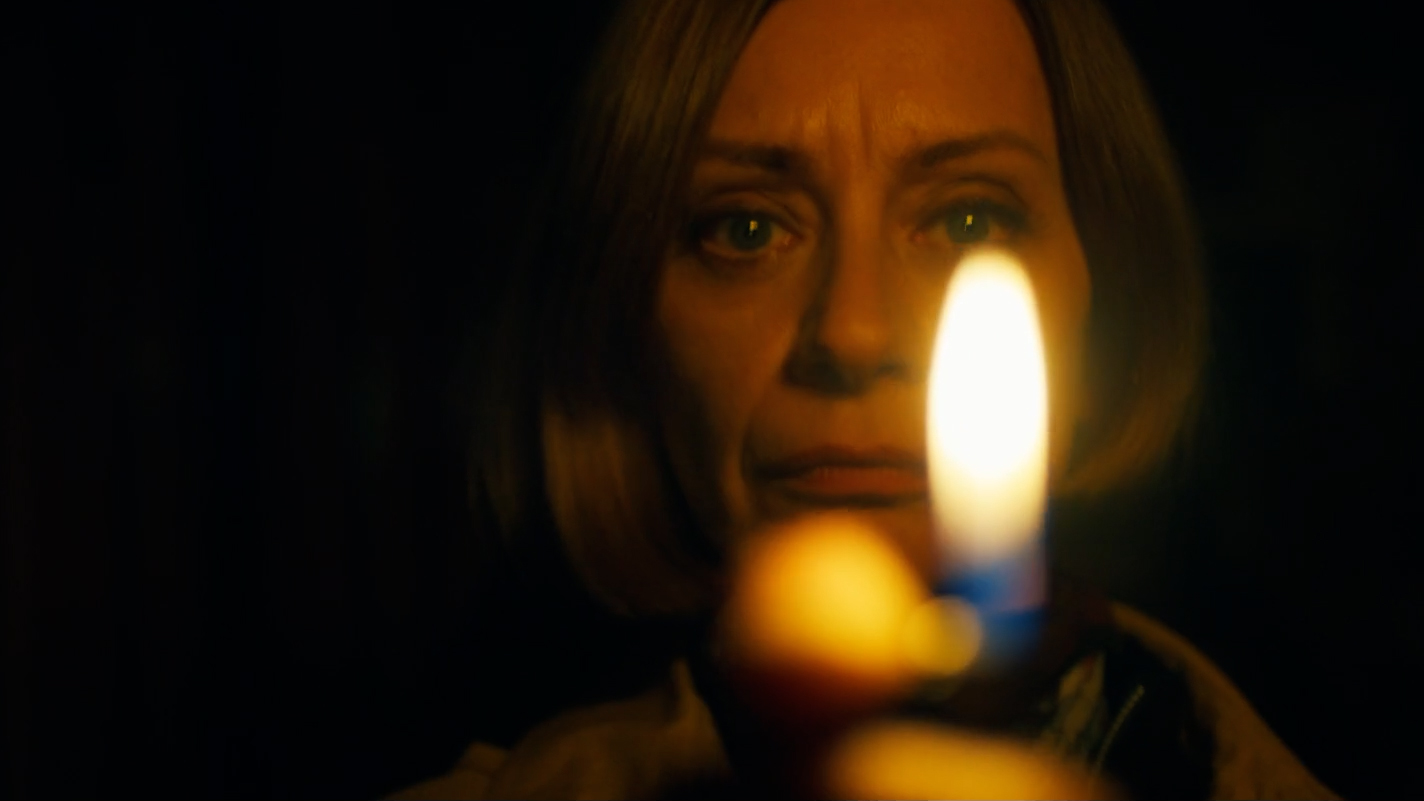
Thriller, Mystery, by Serge Turgeon, Italy, 2023.
In Venice, an art historian realizes that her brilliant mind will not be enough to solve the mystery surrounding the disappearance of an unknown woman. In addition to regaining trust in her intuition and her heart, she will need the help of a series of colorful characters from her community.
The idea behind Trench is to tell, through a detective story, the journey of an intellectual woman who suffered while growing up in a working-class district of Venice, where she never felt truly valued. In order to solve a mystery, she must face danger and rely on the help of the “non-intellectual” members of her community, rediscovering along the way her resourcefulness, her Venetian identity, and her true self.
LANGUAGE: Italian
SUBTITLES: English, Spanish, French, German, Portuguese
The Immigrant Who Invented Himself
There is a particular kind of exhaustion that comes not from work but from performance — the daily labor of being someone you decided to become rather than someone you simply are. You know it if you have ever walked into a room and felt the gap between the person you present and the person who walked out of whatever life preceded you. Berenson knew that gap intimately, and he spent decades papering it over with languages, with taste, with an almost surgical reinvention of the self.
He was born Bernhard Valvrojenski in 1865, in Butrimonys, a small Jewish settlement in what was then the Russian Empire, that flat and provincial world of Yiddish and poverty and the particular claustrophobia of a minority existence under a hostile state. When his family emigrated to Boston in 1875, he was ten years old. The name changed. The trajectory changed. What did not change — what never changes — was the memory of the first world, even when that memory is most fiercely suppressed.
America in the 1870s and 1880s was not the pluralist fantasy it occasionally pretended to be. It was a society that tolerated newcomers on a very specific condition: that they disappear into it. The sociologist Erving Goffman, writing in Stigma in 1963, described what he called “passing” — the social performance by which a person with a discreditable identity manages information about themselves so thoroughly that the stigma becomes invisible. Goffman’s insight was clinical, but the reality it described was visceral. Passing is not freedom. It is another form of captivity, more elegant and more exhausting than the original.
Bernhard Valvrojenski became Bernard Berenson. The consonants softened, the surname dissolved into something vaguely Northern European, something that would not announce itself as a problem in a Boston drawing room. He enrolled at Boston University and then, through a combination of brilliance and strategic charm, made his way to Harvard, where he came under the influence of Charles Eliot Norton, who was building American aesthetic culture from the top down, deciding what refined people ought to value and who could legitimately speak about it. Berenson understood instinctively that the gatekeepers of taste were also the gatekeepers of identity, and that to master the former was to purchase the latter.
What he was doing was not unusual. It was, in fact, the condition of modernity for millions. The historian Werner Sollors, in Beyond Ethnicity published in 1986, argued that American identity has always been structured around the tension between “consent” and “descent” — between who you choose to become and who you were born as. The American promise was that consent could override descent entirely. The American reality was that descent never quite disappeared; it simply became the thing you carried in silence, the weight that gave your ambitions their particular driven quality.
Berenson converted to Christianity, first Episcopalian and then, in adulthood, Catholic. He later tried to minimize the Jewish origins he had so deliberately obscured, and the tragedy in this is not personal weakness but structural logic. He was doing what the culture demanded. The door to the world of Ruskin, of Pater, of the grand European tradition of aesthetic contemplation, had a very specific shape, and you had to make yourself fit it or stand outside. He chose to fit it. He chose so completely, so artfully, that for decades the choice was nearly invisible.
But the seams, as they always do, showed in unexpected places. In the sharpness of his need to be recognized. In the ferocity of his self-promotion. In the particular anxiety of a man who has built his entire life on a foundation he cannot acknowledge, who must therefore build higher and higher, ensuring that no one ever has reason to look down.

Harvard, Pater, and the Religion of Seeing
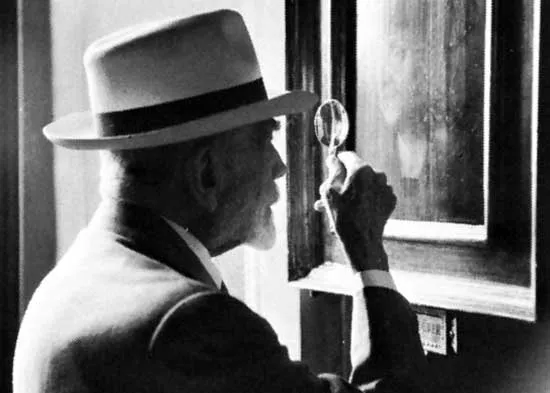
There is a particular kind of young man who arrives at a great university already half-convinced that the world owes him a revelation. Berenson was that man. He entered Harvard in 1884 carrying with him the residual hunger of a Jewish immigrant household in Boston — the specific gravity of a family that had traded one world for another and had not yet found what the new one was for. Harvard did not disappoint him, but it transformed the question. What he found there was not certainty. He found something more dangerous: a method of longing.
Charles Eliot Norton was already a figure of enormous prestige when Berenson sat in his lectures on the fine arts, the first systematic instruction in art history that Harvard had ever offered. Norton had absorbed Ruskin, had traveled the sites, had developed the peculiar New England conviction that aesthetic experience was a form of moral seriousness. But it was not Norton who cracked Berenson open. It was a book Norton pointed him toward, a book that had been quietly scandalizing English intellectual life since 1873. Walter Pater’s “The Renaissance: Studies in Art and Poetry” arrived in Berenson’s hands like a diagnosis he had been waiting for without knowing he was ill.
Pater’s argument — if argument is even the right word for something so deliberately sensuous — was that the highest purpose of human existence was to maintain a state of perpetual, trembling receptivity to experience. Not to judge experience morally. Not to extract lessons from it. But to burn, as he wrote in the book’s famous Conclusion, with a hard gem-like flame. To feel more, to feel more finely, to let the impression of a painted face or a carved torso register in the body as fully as any physical sensation. This was, in 1884, a genuinely subversive proposition for a young man raised in a tradition where the sacred and the sensory had been carefully separated, where beauty could be acknowledged but never worshipped. Pater gave Berenson philosophical permission to worship.
What he was being given permission to do, understood properly, was to construct a substitute theology. The historian George Santayana, who was at Harvard during precisely these years, later described the American intellectual atmosphere of the 1880s as one in which Protestant faith had hollowed out but the appetite for transcendence remained enormous, unhoused, looking for objects. Berenson’s entire subsequent career can be read as the most elaborate possible answer to that homelessness. If God could no longer organize the experience of the sacred, then Giotto could. If revelation was unavailable, then the precise sensation of a Florentine brushstroke on prepared panel — what Berenson would later theorize as “tactile values,” the feeling of three-dimensional solidity conjured by line and shadow — could stand in its place.
This is not metaphor. Berenson meant it physiologically. His theory of aesthetic response, developed in the essays he would begin publishing in the 1890s, insisted that great painting activated the same neural pathways as actual touch. To look at a figure by Masaccio was, in some measurable sense, to feel the weight of a real body. The experience was somatic before it was intellectual. You felt it in your hands before you could name it with your mind. This was Pater translated into something almost neurological, decades before neuroscience had the vocabulary to confirm what Berenson was intuiting.
Walking through the Fogg Museum as a student, pausing in front of a reproduction, feeling something he could not yet name settle into his chest like a physical certainty — this was where connoisseurship was born in him. Not as a discipline. As a need. The need to locate, in the visible and the tangible, something that would hold the weight that faith had once carried and could no longer support. He was twenty years old and already building a church out of looking.
The Methodology of the Trembling Nerve
You stand before a Florentine panel painting, perhaps two feet wide, and something happens before you can name it. Not thought, not recognition — something more immediate, more physical. Your hand wants to move. Your fingers curve slightly, as if the painted drapery folds had weight, as if the muscular tension in a forearm reaching across the composition could be transferred through the retina to your own tendons. You did not decide to feel this. It arrived.
This is precisely what Berenson spent a decade trying to explain, and the explanation turned out to be more radical than the phenomenon itself. He called it tactile values — the capacity of certain painters, above all the Florentines, to stimulate the viewer’s sense of touch through purely visual means. A painted form, when it achieved this quality, did not merely represent a body occupying space. It communicated the felt reality of mass, resistance, weight, presence. The nervous system was activated before the intellect had formed a single sentence about what it was seeing. Berenson called the result life-enhancement, a phrase that sounds almost embarrassingly optimistic until you realize he meant something almost physiological by it: the organism, confronted with this particular quality of representation, registers an increase in its own sense of being alive.
The intellectual source for this was sitting in a Harvard lecture hall in the late 1880s, when William James was reformulating the entire Western understanding of consciousness. James’s insistence, fully elaborated in The Principles of Psychology published in 1890, that emotion was not the cause of bodily response but its consequence — that you do not tremble because you are afraid, but rather that the trembling is the fear — gave Berenson a philosophical skeleton onto which he could hang his aesthetic observations. If subjective experience was always already embodied, then a painting that addressed the body directly was not producing mere decoration or mere pleasure. It was intervening at the most fundamental level of lived experience. Berenson absorbed this and pushed it somewhere James had not ventured: into the darkness of the museum, in front of objects most people in 1895 barely knew how to name.
But the other current running beneath Berenson’s methodology came from somewhere considerably stranger. Giovanni Morelli, the Italian physician and art critic, had proposed in the 1870s and 1880s a technique of attribution that scandalized and fascinated in equal measure. Ignore the grand gestures, Morelli said. Ignore the heroic compositions, the famous signatures, the institutional attributions that had accumulated over centuries like barnacles on a ship’s hull. Look instead at the ear. Look at how the artist renders a thumbnail, the lobe of the ear, the twist of a nostril. These minor elements, precisely because they are minor, fall beneath the threshold of conscious imitation. They are, Morelli argued, involuntary — traces of a hand acting from habit rather than intention, signatures more reliable than signatures.
Sigmund Freud, who encountered Morelli’s writings around the same period and acknowledged them directly in a 1914 essay, recognized immediately that Morelli had invented a method of reading the unconscious before the concept of the unconscious had been codified. The small, the marginal, the unremarked: these were the places where the truth leaked out. Berenson made this method his own instrument, carrying it through the storerooms and sacristies of Italy with a physical intensity that contemporaries found unsettling. He would hold a photograph at strange angles, press his face close to a painted surface, linger at the periphery of a composition while other visitors were admiring the center. The method was ostensibly scientific, systematic, cool. And yet there was nothing cool about the way he practiced it. The attention he brought to a painted hand, to the particular softness of a painted earlobe, carried an intimacy that exceeded scholarship — something closer to the attention one pays to the body of someone whose reality you need to verify through touch, again and again, as if looking alone could never quite be enough.
The Dealer’s Shadow: Joseph Duveen and the Corruption of the Eye
There is a moment when you realize that the most authoritative voice in the room has a financial interest in what it is telling you. Not a vague interest, not a philosophical alignment, but a direct, contractual, percentage-based stake in your belief. The realization does not come as a shout. It comes as a quiet shift in the floor beneath you.
For decades, Bernard Berenson occupied the position of the incorruptible eye. His attributions were not opinions. They were verdicts. When he looked at a panel painting and declared it Giorgione, or Lotto, or Filippino Lippi, the market moved. Collectors stopped breathing. Prices doubled, tripled, reached figures that would have seemed fantastical to the painters themselves. And behind nearly all of it, invisible to the buyers and invisible to the public record for many years, stood Joseph Duveen.
Duveen was not a scholar. He was something more powerful: a man who understood that Americans with industrial fortunes and social ambitions needed European art the way they needed surnames with history. He supplied both, essentially. What he could not supply himself was legitimacy of a specific kind — the legitimacy that only comes from a man who seems to want nothing, who appears to stand outside the transaction entirely, who speaks in the cadences of pure aesthetic experience. For that, he needed Berenson. And Berenson, whose villa I Tatti required constant maintenance, whose library demanded perpetual expansion, whose life had been constructed on a scale that a scholar’s income could not sustain, needed Duveen’s percentages.
The arrangement, formalized and adjusted across several decades from the 1890s through the 1930s, gave Berenson a cut of sales on works he authenticated — figures that in peak years reached twenty-five percent of transactions that moved millions of dollars through Duveen Brothers’ hands. The Mellon collection, the Frick collection, the Morgan acquisitions: the redirection of American industrial capital into Renaissance painting passed through this agreement like water through a hidden channel. What the buyers purchased was not merely an object. They purchased Berenson’s sentence about the object. That sentence, which sounded like the disinterested utterance of a man devoted to truth alone, was in fact remunerated speech.
Hannah Arendt wrote, in a different context but with a precision that applies here with uncomfortable exactness, about the way that fabrication corrupts not only the fabricator but the very standards by which fabrication might be detected. When the person who sets the criteria of judgment is the same person who benefits from a particular judgment’s outcome, the corruption is not merely ethical. It is epistemological. You no longer have a distorted measurement. You have a distorted measuring instrument, one that cannot diagnose its own distortion.
Berenson knew this. The correspondence that emerged after his death, and the investigations that followed the 1929 Hahn lawsuit — in which a collector challenged a Duveen attribution of a Leonardo and Berenson’s involvement became partially visible — suggests a man who was not unconscious of the contradiction he embodied. He was not a simple fraud. He was something more interesting and more troubling: a man of genuine gifts who allowed those gifts to become collateral in a commercial arrangement, and who then spent enormous intellectual energy constructing a self-image in which the gifts remained pure even as their outputs were being sold.
The language of connoisseurship, with its insistence on the autonomy of the trained eye, its almost mystical claim to unmediated contact with quality, was precisely the language that made the corruption possible. You cannot audit a visceral response. You cannot cross-examine a tactile memory. Berenson had built an epistemology that was, structurally, immune to accountability. And Duveen had recognized this long before Berenson recognized it about himself.
A vision curated by a filmmaker, not an algorithm
In this video I explain our vision
Villa I Tatti and the Architecture of a Legend

The gravel crunches under your feet before you even reach the door, and something in you adjusts — posture, pace, the angle of your chin. That is what the place was designed to do. Not to welcome you, exactly, but to recalibrate you, to remind you that you have entered a space where certain standards of being apply, where the casual and the provisional have been architecturally excluded. The cypresses stand at intervals that feel inevitable, as though nature itself had agreed to observe proportion. The view across the Fiesole hills arrives at precisely the moment the path turns, calculated to stun before you have collected yourself. Nothing at I Tatti happened by accident, which is another way of saying that everything there was a form of argument.
Bernard Berenson acquired the lease on the villa at Settignano in 1900 and spent the following decades transforming it into something that occupied an uneasy middle ground between private residence and secular temple. The library grew to roughly fifty thousand volumes, organized with the obsessive logic of a man who needed knowledge to be not merely accessible but visibly total, a wall of evidence against ignorance and against the particular ignorance that had threatened to define him. The gardens, redesigned with the architect Cecil Pinsent beginning around 1909, imposed a Renaissance geometry on the Tuscan hillside — box hedges, stone paths, limonaia, water features placed with the confidence of someone who had decided once and for all what beauty was and would not revisit the question. Pierre Bourdieu, writing in Distinction in 1979, described how cultural taste functions as a mechanism of class reproduction, how the aesthetic preferences of any given group work simultaneously as genuine preferences and as instruments of social boundary-marking. I Tatti was Bourdieu’s thesis made habitable, made fragrant with wisteria and old paper.
The social world Berenson curated there was as deliberate as the planting scheme. Edith Wharton came. Henry James came, before the friendship cooled. Scholars, collectors, diplomats, and the kind of aristocrat who understood that genuine cultural authority could confer legitimacy that mere title could not. Berenson presided over this circulation with the manner of someone entirely at ease — the long walks during which he delivered his judgments on art and life with the unhurried certainty of a man who had always known these things, who had never sweated over attribution tables or lain awake calculating whether his opinions would survive the next decade of scholarship. The performance was extraordinary. What makes it almost unbearable to look at directly is how necessary it was.
He had arrived from Butrimonys in Lithuania as Bernhard Valvrojenski, a Jewish immigrant child carried to Boston in 1875 among hundreds of thousands making the same crossing for the same reasons. The name was anglicized. The identity was reconstructed. Erik Erikson, whose 1950 work Childhood and Society mapped the psychological architecture of identity formation, understood that the self built under conditions of displacement is never simply a self — it is a project, a perpetual negotiation between what one was and what one has decided to become, haunted by the awareness that the decision itself could be unmade. Berenson never stopped building I Tatti because he never stopped building Berenson. The library was not just a collection. It was fortification. The garden was not just beautiful. It was proof.
What the villa could not quite conceal, to anyone paying the right kind of attention, was the precise nature of the energy animating it. There is a difference between inhabiting a space and occupying it, between living inside beauty and stationing yourself within it as though guarding against something that might still arrive. The fifty thousand books faced outward.
The Woman Who Held the Pen: Mary and the Invisible Collaboration
There is a photograph of them working together at I Tatti, both bent over papers at the same table, and if you cover the caption you cannot immediately tell which one is the scholar and which one is the assistant. This is not an accident of posture. It is the visual residue of an arrangement so thoroughly normalized by the culture that surrounded them that neither participant could have named it cleanly, and perhaps neither fully tried.
Mary Costelloe arrived in Berenson’s life not as an admirer but as an intellectual equal who had already demonstrated the capacity for the kind of precise, sustained looking that his method required. She had read Pater, worked through the same Florentine rooms, developed her own eye. When the early essays that would become the Florentine Painters of the Renaissance and the Venetian Painters took shape in the 1890s, Mary was not merely transcribing or editing. Recent scholarship, including Rachel Cohen‘s granular account and the archival work built around the correspondence preserved at Harvard’s Villa I Tatti, has made increasingly visible what was once diffuse: that passages, arguments, and organizational frameworks attributed entirely to Berenson carry Mary’s fingerprints in the drafts. Her letters describe contributing to the lists, working through attributions, shaping the prose. His letters to her during the same period read sometimes like progress reports to a collaborator, not notes to a companion waiting at home.
The philosopher Miranda Fricker, in her work on epistemic injustice published in 2007, describes a specific mechanism she calls testimonial injustice, the deflation of a speaker’s credibility based on identity prejudice. But what happened with Mary is something adjacent and perhaps more insidious: not that her testimony was doubted, but that it was absorbed. Her voice did not fail to be believed. It simply ceased to be marked as hers. The singular genius requires, structurally, that the labor flowing into it become anonymous at the point of contact. Not stolen in the dramatic sense, because drama would require acknowledged ownership first.
You know this dynamic without needing to look it up in a book. You have been in a room where someone repeated your idea three minutes after you said it and was congratulated for it. The repetition was not cynical. It was almost unconscious. That is precisely what makes the mechanism durable.
Berenson’s name went on the covers because the publishing and collecting world of the late nineteenth century was organized around individual masculine authority. The connoisseur had to be a figure, singular and legible, someone whose taste could be trusted like a brand. Mary understood this architecture well enough to have written about it, privately, with a bitterness that sharpens as the decades in the correspondence progress. She was not naive about what was happening. She was simply not in a position to refuse the arrangement without losing the entire intellectual life it afforded her, which included access to the collections, the travel, the libraries, the sustained engagement with objects she loved. The price of admission was the cover page.
The historian Londa Schiebinger, in her work on the gendered structures of scientific knowledge, traced how invisibility of this kind compounds across generations: when the attributed figure becomes canonical, the unattributed labor becomes doubly erased, once in the original moment and once again in every subsequent account that accepts the original attribution as settled fact. The Berenson who trained a century of American taste, whose methods shaped institutional collecting from the Gardner to the Frick, is already a simplified figure. The further simplification that removed Mary from the equation did not happen against the grain of how intellectual history is written. It happened exactly according to it.
What the photograph at I Tatti holds, then, is not sentiment. It is evidence of a structure so ordinary it required a century to become visible, and may require another before anyone stops calling it an exception.
What Remains When the Eye Goes Blind
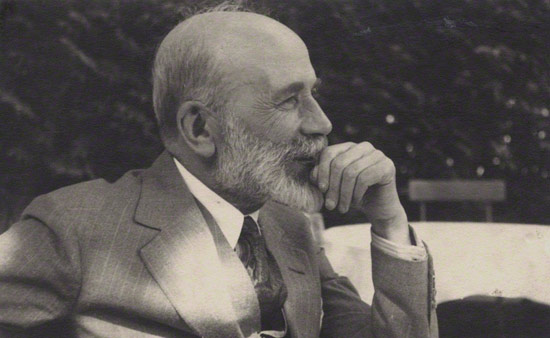
The last years at I Tatti were years of a particular kind of silence. Not the silence of withdrawal or defeat, but the silence of a man who had spent eight decades training his eyes and now had to learn what remained when the light began to fail. He was old, hidden, and the world outside the villa’s walls had chosen ugliness as its official aesthetic — the squared jaw of Fascist architecture, the choreographed torchlight, the aestheticization of mass murder that Walter Benjamin had already diagnosed in 1936 as the logical endpoint of a civilization that had confused beauty with power. Benjamin wrote that Fascism renders politics aesthetic while Communism responds by politicizing art. Berenson had spent his life in the first half of that sentence without knowing it, and now the second half was burning Europe to the ground around him.
During the war years, sheltered by the Florentine aristocracy while his name appeared on lists that ended in transport and ash, he continued to write. There is something almost unbearable about this image — a Jewish man born in the Lithuanian Pale of Settlement, who had reconstructed himself so completely as an arbiter of Renaissance refinement that he had nearly erased his own origins, now discovering that those origins were precisely what the century intended to destroy. The erasure had not worked. It never does. Identity is not a coat you remove at the door of a greater civilization. He had believed, with the faith of the convert, that immersion in beauty constituted a kind of transcendence. The century responded by demonstrating that transcendence is not a shelter.
And yet he wrote. Aesthetics and History appeared in 1948, three years after the camps were liberated, an act of extraordinary stubbornness or extraordinary faith — it is impossible to say which. The book argues that art is not merely decoration or historical document but a form of life-enhancement, a concept he had carried from his earliest work and refused to abandon even as the evidence against it accumulated like rubble. Then came The Arch of Constantine in 1954, a meditation on late antique art, on decline, on what happens to form when the animating energy of a civilization begins to withdraw. He was approaching ninety. He was writing about endings with the precision of a man who had always understood that the eye, trained to see, eventually turns inward.
The philosopher Hans-Georg Gadamer argued that aesthetic experience is not a subjective retreat from the world but an encounter with truth — that beauty, properly perceived, makes a claim on us. Berenson had staked his entire existence on something structurally similar. But the question that his life leaves open, the question that does not resolve simply because a man survived and continued to think, is whether the refinement of perception constitutes an ethical act or merely an ethical alibi. He saw truly. Few people in the twentieth century saw Renaissance painting with greater clarity, greater rigor, greater earned authority. And yet the world in which he exercised that vision was also a world of dispossession, manipulation, and the quiet cruelties of class and exclusion to which his trained eye remained, at times, conveniently blind.
To see beauty is not automatically to become good. This is the oldest trap of the aesthetic life, and Berenson walked into it with his eyes open, which is perhaps the most honest thing that can be said about him. He did not pretend that looking was innocent. He simply believed, until the very end, that it was necessary — that a civilization which stopped training its eyes to perceive the difference between the genuine and the false would eventually lose the capacity to make that distinction anywhere, in art, in politics, in the face of another human being asking to be seen.
🎨 Art, Vision, and the Aesthetics of Form
Bernard Berenson, the legendary art historian and connoisseur, spent his life developing a refined theory of visual perception, aesthetic response, and the cultural transmission of artistic values. These related articles explore the broader intellectual landscape in which his thought was rooted — from the philosophy of artistic form to the lives of critics, painters, and thinkers who shaped the Western gaze.
Erwin Panofsky: Life and Iconology
Erwin Panofsky developed iconology as a rigorous method for interpreting the layers of meaning embedded in visual art, moving beyond surface description to reveal symbolic and cultural significance. Like Berenson, Panofsky believed that understanding art required deep historical and philosophical knowledge. His work transformed art history into a humanistic discipline of extraordinary analytical depth.
GO TO THE SELECTION: Erwin Panofsky: Life and Iconology
Alois Riegl: Life and Theory of Conservation
Alois Riegl was one of the founding figures of modern art history, pioneering the concept of Kunstwollen — the collective artistic will that drives stylistic change across epochs. His theoretical approach to the formal qualities of art anticipates many of the concerns Berenson would develop in his own connoisseurship practice. Together, Riegl and Berenson represent the golden age of systematic aesthetic inquiry.
GO TO THE SELECTION: Alois Riegl: Life and Theory of Conservation
Pierre Bourdieu and the Artistic Field
Pierre Bourdieu‘s sociology of the artistic field reveals how taste, cultural capital, and institutional power shape what is recognized as great art and who gets to define it. Berenson himself operated at the intersection of aesthetic judgment and market influence, making Bourdieu’s framework an illuminating lens through which to reconsider his legacy. This article traces the social dynamics that underlie even the most seemingly pure acts of connoisseurship.
GO TO THE SELECTION: Pierre Bourdieu and the Artistic Field
Titian: Life and Works
Titian stands as one of the supreme masters of Venetian painting, a tradition that Berenson studied with particular passion and to which he devoted some of his most celebrated critical writing. Understanding Titian’s use of color, form, and sensory richness is essential to grasping the aesthetic principles Berenson sought to codify. This article offers a comprehensive portrait of the painter whose work embodies so much of what Berenson found most alive in Italian art.
GO TO THE SELECTION: Titian: Life and Works
Discover Art and Vision Through Independent Cinema
If the life and thought of Bernard Berenson have stirred your curiosity about beauty, perception, and the hidden languages of art, Indiecinema offers a curated selection of independent and documentary films that explore these very questions through the power of moving images. Step beyond the mainstream and discover cinema that sees the world with the same depth and wonder that Berenson brought to painting.
👉 EXPLORE THE CATALOG: Watch Indie Films in Streaming
A vision curated by a filmmaker, not an algorithm
In this video I explain our vision

