
The Architecture of Ambition in the Late Republic
You are standing in the Forum on a morning in 70 BCE, surrounded by marble that still smells of ambition, and you already know something is wrong. The republic functions the way a body functions after the brain has stopped sending clean signals — the limbs move, the speeches are made, the votes are cast, but the coherence is gone. Two men, Pompey and Crassus, have just shared a consulship that was less a governance than a performance of governance, a theater piece staged for a crowd that had forgotten what the original play was about.

The Roman Republic of the late first century BCE was not collapsing in the dramatic sense that later historians, seduced by narrative tidiness, would have us believe. It was dissolving, which is slower and more interesting. The sociologist Max Weber, writing in “Economy and Society” in 1922, distinguished between the legitimacy of traditional authority and the legitimacy of charismatic authority, and what the Republic was experiencing was the catastrophic gap between the two — the old senatorial tradition had lost its ability to compel obedience not because it had been defeated militarily, but because it could no longer produce outcomes. A system earns its legitimacy through what it delivers. By the time the Sullan constitution was being quietly dismantled, the Senate could not deliver security, could not deliver land to veterans, could not manage the grain supply for a city of perhaps one million people who needed to eat every day. Cicero could make the most magnificent speeches in the history of Latin rhetoric and the price of bread would still spike in August.
The political fragmentation was structural before it was personal. The lex Hortensia of 287 BCE had made plebiscites binding on all Romans, theoretically democratizing legislation, but in practice it created a permanent tension between popular assemblies and senatorial prerogative that nobody had ever honestly resolved. By Caesar’s era, that tension had metastasized. The tribunate, once a protective office, had become a weapon available to whoever was bold enough to seize it — as Tiberius Gracchus demonstrated in 133 BCE when he bypassed the Senate entirely to pass land reform, and paid for the audacity with his skull. The institution had already shown everyone exactly how naked power worked. What it needed now was someone willing to go further without flinching.
The historian Ronald Syme, in “The Roman Revolution” published in 1939, argued with cold precision that what happened in Rome was not the rise of one exceptional man but the replacement of one oligarchy by another, a circulation of elites disguised as revolution. This is accurate and also insufficient, because it does not account for the psychological ecology that made certain individuals more legible to their moment than others. Vacuum is not passive. A political vacuum actively selects — it rewards specific traits, specific tolerances for risk, specific relationships to the idea of rule itself. A man who cannot imagine himself as the center of things is invisible to the vacancy. A man who can imagine nothing else becomes the only available answer to a question the institutions are too exhausted to answer themselves.
Caesar’s family, the gens Julia, claimed descent from Venus through Aeneas — a genealogical fiction so obviously useful that its very audacity was part of the point. He was born in 100 BCE into a patrician family of middling actual influence, which meant he inherited a name worth something and an estate worth considerably less. This combination, prestige without sufficient material power to sustain it, is one of the most reliably dangerous conditions a society can produce. It creates men who must perform at the absolute edge of their capacity simply to maintain what they were told they already possessed, men for whom ambition is not a choice but a structural inheritance imposed at birth by the gap between what the name promises and what the purse contains.
Bloodline, Debt, and the Myth of Noble Origin
You are standing at the edge of a Roman funeral, circa 69 BCE, watching a young magistrate do something no one in the crowd quite expected. The man is in his early thirties, recently returned from provincial obscurity, and he is delivering the eulogy for his aunt Julia — widow of the general Marius, whose name had spent a decade being systematically erased from public memory by the Sullan establishment. The nephew does not lower his voice. He does not soften the name. He lifts a wax portrait mask of Marius before the assembled crowd and holds it there, in full daylight, as if daring Rome to look away. The crowd does not look away. Neither does history.
What that gesture accomplished had nothing to do with grief and everything to do with architecture — the construction of a political self from materials that were, by any honest measure, dangerously thin. Gaius Julius Caesar was aristocratic in name and nearly bankrupt in fact. The Julian gens was ancient, technically patrician, and utterly without contemporary influence. His father had died when Caesar was fifteen, leaving no military legacy worth invoking, no network of clients powerful enough to translate into electoral muscle. The family’s Subura neighborhood was not the address of Roman power. It was the address of managed decline. What Caesar possessed instead of money or connections was a story — and he understood, with the instinct of someone who had been studying the room since childhood, that in Rome a sufficiently ancient story could function as currency.
The claimed descent from Venus through Aeneas and then through Iulus was not unique to the Julii, but Caesar’s deployment of it was. Genealogical myth was standard aristocratic technology in the late Republic — what the anthropologist Clifford Geertz would later describe, in a different context, as the “theater of power,” the performance by which authority naturalizes itself as something other than performance. Roman noble families commissioned poets, manipulated priestly records, and inserted divine ancestors into their lineage the way a merchant inserts receipts into an account book, retroactively balancing figures that had never quite added up. The difference was that most families deploying this technology already had the legions, the grain contracts, the urban coalitions to make the mythology feel redundant. Caesar was deploying it instead of those things. He was running the theater without the backing capital.
His debts by the time of his praetorship in 62 BCE were estimated by Plutarch at roughly 25 million sesterces — a number so operatically large that it had become its own kind of spectacle. Crassus, the wealthiest man in Rome, effectively co-signed Caesar’s political survival because Crassus understood, with the cold clarity of a man who had made his fortune buying burning buildings, that Caesar was a leveraged asset with exceptional upside. But debt in this quantity does not merely describe a financial position — it describes a psychological one. A man who owes 25 million sesterces to Roman creditors cannot afford to be modest about his origins. Modesty is a luxury of the already-secured. Grandiosity is a structural necessity for someone whose entire forward motion depends on convincing the next creditor, the next voter, the next provincial governor, that the collateral is divine.
What gets lost in the standard biographical treatment of Caesar’s lineage is the directionality of the claim. The descent from Venus was not a belief Caesar held and then expressed. It was a conclusion he required and then assembled. The Roman aristocratic imagination had long since developed the rhetorical infrastructure for exactly this kind of reverse engineering — Livy’s Ab Urbe Condita, completed decades after Caesar’s death but drawing on annalistic traditions Caesar himself would have known intimately, demonstrates how foundational Roman self-understanding was built through exactly this process of myth selected to justify a present that had already been chosen.

The Cursus Honorum as Controlled Demolition
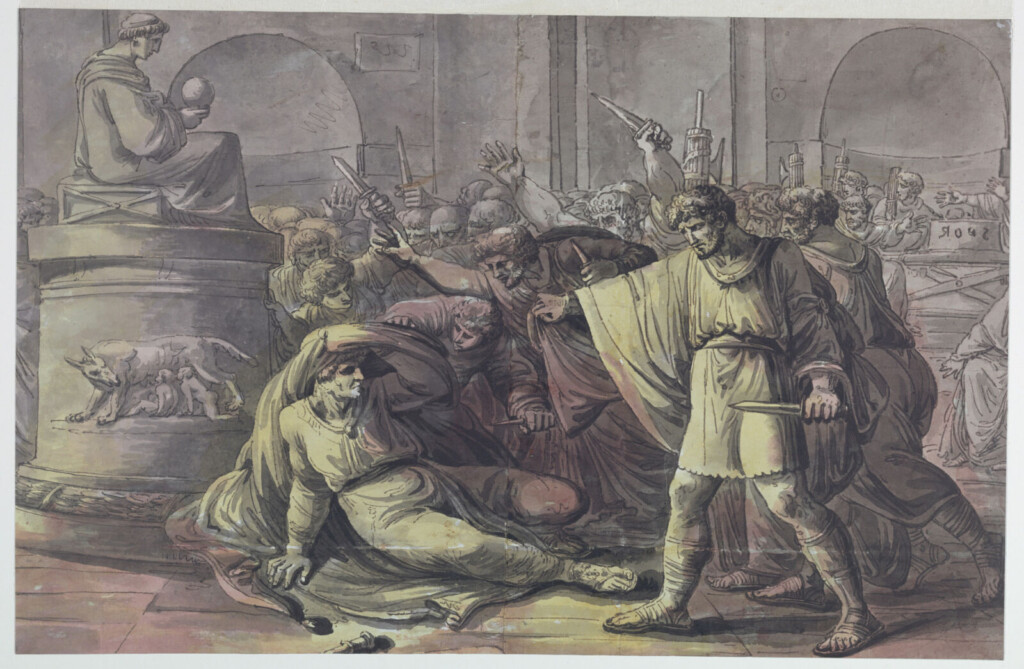
You already know what ambition looks like when it wears a mask — it arrives early, it volunteers for thankless work, it smiles at rivals while cataloguing their weaknesses. What Roman constitutional tradition never anticipated was a man who would learn its grammar so completely that he could speak it backward.
When Caesar took up the quaestorship in 68 BCE, the office was designed as a fiscal apprenticeship, a subordinate posting in the provinces meant to teach deference and patience to young aristocrats still forming their reputations. He served in Hispania Ulterior under the praetor Antistius Vetus, and by every visible measure he performed the role correctly. What the Senate could not see, because the architecture of the cursus honorum did not provide lenses for this kind of vision, was that Caesar was not learning the system’s rules — he was auditing its tolerances, discovering precisely how much pressure each institutional joint could bear before it buckled. The Roman Republic in the late first century BCE had accumulated procedures the way old buildings accumulate load-bearing walls that nobody can identify anymore: everyone knew the rules existed; almost nobody understood why they had been placed where they were.
The aedileship of 65 BCE made the diagnostic public. The office carried responsibility for public games, infrastructure, and the grain supply — practical, municipal, unglamorous. Caesar spent money that did not exist, financing spectacles of such extravagance that the Roman crowd, that volatile political instrument, began to attach his name to pleasure itself. Plutarch recorded that Caesar restored eighty statues of Gaius Marius that Sulla had removed from the Capitoline, doing so overnight, so that Romans woke to find the past reconstituted without anyone having voted on it. The gesture was not nostalgia. It was a demonstration that institutional memory could be rewritten faster than institutional response could organize itself. His debts at this point had reached, according to Plutarch’s account, somewhere in the range of 1,300 talents — a figure that had crossed the threshold where personal ruin and political necessity become indistinguishable from each other, which is precisely where Caesar intended to stand.
The pontificate changed the register entirely. In 63 BCE, Caesar ran for pontifex maximus against two senior optimates — Quintus Lutatius Catulus and Publius Servilius Vatia Isauricus — men with the accumulated prestige and factional support that should have made the contest a formality. He won by mobilizing tribal votes through networks of obligation he had been constructing since the aedileship, essentially purchasing the highest religious office in Rome with political currency the office was never meant to generate. Religion in Rome was not separate from governance; it was governance’s oldest language, the idiom in which decisions were sanctified and opponents were delegitimized. What Caesar now controlled was the institution that validated all other institutions. He did not use it crudely. He used it as a structural guarantee, a position so embedded in Roman sacred procedure that attacking him directly risked attacking the legitimacy of every ritual act the state had performed.
By the time he reached the consulship of 59 BCE with Bibulus as his colleague, the manipulation had become almost theoretical in its precision. When Bibulus attempted to block legislation through religious obstruction — declaring the omens unfavorable, a perfectly constitutional maneuver — Caesar simply ignored him and passed the laws anyway. Bibulus retreated to his house and issued edicts from there for the remainder of the year. Romans began calling it, with the dark humor characteristic of a people watching their system dissolve, not the consulship of Caesar and Bibulus, but the consulship of Julius and Caesar. The constitution had been given every opportunity to function as designed.
Gaul as Laboratory: Violence, Colonization, and the Census of the Conquered
You have never watched an empire being built in real time, but Caesar’s readers did, and that was precisely the point. The dispatches arrived in Rome while the ground in Gaul was still warm, written in the third person with a coldness that reads less like modesty and more like the studied detachment of a man who understood that narrative control is indistinguishable from military control. The Commentarii de Bello Gallico, composed across eight years of active campaigning between 58 and 50 BCE, is among the most successful acts of self-justifying propaganda in the literary record — not because it lies outright, but because it selects with surgical precision, framing massacre as pacification, enslavement as the natural consequence of barbarian resistance, and territorial annexation as a reluctant defensive necessity thrust upon a reasonable man by unreasonable peoples.
Plutarch, writing roughly a century and a half after the events, preserves numbers that the Commentarii carefully avoids stating plainly: approximately one million Gauls killed, one million more enslaved, three hundred tribes subjugated, eight hundred cities destroyed. Whether these figures are exact or rhetorical amplifications almost does not matter — they describe an order of magnitude that Caesar himself never found necessary to quantify in his own account, because quantification would have shifted the genre from military memoir to something requiring a different kind of moral accounting. The brilliance of the third-person voice — Caesar always writes “Caesar did this,” never “I did this” — is that it creates the optical illusion of an observer rather than an agent, a chronicler present at events that seem to unfold by their own historical logic rather than by the decisions of one man with a political career to protect and debts in Rome that conquest alone could repay.
The economic architecture of the Gallic Wars is inseparable from their violence. Caesar arrived in the province of Gallia Narbonensis carrying personal debts that ancient sources estimate in the range of twenty-five million denarii — a figure so vast it constituted a political threat as much as a financial one, since a private citizen without imperium could be prosecuted by his creditors. The conquest of Gaul was simultaneously a military campaign, a fundraising operation, and a preemptive legal maneuver. Slaves taken in war were sold immediately into a Mediterranean market that priced Gallic captives differently depending on age, sex, and perceived docility, generating capital that flowed back toward Rome’s banking networks. The census Caesar conducted of conquered peoples — documented in Book One when he records the Helvetii’s own population tablets found after their defeat — was not an administrative curiosity but a technology of dominion, converting human communities into legible, taxable, exploitable units. Michel Foucault would have recognized the structure instantly: the counted population is already a subjugated population, because to be made legible to power is to have already lost the sovereignty of opacity.
What makes the Commentarii genuinely dangerous as a historical document is its enormous literary quality. The prose is transparent, almost colorless, achieving in Latin what technical manuals achieve in modern bureaucratic writing — the sensation that facts are simply being reported, that no argument is being made, that the reader is receiving reality rather than a version of it. Edward Said, in Orientalism published in 1978, traced a recurring structure in which the colonized people are described through the colonizer’s categories precisely at the moment of their subjugation, their own frameworks rendered invisible or primitive. Caesar describes Gallic druids, political structures, and migration patterns with apparent ethnographic curiosity, but always within a narrative where these features exist to explain Gallic behavior toward Roman interests, never as independent civilizational facts. The Gaul who appears in the Commentarii is already a Gaul defined by his relationship to Rome’s arrival, stripped of the history that preceded the moment Caesar decided that history needed to be interrupted.
The Crossing as Philosophical Rupture
You are standing at the edge of something you cannot name yet, and you already know — in the part of yourself that precedes language — that the moment you move forward, the person who hesitated here will cease to exist. Not die. Cease. Become a previous version so thoroughly superseded that memory itself will struggle to retrieve him without distortion. This is not drama. This is the precise phenomenological structure of an irreversible act, and Caesar felt it on the northern bank of the Rubicon in January 49 BCE as surely as any human being has ever felt anything.
Hannah Arendt argued in The Human Condition, published in 1958, that action — true action, in the political and ontological sense — is the only human faculty that creates something genuinely new in the world. She called this natality: the capacity to begin, to introduce into the existing order a causality that was not already latent within it. Most of what we call decisions are not this. Most decisions are selections between pre-existing options within a stable frame. Caesar’s crossing was not a selection. It was the annihilation of the frame itself. Roman law was explicit and had been for generations: a general commanding an army could not cross the Rubicon southward with his legions intact. That boundary was not a line on a map. It was a constitutional threshold, the perimeter of the republic’s self-understanding. To cross it was not to break a rule. It was to dissolve the conceptual universe in which the rule had meaning.
What makes this philosophically vertiginous is the retroactive force of the act. Once Caesar moved, everything that came before him was reinterpreted by what he had done. The campaigns in Gaul between 58 and 50 BCE — eight years of military expansion that extended Roman control to the Rhine and the Channel, campaigns he documented himself in the Commentarii de Bello Gallico with a third-person clinical distance that was itself a political performance — were no longer simply conquest. They became prologue. The Senate’s vote to strip him of command, Pompey’s alignment with the conservative optimates, the decade of tension between Caesar’s populist ambitions and the republican aristocracy’s structural terror of accumulated personal power: all of it collapsed into a single vector pointing toward that January night on the riverbank. The act did not follow from history. It rewrote history’s direction from the inside.
This is what distinguishes genuine rupture from spectacular gesture. A coup announces itself as transgression and remains legible within the old order’s moral grammar — it knows what it is violating and gains its energy from that violation. Caesar’s crossing was something different, something more disturbing: it operated as if the old grammar had already expired, as if he were not breaking a law but simply moving through a space where that law no longer had jurisdiction. Suetonius records that Caesar paused, that he deliberated, that he quoted Menander — the die is cast — but the quote itself reveals the logic: a die cast is not a decision in progress. It is a decision already complete, being recognized after the fact. The pause was not hesitation. It was the mind catching up to what the body and the will had already resolved.
Arendt was also careful to note that action of this kind, precisely because it creates something irreversibly new, carries an exposure that no other human activity does. The actor cannot control what the act releases into the world. Caesar crossed and started a civil war he expected to win quickly, but what he also started — without intention, without plan — was the permanent delegitimization of the republican form, a process that would take another two decades to complete and would leave no structure he had imagined in its place, only the raw need for a different kind of order that his own heir would have to invent without a blueprint.
A vision curated by a filmmaker, not an algorithm
In this video I explain our vision
Civil War and the Seduction of Clemency

You have just surrendered. Your sword is on the ground, your men are exhausted, and the man who defeated you is looking at you with something that resembles warmth. He tells you that you are free to go. He tells you he holds no grudge. And you feel, in that precise moment, something that is not relief — it is a weight you did not have before you lost.
Between 49 and 45 BCE, Caesar crossed the Rubicon, dismantled the Republic’s military resistance across Spain, Greece, North Africa, and Asia Minor, and emerged as the undisputed master of the Roman world. He could have exterminated his enemies the way Sulla had, publishing proscription lists and turning the streets of Rome into an open market for vengeance. He did not. Instead he practiced clementia — a Latin term that does not quite translate as mercy, because mercy implies a moral surplus, a giving beyond what is owed. Clementia was something older and more precise: the restraint of the victor, the deliberate decision not to destroy what you could legally and militarily annihilate. The distinction matters enormously, because it tells you who holds the definition of the act.
Michel Foucault, in Discipline and Punish published in 1975, traced the genealogy of power not through its explosions of violence but through its quieter architectures — the systems that make people regulate themselves. His central insight was that the most sophisticated power does not need to punish constantly; it needs to be felt as a permanent possibility. Caesar’s clementia operates on precisely this logic. By sparing Cicero, by welcoming Brutus back into his circle, by releasing Pompey’s officers to return to private life, Caesar was not practicing magnanimity in any humanistic sense. He was constructing a theater in which every living enemy was a daily demonstration of his restraint. Their survival was his advertisement.
The trap inside clementia is that it cannot be refused without catastrophic self-indictment. When Caesar pardoned Marcus Junius Brutus after Pharsalus in 48 BCE and elevated him to the praetorship of Rome itself, Brutus was placed inside a debt structure that had no legal tender. You cannot repay a man who spared your life with money or service, because the currency of life exceeds both. The only way to discharge the debt would be to offer your submission so completely that you cease to be a political subject at all. Brutus refused this dissolution — and what emerged from that refusal was not independence but the Ides of March. The dagger was, among other things, the only grammar available to a man who could not live inside the sentence Caesar had written for him.
Cicero understood the mechanism clearly, which is why his letters from this period have the texture of a man writing inside a room whose walls are slowly closing. In the Philippics, composed after Caesar’s death, he would describe these years with retrospective fury — but during Caesar’s lifetime, his correspondence reveals a practiced gratitude that he knew was also a collar. He thanked Caesar. He praised Caesar. He appeared at public events where Caesar presided. Every act of public endorsement was simultaneously an act of self-erasure, and Cicero was too intelligent not to know it, and too rational not to perform it anyway.
What Caesar had invented — or perhaps perfected, since the Romans had always understood that magnanimity was a political instrument — was a system in which defeat never fully arrived. The vanquished were kept in a permanent anteroom between submission and reinstatement, never quite crushed and never quite free. The psychological literature on this structure is extensive: Erving Goffman’s work on total institutions in Asylums, published in 1961, describes how absolute environments manufacture consent not through overt coercion but through the removal of any position outside the institution from which resistance could be coherently organized.
Caesar’s Rome was not a prison. But it had no outside.
Dictatorship Perpetuo and the Grammar of Constitutional Erosion
You are already living inside a constitutional order that is dissolving, and you will not notice it until someone names it for you after the fact. That is not a metaphor borrowed from the present — it is the precise phenomenology of what happened in Rome between 49 and 44 BCE, and the scholars who have spent the longest time with the primary sources agree on something deeply uncomfortable: almost every individual act Caesar took was legally defensible within the framework of the republic he was dismantling.
The crossing of the Rubicon in January 49 BCE was itself framed as a defensive response to the Senate’s ultimatum, and enough Romans accepted that framing to prevent immediate civil collapse. Caesar’s first dictatorship, granted in 49 BCE, lasted eleven days — just long enough to organize elections — and he surrendered the title with a punctuality that would have satisfied the most traditional Roman constitutionalist. This is the mechanism that makes structural erosion so difficult to name in real time: it wears the costume of proceduralism. Each step borrows legitimacy from the step before it, and the cumulative architecture only becomes visible to those who refuse to look at the pieces in isolation.
What accelerated was the duration. After Pharsalus in 48 BCE, the dictatorship was granted for a year; after the African campaign in 46 BCE, it was extended to ten years; and then in February 44 BCE came the title that Roman legal vocabulary had never previously housed — dictator perpetuo, dictator in perpetuity. The Roman tradition had always understood the dictatorship as an emergency mechanism with a temporal ceiling written into its nature. Cicero, in De Re Publica, had articulated the republic’s genius precisely as its distribution of power across time and office, its structural allergy to the permanent concentration of authority in one body. Caesar’s title did not merely extend a duration — it annihilated the temporal logic that made the office constitutionally coherent.
The calendar reform of 46 BCE is rarely read for what it also was: an act of epistemic sovereignty. By replacing the lunar calendar — which had been managed and manipulated by the pontifices, giving the priestly class a form of temporal power over public and commercial life — with the Julian solar calendar of 365 days and a leap-year correction developed in consultation with the Alexandrian astronomer Sosigenes, Caesar placed the organization of time itself under his personal intellectual authority. A man who can restructure how a civilization measures its days is performing a very specific kind of dominance, one that does not require legions.
The Senate, meanwhile, was being reformed not by abolition but by expansion. Caesar raised its membership from roughly 600 to approximately 900, filling the new seats with supporters from Gaul, Spain, and equestrian families that the old senatorial aristocracy regarded with undisguised contempt. Suetonius records that some of these new senators could not read Latin with full fluency. The institution remained; its deliberative sovereignty quietly hollowed out. This is the pattern that Montesquieu would later identify in The Spirit of the Laws as the characteristic signature of the transition from republic to despotism — not the dramatic abolition of forms, but their preservation alongside the gradual evacuation of their substance.
Caesar also held the consulship, the tribunician power, the censorial authority, and the title of pontifex maximus simultaneously — a concentration that the entire constitutional grammar of Rome had been engineered to prevent. Marcus Junius Brutus, when he finally placed his name on the conspiracy, was not acting from wounded vanity alone. He carried in his hand a copy of Polybius, whose second-century BCE analysis of Rome’s mixed constitution had argued that the genius of the republic was precisely its structural resistance to the kind of personal sovereignty Caesar was now embodying without apology, and without the grammatical camouflage he had once considered necessary.
The Ides and the Impossibility of Killing an Idea
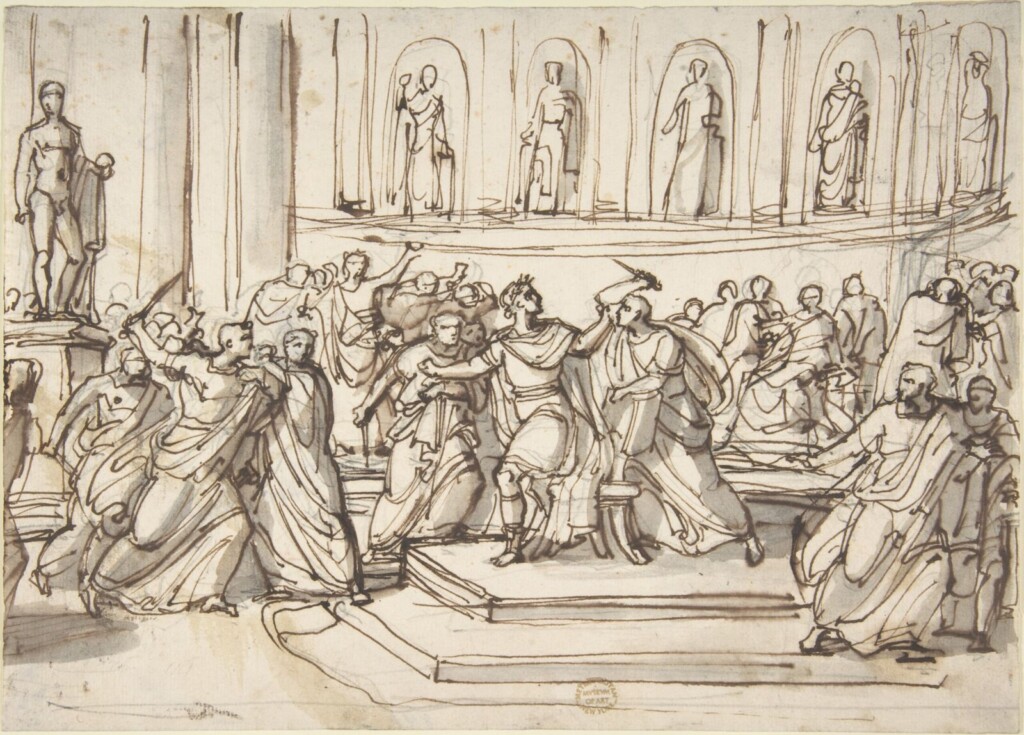
You are standing in the Theatre of Pompey on the fifteenth of March, 44 BCE, and the man being stabbed twenty-three times is not a tyrant being removed — he is a symbol being consecrated. The conspirators, sixty of them, men who had eaten at Caesar’s table and received his pardons, believed that killing the body would dissolve the idea inhabiting it. They were catastrophically wrong about how ideas work.
René Girard spent much of “Violence and the Sacred,” published in 1972, demonstrating that sacrificial killing does not neutralize the sacred — it concentrates it. The victim, once slaughtered, becomes untouchable in precisely the opposite direction: from dangerous living presence to immortal organizing principle. What the conspirators performed in that marble hall was not a surgical excision of tyranny but its ritual installation. The blood on the floor of the Theatre of Pompey was the founding rite of everything they claimed to oppose.
The Republic they invoked had already become a rhetorical costume worn over a century of structural collapse. Since the Gracchi reforms of 133 BCE, Roman political life had been a sequence of violent crises that the Senate’s procedural architecture consistently failed to contain. Sulla had marched on Rome in 88 BCE. The office of dictator had been stretched beyond its emergency function until it resembled exactly the permanent personal power the assassins now claimed to be extinguishing. Brutus and Cassius were not restoring something intact — they were gesturing toward a corpse and calling it a living system.
What the murder actually accomplished was to transfer Caesar’s accumulation of loyalty networks, veteran legions, public grief, and mythological identity to a nineteen-year-old named Gaius Octavius Thurinus, who understood immediately that the inheritance was not political but theological. Octavian did not simply claim Caesar’s assets — he claimed Caesar’s divinity, engineering the Senate’s posthumous deification of his adoptive father in 42 BCE with the kind of precision that reveals total comprehension of the mechanism at work. Once Caesar became Divus Julius, Octavian became Divi filius, son of a god, and the transformation of Roman governance from republican competition into dynastic sacrality was complete in everything but name.
The conspirators had handed their enemy a martyrdom, and martyrdom, as every political history demonstrates, is a force multiplier of a different order than any living authority. A man who can be argued with, outmaneuvered, or outlasted presents one kind of political problem. A dead man around whom grief organizes becomes something immune to ordinary opposition — he has been removed from the arena of contestation and elevated into its foundations.
By the time Octavian accepted the title Augustus in 27 BCE, rebranding autocracy as the restoration of ancestral virtue through the carefully staged performance of refusing formal kingship, the entire logic had closed on itself with terrible elegance. Augustus ruled for forty-one years. He reformed the Senate, controlled the legions, administered the provinces, and shaped religious life — doing in institutionalized form everything Caesar had been killed for doing with too much individual visibility. The difference between Caesar and Augustus was not structural, it was theatrical.
What the Ides of March produced, then, was not the thing it aimed to prevent but the conditions under which that thing could never again be destroyed by the same method. The principate was Caesar’s power made systemic, distributed into offices and titles and precedents so that no single stabbing could locate it. Killing Caesar had taught the Roman world that power needed to hide inside the republic’s own vocabulary in order to survive, and Augustus was the first man disciplined enough to speak that vocabulary fluently while meaning something entirely different by every word.
⚔️ Power, Empire, and the Fate of Civilizations
The life of Gaius Julius Caesar is inseparable from the grand currents of political ambition, military conquest, and cultural transformation that shaped the ancient world. To understand Caesar is to understand how power is seized, legitimized, and lost — themes that echo across history, literature, and philosophy. These related articles trace the intellectual and cultural roots of the world Caesar both inherited and remade.
Niccolò Machiavelli: Life and Political Thought
Niccolò Machiavelli spent a lifetime studying the mechanics of power, and Caesar loomed large in his imagination as a figure of both admiration and warning. His treatise ‘The Prince’ distills the brutal logic of political survival into principles that remain disturbingly relevant today. To read Machiavelli is to understand the cold calculus behind every great conqueror, including Caesar himself.
GO TO THE SELECTION: Niccolò Machiavelli: Life and Political Thought
Machiavelli’s The Prince: Meaning and Analysis
Machiavelli’s ‘The Prince’ is not merely a handbook for tyrants but a profound meditation on the fragility of power and the ruthlessness required to maintain it. Caesar appears throughout Renaissance political thought as the archetypal figure who crossed the Rubicon of republican norms in pursuit of supreme authority. This analysis unpacks the text’s enduring relevance to anyone who seeks to understand how empires are built and destroyed.
GO TO THE SELECTION: Machiavelli’s The Prince: Meaning and Analysis
Homer and the Odyssey: Nostos and the Archetype of Return
Homer’s Odyssey established the archetype of the heroic journey long before Caesar marched his legions across Gaul and into the pages of history. The theme of ‘nostos’ — the longing for home and the glory of return — runs through ancient Mediterranean culture and shaped the Roman ideals Caesar both embodied and subverted. Exploring Homer opens a deeper understanding of the mythological framework within which Roman leaders fashioned their own legends.
GO TO THE SELECTION: Homer and the Odyssey: Nostos and the Archetype of Return
Thomas Hobbes: Life and Political Thought
Thomas Hobbes built his political philosophy on the conviction that without a supreme sovereign, human life degenerates into chaos and perpetual conflict — a vision that would have resonated deeply with the Rome of Caesar’s era. The collapse of the Roman Republic into civil war offered Hobbes exactly the historical evidence he needed to argue for concentrated, undivided authority. Understanding Hobbes illuminates why so many Romans ultimately accepted, even welcomed, Caesar’s consolidation of power.
GO TO THE SELECTION: Thomas Hobbes: Life and Political Thought
Discover Cinema That Thinks Big on Indiecinema
If these journeys through power, history, and human ambition have stirred your curiosity, Indiecinema is the streaming platform where great ideas meet great filmmaking. Discover independent and documentary cinema that explores the forces shaping civilizations, from ancient Rome to the modern world. Join us and stream films that dare to ask the questions history never stops asking.
👉 EXPLORE THE CATALOG: Watch Indie Films in Streaming
A vision curated by a filmmaker, not an algorithm
In this video I explain our vision

