
The Body in the Street
You are walking home. It is late, the street is empty, and somewhere behind you there is a sound — footsteps, or maybe just the wind displacing a bottle against the pavement. You do not stop to verify. Your body has already made its calculation before your mind has finished forming the question. The shoulders tighten. The pace quickens. You have moved to the center of the street, away from the doorways, without deciding to. Something older than your education and your political opinions and your carefully maintained social tolerance has taken the controls, and it is running a very simple program: assess, position, survive.

This is not paranoia. This is not a failure of reason. This is reason in its most ancient form, operating below the threshold of language, making probability assessments that your conscious mind will only catch up with seconds later, if at all. And here is what is remarkable about that moment: everything you believe about civilization, about trust, about the fundamental decency of strangers, is temporarily suspended. Not refuted — suspended. The suspension is total and instantaneous. One sound in an empty street and you are no longer a citizen, no longer a social creature embedded in networks of mutual obligation and legal protection. You are a body calculating distance and exits.
Thomas Hobbes knew this moment intimately, though he would not have used those words. Born in 1588 in Westport, Malmesbury, prematurely — his mother, according to the philosopher’s own account, brought him into the world early out of fright at the news of the Spanish Armada’s approach — he arrived already marked by fear, or so the biographical legend insists. Whether or not one credits the anecdote, what is certain is that Hobbes spent his formative decades in an England convulsed by civil war, theological violence, and the systematic collapse of the authorities that were supposed to make social life stable and predictable. He watched men kill each other over the question of who held legitimate power, and what he concluded from that spectacle was not that humans are inherently evil but something more unsettling: that they are inherently rational, and that rational creatures in conditions of uncertainty will always, inevitably, move to protect themselves first.
The argument he built from this observation, assembled most completely in Leviathan in 1651, is not a cynical argument. It is a structural one. The state of nature — the condition of human beings absent any overarching authority — is not a distant past or a hypothetical thought experiment. It is a permanent substrate beneath every layer of social arrangement, always present, always capable of reasserting itself the moment those layers thin or crack. Hobbes was not describing savages. He was describing you, in an empty street, at eleven o’clock at night, listening to footsteps that may or may not be there.
What makes Hobbes so difficult to dismiss, across nearly four centuries, is precisely this: his intuition does not require you to believe anything particularly dark about human nature. It only requires you to believe that under conditions of genuine uncertainty, where you cannot be sure whether the other person intends you harm, the rational move is defensive. And that this rationality, multiplied across every individual making the same calculation simultaneously, produces a collective condition that is worse for everyone than any individual calculation intended. The trap is not malice. The trap is logic. Everyone protects themselves, which gives everyone reason to fear everyone else, which gives everyone more reason to protect themselves, and so the spiral descends not into evil but into a perfectly coherent, mutually reinforcing catastrophe.
The sound behind you may have been nothing. You arrive home, the door closes, the moment dissolves. But the calculation ran. It always runs. Hobbes built an entire political philosophy on the fact that it never stops.
The Mirror and the Rascal
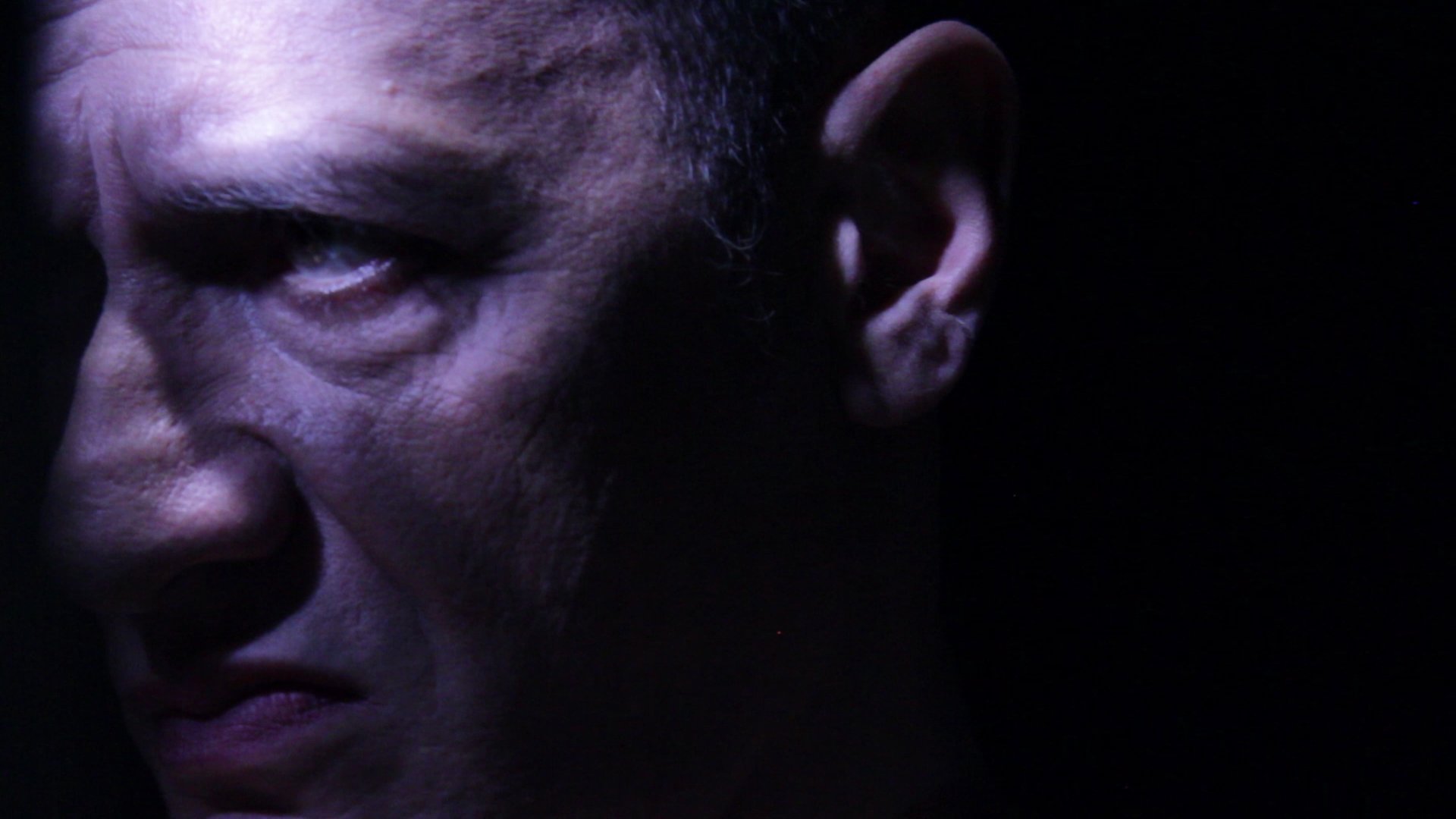
Drama film, by Valerio De Filippis, Italy, 2019.
The mirror and the rascal is an experimental film based on the tragedy "Richard III" by William Shakespeare. It tells the delirium of contemporary power in an author's reinterpretation of cinema, video art and music. The protagonist, Richard Duke of Gloucester, brother of King Edward IV, through a long series of crimes eliminates all the obstacles that stand between him and the throne of England.
Valerio de Filippis, a well-known painter who has been following his research path for a long time, investigating the relationship between light, corporeality and the psyche. The mirror and the rogue and the cinematographic equivalent of Valerio De Filippis' painting, his figurative style is in fact very recognizable looking at his paintings. But cinema is a new way where the artist can also be involved as an actor and performer, with an original mix between acting and singing. Staging the dark side of the human soul, the film is a surreal and disturbing interpretation of a great classic. The director says: "The first suggestion was musical: I was interested in transforming the text of Shakespeare's tragedy Richard III into notes. I love cinema and at a certain point I felt that the time had come to combine research on the image of painting to my love for cinema and music. When the film is finished I realize that I have remained faithful to painting: every frame of the film appears to me like a painting: the same light, the same colors, the same atmosphere ". The mirror and the rascal is a kind of psychoanalytic session that the painter does while hiding behind the mask of Richard III. Behind this ferocious and unscrupulous character we find a path of self-analysis by De Filippis, who is mainly interested in the more violent and turbid aspects. An experimental film in which, with great courage, the author gets involved completely, fragmenting the images in an unconventional montage, which is at the same time a flow of consciousness and spectacle.
LANGUAGE: English
SUBTITLES: Italian
A Man Born in Fear, Twice
He arrived in the world ahead of schedule, pulled into existence by panic. His mother, somewhere in Wiltshire in April of 1588, heard the news spreading through England like wildfire through dry grass: the Spanish Armada was coming, the fleet was massing, invasion was imminent. The shock sent her into labor weeks early, and Thomas Hobbes entered life at the precise moment his country believed it was about to be destroyed. He would later say it himself, with the kind of bitter wit that only a man who has truly suffered earns the right to use: fear and I were born twins. Most people dismiss this as an aphorism, a charming biographical footnote. They are wrong to do so. It is the confession of an entire philosophy.
To understand what Hobbes built intellectually, you must first sit with what he witnessed materially. He lived to eighty-one years old, which in seventeenth-century England was already an act of stubborn biological defiance, and across those decades he watched his country dismantle itself with extraordinary thoroughness. The England of his youth was already fractured along religious and constitutional fault lines that had been deepening since Henry VIII’s break with Rome half a century before his birth. By the time Hobbes reached intellectual maturity, the fractures had become chasms. Parliament and Crown were locked in a conflict that was not merely political but existential — a war over the very question of where sovereignty resided, who held the right to command, and what happened to a society when that question could no longer be answered without killing.
The answer, it turned out, was: this. The First English Civil War erupted in 1642, and what followed was not the clean ideological drama that later historians sometimes make it appear. It was the lived experience of order collapsing in real time. Armies moved through the countryside. Courts of law ceased functioning in significant portions of the kingdom. The social fabric that people had assumed was simply the nature of things revealed itself to be a fragile construction, maintained not by God or nature but by collective agreement and the credible threat of enforcement. When that threat dissolved, so did the fabric. Hobbes had already left England by then, having fled to Paris in 1640 as the political situation deteriorated and his own royalist sympathies made remaining dangerous. He spent eleven years in exile, watching from the continent as his country consumed itself.
Then, in January of 1649, Charles I was beheaded outside the Banqueting House in London. The execution of a king — not a murder in a corridor, not a battlefield death, but a public, legally formalized killing — was not merely a political event. It was a philosophical catastrophe. It annihilated the theory of divine right at the level of brute fact. If a king could be tried, sentenced, and executed by his own subjects, then the entire architecture of authority that had organized European political life for centuries was revealed as contingent, constructed, reversible. The ground beneath every assumption about power and legitimacy turned suddenly to sand.
Hobbes began writing Leviathan in Paris during these years, and this is what you must hold in your mind when you read it: this was not a scholar composing a theoretical treatise in comfortable distance from events. This was a man writing in exile, in fear, having watched legitimate authority be publicly decapitated, trying desperately to reconstruct on rational grounds what history had just destroyed on blood-soaked ones. The book was published in 1651, and every sentence in it carries the weight of that biography. When Hobbes describes the state of nature as a condition of war of every man against every man, he is not performing a thought experiment. He is describing something he had come close enough to touch.

The War of All Against All
There is a moment, familiar to anyone who has lived through an institutional collapse — a company folding, a neighborhood gutting itself, a government losing its grip on a province — when you watch someone you have known for years become unrecognizable. Not monstrous, exactly. Just honest. The politeness evaporates. The shared fictions dissolve. What remains is a person calculating, with perfect clarity, what they need and what they are willing to do to get it. You have seen this. You know the face it makes.
This is what Hobbes was describing, and he was not describing prehistory. He was not conjuring some savage dawn before agriculture or writing. The state of nature was never, for Hobbes, a historical period. It was a logical condition — the permanent undertow beneath every functioning society, the thing that surfaces the moment the structure fails. In Leviathan, published in 1651 after he had watched England tear itself apart through civil war, regicide, and the collapse of every institution that had previously seemed eternal, he was precise about this. Without a common power to keep men in awe, he wrote, they are in that condition called war, and such a war as is of every man against every man. The famous phrase that follows — that life in such a condition is solitary, poor, nasty, brutish, and short — is not a metaphor. It is a clinical observation.
He had learned to make clinical observations early. In 1629, at the age of forty-one, Hobbes translated Thucydides into English — the first complete translation from the Greek — and that encounter left a permanent mark on his thinking. What Thucydides gave him was the unsentimental record of a civilization discovering what it actually was. The Melian Dialogue, that extraordinary passage in the fifth book of the History, is perhaps the first honest political document in Western literature. The Athenians have come to the island of Melos with a fleet and a demand: submit or be destroyed. When the Melians appeal to justice, to the gods, to the natural sympathy of one Greek people for another, the Athenians reply with something so blunt it still feels transgressive to read it. The strong do what they can, they say. The weak suffer what they must. There is no appeal beyond power. The gods, if they exist, follow the same logic.
Thucydides did not write this to celebrate it. He wrote it as a record of what men do when the architecture of constraint is removed or irrelevant. Hobbes read it and recognized the grammar of all political life. Not the exception. The grammar.
What this means, carried into lived experience, is something vertiginous. Think of a man who finds himself suddenly outside the web of institutional protection — fired without warning, cut off from networks that had defined his worth, watching former allies realign with the speed and cold efficiency of people who were never, it turns out, his allies at all. He does not encounter monsters. He encounters people behaving rationally according to the only logic that remains when the social contract has been withdrawn from him personally, even as it continues to operate for others. The structure that made cooperation feel natural was never natural. It was constructed, maintained, enforced. Without it, what Hobbes called the right of nature — the liberty each man has to use his own power for the preservation of his own life — reasserts itself with the inevitability of gravity.
This is the move that separates Hobbes from nearly every political thinker before him. He refused to ground politics in virtue, in reason’s natural tendency toward the good, in the Aristotelian assumption that man is a political animal by nature and that community is his proper home. For Hobbes, community is an artifact. A brilliant, necessary, fragile artifact. And the war is always waiting underneath it.
The Sovereign Machine
There is a moment when you realize the institution you trusted was never designed to know you. You are standing in a government office, or watching a press conference, or reading a law that seems written in a language that only accidentally resembles the one you speak, and something cold passes through you — not anger exactly, but recognition. The machine is running. It was always running. You were never inside it; you were always fuel.
This is precisely what Hobbes built, and he built it on purpose.
The social contract, as Hobbes conceives it in Leviathan, published in 1651 in the aftermath of English civil war and the executed king’s still-fresh memory, is not a handshake between reasonable men. It is not Rousseau‘s warm fantasy of a people discovering their common will, nor Locke’s gentlemen’s agreement about property rights. It is a transaction conducted under duress, signed at the edge of a cliff. You give up your natural freedom — your absolute, terrifying, murderous right to do anything necessary to survive — because the alternative is dying in a ditch while your neighbor does the same to you first. The contract is not born from virtue. It is born from exhaustion and fear.
Hobbes is precise about this in a way that makes comfortable readers flinch. Every man, in the state of nature, has a right to everything, including another man’s body. This is not a metaphor. The surrender of that right is not a moral awakening but a mathematical calculation: you trade the freedom to kill for the security of not being killed. The sovereign receives what everyone else relinquishes. And then the sovereign becomes something none of the original contractors could quite have imagined — something that exceeds them individually, something that does not depend on their continued approval to exist.
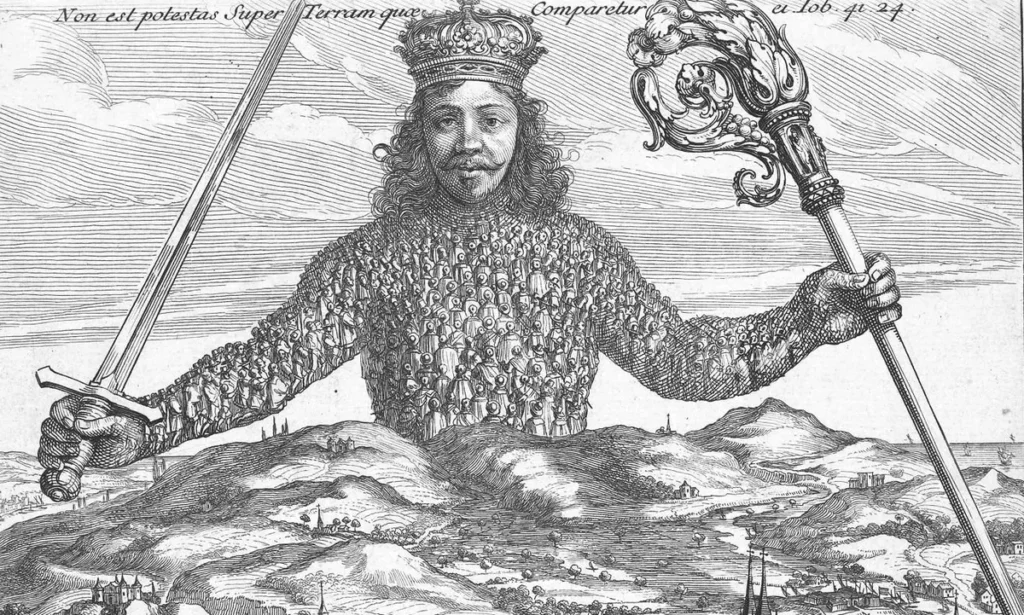
The image Hobbes places on the frontispiece of his great work is worth sitting with. A giant figure rises above a landscape of towns and fields, its torso composed entirely of tiny human bodies pressed together, each face turned toward the center, toward the sovereign head. They are inside it. They built it. And it does not look back at them. The Leviathan — the name borrowed from the Book of Job, from the monster God uses to humble human presumption — is an artificial man, a mechanical body assembled from human parts, animated by covenant rather than by God. Hobbes calls it a Commonwealth, but what he means is a machine. And machines do not feel loyalty to their components.
This is the paradox that Hobbes refuses to soften. The cure for the war of all against all is not peace in any humane sense. It is the installation of a power so absolute that war becomes irrational to attempt. The monster you elect, or inherit, or consent to through your mere continued residence in its territory, is by design larger than your grievance, older than your memory, indifferent to your particular face. You watch it from a distance and understand, slowly, that it was always watching something else — the horizon, the border, the aggregate, the abstract citizen who is everyone and therefore no one.
Hannah Arendt, writing three centuries after Hobbes in The Origins of Totalitarianism, would identify something similar in the logic of state power: that the bureaucratic machine renders individual suffering statistically irrelevant not through malice but through structure. The structure is the point. Hobbes knew this. He designed it this way because he had seen what happened when the structure collapsed — the scaffold, the severed head, the armies moving across England burning everything they claimed to be saving.
The monster is monstrous. Hobbes never denies it. He simply insists that you made it, you needed it, and the alternative was worse.
What Hobbes Saw That We Refuse To
You have sat across a table from someone, both of you smiling, both of you choosing your words with surgical care, and you have known — with a clarity that required no evidence — that neither of you meant a single syllable of goodwill you were performing. The coffee cups were there. The pleasantries were there. And underneath, two calculations running simultaneously, each trying to extract the maximum without yielding the necessary. You did not say this aloud. Neither did they. The meeting ended cordially. You both knew exactly what had happened.
Hobbes would not have been surprised. He would have recognized it as the only honest transaction you had that week.
The argument he makes in Leviathan, published in 1651 at the precise midpoint of an English civil war that had already cost somewhere between one and two hundred thousand lives, is not that human beings are monsters. It is far more unsettling than that. It is that we are equals. In the state of nature — that thought experiment which is also, as he quietly insists, an actual condition still visible among sovereign states and collapsing societies — no single person is so powerful that they cannot be killed by another, whether through superior strength or cunning or coalition. This symmetry, this radical democratic vulnerability, is the engine of conflict. Because you can kill me, and I know it, and you know I know it, neither of us can ever fully rest. The rational response to equality is preemptive aggression. Not evil. Just arithmetic.
John Locke, writing forty years later in a world that had settled into something resembling constitutional order, needed human nature to be more cooperative. His state of nature is governed by reason, by a natural law discernible to all, by a fundamental sociability that precedes political institutions. People are, for Locke, essentially decent beings who build governments to protect what they already, naturally, tend to respect. This is a more agreeable picture. It also requires you to forget the negotiation you just sat through.
Rousseau goes further into comfort. For him, natural man is not merely reasonable but innocent — corrupted only by civilization itself, by property, by comparison, by the grinding machinery of social distinction. The savage is happy. Society poisoned him. This vision is so seductive that it has never entirely left Western politics, reappearing in every movement that believes the problem is the system and that beneath the system a purer human waits to be liberated. It explains nothing about what happens when two people sit across a table wanting the same thing.
The reason we prefer Locke and Rousseau is not that they are more accurate. It is that they are more livable. Hobbes offers no redemption arc. He does not promise that the right institutions will eventually produce the right people, or that somewhere beneath the performance of civility there is genuine solidarity waiting to emerge. He says the performance is all there is, and that the sovereign’s function is precisely to make the performance stable enough that we can conduct our negotiations without reaching for weapons. The law is not the expression of our better nature. It is the cage that makes civilization possible for creatures who do not have one.
We punish him for this by calling him a pessimist, as though pessimism were a character flaw rather than a diagnostic category. We file him away as an apologist for authoritarianism, which is partly fair and mostly a way of avoiding what he actually saw. The philosopher Jean Hampton, in her 1986 study Hobbes and the Social Contract Tradition, argued that Hobbes was working within a genuine contractarian logic — that his sovereign derives authority from rational consent, not from divine right or brute force. The authoritarianism is a conclusion, not a premise. The premise is simply that the people across the table from you are doing exactly what you are doing, and that this will never entirely stop being true.
A vision curated by a filmmaker, not an algorithm
In this video I explain our vision
Religion, Fear, and the Uses of God

There is a moment when you sit in a pew and realize, with a clarity that feels almost indecent, that the building around you is not merely a house of worship. The collection plate moves through the rows with the same quiet inevitability as a tax notice slipped under the door. The sermon speaks of eternal consequence, of souls weighed against their obedience, and you understand — not as an abstraction but as something felt in the sternum — that the institution promising to save you from death is simultaneously drawing its institutional power from your fear of it. The fear is the product. The salvation is the storefront.
Hobbes understood this with a precision that his century found unforgivable. In the third and fourth parts of Leviathan, published in 1651, he turned his analytical machinery not toward the state of nature or the social contract but toward the Church, and what he found there was a rival sovereign hiding inside eschatology. The ecclesiastical apparatus, he argued, had constructed an entire parallel kingdom — a Kingdom of Darkness, he called it bluntly in Part IV — built not on physical coercion but on something more durable: the manipulation of what men fear after death. This was not theology. It was political science applied to the afterlife.
The accusation of atheism followed him immediately and never left. It pursued him through the Restoration, through the parliamentary debates of 1666 when his books were formally investigated as potential causes of divine punishment for the Great Fire of London, and through the remaining thirteen years of his life, which ended in December 1679 when he died at ninety-one, still writing, still accused. He never recanted. The accusation was, in a certain sense, a category error. Hobbes did not deny God’s existence. He did something more destabilizing: he denied the Church’s exclusive right to interpret what God required of you politically.
The distinction matters enormously. For Hobbes, religion and sovereignty could not occupy the same space without one devouring the other. When a priest tells you that your obligation to God overrides your obligation to the sovereign, he has effectively made himself the sovereign. He has replaced one throne with another and simply changed the costume. Carl Schmitt, writing nearly three centuries later in Political Theology, recognized this Hobbesian logic as foundational: the one who decides on the exception decides on the ultimate authority, and whoever controls the definition of divine law controls the exception permanently. Hobbes saw it first, and he said it without Schmitt’s elegance and without Schmitt’s willingness to soften the blow.
What made the argument radical was its structural honesty. Hobbes was not attacking faith. He was attacking the institutional capture of fear. The Church had, over centuries, built a monopoly on the most intimate human terror — the terror of dying badly, of dying damned, of dying into nothing — and converted that monopoly into land, taxation, political veto, and the power to depose kings. Henry VIII had already torn one seam of this arrangement open in England, but he had not theorized the wound. Hobbes theorized it with the cold exactitude of someone who had watched men kill each other over competing claims to divine mandate and decided the architecture itself was the problem.
His solution was not secularism in any modern sense. It was sovereignty as the condition of all other goods, including religious ones. The sovereign interprets scripture for civil purposes. The sovereign determines which prophets are authorized. The sovereign decides, finally, what the Church is permitted to say about death and what it must leave in silence. This was not atheism. It was the most threatening thing possible to any institution that rules through the management of invisible terror: it was exposure.
The Mirror We Smash Rather Than Look Into
There is a particular kind of book that gets burned not because it is wrong but because it is accurate in a way that cannot be forgiven. Leviathan was placed on the Oxford University list of damnable books in 1683, alongside works that threatened the divine right of kings. It was condemned by the Catholic Church. It was denounced by Presbyterians, Anglicans, and royalists with equal fury — which tells you something precise: when every faction agrees a thinker is dangerous, the thinker has probably said the one thing none of them can afford to hear. Hobbes did not threaten a political position. He threatened the entire theater of justification within which all political positions perform.
What he said, stripped of every diplomatic softening, was this: political order is not natural. It is not moral in any cosmic sense. It is not ordained by God or discovered by reason in the structure of things. It is built, violently, by frightened human beings who chose subjugation over annihilation, and it is maintained by the same logic every single day. The sovereign is not your father, your shepherd, or the embodiment of justice. The sovereign is the man holding the sword that everyone agreed to stop fighting over.
Hannah Arendt, who disagreed with Hobbes on nearly everything temperamentally, nevertheless identified in her 1951 analysis of totalitarianism something that his framework had already anticipated: that power, when it loses its artificial, constructed character and begins to claim natural or organic legitimacy, becomes most dangerous precisely when it seems most inevitable. Her distinction in The Human Condition between power as collective human action and violence as its breakdown echoes, in negative, the Hobbesian insight that what we call political stability is always a managed tension, never a settled truth. She could not accept his conclusions. But she could not escape his diagnosis.
Michel Foucault arrived at the same ruins from the opposite direction. His archaeology of sovereign power, developed across Discipline and Punish in 1975 and the lectures collected in Society Must Be Defended, traced how the language of war and conquest never actually leaves political order — it simply gets laundered through law, administration, medicine, and normalization. The sovereign who once publicly executed the condemned body transforms into the state that classifies, surveils, and manages populations. The violence does not disappear. It becomes invisible, which is something considerably worse. Foucault did not cite Hobbes as an ancestor so much as an honest predecessor whom the tradition chose to bury and replace with more palatable fictions.
Then there is the figure who should make every liberal reader genuinely uncomfortable. Carl Schmitt, the German jurist who joined the Nazi party in 1933 and provided some of its most sophisticated legal justifications, was also one of the twentieth century’s most penetrating readers of Hobbes. His 1938 study of Leviathan identified with cold precision what everyone else had tried to sentimentalize away: that at the heart of every political order lies a decision, a sovereign decision about who belongs and who does not, who is protected and who is the enemy. Schmitt used Hobbes to argue that liberalism was a lie it told itself, that beneath its procedural gentleness the same logic of friend and enemy operated, just concealed behind parliamentary courtesy.
He was not entirely wrong about the diagnosis. He was catastrophically wrong about the prescription. And that is the precise discomfort Hobbes’s legacy demands you sit with. When you dismiss Hobbes as a cold cynic who saw too little in human nature, you find yourself agreeing, in your dismissal, with every bishop who burned his book and every humanitarian who preferred a prettier story. And when you accept his analysis as accurate, you discover you are standing in uncomfortable proximity to the man who used it to justify one of history’s most deliberate atrocities.
The Contract You Already Signed
You clicked “I agree” this morning. You did not read what you agreed to. You never do, and neither does anyone else — a 2008 study by Lorrie Faith Cranor and colleagues at Carnegie Mellon estimated that reading every privacy policy encountered in a year would consume roughly 76 working days of an average American’s life. So you clicked through, as you always do, and in that small, tired gesture you performed the oldest political act in the modern world.
Hobbes never believed there was a founding moment. No meadow, no parchment, no gathering of free individuals who deliberated and chose. The social contract in Leviathan, published in 1651, is not a historical event but a logical structure — a way of describing what you are already doing every time you pay a tax without shooting the tax collector, every time you stop at a red light at three in the morning when no one is watching, every time you swallow an insult from a bureaucrat because the alternative is worse. The contract is not something your ancestors signed. It is something you renew, silently, continuously, with your body and your compliance, every single day.
Think of a man who has spent years building a case against the system that employs him, documenting its hypocrisies, its small corruptions, its contempt for the people it claims to serve. He does not quit. He does not expose anyone. He shows up, files his reports, nods at the right moments. Not because he believes, but because the weight of what he would lose — salary, pension, health insurance, the ordinary texture of a life — is heavier than whatever remains of his conviction. He has calculated, exactly as Hobbes said he would. He has chosen security over integrity and called it maturity.
The philosopher Jean-Jacques Rousseau wrote in 1762, in The Social Contract, that man is born free and everywhere is in chains, intending it as an indictment. Hobbes would have read it as a description of success. The chains are the point. The chains are what stand between you and the man who wants what you have. Michel Foucault, two centuries later, would map how those chains become invisible — how power internalizes itself so thoroughly in Discipline and Punish, published in 1975, that the prisoner eventually guards himself, and the citizen eventually polices her own dissent before it reaches her lips. What Hobbes designed as a mechanism, Foucault revealed as a climate.
And the fear — Hobbes’s foundational fear, the fear of violent death that drives rational beings to surrender their natural liberty — the fear never actually leaves. This is perhaps the most honest thing Hobbes ever admitted, buried quietly in the logic of his system. The sovereign does not eliminate fear. The sovereign redirects it, concentrates it, makes it flow in approved channels. You are afraid of crime, of illness, of destitution, of the stranger at the border — and the state offers itself as the only adequate answer to every terror it has partly cultivated. The protection racket and the legitimate government have always shared a family resemblance that respectable political theory works hard not to examine directly.
So you sit in the voting booth, and you choose between options you did not design, inside a system you did not build, according to rules you inherited, to ratify an arrangement that will continue with or without your participation. You call this freedom because the alternative vocabulary has been made to sound naive. You defend the order not because it serves you perfectly but because disorder, you have been taught, serves you not at all.
If the contract was never freely signed, if the sovereign was never truly authorized, if the fear is a managed condition rather than a solved one, then what you are protecting when you defend this order is not security — it is the habit of believing that security and this particular order are the same thing.
⚖️ Power, Sovereignty, and the Roots of Political Thought
Thomas Hobbes reshaped how we understand the state, power, and human nature. These related articles trace the intellectual lineage of political philosophy, from Renaissance realism to early modern governance, revealing the deep currents that flow beneath Western political thought.
Niccolò Machiavelli: Life and Political Thought
Niccolò Machiavelli stands as one of the most provocative predecessors to Hobbesian political realism, stripping away moral idealism to examine power as it truly operates. His analysis of the prince as a figure who must master both force and cunning anticipates Hobbes’s vision of the sovereign as the sole guarantor of order. Together, these two thinkers form the twin pillars of early modern political philosophy.
GO TO THE SELECTION: Niccolò Machiavelli: Life and Political Thought
Shakespeare’s Richard III: Meaning and Analysis
Shakespeare’s Richard III presents a chilling dramatization of political ambition and the will to dominate that resonates deeply with Hobbes’s state of nature. The play stages a world where the absence of legitimate authority breeds monstrous self-interest and perpetual conflict. Reading Richard III alongside Hobbes illuminates how Renaissance culture grappled with the terrifying logic of unchecked power.
GO TO THE SELECTION: Shakespeare’s Richard III: Meaning and Analysis
Hannah Arendt: the Philosopher Who Unmasked the Banality of Evil
Hannah Arendt, one of the twentieth century’s most incisive political philosophers, engaged critically with the tradition that Hobbes helped establish, particularly the nature of power, violence, and political legitimacy. Her landmark concept of the ‘banality of evil‘ challenges Hobbesian assumptions about sovereignty and human nature from within the modern experience of totalitarianism. Exploring Arendt alongside Hobbes opens a vital philosophical dialogue across the centuries.
GO TO THE SELECTION: Hannah Arendt: the Philosopher Who Unmasked the Banality of Evil
Italian Medieval Communes: History and Culture
The Italian Medieval Communes represent a fascinating historical laboratory for the questions Hobbes would later theorize: how do communities organize authority, maintain peace, and prevent civil war? These city-states navigated the fragile border between collective self-governance and factional violence, embodying the very tensions Hobbes sought to resolve through the concept of the sovereign. Understanding their rise and fall provides essential historical context for Leviathan’s central arguments.
GO TO THE SELECTION: Italian Medieval Communes: History and Culture
Discover Independent Cinema on Indiecinema
If political philosophy stirs your curiosity about power, freedom, and the human condition, Indiecinema’s streaming catalog offers a world of independent films that explore these very themes with courage and artistic depth. From political dramas to philosophical documentaries, there is always a film waiting to challenge your thinking. Visit Indiecinema and let independent cinema expand your perspective beyond the page.
👉 EXPLORE THE CATALOG: Watch Indie Films in Streaming
A vision curated by a filmmaker, not an algorithm
In this video I explain our vision

