
The Face You Make When You Lose
You did everything right. You arrived early, stayed late, delivered results that were measurable and clean. You built your competence the way you were told to build it — quietly, steadily, without making enemies or demanding attention before you had earned it. And then one Tuesday morning, with the particular cruelty of institutional life, you found out that the position went to someone else. Not someone more capable. Not someone with a longer record or a sharper mind. Someone who had lunch with the right person at the right moment, who knew how to laugh at the correct jokes, who understood instinctively that the game being played in that office was never the game written in the employee handbook.

The face you make in that moment is not anger, not exactly. It is something older and more disorienting — the expression of a person who has just discovered that the map they were given bears no relation to the territory they were walking through. The rules were real. You followed them. The rules were also, it turns out, decorative.
This is not a modern problem and it is not a personal failure, though it will feel like both. What you experienced in that fluorescent-lit corridor, holding a coffee that has gone cold, is the same structural revelation that has undone ambitious and honest people for as long as there have been courts, councils, republics, and offices. The gap between merit and reward is not a bug in the system. In most systems, historically and demonstrably, it is a feature.
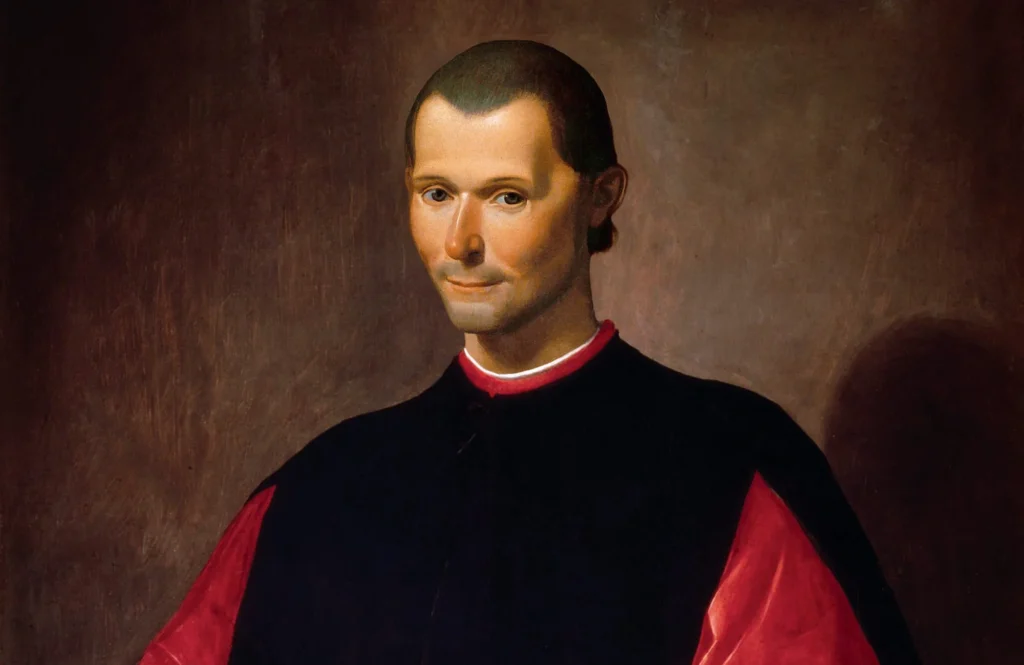
Niccolò Machiavelli understood this not as a philosopher constructing arguments in comfortable distance from consequence, but as a man who had lived it with his entire body. He had served the Florentine Republic for fourteen years as Second Chancellor — a position of genuine diplomatic and administrative weight — traveling to France, to the Holy Roman Emperor, to Cesare Borgia, reading power at close range and with exceptional precision. He was not a theorist looking in from outside. He was inside the machine, turning its gears, watching who survived and who did not, noting with the cold attention of someone who cannot afford sentimentality which virtues actually paid and which were simply expensive to maintain.
Then, in 1512, the Medici returned to Florence. The Republic fell. Machiavelli was dismissed, accused of conspiracy, arrested, subjected to torture by strappado — his hands bound behind his back, hoisted by a rope, dropped. He confessed nothing because there was nothing to confess. He was released, exiled to his small property at Sant’Andrea in Percussina, south of Florence, stripped of everything he had built over a decade and a half of faithful service to a state that no longer existed.
What he wrote afterward — The Prince in 1513, the Discourses on Livy across the following years, the Florentine Histories, the Art of War — emerged from that rupture. Not from the library, as his readers sometimes imagine, but from the gap between what he had believed about political life and what political life had actually done to him. The bitterness in his prose is not cynicism for effect. It is the residue of someone who once believed that competence and loyalty were currencies the powerful honored, and then learned, at the cost of his livelihood and his body, that they are not.
What makes Machiavelli still unbearable to certain readers — still banned, still caricatured, still reduced to a cartoon villain whispering corruption — is precisely that he refused to look away from this discovery. He refused to console himself or his readers with the idea that virtue is its own reward, that the honest man sleeps better, that justice moves slowly but arrives. He had been on the rope. He knew what moved and what did not.
The Mirror and the Rascal
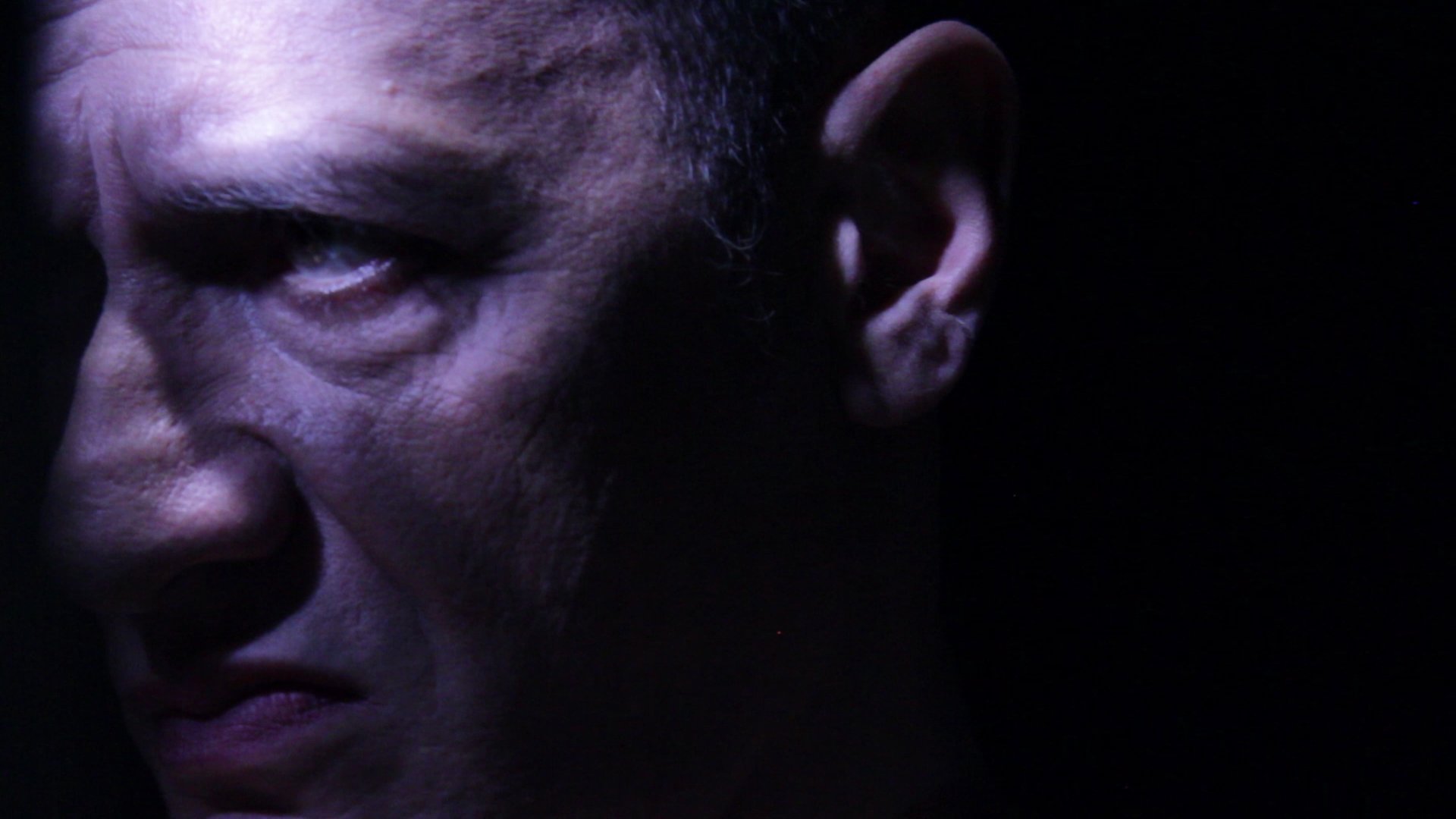
Drama film, by Valerio De Filippis, Italy, 2019.
The mirror and the rascal is an experimental film based on the tragedy "Richard III" by William Shakespeare. It tells the delirium of contemporary power in an author's reinterpretation of cinema, video art and music. The protagonist, Richard Duke of Gloucester, brother of King Edward IV, through a long series of crimes eliminates all the obstacles that stand between him and the throne of England.
Valerio de Filippis, a well-known painter who has been following his research path for a long time, investigating the relationship between light, corporeality and the psyche. The mirror and the rogue and the cinematographic equivalent of Valerio De Filippis' painting, his figurative style is in fact very recognizable looking at his paintings. But cinema is a new way where the artist can also be involved as an actor and performer, with an original mix between acting and singing. Staging the dark side of the human soul, the film is a surreal and disturbing interpretation of a great classic. The director says: "The first suggestion was musical: I was interested in transforming the text of Shakespeare's tragedy Richard III into notes. I love cinema and at a certain point I felt that the time had come to combine research on the image of painting to my love for cinema and music. When the film is finished I realize that I have remained faithful to painting: every frame of the film appears to me like a painting: the same light, the same colors, the same atmosphere ". The mirror and the rascal is a kind of psychoanalytic session that the painter does while hiding behind the mask of Richard III. Behind this ferocious and unscrupulous character we find a path of self-analysis by De Filippis, who is mainly interested in the more violent and turbid aspects. An experimental film in which, with great courage, the author gets involved completely, fragmenting the images in an unconventional montage, which is at the same time a flow of consciousness and spectacle.
LANGUAGE: English
SUBTITLES: Italian
A Man Born Into the Wrong Century’s Corpse
You do not become a political thinker by reading political philosophy. You become one by watching everything you built get dismantled in an afternoon.
Florence in 1469, the year Niccolò Machiavelli was born, was already a city that had learned to wear magnificence as armor. The Medici had perfected the art of ruling without appearing to rule, of holding power through the grammar of generosity rather than the syntax of force. Machiavelli grew up inside this theater, educated in the Latin and humanist traditions that the republic’s merchant class considered its spiritual inheritance, and he watched closely enough to understand that what he was observing was not civic virtue but its remarkably convincing imitation. By the time he was twenty-nine years old, the Medici had been expelled, the republic briefly restored, and Machiavelli had been appointed Second Chancellor of the Florentine Republic in 1498 — a position that placed him not at the center of glory but at the center of work. The real work. The dispatches, the negotiations, the military assessments, the fourteen-year accumulation of observed human behavior in conditions of actual consequence.
He rode to meet Cesare Borgia not once but repeatedly. He sat across from a man who was systematically liquidating rivals and consolidating territory through a combination of audacity and clinical ruthlessness, and he did not look away. Most diplomats in his position were performing their function; Machiavelli was conducting an autopsy on power while its subject was still breathing. He watched Borgia have his own lieutenant strangled and then displayed the body publicly — a theatrical gesture of absolute control — and recognized in that action not horror but information. Something about the nature of authority that his Florentine contemporaries preferred not to name directly.
For fourteen years he served. Missions to France, to the papacy, to the court of the Holy Roman Emperor. He designed and implemented a citizen militia to replace the mercenary forces he had come to consider structurally unreliable, a project he pressed with the conviction of someone who understood that a republic that outsources its violence has already begun to surrender its sovereignty. Then 1512 arrived. The Medici returned. The republic dissolved with a speed that must have felt, to someone who had spent fourteen years in its service, less like a political transition and more like a sentence.
He was arrested. Accused of conspiracy. Subjected to the strappado — a torture method that involved binding the hands behind the back and suspending the body by the wrists, then dropping it in repeated jolts that could dislocate shoulders and destroy tissue — four times. He confessed to nothing because there was nothing to confess. He was released, stripped of all offices, and banished to his small farm at Sant’Andrea in Percussina, near San Casciano. He was forty-three years old.
What happened there resists easy narration, because what happened there was the transmutation of institutional humiliation into the most consequential political text of the modern Western tradition. He described his daily existence in letters: the mornings spent walking in the woods, the afternoons in the local tavern playing cards and dice with men who shouted and quarreled over trivial sums, and then the evenings — when he would change into his formal robes, enter his study, and spend hours in conversation with the ancient writers he had spent a life reading. He was performing a kind of ceremony of selfhood in the ruins of his public identity.
What he wrote in those months was not the product of distance or dispassion. It was written by a man who had genuinely believed in the republic, who had staked fourteen years of labor on its survival, and who was now reconstructing from its wreckage a theory of power that no longer had the luxury of being idealistic. The wound is in every sentence, even when the sentences are perfectly controlled.

The Prince Nobody Wanted to Admit They Were Reading
There is a man you know. Maybe you have worked for him, or voted for him, or admired him from a distance at the kind of dinner party where the conversation stays carefully elevated. He speaks about values. He uses words like integrity and responsibility with a fluency that seems genuine, almost moving. And then, in some back corridor of your experience with him, you catch a glimpse of how he actually operates — the phone call made at the wrong hour to the right person, the silence deployed with surgical precision, the loyalty demanded without ever being offered in return. You do not tell anyone what you saw. Because part of you already knew. Because part of you recognized the grammar of it.
This is the grammar Machiavelli wrote down.
Il Principe was completed in 1513, a text Machiavelli drafted in something close to desperation, a deposed civil servant trying to purchase his way back into relevance with the Medici family that had just had him tortured. It circulated in manuscript for nearly two decades — passed hand to hand, copied, annotated, discussed in private while being carefully ignored in public. It was published only in 1532, five years after its author’s death, as though the world needed him safely buried before it could admit to reading him. And then, in 1559, the Papal Index of Forbidden Books made it official: this text was dangerous. Which, as any honest historian of ideas will tell you, is the surest method ever devised for guaranteeing that everyone reads something.
Every ruler read it. Every strategist, every diplomat, every political operator who publicly denounced it kept a copy close. Francis Bacon read it. Richelieu read it. Frederick the Great wrote a rebuttal — Anti-Machiavel, published in 1740 — and historians have noted with a kind of dry pleasure that Frederick’s actual conduct of Prussian statecraft was thoroughly Machiavellian. Napoleon annotated his copy directly. What produced this compulsive, shamefaced intimacy with a banned text? Not the novelty of the ideas. That is the thing the moralistic tradition has always gotten wrong about Machiavelli’s scandal.
There is a moment — not in any book, but in a life, the kind of life you have either lived or watched closely — where a man who has cultivated an image of measured reasonableness, even a kind of spiritual gravity, sits across a table from someone he is about to destroy professionally and speaks with complete warmth. The smile is real. The concern in his voice is real. Nothing he says is technically false. And the destruction proceeds anyway, through channels he will never be seen near. What is happening in that room is not hypocrisy in the vulgar sense. It is something more structured, more ancient. It is the management of appearances as a distinct discipline, separate from and parallel to the management of reality.
Machiavelli did not invent this. He described it. That is the distinction that his critics, from the sixteenth century to the present, have never been able to metabolize. Antonio Gramsci, writing from a Fascist prison cell in the early 1930s, understood this with unusual clarity — arguing in his Prison Notebooks that Machiavelli’s real transgression was making explicit what political power had always required but required in silence. The scandal was not the content. The scandal was the explicitness. Power had always operated this way. What it had never done before was sit down and say so in plain Italian prose.
Leo Strauss, in Thoughts on Machiavelli published in 1958, called him a teacher of evil. But even Strauss could not stop reading him, could not stop arguing with him across four hundred pages of dense philosophical engagement. You do not spend that much energy on something you genuinely believe is simply wrong.
You spend it on something that keeps being right.
Virtù Is Not Virtue and That Is the Whole Problem
You made a promise last week that you knew, even as the words left your mouth, you would have to break. Not because you are dishonest. Because keeping it would have cost you something you could not afford to lose, and so you smiled, you reassured, you let the other person walk away believing something that was not quite true. And somewhere beneath the relief, there was a small, cold shame you could not name precisely. That shame has a name. It is the gap between what Machiavelli called virtù and what every culture you have ever lived inside told you virtue means.
The confusion is not accidental. It has been manufactured across centuries of willful misreading. When Machiavelli writes of virtù in The Prince, composed in 1513 and circulating in manuscript before its posthumous publication in 1532, he is not praising goodness. He is praising capacity. The virtu of a prince is his ability to read a situation, to impose form on chaos, to bend the flood of circumstance before it bends him. It is closer to the Roman virtus, the quality of a man who acts decisively in the face of what fortune throws, than to anything the Sermon on the Mount recommends. Fortuna, for Machiavelli, is that river he describes so vividly, torrential and indifferent. Virtù is not righteousness. It is engineering. It is the levee you build before the flood arrives, and the ruthlessness to build it correctly rather than beautifully.
Isaiah Berlin saw this with uncommon clarity. In his 1972 essay The Originality of Machiavelli, one of the sharpest pieces of intellectual excavation in twentieth-century political philosophy, Berlin argued that the scandal of Machiavelli was not that he corrupted politics with immorality. The real scandal, Berlin wrote, is that Machiavelli revealed two genuinely incompatible moralities standing side by side, neither capable of defeating the other. One is the pagan civic tradition, rooted in Roman and Greek ideals of collective strength, honor, glory, the health of the republic. The other is Christian morality, with its emphasis on humility, mercy, the inner life, the salvation of the individual soul. Berlin’s insight was that these two systems do not merely disagree on tactics. They disagree on what a good life is, what a good community is, what goodness itself means. Machiavelli did not choose evil over good. He chose one conception of the good over another, and had the terrible honesty to say so plainly.
Think of the man who has built something, a city, an organization, a movement, and who stands at the moment when a subordinate must be destroyed to preserve it. Not punished. Destroyed. Removed from history’s ledger with enough force that no one follows the example. He does it. He does it with ceremony, even, because Machiavelli understood that cruelty performed with form is more merciful in aggregate than cruelty dispersed across years of hesitation. The man goes home. He is not a monster. He sleeps, eventually. But he knows that the person who could have done otherwise, who could have extended mercy and absorbed the cost personally, that person would have been living by a different moral grammar entirely. A grammar he long ago decided he could not afford.
This is what Berlin means when he says Machiavelli opened a wound in Western thought that has never healed. The wound is not cynicism. It is the recognition that you cannot be fully Christian and fully effective in the civic sense simultaneously, and that every person who has ever held responsibility of any scale has felt that tearing, even if they called it by other names. Compromise. Pragmatism. The lesser evil. Doing what needed to be done.
You made a promise last week that you knew you would break. You already knew which morality you served.
Fortuna, the River That Does Not Forgive the Unprepared
There is a moment you have lived, even if you refuse to name it as such. Everything was working. The income was stable, the relationship solid, the position secured. You did not act carelessly — on the contrary, you were cautious, you maintained, you preserved. And then something shifted, not catastrophically at first, more like a floor that had been hollow beneath your feet for years, and one ordinary Tuesday you put your weight in the wrong place and the whole thing gave way. You were not punished for being wicked. You were punished for having believed that solidity was a permanent condition rather than a temporary one you had been lucky enough to stand on.
Machiavelli had seen this happen to men far more powerful than you. He had watched Francesco Sforza build Milan through his own force and cunning, and he had watched Cesare Borgia, perhaps the most operationally gifted prince of his era, lose everything not through stupidity or weakness but because he was struck by illness at precisely the moment when history required him to be at full capacity. The timing was lethal. The preparation, for that specific contingency, had been insufficient. And from this, Machiavelli drew not a moral lesson but a structural one: fortuna is a river.
The metaphor appears in the twenty-fifth chapter of Il Principe, written around 1513 though not published until 1532, five years after his death. When the river is calm, he writes, everyone walks along its banks, admires it, builds near it. No one thinks about its nature as a force. But when rains come and it floods, it destroys everything in its path — not because it has chosen its victims, not because it has judged them — but simply because the dikes were not built. Those who had built them beforehand survive. Those who had assumed the river was the river as they had always seen it, do not.
Quentin Skinner, in his 1981 intellectual biography of Machiavelli, identifies precisely what was radical about this metaphor. For centuries before Machiavelli, political thought had operated within a theological architecture in which fortune was either divine providence in disguise or a test imposed by God on men whose virtue would eventually redeem them. Boethius had written the Consolation of Philosophy in a prison cell waiting for execution, and his central argument was that fortune was illusory, that real stability existed in God, that the turning wheel was a reminder to detach from earthly outcomes. This was not merely comforting — it was politically functional, because it made catastrophe legible as part of a divine plan and therefore endurable. Machiavelli dismantled this entirely. He removed God from political causality with surgical precision. Fortune is not a test. It is not providence. It is a river. It has no intention. It does not care whether you prayed.
A man sits in the ruins of a company he built over three decades, every decision documented, every risk calculated. His partners had warned him about a particular dependency, a single supplier, a single market, a single set of circumstances whose continuation he had assumed without examining that assumption. He had not been reckless. He had been static. There is a particular face a person makes in that moment — not grief, exactly, not anger — something closer to the expression of someone who has just understood a rule that was always in operation, that everyone around them somehow knew, and that no one had ever spoken aloud.
Fortuna does not punish the wicked. This is the sentence that should have been written on every palace wall in Renaissance Italy and that should probably be written somewhere you can see it now. She punishes the unprepared. The moral life and the political life operate by different logics, and confusing them — believing that righteousness confers structural protection — is not virtue. It is a category error that the river will eventually correct.
A vision curated by a filmmaker, not an algorithm
In this video I explain our vision
The Republic He Actually Believed In

You have worked somewhere — perhaps you still do — where there was a tension that never fully resolved. Two factions, two logics, two ways of reading the room. It was uncomfortable, sometimes exhausting, occasionally theatrical. And then one side won. Completely, cleanly, without remainder. And you watched, over the following months, as the place became something quieter and somehow less alive, as meetings lost their friction and decisions arrived pre-formed, as the people who remained learned the particular silence of those who have understood that the point is no longer to contribute but to survive.
This is the thing Machiavelli actually saw in Rome. Not the corruption, not the violence, not the intrigue — those he saw too, but they were not his discovery. His discovery was that the conflict between the Senate and the plebs, the structural antagonism that every contemporary analyst treated as Rome’s congenital disease, was in fact the mechanism of its extraordinary vitality. In the Discorsi sopra la prima deca di Tito Livio, composed across the years roughly spanning 1513 to 1519 — written, that is, in almost exact parallel with The Prince, the two texts breathing the same air — he states it with a clarity that still lands like a provocation: the tumults between the nobles and the people were the primary cause of Rome’s liberty, not its obstacle.
This is the Machiavelli that the myth buries. The Machiavellian is a figure of unified, concentrated, unaccountable power. But the Machiavelli of the Discorsi is someone who looks at an institution divided against itself and sees health rather than pathology. He is watching opposing interests grind against each other and recognizing in that friction the production of something that neither faction could generate alone — law, accountability, the permanent negotiation that is what freedom actually looks like when it is not a slogan.
Philip Pettit, in his 1997 Republicanism, gives this intuition its most rigorous modern form. For Pettit, freedom is not the absence of interference — the liberal definition that has dominated Anglo-American political thought since Hobbes and hardened into ideology through Locke, Bentham, and eventually Isaiah Berlin’s famous 1958 distinction between negative and positive liberty. Freedom, Pettit argues, is the absence of domination. You are free not when no one happens to be interfering with you, but when no one has the structural capacity to interfere with you arbitrarily — when you are not dependent on another’s goodwill, caprice, or restraint for the conditions of your own life. The slave whose master is kind is not free. The employee who is well treated by a benevolent executive is not free. The citizen who lives undisturbed under a ruler who simply hasn’t gotten around to disturbing them yet is not free. Freedom as non-domination requires institutions that make arbitrary power structurally impossible, not merely unlikely.
Machiavelli understood this before the vocabulary existed. What the tension between Senate and plebs produced, in his reading, was precisely a set of institutional constraints that neither side could simply abolish — laws, tribunes, appeals, the whole apparatus of Roman republican life that emerged not from philosophical design but from the unresolved pressure of incompatible interests. The conflict was not a problem waiting for a solution. It was the solution. The moment one faction achieved total dominance, the condition for non-domination evaporated, and what remained was a population that had learned — as people in captured institutions always learn — to anticipate rather than contest, to please rather than argue, to read faces rather than make arguments.
You have seen that room. You have perhaps been one of the people learning to read faces. What got lost when the friction disappeared was not the drama of argument but the structural guarantee that your voice had somewhere to land other than the floor.
Why We Needed Him to Be the Devil
There is someone you know — or knew — who said the uncomfortable thing out loud. Not cruelly, not with pleasure, but plainly, without the cushioning language everyone else had agreed to use. Maybe it was in a meeting, maybe at a family table, maybe in a relationship that was already ending. They named what was actually happening. And the room turned on them. Not on the situation, not on the dynamics that had produced the situation — on the person who had spoken it aloud. They became the problem. They became, in some collective and unspoken vote, the difficult one, the cynical one, the one who made everything harder than it needed to be.
You have probably condemned someone like this at least once. It is worth sitting with that.
The word “Machiavellian” entered common usage as an insult approximately a century after Machiavelli’s death, and it has functioned as one ever since — a convenient label for whoever calculates openly, whoever acknowledges the mechanics of power without pretending they do not exist. To call someone Machiavellian is to mark them as morally suspect, as someone who operates without the veil of good intentions that respectable people wear as a matter of social necessity. It is, if you examine it carefully, an accusation of honesty disguised as an accusation of manipulation.
Jean-Jacques Rousseau, writing in Du contrat social in 1762, proposed something that has never quite received the attention it deserves: that Il Principe was not a manual for princes at all, but a warning to the people — a mirror held up so that citizens could see the machinery of domination for what it was. Rousseau‘s reading has the quality of something almost too obvious to be believed. If you want to expose how power operates, you describe it precisely and without euphemism. The book that scandalized Catholic Europe and earned its author posthumous excommunication was, in this reading, an act of radical transparency. The prince was never the audience. The people were.
Antonio Gramsci, writing in a Fascist prison between 1929 and 1935, carried this further. In the Prison Notebooks he argued that Machiavelli was the theorist of collective political will — that the real subject of his work was not the individual ruler but the possibility of a new political order built from historical necessity. Gramsci’s “Modern Prince” was not a man but a party, a movement, an organized collective capable of facing reality without illusions. What Machiavelli had described was not cynicism but lucidity, and lucidity, Gramsci understood from his cell, is the most dangerous quality a political thinker can possess.
The myth of the devil was necessary precisely because the alternative was unbearable. If Machiavelli was simply describing power as it functions — in courts, in republics, in churches, in corporations, in households — then his portrait includes everyone. It includes the statesman who orders a war with a heavy heart and calls it reluctant necessity. It includes the executive who eliminates a department and frames it as strategic realignment. It includes the person who ends a friendship through slow neglect rather than honest rupture, because the slow neglect feels kinder, which is to say it feels less accountable.
Think of a man who is brought in to manage a crisis no one else would touch, who makes the decisions that keep the institution alive, who names the cost clearly and absorbs the hatred for naming it — while those who had created the crisis, who had benefited from it, who would benefit from its resolution, remain untouched by any accusation of ruthlessness. He said what was required. They did what was required. The difference between them was vocabulary.
We made Machiavelli the devil so we could keep doing what he described, without having to recognize ourselves in the description.
The Letter He Wrote at Night, to Men Who Were Already Dead
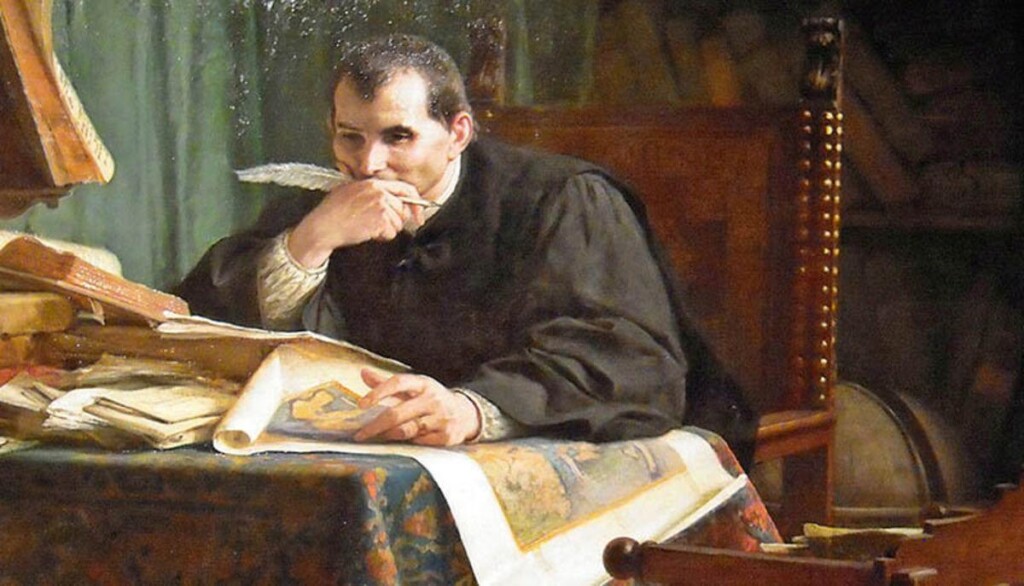
There is a letter. It was written in December 1513, from a small farm outside Florence, by a man who had been tortured that year, stripped of his office, exiled from the city he had served for fourteen years. During the day, Niccolò Machiavelli caught thrushes, chopped wood, argued with woodcutters about petty sums, played cards and dice at the local inn until he wanted to scream. He recorded all of this with a precision that borders on cruelty toward himself — not self-pity, but something more unsettling, a refusal to look away from the smallness of what his days had become. Then at night, he wrote to his friend Francesco Vettori, he would go home, remove his dirty clothes, put on his court robes, and enter his study. There, in the silence, he would sit with the ancients. He would ask them questions. They would answer.
Read that again slowly. A man who has lost his position, his income, his proximity to power, the very instruments through which his thinking had meaning in the world — this man changes his clothes before sitting down to read. Not as ritual. Not as performance for anyone who might be watching, because no one is watching. He does it because the conversation he is about to have deserves that register. The dignity is not for the ancients, who are dead. It is not for posterity, which he cannot see. It is for the thinking itself, which he refuses to treat as less than it is simply because fortune has reduced his circumstances.
This is the posture you recognize even if you have never lost anything as catastrophic as Machiavelli lost. You have sat somewhere — a kitchen at midnight, a parked car, a desk in a job that uses perhaps a fifth of what you are capable of — and thought something precise and true about the world, and felt the gap between the quality of the thought and the scale of the stage on which you were permitted to think it. That gap does not announce itself loudly. It sits there, specific and quiet, and you either let it become bitterness or you do what Machiavelli did, which is change your clothes anyway.
There is a man who sits in a nearly empty room and continues to make careful, reasoned observations about a world that has decided it no longer needs his observations. Not out of delusion — he knows exactly what has happened and why. Not out of hope — he is forty-four years old, experienced enough in the mechanics of Florentine politics to understand that rehabilitation is not guaranteed and may never come. He continues because something in the structure of his thinking requires continuation, the way a proof requires completion not because anyone is grading it but because incompleteness is its own kind of lie.
Hannah Arendt, writing in The Origins of Totalitarianism in 1951, described the peculiar condition of those who think rigorously about power from outside it — how their clarity becomes both more pure and more weightless at the same time, uncontaminated by compromise but also unmoored from consequence. This is what The Prince carries in its bones: the distillate of a mind that has been freed from the need to be tactful because it has already been destroyed, and so it can finally say, with surgical calm, exactly what it sees.
Whether that clarity constitutes a form of power or the most honest form of defeat imaginable is the question that the letter does not answer and was never meant to, because Machiavelli understood something about questions that only appear to be asking for resolution — that what they are actually doing is measuring the distance between what a mind can hold and what the world will allow it to touch.
🏛️ Power, Thought, and the Labyrinth of History
Machiavelli’s political thought did not emerge in a vacuum — it grew from a rich soil of Renaissance humanism, moral philosophy, and the turbulent history of Italian culture. The articles below trace the intellectual maze that surrounds his legacy, from the philosophical traditions that shaped his world to the thinkers who grappled with power, ethics, and human nature across the centuries.
Antonio Gramsci: vita e pensiero politico
Antonio Gramsci, like Machiavelli, made the relationship between power and civil society the center of his political thought. His reflections on hegemony and the role of intellectuals can be read as a direct continuation of the Machiavellian legacy filtered through a modern lens. Understanding Gramsci is essential for anyone who wants to trace the long shadow that The Prince has cast over Western political theory.
GO TO THE SELECTION: Antonio Gramsci: vita e pensiero politico
Giordano Bruno and the Hermetic Tradition
Giordano Bruno lived and thought in the same Italian Renaissance world that produced Machiavelli, navigating the dangerous intersection of philosophy, religion, and power. His engagement with the Hermetic tradition reveals another face of the same cultural moment — one in which daring ideas could cost a thinker everything. Bruno’s life illuminates the broader intellectual and political risks that Renaissance thinkers faced when challenging established authority.
GO TO THE SELECTION: Giordano Bruno and the Hermetic Tradition
Hannah Arendt: the Philosopher Who Unmasked the Banality of Evil
Hannah Arendt‘s analysis of political power, totalitarianism, and the nature of evil places her in direct dialogue with the Machiavellian tradition she both inherited and critiqued. Her concept of the ‘banality of evil‘ offers a modern counterpoint to Machiavelli’s cold-eyed realism about human nature and statecraft. Reading Arendt alongside Machiavelli reveals how the questions he first posed about power and morality continue to haunt contemporary political philosophy.
GO TO THE SELECTION: Hannah Arendt: the Philosopher Who Unmasked the Banality of Evil
Montaigne: Life and Essays
Montaigne was a near-contemporary of Machiavelli’s legacy and responded to the same Renaissance crisis of values and political instability. His Essays represent a profoundly different answer to the same questions about how a thinking person should live and act in a world of uncertainty and power. Together, Machiavelli and Montaigne form two complementary poles of Renaissance moral and political reflection.
GO TO THE SELECTION: Montaigne: Life and Essays
Explore the Cinema of Ideas on Indiecinema
If these philosophical and political labyrinths have stirred your curiosity, Indiecinema is the streaming platform where thought meets image. Discover a curated selection of independent films that engage with power, history, and the human condition in ways that mainstream cinema rarely dares. Join the community of free thinkers and explore cinema as a form of philosophy in motion.
👉 EXPLORE THE CATALOG: Watch Indie Films in Streaming
A vision curated by a filmmaker, not an algorithm
In this video I explain our vision

