
The Communal Imagination as a Sorting Mechanism
You are sitting in a village that has no name you would recognize, sometime in the thirteenth century, and the woman at the edge of the settlement has just done something that nobody can explain. Her goat survived the winter when yours did not. Her herbs work when the priest’s prayers did not. She has not attended the last two feast days, and when old Margarethe’s child died of a fever, the timing was noticed. Nothing has been said aloud yet. But something has already been decided.

Folklore precedes law the way weather precedes climate. Before any inquisitorial manual was written, before the Malleus Maleficarum appeared in 1487 to systematize what churchmen already suspected, communities across medieval Europe had developed extraordinarily precise local grammars for identifying who belonged and who had secretly always been outside. These were not primitive superstitions waiting to be corrected by doctrine. They were functional taxonomies, embedded in stories, in the names given to illnesses, in the routes taken to avoid certain thresholds after dark. Carlo Ginzburg, in his 1966 study of the benandanti of Friuli, documented how an agrarian fertility cult in northeastern Italy had developed its own internal logic of who fought for the harvest and who threatened it — years before Roman inquisitors arrived and began translating that folk cosmology into the vocabulary of diabolism. The persecution did not create the categories. It inherited them.
What makes this inheritance so difficult to see is that folklore presents itself as memory rather than argument. A legend does not claim to accuse anyone; it claims to remember what happened. The story of the shape-shifting woman who crossed the river at midnight is framed as testimony, not ideology. Yet the social work performed by that story is remarkably precise: it marks a category of person, attaches transgression to specific behaviors — moving alone, refusing surveillance, possessing knowledge that was not transmitted through the approved channels of family or church — and encodes that transgression as something that was always already true about certain people. The story does not produce the outcast. It explains why the outcast was always there.
Keith Thomas, in Religion and the Decline of Magic published in 1971, traced how accusations of witchcraft in early modern England clustered almost perfectly around a specific social rupture: the moment a neighbor refused charity and the person who refused later suffered misfortune. The guilt of turning away the beggar woman was converted, through folk belief, into the anxiety that she had cursed you on the way out. The belief system did not simply reflect social tension; it resolved it by relocating moral culpability. The folklore was doing accounting, not poetry.
This is where the fine line becomes almost invisible, because the mechanisms of communal imagination are not experienced as mechanisms at all. They are experienced as recognition. The village does not believe it is constructing a category when it begins to whisper about the woman at the edge. It believes it is finally seeing clearly what was always there. The feeling is not malice — or not only malice — but the specific relief of a pattern that has suddenly made sense of a sequence of misfortunes. Anthropologists studying rumor propagation in closed communities have noted how rapidly a narrative that assigns cause also assigns identity, and how quickly that assigned identity becomes more real to the community than any contradicting evidence. The story about what someone is capable of becomes the story of what they are, and what they are becomes the justification for what will eventually be done to them — but that logic runs underground, invisible, wrapped in the felt certainty of collective memory rather than the declared transparency of formal accusation.
The Witches of Mount Sciliar
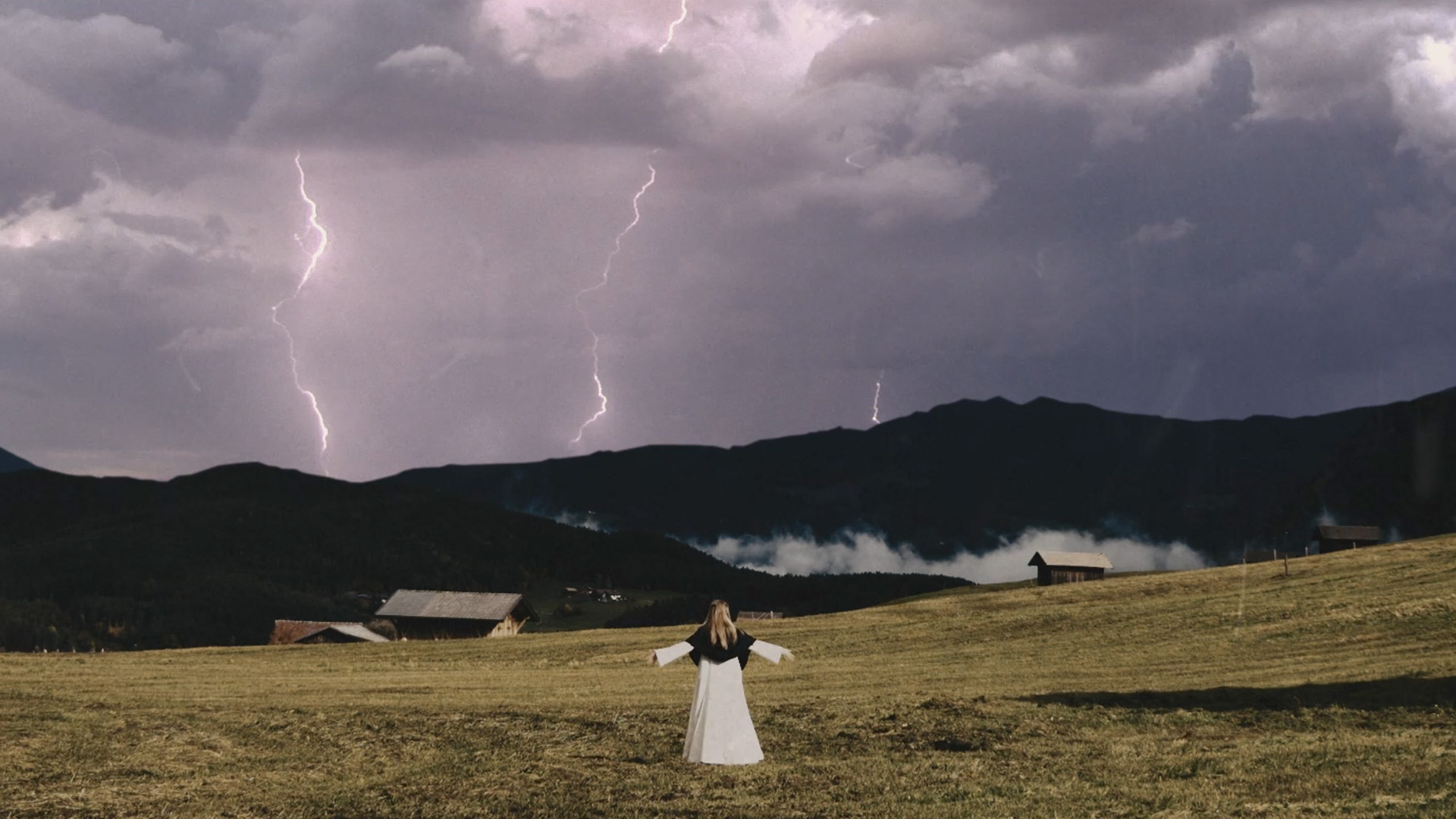
Docufiction, by Andrea Dalfino, 2022, Italy.
The Witches of Scillar is a documentary that delves deeply into the trials that took place in Alto Adige, in Castel Presule and surrounding areas at the beginning of the 16th century, following which more than 10 were condemned to the stake on charges of witchcraft, becoming the real and precursors of the infamous Witch Hunt. Starting from the analysis of the historical context and intertwining local legends with actual events and analyzing the locations of the events with the help and guidance of experts, this film offers a new historical perspective on what happened, culminating with the exposition of what remains of the witches in South Tyrol today and how the crimes of the inquisition are judged in retrospect today.
Alto Adige is a land full of mystery, where history and legend are intertwined, with its magical and fascinating scenarios that push the mind and imagination to wander, investigate, discover. Here is the Sciliar, a suggestive mountain massif located in the natural park of the same name against the backdrop of the Dolomites, and no other mountain is so full of myths and legends as this one, on which it is said that fairy creatures and spirits of all sorts live , and in the Middle Ages it was held up as a meeting place for witches and devils. Here, during the time of the Inquisition, 10 women accused of witchcraft were tried and killed. Director Andrea Dalfino made the documentary The Witches of the Sciliar, enriching the film with fictional scenes that retrace the intricate events of the Fiè trial.
LANGUAGE: Italian
SUBTITLES: English, Spanish, French, German, Portuguese
The Threshold Between Story and Accusation
You have heard the story a hundred times before you understood what it was doing. A woman at the edge of the village — older than she should be, unmarried longer than was comfortable, keeping herbs in bundles that smelled of something you couldn’t name — becomes the subject of a story told by firelight. At first the story is almost tender. It explains her. It gives the community a language for what unsettles them. Then a child falls ill, and the story is still there, perfectly shaped, waiting to become something else entirely.
Stanley Cohen, writing in 1972 in Folk Devils and Moral Panics, identified a process he called the “inventory” — the moment when a society takes stock of a perceived threat and begins rendering it legible through exaggeration and distortion. What Cohen observed in the treatment of British youth subcultures in the 1960s had, in fact, been running as a social mechanism for centuries before anyone named it. The peculiar efficiency of pre-modern village life was that everyone already knew the inventory by heart. The figure of the outsider, the transgressor, the one who didn’t marry or mourn or worship quite correctly, had been catalogued long before any specific person filled the role. The story preceded the accused. It only needed a body.
What makes this threshold so difficult to locate is that the crossing happens through the grammar of ordinary concern. Émile Durkheim argued in The Rules of Sociological Method in 1895 that crime — and by extension, deviance — functions as a boundary marker for the community, not a disruption of it. The village that whispers about the strange woman is not simply afraid of her. It is, in the act of whispering, rehearsing its own coherence. The story about her tells everyone who they are not, which is to say, who they are. The danger encoded in the narrative is also a kind of gift the community gives itself. Persecution, when it comes, is often the by-product of a community trying to feel whole.
Historical records from the witch trial proceedings in Salem in 1692 reveal something that pure theology cannot explain: the accusations clustered around pre-existing social fractures. Carol Karlsen’s 1987 study The Devil in the Shape of a Woman demonstrated that accused women in colonial New England were disproportionately those who stood to inherit property in the absence of male heirs, those whose economic independence had already made them socially illegible. The supernatural narrative did not create the suspicion. It formalized it. It gave a courtroom vocabulary to an anxiety that had been circulating in kitchens and fields for years before the first formal accusation was ever written down.
This is the precise location of the threshold: not in the story itself, and not in the accusation itself, but in the moment when the community stops tolerating the ambiguity the story was originally built to contain. Folk narratives about the strange and the uncanny are, in their earliest form, technologies of coexistence. They let the village say: something here is not fully understood, and we are managing that fact together through language. The story holds the unknown in a kind of suspension. What ruptures that suspension is almost always pressure from outside the narrative — a harvest that fails, a fever that spreads, a legal or ecclesiastical structure that arrives offering resolution in exchange for a name.
Once an institutional framework enters the space that myth had been occupying, the story can no longer afford to stay ambiguous. It must produce evidence. It must name. The folklore that had been a communal murmur becomes testimony, and in that transformation something irreversible occurs — not because the story changed, but because the audience did.

Scapegoating as Inherited Grammar
You are standing in a village in the Jura mountains sometime in the winter of 1610, and the miller’s youngest son has just died of a fever that came and went in three days. No one in the village has a name for what killed him, which means everyone in the village already knows what killed him. The knowledge arrives before the reasoning does. It arrives in the body, as certainty.
What the inquisitors of the fifteenth and sixteenth centuries discovered — and this is the detail that most histories of persecution prefer to skip over — is that they did not need to teach populations how to accuse. The populations already knew. The Malleus Maleficarum, published in 1487 by Heinrich Kramer and Jacob Sprenger, is often read as a machinery of top-down terror, a manual that imposed new fears onto credulous peasants. But Carlo Ginzburg’s work in the 1960s and 1970s, particularly his reconstruction of the benandanti trials in the Friuli region, demonstrated something far more unsettling: the inquisitors frequently arrived in villages where the cosmological architecture of guilt was already standing. They did not build the structure. They simply moved in and began managing the rent.
Folklore had spent centuries developing an extraordinarily efficient causal grammar. When crops failed, when cattle sickened, when a child was born twisted or died before it could speak, the community did not experience randomness. Randomness is a philosophical luxury that requires institutional distance from suffering. For people whose survival margin was measured in grain stored before the first frost, causeless catastrophe was cognitively unbearable. The narrative logic that filled that void was not superstition in the condescending modern sense — it was a functional epistemic system that assigned agency to misfortune, located that agency in a human body nearby, and provided a procedure for response. The witch, the evil eye, the man who walked through the rye at the wrong hour — these were not metaphors. They were load-bearing explanations holding up the entire structure of communal meaning.
What the juridical apparatus of early modern persecution did was borrow this grammar wholesale and then standardize it. The same narrative sequence that a village elder used to explain a child’s death — proximity, difference, transgression, consequence — became the skeletal logic of inquisitorial procedure. René Girard, writing in La Violence et le sacré in 1972, identified the victim of collective violence as almost always someone who occupies a liminal or anomalous position in the group: the stranger, the disabled, the one who arrived last, the one who refused to marry. This is not a feature of institutional persecution. It is a feature of how communities have always managed anxiety about internal disorder. The institution did not invent the target profile. It inherited it, codified it in Latin, and gave it the authority of parchment and seal.
This inheritance is what makes scapegoating so difficult to recognize from the inside. Because the accusation never feels like accusation — it feels like recognition. The community does not experience itself as constructing a guilty party. It experiences itself as finally naming what everyone already sensed. The emotional register is one of relief, not aggression. And this relief is not cynical. It is genuine. It is the relief of a mind that has found a cause for its suffering and can now act. The social anthropologist Mary Douglas, in Purity and Danger published in 1966, showed that what cultures classify as dangerous or polluting is never arbitrary — it maps precisely onto whatever threatens the coherence of their categorical systems. Persecution follows the same logic: it is not aimed at the genuinely powerful, who are too costly to accuse, but at whoever has already been pre-classified as structurally anomalous by the inherited symbolic order that preceded every trial, every edict, every inquisitor.
The Normalization of the Monstrous Neighbor

You have probably heard the story before, even if you cannot trace its origin: a child falls ill, a neighbor is strange, and the village already knows, somehow, before anyone has spoken a word in accusation. The knowing precedes the evidence because it was never waiting for evidence. It was waiting for occasion.
This is the mechanism that Carlo Ginzburg spent decades excavating in the court records of sixteenth-century Friuli, and what he found in “The Night Battles” (1966) was not a population of cynical manipulators inventing charges against the innocent, but something far more unsettling — communities of people who genuinely believed, who had inherited an entire symbolic architecture that made accusation feel like recognition. The benandanti who confessed to nocturnal battles against witches were not lying. They were speaking from within a cosmology that the Inquisition itself struggled to overwrite, because that cosmology was older, more intimate, more woven into the texture of daily life than any theological correction could reach. Persecution does not require malice. It requires inheritance.
What folklore accomplishes, and what distinguishes it from other forms of social regulation, is that it naturalizes the category of the internal enemy before any specific enemy exists to fill it. The witch is not invented in response to a particular woman. The particular woman is perceived through a template that has been in place for generations, refined through repetition, transmitted through lullabies and cautionary tales, embedded in the very metaphors a community uses to explain misfortune. By the time a finger is pointed, the conceptual slot has been waiting, fully furnished, for a tenant. This is what makes the violence that follows feel, to those who commit it, like diagnosis rather than assault.
The figure of the changeling is perhaps the purest expression of this logic. In Germanic and Celtic traditions running at least through the medieval period and well into the seventeenth century, the belief that fairies or demons had replaced a human infant with a malformed substitute provided communities with a narrative container for disability, developmental difference, and maternal despair. The historian Keith Thomas documented in “Religion and the Decline of Magic” (1971) how these beliefs were not peripheral superstitions held by the ignorant but structuring assumptions that shaped behavior across social classes. A child who did not develop as expected was not a child to be accommodated — it was evidence of an invasion, and the appropriate response was exposure, starvation, or ritual violence aimed at forcing the original child’s return. The monstrous neighbor had been miniaturized, placed in the cradle, and the mother who mourned was mourning something that had already been semantically erased.
What insulates communities from recognizing this as violence is precisely the comfort of the narrative. Folklore is not experienced as ideology — it is experienced as common sense, as the kind of thing everyone knows, which means it carries none of the cognitive friction that deliberate cruelty would produce. The persecutors of the early modern witch trials, as Robert Muchembled argued in “A History of the Devil” (2003), were not aberrations from their culture. They were its most faithful expressions. The judges who signed death warrants, the neighbors who testified, the priests who blessed the proceedings — they were all operating within a hermeneutic that had been so thoroughly internalized it had ceased to be visible as a choice. You cannot refuse a grammar you do not know you are speaking.
And here is where the domestication becomes most dangerous: the more ordinary the monstrous figure, the more invisible the threshold between suspicion and sentence.
Institutional Codification of the Folkloric Impulse
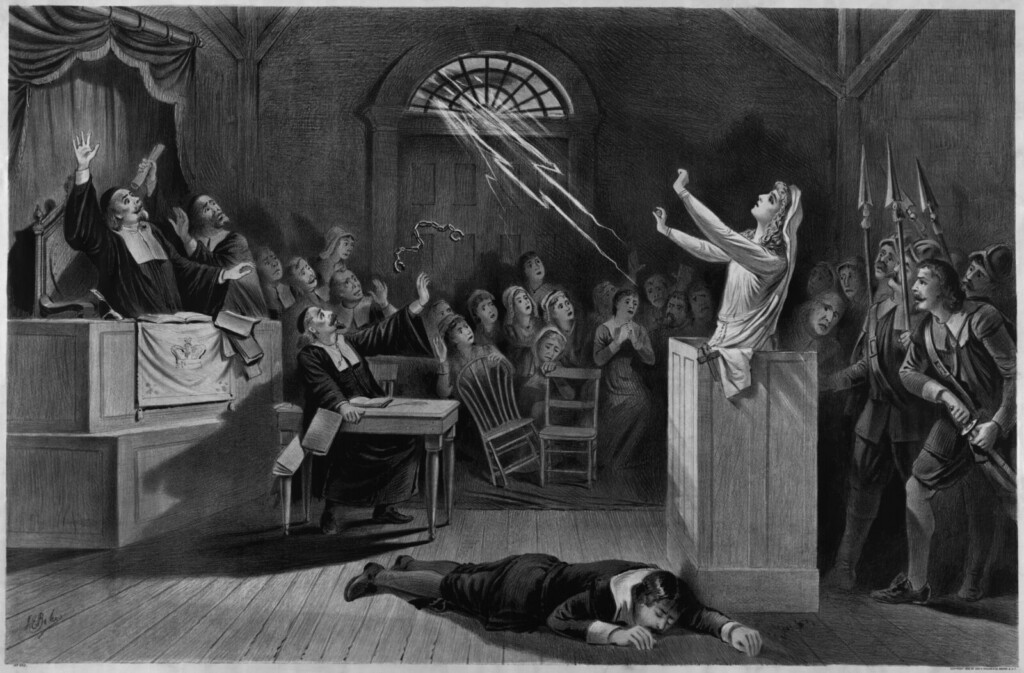
You are sitting in a courtroom in Innsbruck in 1485, and the man reading from a document is not improvising. Heinrich Kramer has spent years collecting testimony — whispers from villages, accusations exchanged across fences, the accumulated sediment of generations of folk belief about who poisons wells and who makes cattle barren — and he is now organizing it into a prosecutorial architecture. What he produces two years later, the Malleus Maleficarum published in 1487, is not an invention. It is a codification. The horror it enables is precisely the horror that was already circulating in the spoken language of ordinary communities, now given Latin syntax, papal endorsement, and the weight of print.
The printing press had existed for roughly three decades when Kramer’s text appeared, and that timing is not incidental. Before mechanical reproduction, local folklore remained local — porous, contradictory, unable to achieve the lethal consistency that persecution requires. The Malleus went through at least fourteen editions before 1520, not because inquisitors were uniquely sadistic, but because it resolved a practical problem: how do you prosecute something that everyone believes differently? You standardize the belief. The institution does not generate the fear; it generates the procedure that makes fear actionable across jurisdictions, across languages, across centuries.
Roman law had already demonstrated what happens when communal suspicion receives procedural infrastructure. The quaestio per tormenta — judicial torture — was reintroduced into European legal practice through the revival of Roman legal texts in the twelfth and thirteenth centuries, culminating in Frederick II’s Constitutions of Melfi in 1231. What this meant in practice was that the threshold between accusation and confession collapsed. A neighbor’s word, embedded in a legal system that permitted extracting confession through pain, became indistinguishable from proof. The community’s pre-existing repertoire of suspicion — she is strange, he arrived recently, they do not mourn the same way we do — acquired the formal dignity of evidence.
What nationalism did in the nineteenth century was structurally identical, though the mythology it mobilized was secular rather than theological. Jacob and Wilhelm Grimm were not simply collecting fairy tales when they published their Kinder- und Hausmärchen in 1812; they were performing an act of ethnic cartography, selecting which stories belonged to the German Volk and which did not, purging foreign elements across successive editions, hardening a fluid oral tradition into a monument of racial identity. By the time the collection reached its seventh edition in 1857, it had been transformed from folklore into genealogy — a document that implicitly defined who counted as native and who remained perpetually external to the blood-memory of the community.
The distance between that editorial project and the legal categories of the following century is measurable in specific legislative steps, not in some vague cultural drift. The apparatus was always the translation mechanism: the point where the community’s unarticulated sense of who belongs converts into a list, a category, a statute. Giorgio Agamben, examining the structure of the state of exception in Homo Sacer published in 1995, argues that sovereign power defines itself precisely by its capacity to exclude — to place certain lives outside the protection of law while keeping them inside the territory of its operation. What he describes philosophically, the witch trial and the ethnic register had already performed administratively, centuries apart, using the raw material that folklore provided.
The folk community never needed institutions to feel the presence of the threatening outsider. What it needed them for was permanence — the conversion of a seasonal anxiety into a durable category, a monstrous figure that could outlast the specific harvest failure or epidemic that first conjured it, and travel forward in time as policy.
A vision curated by a filmmaker, not an algorithm
In this video I explain our vision
🌿 When Tradition Turns Into a Weapon of Fear
The border between a community’s living myths and the mechanisms of scapegoating is thinner than it seems. Local folklore carries the memory of a people, but it can also become the ideological soil in which persecution takes root. These articles explore the cultural, psychological, and historical forces that transform belonging into exclusion.
The roots of social prejudice and the mechanisms of exclusion
Social prejudice rarely emerges from nowhere — it is built slowly through stories, rituals, and inherited suspicions that a community tells itself about those who are different. Understanding the deep roots of exclusion means tracing the folklore and shared narratives that give prejudice its apparent legitimacy. This article dissects the mechanisms by which cultural traditions can quietly become instruments of marginalization.
GO TO THE SELECTION: The roots of social prejudice and the mechanisms of exclusion
Cultural resilience as a defense against the extinction of minorities
When a minority community clings to its cultural identity under pressure, it is performing an act of survival that carries both beauty and risk. Cultural resilience can preserve a people’s soul, but the majority’s fear of that same resilience has historically sparked persecution. This piece examines how minority cultures resist erasure while navigating the danger that their very distinctiveness provokes.
GO TO THE SELECTION: Cultural resilience as a defense against the extinction of minorities
The indissoluble link between historical memory and collective consciousness
Collective consciousness is shaped by the stories a society chooses to remember and those it decides to forget — and folklore sits precisely at that contested boundary. Historical memory can sanctify a community’s identity while simultaneously casting shadows on those who do not share it. This article investigates the indissoluble link between what we remember together and how we treat those we define as other.
GO TO THE SELECTION: The indissoluble link between historical memory and collective consciousness
Protecting human dignity against the processes of social marginalization
The process of social marginalization often begins with cultural labeling — the assignment of stigma through legend, rumor, and communal myth. Protecting human dignity means recognizing how folklore and tradition can be weaponized to justify the exclusion of entire groups. This article reflects on the philosophical and social tools available to resist the slow erosion of dignity that persecution always begins with.
GO TO THE SELECTION: Protecting human dignity against the processes of social marginalization
Discover the Cinema That Asks the Hard Questions
If these themes stir something in you, independent cinema is where they find their most honest and unfiltered expression. On Indiecinema you will discover films that confront the origins of fear, the fragility of belonging, and the courage of those who refuse to become someone else’s myth. Explore our streaming catalog and let the films that matter find you.
👉 EXPLORE THE CATALOG: Watch Indie Films in Streaming
A vision curated by a filmmaker, not an algorithm
In this video I explain our vision

