
The Slow Grammar of Disappearance
You stop correcting people when they mispronounce your grandmother’s name. Not because it no longer matters, but because the correction itself has become exhausting in a way that feels, after a while, indistinguishable from shame. The name softens. The edges round off. You begin introducing her differently, with a version that sits more comfortably in other people’s mouths, and one morning you realize you can no longer hear the original without it sounding faintly foreign to you too. Nothing was taken. No one threatened you. The disappearance was collaborative, performed in small daily surrenders so incremental they never triggered the alarm that violence would have.

This is the grammar most minorities actually die by. Not the dramatic grammar of pogroms and bonfires, not the grammar that produces martyrs and monuments, but the slow subordinate-clause grammar of adaptation, of social lubrication, of wanting to be understood more than you want to be yourself. The distinction matters enormously, because the two processes demand entirely different frameworks of analysis and entirely different forms of resistance. A culture destroyed by force leaves ruins, archives, a before-and-after that history can name. A culture dissolved by consent leaves almost nothing — no clear perpetrator, no moment of rupture, only a community that gradually stops teaching its children something it had taught for four hundred years, because the children asked why, and the parents, for the first time, had no answer.
Orlando Figes, reconstructing the interior lives of Soviet citizens across three decades of Stalinist rule in his 2007 work The Whisperers, documents something more disturbing than official repression. He finds a population that had internalized the logic of erasure so thoroughly that it no longer required enforcement. Families destroyed their own letters, their own photographs, their own religious objects — not because soldiers were at the door, but because the cost of holding onto them had been calculated privately and found too high. The Soviet state had not simply banned certain identities; it had restructured the emotional economics of selfhood so that voluntary abandonment felt rational, even prudent, even loving, when done to protect one’s children from the consequences of inheritance. The culture did not vanish because it was forbidden. It vanished because its carriers decided, one by one, that transmission was a form of cruelty.
What Figes captures in that political context has a structural equivalent in every minority community navigating a dominant culture’s gravitational pull. The mechanism is not ideology but arithmetic. When the language you speak at home guarantees social friction, reduced economic opportunity, and the daily low-grade violence of being legible as other, you do not need a state apparatus to convince you to abandon it. The market does the work. The school does the work. The hiring manager who cannot place your accent does the work. By the time a language reaches what linguists call “the last-speaker threshold,” the community has usually been making the same rational calculation for two or three generations, each one slightly more fluent in the dominant tongue, slightly less embarrassed by the relief that fluency brings.
There are roughly seven thousand languages spoken on earth today. Linguists at the Summer Institute of Linguistics estimated in their 2023 Ethnologue report that approximately forty percent of those languages are endangered, with fewer than one thousand speakers each. The number is not what should arrest you. What should arrest you is the silence surrounding how most of them will end — not with a ban, not with a cultural revolution, but with a grandson who understands perfectly and answers in the other language, because that is simply how the conversation goes now, and no one in the room marks it as a threshold, because thresholds only become visible after you have already crossed them.
Ancestral
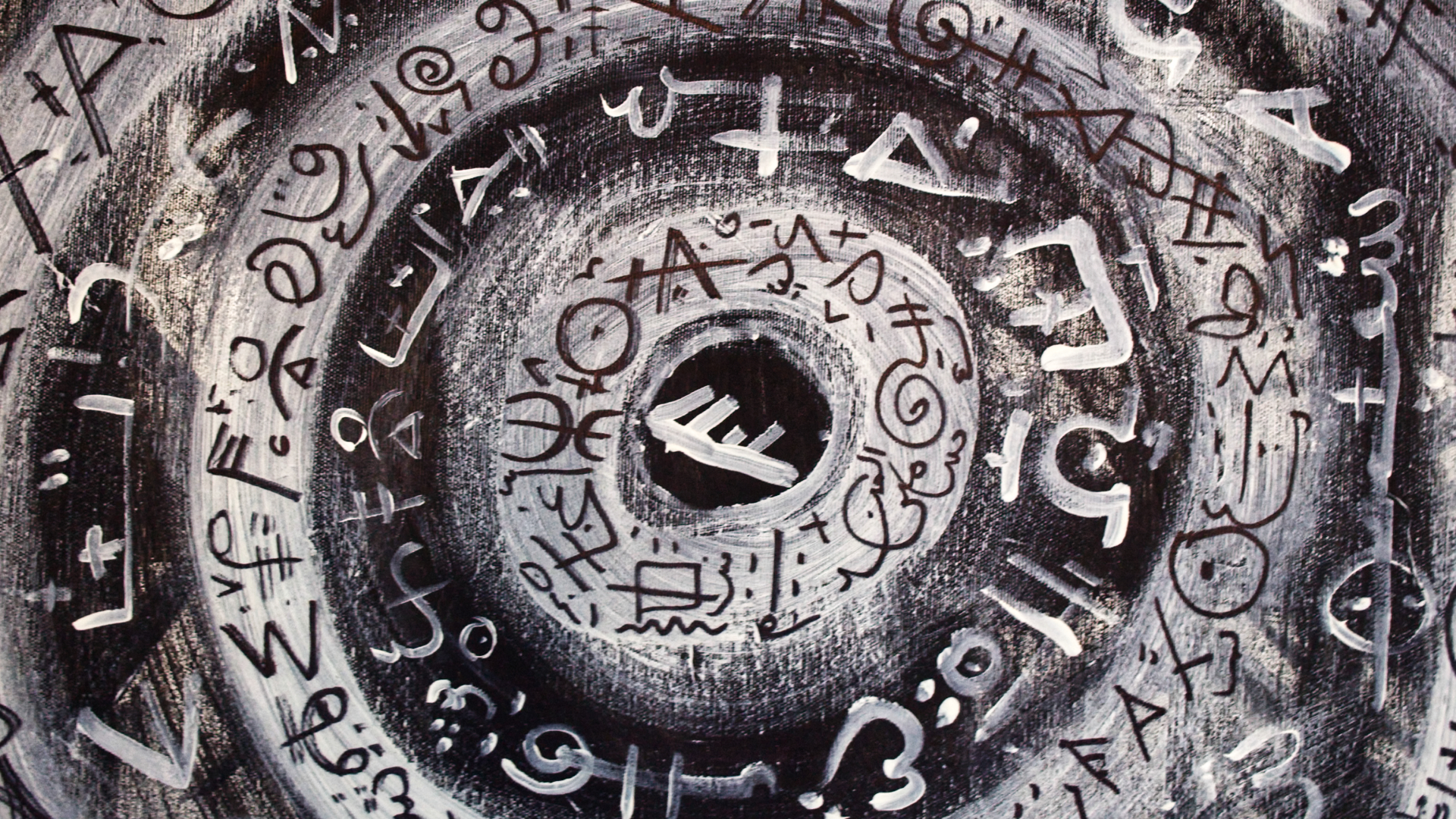
Documentary, by Lumar Brothers, Italy, 2023.
“Ancestral: Life and Art of Massinissa Askeur” is a documentary that explores the life and art of Algerian painter Massinissa Askeur. The film follows Askeur on his creative journey, showing his artistic process and his commitment to the preservation of Berber culture and tradition. Through interviews with Askeur, his family, friends and testimonies from people who knew him on a personal, professional and artistic level, the documentary tells the story of his past and his deep connection to his Berber roots. Askeur displays his art, from canvases to sculptures, which are inspired by the shapes and symbols of Berber culture, representing his search for a connection between the past and the present.
The documentary also explores the challenges Askeur faced throughout his life, including racial discrimination, poverty and the difficulty of making his art known outside of Algeria. However, despite these difficulties, Askeur continues to create and promote his art as a form of cultural resistance and celebration of his ancestral heritage. A vision far from art as a commercial product and very close, instead, to the exploration of the depths of one's own soul and the soul of the world. Massinissa's mission is to leave a testimony of his time to future generations.
LANGUAGE: Italian
SUBTITLES: English, Spanish, French, German, Portuguese
Resilience as Contested Terrain
You inherit a language you were never supposed to keep. Not because your ancestors were poets or patriots, but because speaking it in the wrong room, at the wrong moment, in front of the wrong official, carried a price they could not afford to stop paying. The survival of that language had nothing romantic in it. It was a transaction conducted under duress, in the margins of the permissible, passed between people who understood that visibility was a form of exposure.
The word resilience arrives too clean for this history. It implies a tensile strength, something that bends without breaking, a quality almost biological in its elegance. But what actually sustained minority cultures through the long pressures of colonial administration, religious prohibition, and state-sponsored assimilation was not strength in any heroic sense. It was concealment, strategic incoherence, the deliberate performance of compliance while maintaining a parallel interior life. James C. Scott spent years documenting exactly this mechanism, and what he found was not a culture heroically resisting — it was a culture lying, brilliantly and systematically, to its oppressors. In Domination and the Arts of Resistance, published in 1990, Scott named this the hidden transcript: the discourse that takes place offstage, beyond the surveillance of those who hold power, where the subordinate group says what it cannot afford to say publicly. The public performance of deference is not capitulation. It is infrastructure.
What this means, concretely, is that minority culture survived in kitchens and not in squares, in lullabies and not in manifestos, in the deliberate mispronunciation of a borrowed word that preserved phonemic memory without announcing it. The Yiddish theater in early twentieth-century New York was not an act of defiance aimed at the dominant culture. It was an internal communication system. The Welsh-language chapels that persisted through anglicization were not monuments to resistance. They were places where a particular cognitive and emotional grammar could be rehearsed without requiring translation. Survival operated through opacity, and opacity was the condition of its possibility.
This is the ground on which the contemporary demand for cultural authenticity becomes dangerous. When a minority culture is asked to demonstrate its legitimacy through visibility — to perform its identity for documentation, for policy recognition, for the validation of a cultural grant body — it is being asked to do the opposite of what kept it alive. The demand for authenticity is structurally a demand for transparency, and transparency was historically the first step toward regulation. Theodor Adorno observed, writing in a different register, that what the culture industry produces is not culture but the image of culture — a legible, consumable surface that substitutes for the actual thing. The same logic now operates through the apparatus of cultural preservation. When an indigenous practice is filmed, catalogued, and celebrated in a heritage festival, something happens to it that is not preservation. It is converted into a sign of itself.
The violence in this is not obvious, which is what makes it so effective. It arrives with funding attached. It offers recognition, which communities that have been denied it for generations are understandably hungry to receive. But recognition on the dominant culture’s terms requires the minority culture to stabilize itself, to become legible, to stop being a moving target. And a moving target is precisely what it had to be in order to survive. Scott’s concept of infrapolitics captures this: the low-profile, decentralized, nearly invisible forms of resistance that leave no archive because leaving an archive would have been fatal. The demand that a culture produce an archive of itself in order to be counted as real is the demand that it abandon the strategy that kept it real.

The State, the Archive, and the Manufactured Majority
You are handed a passport and told it contains your identity. The document was designed in a ministry you have never visited, in a language that may not be the one your grandmother used to name the rain, and its categories — nationality, ethnicity, place of birth — were drafted by administrators whose primary concern was the coherence of a state, not the accuracy of a life. The passport does not describe you. It conscripts you.
Eric Hobsbawm argued in The Invention of Tradition, published in 1983 with Terence Ranger, that many of the rituals, symbols, and continuities modern nations present as ancient are in fact recent fabrications, engineered to manufacture consent for political arrangements that required a sense of deep historical inevitability. The Scottish Highland dress, the formalized pageantry of the British monarchy, the invented lineages of new European states — these were not survivals but constructions, assembled to make the present feel inevitable by forging a usable past. What Hobsbawm identified as invention, minorities have always experienced as erasure: the majority tradition is not merely promoted, it is installed as the default frequency against which all other signals become noise.
The 1847 report on education in Wales, known to Welsh speakers ever since as Brad y Llyfrau Gleision — the Treachery of the Blue Books — demonstrates precisely how institutional memory becomes a weapon. Three English commissioners were dispatched to assess Welsh schools and returned with a document that described the Welsh language as a barrier to moral improvement, economic progress, and civic participation. The Welsh tongue, they concluded, was the reason Welsh people remained poor, isolated, and allegedly immoral. The report was not a neutral assessment. It was an administrative act of cultural pathologization, and it succeeded: within a generation, children in Welsh schools were punished for speaking Welsh through the Welsh Not, a wooden board hung around the neck of any child caught using their native language, passed from child to child throughout the school day until the last holder received a beating at close of school. The archive had spoken. The punishment was merely its enforcement arm.
What makes this mechanism durable is that it does not require ongoing violence once the institutional architecture is in place. The archive — the school curriculum, the official history, the national museum, the census category — continues the work quietly, structurally, without a face attached to it. When a minority community then insists on its own language, its own historiography, its own naming of the world, the state apparatus does not need to call this dangerous. It simply calls it backward. The framing does not require malice; it requires only the assumption that the majority narrative is synonymous with progress, and that any divergence from it is a failure to arrive somewhere everyone is presumably headed.
This reframing has a peculiar psychological efficiency. It turns the act of cultural persistence into an act of aggression. A Breton speaker in twentieth-century France was not understood as someone preserving a living inheritance; they were understood as someone refusing France. A Kurdish child taught Kurdish history was not described as gaining knowledge; the curriculum was described as separatist infrastructure. The state’s own archive, its own invented continuity, became the neutral ground from which all minority memory was measured as deviation. Pierre Nora‘s monumental work Les Lieux de mémoire, which began publication in 1984, exposed how national memory is never simply memory — it is always a selection that doubles as a suppression, a set of consecrated sites and dates that implicitly renders everything outside them unmemorable, marginal, or threatening to collective coherence.
What survives inside a community that has been told its memory does not count is not simply stubbornness.
Identity Under Metabolic Pressure

You wake up one morning and realize you have become legible. Not understood — legible. Your difference has been processed into something the market can shelve, price, and rotate seasonally, and the terrifying part is that it happened while you were trying to survive.
Frantz Fanon observed in his clinical work at the Blida-Joinville Hospital in the early 1950s something that went far beyond the political: colonial subjects were not merely oppressed from outside but restructured from within. In “Black Skin, White Masks,” published in 1952, he described how the colonized person learns to see themselves through the eyes of the colonizer — not as an act of submission but as a psychic survival strategy so deeply embedded it eventually feels like selfhood. The violence Fanon documented was not the violence of the whip but of the mirror: the moment a person reaches for an identity and finds, in their own hands, a reflection belonging to someone else. What he traced in the Antillean intellectual reaching for French cultural validation is not historically distant. It is structurally contemporary. Every minority community navigating economic survival within systems built by and calibrated for dominant cultures is performing a version of the same internal negotiation — constantly translating themselves into a vocabulary that was never designed to hold them.
The economic dimension is not incidental to this psychic erosion; it is its primary engine. When the dominant culture controls the infrastructure of livelihood — the hiring criteria, the aesthetic norms of professional environments, the language of institutional legitimacy — cultural difference becomes a liability with a calculable cost. Sociologist William Julius Wilson documented in “The Declining Significance of Race” in 1978 how class-based mechanisms gradually replaced explicit racial exclusion as the operative force of marginalization, shifting the burden of adaptation entirely onto the individual. The structural message is consistent and unambiguous: assimilate incrementally, render yourself less dissonant, and the penalty decreases. What gets called upward mobility is often, at its affective core, a carefully managed program of cultural self-reduction.
The cruelest contemporary mutation of this pressure is that it no longer arrives as prohibition. It arrives as celebration. Dominant culture has developed an extraordinary capacity to absorb minority difference and reflect it back as product — stripped of its genealogy, its pain, its political charge, and its communal function. A cuisine that encoded generations of agricultural knowledge and colonial displacement becomes a trend. A musical form born from collective grief becomes a streaming algorithm’s recommendation engine. The anthropologist Nestor Garcia Canclini, writing in “Hybrid Cultures” in 1989, identified how modernization processes in Latin America systematically converted traditional cultural forms into folklore precisely at the moment they were economically neutralized — rendered decorative, non-threatening, and purchasable. What looked like preservation was in fact a taxidermy. The culture was displayed without its life-support systems: the community, the function, the transmission across generations.
This metabolization is more destabilizing than hostility because it offers no clear enemy and demands no visible surrender. A community that faces explicit suppression can organize around the wound. A community that watches its most intimate expressions absorbed into mainstream aesthetics and sold back to them at a premium experiences a disorientation that has no obvious political grammar. The threat does not announce itself. It flatters before it hollows. And the members of that community who are most economically mobile, most integrated into dominant institutions, most fluent in the language of legibility, are precisely those with the least structural incentive to sound the alarm — because the metabolization, for them, has already begun to feel indistinguishable from arrival.
The Inheritance That Cannot Be Translated
You are handed a word in a language that has no translation and told simply to feel it. The Tofa people of Siberia have a term for a reindeer that is in its third year and not yet broken for riding — a single word carrying inside it an entire economy of patience, of seasonal timing, of a relationship between a body and an animal that English cannot approach without a paragraph. When that word disappears, the paragraph never gets written. What vanishes is not a synonym. What vanishes is the cognitive groove worn into the mind by centuries of needing to perceive that distinction as primary, as the kind of thing worth naming before anything else.
The 2010 UNESCO Atlas of the World’s Languages in Danger documented 2,473 languages at varying degrees of threat, with roughly 230 languages having gone extinct since 1950 alone. These are not losses of communication — every speaker of a dying language typically holds a second, dominant tongue. These are losses of architecture. Cognitive linguists since Benjamin Lee Whorf have been misread as claiming that language determines thought, which is too crude, but the more durable finding, refined by Lera Boroditsky’s experimental work at Stanford through the 2000s, is that habitual linguistic categories shape the default pathways along which perception moves. The Kuuk Thaayorre of northern Australia orient themselves not by relative position — left, right, behind — but by absolute cardinal directions at all times. A Kuuk Thaayorre speaker cannot say their hand hurts without implicitly knowing where north is. That spatial cognition, that permanent situatedness in the world, is not a metaphor for cultural identity. It is a measurable neurological habit that ceases to be transmitted the moment children stop dreaming in the language.
Oral traditions accelerate this irreversibility because they carry what no archive can hold: the performative body. The Homeric epics survived their oral phase only because the Greek world had already developed conditions for transcription, but the vast majority of oral cultures did not encounter writing on their own terms. They encountered it as colonial instrument — the missionary school, the census form, the land treaty written in a language whose legal epistemology encoded theft as procedure. What the anthropologist Jack Goody identified in The Domestication of the Savage Mind in 1977 as the structural difference between oral and literate cognition is not a hierarchy of sophistication but a genuine divergence in how memory, authority, and social trust are organized. Oral cultures distribute knowledge across living relationships — it lives in the grandmother’s particular intonation, in the ceremonial sequence that cannot be abbreviated without losing meaning — rather than in retrievable objects. Once the chain of transmission breaks, the archive cannot substitute for it, because the archive was never what the knowledge was stored in.
The paradox that haunts every cultural preservation effort is that the most irreducible elements are also the least legible to the institutions offering protection. UNESCO can register an intangible heritage. A government can fund a language revitalization program. But the relational structures that give a ritual its actual function — the specific obligation network, the hierarchy of speakers, the seasonal timing tied to a landscape being simultaneously destroyed by extractive industry — these do not survive the translation into fundable categories. The Welsh language revival since the 1960s, culminating in the Welsh Language Act of 1993 and a current speaker population hovering around 900,000, demonstrates that legal recognition and educational infrastructure can genuinely arrest decline. What it cannot restore is the social world in which Welsh was once the language of chapel debt, of inheritance disputes, of the specific moral texture of a nonconformist community organized around obligations that have no continuation. Language returns; the cognitive world it once indexed does not always follow, because that world was not made of words but of the living arrangements that made certain words necessary.
A vision curated by a filmmaker, not an algorithm
In this video I explain our vision
🌿 When Cultures Resist Erasure and Endure
Cultural resilience is one of the most powerful forces a minority community can wield against the threat of extinction. From language preservation to artistic tradition, the acts of remembering and creating become forms of survival. These articles trace the many faces of resistance, identity, and the refusal to disappear.
Psychological Resilience: How to Turn Hardship into Strength
Psychological resilience is not merely an individual capacity — it is also a collective muscle that communities develop in response to sustained pressure and marginalization. This article explores how adversity can be transformed into strength, drawing on psychology to illuminate the inner architecture of endurance. For minority cultures facing assimilation or erasure, such frameworks offer both language and strategy for survival.
GO TO THE SELECTION: Psychological Resilience: How to Turn Hardship into Strength
Antonio Gramsci: vita e pensiero politico
Antonio Gramsci‘s concept of cultural hegemony remains one of the sharpest tools for understanding how dominant cultures suppress minority identities not through force alone, but through the gradual colonization of thought and meaning. His life and political thought reveal how subaltern groups can resist by building counter-narratives and asserting the legitimacy of their own knowledge. Cultural resilience, in Gramsci’s terms, is always also a political act.
GO TO THE SELECTION: Antonio Gramsci: vita e pensiero politico
Williams’s Culture and Society: Analysis
Raymond Williams‘s landmark work Culture and Society examines how culture functions as a living record of collective experience, one that can be preserved, contested, or destroyed depending on the forces at play in a given society. His analysis illuminates why cultural identity is never merely symbolic but is tied directly to social power and survival. For endangered minorities, sustaining a distinct cultural life is inseparable from sustaining the community itself.
GO TO THE SELECTION: Williams’s Culture and Society: Analysis
Jan Assmann and Cultural Memory
Jan Assmann‘s theory of cultural memory explores how societies encode their identity into rituals, texts, and monuments in order to transmit it across generations and resist the erosion of time or conquest. His work is essential for understanding why minorities invest so deeply in cultural practices that may seem marginal to outsiders — they are, in fact, the architecture of collective survival. Without cultural memory, a people loses not only its past but its sense of a shared future.
GO TO THE SELECTION: Jan Assmann and Cultural Memory
Discover Cinema That Bears Witness to Living Cultures
On Indiecinema you will find independent films that give voice to the stories, struggles, and beauty of communities fighting to preserve who they are. Explore our streaming catalog and let cinema be your guide through the landscapes of cultural resilience.
👉 EXPLORE THE CATALOG: Watch Indie Films in Streaming
A vision curated by a filmmaker, not an algorithm
In this video I explain our vision

