
The Mountain as Psychological Architecture
You are walking a path that narrows as it climbs, and at some point the valley below has disappeared entirely — not gradually, not metaphorically, but with the sudden finality of a door closing. The village you left an hour ago no longer exists in any perceptible sense. There is only rock, wind, and the particular silence that high altitude produces, a silence so complete it begins to manufacture sounds from within you rather than without. What your nervous system does in that moment is not mysticism. It is architecture.

The Alps did not simply surround medieval communities — they structured their cognition. Geographers and anthropologists have long noted that enclosed terrain produces what might be called topographic determinism, a condition in which the physical limits of a landscape become the psychological limits of a mind. In 1974, the anthropologist Robert Netting published his landmark study of the Lötschen Valley in the Swiss Alps, documenting how communities sealed by mountain walls for months at a time developed belief systems that were not decorative but functional — maps of a world in which the boundary between the living and the dead, between the knowable and the forbidden, tracked almost exactly onto the boundary between the valley floor and the peaks above. The supernatural was not imported into these places. It was extruded from them, the way pressure extrudes material through the only opening available.
Altitude itself is a neurological event. At elevations above 2,500 meters, even without acute mountain sickness, the brain operates under reduced oxygen partial pressure, producing subtle but measurable effects: heightened emotional sensitivity, increased incidence of auditory and visual anomalies, a loosening of the boundary between self and environment that neurologists associate with activity in the right temporal-parietal junction. The 18th-century physician Johann Jakob Scheuchzer, who traveled extensively through the Alps and published his Itinera per Helvetiae alpinas regiones between 1723 and 1733, recorded with scientific earnestness the testimonies of mountain guides who described presences, voices, and figures at high altitude — and then proceeded to catalogue them as evidence for the existence of dragons. What is extraordinary is not his credulity but his method: he was applying the best empirical framework available to him, and the data kept insisting on anomaly. The mountain was producing experiences that resisted every category except the supernatural.
Isolation compounds this in ways that are not linear but exponential. Social psychologists studying sensory and social deprivation — most rigorously in the work of John Zubek’s research programs at the University of Manitoba through the 1960s — found that even relatively brief periods of reduced social contact and environmental monotony produce hallucination rates and reality-testing failures in otherwise healthy adults that would be clinically alarming in any other context. In Alpine communities, winter isolation was not a laboratory condition but a structural fact of life lasting four to six months annually, generation after generation, with no interruption across centuries. The mythology that emerged was not a failure of reason — it was reason operating on a dataset that genuinely contained phenomena no existing category could absorb.
What this means is that the magical imagery of the Alps was never primitive in the sense of being pre-rational. It was post-experiential — the codification of actual perceptual events that the community needed to share, transmit, and make survivable. A creature that inhabits the high snowfield and punishes those who cross it without permission is not a fairy tale told to children. It is a distributed warning system, a socially legible form for encoding real danger in terrain where individual error is fatal and collective memory is the only archive that survives the next avalanche.
The Witches of Mount Sciliar
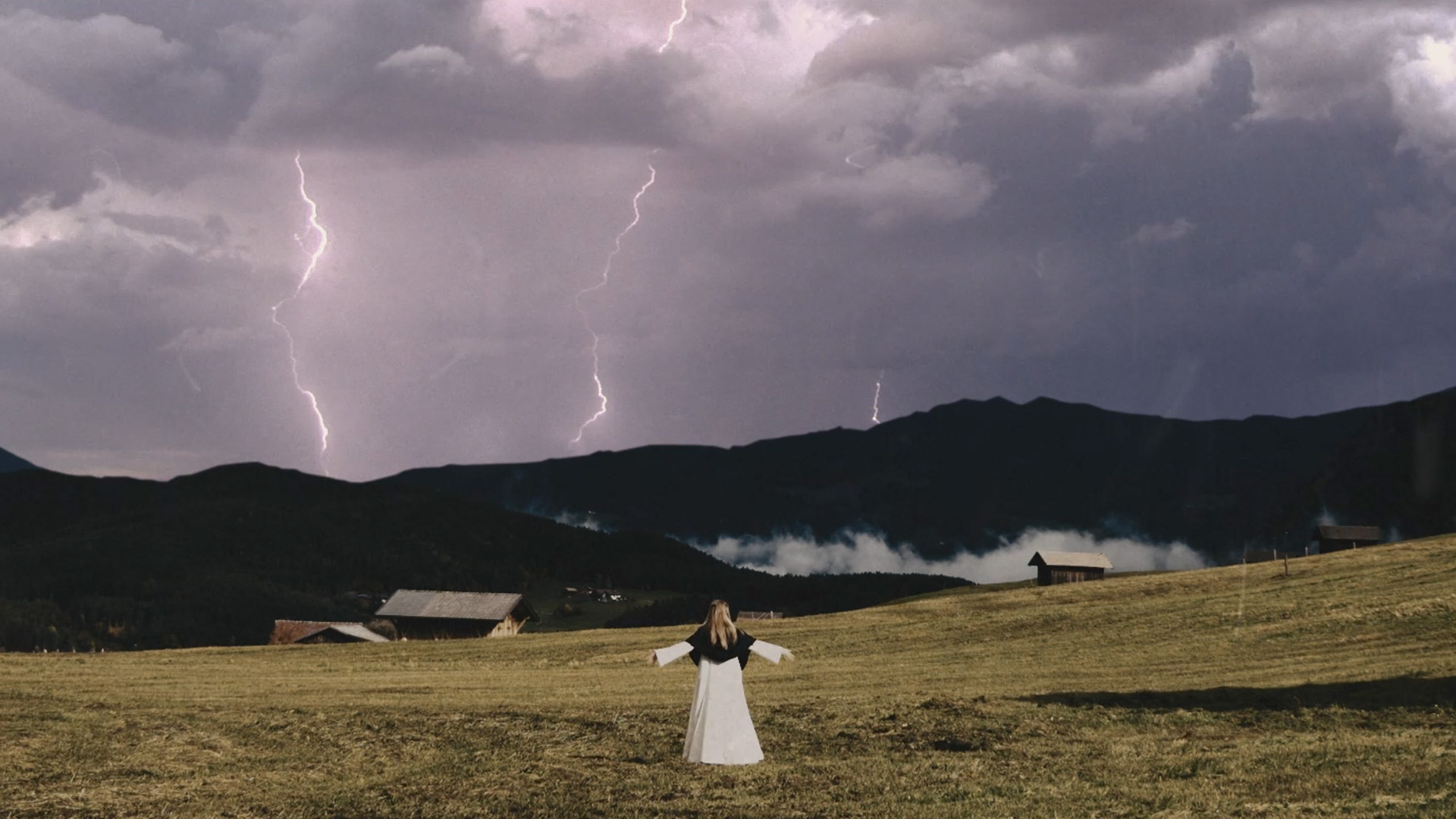
Docufiction, by Andrea Dalfino, 2022, Italy.
The Witches of Scillar is a documentary that delves deeply into the trials that took place in Alto Adige, in Castel Presule and surrounding areas at the beginning of the 16th century, following which more than 10 were condemned to the stake on charges of witchcraft, becoming the real and precursors of the infamous Witch Hunt. Starting from the analysis of the historical context and intertwining local legends with actual events and analyzing the locations of the events with the help and guidance of experts, this film offers a new historical perspective on what happened, culminating with the exposition of what remains of the witches in South Tyrol today and how the crimes of the inquisition are judged in retrospect today.
Alto Adige is a land full of mystery, where history and legend are intertwined, with its magical and fascinating scenarios that push the mind and imagination to wander, investigate, discover. Here is the Sciliar, a suggestive mountain massif located in the natural park of the same name against the backdrop of the Dolomites, and no other mountain is so full of myths and legends as this one, on which it is said that fairy creatures and spirits of all sorts live , and in the Middle Ages it was held up as a meeting place for witches and devils. Here, during the time of the Inquisition, 10 women accused of witchcraft were tried and killed. Director Andrea Dalfino made the documentary The Witches of the Sciliar, enriching the film with fictional scenes that retrace the intricate events of the Fiè trial.
LANGUAGE: Italian
SUBTITLES: English, Spanish, French, German, Portuguese
Superstition as Social Technology

You do not stumble upon the witch trials of the Valais by accident. The records begin around 1428, earlier than almost anywhere else in Europe, and they concentrate with peculiar density in the narrow corridors between peaks where land was scarce, inheritance disputes festered for generations, and a single bad harvest could tip an entire community toward starvation. What the historians Richard Kieckhefer and Wolfgang Behringer both noticed, approaching the archives from different angles, is that the accused were rarely strangers. They were neighbors. The woman who knew too much about your goats. The man whose field inexplicably survived the frost that killed yours. The supernatural accusation was not imported from outside; it was manufactured from the friction of proximity.
Behringer’s work on witch trials in Bavaria and the Alpine foothills, particularly in his 1998 study, makes the case that persecution waves tracked climate catastrophe with uncomfortable precision. The years between 1560 and 1630 correspond to the harshest phase of the Little Ice Age, when Alpine glaciers advanced visibly within a single lifetime and harvests failed in cascades. In that context, the figure of the weather-witch was not metaphor. It was a diagnostic tool. Someone had to be responsible for the cold. The theological machinery of the Malleus Maleficarum, published in 1486 by Heinrich Kramer, provided the operating manual, but the communities themselves provided the fuel. What gets lost in the standard narrative of Church persecution raining down on passive victims is that local accusation networks functioned with extraordinary social logic: they identified surplus-holders, boundary-crossers, and those who violated the unspoken economy of mutual dependency.
The cursed peak operated by the same logic as the accused neighbor, but at a territorial scale. When communities in the Bernese Oberland or the Aosta Valley designated a specific summit as forbidden — haunted, inhabited by spirits hostile to the living — they were encoding a property relation in supernatural language. Livestock did not graze there. Outsiders who attempted to cross received warnings they understood as spiritual but that functioned as political. Carlo Ginzburg’s research into the benandanti of Friuli, published in 1966, revealed something structurally identical: a class of ritual specialists whose role was ostensibly cosmological but whose actual function was to adjudicate disputes about harvests, thefts, and communal boundaries. The supernatural was never merely decorative. It was administrative.
What makes this particularly difficult to see from the present is that we have inherited a contempt for superstition that itself carries ideological freight. The Enlightenment reframing of Alpine magical belief as primitive error was not a neutral act of intellectual clarification. It was a precondition for the administrative absorption of Alpine communities into centralized nation-states. Once you convince a population that their regulatory fictions are embarrassing fantasies rather than functional social technologies, you dissolve the local authority that gave those fictions their binding force. The Swiss historian Jon Mathieu has documented how state-building pressure in the eighteenth century systematically delegitimized communal Alpine governance structures, and the ridicule of folk belief was one of its instruments — subtle, effective, and almost never recognized as coercive because it arrived dressed as reason.
The fear of the Tatzelwurm, a creature reported in Austrian and Swiss Alpine folklore well into the nineteenth century, kept children from certain ravines. Whether the creature existed is the wrong question entirely. The ravines were dangerous. The prohibition was real. And the image of a scaled, armless serpent lurking in the mist enforced a spatial boundary that no legal ordinance could have communicated with equivalent force to a population that had no reliable access to written law and every reason to distrust the officials who administered it.

The Romanticization Trap and Its Ideological Cost
You have stood at the edge of a precipice in the Alps and felt something rise in your chest that you immediately wanted to call sublime — that clean, almost pleasurable vertigo, the sense of being small before something vast and indifferent. What you felt in that moment was not a natural response. It was a learned one, installed over two centuries of cultural production designed to make the mountain safe enough to feel.
Jean-Jacques Rousseau‘s Julie, ou la Nouvelle Héloïse, published in 1761, triggered what historians of sensibility now recognize as the first mass aesthetic conversion to alpine landscape. Before that novel, educated Europeans largely described high mountain terrain as repulsive — deformed, hostile, a wound in the earth’s surface. Rousseau transformed altitude into moral elevation, and the Swiss peaks into a stage for spiritual refinement available to any sufficiently sensitive soul willing to make the journey. The crucial operation in this transformation was not description but erasure. What vanished from the mountain, in his telling, was exactly what the people who actually lived there had spent centuries articulating: the presence of entities that ate children, the pacts made at crossroads during snowstorms, the particular horror of losing a neighbor to an avalanche that could not be explained by physics because physics was not yet the explanatory framework available. Rousseau replaced a populated supernatural landscape with a depopulated aesthetic one.
Caspar David Friedrich‘s paintings between 1808 and 1824 completed the iconographic work that Rousseau’s prose had begun. The wanderer above the sea of fog — a solitary bourgeois male, back turned, contemplating immensity — became the visual grammar through which an entire class learned to consume wildness from a position of safety. The figure in Friedrich’s canvases is never in danger. He stands at the edge but is never at risk of falling, never at risk of meeting something. This is the tell: genuine Alpine superstition is saturated with encounter, with the possibility that the mountain will respond to your presence in ways you cannot control. The Romantic sublime neutralized exactly that reciprocity. The mountain became a mirror for the educated self, not an agent with its own intentions.
What this aestheticization cost was not merely accuracy about the past. It actively delegitimized the epistemic frameworks of the communities whose fear it beautified. When the Romantics declared alpine terror to be a form of spiritual elevation, they simultaneously reclassified the literal beliefs of mountain dwellers as primitive misreadings of an experience that the bourgeois tourist was now equipped to interpret correctly. The peasant who refused to cross a particular ridge after dark was not, in this new framework, responding to a coherent local knowledge system built over generations of specific ecological and social conditions. He was simply underdeveloped, not yet sophisticated enough to understand that what he feared was actually beautiful. Anthropologists working in Alpine communities as late as the 1930s, including collectors affiliated with the Atlas der schweizerischen Volkskunde project, documented belief systems of extraordinary internal consistency — systems that encoded real information about weather patterns, avalanche risk, and social transgression in the language of demonic encounter. These were not failures of reasoning. They were reasoning operating through different instruments.
The violence of romanticization lies precisely in its generosity. It does not attack what it erases — it celebrates it, frames it, hangs it on a wall in a warm room with good lighting. The mountain becomes decoration for an interior life that was always more interested in itself than in the mountain. And the people who actually lived inside the fear, who needed it to function, who organized their relationships and their seasons and their deaths around it, become picturesque background, local color, evidence of how far the civilized mind has traveled from its own superstitious origins — when in fact they were the ones who had never stopped paying attention to what the mountain was actually doing.
Isolation, Cognitive Deviation, and the Myth of Pure Communities

You are alone with the mountain for long enough, and the mountain begins to speak back. Not metaphorically — the auditory and visual cortex, deprived of sufficient external stimulation, begin generating their own signal. This is not folklore. This is the documented neurological phenomenon that researchers studying sensory restriction have traced since the 1950s, when John Lilly’s early isolation experiments at the National Institute of Mental Health revealed that the brain, starved of variety, hallucinates not randomly but coherently, producing voices, presences, narratives that feel more real than ordinary perception. Alpine communities did not need flotation tanks. They had winter.
What accumulates inside a valley sealed by snow for four consecutive months is not purity. It is pressure. The anthropologist Robert Netting, in his 1981 study of the Swiss village of Törbel in the canton of Valais, documented a community of roughly six hundred people who had shared the same genetic stock, the same pastures, and the same unresolved disputes for over five centuries. Netting intended to demonstrate the rational efficiency of Alpine commons management, and he succeeded — but the data he assembled also revealed something else entirely: a social structure so tightly closed that deviance from collective norm triggered mechanisms of exclusion so swift and total that they left no room for the category of the merely eccentric. There was the accepted and the expelled. In a landscape where expulsion in winter was functionally equivalent to a death sentence, the community enforced its own internal logic with a precision that no external authority could have matched.
The cultural myth insists on reading this as cohesion, as organic solidarity — the term Émile Durkheim applied in 1893 to pre-industrial communities bound by resemblance rather than differentiation. But Durkheim himself was careful to note that mechanical solidarity produces an extraordinarily punitive relationship with transgression, because any deviation threatens the collective identity at its core. The witch trials that spread through Alpine cantons between 1420 and 1440 — the Valais witch trials being the earliest systematically documented in European history, predating the Malleus Maleficarum by half a century — were not imported superstitions carried in from cosmopolitan centers. They erupted from within, generated by communities that had developed their own internal demonology precisely because isolation had allowed fear to ferment without the diluting friction of outside contact.
Chronic geographic confinement does not preserve the human imagination in some pristine original state. It radicalizes it. When the same faces repeat across every day of a life, when the same peaks define the absolute limit of the visible horizon, the mind begins to charge familiar things with unbearable significance. A neighbor’s cow that produces less milk becomes legible as evidence of intentional harm. A woman who lives alone and gathers herbs is not merely unusual — she is cosmologically threatening. Cognitive scientists studying what they call apophenia, the tendency to perceive meaningful patterns in unrelated stimuli, have consistently found that the condition intensifies under conditions of stress, uncertainty, and reduced informational variety. The Alpine winter provided all three simultaneously, for months, year after year, generation after generation.
What was built inside those valleys was not innocence. It was a very sophisticated, very local system of meaning-making that solved the problem of existential terror through radical attribution — everything that went wrong had a cause, and the cause had a face. The persistence of that interpretive structure long after the material conditions that generated it had changed explains why certain Alpine communities carried their suspicion architecturally: the protective symbols carved into lintels, the iron crosses sunk into passes, the chapels erected at the exact points where the path narrowed and the drop became vertical were not decorations placed by a people at peace with their landscape.
The Commercial Afterlife of Alpine Magic
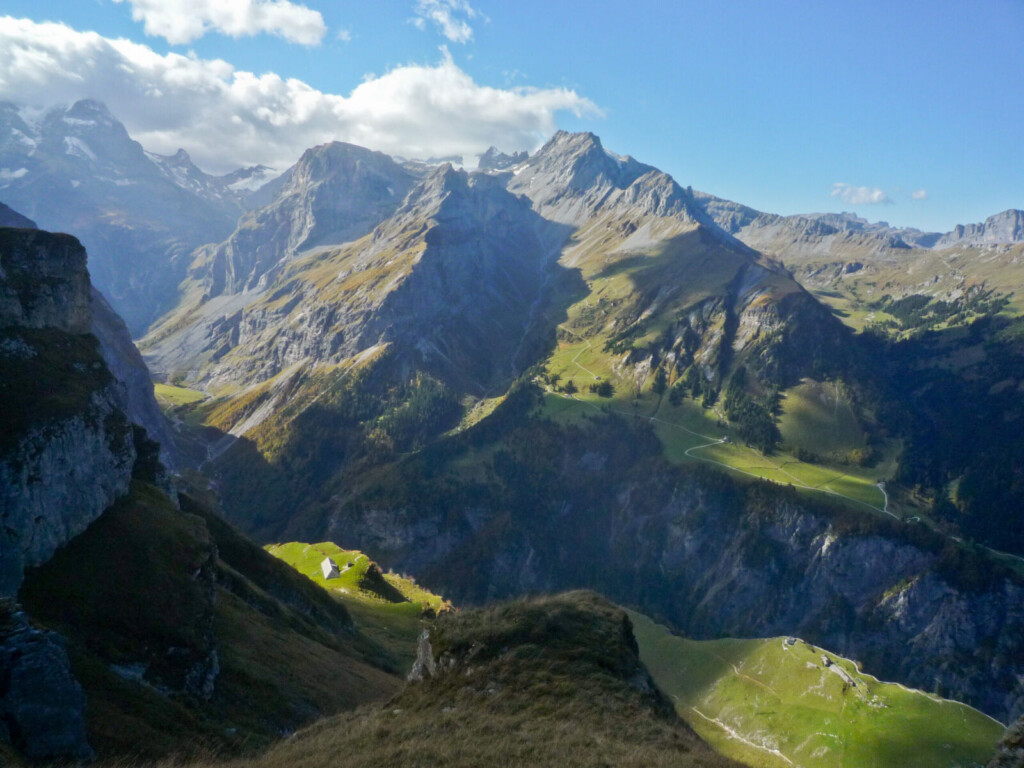
You have seen the brochure. Snow-capped peaks under a violet sky, a lone wooden chalet exhaling smoke into crystalline air, and somewhere in the fine print, a word like “ancestral” or “timeless” deployed with the confidence of someone who has never once wondered what time actually did to these mountains.
The machinery that produced that brochure did not invent its imagery from nothing. It inherited a symbolic vocabulary that had been accumulating for centuries — the Alpine sublime as zone of spiritual intensity, the mountain as threshold between the human and the inhuman, the fog-filled valley as a place where ordinary causality occasionally failed. What the tourism industry of the twentieth century accomplished, with remarkable efficiency, was to extract that vocabulary from the social conditions that had generated it and repackage it as a sensory product, purchasable by the weekend.
Ernst Gellner, writing in Nations and Nationalism in 1983, argued that modern nationalist cultures required the illusion of antiquity — that they systematically fabricated a deep past to legitimate a shallow present. The Alpine tourist apparatus performed an identical operation, but for commerce rather than statehood, manufacturing an eternal mountain spirit that conveniently had no memory of the crop failures, the witch trials, the forced migrations, or the intimate violence that rural isolation historically produced. Switzerland alone received 39.7 million tourist overnight stays in 2019, each transaction premised partly on the fantasy that the mountains preserve something ancient and uncorrupted, that proximity to altitude is proximity to something true.
Wellness culture then absorbed what tourism had already softened. The Romantic terror of the high passes — the genuine psychic disorientation that travelers like Horace-Bénédict de Saussure reported when ascending Mont Blanc in 1787, the sense that human scale simply ceased to apply — became, by the early twenty-first century, a therapeutic feature. Altitude retreats, forest bathing packages, silence programs at converted monasteries: the mountain’s power to overwhelm the self was now being marketed as a controlled dissolution, a managed loss of ego available for four nights at a curated rate. The thing that had once genuinely threatened the traveler’s sense of coherence was now being sold as a means of recovering it.
What makes this substitution ideologically effective rather than merely commercially cynical is the way it forecloses the question of what the original imagery actually encoded. The superstitions of Alpine communities were not decorative folklore. They were cognitive instruments for navigating radical uncertainty — the unpredictability of avalanche seasons, the capriciousness of growing conditions above 1,500 meters, the psychological pressure of months of near-total darkness and social confinement. When scholars like Katharine Anderson, in her work on meteorological knowledge in early modern Europe, traced how mountain communities developed layered interpretive systems around weather and natural phenomena, she was documenting a form of environmental intelligence that made no clean distinction between the empirical and the supernatural because the conditions of life did not offer that luxury. The commodified version of Alpine mysticism requires that distinction to disappear again, but for opposite reasons: not because reality is genuinely ambiguous, but because ambiguity is more sellable than history.
The nationalist appropriation runs parallel and occasionally intersects. Alpine imagery anchored multiple European identity projects throughout the twentieth century, from Swiss Helvetic mythology to certain strands of German Naturphilosophie that passed through darker political territories. The mountain as emblem of national character, of hardy self-sufficiency, of a people forged by vertical terrain — this framing required the same amnesia as the tourist brochure, the same erasure of the actual social texture of mountain life in favor of an abstraction whose emotional power depended entirely on its historical emptiness. What survives in contemporary culture is not the memory of what the Alps meant to those who could not leave them, but the silhouette of that meaning, reproduced at scale, stripped of everything that once made it true.
A vision curated by a filmmaker, not an algorithm
In this video I explain our vision
🏔️ Peaks, Spirits, and the Solitude of Wild Places
The Alps have long been a theater of the human imagination, where isolation breeds myth and the landscape becomes a mirror of inner fear. From the sublime terror of remote peaks to the superstitions woven into mountain folklore, these related articles explore how nature and the uncanny intertwine in literature, art, and the collective unconscious.
Algernon Blackwood: The Supernatural in Hostile Nature
Algernon Blackwood was perhaps the greatest literary explorer of nature as an entity that overwhelms and unsettles the human psyche. His stories, set in forests, rivers, and desolate landscapes, transform the natural world into a living force of supernatural dread, perfectly mirroring the Alpine sense of a wilderness that watches back. Reading Blackwood alongside Alpine imagery reveals how isolation in wild places has always invited the presence of something beyond rational explanation.
GO TO THE SELECTION: Algernon Blackwood: The Supernatural in Hostile Nature
The Aesthetics of the Sublime: When Beauty Is Frightening
The aesthetics of the sublime, as theorized by Burke and Kant, finds its most visceral expression in the towering peaks and glacial silences of the Alps. This article traces how beauty and terror fuse into a single overwhelming experience when the human being confronts the infinite scale of mountain landscapes. The sublime is not merely an aesthetic category but a psychological event, one that strips away civilized certainty and exposes the self to something ancient and uncontrollable.
GO TO THE SELECTION: The Aesthetics of the Sublime: When Beauty Is Frightening
Caspar David Friedrich: The Painter Who Painted the Infinite
Caspar David Friedrich made the encounter between solitary human figures and vast, indifferent nature the defining image of Romantic longing and metaphysical anxiety. His canvases, filled with mist-shrouded peaks and figures standing at the edge of the abyss, resonate deeply with the Alpine tradition of landscape as spiritual and existential territory. To look at Friedrich’s work is to understand how mountain imagery became the visual language of isolation, superstition, and the search for the sacred.
GO TO THE SELECTION: Caspar David Friedrich: The Painter Who Painted the Infinite
Genius Loci: When Places Have a Soul
The concept of Genius Loci — the spirit of a place — offers a fascinating lens through which to read the magical imagery of Alpine environments, where certain valleys, passes, and summits have accumulated centuries of mythological and superstitious meaning. This article explores how places develop a soul of their own, shaping the behavior, beliefs, and fears of the communities that inhabit them. In the Alps, this invisible presence is not metaphor but lived reality, embedded in local legends, ritual practices, and an enduring sense that the mountain is never entirely safe.
GO TO THE SELECTION: Genius Loci: When Places Have a Soul
Discover the Cinema of Wild Solitude on Indiecinema
If these themes of isolation, magical landscapes, and the uncanny power of remote places speak to you, Indiecinema is where you will find independent films that dare to explore them with honesty and depth. Our streaming platform is home to a curated selection of works that treat nature, myth, and solitude not as backdrops but as living protagonists. Come and discover a cinema that takes you beyond the comfortable and into the truly unknown.
👉 EXPLORE THE CATALOG: Watch Indie Films in Streaming
A vision curated by a filmmaker, not an algorithm
In this video I explain our vision

