
The Forest That Does Not Care
You are standing at the edge of a treeline as the last of the afternoon light collapses behind the ridge, and something shifts in the way the forest sounds. Not silence — silence would be a relief. This is a subtraction, a frequency dropping out of the air the way a note vanishes from a chord and leaves something dissonant and unresolved in its place. You are not afraid of a predator. You are not scanning for movement. The fear is older than that, older than the category of threat and response your nervous system learned to recognize. What you feel is the sudden, vertiginous awareness that nothing out there — not the spruce trees bending in the cooling wind, not the granite escarpment going grey and distant, not the creek you can still hear somewhere below — none of it is organized around your presence. You are not the center of anything. You are not even a variable in whatever this place is doing. And the horror of that, the clean and indifferent horror of it, has nothing to do with danger. It has to do with scale.

Algernon Blackwood understood this particular terror with a precision that most horror writers have never approached, because most horror writers are fundamentally anthropocentric — their monsters wear intentions, their darkness is relational, their landscapes exist as moods projected outward from a suffering human consciousness. Blackwood, writing in the first decade of the twentieth century, reversed the architecture entirely. In his 1907 story “The Willows,” the two travelers on the Danube do not encounter something that wants to harm them. They encounter something that does not register them at all — and this non-recognition, this absolute ontological exclusion from whatever the willows and the floodwaters are participating in, becomes the most destabilizing experience a human being can have. Not to be hated. Not to be hunted. To be irrelevant to forces that are nevertheless everywhere around you and enormously powerful.
What Blackwood was mapping in his fiction had already been partially charted in philosophy, though without his particular emotional pitch. Immanuel Kant had drawn the distinction between the beautiful and the sublime, locating in the latter an experience of nature so vast or violent that it briefly exceeds the mind’s capacity to synthesize it into something manageable. Edmund Burke in 1757, in his Philosophical Enquiry into the Origin of Our Ideas of the Sublime and Beautiful, had gone further, identifying terror as the ruling principle of the sublime — but even Burke’s terror was still, in its structure, a human response to a human-scaled threat, something that could be metabolized into aesthetic experience and eventually framed in a drawing room discussion. Blackwood refused that metabolization. His characters in “The Wendigo,” published in 1910, do not return with an expanded sense of their own rational faculties sharpened against enormity. They return diminished, altered, with something scraped away that does not grow back.
The wilderness in Blackwood’s work functions as a reminder of a reality that human civilization has spent several thousand years constructing elaborate systems to deny — that the conditions sustaining human life on this planet are local, contingent, and cosmically unguaranteed. Agriculture, legal systems, theology, architecture, the narrative conventions of literature itself: all of these are, among their other functions, technologies for making nature legible and therefore bearable, for inserting the human story into landscapes that do not tell stories. What Blackwood forces into the light is the thinness of those technologies. Stand far enough from a city, wait long enough for the cultural noise to drain out of your perception, and you arrive at exactly that treeline at dusk — that dropping frequency, that chord resolving into something that has no interest in whether you find it beautiful or terrible or anything at all.
Simon Marsden’s Haunted Life In Pictures
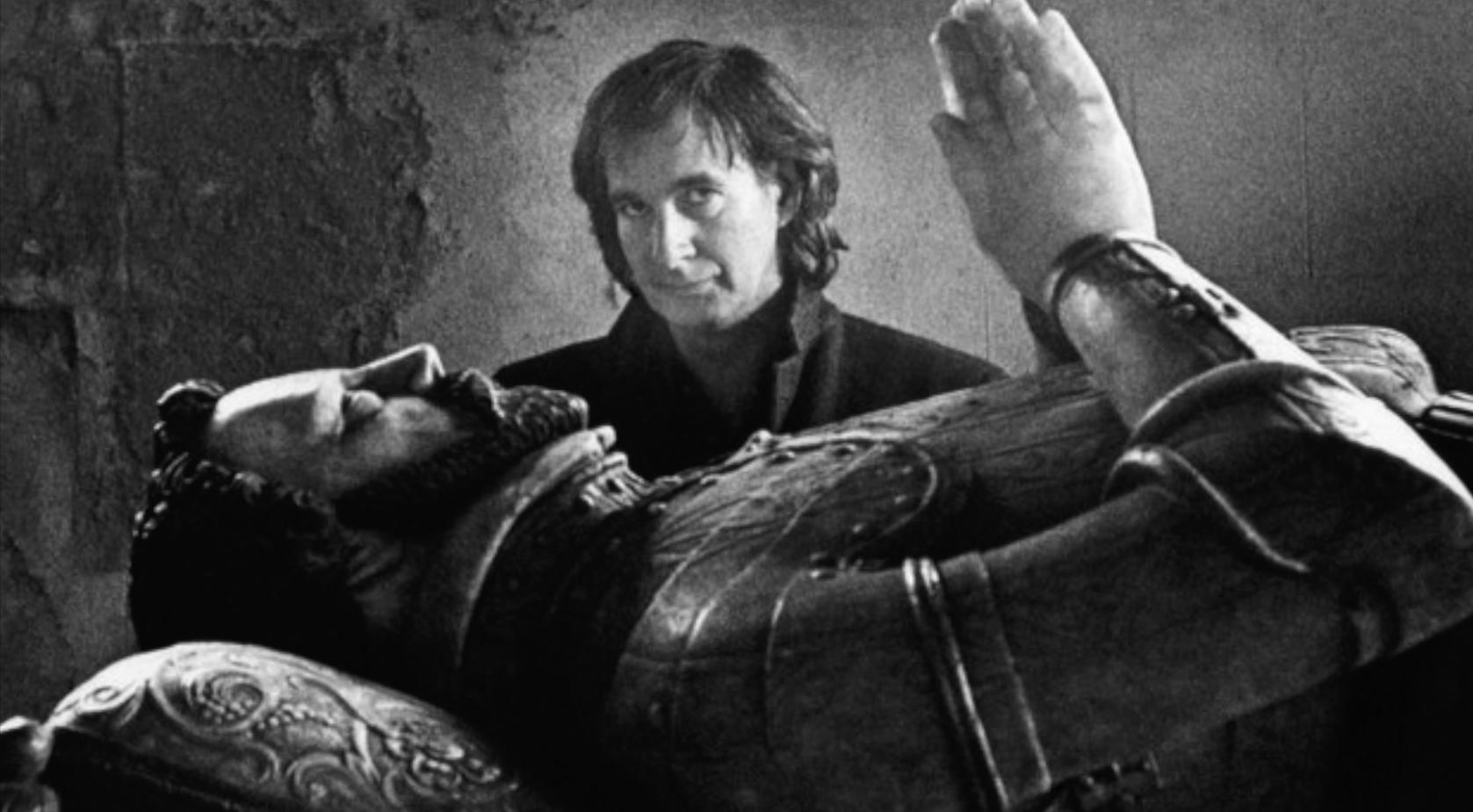
Documentary, by Jason Figgis, United States, 2019.
This documentary retraces the life and work of Simon Marsden, widely regarded as one of the foremost photographers of the supernatural. Premiered at the British Film Institute in London, the film offers a fascinating journey into his creative universe, appealing not only to photography enthusiasts but also to scholars, teachers, students, and anyone intrigued by the mysteries of the unseen. Through evocative imagery and first-hand accounts, it explores the artistic path of a photographer whose work has appeared in books, on U2 album covers, and in museum exhibitions around the world.
Although convinced of the existence of ghosts, Marsden never claimed to capture them directly with his camera. Instead, he used black-and-white infrared film to record the atmosphere and the invisible traces that, in his view, spirits left imprinted upon places. From the landscapes of Ireland to the vast expanses of Russia, passing through Venice and the American Southwest, he transformed historic buildings, ruins, and haunting locations into deeply evocative images capable of suggesting dark and unsettling stories. His photographs continue to captivate the imagination, demonstrating how the most powerful works of art can leave a lasting impression on those who behold them.
LANGUAGE: English
SUBTITLES: Spanish, French, German, Portuguese
Blackwood’s Biography as Wound
You are thirty-two years old, living in a rented room in Manhattan that smells of damp wood and someone else’s cooking, and you have not eaten a full meal in four days. This is not metaphor. This is Algernon Blackwood in the early 1890s, having arrived in New York with the particular confidence of a man whose education at Wellington College and Edinburgh University had convinced him that the world would eventually recognize his quality. It had not. He tried dairy farming in Ontario. He tried running a hotel. He tried journalism, gold prospecting, and the kind of odd entrepreneurial ventures that sound almost reasonable when described by someone who has never been genuinely desperate. Each attempt collapsed. He pawned everything that could be pawned. He slept in places that do not appear in the polished biographical summaries.
What matters about this destitution is not its melodrama but its texture. Blackwood was not suffering in an urban void — he was oscillating between the brutal indifference of a major American city and the Canadian wilderness, and the contrast was doing something to him neurologically that no amount of conventional literary influence could have produced. The Ontario backcountry he had moved through in the late 1880s was not picturesque wilderness. It was the kind of landscape that erases the human silhouette entirely, where the scale of spruce forest and frozen lake communicates, with quiet efficiency, that consciousness is a recent and provisional experiment. He absorbed this not as a romantic visitor but as someone working the land under economic pressure, which means he absorbed it physically — through exhaustion, through cold that has opinions, through the specific silence of forests at three in the morning that is not peaceful but watchful.
Sigmund Freud published “The Uncanny” in 1919, long after Blackwood had already written his most important work, but the concept operates retroactively as a diagnostic tool. The unheimlich — that which is simultaneously familiar and foreign, homely and threatening — describes precisely what the Canadian wilderness had become for Blackwood: a space he had lived inside, worked inside, nearly died inside, and which had never once acknowledged him. The horror in his later fiction does not emerge from the supernatural invading the domestic. It emerges from the natural world revealing that the domestic was always the intrusion.
By the time Blackwood reached New York’s lowest register — reporting for the New York Sun and the New York Times in the mid-1890s, doing hack work that paid almost nothing — his inner cartography had already been permanently redrawn. The city’s indifference and the wilderness’s indifference were not the same quality of indifference, and he knew it. The city ignored you socially. The wilderness ignored you cosmologically. One could be corrected by success. The other could not be corrected at all.
His 1907 collection “The Listener and Other Stories” did not arrive from nowhere. It arrived from twenty years of accumulated displacement, of being a body moving through spaces — Canadian, American, eventually European — that consistently refused to organize themselves around human need. The stories in that collection have been classified as supernatural fiction because the genre system demands classification, but their actual mechanism is ontological friction: the sensation of a consciousness encountering a world that operates according to principles older and larger and utterly uninterested in consciousness. This is not gothic horror, which requires architecture, inheritance, and the weight of human history. This is something prior to human history, something that was present before the first story was told around the first fire and will be present after the last one gutters out.
Blackwood never described his years of failure as formative in the way that writers perform retrospective gratitude for their suffering. He described them as simply what happened, which is a far more disturbing kind of honesty, because it removes the consoling narrative of necessary wound and leaves only the wound.

The Wendigo and What It Actually Hunts
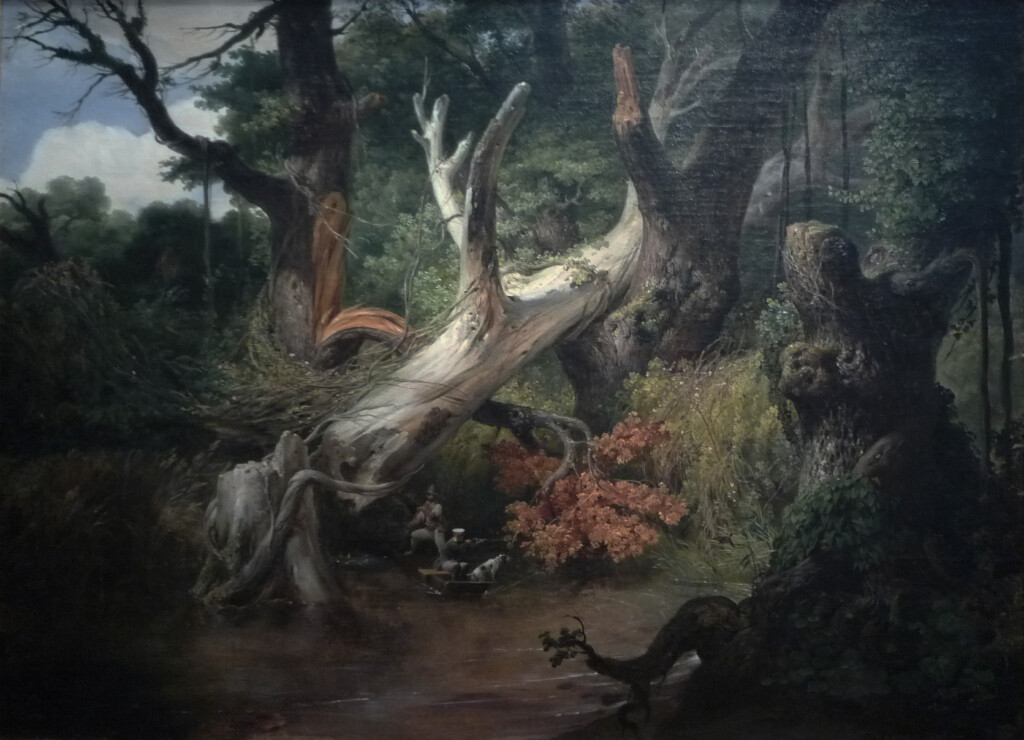
You are walking through a forest that has been growing for four hundred years and you realize, without being able to say exactly when the realization arrived, that it does not know you are there.
Not indifference in the human sense — not the cold shoulder of a person who has chosen to ignore you. Something far more corrosive: the absolute structural impossibility of your mattering to this place. The trees are not ignoring you. They are organized according to a grammar that does not contain a word for you.
This is the precise sensation Blackwood engineers in “The Wendigo,” published in 1910, and it is worth being clear about what the creature in that story actually is, because it is not a monster in any conventional sense. It does not stalk the hunting party out of hunger or malice. It does not want anything from them in the way that predators want from prey. What it does is far stranger: it pulls one of them — Défago, the French-Canadian guide — upward and outward, stretching him across geography until he is no longer a self but a smear of consciousness across an impossible distance. The horror is not death. It is dissolution into scale.
Edmund Burke, in his 1757 “A Philosophical Enquiry into the Origin of Our Ideas of the Sublime and Beautiful,” made a distinction that his Romantic inheritors would spend the next century selectively misreading. Burke’s sublime was not exhilarating. It was, at its purest, the sensation of being in the presence of something so vast and so indifferent that the ego briefly ceased to function — and he was explicit that this sensation bordered on terror, that it was pleasurable only at a safe distance, only when the perceiving subject remained structurally intact. The key word is intact. Wordsworth and his contemporaries borrowed Burke’s architecture and quietly removed its teeth, transforming the encounter with overwhelming nature into a spiritual transaction that always ended with the self enlarged, confirmed, returned to itself with fresh credentials. You went to the mountains. You felt small. You came back bigger.
Blackwood refuses this transaction entirely. In “The Wendigo,” there is no return, no enlargement, no self that reassembles itself having briefly touched something immense. Défago comes back, but what comes back is not him — or rather, it is him minus the membrane that kept him separate from the boreal forest. His feet have been burned, his eyes have shifted in a way no one can precisely describe, and when he speaks it is with a disorientation that suggests he has been spread too thin across too many miles to fully reconcentrate. The Wendigo does not kill him. It un-individuates him. Burke’s safe distance — the conceptual moat that made the sublime survivable — does not exist in Blackwood’s geography.
What makes this philosophically precise rather than merely atmospherically effective is that Blackwood understood something about the Canadian wilderness that the Romantic tradition was structurally incapable of processing: some landscapes are not sublime in any redemptive sense because they were never organized around the possibility of a human witness. The European sublime, from Burke through Kant’s treatment of it in the 1790 “Critique of Judgment,” always secretly assumed that nature was performing for someone — that the mountain’s vastness was meaningful because a mind capable of measuring its own smallness stood before it. The human capacity to conceive of what overwhelms you was, for Kant, precisely what made you larger than the thing that dwarfed you. The mind that could think the infinite was, in some sense, superior to it.
The Wendigo country does not perform. It does not require a witness and gains nothing from having one. Défago’s tragedy is not that he encountered something too large for him but that he encountered something for which his existence was not even a category.
Nature as Anti-Sanctuary
You go to the woods to get well. This is the oldest lie in the modern repertoire — the conviction that concrete and noise have poisoned you, that somewhere beyond the treeline a silence waits that will restore what civilization stole. You carry this belief like inherited money, spending it without checking where it came from.
It came, largely, from Jean-Jacques Rousseau, who in the 1750s constructed a philosophical architecture around the idea that the natural state precedes and exceeds the corrupted social one. The Second Discourse of 1755 gave Western culture its permission slip to sentimentalize wilderness as moral teacher, as corrective therapy, as the space where the authentic self resurfaces through bark and birdsong. Wordsworth absorbed this and made it lyrical. Thoreau disciplined it into a practice. By the twentieth century it had hardened into assumption — the assumption that wilderness, at minimum, means you no harm.
Algernon Blackwood spent enough time actually inside wilderness to notice something that contradicts this entirely. In 1907, drawing on his own canoe journeys through the Danube delta, he published what Arthur Machen called one of the finest horror stories ever written in the English language. Two men descend a flooding river into a region of willow islands, and the willows themselves — the landscape itself, persistent and vegetative and indifferent — begin to press against the membrane separating human consciousness from something it was never equipped to process. There is no monster with teeth. There is terrain.
What Blackwood understood, and what the Rousseauian tradition systematically suppresses, is that indifference and hostility are not the same thing — but both equally destroy the idea of nature as sanctuary. The willows are not malevolent in any morally legible sense. They do not hate the narrator. They are not organized against him. They are simply oriented in ways that have nothing to do with human existence, and that reorientation, that sheer directionality away from the human, is what dismantles him. Hostility would be almost comforting by comparison. Hostility at least implies recognition.
The philosopher Timothy Morton, writing in Ecology Without Nature in 2007, argues that the very concept of Nature as a stable, coherent backdrop to human life is an ideological construction — a fantasy that aestheticizes the nonhuman world in order to make it manageable and meaningful to us. What Blackwood dramatized decades earlier in fiction, Morton diagnoses in theory: the moment you stop projecting human grammar onto the nonhuman world, what remains is not peace, not restoration, not moral instruction. What remains is something for which consciousness has no container.
The two travelers in the story begin to lose not their courage but their cognitive architecture. The categories that normally organize experience — inside and outside, cause and effect, presence and absence — start to behave unreliably. This is Blackwood’s specific genius: he locates the horror not in what the environment does to the body but in what it does to the mind’s ability to process being. The natural world here is not dangerous in any survival sense. It is dangerous in a phenomenological one.
Every wellness retreat, every forest bathing protocol, every prescription for time in green spaces operates on the precise assumption Blackwood spent his career dismantling — that the nonhuman world is oriented, in some fundamental register, toward human flourishing. That it receives us. That it has, however mutely, our interests somewhere in its composition. The marketing copy for these experiences is essentially Rousseau with a subscription model.
What the river in that story offers instead is a confrontation with scale and indifference so total that selfhood becomes a local and temporary accident rather than a fact with any special standing in the structure of things, and the ground you assumed was beneath you turns out to have been moving the entire time without ever having agreed to hold you.
Panpsychism’s Darker Sibling
You are standing at the edge of a forest at dusk, and you feel, with absolute certainty, that it is watching you. Not metaphorically. Not as a projection of some childhood anxiety draped over bark and shadow. Watching. With the slow, distributed attention of something that has never needed eyes.
Gustav Fechner, the nineteenth-century German physicist-turned-mystic, published his Zend-Avesta in 1851 and spent the remaining decades of his career arguing that consciousness was not a product of biological complexity but a fundamental property of matter itself — that the Earth was a living soul, that plants experienced something, that the entire physical universe was saturated with interior life. William James encountered this work and found in it not the lunacy that mainstream psychology would later diagnose, but a serious philosophical challenge to the Cartesian wall between mind and matter. James built his radical empiricism partly on this foundation, insisting in Essays in Radical Empiricism, published posthumously in 1912, that relations between things are as real as the things themselves, that experience is the basic stuff of the universe, not an epiphenomenon riding atop dead mechanism. Both men meant this as an expansion of the human. They were enlarging the circle of dignity, extending interiority outward to include more of the world.
Algernon Blackwood read voraciously in this tradition and was, by all biographical accounts, a genuine believer in the animism these thinkers were rehabilitating philosophically. He was a member of the Hermetic Order of the Golden Dawn, a student of occult naturalism, a man who spent weeks alone in the Canadian wilderness and the Egyptian desert precisely because he wanted contact, not isolation. But something happened in the translation from philosophical proposition to narrative imagination, and what emerged on the page was not Fechner’s warm cosmic democracy of souls. What emerged was something those philosophers had carefully avoided thinking through to its logical terminus.
If consciousness is everywhere, then the human nervous system is not the apex of awareness — it is one node among billions, and a remarkably fragile one. Fechner imagined a universe of graduated souls, with the Earth-soul vast and serene and ultimately benevolent, an order in which human consciousness participated meaningfully upward. This is the philosophical version of a creation myth in which we are still, quietly, at the center. James was more rigorous and less theological, but his pluralistic universe in A Pluralistic Universe from 1909 still presumed that human experience was a legitimate participant in the great congress of relations. Neither man could quite bring himself to write the sentence that Blackwood’s fiction writes on every page: that if everything is aware, then everything is also, from its own perspective, primary, and your sense of being the observer is indistinguishable from being the observed.
In “The Willows,” published in 1907 and later cited by H.P. Lovecraft as the finest supernatural tale in the English language, two men on a canoe trip down the Danube find themselves stranded on a sandbar among willow thickets that do not behave like vegetation. The plants are not menacing in any animal sense. They do not move toward the men. They simply pursue their own processes with a completeness that leaves no remainder, no gap in which human significance can install itself. The horror is not that the willows want to harm the men. The horror is that the willows do not want anything in relation to the men at all — and yet the men are being unmade by this indifference, which is somehow not passive. Fechner’s Earth-soul had room for you. Blackwood’s willows have room only for what they are.
The philosophical move Blackwood makes is to take panpsychism seriously enough to strip it of its anthropocentric comfort, which turns out to strip it of almost everything that made it appealing to begin with.
A vision curated by a filmmaker, not an algorithm
In this video I explain our vision
The Collapse of the Perceiving Self

You are standing at the edge of a forest that has no center, and something is looking back at you — not with malice, not with intention, but with the absolute indifference of a process that was operating long before eyes existed to register it. The horror is not that it wants you. The horror is that it doesn’t need to.
Blackwood’s protagonists rarely fight. This is what separates them from the entire tradition of gothic resistance, from Van Helsing’s crucifixes to every barricaded door in Victorian supernatural fiction. His characters do not arm themselves, do not invoke God, do not ultimately prevail through courage or love or the reassertion of rational order. They thin out. They become permeable. The self — that anxious, boundary-maintaining construction that spends most of its waking life insisting on its own coherence — begins to leak at the edges, and what flows in is not evil but something far more disorienting: a form of belonging the protagonist never asked for and cannot refuse.
William James, delivering the Gifford Lectures in Edinburgh in 1901 and 1902 and publishing them as The Varieties of Religious Experience, was attempting something genuinely dangerous for his moment. He wanted to take mystical states seriously as psychological data without reducing them to pathology, and without inflating them into proof of anything theological. What he found, in the testimonies of hundreds of subjects across traditions, was a consistent phenomenology: the dissolution of the boundary between self and world, the sensation of unity with something vast and impersonal, and — crucially — an emotional register that did not map cleanly onto joy or terror but occupied a third category he struggled to name. He called it, carefully, a noetic quality combined with passivity. The subject does not act. The subject is acted upon. And the experience carries an authority that survives the return to ordinary consciousness, leaving the person changed in ways they cannot fully account for.
Strip the theological scaffolding from that description and you are left with something that reads almost exactly like what happens to the two men in “The Willows” as the island contracts around them. The Swedish companion’s mind breaks along a seam that opens suddenly; the narrator barely holds his own edges together. What James called passivity Blackwood renders as a progressive inability to distinguish between perceiving and being perceived. The self does not vanish all at once. It softens incrementally, losing first its certainty, then its authority, finally its sense of being a stable point from which the world is observed rather than a temporary eddy in the world’s own current.
The theological removal is everything. James himself acknowledged that mystical experience in its raw form, before doctrine covers it with meaning and community surrounds it with ritual, is not comforting. It is overwhelming. The comfort arrives afterwards, supplied by the framework the tradition hands to the experiencer — the Saint Teresa who encounters the abyss and calls it God, the Sufi mystic who loses the self and calls it union. Blackwood refuses the framework. His characters dissolve without a name for what they are dissolving into, which means they dissolve without the retrospective consolation of significance. The experience is real; its meaning is nowhere.
This is philosophically more honest than most religious literature will allow itself to be, and it is precisely the honesty that makes it unbearable. James noted in 1902 that the mystical state, for all its authority, cannot be communicated to someone who has not experienced it — it is, in his precise term, ineffable. Blackwood’s narrative strategy is to write from inside that ineffability, to use language not to describe the experience but to reproduce its pressure on the reader, so that the dissolution of the character becomes a mild, unsettling loosening in whoever holds the page.
A Second Scene: The Scientist Who Stops Taking Notes
He has been in the field for eleven days. The instruments are working — barometer stable, thermometer accurate to a tenth of a degree, the compass needle behaving exactly as it should. His notebook is open on the folding table and the pencil is in his hand. Outside, the boreal forest presses against the canvas walls of the tent with a silence so total it registers in the body as pressure rather than absence. He does not write. He has not written in three hours. He is not experiencing fear in any clinically recognizable sense — his pulse is unremarkable, his cognition intact — but something has made the act of recording feel not merely futile but actively wrong, as though the notation of data constitutes a kind of aggression against something that has chosen, with full deliberateness, to be unknowable.
This is precisely the break that Blackwood spent his entire literary career approaching from the outside, circling it in prose the way a surveyor circles terrain too unstable to walk. The researcher in that tent is not having a breakdown. He is having a recognition — and recognition, unlike data, cannot be filed. What collapses is not his rationality but his confidence that rationality was ever the appropriate instrument. William James, writing in The Varieties of Religious Experience in 1902, called this noetic quality one of the defining features of mystical states: the overwhelming sense that something has been genuinely known, arrived at through no logical process and utterly resistant to logical dismantling afterward. James was careful to frame this as a category of experience rather than a proof of anything transcendent — but Blackwood, who almost certainly encountered James’s work in his years moving between London, New York, and the Canadian wilderness, pushed the insight somewhere James’s empiricist training would not let him go. The wilderness does not induce mystical experience as a side effect of isolation or privation. The wilderness is itself the cognizing entity.
That distinction carries enormous weight because it relocates the problem entirely. If what the researcher feels is generated by his own psychology — by loneliness, by accumulated fatigue, by the perceptual drift that comes from days without social feedback — then the methodology is still sound and the lapse is merely personal. But Blackwood’s fiction systematically dismantles that escape route. The landscapes in his major work do not behave like neutral backdrops against which human psychology performs its distortions. They respond. The river in one of his most architecturally precise narratives shifts its channels in ways that disorient the travelers not randomly but specifically, as though it has read their capacity for spatial reasoning and is working precisely against it. The wind does not merely howl; it personalizes. This is not animism in any anthropological sense — there are no spirits in human form, no mythology to decode. It is something closer to what the philosopher Thomas Nagel, in his 1974 essay “What Is It Like to Be a Bat?”, identified as the irreducible otherness of alien consciousness: the recognition that there may be forms of subjectivity so structurally unlike human experience that no methodological bridge can reach them, not because they are inferior but because the gap is categorical.
The researcher in the tent understands none of this conceptually. He feels it somatically, which is the only register in which it can be felt. His pencil stays in his hand because putting it down would mean admitting the session is over, and admitting the session is over would mean admitting that something out there has ended it for him. So he holds the pencil above the blank page in a posture that looks, to no one watching, exactly like a man about to write — which is one of the quietest defeats in the history of a species that built its entire civilizational identity on the belief that the world, given sufficient patience, will eventually answer a direct question.
What Hostile Nature Exposes About the Human Contract
You are standing at the edge of a forest at dusk, and for a moment the thought arrives unbidden: everything you have built, every law you have signed, every institution you have entered — none of it reaches past the treeline.
Blackwood’s wilderness does not simply frighten. It performs a kind of philosophical surgery, removing the comfortable tissue of assumption that civilization has grafted over the animal body. What bleeds out is the realization that the organized world — its courts, its table manners, its psychiatric categories — rests not on conquest but on consent, and consent is precisely what the non-human world has never offered. Norbert Elias, writing in 1939 at the exact historical moment when European civilization was demonstrating its own spectacular capacity for collapse, argued in The Civilizing Process that what we call civilization is a learned suppression of instinct, a long pedagogical project beginning roughly in the sixteenth century in which the thresholds of shame and repugnance were gradually raised, the body was disciplined, and violence was monopolized by the state. Elias was not celebrating this process. He was describing its machinery, and the machinery requires constant maintenance, constant reinvestment, constant institutional pressure. Remove the pressure and the threshold drops with alarming speed.
What Elias tracked in the historical record, Blackwood staged in the body. The characters who enter the deep wilderness in his fiction do not become villains. They become porous. The self that held opinions, held property, held a social position, begins to lose its grip on its own edges. This is not madness in the clinical sense — it is closer to what the anthropologist Victor Turner called liminality in The Ritual Process (1969), the threshold state in which identity has been stripped but not yet replaced, in which the individual stands outside all social structures simultaneously and therefore outside the protections those structures provide. Turner meant it as a description of ritual passage. Blackwood made it a permanent condition of anyone who strayed far enough from the lamp-lit room.
The deeper philosophical provocation is this: civilization does not conquer nature, it negotiates a temporary perimeter, and the perimeter is drawn in fear. The Roman limes, the medieval walled city, the Enlightenment’s categorical boundary between reason and wilderness — these are not victories but ongoing arguments, and they require the other party to remain silent. The moment the forest answers back, the argument collapses. Edmund Burke identified the sublime in 1757 as the aesthetic category generated by vastness and obscurity and the threat of annihilation — but he still contained it within aesthetics, as an experience to be had safely, from a distance. Blackwood refused the distance. His wilderness does not generate the sublime as a pleasurable frisson. It generates something older, something Burke’s vocabulary was designed precisely to domesticate.
The social stakes are not abstract. A civilization that believes it has subdued nature will organize its politics, its economics, its urban planning, and its emotional life around that belief. It will treat the non-human world as a resource, an obstacle, or an irrelevance, and it will regard any human being who fails to maintain the correct distance from that world — the mystic, the hermit, the indigenous person who insists on a different cosmology — as primitive, as underdeveloped, as a figure requiring correction. Blackwood, writing between 1906 and the 1940s, was not making an ecological argument in the modern sense, but he was exposing the arrogance that ecological catastrophe would later charge with its full bill.
What hostile nature exposes, ultimately, is that the human contract was always signed only among humans, witnessed only by humans, and enforceable only within the narrow band of territory where humans remain numerous enough to frighten each other into compliance — and the universe, vast and utterly indifferent, never countersigned a single page.
🌿 When Nature Becomes the Unknown
Algernon Blackwood transformed forests, rivers, and open wilderness into living entities that overwhelm and devour the human soul. To understand his vision, we must explore the deeper currents of the sublime, the uncanny, and the strange territories between the natural and the supernatural.
Arthur Machen: Life and The Great God Pan
Arthur Machen, like Blackwood, found the source of all horror not in cities but in the ancient, indifferent forces sleeping beneath the green surface of the world. His novella The Great God Pan conjures a nature that is not pastoral but terrifyingly alive, capable of dissolving the boundaries of the human self. Exploring Machen’s work opens a direct pathway into the literary tradition from which Blackwood drew his darkest inspirations.
GO TO THE SELECTION: Arthur Machen: Life and The Great God Pan
The Aesthetics of the Sublime: When Beauty Is Frightening
The aesthetics of the sublime provide the philosophical backbone for understanding why Blackwood’s hostile nature strikes us as both beautiful and annihilating. When landscapes exceed the capacity of human reason to contain them, they generate that precise mixture of terror and awe that defines the sublime experience. This tradition, running from Burke to Kant, gave Blackwood the conceptual language to articulate what the wilderness truly does to the human mind.
GO TO THE SELECTION: The Aesthetics of the Sublime: When Beauty Is Frightening
Edmund Burke and the Sublime: Terror as Aesthetic Experience
Edmund Burke’s foundational analysis of terror as an aesthetic experience is essential reading for anyone drawn to Blackwood’s supernatural wilderness. Burke argued that vastness, darkness, and obscurity produce the strongest and most overwhelming emotional responses in the human observer. Blackwood’s forests and rivers are Burkean landscapes made flesh, environments engineered to dissolve the comfortable illusion of human dominance over nature.
GO TO THE SELECTION: Edmund Burke and the Sublime: Terror as Aesthetic Experience
Genius Loci: When Places Have a Soul
The concept of Genius Loci — the spirit or soul that inhabits a specific place — stands at the very heart of Blackwood’s supernatural imagination. His stories insist that certain locations possess a will of their own, indifferent or openly hostile to human presence. Understanding how place accumulates spiritual meaning and memory allows us to read Blackwood’s landscapes not as settings but as true antagonists with ancient, ungovernable desires.
GO TO THE SELECTION: Genius Loci: When Places Have a Soul
Discover the Cinema of the Strange on Indiecinema
If Blackwood’s vision of a nature that terrifies and transforms resonates with you, Indiecinema is the streaming destination where those same themes come alive on screen. From supernatural slow cinema to nature-horror and visionary independent filmmaking, our catalog is curated for those who seek depth beyond the mainstream. Join us and explore the edges of the visible world.
👉 EXPLORE THE CATALOG: Watch Indie Films in Streaming
A vision curated by a filmmaker, not an algorithm
In this video I explain our vision

