
The Edge You Cannot Step Back From
You are standing at the edge of something that has no interest in you whatsoever. The storm is not performing. The cliff does not know your name. The abyss beneath the overhang where your toes curl inside your boots has existed for ten thousand years without requiring your presence to complete itself, and this — this precise indifference — is what roots you there when every rational signal in your nervous system is filing for evacuation. You should leave. You know you should leave. You stay.

This is not courage and it is not stupidity, though it resembles both from a distance. What holds you at that edge is something stranger and more compromising than bravery: it is the recognition, arriving not as a thought but as a sensation in the chest cavity, that you are in the presence of something that exceeds your capacity to metabolize it. The scale is wrong. The power is wrong. Your categories — dangerous, beautiful, threatening, magnificent — keep misfiring, keep pointing at the same object simultaneously, and the resulting short-circuit in the mind produces something that feels, against all logic, like pleasure.
Edmund Burke was the first to treat this as a philosophical problem rather than a personal failing. In his 1757 Philosophical Enquiry into the Origin of Our Ideas of the Sublime and Beautiful, he drew a line between beauty — which pleases, soothes, and fits comfortably within human proportion — and the sublime, which overwhelms, threatens, and operates on a frequency the human organism is not engineered to handle cleanly. Burke identified astonishment as the supreme effect of the sublime, a state in which the mind is so entirely filled with its object that it cannot entertain any other, cannot reason around it, cannot file it away. He was describing paralysis as ecstasy, terror as the mechanism of a particular kind of transport.
What Burke intuited physiologically, Immanuel Kant systematized twenty-four years later in the Critique of Judgment, and the shift in framing is revealing. For Kant, the experience at the cliff edge is not really about the cliff. The storm is not sublime — the storm is merely enormous and violent. What is sublime, in his account, is the human mind’s discovery that it contains something the storm cannot touch: the capacity for rational ideas that no quantity of wind and stone can overwhelm. The fear, then, is the setup. The moment you feel small is the moment before you discover that some part of you refuses smallness. Kant turns the paralysis Burke described into a dialectic, a kind of internal argument where annihilation and dignity arrive in the same breath.
But something goes missing in that rescue operation. The philosophical move Kant makes — reassuring us that our rational faculties survive the encounter intact, that we emerge affirmed rather than dissolved — describes an experience cleaner than the one you are actually having on that overhang. Because what you feel standing there is not the quiet triumph of reason over nature. What you feel is closer to the sensation of being temporarily unmade. The coordinates by which you navigate daily life — your scale, your importance, your sense of continuous and coherent selfhood — are not vindicated by the cliff. They are suspended. And the alarming thing, the thing that philosophy keeps trying to resolve before it can sit with it, is that the suspension feels like relief.
There is a word in German that has no precise English equivalent: Weltschmerz, the pain of the world pressing against your smallness. The sublime is its photographic negative — the smallness of the world pressing against something in you that the world cannot name or measure. Both produce the same posture: the figure standing at the edge, not moving, not speaking, staring into something that stares back at nothing.
Simon Marsden’s Haunted Life In Pictures
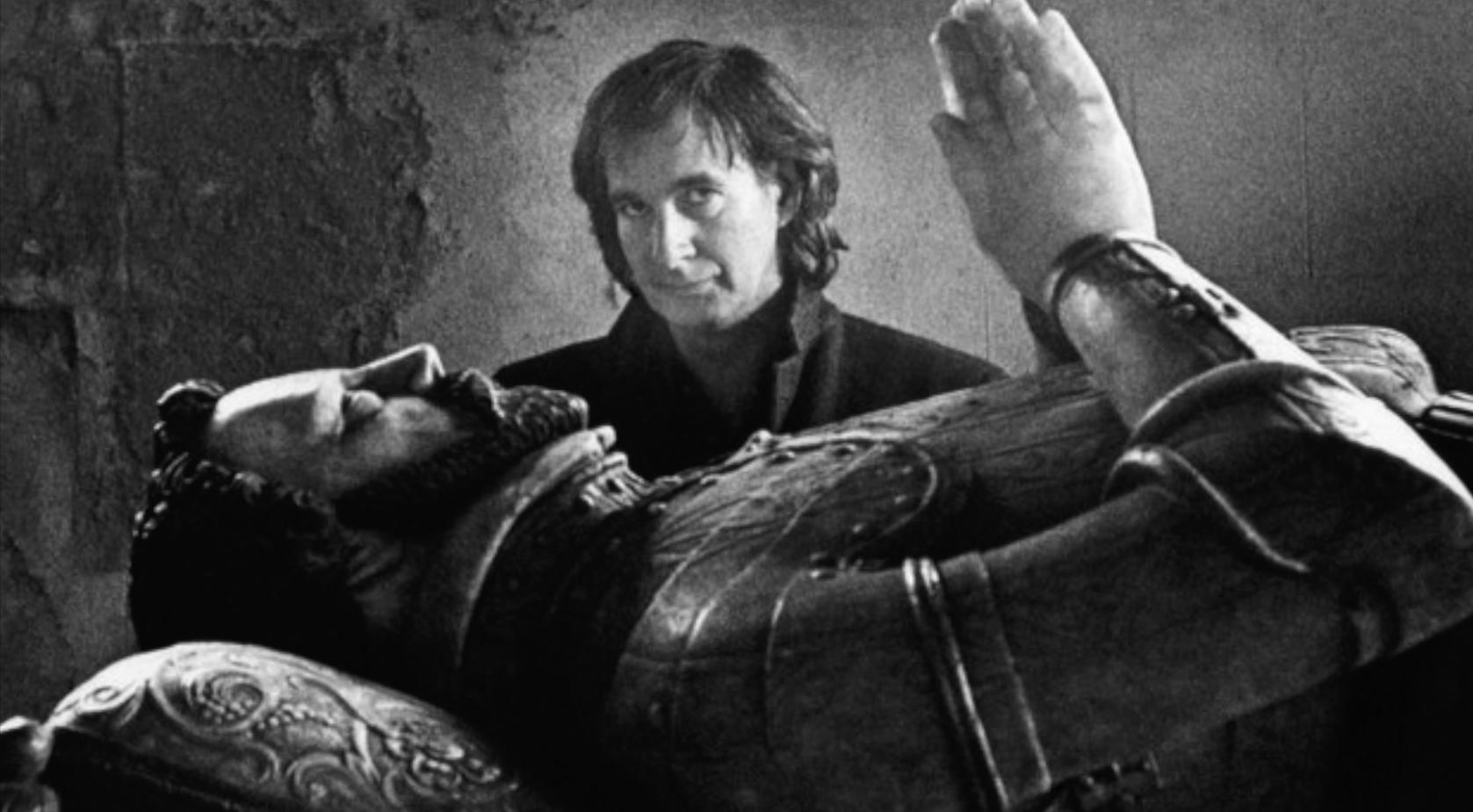
Documentary, by Jason Figgis, United States, 2019.
This documentary retraces the life and work of Simon Marsden, widely regarded as one of the foremost photographers of the supernatural. Premiered at the British Film Institute in London, the film offers a fascinating journey into his creative universe, appealing not only to photography enthusiasts but also to scholars, teachers, students, and anyone intrigued by the mysteries of the unseen. Through evocative imagery and first-hand accounts, it explores the artistic path of a photographer whose work has appeared in books, on U2 album covers, and in museum exhibitions around the world.
Although convinced of the existence of ghosts, Marsden never claimed to capture them directly with his camera. Instead, he used black-and-white infrared film to record the atmosphere and the invisible traces that, in his view, spirits left imprinted upon places. From the landscapes of Ireland to the vast expanses of Russia, passing through Venice and the American Southwest, he transformed historic buildings, ruins, and haunting locations into deeply evocative images capable of suggesting dark and unsettling stories. His photographs continue to captivate the imagination, demonstrating how the most powerful works of art can leave a lasting impression on those who behold them.
LANGUAGE: English
SUBTITLES: Spanish, French, German, Portuguese
Burke’s Useful Terror
You are standing at the edge of something enormous — a cliff, a storm front moving across an open plain, a piece of music that seems to have no ceiling — and your mind does something it almost never does in ordinary life: it stops. Not pauses. Stops. The machinery of analysis, comparison, and judgment seizes for a moment, and what replaces it is something closer to shock than to appreciation. Edmund Burke noticed this in 1757, and unlike most people who notice uncomfortable things, he decided to press directly into it rather than explain it away.
His Philosophical Enquiry into the Origin of Our Ideas of the Sublime and Beautiful is not a long book, but it operates like a controlled detonation. Burke was twenty-seven when he published it, which may explain why it has the audacity to say plainly what more cautious thinkers had been circling for decades: that the most powerful aesthetic experiences are not pleasurable at all, at least not in any simple sense. They are, at their core, a species of terror. The key word he reaches for is astonishment, and he means it with clinical precision — the condition in which the mind is so entirely filled with its object that it cannot entertain any other. This is not wonder. Wonder still leaves room for the self. Astonishment obliterates it temporarily, and that obliteration, Burke argues, is exactly what gives the sublime its grip.
What makes the architecture of his argument so quietly radical is the knife he draws between the sublime and the beautiful. For Burke, beauty operates through a specific set of physical and psychological registers: smallness, smoothness, gradual variation, delicacy, mildness of color. A beautiful thing invites you. It accommodates your gaze and your desire, asks little of you in return, and produces what he calls positive pleasure — a relaxation of the nerves, a gentle stimulation. The sublime works by entirely different mechanics. Its instruments are vastness, obscurity, darkness, power, infinity, and above all, the suggestion of pain or danger held at sufficient distance to remain survivable. The feeling it produces is not pleasure but something he calls delight, and his distinction here matters enormously: delight is the sensation of relief from terror, not the absence of terror, which means that fear is not incidental to the experience — it is the engine.
The obscurity element deserves particular attention because it has been so thoroughly naturalized that we rarely recognize it as a deliberate aesthetic tool. Burke points to Milton’s Satan as evidence: the description works not because it is precise but because it is strategically incomplete, because the mind is forced to reach toward something it cannot fully grasp and strains in that reaching. Clarity, Burke insists, is an enemy of the sublime. A perfectly lit, fully described, comprehensively explained thing cannot astonish you. It can only inform you, and information soothes where astonishment ruptures.
The split Burke formalized in 1757 did not stay confined to the pages of a philosophical treatise. It embedded itself into the operating assumptions of Western aesthetics with a persistence that outlasted every theoretical system built to replace it. Beauty became associated with the domestic, the feminine, the manageable, and the pleasurable. Sublimity became associated with the masculine, the uncontrollable, the transcendent, and the dangerous. These were not neutral descriptive categories. They carried a full load of cultural and political freight, organizing which kinds of art, which kinds of landscapes, and eventually which kinds of experience were considered serious, worthy of philosophical attention, capable of producing genuine transformation in the person who encountered them. The Alps were sublime. The garden was beautiful. One elevated you toward something beyond yourself. The other made you comfortable where you were. And a culture that had decided comfort was not enough, that the self needed to be periodically shattered and reconstituted, found in Burke’s framework something it could use for purposes he never entirely anticipated.

Kant’s Distance Machine
You are standing at the window of a stone building, watching the sea dismantle itself against the cliffs below. The waves are enormous — you can feel the vibration in your sternum even at this distance — but you are warm, you are dry, and there is glass between your nerve endings and the Atlantic. This is not incidental to what you feel. The terror and the grandeur arrive together precisely because the glass exists.
Immanuel Kant formalized this in 1790 with a precision that can still make you slightly uncomfortable if you take it seriously. In the Critique of Judgment, he argued that the sublime is not a property of the object — not of the mountain, the storm, the volcanic crater — but of the subject’s rational capacity to recognize that it cannot be destroyed by what it is contemplating. The towering cliff, the thundercloud massing on the horizon, the roaring waterfall: Kant lists these with an almost clinical relish, insisting that what elevates the observer is the moment when reason asserts its own indestructibility against the spectacle of physical overwhelming. Nature dwarfs the body. Reason, standing behind the body like a theater director behind a curtain, declares itself superior to nature. The experience of the sublime is, for Kant, essentially a cognitive triumph — a realization that the mind belongs to a moral order that no wave can touch.
What this architecture requires, and what almost nobody has wanted to say plainly, is a condition of prior safety that must already be in place before the aesthetic experience becomes possible. Kant’s observer is not in the water. Kant’s observer has never been in the water. The sublime, in his framework, demands a body that is not at immediate physical risk, a consciousness that has the luxury of processing fear as metaphor rather than as information. When reason triumphs over nature in Kant’s model, it does so from a considerable distance, and that distance is not philosophically neutral — it is a social coordinate disguised as a universal one.
The fisherman who watched his father drown in those same waves does not have Kant’s experience. He has something else entirely, something for which the eighteenth-century vocabulary of aesthetics has no word, because aesthetics of this type was constructed by men who read beside fires and traveled in coaches and who engaged with dangerous landscapes as paying spectators. Edmund Burke, just thirty years before Kant’s Critique, had already located the sublime in what he called astonishment with degrees of horror, but even Burke’s formulation preserved a membrane of safety — the horror had to be, as he wrote in A Philosophical Enquiry into the Origin of Our Ideas of the Sublime and Beautiful from 1757, not immediately threatening to survival. Both men were theorizing from the position of the visitor, the literate tourist, the gentleman naturalist who could leave when the weather turned.
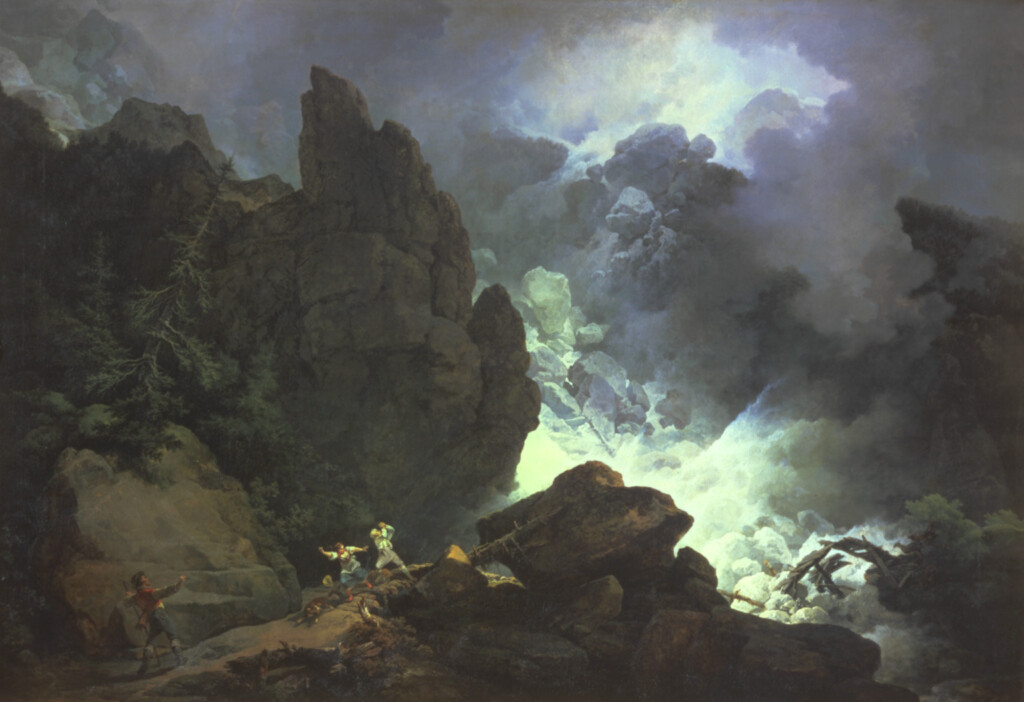
This is not a small problem. It is a structural one. The entire Kantian project of elevating aesthetic response into evidence of human rational dignity depends on the observer being the kind of person who does not need to fear the landscape professionally. When the sublime gets codified as a universal human capacity — the ability to feel small before nature and then feel enormous inside the mind — it smuggles in a class position and calls it philosophy. The shepherd in the Alps who spent his winters calculating which slopes would kill his flock did not experience the mountains as an occasion for self-transcendence. He experienced them as a workplace, which is to say, as a place where the wrong decision is fatal and where no amount of rational superiority would stop the avalanche from arriving on schedule.
There is something almost architectural in the way this exclusion was built. Not through hostility, not through explicit gatekeeping, but through the simple act of writing universal theory from a very particular window, in a very particular building, with glass that most people in 1790 could not afford to stand behind.
When the Peasant Has No Sublime
You stand at the edge of a cliff in 1757 and feel your chest open with something that isn’t quite fear and isn’t quite pleasure, and the entire architecture of that feeling depends on one condition you have never had to examine: that you are not the person who will have to climb down.
Edmund Burke’s “A Philosophical Enquiry into the Origin of Our Ideas of the Sublime and Beautiful,” published that same year, constructs its entire theory of aesthetic terror on a body that is fundamentally safe. The astonishment Burke describes, that paralysis of the mind in the face of vastness and obscurity, requires what he quietly assumes without ever naming: distance. Not geographical distance only, but economic distance. The sublime, as Burke theorizes it, is the experience of danger without the obligation to survive it. Pain and terror, he writes, are the sources of the sublime when they operate at a certain distance from us. That distance was never equally distributed.
The Lisbon earthquake of November 1755 killed between thirty and forty thousand people in the space of six minutes, and then the fires burned for five days, and then the tsunami arrived. The poor quarters built against the riverbanks and close to the wharves were obliterated first. The sailors who worked the docks, the fishermen, the women who sold bread near the harbor — these were the bodies that geological violence actually claimed. Voltaire wrote “Poème sur le désastre de Lisbonne” shortly after, wrestling with theodicy and the failure of optimism. What he did not write, and what no aesthetic treatise of the period bothered to write, was a line about what the experience of an earthquake feels like when you cannot leave, when your house is your only asset and the ground has swallowed it.
The Great Storm of 1703 had already demonstrated this logic with brutal clarity fifty years earlier. Daniel Defoe documented it obsessively in “The Storm,” collecting accounts from across England and calculating a death toll that included somewhere between eight and fifteen thousand sailors lost at sea in a single night. Defoe was remarkable in his attention to testimony, but even he was assembling the event as spectacle for a reading public whose relationship to the sea was recreational or commercial rather than mortal. The miner in the Cornish tin mines who felt the earth shake and saw the shaft flood had no philosophical category for his experience. What he had was a dead colleague and the knowledge that next week he would go back underground.
Terry Eagleton, writing about the ideological function of the aesthetic in “The Ideology of the Aesthetic” in 1990, identifies the eighteenth-century discourse around beauty and sublimity as part of a broader project of bourgeois self-definition. The aesthetic subject who can stand before nature’s violence and transform it into inner elevation is precisely the subject who has separated himself from productive labor, who consumes the world rather than extracting it. This is not a marginal point about exclusion. It is a structural argument: the sublime requires a class position. The farmer who watches a thunderstorm move across his fields is performing a calculation about crop loss, drainage, and whether the harvest can be saved. His nervous system is responding to the same atmospheric event that Kant would later describe, in the “Critique of Judgment” of 1790, as the gateway to moral self-recognition. But the farmer’s moral self-recognition, if it arrives at all, arrives after the accounting.
The Alpine tourism that fed Romantic aesthetics throughout the late eighteenth century depended on a local peasant economy that carried luggage, guided paths, and died in avalanches that travelers described as magnificent. The body count from Mont Blanc alone between 1786 and 1850 was largely local, largely poor, and entirely absent from the literature that celebrated the mountain as a theater of the infinite.
The Romantic Lie of the Lone Witness
You have stood at the edge of something vast and felt, for a moment, that the vastness was yours — that your capacity to perceive it was itself a kind of ownership. That feeling has a painter, a date, and a canvas: 1818, oil on canvas, roughly 94 by 75 centimeters, a man in a dark coat standing on a rocky promontory above a churning sea of cloud. His back is turned to you. He does not acknowledge your presence. He is too busy possessing the horizon.
What Caspar David Friedrich encoded in that image was not a spiritual encounter but a transaction. The figure does not kneel, does not recoil, does not dissolve. He stands with his walking stick planted like a claim flag, shoulders squared, chin presumably lifted toward the infinite. The mist below him is real German mist — the Elbe Sandstone Mountains — but it has been aestheticized into something oceanic, something that confirms rather than threatens the man who surveys it. Edmund Burke had argued in 1757, in his Philosophical Enquiry into the Origin of Our Ideas of the Sublime and Beautiful, that the sublime required distance from actual danger for pleasure to occur. Friedrich’s Wanderer is the visual proof of that thesis: the abyss is there, but he is above it, and the composition makes absolutely certain you understand the difference between the two positions.
The Romantic movement, which Friedrich inhabited and in part invented visually, needed the solitary male figure for structural reasons that had nothing to do with transcendence. The early nineteenth century was a period of radical social disruption — the Napoleonic Wars, the dissolution of feudal orders, the first tremors of industrialization — and the lone genius on the mountaintop was a cultural technology for relocating sovereignty from collapsing institutions into the individual sensibility. Friedrich painted the Wanderer the same year Mary Shelley published Frankenstein, another text obsessed with a solitary man standing before an Arctic waste and interpreting his own suffering as cosmic significance. The sublime, in both cases, is doing ideological work: it is converting social anxiety into aesthetic grandeur, making the loss of collective structures feel like the birth of individual depth.
What this codification excluded was not incidental. The sublime landscape tradition that ran from Friedrich through Turner and into the Hudson River School painters of mid-century America was overwhelmingly a white European male tradition, and not by accident. Alexander von Humboldt, whose Kosmos published between 1845 and 1862 synthesized natural science and aesthetic response, explicitly connected the capacity for sublime experience with a cultivated European sensibility. Indigenous relationships to the same landscapes being painted were not classified as sublime encounters — they were classified as mere habitation, practical proximity, the absence of aesthetic distance. To feel the sublime, the logic went, you needed to be a visitor. The terror had to be recreational.
This is where the lone witness becomes a social instrument rather than a private experience. The back turned to the viewer in Friedrich’s painting is also a back turned to community, to interdependence, to any relationship with the landscape that is not contemplative and consuming. The figure does not farm the mountain, does not know its names in the language of the people who lived beneath it for centuries, does not have a body that could be endangered by it. He has arrived with his coat and his walking stick and his educated eyes, and what he takes away — the feeling of having been enlarged by contact with something infinite — costs the landscape nothing in his imagination, because the landscape in his imagination is not a living system but a backdrop for his inner life.
The genius of the image is that it taught the viewer standing behind the Wanderer to identify with him automatically, to slide into his perspective as though it were the only available one, as though the promontory had been waiting specifically for someone with the cultural formation to appreciate what it offered.
A vision curated by a filmmaker, not an algorithm
In this video I explain our vision
Horror as the Sublime’s Illegitimate Child
You buy a ticket knowing exactly what will happen to you. You sit in a darkened room, surrounded by strangers, and you voluntarily surrender your nervous system to someone whose only job is to destroy your composure. The transaction is almost liturgical in its structure — the dim lights, the threshold of the entrance, the collective held breath — and yet we rarely pause to ask what kind of civilization produces this ritual as a form of leisure, or what ancient wiring in the human animal makes the experience not merely tolerable but actively desired.
Sigmund Freud, writing in 1919 in his essay “Das Unheimliche,” identified something that the Romantic philosophers had circled without naming directly. The uncanny, he argued, is not the encounter with something alien — it is the encounter with something that was once intimate and has been estranged, or something familiar that has been disfigured just enough to become threatening. The German word carries this double meaning in its bones: heimlich means homely, familiar, belonging to the domestic sphere, and yet in its older usage it also means concealed, hidden, kept from sight. The un- prefix does not introduce an opposite; it peels back a surface to reveal what was already there. What horrifies us most is not the unknown but the known wearing the wrong face.
This is why the horror genre’s most durable monsters are not creatures from another dimension but distortions of the proximate. The house that should shelter becomes the house that traps. The mother whose love should protect becomes the love that consumes. The neighbor’s face glimpsed at an angle that is suddenly, inexplicably wrong. Every effective horror mechanism operates on exactly this principle of contaminated familiarity, and it does so because it is drawing on a structure that was already neurologically and culturally installed — not invented by cinema or pulp fiction, but inherited from two centuries of aesthetic theory that taught audiences to find pleasure precisely at the edge of what they could endure.
Edmund Burke in 1757 had already noticed that terror, when experienced from a position of safety, produces a specific physiological intensity that mere beauty cannot match. What he called the astonishment that “so entirely fills the mind” that it leaves no room for reasoning — that total occupation of consciousness — is something the horror film industrializes. The genre does not discover a new emotion; it constructs a reliable delivery apparatus for one that had already been theorized as the most powerful in the aesthetic register. By the time the first horror films were produced in the early twentieth century, audiences already possessed a century and a half of cultural permission to seek out overwhelming sensation as a form of elevation rather than degradation.
What shifts in the twentieth century is not the desire but its democratization and its severance from any claim to nobility. The Romantic sublime required mountains, oceans, the confrontation with geological time. It was geographically expensive, philosophically ambitious, and socially exclusive. The horror film collapses all of that into ninety minutes and a ticket price. It strips away the pretense that the seeker of overwhelming sensation is engaged in something edifying, and in doing so it reveals what was always structurally true: the pleasure was never really about elevation. It was about the body’s response to the threshold, the moment where the organism cannot determine whether it is about to survive or not, and the extraordinary aliveness that floods through the system in that suspension.
There is something almost punitive about the clarity this brings to the sublime’s long history of self-flattery. The mountaineer who claimed to commune with the infinite and the teenager who screams at a jump scare are running the same neurological program, and the horror film’s lack of pretension about what it is doing makes it in some ways the more honest genre — one that has stopped dressing the appetite in philosophical clothing and simply serves it directly, without apology, in the dark.
The Technological Sublime and Its Silence
You stand in a data center somewhere outside Phoenix, Arizona, and the sound hits you before the cold does — a low, continuous roar that has no identifiable source, as if the building itself is breathing through machinery too large to see whole. Row after row of black servers extend beyond the point where perspective collapses, and the blinking lights in their thousands produce something closer to a star field than an interior. Nobody warned you it would feel like this. Nobody warned you because nobody talks about it.
Leo Marx, writing in The Machine in the Garden in 1964, identified the central anxiety of American technological culture as the violent intrusion of industrial power into pastoral fantasy — the locomotive screaming through Jefferson’s agrarian dream. But Marx was describing discomfort, not awe. It was David Nye, in American Technological Sublime published in 1994, who traced the more disturbing truth: that Americans transferred the emotional architecture of natural vastness directly onto their own manufactured creations. Niagara Falls and the transcontinental railroad produced identical physiological responses in nineteenth-century witnesses — the quickened pulse, the involuntary smallness, the strange pride that collapses into fear before it can be named. The technology didn’t replace the sublime. It became it. And once that transfer was complete, the moral questions that might have attached to industrial power were quietly dissolved into the aesthetic experience of scale.
What Nye documented across bridges, dams, and electrified cities was a pattern of deliberate spectacle — engineers and industrialists who understood, sometimes consciously, that overwhelming the senses forestalled critical judgment. The Hoover Dam, completed in 1936 during a period of profound democratic anxiety about concentrated capital, was immediately framed as a monument to human achievement collectively shared. Visitors were given tours designed to induce precisely the sensation of being dwarfed. Three and a half million people made the pilgrimage in its first decade. Almost none of them asked who owned the water.
On July 16, 1945, in the Jornada del Muerto desert in New Mexico, the Trinity test produced a fireball visible from 160 miles away and a shockwave felt across three states. J. Robert Oppenheimer’s now-legendary response borrowed from the Bhagavad Gita, and the borrowing was telling — he reached for ancient religious language because secular language had no category for what he had witnessed. But the photographs taken that morning were classified immediately, and the reasoning was not, as official records suggest, purely strategic. The images were beautiful. Not beautiful in the way a sunset or a mountain is beautiful, but beautiful in the way that absolute, concentrated, irreversible power is beautiful — and that specific beauty, publicly circulated, posed a problem that had nothing to do with military secrets. A population that had been asked to build these weapons, to fund them, to accept the moral premise of their use, could not simultaneously be shown that the weapons were gorgeous. The aesthetic experience would contaminate the political one. Or worse, it would clarify it.
Edmund Burke’s 1757 framework in A Philosophical Enquiry into the Origin of Our Ideas of the Sublime and Beautiful had established that the sublime required distance — terror experienced from safety. What the Trinity photographs collapsed was exactly that distance. There was no safe position from which to aestheticize an atomic detonation, because the viewer was always already within the radius of what they were looking at. The beauty of the image was therefore also a confession of proximity to annihilation, and that confession was the dangerous thing. Not the bomb. The feeling about the bomb.
Every technology that has crossed the threshold into genuine sublimity — the rocket launch, the particle accelerator, the submarine canyon mapped by sonar — has generated the same bureaucratic reflex: classify the image, control the access, manage the moment when a human being first confronts something their civilization built that is larger than their capacity to hold it morally.
What You Feel When You Cannot Name It
You are standing at the edge of something — not a cliff, not a coastline, though it might be either of those — and what moves through your chest is not emotion in any ordinary sense. It does not arrive with a name attached. It does not ask for your interpretation before it occupies you. The body registers it first: a slowing of breath, a dilation that has nothing to do with fear and yet resembles it structurally, a stillness that feels less like calm than like the sudden suspension of everything that was previously in motion.
Maurice Merleau-Ponty spent the better part of his philosophical life insisting that perception is not a cognitive act layered onto raw sensation but a primary mode of being-in-the-world — that the body knows before the mind names, and that this priority is not a deficiency but the very condition of meaning. His Phenomenology of Perception, published in 1945, dismantled the Cartesian assumption that experience is processed from the inside out, arguing instead that the flesh is already intelligent, already oriented, already in relation before consciousness arrives to supervise. What this means for the sublime is something no aesthetic theory has fully absorbed: the experience is not yours in the sense of belonging to your subjectivity. It happens at the threshold where your body and the world are still negotiating the terms of their separation.
This is what makes the sublime so difficult to speak about without immediately falsifying it. The moment you reach for language, you have already retreated from the site of the encounter. You have moved from the threshold into the interior, taken the raw material of the experience and begun processing it into something the mind can circulate and compare. Edmund Burke understood in 1757 that the sublime operated through the body — through darkness, vastness, loudness, obscurity — but even he converted this somatic disruption into a taxonomy, a list of causes, which is the mind’s way of surviving what it cannot metabolize. Every theoretical frame built around the sublime is, at some level, a defensive structure.
What survives every frame is the remainder: what was happening before you started thinking about what was happening. The philosopher Emmanuel Levinas, working in an entirely different register, argued that the encounter with absolute otherness — the face of the other, in his vocabulary — produces an ethical demand that precedes choice, precedes language, precedes the construction of the self as a stable entity capable of choosing. The sublime operates with analogous force. It does not wait for your consent. It does not present itself as an invitation. It arrives as a fact about reality that your categories were not large enough to accommodate, and the experience of that inadequacy — felt in the chest, in the sudden arrest of habitual thought — is not a problem to be solved but a condition to be inhabited.
Most people spend their lives building interiors against exactly this. The routines, the noise, the preference for the merely beautiful over the frighteningly vast — all of it is a slow and largely unconscious project of scale reduction, a way of keeping the world at a size the self can manage. This is not cowardice. It is the ordinary cost of functioning. But it means that when the sublime breaks through anyway — in a storm that arrives without warning, in a piece of music that suddenly exceeds what you thought music could do to a body, in a silence that opens beneath a conversation and does not close — it finds you unprepared in a way that is structural rather than accidental.
The question that remains is not what you were feeling in that moment. The question is what that feeling has been doing to you across the whole span of your life — quietly, without announcement, shaping the contours of what you are able to bear and what you have learned, without knowing you learned it, to turn away from.
🌑 When Beauty Trembles at the Edge of the Abyss
The sublime is that rare and unsettling experience where beauty and terror become indistinguishable — a vastness so overwhelming it threatens to dissolve the self entirely. From romantic landscapes to gothic visions, art and philosophy have long wrestled with the frightening power of the beautiful. These related articles trace the deepest contours of that encounter.
Goya’s Black Paintings: Meaning and Analysis
Goya’s Black Paintings represent one of the most visceral confrontations with the sublime in Western art history. Painted directly onto the walls of his own home in isolation and near-deafness, these works strip away beauty’s consoling veneer to reveal the monstrous forces underneath. Saturn devouring his son is not merely horror — it is the unbearable, hypnotic face of time and annihilation.
GO TO THE SELECTION: Goya’s Black Paintings: Meaning and Analysis
Schopenhauer’s The World as Will and Representation
Schopenhauer’s philosophy offers one of the most rigorous accounts of how aesthetic experience brushes against terror and transcendence simultaneously. For Schopenhauer, the sublime arises precisely when we contemplate something threatening or immense yet manage to hold our ground as pure knowing subjects. This paradox — of being overwhelmed and yet strangely free — lies at the very heart of the aesthetics of the sublime.
GO TO THE SELECTION: Schopenhauer’s The World as Will and Representation
H.P. Lovecraft: Life and Works
H.P. Lovecraft built an entire literary cosmos around the idea that true beauty and true horror share the same source: the encounter with something incomprehensibly vast and utterly indifferent to human existence. His concept of ‘cosmic horror’ is in many ways a dark inversion of the Kantian sublime, replacing elevation with annihilation. To read Lovecraft is to stand at the edge of the knowable world and feel its cold breath.
GO TO THE SELECTION: H.P. Lovecraft: Life and Works
Francis Bacon: Life and Works
Francis Bacon’s distorted, screaming figures explore the terrifying underside of the human form, forcing the viewer into a confrontation with flesh, mortality, and psychological disintegration. His canvases do not simply disturb — they produce a strange, compulsive fascination that refuses to release the gaze. In this tension between repulsion and magnetism, Bacon becomes one of the supreme painters of the frightening beautiful.
GO TO THE SELECTION: Francis Bacon: Life and Works
Discover the Cinema of the Sublime on Indiecinema
If these ideas stir something in you — that trembling at the threshold of beauty and fear — then independent cinema is the art form most capable of taking you further. On Indiecinema you will find films that dare to look into the abyss with open eyes, works that transform unease into wonder and darkness into revelation. Come explore a streaming world built for those who want their cinema to matter.
👉 EXPLORE THE CATALOG: Watch Indie Films in Streaming
A vision curated by a filmmaker, not an algorithm
In this video I explain our vision

