
The Visceral Pull of Collective Identity
You walk into the room and something shifts before you can name it. The air carries a specific density — bodies in agreement, voices pitched to a shared frequency — and your nervous system reads it faster than your mind does. You have not yet spoken to anyone. You do not yet know whether you believe what these people believe. But the relief is already moving through you like warm water, loosening something that has been held rigid for longer than you realized. This is not a thought. It is closer to what happens when a dislocated joint slides back into place.

What you are feeling has a biological address. The anthropologist Robin Dunbar, in his 1992 work on social brain theory, demonstrated that the human neocortex expanded in direct proportion to the complexity of the social groups our ancestors were required to navigate. We did not develop large brains to solve abstract problems. We developed them to track alliances, read intentions, and maintain position within communities of roughly 150 people — the number that still shows up, with eerie consistency, in military unit cohesion studies, village census records across pre-industrial societies, and the natural splintering points of modern organizations. Your brain was built for belonging the way a hand was built for gripping. When belonging is absent, something structural goes wrong.
This is why the experience of entering a group rarely feels like a neutral social event. The body registers it as a survival verdict. Neuroscientist John Cacioppo spent decades mapping the physiological consequences of chronic social exclusion, documenting in his 2008 book Loneliness that perceived isolation triggers the same stress-response cascade as physical pain — elevated cortisol, disrupted sleep architecture, accelerated cellular aging. The organism does not distinguish cleanly between being alone in a forest with no shelter and being alone in a city with no one who knows your name. Both read as danger. Both activate the same ancient alarm.
Which means the relief you felt walking into that room is not sentiment. It is your body standing down from a threat posture it may have been holding for months. The loosening in your chest is a physiological event, and it precedes any question of whether this particular group deserves your loyalty, shares your values, or will ultimately cost you something you cannot afford to lose. The body votes first. The mind arrives later to construct the rationale.
This sequencing matters enormously, because it means that collective identity is never chosen from a neutral starting position. By the time you are consciously evaluating whether to commit to a group — a religion, a political movement, a neighborhood association, a fan community, a professional guild — the evaluation is already contaminated by the relief you felt on entering. The French sociologist Émile Durkheim called the experience of collective effervescence in his 1912 study The Elementary Forms of Religious Life, describing the distinctive emotional electricity that runs through a crowd engaged in shared ritual. He was not writing about mysticism. He was writing about chemistry — the way individual identity temporarily dissolves into something larger, and the way that dissolution produces a sensation so powerful that people will organize their entire lives around repeating it.
The crowd at a stadium, the congregation at dawn prayer, the committee meeting where everyone finally agrees — these are not categorically different experiences. They are points on the same continuum, activating the same circuitry, delivering the same signal: you are not alone, you are legible to others, your existence is being witnessed and confirmed. The specific content of the group’s beliefs matters far less, in that first moment, than the sheer fact of the group’s existence and its willingness to include you. And that gap — between what a group is and what it feels like to be held by one — is where most of the serious trouble begins.
The Girl from the Back Desk

Drama, by Matteo Piacenti, Corrado Bonicelli, Italy, 2020.
Viola is a lonely teenager who feels out of place in the world around her, inadequate and imperfect. The comfort and support of her parents and friends are of no use. Art is the only way she has to express herself: like a colorful mosaic, Viola represents her own world and her way of seeing reality, one drawing at a time. Then she meets Giacomo, her new deskmate. From the relationship between the two, something opens up in the shell that imprisons Viola in loneliness and social isolation. A new path opens up for her in this difficult adolescent phase, which leads her to realize something more about herself and the reality around her.
This is a film made by very young boys and girls who share a passion for films, theater, and art. The film explores the sensitivity of young people, encourages them to reflect on their own self-perception in relation to society, with a positive message and attitude towards themselves and the community. "The Girl from the Back Desk" highlights the values that adolescents believe are essential for a healthy society: respect, generosity, kindness, trust in others, courage in defending their ideals, and participation.
LANGUAGE: Italian
SUBTITLES: English, Spanish, French, German, Portuguese
Belonging as Biological Inheritance, Not Social Choice
You already know the feeling — not the romantic version of loneliness that poets have made bearable by aestheticizing it, but the specific bodily wrongness of it, the way an evening alone can tip, without warning, into something that feels almost like nausea. That sensation is not a weakness of character. It is an alarm system roughly 500 million years old, and it is running exactly as designed.
John Cacioppo spent the better part of three decades mapping what happens inside a human nervous system when social connection is severed. His research, consolidated in the 2008 work Loneliness: Human Nature and the Need for Social Connection, produced findings that dismantled the comfortable modern assumption that solitude is simply a lifestyle preference some people handle better than others. What Cacioppo and his collaborators discovered through neuroimaging and longitudinal data was that perceived social isolation activates the dorsal anterior cingulate cortex — the same region that processes physical pain. The body does not distinguish, at the level of neural architecture, between a broken bone and a broken bond. Both register as threat. Both demand resolution. The difference is that when you break a bone, nobody suggests you simply choose to reframe the experience.
The mechanism has a logic that evolution had millions of years to refine. An organism separated from its group on the African savanna was not merely uncomfortable — it was approximately forty-eight hours from being eaten. Social exclusion was a reliable predictor of death, and so the brain developed a system to make isolation feel intolerable, to guarantee that the organism would fight its way back into the collective. Pain, in this context, was not punishment. It was instruction. And because the instruction was so urgent, the brain encoded it at the deepest possible level, below conscious deliberation, below the reach of willpower or philosophical conviction. You cannot reason your way out of loneliness any more than you can reason your way out of hunger, because both are the same category of signal — a deficit the organism is being commanded to correct.
Robin Dunbar approached the same question from a different angle. His work in evolutionary anthropology, particularly the research published through the 1990s and elaborated in subsequent decades, identified what became known as Dunbar’s number: approximately 150 individuals as the cognitive ceiling for stable social relationships in humans. This figure was not arbitrary. It corresponded to the size of hunter-gatherer bands across unconnected cultures, to village structures predating industrialization, to functional military units across different historical armies. The neocortex of the human brain was, in Dunbar’s framing, sized precisely to manage a social world of roughly that diameter. Beyond 150, the machinery starts to strain. Below a certain threshold, it starts to starve.
What this means, in practice, is that every person sitting inside a modern city of several million inhabitants is operating a piece of biological equipment calibrated for a world that no longer exists. The urbanization that accelerated through the nineteenth century, reaching the point where more than half the global population now lives in cities — a threshold crossed sometime around 2007 according to United Nations population data — created social environments of extraordinary density and extraordinary isolation simultaneously. Proximity without intimacy is not a neutral condition for a brain wired to Dunbar’s specifications. It is, neurologically, closer to a provocation.
The civilization that prides itself on individual freedom constructed its architecture around a definition of personhood that the human nervous system was never equipped to inhabit comfortably. The Enlightenment ideal of the autonomous rational agent — self-sufficient, self-authoring, requiring others only by voluntary contract — describes a creature that does not biologically exist. What exists instead is an animal that experiences exclusion as pain, that counts its intimate circle in dozens rather than millions, and that has been told, for roughly three centuries, that needing people is a form of weakness.

The Historical Construction of the 'Natural' Community
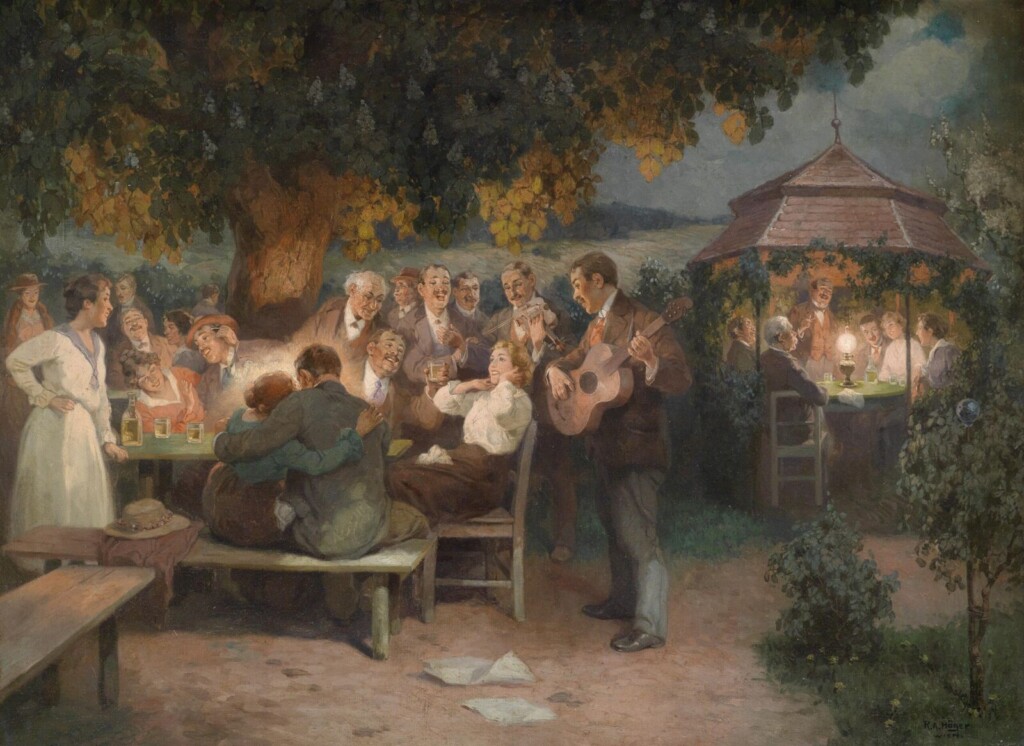
You grew up knowing, without anyone ever having to tell you, that you belonged somewhere before you belonged to yourself. The flag in the schoolyard, the anthem that rose in your chest before you understood its words, the stories of ancestors whose struggles had made you possible — none of this arrived as argument. It arrived as atmosphere, which is precisely why it worked.
Benedict Anderson noticed something structurally strange about this atmosphere. In Imagined Communities, published in 1983, he observed that nations require their members to feel profound horizontal solidarity with millions of people they will never meet, mourn for, or touch. The mechanism that makes this possible is not shared blood or shared memory but shared media — the newspaper read simultaneously by strangers across a territory, each reader aware that others are reading the same words at the same moment, producing what Anderson called “the almost precisely simultaneous consumption” that generates the feeling of a synchronized collective life. The nation is not discovered. It is synchronized into existence. The emotion is real. The ancient origin is not.
What is more disturbing than the fabrication itself is the specific historical moment in which it was needed most urgently. The decades between 1870 and 1914 saw an explosion of invented ritual across Europe — new coronation ceremonies, newly minted military traditions, freshly composed folk costumes declared to be immemorial. Eric Hobsbawm and Terence Ranger documented this in The Invention of Tradition, also 1983, cataloguing how Scottish Highland culture as a coherent ethnic identity was substantially constructed in the early nineteenth century, how the British monarchy developed its current ceremonial grandeur not from medieval continuity but from late Victorian anxiety about industrial disorder and class dissolution. The pageantry was not ancient. It was a response to modernity’s capacity to dissolve every stable anchor of collective identity — and it needed to appear ancient precisely because the dissolution was so recent and so violent.
The parish, the tribe, the village — these feel older than the nation, more intimate, less manufactured. But the intimacy is also a construction, though of a different register. What sociologists call Gemeinschaft, the warm face-to-face community theorized by Ferdinand Tönnies in 1887, was already partly a retrospective idealization at the moment of its naming. Tönnies was describing something he believed was disappearing under industrialization, which means the concept of the natural, rooted community arrived in intellectual history already as an elegiac fiction — a portrait painted from loss rather than observation. The village elder dispensing wisdom under the oak tree, the unbroken transmission of values from grandfather to grandchild, the rituals that required no explanation because everyone simply knew — these images were always more powerful as mythology than they were accurate as anthropology.
There is something important in the timing. The tools for manufacturing communal feeling — mass literacy, print capitalism, standardized national languages — became widely available in Europe roughly between 1750 and 1850. This is also the period during which organic, ancestral community was most fervently claimed and most sentimentally mourned. The nostalgia and the technology arrived together, which suggests they were never opposites but collaborators: the printing press needed the myth of the hearth, and the myth of the hearth needed the printing press to circulate widely enough to feel universal.
This means that when someone tells you their community is simply what they are — not a choice but a nature, not a construction but a birth — they are repeating a story that was written, at a specific historical moment, by people with specific political and economic interests in making certain affiliations feel inevitable. The feeling of naturalness is not evidence of naturalness. It is the most sophisticated product of the construction, the final layer that erases all the previous layers, leaving only the sensation of having always already belonged.
What Groups Actually Demand in Exchange for Membership
You joined something, and you felt it immediately — that small but unmistakable warmth of being on the inside of a line rather than outside it. What you probably did not feel, because it arrived too gradually and too quietly, was the weight of what you had just agreed to pay.
Henri Tajfel understood this before most people were willing to say it plainly. In 1971, working with colleagues at the University of Bristol, he divided schoolboys into groups based on criteria that were, by design, completely meaningless — a supposed preference for one abstract painter over another, a coin flip dressed in aesthetic language. No shared history, no common enemy, no ideology, no ritual. And yet within minutes, the boys began allocating resources in ways that favored their own group, even when doing so was materially irrational, even when it meant giving their group less in absolute terms as long as they maintained a relative advantage over the other side. Tajfel called these the minimal group experiments, and what they revealed was not a quirk of adolescence but a constitutional feature of human cognition: the act of categorization alone is sufficient to generate loyalty, suspicion, and the willingness to penalize strangers. The group did not need to mean anything. It only needed to exist.
This is where the conventional story about belonging goes wrong. We tend to narrate communities as spaces that form around pre-existing bonds — shared values, common suffering, mutual recognition. But Tajfel’s data suggests the causal arrow often runs in reverse: the bond forms because the boundary does. First there is a line drawn, however arbitrarily, and then the emotional architecture of loyalty and identity constructs itself around that line, retroactively generating the sense of deep connection that we later remember as the reason we joined. The feeling of belonging is frequently the product of exclusion, not its opposite.
Every community that has ever sustained itself over time has required its members to perform a specific act that is rarely named as such: the active devaluation of those outside it. This is not incidental to belonging; it is load-bearing. Irving Goffman’s work on stigma, published in 1963, traced how groups stabilize their internal identity by constructing a category of the disqualified — the ones who do not meet an unspoken norm, the ones whose difference is made to carry moral weight. The group does not merely tolerate this mechanism; it depends on it. Membership is not simply inclusion in something; it is the ongoing practice of maintaining a distinction that justifies why some people are in and others are not.
What makes this particularly difficult to see from the inside is that the demands of membership rarely announce themselves as demands. They arrive as norms, as intuitions, as the vague social discomfort you feel when you say something that breaks the room. Conformity in tightly bonded groups is not usually enforced through explicit punishment — Solomon Asch demonstrated in his 1951 conformity experiments that people will deny the evidence of their own eyes rather than contradict a unanimous group — it is enforced through the far more efficient mechanism of anticipated shame. You censor yourself not because someone threatened you but because you have already internalized the group’s judgment and run it against your thought before it reaches your mouth.
The price of membership, then, is not paid once at entry. It is collected continuously, in small installments, in every moment when you choose the group’s version of reality over your own perception, in every conversation where you signal your loyalty by agreeing faster than you thought, in every stranger you dismissed a little too quickly because dismissing them was the easiest way to feel at home among people who had already decided what kind of person belongs here and what kind does not.
The Substitution of Meaning for Solidarity
You are standing in a crowd of forty thousand people who believe exactly what you believe, wear what you wear, chant what you chant, and you have never felt more alone in your life. The flags are the right color. The slogans are yours. Every face around you reflects your own position back at you with the fidelity of a mirror, and yet something underneath refuses to be satisfied, something older and more demanding than ideology or aesthetic preference, something that recognition alone cannot feed.
What has happened, quietly and without announcement, is that the architecture of belonging has been rebuilt around a fundamentally different load-bearing structure. Where communities once cohered through mutual obligation — the kind that cost you something, that made demands on your time and body and resources, that bound you to specific people in specific places through specific acts of reciprocal care — they now cohere through shared signal. You belong because you consume the same things, reference the same texts, perform allegiance to the same symbols. The sociologist Zygmunt Bauman, writing in Liquid Modernity in 2000, called this “aesthetic communities” — groupings that assemble around shared taste rather than shared fate, that dissolve the moment the aesthetic loses its charge or a newer, more compelling signal appears on the market.
The critical distinction Bauman was tracking is not simply about shallowness. It is about reversibility. A community of obligation is difficult to exit because you owe something to its members and they owe something to you; there are costs to leaving, relational debts, histories of interdependence that cannot simply be deleted. A community of consumption is, by design, infinitely reversible. You can unsubscribe. You can rebrand. You can migrate to the next formation the moment this one stops producing the sensation of recognition. This reversibility feels like freedom, and it is marketed precisely that way, but what it actually eliminates is the condition under which genuine solidarity becomes possible: the moment you cannot leave.
Robert Bellah and his co-authors observed something structurally related in Habits of the Heart in 1985, documenting how Americans had begun replacing commitments rooted in tradition or civic obligation with what they called “lifestyle enclaves” — groups united not by shared responsibility for a common world but by shared preferences within a private one. Four decades later, the infrastructure for this substitution has been so thoroughly industrialized that the lifestyle enclave is now the default social unit, not the exception. Platforms are engineered to aggregate people by preference, algorithmically refining the signal until the group is perfectly homogeneous, perfectly reflective, and perfectly useless as a site of genuine encounter with difference or need.
There is a specific kind of loneliness that this arrangement produces, distinguishable from ordinary isolation. It is the loneliness of being seen but not known, recognized but not reached. When belonging operates through identification with a brand, a movement, an aesthetic tribe, what is being recognized is not you — it is your signal. The crowd that cheers alongside you is cheering for the position you occupy in a shared symbolic system, not for the particular, irreducible, difficult fact of your existence. This distinction, between being recognized as a type and being known as a person, maps almost exactly onto what the philosopher Martin Buber described in 1923 as the difference between I-It and I-Thou relations — one in which the other is an object confirming your categories, the other in which the other disrupts and exceeds every category you brought to the encounter.
The disruption is the point. The friction of genuine solidarity — the neighbor whose politics offend you but whose roof needs fixing, the colleague whose grief arrives at an inconvenient moment and cannot be managed into a palatable aesthetic — is precisely what modern belonging has been engineered to remove, because friction does not scale, cannot be monetized, and refuses to perform cohesion on demand.
A vision curated by a filmmaker, not an algorithm
In this video I explain our vision
Durkheim’s Collective Effervescence and Its Contemporary Distortions

You have felt it at least once — a stadium, a protest, a concert, a funeral where the grief was shared so completely it became almost unbearable in its warmth. The moment when the boundary between your body and the crowd seemed to dissolve, when you were no longer an individual navigating your own private concerns but something larger, something briefly collective and electric. You did not manufacture that feeling. It arrived, uninvited, and left a residue that individual experience rarely matches.
Émile Durkheim named this with clinical precision in 1912, in “The Elementary Forms of Religious Life,” calling it collective effervescence — the surge of energy that occurs when bodies gather around a shared symbol and temporarily fuse into what he described as a single moral organism. For Durkheim, this was not mysticism but sociology: the crowd produces a force that is genuinely greater than the sum of its members, and the individual who enters it returns altered, charged with beliefs and loyalties that feel as though they come from somewhere sacred because, in a functional sense, they do. The group is the origin of everything humanity has ever called divine.
What Durkheim could not have anticipated, because it required another century of consumer engineering to make possible, is the systematic manufacture of that fusion as a purchasable experience stripped entirely of its social consequence. The effervescence he documented in Australian Aboriginal ceremonies was inseparable from obligation — the rituals bound participants to one another, to the dead, to rules of conduct that extended far beyond the ceremony itself. The ecstasy was the entry point to a durable moral order. Remove the moral order and what remains is the neurological signature of belonging without its architecture.
Modern entertainment industries have become extraordinarily precise at triggering exactly that signature. The technology is not metaphorical — it is acoustic, spatial, choreographic, and increasingly algorithmic. A festival designed by professionals in crowd psychology, with lighting calibrated to dissolve individual selfhood and bass frequencies that synchronize heartbeats across thousands of bodies, is producing a real physiological state. The brain cannot always distinguish between effervescence that grows organically from shared sacrifice and effervescence that has been purchased with a ticket. But the social body knows the difference in the aftermath, in the silence that follows, in the specific desolation of returning to an ordinary life that the event did not structurally change.
The sociologist Randall Collins, building on Durkheim in his 2004 work “Interaction Ritual Chains,” argued that emotional energy — the charge accumulated during moments of collective synchrony — requires a chain of subsequent interactions to remain alive. Without those chains, the energy dissipates, leaving not solidarity but its ghost. What the contemporary experience economy sells is the peak without the chain, the ignition without the engine. People leave these events having genuinely touched something real, which makes the erosion that follows more disorienting than simple disappointment. They had the feeling. They cannot locate where it went or why it did not hold.
This creates a peculiar market logic: the more efficiently the sensation is delivered and the more cleanly it is severed from any ongoing obligation, the sooner the consumer returns for the next dose. Loneliness and manufactured communion have entered a relationship of mutual amplification, each feeding the conditions that make the other necessary. The industries that profit from selling belonging have no structural incentive to produce the kind of belonging that would make people less likely to buy it again. The result is not cynicism at the top and naivety at the bottom — most participants in this economy are neither manipulated nor fully aware, but suspended in something more uncomfortable, which is the genuine experience of a real need being met by something that is almost, but not quite, its satisfaction.
What gets quietly buried in this arrangement is the cost that authentic collective life has always demanded: the surrender of some private preference to a shared claim that does not expire when the lights come up.
The Outsider as the Community’s Load-Bearing Wall
You are handed a lanyard at the door, your name already printed on it in clean sans-serif letters, and for a moment the small weight of that plastic rectangle against your chest feels like proof of something — that you were expected, that someone accounted for you, that the circle has opened just wide enough to let you step inside. What you do not feel, because you are not meant to feel it, is the precise and necessary function of the person who will not receive a lanyard. The warmth in the room is not incidental. It is calibrated by the cold outside.
René Girard spent decades tracing this calibration to its structural core. In Violence and the Sacred, published in 1972, he argued that human communities have never achieved cohesion through shared values alone — they achieve it through the shared identification of a victim. The scapegoat is not a dysfunction of communal life; it is the mechanism by which communal life becomes possible at all. When internal tensions accumulate, when rivalries and resentments threaten to turn a group against itself, the violence does not dissolve — it converges. It finds a body to absorb it. And the community, suddenly unified in its condemnation, mistakes that unity for virtue. The expulsion feels like justice. It feels like health. It is neither.
What makes this mechanism so difficult to dismantle is that it operates below the threshold of conscious intention. No one in the group needs to decide that someone will be cast out. The process is self-organizing, fed by mimetic desire — the way humans learn what to want by watching what others want, and therefore inevitably learn what to hate by watching what others hate. By 1978, Girard had extended this framework in Things Hidden Since the Foundation of the World, arguing that the entire architecture of sacred violence — sacrifice, ritual, taboo — is humanity’s attempt to institutionalize the scapegoat mechanism so that communities don’t have to improvise it each time from scratch. Religion, in this reading, is partly a technology for managing collective murder so efficiently that it no longer looks like murder at all.
The sociological surface of this looks more familiar than the anthropological depth. Every institution has its informal taxonomy of the tolerated and the barely tolerated. The person who is technically a member but is never included in the smaller conversations after the meeting, who finds their suggestions met with a particular quality of silence — that person is not simply being ignored. They are performing a structural function. Their precarious position on the interior edge of the group gives other members a reference point, a proof that belonging is conditional and therefore precious. Remove that person entirely and the anxiety that kept everyone else in line begins to diffuse. Include them fully and the hierarchy that organizes who belongs more loses one of its load-bearing columns.
What communities call identity is therefore never simply a description of what they are. It is also a description of what they have decided not to be — and more precisely, who they have decided embodies that negation. The philosopher Chantal Mouffe, writing in The Democratic Paradox in 2000, argued that political identity is constituted through antagonism, that every “we” requires a “they” not as an unfortunate side effect but as a constitutive condition. She was writing about democratic politics, but the logic reaches into every PTA meeting, every WhatsApp group with a name, every neighborhood association that forms in the aftermath of something perceived as a threat.
The threat, of course, does not need to be real. It needs only to be shared. A community that runs out of external threats will, with a quiet and almost gravitational inevitability, begin manufacturing them internally — finding within its own boundaries someone whose difference is suddenly legible as danger, whose presence retrospectively explains whatever had been going wrong.
When the Self Dissolves Into the Group

You have attended the meeting, signed the petition, worn the shirt, learned the handshake, repeated the slogans until they felt like your own thoughts — and somewhere in that process, without a ceremony or a rupture, the original reason you joined became less important than the fact of belonging itself.
This is not a failure of individual willpower. Erich Fromm diagnosed the mechanism with clinical precision in 1941, writing in the aftermath of watching European democracies collapse not under external assault but under the weight of their own citizens’ hunger for submission. In “Escape from Freedom,” he argued that the modern individual, severed from the fixed identities of medieval guild and church and village, inherits a freedom that is experienced less as liberation than as exposure — a terrifying weightlessness that the self rushes to escape by fusing with something larger and more certain than itself. The authoritarian collective does not seduce people despite their love of belonging; it seduces them through it, offering the intoxicating relief of a self that no longer has to bear the burden of its own separateness.
What makes this dynamic so resistant to recognition is that the surrender feels, from the inside, like arrival. The person who has dissolved into the group reports feeling more themselves than ever before, more purposeful, more real. Identity becomes legible through reflection in a communal mirror, and the clearer that mirror, the less room it leaves for anything the group has not already sanctioned. Fromm observed that this was not the exclusive property of fascism — it was a structural feature of how belonging operates under conditions of psychological insecurity, which is to say, under most conditions most people actually inhabit.
Sociology has documented the cost at the level of behavior. Irving Janis, studying foreign policy disasters in the mid-twentieth century, introduced the term “groupthink” in 1972 to describe the systematic suppression of dissent inside cohesive groups — not through explicit coercion but through the social penalty attached to disrupting harmony. People who belong deeply enough begin to self-censor not because they fear punishment but because internal disagreement starts to feel like disloyalty to something they have made part of themselves. The boundary between critique and self-destruction becomes genuinely unclear.
Children absorb this grammar before they have language for it. Developmental psychologists tracking social behavior in early childhood find that exclusion from peer groups registers in the brain along the same neural pathways as physical pain — the anterior cingulate cortex lighting up identically whether a child has been struck or left out of a game. Belonging is not a preference layered over more fundamental drives; it is wired in at the level where hunger and fear live. Which means the willingness to reshape the self in order to keep it is not weakness — it is the organism doing exactly what it was built to do.
This is where the honest reckoning becomes uncomfortable, because it dissolves the clean distinction between authentic community and coercive conformity. If the psychological need is strong enough to bend perception, language, memory, and moral judgment — and the evidence suggests it is — then every community exists on a spectrum that begins with warmth and shared purpose and ends somewhere Fromm recognized as the abdication of the self. The intentional communities of the 1960s, built explicitly against conformity, generated their own orthodoxies within years. The online spaces organized around dissent calcify into doctrines policed more aggressively than the institutions they oppose.
What remains genuinely open is whether the gravitational pull Fromm identified is a permanent condition of human sociality or a symptom of a specific kind of psychic wound that different arrangements of life might actually heal — and whether the communities most certain they have escaped it are precisely the ones that have already surrendered to it most completely.
🤝 The Invisible Thread: Belonging, Groups, and Human Bonds
The need to belong is one of the most primal forces shaping human behavior, identity, and collective life. From tribes to utopian communities, from sectarian dynamics to social capital, the question of what binds us together — and what tears us apart — runs through philosophy, sociology, and cinema alike. These articles explore the deeper architecture of human togetherness.
Tribalism and group identity: social psychology
Tribalism and group identity are not relics of a distant past but living forces that shape how modern individuals construct their sense of self in relation to others. Social psychology has long examined how belonging to a group confers meaning, protection, and purpose, while simultaneously generating exclusion and hostility toward outsiders. Understanding these mechanisms is essential to grasping why the need to be part of something can become both a source of strength and a vector of division.
GO TO THE SELECTION: Tribalism and group identity: social psychology
Closed communities and sectarianism: isolated group dynamics
Closed communities and sectarian groups represent one of the most extreme expressions of the human need for belonging, where the desire for unity hardens into isolation and control. The sociology of isolated group dynamics reveals how charismatic leadership, shared rituals, and rigid boundaries create powerful bonds that are extraordinarily difficult to break. These environments offer a distorted mirror of the communal ideal, showing how the longing to belong can be weaponized.
GO TO THE SELECTION: Closed communities and sectarianism: isolated group dynamics
Putnam’s Bowling Alone: Analysis
Robert Putnam‘s landmark study ‘Bowling Alone’ diagnoses a quiet crisis at the heart of modern democratic life: the erosion of social capital and the unraveling of the civic bonds that once held communities together. As associational life declines, individuals find themselves increasingly isolated despite living in densely populated societies, craving connection without the structures that make it possible. Putnam’s analysis remains one of the most urgent and unsettling accounts of what we lose when belonging fades.
GO TO THE SELECTION: Putnam’s Bowling Alone: Analysis
Alternative Communities: History, Sociology and the Ecovillage Model
Alternative communities and the ecovillage model represent deliberate, conscious attempts to reconstruct the sense of belonging that mainstream society seems unable to provide. Drawing on a rich history of utopian experimentation, these groups seek to reweave the social fabric through shared values, cooperative living, and ecological commitment. Their story is a testament to how deeply the need to be part of something meaningful drives human beings to reimagine the very structures of collective life.
GO TO THE SELECTION: Alternative Communities: History, Sociology and the Ecovillage Model
Discover the Cinema of Community and the Human Search for Belonging
If these themes stir something in you — the longing for connection, the fragility of community, the beauty and danger of belonging — then independent cinema is perhaps the most honest mirror we have. On Indiecinema, you’ll find films that dare to explore these questions with courage and intimacy, far from the noise of mainstream storytelling. Step inside and let independent cinema show you what it means to truly be part of something.
👉 EXPLORE THE CATALOG: Watch Indie Films in Streaming
A vision curated by a filmmaker, not an algorithm
In this video I explain our vision

