
The Morning Ritual
You reach for it before your eyes have fully adjusted to the light. The motion is already complete before the thought arrives — thumb pressing the glass, the small explosion of notifications assembling themselves into something that feels, for just a moment, like being needed. You lie there in the specific warmth of a bed you haven’t yet left, scrolling through images of people you’ve never met living lives you didn’t ask to witness, and something in you registers all of it as normal. As morning. As the thing that comes before coffee, before the face in the mirror, before whatever version of yourself you will be required to produce today.

There is a performance that begins before you stand up. You already know, somewhere below the level of articulate thought, which clothes carry which message, what the day’s first words to a colleague should sound like, how to calibrate the expression you’ll wear on the commute so that you appear neither too vacant nor too intensely present. You have rehearsed this without rehearsing it. The self that moves through the morning is not assembled from scratch each day — it was constructed long ago, and you have simply agreed, again, to wear it. The agreement takes no deliberate effort. That is precisely the point.
By the time you’ve showered and eaten something approximate to breakfast, you’ve already received more information than any human being living before 1900 would have encountered in a week. None of it has moved you. A wildfire somewhere, a political statement designed to provoke, a photograph of someone’s carefully arranged meal, a death toll presented beside a sports result in the same typographic weight. The machine that delivers these things to you does not distinguish between them in tone, and after long enough exposure, neither do you. You absorb it all with the same mild, practiced responsiveness — the small frown, the brief exhale, the thumb already moving.
What is strange about this is not the technology. What is strange is how fluently you perform the role of a person engaged with the world while experiencing almost none of it at depth. You are, functionally, present. You respond when spoken to. You meet the requirements of the hour. But there is a quality of distance inside the efficiency — a gap between the self that acts and whatever is underneath it — that you have learned not to examine too closely, because examining it too closely does not appear to produce anything useful, and the day is already asking for you.
The word for this, in clinical language, would never be applied to you. You are not suffering in any way that would register on a diagnostic scale. You sleep adequately. You meet your obligations. You experience what passes for satisfaction when a project is finished, what passes for pleasure when the weekend arrives, what passes for connection when you are with people who know your name. These are not performances you’ve invented — they are performances you were handed, and they fit well enough that you rarely feel them as performances at all. That seamlessness is not comfort. It is a different thing entirely, though the difference is difficult to name from inside it.
Somewhere in the middle of the twentieth century, a man who had fled one collapsing civilization for another began to argue that the most dangerous pathologies were not the ones that felt like suffering. That a society could be comprehensively, structurally ill and still produce individuals who functioned, who smiled at appropriate moments, who built careers and families and held opinions about the news. That sanity was not the same thing as adjustment. That the absence of obvious distress was not evidence of health, but might be, under certain conditions, evidence of something much more troubling — a successful adaptation to conditions that should, by any honest measure, be refused.
You put the phone down. You begin the day.
Crazy World
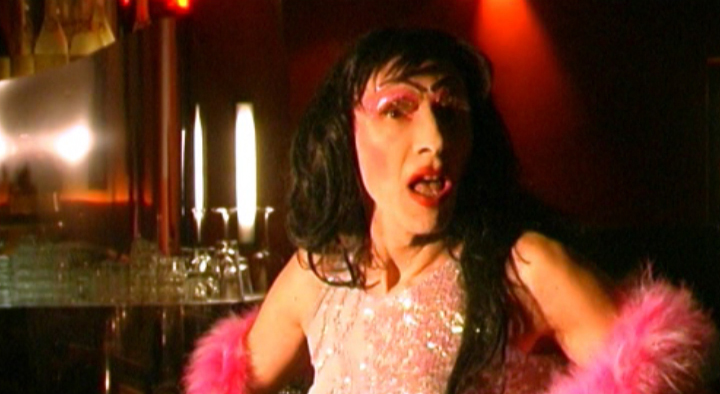
Drama, thriller, by Fabio Del Greco, Italy, 2010.
Luca is poor and works, precariously, as a waiter. He lives a problematic relationship with his girlfriend, and his life is full of doubts. One day Luca meets Chiara, a friend who had studied philosophy with him at university. She has realized her dream of opening a night and is now well-off. Luca leaves everything behind and starts a relationship with Chiara. He manages the nightclub with her and, thanks to the cocaine and call girls sold to politicians, he gets out of his hard economic situation. But Chiara does not manage to obtain the contract for an old furnace, so she blackmails Saverio, a member of the Parliament. Chiara owns a video in which Saverio has sexual intercourse with a transsexual.
LANGUAGE: Italian
SUBTITLES: English, French, Spanish, German, Dutch, Portuguese.
Fromm’s Diagnosis and the Concept of Social Character
You are standing in a factory in 1953, not in Detroit specifically but in any of a hundred cities where the logic is identical: you arrive at a fixed hour, perform a motion that has been subdivided so finely it no longer resembles anything human beings would choose to do, and you leave having produced a fragment of something you will never own, never fully see, never use. The object of your labor is a stranger to you. What is more unsettling — and this is what Erich Fromm was watching with the precision of a clinician — is that most people doing this do not experience it as unbearable. They adapt. They call the adaptation maturity.
Fromm published The Sane Society in 1955, two years after Stalin’s death and in the middle of the most sustained economic expansion the Western world had ever recorded. American GDP had nearly doubled since 1940. Suburbs were being constructed at a pace that required the invention of new logistical categories. The psychiatric establishment was largely congratulating itself on the integration of the returning soldier into productive civilian life. Fromm looked at all of this and asked a question that the decade’s triumphalism made almost inaudible: what if the adjustment itself is the pathology?
His answer required a concept that sits uncomfortably between psychology and sociology, belonging fully to neither. Social character, as Fromm developed it across The Sane Society and the earlier Escape from Freedom in 1941, is not a description of how individuals differ from one another. It is a description of what they share — not by accident, not by nature, but because a given economic and social arrangement requires a specific psychic structure in order to reproduce itself. A capitalist consumer economy does not merely need workers who show up on time. It needs people who have reorganized their inner lives around the values that make such showing up feel like freedom. It needs people who experience acquiring things as a form of self-expression, who feel anxiety rather than relief when unoccupied, who interpret submission to institutional authority as personal responsibility.
The distinction Fromm was drawing is not subtle once you see it, but it is easy to miss because it operates at the level of what feels natural. Sigmund Freud had already established that the character structures adults present to the world are not chosen consciously — they are sedimentations of early experience, defenses that calcified into personality. Fromm accepted this architecture but shifted the question of origin. Where Freud located the formative pressure primarily in the family drama, Fromm pressed further back and asked what forces shape the family itself. The answer was always, in some decisive measure, economic. The authoritarian father of the nineteenth-century bourgeois household was not a psychological accident; he was a functional product of a productive order that required hierarchical obedience and delayed gratification and transmitted these requirements through the most intimate available channel.
By the mid-twentieth century the requirement had changed. Industrial capitalism in its consumer phase needed not the ascetic accumulator but the enthusiastic spender, not the self-denying patriarch but the personality who experiences the self as a commodity to be packaged and sold, whose identity is assembled from purchases. David Riesman had described something adjacent to this in The Lonely Crowd in 1950, charting the shift from inner-directed to other-directed personality types. Fromm was making a darker claim: that the new character type was not merely a sociological observation but a diagnosis. The marketing orientation — his term for the psychic posture that experiences the self as something to be traded on an interpersonal market — was not a style of relating. It was a wound that the culture had agreed to call health.
The wound was invisible precisely because it was universal. A society cannot easily recognize its own character as a pathology when that character is the baseline against which all deviation is measured.

Necrophilia as a Cultural Logic
You are filling out a form. Not a tax form, not a medical intake questionnaire — though those will come — but a simple one, the kind you encounter before you can speak to a human being about a problem that is already costing you sleep. The fields multiply. The dropdown menus do not contain your actual situation. You select the closest approximation of your life from a list someone else composed, and somewhere in that small act of translation, something accurate about you is quietly deleted.
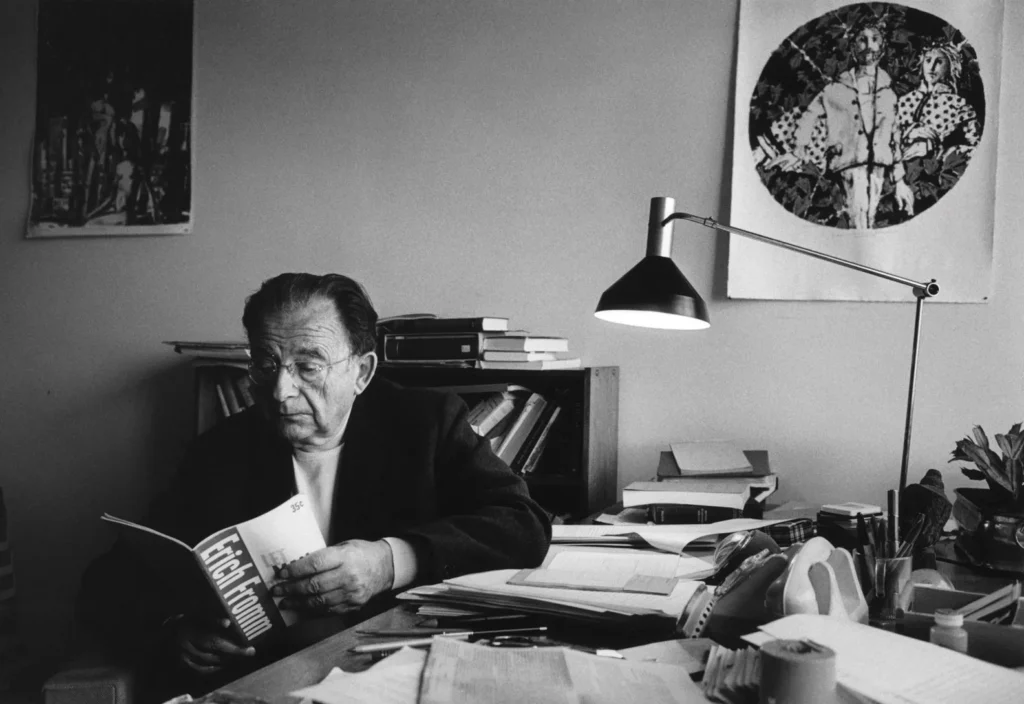
Erich Fromm named the force behind that deletion. In The Heart of Man, published in 1964, he introduced a concept he called necrophilia — not in its clinical or sensational sense, but as a characterological orientation, a way of being drawn toward what is dead, fixed, and controllable rather than what is alive, unpredictable, and growing. The necrophilous character, in Fromm’s analysis, does not love death in the theatrical sense. He loves order. He loves precision. He loves what can be measured, catalogued, and managed without remainder. What he cannot tolerate is the excess that living things produce — the way they exceed their descriptions, change their minds, refuse to stay where they were placed.
This is not a pathology confined to individuals. Fromm was explicit that entire social arrangements could be organized around necrophilous logic, and that industrial modernity had constructed several of them simultaneously. The bureaucratic apparatus is perhaps the purest expression: a system designed so that no living judgment is required at any point, where every decision has already been pre-decided by a procedure, where the human being who administers the form is as much its subject as the person filling it out. Max Weber had already mapped this territory in Economy and Society, describing the iron cage of rationalized administration — but Weber was largely descriptive, tracing the historical emergence of bureaucratic domination. Fromm asked what kind of person this system required, and what kind it produced. The answer was someone who found comfort in the rule precisely because the rule removed the terror of encountering another person as genuinely other.
Consumer culture operates on a parallel logic, though it disguises itself as its opposite. It presents itself as vitality — color, desire, novelty, pleasure — while organizing all of that vitality around the acquisition of objects that do not talk back. The car does not leave. The appliance does not disappoint you by growing in an unexpected direction. The upgrade arrives on schedule and replaces what existed before with something slightly smoother, slightly more responsive to the pressure of a finger. There is a reason the word “seamless” became the highest praise available to product designers in the early twenty-first century: seamlessness is the elimination of friction, and friction is what living things produce when they encounter one another. A world optimized for seamlessness is a world from which the living have been gently, cheerfully removed.
Fromm observed in 1964 that automation had not freed workers from toil so much as it had replaced the relationship between a person and their labor with a relationship between a person and a mechanism. By 2023, the global consulting firm McKinsey estimated that nearly a third of work tasks across major economies were technically automatable — a figure presented as economic forecast but which functions equally as a portrait of what has already been quietly accomplished in the imagination of the workplace. The worker who remains is increasingly the worker who has learned to behave like the part of the process that has not yet been replaced: consistent, predictable, error-minimizing, available. The aspiration, if it can be called that, is to become indistinguishable from the machine that will eventually perform the same function.
What Fromm saw was that this aspiration does not feel like defeat to the person experiencing it. It feels like competence. It feels like professionalism. It feels, under certain fluorescent lights and with the right vocabulary applied to it, like excellence.
The Market Character and the Self as Product
You rehearse your own introduction before you walk into the room. Not the words exactly, but the shape of them — the tone, the pause, the precise degree of warmth that signals confidence without arrogance. You have done this so many times that the rehearsal no longer feels like rehearsal. It feels like memory.
Erich Fromm named this condition in 1947, in Man for Himself, with a clarity that should have been more disturbing than it was. He called it the marketing orientation, and he placed it alongside the receptive, the hoarding, and the exploitative as one of the fundamental ways a human being can relate to existence — except that the marketing orientation was different in kind, not just degree. The others were distortions of desire or possession. This one was something structurally more corrosive: it transformed the self into a commodity. The person did not merely want things or fear losing them. The person became a thing to be packaged, presented, and exchanged at whatever price the market would bear.
What Fromm understood, and what takes time to sit with, is that this is not vanity. Vanity is still attached to a self that cares about its own image. The marketing orientation goes further: it dissolves the boundary between image and substance entirely. The question is no longer who am I, but what sells. And because the market is never stable, because what sells today is already becoming obsolete, the person shaped by this orientation lives in a state of permanent, low-grade terror. Not the terror of death or loss, but the subtler terror of becoming irrelevant — of being a product no one wants anymore, discontinued, clearanced, quietly removed from the shelf.
This is precisely why the anxiety of modern self-presentation cannot be resolved by performing better. The performance is the trap. The more fluently someone learns to package themselves, the more they confirm that the self is a package, and packages have expiration dates. Fromm drew on his training under Karl Abraham and the Frankfurt School’s attempt to fuse Marx with Freud to argue that this was not a personal neurosis but a social one — that a market economy does not merely reward the marketing orientation, it produces it, trains it into people from childhood, disguises it as ambition, confidence, personal branding. He wrote this before the phrase personal branding existed, which makes the diagnosis feel less like historical analysis and more like prophecy.
The cruelty of the arrangement is that it feels like freedom. You are not assigned your identity; you construct it. You choose your presentation, your narrative, the story you tell about your own competence and likability. But Fromm would insist that this is precisely the structure of alienation: the sensation of agency within a frame so total that the frame itself becomes invisible. What you experience as self-expression is, in the terms he laid out in 1947, a form of self-betrayal — the substitution of marketability for character, of popularity for integrity, of reception by others for genuine contact with oneself.
The person who has lived inside this orientation long enough begins to experience a strange vertigo when no one is watching. The absence of an audience does not feel like rest; it feels like formlessness. There is no approved version of the self to perform, and without performance, something uncomfortably hollow opens up. Fromm located this hollowness at the center of what he called the having mode — a mode of existence organized around what one can acquire, display, and exchange rather than around what one genuinely is or does. The hollowness is not a personal failure. It is the logical result of a structure that has made the self into an instrument of its own marketability, leaving no remainder, no interior, no part of the person that belongs only to themselves and serves no function in the transaction.
The room you walked into is still waiting for your introduction.
Alienation Beyond Marx
You clock in at 7:43 a.m. and something closes. Not a door exactly — more like the small muscular thing inside you that was still half-alive from the night before, still carrying the residue of a dream you almost remembered, shuts off the way a pilot light goes out. You walk to your station. You do what the station requires. At 4:58 p.m. the same thing reopens, faintly, in the parking lot, but by the time you reach the car it has already learned not to expect too much from the next few hours.
Karl Marx identified alienation as what happens when a worker is separated from the product of their labor, from the act of production itself, from other human beings, and finally from what he called their species-being — the creative, self-determining nature that distinguishes human life from mere animal metabolism. He wrote this in the Economic and Philosophic Manuscripts of 1844, and for over a century it remained primarily an economic diagnosis: capitalism estranges the worker because the worker does not own what they make. Erich Fromm accepted this architecture entirely and then blew through its walls. In The Sane Society, published in 1955, he argued that the crisis had migrated inward — that alienation had become ontological, a severance not from external products but from one’s own interiority, from the felt sense of being alive rather than merely functioning.
The historical timing of this argument was not accidental. Between 1947 and 1957, American consumer spending increased by nearly forty percent in real terms. Suburban homeownership doubled. The number of television sets in American households went from approximately 14,000 in 1947 to over 50 million by 1960. These are not just economic facts — they are measurements of a new kind of self-relation, in which the human being begins to experience themselves primarily as a receiver and consumer of stimulation rather than as an agent of their own life. Fromm borrowed the term “marketing character” to describe a personality type that had reorganized itself around exchangeability: the person who no longer asks what they feel or want but rather what kind of person they need to appear to be in order to succeed in the transaction the moment demands.
What makes this extension of Marx genuinely disturbing is that it cannot be solved by any redistribution of ownership. A worker who owns shares in the company that employs them can be just as deeply estranged from their own aliveness as a nineteenth-century factory hand in Manchester. The estrangement Fromm is tracking is not a function of who controls the means of production but of whether the human being has maintained any live connection to their own spontaneous responses — to desire that has not been prefabricated, to thought that has not been pre-sanctioned, to love that does not serve as a vehicle for something else. David Riesman, writing in The Lonely Crowd in 1950, noticed the same erosion from a sociological angle, describing the shift from inner-directed personalities guided by internalized values to other-directed personalities perpetually scanning the social environment for cues about who to be. Fromm’s contribution was to push below the sociological into the existential: what is lost in this process is not just authenticity in the therapeutic sense but the direct experience of one’s own existence as real.
This is why the post-war American suburb becomes, in Fromm’s analysis, something structurally more troubling than poverty ever was. Poverty could produce misery that was at least legible, that knew its own name. The new condition produced a population that was comfortable, adjusted, and intermittently cheerful — and had no language for the specific deadness it was carrying, because the culture that shaped them had no category for it, and no interest in creating one.
A vision curated by a filmmaker, not an algorithm
In this video I explain our vision
The Automaton and the Illusion of Freedom

You chose the job. You chose the city, the partner, the political opinion you defend at dinner. You made these choices consciously, you remember making them, and the memory of choosing feels like evidence of a self that was there, deliberating, sovereign. But Fromm, writing in 1941 in Escape from Freedom, identified something that makes that memory unreliable in a way that is difficult to sit with: the mechanism he called automaton conformity, by which a person does not merely adopt the values and desires of the surrounding culture but genuinely experiences those adopted values as their own. The theft is so complete that there is no sense of loss. You do not feel the bars because you have become, in some functional sense, the shape of the cage.
The terror that drives this process is not metaphorical. Fromm was writing from a psychoanalytic tradition that understood isolation as a primary human wound, not a preference or a social inconvenience but something close to annihilation. The individual who emerges from the dissolution of medieval communal structures — the guild, the Church, the fixed hierarchical order that told you exactly who you were and where you belonged — gains freedom in the most literal sense and discovers almost immediately that freedom of this kind is unbearable. The fifteenth and sixteenth centuries produced not only the Renaissance and Reformation but an epidemic of witch trials, flagellant movements, and mass voluntary submission to authoritarian religious figures. Fromm read this not as an aberration but as a symptomatic response to the vertigo of individuation: when the self becomes responsible for its own meaning and finds no ground beneath it, the easiest escape is to dissolve back into something larger and let that larger thing do the meaning-making.
What changed in the twentieth century is that this dissolution became invisible. The authoritarian submission Fromm watched in the rise of fascism was at least legible as submission — there was a visible leader, a flag, an explicit demand for surrender. The more refined version, the one that concerns us now, produces no such visible altar. Instead, culture itself becomes the authority, diffuse and total, and conformity to it feels indistinguishable from personal taste. You do not click on that article because an algorithm determined your engagement probability. You click because you are curious, interested, yourself. The self that feels curious is real. What Fromm is asking you to consider is whether the shape of that curiosity was assembled somewhere else, by forces that had no particular interest in you as a person but a very precise interest in you as a unit of predictable behavior.
David Riesman, working independently in 1950 in The Lonely Crowd, would arrive at a structurally similar diagnosis through sociological rather than psychoanalytic means, describing the shift from inner-directed to other-directed character types — people who navigate life not by an internal gyroscope formed in childhood but by a kind of radar perpetually scanning the social environment for cues. The result is not a person without convictions but a person whose convictions are continuously updated to match the room. Fromm’s contribution is to show why this does not feel like weakness: because the alternative, the genuinely inner-directed life, requires tolerating the anxiety of being a self that no one else has ratified. Most people will pay almost any price to avoid that particular loneliness.
The price is subtle enough that it rarely appears on the invoice. It shows up instead in a faint but persistent sense that your life is happening correctly according to all visible standards and yet somehow does not feel entirely yours — a suspicion you quickly dismiss because the evidence against it is everywhere, and the evidence is you, and you chose all of this, you remember choosing, and the memory is so vivid and so continuous that to question it feels like a kind of madness rather than the beginning of something.
A Scene of Chosen Chains
She has been planning this for eight months. The spreadsheet is color-coded — green for savings, red for debt, yellow for the transitional period she has calculated down to the week. She is leaving the consulting firm. She has told her closest friend, her mother, and the man she lives with. She has rehearsed the conversation with her manager in the shower at six in the morning. She knows what she wants: a smaller life, she calls it, something with more oxygen in it. The decision feels radical. It feels, to her, like the first genuinely free act of her adult life.
What she has chosen instead is a wellness brand. She will build it herself, she explains, on her own terms. She has a name, a color palette, a target demographic she describes with the fluency of someone who has been trained to think in demographics. The product is a line of supplements combined with a digital subscription for guided self-optimization — sleep tracking, cortisol management, intentional rest. She has a mentor who charges four hundred dollars an hour and refers to her clients as visionaries. The language she uses to describe her future is indistinguishable from the language she used to describe her corporate present, except that now the quarterly targets serve her own growth rather than someone else’s. Freedom, in this register, is simply ownership of the mechanism that was previously owned by another.
What Fromm identified in 1941, in Escape from Freedom, was precisely this: that the modern individual does not simply submit to external authority but internalizes its logic so completely that liberation becomes structurally impossible to distinguish from a more sophisticated form of compliance. The book was written in the shadow of fascism, but its argument was never really about fascism. It was about the democratic, consumerist, therapeutic West that fascism had revealed, by contrast, to be hiding its own authoritarian scaffolding beneath the vocabulary of choice. The person who escapes the firm to build the brand has not exited the system — she has become its most efficient unit, the entrepreneur who disciplines herself so that no boss ever needs to.
The sociologist C. Wright Mills, writing in White Collar in 1951, described the American middle class as having sold not just their labor but their personalities — their smiles, their affect, their capacity for enthusiasm, leased to whoever was paying. What has changed in the seventy years since is that the transaction has become aspirational. You are now encouraged to monetize your authentic self, which means the self itself has become inventory. The woman with the color-coded spreadsheet is not deceived in the ordinary sense. She is operating with complete information and full intention. The trap is more elegant than deception: it has made itself into the shape of escape.
There is a particular quality to the confidence she carries in that moment of decision — the morning she submits her resignation, the clean feeling of it, the sense of having finally acted rather than been acted upon. Fromm would have recognized that feeling not as evidence of freedom but as its most seductive simulation. In The Sane Society, published in 1955, he argued that a culture organized around production and consumption generates a specific psychological type: the marketing character, a person whose identity is experienced as a commodity to be packaged and sold, including to oneself. The resignation letter, in this frame, is not a break from the market — it is the market’s most intimate product, the moment when a human being fully absorbs its values and mistakes them for her own.
She posts about it that evening. The response is immediate and warm. Forty-seven people tell her she is brave.
Sanity as Deviance
You are sitting across from a psychiatrist in 1971, and you have just told him, calmly and with full conviction, that the war your country is fighting is wrong, that the economy serves the few, that the life being offered to you — the suburb, the promotion, the lawn — feels like a slow erasure of everything you recognize as human. He writes something in his notes. The word he uses is not “perceptive.” It is not “lucid.” The clinical vocabulary available to him does not contain a category for “correct.”
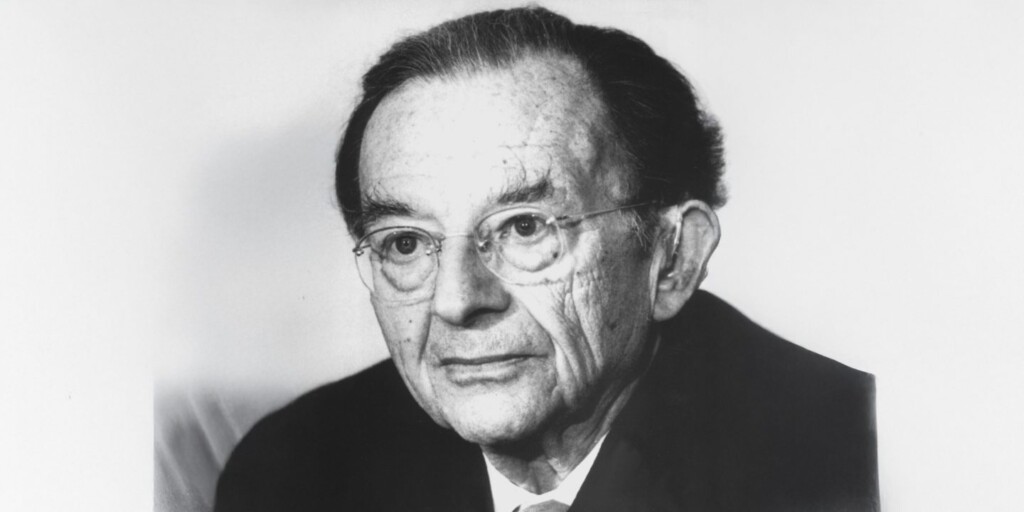
Erich Fromm spent decades building toward a single, almost unbearable conclusion: that the psychological norm and the ethical norm are not the same thing, and that in a sufficiently disordered society, the distance between them becomes a diagnostic trap. In “The Sane Society,” published in 1955, he argued that mental health could not be defined by adaptation to existing conditions, because those conditions might themselves constitute the pathology. A person who adjusts seamlessly to an insane world is not healthy. They are simply well-camouflaged.
The history of psychiatry has obliged this argument in ways Fromm could not have entirely anticipated. The American Psychiatric Association’s Diagnostic and Statistical Manual included homosexuality as a mental disorder until 1973 — not because of clinical evidence, but because of cultural consensus. “Drapetomania,” a diagnosis proposed by Samuel Cartwright in 1851, described the supposed mental illness that caused enslaved people to flee captivity. The Soviet psychiatric system deployed the diagnosis of “sluggish schizophrenia” to hospitalize dissidents throughout the 1960s and 1970s — people whose primary symptom was disagreeing with the state. These are not aberrations. They are the logical terminus of defining health as conformity.
What makes this pattern genuinely vertiginous is that it does not require malice to function. The psychiatrist writing in his notes is not, in most cases, an agent of repression consciously deploying diagnosis as a weapon. He is simply operating within a framework that has already decided what the baseline looks like, and the baseline is the society that trained him. Thomas Szasz, in “The Myth of Mental Illness” in 1961, argued that most psychiatric diagnosis is a covert moral and political judgment dressed in medical language. The person who cannot function within existing arrangements is not described as someone the arrangements have failed. They are described as someone who has failed.
The deviant, in Fromm’s architecture, is often the most accurate reader of the room. The person who feels alienated by assembly-line labor is responding appropriately to assembly-line labor. The person who cannot sustain manufactured cheerfulness in the face of genuine loss is not suffering from a mood disorder — they are suffering from honesty. But honesty without social permission looks, from the outside, exactly like dysfunction. It presents with the same surface features: withdrawal, inability to perform, refusal to participate in the agreed-upon fiction.
This is what makes Fromm’s radical claim so difficult to sit with. It is not merely that society sometimes misidentifies the disturbed as the well. It is that the well, in a sick society, have a structural incentive to appear disturbed — because wellness, in Fromm’s sense, involves seeing clearly, and seeing clearly is destabilizing to people who have organized their lives around not seeing. The truly adapted person is not neutral. They are an active participant in the maintenance of conditions that require others to be classified as broken in order to remain invisible.
The question that follows from this is not comfortable, and it does not resolve. If the diagnostic apparatus of a society reflects that society’s pathologies rather than correcting them, then the very tools used to identify who is well and who is unwell are contaminated at the source — and the person reading this sentence has almost certainly been evaluated, formally or informally, by those tools, and found, on at least one occasion, to be the one who needed to adjust.
🧩 The Sick Society and Its Critics
Erich Fromm’s diagnosis of modern society as fundamentally pathological did not emerge in isolation — it belongs to a broader tradition of thinkers who questioned conformity, alienation, and the hidden mechanisms of social control. These related articles trace the intellectual landscape surrounding Fromm’s thought, from the critique of consumer manipulation to the deeper roots of human estrangement.
Karl Marx and Alienation: Economic and Philosophical Manuscripts
Karl Marx’s early manuscripts laid the philosophical foundation for much of Fromm’s later work, particularly the concept of alienation as a structural condition of capitalist society. Fromm drew heavily on these texts to argue that modern individuals are estranged not just from their labor but from their own humanity. Reading Marx alongside Fromm reveals how the diagnosis of the sick society has deep economic and anthropological roots.
GO TO THE SELECTION: Karl Marx and Alienation: Economic and Philosophical Manuscripts
Herbert Marcuse and Art: The Aesthetic Dimension
Herbert Marcuse, like Fromm a member of the Frankfurt School, developed a parallel critique of consumer society that challenged the repressive nature of so-called tolerance and pleasure. His notion of ‘repressive desublimation’ complements Fromm’s analysis of the marketing character and the conformist personality. Together, their work forms one of the most powerful critical frameworks for understanding modern Western culture.
GO TO THE SELECTION: Herbert Marcuse and Art: The Aesthetic Dimension
Packard’s The Hidden Persuaders: Analysis
Vance Packard‘s landmark investigation into the advertising industry exposed the hidden psychological techniques used to manipulate consumer desires and bypass rational agency. His findings strikingly parallel Fromm’s concern that modern capitalism shapes human character to serve market needs rather than genuine human flourishing. The book remains a disturbing and illuminating companion to Fromm’s vision of a society that manufactures its own sickness.
GO TO THE SELECTION: Packard’s The Hidden Persuaders: Analysis
Kafka and Bureaucracy: The Trial and The Castle
Kafka’s novels The Trial and The Castle gave literary form to the experience of bureaucratic dehumanization that Fromm analyzed as a key symptom of the sick society. In Kafka’s world, individuals are rendered powerless by anonymous systems that demand conformity while offering no intelligible meaning — a perfect fictional counterpart to Fromm’s philosophical critique. Exploring Kafka through Fromm’s lens transforms these novels into profound psychological documents of modern estrangement.
GO TO THE SELECTION: Kafka and Bureaucracy: The Trial and The Castle
Discover the Cinema That Questions Society
If these ideas resonate with you, Indiecinema’s streaming platform offers a carefully curated selection of independent and auteur films that dare to question conformity, power, and the hidden costs of modern life. Explore films that go beyond entertainment to become genuine acts of critical thought — the kind of cinema Fromm himself would have recognized as a form of cultural resistance.
👉 EXPLORE THE CATALOG: Watch Indie Films in Streaming
A vision curated by a filmmaker, not an algorithm
In this video I explain our vision

