
The Familiar Lie
You read it at 7 a.m., still horizontal, phone tilted toward your face in the grey light before the day has made any demands on you. A headline. A claim so perfectly shaped to confirm what you already suspected — about the politician, the institution, the group of people you have never fully trusted — that your body registers something close to satisfaction before your mind has even processed the syntax. You screenshot it. You forward it. You say nothing because you don’t need to. The image does the talking, and by the time you have made coffee, three people you know have received a piece of information that is entirely fabricated, dressed in the visual grammar of truth.

What is remarkable is not the lie. Lies are ancient. What is remarkable is the particular modern architecture of believability — the way false information no longer needs to overcome your skepticism, because it was engineered in a laboratory of attention to arrive at the precise angle where your skepticism was never stationed. The cognitive psychologist Daniel Kahneman spent decades mapping the difference between the fast, automatic thinking that governs most daily judgment and the slower, more effortful reasoning that humans are capable of but structurally avoid. His 2011 synthesis of that research made one thing devastatingly clear: the conditions under which people encounter information in the digital environment are almost perfectly optimized to engage the first system and bypass the second entirely. Fatigue, speed, emotional priming, repetition — these are not accidents of the modern media landscape. They are its load-bearing walls.
The word disinformation carries a clinical distance that the experience does not deserve. It suggests something external, a foreign object introduced into an otherwise healthy system. But the Stanford Internet Observatory, tracking coordinated inauthentic behavior across platforms between 2016 and 2022, found something more uncomfortable: the most effective disinformation did not arrive from outside the communities it damaged. It was amplified, shared, and given credibility almost entirely from within. The vector was not the original fabricator. The vector was the neighbor, the cousin, the colleague — people acting in complete sincerity, experiencing themselves as responsible citizens doing their duty to inform.
This is where the history of propaganda becomes genuinely destabilizing rather than merely instructive. The techniques deployed by the Nazi Ministry of Public Enlightenment under Joseph Goebbels in the 1930s — the reduction of complex political reality to a single emotional enemy, the repetition of simplified claims until repetition itself produced familiarity, the deliberate flooding of the information environment with contradictions to induce paralysis — were not invented by Goebbels. They were synthesized from existing literature on mass psychology, including the work of Gustave Le Bon, whose 1895 study of crowd behavior described exactly how collective emotional states dissolve individual critical capacity. What Goebbels understood with terrifying precision was that you do not need to make people believe the lie. You only need to make them uncertain enough about the truth that the lie becomes one option among many.
That uncertainty is now industrialized. The political theorist Hannah Arendt, writing in 1951, identified the destruction of the distinction between fact and fiction as the precondition for totalitarian thought, not the consequence of it. The lie, in this analysis, is not primarily an instrument of control after power has been seized. It is the solvent applied to reality beforehand, the process by which a population loses its shared footing in verifiable events and becomes, in her word, superfluous to itself — unmoored from the common world that makes collective judgment possible. What she could not have anticipated was the degree to which that solvent would be delivered voluntarily, by private individuals, through devices they paid for, during the quiet hours before the day began.
The War in Cuba
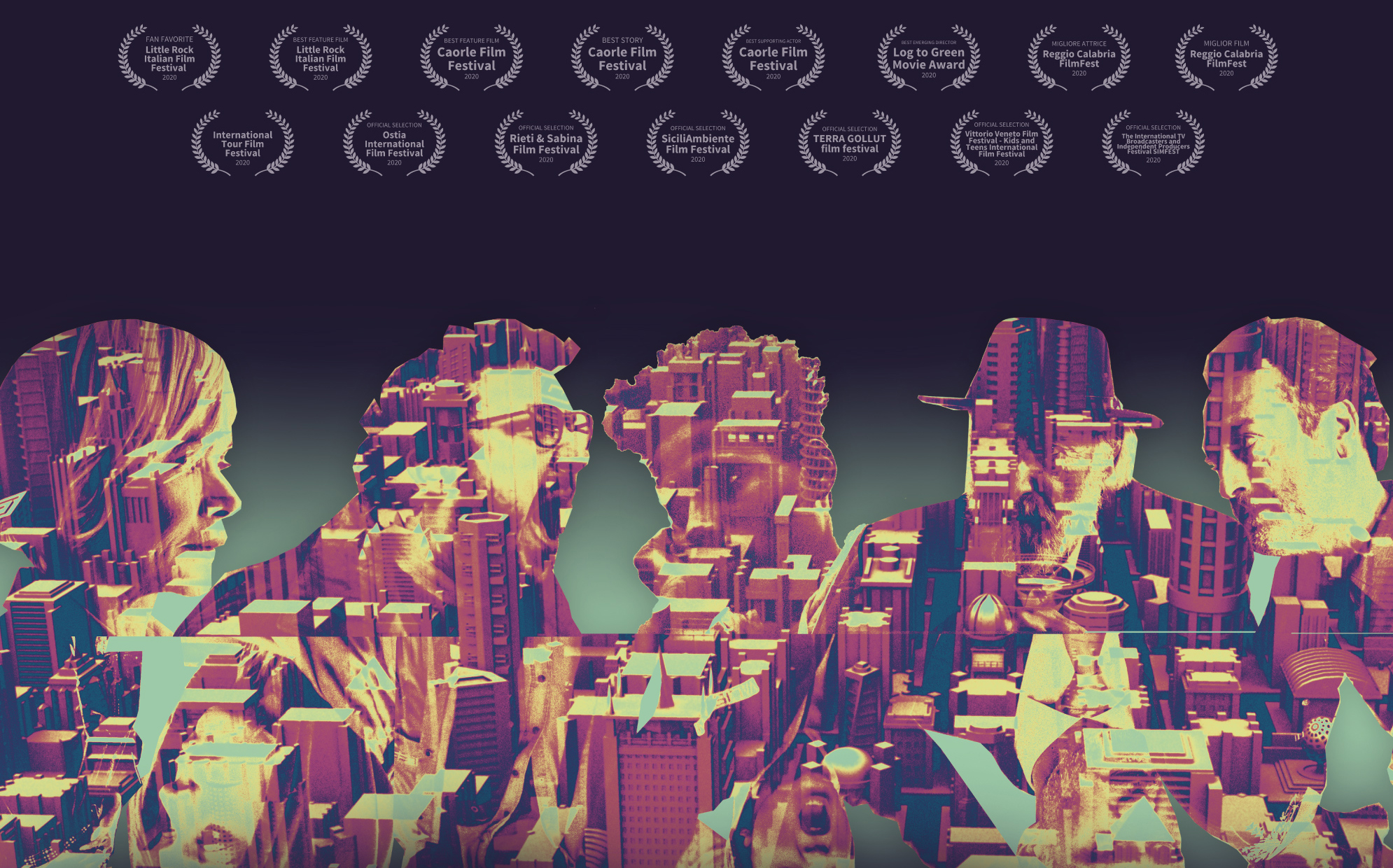
Drama, by Renato Giugliano, Italy, 2019.
The story is set in a small community in Valsamoggia, in the province of Bologna, Italy. The daily routine is disrupted by a strike by the workers of one of the main factories in the area. Parallel to this, five stories unfold, intertwining with each other. The situation is exacerbated by the arrival of a journalist in search of sensational news. Among private and collective events, hidden somewhere between people's indifference and the spread of fake news, a subtle and insidious discontent grows, especially among those who do not have strong ideals to refer to. And so, at the dawn of the festival in Valsamoggia, there is an increase in small and large crimes, more or less serious: from the beating of a black boy, to the escape of a refugee boy, and the forced repatriation of a young immigrant who was instead considered part of the community. In an escalation of clashes, frustrations, and conflicts, someone - in the middle of the Patronal Festival - climbs to the top of the town's bell tower and shoots at the crowd.
Born on the wave of a project on education for integration, "The War in Cuba" is a film that addresses, in a choral story, the horror that arises from the mixing of intolerance, cynicism, and fake news. The story explores a society that has crumbled and whose citizens, confused and lost, increasingly become victims of false myths, serial haters, and fake news. In a world full of frustrations and in which the media are increasingly subservient to the obsession with clicks and advertising, in an instant the monster is created, which, as it happens, is always the other, the one who is different from us, the minority subject. This is the sick game in which the resentment that is in us fuels resentment in others and vice versa.
LANGUAGE: Italian
SUBTITLES: English, Spanish, French, German, Portuguese
Truth as Infrastructure
You are already living inside a version of events you did not witness. The meeting that decided your neighborhood’s zoning, the vote that redirected the hospital budget, the negotiation that set the price of the grain in your bread — none of these passed through your senses. You received them, if at all, as summaries, headlines, secondhand accounts filtered through institutions you trust to varying degrees and for reasons you have rarely examined. This is not a failure of attention. It is simply the structural condition of being a social animal in a world too large for direct experience.
Walter Lippmann understood this with unusual precision in 1922, when he published Public Opinion at a moment when mass-circulation newspapers had already reorganized how Americans understood their own country. His central argument was not that propaganda distorts reality — that would have been too simple. His argument was that there is no unmediated access to the political world for any citizen under modern conditions. What governs behavior, he wrote, is not the world itself but the pictures in our heads: a pseudo-environment constructed from reports, representations, and inherited frameworks that stands between the individual and the brute complexity of actual events. Lippmann was not describing a corruption of democracy. He was describing its operating condition, the water it had always swum in.
What follows from that recognition is uncomfortable. If the pseudo-environment is structural, then the question of whether a given society is epistemically healthy cannot be answered by asking whether citizens are accessing raw reality — they never were. The real question is about the quality, consistency, and shared legibility of the mediated layer itself. Truth, in this sense, functions less like a philosophical ideal and more like infrastructure. A road does not need to be perfect to allow traffic to flow. It needs to be shared, maintained, and stable enough that drivers can make predictions about what will happen when they turn the wheel. An epistemic commons operates on exactly the same logic.
What historians of communication have documented across the nineteenth and twentieth centuries is that every period of rapid institutional expansion — industrialization, urbanization, the rise of universal suffrage — generated a corresponding crisis in that epistemic infrastructure. The expansion of the franchise in Britain after 1867 created an immediate political anxiety about whether newly enfranchised voters could be trusted to form coherent political judgments, which was really an anxiety about whether the shared informational layer was adequate to sustain collective decision-making at scale. The answer, historically, was to build: public libraries, compulsory schooling, a press that accepted, however imperfectly, a set of norms around verification and attribution. These were not acts of idealism. They were acts of system maintenance.
The philosopher Onora O’Neill, in her 2002 Reith Lectures published as A Question of Trust, shifted the frame from truth to trustworthiness, arguing that what institutions owe the public is not sincerity but intelligibility — the capacity to be assessed, checked, and held accountable. A free press is not valuable because journalists are honest people; it is valuable because its structure, when functioning, permits a reader to trace a claim back to its source, to compare accounts, to identify the point of divergence between competing narratives. The infrastructure metaphor holds: what matters is not the virtue of any individual component but the load-bearing capacity of the system as a whole.
Which means the damage done by organized disinformation is not primarily cognitive. It is not that people believe false things — people have always believed false things. The damage is structural. It is the degradation of the shared layer itself, the systematic erosion of the conditions under which disagreement remains legible and correction remains possible. When a bridge fails, you do not blame the last truck.

The Architecture of Belief
You have probably never caught yourself believing something false. That is the problem. The moment of absorption is always invisible — the claim arrives, it fits the shape of something you already hold, and the mind waves it through without inspection, the way a bouncer recognizes a regular and lifts the rope without checking the name on the list. The sensation is not credulity. It feels exactly like recognition.
Leon Festinger spent years documenting what happens when the mind is forced to hold two contradictory beliefs simultaneously, publishing his findings in 1957 under the framework he called cognitive dissonance. What he found was not that people revise their beliefs when confronted with contradictory evidence. They do something far more efficient: they revise the evidence. A group of doomsday believers he studied in the mid-1950s, people who had sold their homes and gathered on a hillside to await the end of the world on a specific date, did not disband in embarrassment when the date passed without apocalypse. They announced that their faith had saved the planet, and their conviction intensified. The failure of the prophecy became proof of their righteousness. This is not a story about fringe psychology. This is a story about the standard operating system.
Confirmation bias — the systematic tendency to seek, interpret, and remember information in ways that confirm what one already believes — is not a flaw in human cognition. It is a feature of mental economy. The mind processes somewhere between 11 million and 40 million bits of sensory information per second, of which consciousness handles roughly 40. Every belief you carry is a compression algorithm, a way of reducing an incomprehensible flood of data into something navigable. To challenge a belief is not a small cognitive event. It is an act of destruction followed by reconstruction, expensive in time and energy, destabilizing in its immediate aftermath. The brain resists it the way the body resists surgery — not out of cowardice but out of the deep biological logic of self-preservation.
This means that the architecture of belief is not a neutral space. It is a landscape already tilted. When a piece of disinformation arrives that confirms an existing fear, an existing grievance, an existing identity, it does not encounter skepticism — it encounters gravity. It falls into place. Researchers at MIT analyzing the spread of true and false news on a major social platform between 2006 and 2017, publishing their results in Science in 2018, found that false stories spread six times faster than true ones, reaching audiences of 1,500 people roughly twenty times more quickly. The explanation was not bots or algorithmic amplification alone. Human beings were the primary vectors. They shared the false stories because those stories were novel, emotionally charged, and identity-confirming — they felt important in the way that only things already believed can feel important.
There is a specific cruelty in the way this operates across what sociologists call in-group and out-group dynamics. Henri Tajfel‘s social identity theory, developed through experiments at the University of Bristol in the early 1970s, demonstrated that people will favor their own group even when the group is formed around something entirely arbitrary — a coin flip, a preference for one abstract painter over another. Once an identity is activated, information that threatens the group is processed differently than information that threatens the individual. It becomes an attack on something larger than the self, which means the defensive response is also larger, faster, and less rational. Disinformation that targets group identity does not need to be plausible. It only needs to be threatening enough that the reader feels the need to defend before they think to verify.
What this produces, at scale, is not a population of people who have been tricked. It is a population of people who have been confirmed — each one standing inside a structure they helped build, certain they are looking outward at the world.
Propaganda's Industrial Turn
You are standing in line at a grocery store in 1929, and you notice something that wasn’t there five years ago: women smoking cigarettes on the street outside, openly, without shame, almost with ceremony. You think nothing of it. You have already forgotten that someone decided you would think nothing of it.
That decision was made in a boardroom, not a legislature. Edward Bernays, nephew of Sigmund Freud and author of the 1928 book Propaganda, was hired by the American Tobacco Company to break the social taboo against women smoking in public. He didn’t run an advertisement. He contacted a group of debutantes and arranged for them to light cigarettes during the 1929 New York Easter Sunday Parade, tipping off press photographers in advance. He gave the gesture a name before the cameras arrived: Torches of Freedom. Within months, female smoking rates climbed, a multi-billion-dollar market unlocked by a single manufactured image dressed as spontaneous rebellion. The genius was not the lie itself but the architecture of sincerity surrounding it.
Bernays operated from a premise that most democracies have never had the courage to examine directly. In his 1923 work Crystallizing Public Opinion, he argued that the conscious and intelligent manipulation of the organized habits and opinions of the masses was not a corruption of democracy but its necessary operating condition. He meant this structurally, not cynically, which makes it considerably more disturbing. He believed that without professional intermediaries shaping mass perception, democratic society would collapse into incoherence. The implication, which he never fully resolved, was that self-governance required a population being governed without its knowledge.
What emerged from this logic was not a fringe technique but an industry. By the mid-twentieth century, public relations had become a fully professionalized field, with academic curricula, trade associations, and government contracts. During the First World War, the United States Committee on Public Information, led by journalist George Creel, deployed over 75,000 volunteer speakers called Four Minute Men to deliver synchronized pro-war messages in cinemas, churches, and factories across the country. They gave roughly 7.5 million speeches in less than two years. The word “propaganda” had not yet acquired its current toxicity; it was used neutrally, sometimes proudly, to mean organized persuasion toward a collective goal.
The psychological machinery underneath all of this drew directly from crowd psychology, particularly Gustave Le Bon’s 1895 study The Crowd: A Study of the Popular Mind, which argued that individuals submerged in collective settings regress to a more primitive, suggestible state and abandon the critical faculties they exercise in private. Le Bon was not writing a manual; he was writing a diagnosis. But Bernays, and later Joseph Goebbels, who kept Le Bon on his desk, read it as a set of instructions. When Walter Lippmann published Public Opinion in 1922 and described the “pictures inside our heads” that substitute for direct experience of the world, he was naming the exact vulnerability that professional propagandists were already systematically exploiting.
What made the post-WWI period historically decisive was the convergence of three things that had never aligned before: mass literacy, mass media infrastructure, and a scientific understanding of unconscious motivation drawn from psychoanalysis. Newspapers reached tens of millions of readers simultaneously. Radio, by the late 1930s, entered the living room as a trusted voice. And the Freudian insight that human behavior is driven more by desire, fear, and identification than by rational deliberation gave manipulators a lever beneath the level of conscious thought. The result was not merely better propaganda but propaganda that could deny it was propaganda at all, that could present itself as news, as public health advice, as grassroots sentiment, as the natural shape of things.
The Torches of Freedom were not cigarettes. They were a prototype for every astroturfed movement, every manufactured consensus, every political message that arrives wearing the face of spontaneous public will.
The Attention Economy as Disinformation Engine
You are scrolling at 11 p.m. and something stops your thumb. Not because it is true. Not because it is useful. Because it made something contract in your chest — outrage, fear, the particular vertigo of recognizing an enemy. The platform registered that contraction as engagement, and engagement is the only currency that matters inside the architecture you are living inside.
The infrastructure that governs most public information exchange was not designed to inform. It was designed in the years immediately following 2004, when the dominant discovery — made simultaneously by competing engineering teams across Silicon Valley — was that emotional volatility could be converted into measurable behavior, and measurable behavior could be sold to advertisers at scale. The timeline feature, the share button, the notification pulse: none of these were neutral tools for connection. They were precision instruments for harvesting attention by exploiting the brain’s ancient bias toward threat detection. The amygdala evolved to prioritize danger signals over neutral information, and the platforms simply industrialized that vulnerability.
The most structurally damning evidence arrived in 2018, from researchers at MIT’s Media Lab, when Soroush Vosoughi, Deb Roy, and Sinan Aral published their study in Science analyzing roughly 126,000 cascades of news stories shared by approximately three million people on a single major platform between 2006 and 2017. False news spread six times faster than true news. It reached audiences twenty times larger. And the mechanism driving this was not bots — it was humans, making voluntary choices, because false stories generated higher novelty and more intense emotional response than verified ones. The system was not broken. It was working exactly as designed: maximum arousal, maximum spread, maximum revenue.
What this exposes is not a malfunction but a values statement written in code. When a platform’s recommendation algorithm consistently surfaces content that triggers disgust, indignation, and tribal solidarity over content that is accurate and complex, it is not making a neutral technical decision. It is expressing a preference — for engagement at any epistemic cost. The philosopher of technology Langdon Winner argued in his 1980 essay “Do Artifacts Have Politics?” that designed objects embed the intentions and power relations of their creators. A platform that monetizes outrage does not need to conspire with disinformation actors. It simply creates the conditions in which disinformation is the most evolutionarily fit content.
This fitness is not metaphorical. A false story about political violence, a fabricated quote from a public figure, a manipulated image implying moral transgression — these are organisms perfectly adapted to the algorithmic environment. They carry the exact molecular structure the system rewards: emotional intensity, social divisiveness, shareability across tribal boundaries. Accurate, nuanced journalism carries a structural disadvantage inside the same environment. Not because audiences are stupid, but because calibrated truth rarely produces the physiological spike that triggers a share. The business model has effectively imposed a natural selection pressure on information, and complexity keeps losing.
What makes this particularly resistant to reform is that the extraction is personal. The platform does not coerce you. It reads you — your pauses, your returns, your micro-hesitations — and then builds a version of the information environment calibrated to your specific vulnerabilities. Eli Pariser named the structural outcome in his 2011 work: the filter bubble, the self-sealing epistemic chamber in which your particular emotional profile determines which version of reality you inhabit. But the bubble is not the primary problem. The primary problem is that the entire architecture treats your capacity for rational updating as an obstacle to be routed around, not a faculty to be engaged.
Disinformation does not need state sponsors or coordinated campaigns to survive in this environment, though it benefits enormously from both when they appear. It needs only the ordinary operation of a system that has decided your fear is worth more than your understanding, and that the distance between those two things is where the profit lives.
A vision curated by a filmmaker, not an algorithm
In this video I explain our vision
Identity Under Informational Siege

Picture a woman in her mid-fifties, a retired nurse, sitting at a kitchen table in a mid-sized midwestern city, scrolling through a Facebook group dedicated to parents of vaccine-injured children. She has not lost a child to a vaccine. She has lost a marriage, a career trajectory, two decades of sleep to the grinding anxiety of raising a son with severe autism. The group gives her a frame. It gives her a cause. It gives her, most devastatingly, a community of people who look at her son and say: we know what happened to him. The medical consensus disagrees with everything posted in that group. She knows this, in some peripheral way, the way you know a door is locked without testing the handle. But knowledge was never the point.
This is where the standard theory of disinformation begins to collapse under its own assumptions. The dominant model — still operative in most fact-checking institutions and media literacy curricula — treats false belief as an error in the information pipeline: the wrong data entered, the wrong conclusion drawn, and so the remedy is correction, clarification, better sources. What this model cannot accommodate is the finding, replicated across social psychology since Henri Tajfel’s foundational work on social identity theory in the early 1970s, that human beings do not primarily process information as isolated epistemic agents. They process it as members of groups whose coherence depends on shared belief. Tajfel demonstrated in 1971 that people would sacrifice material self-interest to maintain in-group advantage even when the groups were assigned arbitrarily and the stakes were meaningless. The implications for disinformation are not metaphorical. They are mechanical.
When a belief becomes load-bearing for a group identity, correcting it stops functioning as education and begins functioning as eviction. The sociologist William Gamson, writing in 1992 in Talking Politics, documented how ordinary Americans filtered political information almost entirely through what he called “collective action frames” — narrative structures that told them who they were in relation to power. The content of any specific claim mattered far less than whether the claim reinforced or threatened the frame. A correction, in this architecture, does not arrive as new data. It arrives as an attack. And the mind responds accordingly, producing what Leon Festinger first catalogued in 1957 as cognitive dissonance reduction — the psychological immune system activating not against the false belief but against the evidence threatening it.
The machinery of contemporary disinformation was built with this vulnerability as its primary target. The architects of the Internet Research Agency operations documented in the Senate Intelligence Committee reports from 2019 were not attempting to convince Americans of specific false propositions. They were attempting to identify existing group fault lines — racial, religious, political, geographic — and flood them with content designed to deepen the emotional investment each group had in its own narrative. The goal was not a nation that believed lies. The goal was a nation so thoroughly sorted into identity-sealed communities that the concept of shared factual ground became operationally meaningless.
What makes this particularly difficult to think about clearly is that the process exploits something genuinely human, not something pathological. The desire to have one’s suffering witnessed and named, to belong to a community that organizes experience into meaning — these are not cognitive failures. They are the conditions under which human life becomes livable. The retired nurse at the kitchen table is not stupid or credulous. She is doing what every human being does: constructing a self that can survive what has happened to her. The disinformation ecosystem did not create that need. It learned to metabolize it, to run on it the way an engine runs on fuel, producing not heat and motion but fracture and displacement, feeding forward into the next cycle with no exhaust valve and no off switch, the combustion continuous and self-replenishing as long as human pain remains abundant enough to burn.
The Epistemology of Distrust
You stop trusting the wrong things first. The official sources, the verified accounts, the institutional voices that spent decades proving themselves unreliable — you stop trusting those, and for a moment it feels like clarity. It feels like you have finally learned to read the room. What no one warns you about is what comes next: the distrust does not stop there. It never stops there.
Steve Fuller, in his 2004 work on the sociology of scientific knowledge, mapped something that most people experience but cannot name — the way that sustained exposure to contradiction and manipulation does not produce a population of believers who have chosen the wrong thing to believe, but a population constitutionally incapable of choosing anything at all. The target of disinformation campaigns is not your opinion. It is your capacity to form one. Fuller’s insight cuts against the comfortable narrative that fake news is simply a problem of bad information replacing good information, as though the solution were merely better fact-checking infrastructure and more rigorous editorial standards. The architecture of chronic disinformation produces a cognitive condition where even accurate information arrives tainted, where the well and the poisoned water look identical from the outside.
Anthony Giddens in 1990 described modernity as a system held together by what he called abstract trust — the faith you extend to systems and experts you will never personally verify, the anonymous confidence that makes it possible to step onto a plane without knowing how an engine works, to take a medication without understanding its molecular structure. This trust was never naive. It was structural, built into the scaffolding of complex societies that could only function if individuals were willing to offload epistemic responsibility to institutions. What Giddens could not fully anticipate was the systematic weaponization of institutional failure — not merely the collapse of trust in this or that specific institution, but the manufacturing of a generalized atmosphere in which the very act of trusting anything signals stupidity or complicity.
By the time the Reuters Institute’s 2022 Digital News Report registered that news avoidance had reached 38 percent across surveyed markets, what it was measuring was not indifference but exhaustion of a very specific kind. People were not walking away from the news because they did not care. They were walking away because caring had become structurally unresolvable. When every claim is shadowed by a counter-claim, when every source has a documented failure somewhere in its history, and when the platforms algorithmically surfacing contradictions operate at a speed that outpaces any individual capacity for verification, the only available relief is withdrawal. But withdrawal is not neutrality. A person who has opted out of collective knowledge production still makes decisions, still votes, still buys, still raises children — they simply do so on the basis of whatever managed to lodge itself before the withdrawal.
What this produces is not the skeptical citizen that Enlightenment thought imagined as its ideal output. Voltaire’s skepticism was active, surgical, aimed at specific targets: the Church, the court, the particular lie embedded in a particular institution. The corrosive universal skepticism of the contemporary epistemic environment is something structurally different — it is not a scalpel but an acid, and it dissolves indiscriminately. The epidemiologist and the conspiracy theorist now occupy the same epistemological position in the mind of someone who has been burned enough times: both are making claims, both have institutional backing of some kind, both can be found on a screen, and neither can be directly verified. This symmetry is not accidental. It was the intended destination.
What makes this architecturally different from ordinary propaganda is the absence of a required belief. Classical propaganda needed you to believe something specific — a race, a leader, a destiny. The new epistemological warfare needs you to believe nothing at all, or rather, to treat belief itself as a category error reserved for the credulous, and what fills that vacuum is not critical thinking but the unexamined defaults of whoever reached you last.
Power and the Deliberate Fog
You have voted in an election where both candidates were trailing clouds of contradiction so dense that by the end you were no longer choosing between platforms but between competing versions of reality itself, and you walked out of the polling station with the strange sensation that the act of choosing had somehow made you less certain, not more.
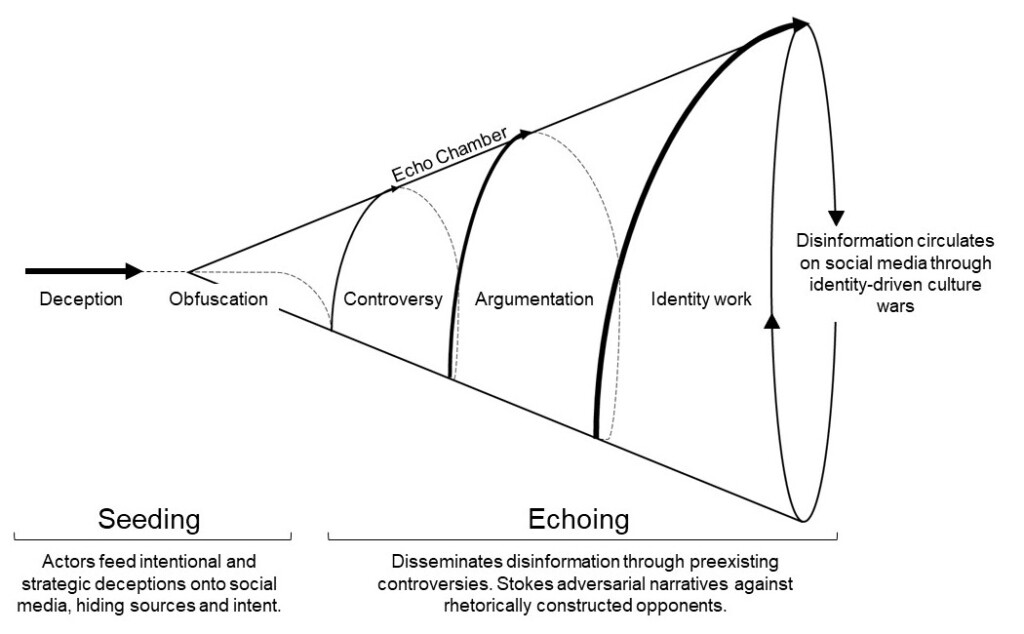
This is not an accident of poor communication or an unfortunate side effect of a polarized media landscape. It is the intended output. Soviet military theorist Vladimir Lefebvre formalized the doctrine of reflexive control in the 1960s, a strategic framework built on the premise that the most powerful way to defeat an adversary is not to deceive them with a single false message but to saturate their decision-making environment with so many competing signals that they begin to doubt their own capacity to evaluate anything. The goal was never a specific belief. The goal was the erosion of the faculty of belief itself.
What Lefebvre described as a military instrument became, across the following half-century, an ambient feature of civilian life. The Russian state’s Internet Research Agency, exposed in Robert Mueller‘s 2019 indictment with documented payrolls, shift schedules, and content quotas, was not primarily in the business of spreading pro-Kremlin talking points to American audiences. Its operatives were instructed to generate conflict across every available fault line simultaneously, to run Black Lives Matter pages and Blue Lives Matter pages from the same office building in St. Petersburg, to inflame evangelical Christians and radical atheists, gun rights advocates and gun control activists, all at once. The product was not a persuaded population. The product was an exhausted one.
There is a distinction, developed with uncomfortable precision by philosopher Harry Frankfurt in his 2005 essay “On Bullshit,” between lying and what he calls bullshitting. The liar knows the truth and works to conceal it; the bullshitter operates in complete indifference to whether what they say is true or false, because truth and falsity are simply not the categories they are playing in. Frankfurt’s distinction, initially aimed at a kind of casual intellectual dishonesty, turns out to describe the operating logic of contemporary information warfare with surgical accuracy. States that deploy manufactured ambiguity are not making claims they believe to be false. They are exiting the entire domain of claim-making and entering the domain of atmospheric engineering.
This is why fact-checking, as a corrective institution, struggles so visibly against state-level disinformation. Fact-checking presupposes a shared interest in resolution, a mutual agreement that there is a truth of the matter and that establishing it would settle something. When the fog is deliberate, resolution is precisely what the architect of the fog is trying to prevent. Timothy Snyder documented in “On Tyranny,” published in 2017, how authoritarian regimes historically demand not belief but performance — citizens are not required to believe the official narrative, only to repeat it, and the act of repetition in the absence of belief produces its own corrosive effect on the speaker’s relationship to truth as a category.
The infrastructure of democratic deliberation — debate, evidence, revision, consensus — was designed for an environment in which participants, even adversarial ones, were playing the same epistemic game. It was not designed for an environment in which one player has decided that the game itself is the target. When a government denies something one day, confirms a different version of it the next, and then dismisses the question entirely on the third day, it is not losing the argument. It is dissolving the conditions under which argument is possible, and a population that cannot argue coherently about what is real will eventually find it very difficult to organize around anything at all.
🕳️ When Truth Becomes a Maze: Power, Perception & Lies
Disinformation does not emerge from a vacuum — it is shaped by centuries of propaganda, psychological manipulation, and the deliberate engineering of public belief. To understand fake news is to trace the deeper architecture of how power manufactures consent, distorts reality, and silences dissent. The articles below illuminate the intellectual roots and social machinery behind the crisis of truth.
Lippmann’s Public Opinion: Analysis
Walter Lippmann’s landmark work Public Opinion laid bare the mechanisms by which mass media constructs a ‘pseudo-environment’ that citizens mistake for reality. Written in 1922, its insights feel devastatingly contemporary: the images in our heads rarely correspond to the world outside. Lippmann’s analysis of stereotype, censorship, and the engineering of consent is essential reading for anyone seeking to understand the soil in which modern disinformation grows.
GO TO THE SELECTION: Lippmann’s Public Opinion: Analysis
Bernays’s Propaganda: Analysis
Edward Bernays, nephew of Sigmund Freud, transformed propaganda from a wartime tool into the invisible engine of modern democratic society. His 1928 book Propaganda openly theorized how a small elite could — and should — manipulate public opinion through emotion rather than reason. Understanding Bernays means understanding the blueprint that still governs political messaging, advertising, and the architecture of manufactured consensus today.
GO TO THE SELECTION: Bernays’s Propaganda: Analysis
Gaslighting: Psychology and Culture
Gaslighting names the insidious practice of making someone question their own perception of reality, and its logic scales from intimate relationships to entire political systems. When disinformation campaigns systematically deny verifiable facts and reframe evidence as conspiracy, they deploy gaslighting as a mass psychological weapon. This article explores the psychological mechanisms that make populations vulnerable to reality distortion and the gradual erosion of shared truth.
GO TO THE SELECTION: Gaslighting: Psychology and Culture
Jean Baudrillard and the Digital Simulacrum
Jean Baudrillard‘s theory of the simulacrum — in which representations of reality replace reality itself — reads today as a precise map of the digital information landscape. In a media ecosystem saturated with images, memes, and algorithmically curated narratives, the original ‘real event’ dissolves entirely into its own circulation. Baudrillard’s thought is indispensable for grasping why fake news is not an aberration of the digital age but its logical culmination.
GO TO THE SELECTION: Jean Baudrillard and the Digital Simulacrum
Discover Independent Cinema on Indiecinema
The crisis of truth is not only a political phenomenon — it is one of the great dramatic subjects of our time, explored with unflinching honesty by independent filmmakers around the world. On Indiecinema, you will find a curated selection of films that interrogate power, perception, and the fragile architecture of reality. Step beyond the algorithm and let independent cinema show you what mainstream screens prefer to keep hidden.
👉 EXPLORE THE CATALOG: Watch Indie Films in Streaming
A vision curated by a filmmaker, not an algorithm
In this video I explain our vision

