
The Moment You Start Doubting Your Own Hands
You remember the conversation. You remember exactly where you were standing — near the kitchen window, afternoon light cutting across the counter — and you remember the words, the tone, the pause before the answer came. You remember because something in you registered it as significant, stored it somewhere beneath ordinary memory, in that part of the mind that keeps receipts. And then you are told, calmly, with the particular patience of someone explaining something to a slow child, that it did not happen that way. That you misunderstood. That you always do this — take things out of context, make them mean something they never meant. The conversation is described back to you in different colors, and the version you are given is so coherent, so detailed, that for a fraction of a second you almost believe it. Not because it is true. Because you are tired, and because the alternative — that someone you trust is deliberately reconstructing reality — is more frightening than the possibility that your own mind is failing you.

That fraction of a second is where everything begins. Not in the lie itself, but in your willingness to entertain it. In the way you reach back into your memory and find, suddenly, that it feels less solid than it did a moment ago. This is not confusion. This is not forgetting. This is something being done to you, with precision, and it works because it exploits the one thing you cannot fully defend: your dependence on another person’s account of shared reality. Human beings do not live inside sealed systems of private experience. We calibrate ourselves against others, constantly, the way a compass corrects against magnetic north. When someone systematically corrupts that calibration, they are not simply lying. They are tampering with the instrument itself.
The term arrives from a 1944 film, but it had been a practice without a name long before Hollywood found a use for it. Patrick Hamilton‘s 1938 stage play Gas Light dramatized a husband’s methodical campaign to make his wife question her perception — dimming the gas lamps of their London home and denying the change she observed — and the domestic architecture of that story was not an invention. It was a recognition. Hamilton was not imagining a new form of cruelty. He was naming one that had always existed inside closed rooms, inside marriages, inside any relationship where one person held more social, financial, or institutional authority than the other. The play simply gave the mechanism a stage and a spotlight.
What clinical psychology would later formalize took decades to reach the language of diagnosis and intervention. Robin Stern’s 2007 book The Gaslight Effect was among the first sustained attempts to translate the phenomenon into therapeutic terms accessible outside academic psychology, but the conceptual groundwork had been laid earlier in the literature on coercive control — most rigorously in Evan Stark’s research through the 1990s and into his 2007 work Coercive Control, which documented how psychological domination operates not through isolated incidents but through cumulative patterns designed to erode autonomous thought. Stark’s data, drawn from years of case documentation with domestic abuse survivors, made something structurally visible that individual testimonies alone could not: this was not a relationship going badly. It was a campaign.
The distinction matters because it changes what the victim is up against. A relationship going badly can be repaired, negotiated, survived through ordinary endurance. A campaign has an architect, a strategy, and a goal. And the goal is not simply control over behavior — it is control over the interior. Over what you believe you heard, what you believe you saw, what you believe you are capable of understanding. By the time most people seek outside confirmation of their experience, they have already spent months or years treating their own perception as the primary suspect. They have become their own unreliable narrator, not because they are, but because they have been carefully taught to read themselves that way.
Katabasis

Drama, Mystery, by Samantha Casella, Italy, 2025.
“Katabasis” is a journey into the underworld. Nora experienced that dark realm as a child, when she suffered abuse. This marked her, shaping her into an ambiguous and manipulative woman, dangerous in her inscrutability, constantly seeking disturbing situations to relive the only condition she has profoundly internalized: pain. And the love story between Nora and Aron is tormented, strictly secret. Aron is a young orphan oppressed by the star system which, orchestrated by Jacob, a cynical manager, made him a star and imposes another façade of life on him. In fact, only the people who revolve around the house-prison where the couple lives are aware of Nora's existence. That majestic villa is the stage for secrets, lies, deceit, as well as unsettling episodes, since Nora is able to communicate with the souls from the beyond.
Director Biography – Samantha Casella
Samantha Casella studied various aspects of cinema, including screenwriting, directing, cinematography, and acting, across Turin, Florence, Rome, and Los Angeles. Her directing thesis, the short film "Juliette," won 19 awards, including the "European Massimo Troisi Award." She continued her path directing surreal short films including "Silenzio Interrotto," "Memoria all'Isola dei Morti," and "Agape." In 2019, she directed "I Am Banksy." At the charismatic TCL Chinese Theater in Los Angeles, at the Golden State Film Festival, she won the award for Best International Short Film. In 2020, she directed the short film "A un Dio Sconosciuto." "Santa Guerra" is her feature film debut.
LANGUAGE: Italian
SUBTITLES: English, Spanish, French, German, Portuguese
A Word Born in a Dark House
You are sitting in a theatre in London, 1938, watching a woman slowly lose her grip on what is real. Her husband dims the gaslights in the upper floors of their Victorian townhouse and, when she notices the flickering, tells her she is imagining it. Night after night, the light fails and the denial holds. Patrick Hamilton wrote Gas Light as a two-act thriller, not a psychological treatise, and yet he had assembled, with the precision of someone who had spent years drinking in the wrong company and watching marriages corrode from the inside, a mechanism so exact that psychiatry would eventually borrow his stagecraft to name a clinical phenomenon.
The play reached Broadway in 1942 and Hollywood twice — once in 1940 and once in the MGM production of 1944, which embedded the image so deeply in popular memory that the title survived long after the plot details faded. What is remarkable is that Hamilton himself was writing from a tradition of Gothic domestic horror, not psychology. The gaslit house was already a cultural symbol of Victorian concealment, of middle-class propriety papering over violence. He took that ambient dread and made it structural, made the architecture of the house an instrument of epistemic warfare. The flickering light was not metaphor. It was method.
The word did not enter clinical literature immediately. For decades it circulated in informal registers, used by therapists in conversation before it appeared in print. The psychiatrist Victor Schwartz was among the earlier figures to begin formalizing the concept in therapeutic contexts, but it was the work of the psychoanalyst Robin Stern — whose 2007 book The Gaslight Effect brought the term to a mainstream readership — that completed the journey from theatrical device to diagnostic category. Stern was careful to distinguish gaslighting from ordinary conflict or manipulation; she defined it as a specific relational dynamic in which one person systematically causes another to doubt their perceptions, memories, and emotional responses over time. The emphasis on time matters. A single lie is not gaslighting. The accumulation is the mechanism.
What psychology found in Hamilton’s stage invention was something it had observed in consulting rooms but had not yet named with sufficient precision. Freud had identified denial and projection; Ferenczi, writing in 1932 in his Clinical Diary, had described patients who had been made to feel insane by the very adults they trusted, particularly in cases of childhood abuse where the abuser’s authority made the child’s testimony structurally incredible. Ferenczi called this the confusion of tongues — the way an adult’s interpretive power can colonize a child’s perception of their own experience. Hamilton dramatized the same dynamic between adults, between equals, or rather between people who appeared to be equals until the architecture of the relationship made clear they were not.
There is something worth pausing over in the fact that this concept needed a name borrowed from domestic light — from the specific, pre-electric technology of gas lamps that required regular tending, that could be adjusted from elsewhere in the house, that produced a warm and deceptive glow. The gaslight was intimate and unreliable in exactly the same proportion. It created the conditions for doubt because it was never entirely stable, and its instability could be attributed to weather, to the pipes, to the imagination of whoever happened to be standing in the room when it dimmed. Hamilton’s genius was to locate control not in a weapon or a raised voice but in infrastructure — in the ordinary systems that govern a shared life and that one person, quietly, knows how to manipulate while the other does not even know manipulation is possible.
By the time the American Psychological Association began incorporating the concept into its frameworks, something had already shifted. The word had escaped the theatre and the consulting room and entered ordinary speech, which is both the sign of a concept’s usefulness and the beginning of its distortion.

What Freud Did Not Name but Mapped

You are sitting across from someone who loves you, and they are explaining, with extraordinary patience and a kind of sorrow that feels genuine, why your memory of last Tuesday is simply wrong. Not mistaken. Not partial. Wrong. The weight of their certainty presses against your chest like a hand, and somewhere in the architecture of your nervous system, before language even arrives, you begin the quiet, catastrophic work of doubting yourself.
Sigmund Freud never named this dynamic. He came extraordinarily close, circling it from multiple angles across decades of clinical observation, and then moved on, as though something in the picture made him uncomfortable. In “The Ego and the Id,” published in 1923, he mapped the ego’s desperate negotiating function — its perpetual labor of mediating between internal drives and external demands — but the external demands he described were largely abstract, social, impersonal. The possibility that one intimate, specific person might systematically install false content into another person’s psyche was a territory he approached and retreated from with conspicuous regularity.
The mechanism he did name was projection: the ego’s technique of attributing to the external world what it cannot tolerate internally. A person who feels hostility imagines themselves surrounded by hostile forces. A person who desires what they have forbidden themselves to desire sees that desire in others. Projection in Freud’s clinical framework is fundamentally a defense, a private operation of the individual psyche. What he did not theorize with any rigor was the weaponization of projection between two people — the way one person can project so forcefully, so persistently, and with such social authority that the other person begins to absorb the projection as self-knowledge.
This is not a minor oversight. Anna Freud, in “The Ego and the Mechanisms of Defense” published in 1936, extended her father’s taxonomy of defensive operations and came measurably closer to the interpersonal dimension. She described identification with the aggressor — the process by which someone subjected to domination internalizes the aggressor’s perspective as a survival mechanism — and in doing so, she illuminated one half of the exchange. But she was still describing what happens inside the victim, not the deliberate architecture of what the perpetrator constructs. The victim’s adaptation became visible; the perpetrator’s method remained theoretically underlit.
What clinical psychoanalysis consistently struggled to accommodate was the possibility of a conscious, or semi-conscious, bad actor within the intimate relationship. The framework was built around neurosis, around internal conflict, around the suffering that people visit upon themselves through repression and displacement. It was structurally resistant to the idea that someone might, with sustained intention, use the tools of intimacy — shared history, private language, mutual vulnerability — as instruments of epistemic violence. Donald Winnicott’s work on the holding environment in the 1950s and 1960s described the conditions under which a self develops securely, but it also, without naming the inverse, gestured toward what happens when the holding environment becomes a controlled one, when the caregiver’s gaze does not reflect the child back to themselves but reflects what the caregiver needs the child to believe they are.
The clinical blind spot was partly structural and partly historical. Psychoanalysis emerged from a bourgeois Viennese context in which certain power arrangements were not scrutinized but assumed. The analyst sat in authority. The patient produced material. The family was understood as the unit of formation, rarely as the unit of pathology. When patients — disproportionately women — reported experiences of being made to feel irrational, disordered, or unreliable by the people closest to them, the clinical move was frequently to analyze what in their own history made them susceptible to such feelings, rather than to take seriously the phenomenological report itself.
This is where theory and lived experience split along a fault line that would take another half century to properly name.
Return to Planet Underground

Drama, Thriller, by Gideon Homes, Netherlands, 2025.
A former underground techno DJ working in a large and famous law firm delves into the dark side of society. With one eye on the past and one on the future, he stirs up the ashes of the true underground. The demand of society to function superficially and deliver top performance increasingly clashes with the protagonist's questioning of his own life reality and the values of his past. After being employed for almost six years and being a respected employee, Tyrel falls ill. On top of that, he witnesses a fraud within the company and asks to leave. But the illness creates a complex situation in which his employer starts playing a game of chess with Tyrel.
In "Return To Planet Underground", director Gideon Homes gives the audience a gripping insight into the Dutch underground techno scene, offering a gripping drama set in a dark world, full of intense moments and touching human tragedies. This film is not just a visual feast; it is a gripping exploration that immerses viewers in the lives of its protagonists. Set to a backdrop of thumping techno beats, "Return To Planet Underground" takes audiences on a rollercoaster ride through the highs and lows of human desires, drug-fueled escapades, societal pressures and the pursuit of perfectionism. Drawing inspiration from iconic films such as Trainspotting, Berlin Calling and Human Traffic, Gideon Homes' work stands out for its unique stylistic devices and unconventional storylines. Based on real events and personal experiences, "Return To Planet Underground" faced numerous lawsuits before finally conquering audiences around the world. Prepare yourself for an immersive dive into a world where music, morality and the human spirit collide.
LANGUAGE: English, Dutch
SUBTITLES: Spanish, French, German, Portuguese
Power Needs No Conspiracy
You are sitting across from someone who has just explained, with complete calm and considerable documentation, why your memory of the meeting is incorrect. Not aggressively. Not with visible malice. Simply with the quiet authority of a person who has never needed to raise their voice to be believed. The documentation is real. The calm is real. And yet something in the room has shifted in a way you cannot name, because the language available to you does not yet contain a word for what just happened to you.
This is not an unusual encounter. It is, in fact, the texture of ordinary institutional life, repeated millions of times daily in offices, courtrooms, medical consultations, and parliamentary committees. What makes it difficult to recognize is that it requires no conspiracy, no coordinated intent, no villain aware of his own villainy. Michel Foucault spent the better part of three decades building the conceptual apparatus to explain why this is the case, and the core of that apparatus is deceptively simple: truth is not discovered, it is produced, and its production always involves the exercise of power over what counts as evidence, who counts as a witness, and which forms of knowledge are legitimate enough to enter the conversation at all. His 1969 work on the archaeology of knowledge was not, as it is often misread, a relativist argument that truth does not exist. It was a structural argument that the conditions under which something becomes true within a given institution are themselves political achievements, maintained by exclusion.
What gets excluded is almost never random. The patient who reports pain that does not match the diagnostic category is producing a truth the institution cannot process without restructuring itself, which it will not do. The worker who names the pattern of who gets promoted and who gets passed over is generating data that the organization’s self-understanding depends on not receiving. The soldier who describes what he witnessed is offering testimony that would require the people above him to become different people, which is the one cost no institution is ever willing to pay. In each case, the person who names what they see is not simply disbelieved. They are repositioned. They become, through a series of small procedural moves, the kind of person whose perception cannot be trusted, which is a transformation achieved not through argument but through the cumulative weight of institutional authority pressing down on a single point.
Foucault called the ensemble of rules governing what can be said, by whom, and in what form a “regime of truth,” and he was careful to note that these regimes do not require a central authority issuing orders. They are maintained by the everyday practices of professionals doing their jobs correctly, each one individually reasonable, the overall effect devastating. A psychiatrist diagnosing, a judge applying precedent, a journalist following editorial standards, a historian citing peer-reviewed sources — none of these people need to be malicious for the combined result to be a system that systematically discredits certain categories of experience. The genius of such a system, and the source of its near-perfect efficiency, is that it recruits its victims into the work of their own discrediting. The person who cannot make their experience legible within the available frameworks is given a choice: accept the framework and lose the experience, or insist on the experience and lose credibility.
The historical record is dense with the consequences of that choice. Women diagnosed with hysteria in the late nineteenth century were not suffering from a mysterious neurological condition. They were suffering from the fact that the medical establishment had no category for female unhappiness that did not also pathologize the woman experiencing it. The category created the condition. The condition justified the category. And anyone who pointed at this closed loop from the outside was, by definition, speaking from a position the loop had already delegitimized.
What remains genuinely unsettling is not that such systems existed in the past. It is that their successors require no formal architecture at all —
The Gender Architecture of Disbelief
You go to your doctor in 1887 and tell him you cannot breathe. He writes in his notes that you are experiencing an episode of nervous excitability. You go back and tell him the breathlessness is worse. He notes an increase in hysterical symptomatology. You bring your husband, who confirms that yes, she has been rather difficult lately. The doctor nods and adjusts his pen. The medical record, from this point forward, is no longer about your lungs.
The diagnosis of hysteria was not a medical error. It was a structural instrument. Between 1850 and 1900, the number of women committed to British and American asylums for conditions classified as hysteria, moral insanity, or excessive religiosity increased at a rate that mirrored, almost precisely, the expansion of women’s legal and political demands. This is not coincidence dressed as correlation. Jean-Martin Charcot at the Salpêtrière was photographing women in states of induced seizure and presenting these images to packed lecture halls as evidence of female biological instability, at exactly the same moment French women were petitioning for the right to testify independently in civil courts. The photography did not document illness. It manufactured the visual grammar of unreliability.
What the nineteenth century established medically, the twentieth century inherited legally. In American courtrooms well into the 1970s, jury instructions in rape cases routinely included language derived from Matthew Hale‘s 1736 principle that rape is an accusation easily made and hard to prove, and harder to be defended by the party accused, though never so innocent. Hale wrote this before the United States existed. His sentence was still being read aloud to juries two hundred and forty years later. The epistemology built into that instruction was precise: female testimony about bodily harm was categorically suspect in a way that male testimony about property crimes was not. The law did not treat this as bias. It treated it as wisdom.
Phyllis Chesler’s Women and Madness, published in 1972, documented something that researchers had been circling without naming: the psychiatric system was being used not primarily to treat distress but to manage social deviance in women who refused the available roles. Women who were too sexual, not sexual enough, too ambitious, too angry, too passive, or too loud were being institutionalized at dramatically higher rates than men exhibiting identical behaviors. The illness was not in the symptom. It was in the deviation from expectation. What Chesler identified was a diagnostic structure that converted female subjectivity itself into pathology.
This structure did not disappear when second-wave feminism named it. It migrated. Studies from the 1990s onward, including work published in the Journal of Women’s Health, consistently showed that women presenting with identical pain levels as men received fewer analgesic prescriptions, waited longer in emergency rooms, and were more frequently referred for psychological evaluation rather than physical investigation. The medical encounter was still being shaped by an inherited grammar in which female sensation is less credible than male sensation, female report less reliable than male report. The word hysteria had been retired. The architecture remained.
When someone spends years being told by institutions that their perception of reality is distorted, their memory unreliable, their emotional responses disproportionate, they do not need a single manipulator in a domestic setting to be gaslit. The institution itself becomes the gaslighter, distributed across white coats, legal briefs, diagnostic manuals, and the trained sympathetic nod of a professional who has already decided the answer before the patient has finished the sentence. What gets called a personality disorder in women gets called eccentricity in men. What gets called emotional dysregulation in a woman describing a real event is the same cognitive and neurological process that gets called passionate conviction when a man describes his version of the same event.
The architecture of disbelief was never accidental. It was constructed, maintained, updated, and exported across generations
A Better Life
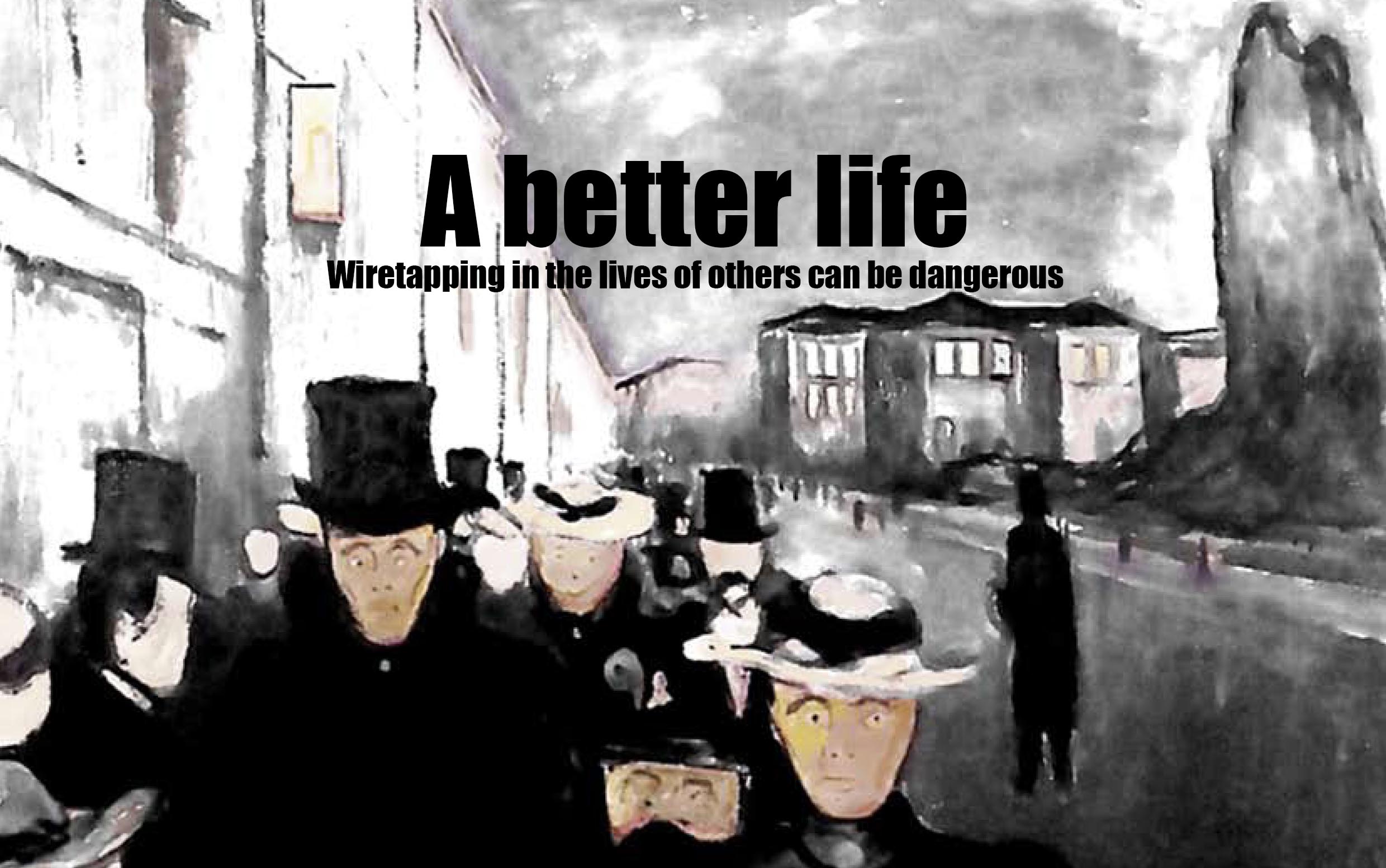
Drama, thriller, by Fabio Del Greco, Italy, 2007.
Rome: Andrea Casadei is a young investigator specializing in audio wiretapping who conducts investigations commissioned by husbands betrayed by their wives, or by parents worried about what their children are doing outside the home. But what interests him most is understanding the human soul, listening to casual conversations in the streets, knowing what people think. He often meets in Piazza Navona with his friend Gigi, a frustrated street artist obsessed with success at all costs, with whom he shares a passion for wiretapping. Shocked by the mystery of the disappearance of Ciccio Simpatia, another street artist common friend, Andrea decides to abandon the commissioned works to seek a better life and reflect on his own and others' existence. He will meet the actress Marina and with a bug he will slowly enter her life until he discovers her most unthinkable secrets. The film deals with an important theme of contemporary Western society: the lack of love. The mysterious and tormented figure of Marina is reflected in a gloomy and soulless Rome.
Director Fabio Del Greco declared about his film: "Perhaps this film is a reflection on the art of observing, of listening, in short, of what one does when one leaves the real world to tell about it. Perhaps he wants to talk about the subtle relationship between the mirages of success touted by today's society, power and the most authentic human relationships.A 'dark cloud' hangs over the city: it is engulfing everyone in a sort of indistinct, uniform mass, where everyone thinks the same things, where everyone they are more alone. Where is the truest part that makes us unique? Maybe you can try to intercept it only secretly."
LANGUAGE: Italian
SUBTITLES: English, Spanish, French, German, Portuguese, Dutch.
A vision curated by a filmmaker, not an algorithm
In this video I explain our vision
When the Collective Rewrites the Room

You are in a meeting room where the fluorescent light flickers every forty seconds, reliably enough that you have started counting. The quarterly report is on the table — printed, distributed, initialed by three department heads — and it shows a seventeen percent drop in employee retention since the new management protocol was introduced eight months ago. You raise this. The regional director looks at you with something that is not quite a smile and says the numbers reflect a transitional period, that the methodology of the previous report was flawed, that what you are interpreting as a problem is in fact the natural elimination of poor cultural fit. Around the table, seven people nod. Not because they believe him. Because the room has already decided what the room believes, and your printed page, your initialed document, your seventeen percent, do not belong to the room anymore.
This is where the psychology of the dyad metastasizes into something with structural permanence. Between two people, the mechanism requires sustained effort — constant contradiction, deliberate erosion, the slow work of making one person doubt their own registration of events. But institutions do not require that effort. They have architecture on their side: hierarchy, procedural language, the sedative effect of consensus, the quiet violence of the nod. What sociologist Diane Vaughan described in her 1996 analysis of the Challenger disaster as “the normalization of deviance” captures something essential here — the way organizations learn to reclassify warning signals as acceptable variance, not because evidence disappears, but because the interpretive frame that surrounds it is collectively maintained by people who need it to hold. The seven people nodding in that meeting room are not liars. They are participants in a shared epistemic contract whose terms were never written down.
Hannah Arendt, writing about the bureaucratic management of political facts in the mid-twentieth century, observed that the most durable form of untruth is not the outright lie but the organized irrelevance — the institutional apparatus that ensures certain facts, even documented ones, are routed around rather than confronted. What makes this different from ordinary propaganda is the intimacy of its scale. It does not require a mass audience. It requires only a room, a hierarchy, and the ambient human need to remain inside the group’s protective consensus. The cost of disagreeing is not punishment, necessarily. It is the colder and more effective threat of social illegibility — of becoming, like that flickering light, something everyone in the room has learned to stop noticing.
Political theorists have documented this dynamic with uncomfortable precision in contexts ranging from corporate cover-ups to state-level denial of documented atrocities. Stanley Cohen’s 2001 work “States of Denial” identified three categories through which institutions manage inconvenient realities: literal denial, interpretive denial, and implicatory denial. The last is the most sophisticated and the most common — the facts are technically acknowledged, but their moral or practical implications are systematically neutralized. The seventeen percent is not denied. It is re-narrated. The document remains on the table. The room simply agrees to read it differently, and the person who read it first is left holding a meaning that no longer has a community to live inside.
What distinguishes institutional reality manipulation from its interpersonal counterpart is not scale but reversibility. In a relationship between two people, the targeted person can eventually leave, and the distortion partially lifts. Institutions do not end when you leave the room. Their re-narrations follow in performance reviews, in official correspondence, in the organizational memory that will greet whoever replaces you. The room rewrites itself in documents that outlast every individual who sat in it, and the next person to raise the seventeen percent will be handed a history in which no one ever saw what you saw — because the archive itself has already agreed on what happened.
Memory as a Contested Territory
You remember it clearly — the afternoon light, the particular silence after the door closed, the exact words that were used. You would stake something on it. And yet the person standing across from you remembers nothing of the kind, and what troubles you most is not their denial but the brief, terrible moment when you wonder whether they might be right.
Elizabeth Loftus spent decades turning that moment into rigorous laboratory science, and what she found destabilizes far more than courtroom testimony. Her research, consolidated across hundreds of experiments beginning in the early 1970s and culminating in landmark studies published in journals like Memory and Cognition, demonstrated that human recollection is not a recording but a reconstruction — pliable, susceptible to suggestion, quietly rewritten each time it is accessed. In her 1974 study with John Palmer, subjects who watched the same car accident footage and were asked how fast the vehicles were going when they “smashed” into each other reported significantly higher speeds than those asked about when the cars “hit” — a single verb reshaping a perceived fact. By the early 1990s, Loftus had gone further, implanting entirely false childhood memories in a substantial proportion of test subjects through nothing more elaborate than confident suggestion and social pressure. The architecture of what we call personal truth turned out to be disturbingly load-bearing on external authority.
What followed in the culture, however, was not a collective reckoning with the fragility of memory. It was a war over who got to use that fragility as a weapon. The false memory debates of the 1990s erupted largely around recovered memory therapy and accusations of childhood sexual abuse — cases where adults, often women, came forward with memories they claimed to have suppressed for years, memories that therapists had helped them access. The False Memory Syndrome Foundation, established in 1992 by Peter and Pamela Freyd — themselves accused by their daughter, the psychologist Jennifer Freyd, of abuse — positioned Loftus’s science as a defense shield. Suddenly the same research that could expose how abusers manipulate victims into doubting their own perceptions was being deployed to suggest that victims themselves were the unreliable narrators. The epistemological knife cut in both directions, and the side with more institutional leverage decided which direction it would face.
Jennifer Freyd’s own theoretical response, betrayal trauma theory, introduced in her 1996 book of the same name, proposed that victims of abuse by trusted figures have a functional motivation to forget — that amnesia is not pathological confabulation but adaptive survival, a way of maintaining attachment to someone you depend on when knowing the full truth would destroy you. Two contradictory scientific frameworks, both with serious empirical grounding, arrived at the same cultural moment and were immediately conscripted into adversarial use. The question of what actually happened — the question memory was supposed to answer — dissolved into the question of whose account the institution would ratify.
This is where gaslighting stops being a psychological dynamic between two individuals and becomes something structural. When scientific discourse itself fractures along the lines of who funds it, who is accused, and who sits on the editorial boards that decide what counts as valid methodology, the contestation of memory scales up from the bedroom to the archive. The DSM, peer-reviewed journals, courtroom standards for expert testimony — these are not neutral vessels for established truth. They are sites where the authority to declare something real or fabricated is fought over, won, and enforced. A person who cannot get their own account of events credited in a conversation is experiencing something that legal systems, medical establishments, and research institutions perform on entire populations, with the added brutality that the mechanism remains invisible beneath the language of objectivity and scientific consensus.
What this means for the individual who stands in that afternoon light, certain of what they heard, is that their problem was never simply psychological.
The Sociology of Not Being Believed

You are at a dinner table, and you say something true — something you watched happen, something that left a mark on your body — and the room goes quiet in a particular way, not the quiet of listening but the quiet of collective suspension, everyone waiting to see whether to believe you or to let the silence do its work for them.
That silence has a structure. Miranda Fricker named part of it in 2007 when she published Epistemic Injustice: Power and the Harm Done to Knowers, introducing the concept of testimonial injustice — the specific wrong inflicted when a hearer deflates a speaker’s credibility because of prejudice tied to identity. Race, gender, class, age: each functions as an invisible coefficient applied to the raw data of what someone claims to have witnessed. The result is not merely social rudeness. It is an epistemic distortion, a systematic miscalibration of trust that operates before content is even evaluated. The woman who reports abuse is not disbelieved because her account is incoherent; she is disbelieved because her category of person has already been pre-assigned a credibility deficit by the culture that trained her listeners.
What makes this mechanism genuinely dangerous is its invisibility to those who operate it. The people who discount testimony rarely experience themselves as exercising prejudice. They experience themselves as being careful, as applying reasonable skepticism, as not wanting to rush to judgment. This is the sociological genius of the system: it recruits its own perpetuation through virtues. Epistemic humility becomes a cover for epistemic cowardice. Wanting to hear both sides becomes a structural refusal to acknowledge that one side has historically been silenced before it could form a side. The machinery self-maintains because its operators are convinced they are lubricating it with fairness.
Entire institutions have been built on this miscalibration. The Catholic Church’s internal protocols for handling abuse reports between roughly 1950 and 2002 — before the Boston Globe investigation broke a silence that had hardened into architecture — were not aberrations of cruelty. They were logical extensions of a credibility economy in which the word of a priest outweighed the word of a child by an institutional fiat so naturalized it required no enforcement. No one needed to instruct a bishop to doubt a minor; the hierarchy did the instructing automatically, invisibly, in the grammar of rank. What Fricker describes philosophically, those decades embodied sociologically on an industrial scale.
The more unsettling question — the one that does not resolve — is what happens to the person whose testimony is finally believed. There is a reflex in contemporary discourse to treat recognition as remedy: if the silenced speaker is at last heard, the injustice is undone, the arc bends. But recognition is not neutral. It arrives with its own framing, its own acceptable narrative shape, its own implicit demand that the speaker’s experience fit the vocabulary of the institution extending belief. Survivors of prolonged gaslighting often report that the moment of being believed brings not relief but a new disorientation — because belief, when it finally comes, frequently requires them to translate their experience into a language that the culture will accept, which is always partially a falsification of the experience itself. To be believed is sometimes to be gently rewritten.
This is not a reason to prefer disbelief. It is a reason to understand that the architecture of credibility is not repaired by individual acts of recognition, because the architecture is not made of individuals. It is made of inherited assumptions about whose perception of reality deserves to be treated as data and whose deserves to be treated as symptom — and those assumptions do not dissolve the moment a room decides to listen, because the room itself was built by them, and it is the room you are still sitting in, at that same table, waiting to see what the quiet decides.
🌀 Mirrors, Mazes & Fractured Minds
Gaslighting is not merely a psychological weapon — it is a labyrinth built from distorted realities, shifting identities, and manipulated perceptions. Literature and philosophy have long explored the terrain where the self dissolves under external pressure. These four works illuminate the darkest corridors of that maze.
Jorge Luis Borges and the Labyrinth of Identity
Borges constructed entire universes where identity fractures against infinite mirrors and recursive paths — a perfect literary map of the gaslighting experience. In his labyrinths, characters lose their grip on a stable self, much like victims of psychological manipulation lose their grasp on truth. His work remains one of the most potent metaphors for the mind trapped inside someone else’s constructed reality.
GO TO THE SELECTION: Jorge Luis Borges and the Labyrinth of Identity
One, No One and One Hundred Thousand by Pirandello: Analysis
Pirandello’s masterwork tears apart the illusion of a singular, coherent self, showing how identity is perpetually reshaped by the gaze of others. This dynamic resonates deeply with gaslighting, where the manipulator imposes a false narrative until the victim internalizes it as truth. The play becomes an unsettling philosophical mirror held up to the nature of psychological coercion.
GO TO THE SELECTION: One, No One and One Hundred Thousand by Pirandello: Analysis
The Heteronyms of Pessoa: Analysis
Pessoa's heteronyms — fully realized alternate personas living within a single mind — offer a haunting parallel to the fragmented self that emerges from sustained gaslighting. Each heteronym embodies a different layer of psychological reality, questioning which voice can be trusted as authentic. Exploring these constructed identities reveals how profoundly unstable the boundary between self and imposed fiction can become.
GO TO THE SELECTION: The Heteronyms of Pessoa: Analysis
Waiting for Godot by Beckett: Analysis
Beckett’s ‘Waiting for Godot’ immerses its characters in a reality that perpetually defers meaning, leaving them unable to trust their own perceptions of time, place, or purpose. This existential suspension mirrors the confusion and helplessness induced by gaslighting, where certainty is systematically eroded. The play’s endless loop becomes a devastating portrait of minds untethered from a reliable shared reality.
GO TO THE SELECTION: Waiting for Godot by Beckett: Analysis
Discover More on Indiecinema
These themes of fractured identity, psychological manipulation, and labyrinthine reality come powerfully alive on screen. Explore a curated selection of independent films that dare to explore the human mind in all its fragility and resilience — streaming now on Indiecinema, your home for bold, boundary-pushing independent cinema.
👉 EXPLORE THE CATALOG: Watch Indie Films in Streaming
A vision curated by a filmmaker, not an algorithm
In this video I explain our vision

