
The Rupture That Cinema Refused to Name
You are sitting in a folding chair in a room that smells of turpentine and cigarettes, somewhere in Paris in 1924, and the image on the wall in front of you is doing something images are not supposed to do. A ballet dancer’s legs multiply, invert, become geometric, dissolve into a close-up of a fisheye lens reflecting a Paris street, then return as pure rhythm, pure percussion of light. You did not come here expecting narrative. You came because someone handed you a flyer that promised something new, and what you received instead was a kind of assault — not on your body, but on the assumption buried so deep inside you that you had never once thought to question it: that moving images exist to tell you a story, to walk you somewhere and return you safely home.

That assumption did not emerge naturally from human consciousness. It was manufactured, deliberately and quickly, in the two decades following the Lumière brothers’ first public projection in December 1895. By 1915, D.W. Griffith had already demonstrated with catastrophic clarity what narrative cinema could do to a mass audience — could make them weep, cheer, hate, and justify. The Birth of a Nation earned roughly sixty million dollars in its original release and was screened at the White House. What it also did was revive Ku Klux Klan membership to approximately three million by the mid-1920s. The machinery of cinematic storytelling, with its shot-reverse-shot logic, its cause-and-effect momentum, its emotional suturing of the viewer into a character’s perspective, had proven itself the most potent ideological apparatus the century had yet produced. The avant-garde filmmakers who followed understood this — even when they lacked the precise theoretical language to say so.
Fernand Léger and Dudley Murphy’s Ballet mécanique, completed in 1924 without a single human narrative thread, was not made in ignorance of what mainstream cinema had already become. It was made in full knowledge of it, as a kind of counter-inscription. When Léger looped a woman climbing stairs — the same three seconds repeated fifteen times without explanation — he was not being playful. He was exposing the mechanical repetition that commercial cinema concealed beneath the illusion of forward motion. Every hero’s journey, every romantic resolution, every moral arc that classical Hollywood would spend decades perfecting, depended on the audience never noticing that they were watching the same emotional loop, again and again, calibrated to produce the same neurochemical response on schedule.
What experimental cinema introduced into this equation was duration without destination. The phenomenologist Maurice Merleau-Ponty, writing in Phenomenology of Perception in 1945, argued that perception is never passive reception — that the body itself participates in constructing what is seen, that consciousness is always already entangled with the world it observes. Experimental film, almost intuitively, weaponized this insight. By refusing to organize time into legible cause and consequence, by presenting images that resisted interpretation rather than rewarding it, the avant-garde forced the viewer back into their own body — back into the discomfort of pure, unmediated looking. This is why the disorientation was never merely aesthetic. Aesthetics without stakes is decoration. The stakes here were epistemological: who controls the grammar of perception controls what a population is capable of imagining as real.
The political dimension was not added later by theorists looking to lend respectability to difficult art. It was structural from the beginning, embedded in the choice to break the shot, to refuse the cut that resolves, to hold an image past the point where the audience’s patience transforms into something rawer and more honest than patience. In that friction, something was being asked of the viewer that commercial cinema had trained them never to supply: their own presence, unmediated and unguided, in front of something that refused to mean on their behalf.
Origins as Mythology: What 1895 Actually Began
You have seen this image a thousand times without choosing to: a train arriving at a station, passengers scattering in what legend insists was panic, the camera fixed and patient as a god recording creation. The year is December 28, 1895, and the story we have inherited from that date is one of pure beginnings, of a technology so transparent it simply captured the world as it was. Except it did not. The Lumière brothers were industrialists who manufactured photographic plates, and what they built in the Salon Indien du Grand Café was not an art form but a demonstration of product capability. The cinematograph was, in their own estimation, an invention without a future. They meant it as a scientific instrument, a novelty for lecture halls and trade exhibitions, not a medium through which human consciousness would one day be shattered and rebuilt.
What the mythology of 1895 suppresses is not a detail but a structural erasure. At the exact same historical moment, figures like Georges Méliès were already treating the moving image as a space for hallucination, for transformation, for the violation of physical law. Méliès understood immediately that the camera could lie, and that this capacity was not a flaw but the most radical gift the medium possessed. His 1902 film “A Trip to the Moon” is not a curiosity of early cinema — it is an argument about what cinema fundamentally is: not a recording instrument but a machine for constructing impossible experience. The institutionalization of film after 1910, led by companies like Edison’s Motion Picture Patents Company and later consolidated through the studio system’s vertical integration of production, distribution, and exhibition, did not represent the natural evolution of the medium. It represented the violent narrowing of it, the decision by capital that one particular formal language — continuity editing, psychological identification with a protagonist, linear causality — would be rendered invisible as technique and presented as nature itself.
David Bordwell and Kristin Thompson, in their 1979 analytical framework for what they called the classical Hollywood style, demonstrated with methodical precision that the conventions audiences experience as transparency — the shot-reverse-shot, the eyeline match, the 180-degree rule — were codified between roughly 1909 and 1917 through explicit industry manuals, trade publications, and the commercial logic of maximizing audience absorption per dollar spent on a seat. These were not discoveries about how the human eye perceives narrative. They were engineering decisions, formalized and taught like accounting.
The consequence of that engineering decision was not merely aesthetic but epistemological. When a formal system presents itself as invisible, it trains perception to treat its assumptions as perception itself. Viewers socialized inside the classical style do not learn to watch films; they learn to not-watch them, to look through the surface toward a story that has been constructed to feel found rather than made. Walter Benjamin, writing in 1935 in “The Work of Art in the Age of Mechanical Reproduction,” registered something adjacent to this when he identified the film apparatus’s capacity to produce a false sense of unmediated access to reality — what he called the elimination of the aura in favor of a commodity-ready reproducibility. But Benjamin was still partly seduced by the democratic potential of that same apparatus, and he underestimated how thoroughly the industry would domesticate even the shock of montage into legible emotion.
What was suppressed between 1910 and 1930 was not a collection of eccentric aesthetic choices made by artists who failed commercially. It was an entire conception of what a moving image could demand from a human body sitting in the dark — not recognition, not identification, not the pleasurable confirmation of a world that makes causal sense, but something closer to what happens when the mind is given a perception it cannot immediately process and is forced, uncomfortably, to build new cognitive structure just to survive the encounter with what it has seen.

Abstraction as Epistemological Violence
You are watching something move and you do not know what it is. Not because it is hidden or obscure, but because the part of your mind that normally reaches out and grabs an image — labels it, domesticates it, files it under a known category — finds nothing to hold. The shapes shift. The rhythm insists. And somewhere in that gap between stimulus and recognition, you discover that seeing was never passive.
What Viking Eggeling completed in 1924 after years of scroll drawings and near-destitution was not an abstract film in the sense we lazily apply that word. Symphonie Diagonale is a systematic dismantling of the contract between eye and world. Eggeling had worked with Hans Richter on what they called “universal language” — the idea, inherited from Kandinsky’s Concerning the Spiritual in Art but pushed into pure temporal form, that visual rhythm could bypass the corrupted channels of linguistic meaning. But what actually happens when you watch those white linear forms against black, growing and dissolving in cadences borrowed from musical counterpoint, is not transcendence. It is exposure. You feel, for the first time, the weight of the cognitive labor you perform every single moment while watching any image, including the ones you think you simply “understand.”
Fernand Léger, working the same year with Dudley Murphy and with Ezra Pound and Man Ray briefly in the orbit of the project, arrived at the same rupture from a completely different direction. Ballet Mécanique has no dancers, and that absence is the entire argument. What it has is close-ups of machine parts, of a woman’s lips looping identically for minutes, of kitchen utensils and geometric forms pulsing in rhythms that the body registers before the intellect can intervene. Léger had spent years as a painter insisting that the modern world had made the human figure obsolete as the organizing center of visual experience — not because humans mattered less, but because the perceptual hierarchy that placed the legible face at the center of attention was itself a historical artifact, a Renaissance convention mistaken for nature. The film does not attack the machine or celebrate it. It uses the machine’s visual grammar to reveal that your grammar for reading images was always someone else’s imposition.
The phenomenologist Maurice Merleau-Ponty, writing in Phenomenology of Perception in 1945, argued that perception is not the passive reception of data but a form of bodily knowledge — a habit, in the philosophical sense, meaning a sedimented history of encounters that has crystallized into what feels like direct contact with the world. What the abstract film of the 1920s does, two decades before Merleau-Ponty articulates it in prose, is stage the moment before the habit takes hold. It shows you perception in the act of failing to congeal into recognition, and in that failure, it shows you the habit itself.
This is why calling these films “difficult” misses the mechanism entirely. Difficulty implies an obstacle between you and meaning. What Eggeling and Léger constructed is not an obstacle but a mirror placed at an angle that catches something you never see directly — the apparatus of your own looking. Cinema had existed for barely three decades and had already developed a full unconscious: continuity editing, the establishing shot, the close-up deployed for emotional amplification, the narrative logic that sutures cuts into invisibility. These were not neutral discoveries. They were decisions that hardened into defaults, and defaults into nature. The avant-garde of 1924 was not rejecting cinema’s past; it was making that past’s arbitrariness suddenly, uncomfortably visible.
There is a specific kind of violence in being shown that something you took for granted was a choice — particularly when that thing is not an opinion you hold but a way your eyes work.
Soviet Montage and the Engineering of Consciousness
You are watching a film and you do not know it is operating on you. The images arrive faster than your consent. A slaughterhouse cut against a crowd, a stone lion rising through three successive frames into the posture of roar — and something in your chest tightens before your mind has had time to form a single opinion. This is not manipulation in the vulgar sense. This is something far more structurally disturbing: the deliberate reorganization of your nervous system as raw material, performed by filmmakers who had read enough Marx and enough Pavlov to understand that perception itself is a political battlefield.
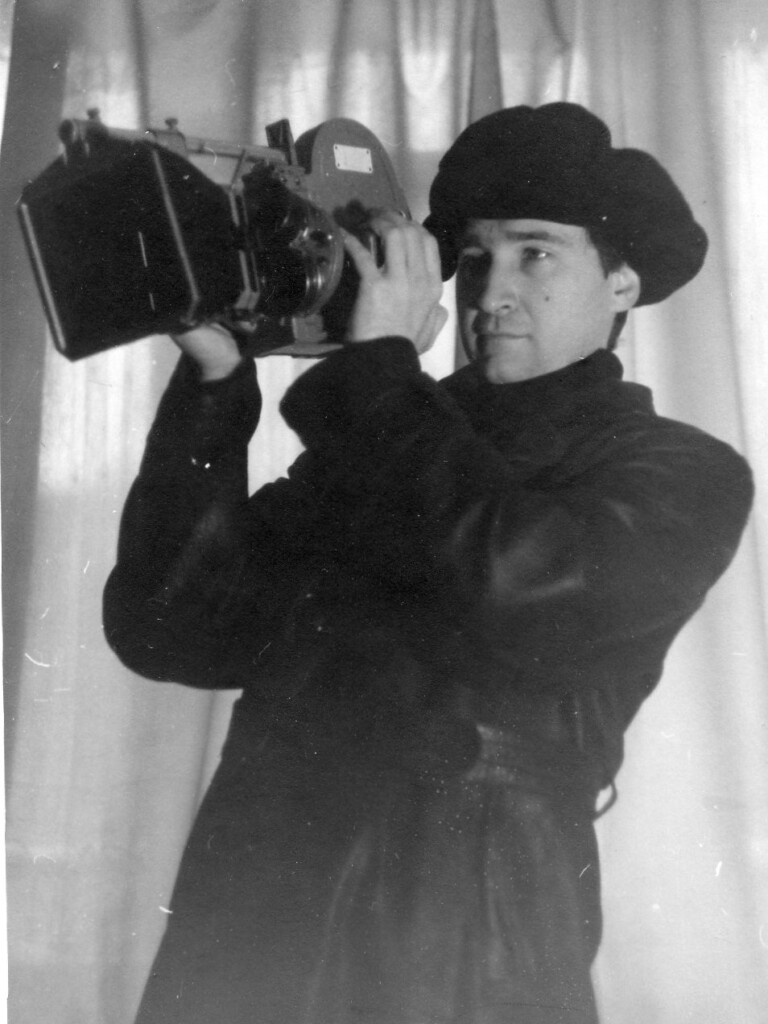
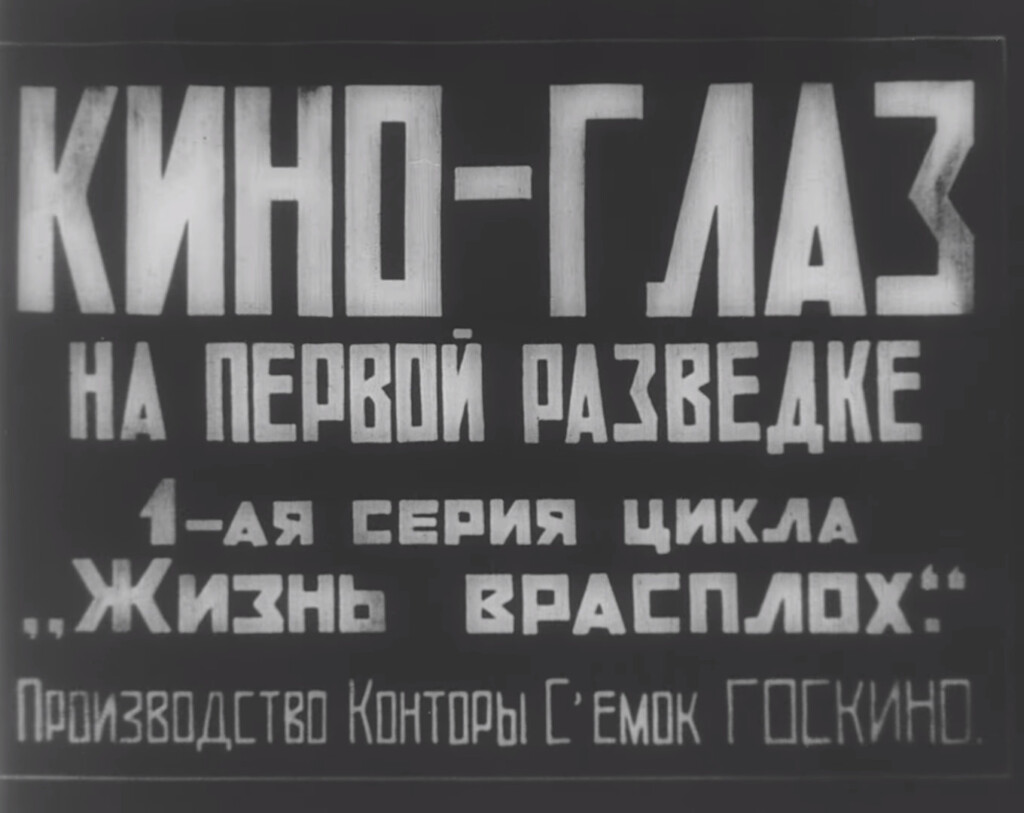
Dziga Vertov spent the early 1920s arguing that the human eye was the problem. In his Kino-Eye manifesto, written between 1922 and 1924 and elaborated through his journal writings collected decades later, he identified biological vision as sluggish, sentimental, and contaminated by habit. The camera, by contrast, could be positioned anywhere, could move at any speed, could be reversed, slowed, frozen — it did not blink, did not flinch, did not look away out of social courtesy. His solution was not to make films about reality but to use the mechanical eye to produce a higher-order reality unavailable to unassisted human consciousness. When he cut between factory machinery and the human body at labor, he was not illustrating an idea about workers. He was attempting to rewire how a body in a seat experienced the relationship between flesh and mechanism, to make that relationship felt as electrical rather than as metaphor.
Sergei Eisenstein’s project was philosophically adjacent but structurally more aggressive. By the time he articulated intellectual montage in “Film Form,” published in its English translation in 1949, he had already been practicing something the Russian Formalists would have recognized as a collision rather than a linkage. Where conventional editing sought to smooth the join between shots, to manufacture continuity, Eisenstein wanted the cut to generate shock — not emotional shock in the melodramatic sense, but cognitive shock, the kind produced when two incompatible concepts are forced into proximity and the viewer’s mind must produce a third term that exists in neither image alone. He borrowed openly from Hegel’s dialectic: thesis and antithesis producing synthesis, not in argument, but in the spectator’s body, at the speed of a frame change.
What made this genuinely dangerous — and what has been systematically misread by film historians who reduce it to Soviet propaganda — is that Eisenstein was not trying to deliver a message. He was trying to create a thinking machine out of the assembled nervous systems in a cinema hall. The distinction matters enormously. Propaganda delivers conclusions. Intellectual montage, as Eisenstein theorized it, was designed to force the viewer through a process of reasoning they could not opt out of, because it bypassed language entirely and operated at the level of reflex, rhythm, and associative shock. He had studied Japanese ideograms and recognized in them the same logic: two independent signs placed together producing a meaning irreducible to either. His films did not tell audiences what to think about capital or about history. They attempted to restructure how thought about those subjects became possible.
The neurological ambition embedded in both projects has never been fully absorbed by the cultures that inherited them. Vertov’s insistence on the camera as prosthetic cognition presaged by half a century what cognitive scientists would eventually describe as extended mind — the idea, formalized by Andy Clark and David Chalmers in their 1998 paper “The Extended Mind,” that cognitive processes do not stop at the skull but extend into tools and environments. What Vertov was building, frame by frame on a Steenbeck table in Moscow, was an argument about where thinking happens that the philosophy of mind would not catch up to for decades. And Eisenstein’s collision aesthetic anticipated what neuroscientist Antonio Damasio would demonstrate in “Descartes’ Error” in 1994: that emotion and reasoning are not separable systems, that you cannot reach a concept without passing through a body that responds to it first.
Surrealism's Unconscious as Social Diagnosis
You are standing in a corridor that goes on longer than any corridor should, and at the end of it there is a door you recognize without having seen it before. This is not a description of a dream. It is a description of what certain films produced between 1928 and 1932 were doing to audiences who had been trained, by every institution available to a modern European society, to trust the coherence of their waking lives.
The surrealist movement’s engagement with cinema was never about spectacle. When Luis Buñuel and Salvador Dalí assembled their images of sliced eyes and rotting donkeys draped over grand pianos, they were following a method derived directly from Sigmund Freud’s 1900 “The Interpretation of Dreams,” which argued that the unconscious does not speak in propositions but in condensations and displacements — images that carry more than one meaning simultaneously, that smuggle repressed content past the internal censor in disguise. What Buñuel understood, with a precision that many of his literary contemporaries missed, was that cinema’s temporal flow made it uniquely capable of reproducing the dream-work’s logic. Cuts could function as repressions. Objects could migrate from one symbolic register to another between shots. Duration itself could be warped so that causality — the grammar of bourgeois consciousness — became optional.
The violence in those films was diagnostic, not decorative. The bourgeois interior — the carefully arranged drawing room, the dinner table with its silverware and silence — appears again and again in surrealist cinema as the primary crime scene. This was not accidental imagery. André Breton had argued in the 1924 “Manifesto of Surrealism” that rationalism had become the instrument of social control, that the insistence on logical order and psychological coherence was how a civilization managed to conduct colonial massacres and industrial slaughter while describing itself as the apex of human development. The irrational image was therefore an accusation, aimed at the smooth surface of a culture that had organized two industrial-scale wars within living memory and still managed to present itself, every morning, as reasonable.
What made this forensic method genuinely disturbing was its intimacy. The target was not the enemy at the gates but the structure of desire inside the respectable household — the sexual violence encoded in property relations, the sadism normalized as parental authority, the thanatos hiding inside the most conventional ambitions. When Georges Bataille, working adjacent to the surrealist circle and publishing in “Documents” between 1929 and 1930, argued that transgression was not the opposite of social order but its necessary underside, he was making visible the mechanism that the films had already begun to show. Repression does not eliminate what it represses. It metabolizes it, gives it new form, redistributes it through the very institutions designed to contain it.
The psychoanalytic concept of the return of the repressed is, in this context, a sociological observation before it is a clinical one. A culture that insists on the absolute separation between reason and madness, between the civilized and the savage, between the erotic and the sacred, is not actually eliminating the categories it refuses — it is concentrating their pressure. The surrealist filmmakers found in that pressure an aesthetic principle: the harder a society pushes against its own unconscious life, the more explosive the image that emerges when containment fails. Their images were not invented. They were extracted from what was already present in the cultural body, already operating beneath the surface of ordinary transactions, ordinary marriages, ordinary afternoons.
The audience that laughed nervously in the cinema, or walked out in offense, was not encountering something foreign. The discomfort was recognition traveling in the wrong direction — not toward something seen for the first time, but toward something known for too long without ever having been named.
A vision curated by a filmmaker, not an algorithm
In this video I explain our vision
The American Underground and the Privatization of Vision

You are watching someone’s home movies, except they are not home movies — they are declarations of war. The screen fills with scratched emulsion, direct light burns, the trembling grain of footage shot without a tripod, without a script, without permission, and you realize that what you are seeing has never been sanctioned by anyone. No studio executive approved this frame. No distribution contract preceded it. The image exists because a single body decided it would exist, and that decision is itself the argument.
When Jonas Mekas arrived in New York in 1949 as a displaced Lithuanian, he carried with him the grammar of someone who had survived camps, displacement, and the particular violence of having one’s language made irrelevant. His response was to build a counter-archive out of dailiness: thousands of hours of 16mm footage catalogued not by subject or dramatic arc but by date, mood, the angle of winter light through a Brooklyn window. His 1969 work Walden — subtitled Diaries, Notes and Sketches — runs nearly three hours and refuses to resolve into anything a traditional viewer would recognize as a film. It is closer to a respiratory rhythm than a narrative. What Mekas understood, and what the New American Cinema Group formalized in its 1960 founding statement, was that authorship in Hollywood was not merely diluted by collaboration — it was structurally eliminated. The studio system produced objects; it did not produce visions.
Stan Brakhage took that argument into the body itself. By the late 1950s he had already begun experimenting with what he called “untutored eye” cinema — the attempt to see before language intercedes, before the cultural apparatus of perspective, framing, and legibility colonizes the optic nerve. His 1959 film Window Water Baby Moving documented the birth of his child in clinical, unsparing footage that was screened in underground venues and confiscated by police in several cities. The legal contestation was not incidental: obscenity law in mid-century America applied to the unmediated body, which tells you everything about what the culture was willing to tolerate being seen. By the 1980s Brakhage had moved entirely beyond the camera, painting directly onto celluloid strip with moth wings, dried flowers, household paint — works like his 2001 series Chinese Series completed days before his death, in which the image is no longer captured but physically constructed, frame by frame, by hand. Vision had become manufacture. The artist’s body was the lens.
What the New American Cinema diagnosed, almost accidentally, was that Hollywood’s industrial anonymity was not a failure of art but a feature of power. When a film is produced by a committee of writers, rewritten by studio executives, scored by a contracted composer, and edited according to market research, the resulting object cannot be attributed to any single consciousness — and that diffusion of responsibility is precisely the condition under which ideology travels most efficiently. No one is accountable for the worldview embedded in a film no one authored. The underground short-circuited this by making accountability total: Brakhage’s fingerprints are literally on the celluloid.
Jack Smith’s Flaming Creatures, completed in 1963 and immediately seized by New York authorities, introduced another dimension entirely — the refusal of gender legibility as a formal strategy. The film’s soft-focus transvestite fantasias were not representations of queerness so much as an argument that the camera, pointed at an unmistakably non-normative body, could no longer pretend to neutrality. Documentary grammar collapsed. Every editing choice became confessional, every framing an admission of desire or revulsion or something the language of criticism still struggles to name cleanly.
The underground did not simply expand what cinema could contain. It made visible the threshold — the precise boundary at which an image becomes politically intolerable — and then crossed it deliberately, repeatedly, to see who would flinch first, and why.
Structural Film and the Trap of Pure Form
You sit in a darkened room and nothing happens, which is precisely the point. A beam of light crosses the space in slow increments, and what you are watching is not a representation of anything — it is the mechanics of watching itself, laid bare and accusatory. The screen offers no character to identify with, no narrative to absorb, no emotion to borrow. What remains is duration, grain, the physics of projection, your own restless body becoming suddenly, uncomfortably visible to you.
The structural film movement that emerged in North America and Britain through the late 1960s and into the 1970s operated under a premise that felt, at the time, genuinely radical: that cinema had been so thoroughly colonized by illusionism that the only honest act was to expose the apparatus itself. Michael Snow’s Wavelength, completed in 1967, reduced forty-five minutes of film to a single continuous zoom across a New York loft, the human events that punctuate it — a collapse, a phone call, a face appearing in the window — rendered incidental, almost embarrassing intrusions into what the film insisted was its real subject: the zoom itself, the movement of focal length through space. Hollis Frampton, whose Zorns Lemma in 1970 replaced alphabetical words with images in a systematic permutation, brought a mathematical rigor to the project — he had studied with Ezra Pound and corresponded with Carl Andre, and his films carried the density of someone who believed that structure, stripped of decoration, was meaning enough.
Peter Gidal formalized the theoretical stakes in his 1976 anthology Structural Film Anthology, where he argued for a cinema of pure materialist practice — one that refused representation on the grounds that every represented image carries the ideological freight of the world that produced it. For Gidal, even a filmed face was already a surrender to bourgeois naturalism, already a seduction into false identification. The film object had to be encountered as film object: celluloid, light, time, the mechanism of the projector throwing its beam through darkness. This was not aesthetic minimalism so much as a political demand — an insistence that consciousness itself could be restructured by stripping the screen of everything it had been trained to deliver.
Anthony McCall’s Line Describing a Cone, first performed in 1973, pushed the logic past the screen entirely. The film projected a slowly completing circle over thirty minutes, but what McCall was actually constructing was the beam itself — a solid cone of light made visible by smoke, a sculptural object that existed in the space between projector and wall. Audiences walked through it, disrupted it with their bodies, made it flicker. The cinema had swallowed itself and become installation, duration, atmosphere.
What the structural filmmakers could not fully account for was the degree to which the elimination of content is itself a content — and a surprisingly comfortable one for the institutions that absorbed it. By 1975, structural film was being taught in universities, screened in galleries funded by the same cultural infrastructure that funded painting and sculpture, reviewed in journals whose editors had graduate degrees in aesthetics. The gesture of refusal had found its market. Guy Debord, who understood the spectacle as a social relation mediated by images rather than a collection of images, had anticipated exactly this absorption: the critique of representation, once institutionalized, becomes another form of representation, legible to the same audience that buys the critique of consumerism as a coffee table book.
The deeper trap is not institutional but phenomenological. A viewer who sits through Wavelength’s forty-five minutes does not escape ideology — they encounter a different set of assumptions about what seriousness looks like, what sophistication demands, what the body is supposed to endure in the name of art. The austere screen does not produce a neutral consciousness; it produces a consciousness shaped by the specific class formation that taught its bearer to read austerity as depth.
The Institutional Absorption of Dissent
You sit in a white room with climate-controlled air and padded benches, watching a film that was once seized by police, its maker hauled before a judge for public indecency, the reels treated as evidence of moral corruption. The room is silent in the way that only institutions know how to manufacture silence — not the silence of attention, but the silence of permission granted. Something has happened between the courtroom and this gallery, and it is not simply that the culture grew more tolerant.
The passage of experimental cinema into museums, universities, and international festival circuits after the 1980s followed a logic that Pierre Bourdieu had already anatomized with some precision in “The Rules of Art,” published in 1992: the avant-garde’s antagonism toward bourgeois culture is not defeated but absorbed, converted into a form of cultural capital that the same bourgeois institutions then redistribute as prestige. What was transgressive becomes, through this alchemy, distinguished. The distinction requires, however, that the transgression be legible — framed, annotated, historicized — which is precisely the condition under which it ceases to operate as transgression at all.
Stan Brakhage spent decades making films that were physically aggressive to the eye, films like “Dog Star Man” that demanded the viewer abandon the trained passivity of theatrical spectatorship. By 2001, when the Museum of Modern Art in New York acquired a substantial portion of his archive, the films had not changed a single frame. What changed was the architecture of encounter — the label beside the screen, the audio guide, the scholarly catalog situating the work within a developmental narrative of art history. The catalog does not merely describe the film; it preemptively digests it, so that the viewer arrives having already metabolized the shock before experiencing it.
University curricula performed a subtler version of the same operation. When structural film entered the syllabi of film studies programs throughout the 1990s, it came packaged inside a theoretical apparatus — psychoanalytic, semiotic, Marxist — that gave students the tools to explain what they were seeing before they had been genuinely unsettled by it. Michael Snow’s “Wavelength” from 1967, a forty-five-minute slow zoom across a loft interrupted by overlapping exposures and a single human death treated with absolute indifference, was designed to frustrate interpretive mastery. Taught correctly, it should produce a kind of epistemological vertigo. Taught inside a framework that assigns it a meaning — “the death of narrative,” “the assertion of pure duration” — it becomes an illustration of someone else’s argument, and illustrations do not disturb anyone.
The festival circuit introduced a different pressure still: the pressure of comparison. Sundance, Rotterdam, Locarno — each built dedicated sections for experimental work, and in doing so created a competitive economy where films were implicitly ranked against one another, where prizes conferred value and the absence of prizes implied inadequacy. Competition requires commensurability. For works to be judged against each other, they must be made comparable, which means the genuinely incommensurable — the film that refuses the category of film, the work that makes no claim on the viewer’s goodwill — is gradually selected out. What survives the festival circuit is experimental cinema that remains just legible enough to be evaluated, which is another way of saying cinema that has already compromised its most disruptive impulse.
None of this is conspiracy; it is something more systematic and therefore more difficult to resist. Institutions do not absorb dissent through malice but through the ordinary functioning of preservation, pedagogy, and programming. The archivist who saves a film from deterioration performs an act of genuine care. The professor who assigns it performs an act of transmission. And yet care and transmission are also domestication — they convert the unbearable into the bearable, the unassimilable into curriculum, the dangerous into heritage, until what once demanded everything from you asks only that you remember having seen it.
🎞️ Beyond the Frame: Roots of Cinematic Revolution
Experimental cinema did not emerge in a vacuum — it grew from a dense soil of aesthetic rebellion, philosophical provocation, and artistic reinvention. To understand the avant-gardes of film, one must trace the broader cultural movements that challenged representation, language, and the very nature of the image. These articles illuminate the intellectual and artistic terrain from which experimental cinema drew its most radical impulses.
Slow and contemplative cinema: the aesthetic of slow cinema
Slow and contemplative cinema represents one of the most deliberate inheritances of avant-garde experimentation, stripping narrative of urgency to expose the raw texture of time and space. Directors in this tradition — from Tarkovsky to Akerman — transformed the screen into a meditative surface where duration itself becomes meaning. Understanding slow cinema is essential to grasping how experimental film reshaped the grammar of moving images.
GO TO THE SELECTION: Slow and contemplative cinema: the aesthetic of slow cinema
Cinematography as a narrative language
Cinematography as a narrative language lies at the heart of every experimental gesture, from the earliest Dadaist film collages to the structural films of the 1970s. The way light, angle, and movement are orchestrated can subvert conventional storytelling and open entirely new perceptual territories. This article explores how the camera’s choices carry ideological and poetic weight far beyond their technical function.
GO TO THE SELECTION: Cinematography as a narrative language
Psychoanalysis and cinema: when the couch becomes the screen
Psychoanalysis and cinema share a foundational obsession with the hidden layers beneath surface appearances, making their dialogue one of the richest in twentieth-century cultural theory. From Freud’s influence on Surrealist filmmakers to Lacan’s impact on feminist film theory, the couch and the screen have continuously mirrored each other. This article traces how depth psychology shaped the aesthetics and thematics of some of cinema’s most daring experiments.
GO TO THE SELECTION: Psychoanalysis and cinema: when the couch becomes the screen
The Avant-Garde Cinema: Movies to Watch
The avant-garde cinema has always existed at the margins of commercial culture, nurturing the most radical visions in film history — from Maya Deren’s ritualistic shorts to Stan Brakhage’s hand-painted celluloid. This curated selection of films offers an essential entry point into a tradition defined by formal risk, poetic freedom, and uncompromising artistic vision. Watching these works is both a challenge and a revelation for anyone serious about the art of cinema.
GO TO THE SELECTION: The Avant-Garde Cinema: Movies to Watch
Discover Experimental Cinema on Indiecinema
If these articles have ignited your curiosity about the fringes of cinematic art, Indiecinema is your destination to watch the films that refuse to follow the rules. Stream rare, independent, and avant-garde titles that continue the tradition of experimentation explored in these pages — because the most important cinema is often the least visible.
👉 EXPLORE THE CATALOG: Watch Indie Films in Streaming
A vision curated by a filmmaker, not an algorithm
In this video I explain our vision

