
The Kamakura Settlement and the Birth of Warrior Rule
A man kneels before another man in the mud outside Kamakura, and what passes between them is not a signature but a pulse: land promised, blood owed, a debt that will outlive both of them. This is 1180, or perhaps 1183, or perhaps some unrecorded afternoon that historians have had to reconstruct from tax registers and temple donations, because the moment itself left no parchment worth trusting. What we know is the outcome. By 1185, after the Taira clan drowned at Dan-no-ura with a child emperor in a nurse’s arms, Minamoto no Yoritomo had made himself the arbiter of who owned what in a country that had, on paper, already settled that question four centuries earlier.

The paper in question was the ritsuryo system, imported wholesale from Tang China in the seventh and eighth centuries, a codified architecture of centralized ministries, provincial governors appointed from the capital, and land theoretically belonging to the emperor and redistributed to cultivators on a rotating basis. It was elegant, legible, and by the twelfth century almost entirely fictional. The court in Kyoto still issued edicts, still performed the rituals of sovereignty, still believed its own paperwork. But the estates called shoen had metastasized across the provinces, private landholdings shielded from tax collectors through exemptions granted to nobles and temples, and the men who actually policed those estates, who collected the rents and put down the peasant revolts, owed their loyalty to no ministry in the capital. They owed it to whoever had given them the shiki, the layered bundle of rights to income and jurisdiction over a piece of land, and after 1185 that giver was increasingly one man in the eastern town of Kamakura, four hundred kilometers from the throne he claimed to serve.
Yoritomo did not abolish the imperial court. This is the detail that later nationalist historiography, particularly in the Meiji period when scholars needed a clean narrative of unbroken imperial legitimacy, preferred to soften or explain away. He left the emperor exactly where he was, a sun that still rose over Kyoto, radiant and functionally irrelevant. In 1192 he accepted the title of sei-i taishogun, barbarian-subduing generalissimo, a designation with a pedigree stretching back to campaigns against the Emishi in the north, and he turned it into something it had never been before: not a temporary military commission but a standing office, a shogunate, bakufu, literally tent government, the phrase itself admitting that power now lived in an encampment rather than a palace.
What Yoritomo built was a parallel structure, not a replacement. He appointed jito, stewards, to manage individual estates, and shugo, constables, to oversee entire provinces, and the genius of the arrangement was that these appointments ran through him personally. A jito did not serve the shoen’s nominal aristocratic owner in Kyoto. He served Yoritomo, who had granted him the position in exchange for military service already rendered or promised, and this exchange was called goon and hoko, benevolence and service, favor given and loyalty returned, a bond structurally intimate compared to the bloodless taxonomy of ritsuryo rank. The legal fiction of centralized land tenure did not vanish overnight, and Kyoto continued issuing its own titles well into the thirteenth century, two competing systems of legitimacy occupying the same soil like water and oil.
The men who received these grants were the gokenin, house men, honorable retainers bound to Yoritomo by ties that historians have compared, not without controversy, to European feudal vassalage, though the comparison strains under its own weight since Japanese vassalage had no equivalent to the mutual contractual theory later formalized by canon lawyers in the West. Marc Bloch, writing Feudal Society in 1939 from a France still governed by the memory of its own medieval fragmentation, warned against assuming that personal bonds of dependency always produce identical institutions. What mattered in Kamakura was not resemblance to Europe but the substitution itself, the replacement of an abstract legal order with a lattice of named men owing named men something that could not be reduced to statute.
Land, Rice, and the Economics of Obligation
A farmer standing ankle-deep in the mud of an eighth-century paddy field did not think of the grain around his legs as wealth. He thought of it as a portion already spoken for, already divided before the stalks had ripened, because the rice had a destination before it had a harvest. Somewhere upstream of his labor sat a temple, a court noble, or a provincial lord whose claim on that field predated his own birth and would outlast his death, and the arithmetic of that claim was not metaphorical. It was written down, measured, and enforced.
The shoen system, which crystallized between the eighth and twelfth centuries as the old ritsuryo land codes decayed, worked by fragmenting ownership into layers of overlapping rights rather than assigning a single owner to a single field. A cultivator held the right to work the land and keep a portion of its yield. A local manager held the right to collect and organize. An absentee proprietor, often a Kyoto aristocrat or a Buddhist institution like Todaiji or Enryakuji, held the right to a share of the proceeds without ever setting foot on the soil. Above all of them, in theory, sat the emperor’s court, though by the twelfth century its authority over these estates had become almost ceremonial, a legal fiction maintained because everyone found it useful to pretend the old order still functioned. What mattered was not who owned the land in an abstract sense, but who could extract what from whom, and under what obligation.
This is where the koku enters, and it enters not as a unit of trade but as a unit of judgment. One koku, roughly 180 liters of rice, was calculated as the amount needed to feed one adult for a year. It became the measure by which a domain’s productive capacity, and therefore a lord’s standing, was calculated. When Toyotomi Hideyoshi ordered the great cadastral surveys of the 1580s and 1590s, the kenchi, he was not counting wealth the way a merchant counts coin. He was fixing, village by village, field by field, the exact kokudaka, the rice-yield rating, that would determine how many soldiers a domain owed, how much rice a retainer could claim as stipend, how a daimyo ranked against his neighbors at court. A domain rated at one hundred thousand koku was not simply richer than one rated at ten thousand. It was obligated differently, positioned differently, entitled to a different number of armed men it had to be capable of fielding on demand.
What is strange, if you come to this from a modern economic frame, is how little of that surplus was designed to become capital. A European wool merchant amassing profit expected that profit to buy ships, credit, more wool, more profit, a recursive spiral of accumulation that Max Weber, writing in The Protestant Ethic and the Spirit of Capitalism in 1905, treated as needing a religious mutation before it could even begin. In the Japanese countryside of the sixteenth century, surplus rice mostly did not spiral. It converted into retainers fed and housed, into horses and armor maintained, into the capacity to answer a summons to war within days rather than weeks. A samurai’s stipend, paid in koku, was not wages for services rendered in the modern sense. It was the material proof of a bond, and the bond, not the rice itself, was the actual asset being cultivated season after season.
This is why the vocabulary of feudal Japan resists translation into the vocabulary of markets. A lord did not compete for tenants the way a landlord competes for renters, because the tenant’s labor was already claimed by birth, by village registration, by generations of prior obligation. Rice moved, constantly and in staggering quantities, but it moved along lines of loyalty and command, not along lines of price discovery. A bad harvest did not simply mean less profit for someone; it meant a retainer went hungry, a lord’s military obligation became harder to meet, a whole chain of dependency strained at every link simultaneously, because the chain had never been built to absorb shock through the impersonal cushioning of a market.

Bushido as Retroactive Construction
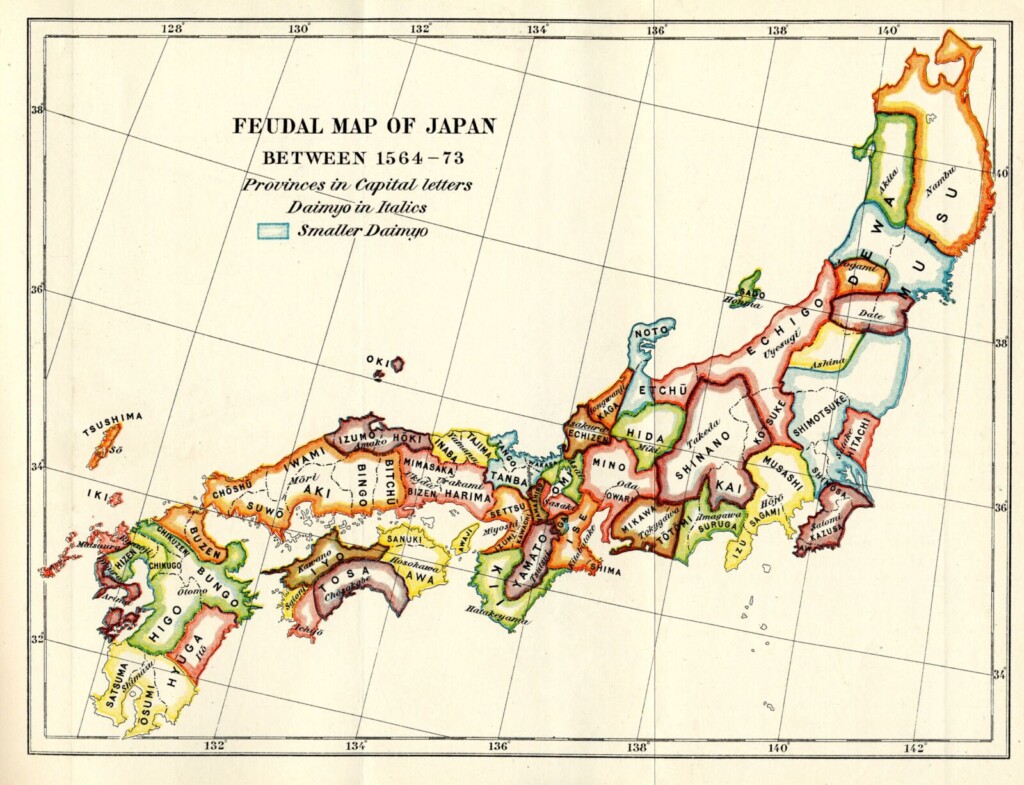
You picture a warrior of the fourteenth century, somewhere in the mountains near Kyoto, and you assume he carries in his chest a code: loyalty unto death, contempt for pain, a fixed and luminous idea of honor that would make suicide preferable to shame. This is the image sold to you by centuries of retrospective varnish, and it is almost entirely fiction. The actual documentary record of medieval Japanese warfare tells a different story, one full of defections, ransom negotiations, warriors switching sides mid-battle when the tide turned, and explicit written complaints to lords demanding better pay for services rendered, as if the whole enterprise were closer to a contractual labor dispute than a mystical vocation. Historian Karl Friday, in works such as Hired Swords, has shown that the early bushi were essentially professional fighters bound by pragmatic ties of kinship and stipend, not by an abstract ethical system that transcended self-interest.
The word bushido itself barely appears in any document before the seventeenth century, and when it does surface, it means something closer to a loose set of regional customs than a unified philosophy. What changed everything was peace. After 1603, with the Tokugawa shogunate consolidating power and eliminating large-scale war for over two centuries, an entire class of professional killers found itself with no one left to kill. Samurai became bureaucrats, tax administrators, sword-carrying clerks drawing stipends from rice yields they never harvested themselves. It is precisely in this vacuum, this crisis of purpose, that the literature of warrior ethics exploded, because a class that no longer fights needs a story to justify why it still deserves its stipend and its swords.
Yamamoto Tsunetomo dictated Hagakure between 1709 and 1716, decades after his own master had died and he had retreated, forbidden from following him in ritual suicide, into a hermitage as a Buddhist monk. The book was not a manual used by warriors in battle. It was the nostalgic, almost bitter meditation of a man who had never fought a real war, romanticizing a death he was never permitted to die, for an era that had already ended before he was born. His most famous line, that the way of the samurai is found in death, was written by someone whose entire adult life was defined by the impossibility of that death. The text circulated only narrowly within one domain, Saga, and remained obscure for nearly two centuries.
Its resurrection came later, and for reasons that have nothing to do with medieval authenticity. In the 1930s and into the war years, Hagakure was mined selectively by military propagandists to justify suicidal tactics, kamikaze missions, and absolute obedience to a state apparatus that had industrialized violence on a scale no fourteenth-century warrior could have imagined. Passages about loyalty were extracted, passages about the corruption of the samurai class and Tsunetomo’s own complaints about the decadence of his contemporaries were quietly dropped.
Parallel to this domestic reinvention runs a stranger case, that of Nitobe Inazo, a Japanese agricultural economist educated partly in the United States, converted to Quakerism, married to an American woman, who in 1899 published Bushido: The Soul of Japan in English, for an English-speaking audience, before it was ever translated back into Japanese. Nitobe wrote it explicitly to answer a Belgian jurist who had asked him how Japan could have morality without religious education. His answer was to construct, almost from scratch, a chivalric code modeled visibly on European ideals of medieval knighthood, footnoted with references to Walter Scott and German romanticism, designed to make Japan legible and respectable to a Western audience obsessed with its own narratives of noble warrior classes. Theodore Roosevelt reportedly bought dozens of copies to distribute. The irony is heavy: the text most responsible for exporting the idea of an ancient, unified samurai ethic to the entire world was written by a man more fluent in Philadelphia’s Quaker meetinghouses than in any actual dojo, translating Japan into a language the West already knew how to admire.
The Sengoku Collapse and the Logic of Total Instability
You are standing in the ashes of Kyoto in 1477, and if you turned to the man beside you and asked what the war had been fought for, he could not tell you, because by the tenth year nobody could remember anymore. Two rival claims to the shogunal succession had ignited it. Two great warrior houses, Hosokawa and Yamana, had marshaled the provincial lords behind those claims. But the claims had long since dissolved into a permanent condition, and the fighting continued for its own sake, because armies once assembled do not disband merely because their reason for existing has evaporated. The capital burned in patches over a decade. The Ashikaga shogunate, which had ruled, however loosely, since 1336, kept existing on paper for another century, a hollow office issuing edicts nobody obeyed, a throne with no floor beneath it.
What the Onin War exposed was not a temporary failure of governance but the underlying condition governance had always concealed. Order in feudal Japan, like order everywhere, had depended on a fiction that force and legitimacy were the same thing, that the men who held land held it because they deserved to, sanctioned by lineage, by imperial appointment, by the accumulated weight of precedent. The war stripped that fiction away in front of everyone at once. Once the shogunate could no longer punish disobedience, obedience simply stopped, not gradually but almost immediately, the way a rumor of a bank’s insolvency empties it within a day even though nothing about the vault has changed. The vault of the Ashikaga order had been empty for a long time. The war just let people see inside it.
Out of that vacuum came a phenomenon the Japanese themselves named with a phrase that translates roughly as the low overthrowing the high: gekokujo. It was not a single event but a working principle for a century and a half, and it meant, in practice, that a castellan could depose his lord, that a lord’s retainer could depose the castellan, that anyone with enough soldiers and enough nerve could claim territory that centuries of pedigree had supposedly reserved for someone else. Saito Dosan, sometimes called the Viper of Mino, is supposed to have begun as an oil merchant, or a monk, or possibly both in sequence, and ended as the master of an entire province, having eliminated the family that had ruled it before him. Whether every detail of his biography is legend hardly matters, because the fact that such a legend could attach itself to a real daimyo tells you what the era had made thinkable. Blood no longer protected anyone. A surname was worth exactly as much muscle as stood behind it that particular year.
This is the part historians of Japan keep circling back to without quite exhausting it: the Sengoku period, the Age of the Country at War, running roughly from 1467 to 1590, did not represent chaos in the sense of pure randomness. It represented a ruthless, accelerated experiment in what actually generates authority when every inherited justification has been suspended. Mary Elizabeth Berry’s work on Kyoto during this period describes a capital that kept functioning commercially, kept building, kept marrying and trading, even as it had no functioning central government worth the name, which suggests that order and the state are far less identical than either medieval chroniclers or modern nostalgia would like to believe. People built their own local arrangements, village leagues, merchant guilds, defensive alliances, because the vacuum above them did not mean the vacuum reached all the way down.
What the Sengoku collapse reveals, stripped of its specific armor and castles, is a structural truth uncomfortable enough that most stable societies spend considerable energy making sure it stays buried: every hierarchy you have ever trusted, every claim to deserve what it holds, is one bad decade of enforcement away from becoming a rumor about a vault nobody has checked in years.
Tokugawa Peace and the Architecture of Control
You are a daimyo in the autumn of 1635, and the shogunate has just informed you that your wife will remain in Edo permanently, your children with her, hostages in silk, while you yourself must uproot your entire retinue twice a year and march hundreds of miles along the Tokaido at your own crushing expense, bowing at checkpoints, announcing your rank through the number of spears and banners you can afford to parade, bankrupting your domain in the very act of demonstrating your loyalty. This is not oppression that announces itself as oppression. It arrives dressed as ceremony, as honor, as the privilege of being received by the shogun.
Tokugawa Ieyasu did not defeat his enemies at Sekigahara in 1600 so much as he inherited the exhaustion of a century that had eaten itself alive. What he built afterward, formalized through his grandson Iemitsu by the 1630s, was not a peace of reconciliation but a peace of engineering, a peace built the way a dam is built, to hold back a pressure that never stops pushing. The sankin-kotai system, alternate attendance, made every daimyo a commuter between two lives, his home domain and the shogun’s capital, and in doing so it drained the one resource that had made the Sengoku warlords dangerous: accumulated wealth translatable into standing armies. A lord spending half his revenue on processions and dual residences had no surplus left for rebellion. Historians estimate that by the eighteenth century some domains were pouring more than half their annual income into this system alone, and the roads that carried them, the fifty-three stations of the Tokaido immortalized later in Hiroshige’s woodblock prints, became arteries of surveillance disguised as arteries of commerce.
Peace, in this architecture, was never the absence of coercion. It was coercion redistributed into calendars, into distances, into the choreography of who bows first and how long. Michel Foucault, writing centuries later and an ocean away, described power that operates not through the spectacle of the scaffold but through the organization of bodies in space and time, and though he never wrote a word about Japan, the Tokugawa state had already discovered what he would later theorize: that a population exhausted by logistics has no energy left for revolt.
Beneath the daimyo, the shogunate froze the entire population into four inherited categories, shi-no-ko-sho, warrior, farmer, artisan, merchant, a hierarchy that pretended to reflect moral worth while actually functioning as a lock on mobility. A farmer’s son died a farmer regardless of talent; a merchant, no matter how wealthy, occupied the bottom rung because his labor was considered parasitic, extracting value rather than creating it. This was not accidental cruelty. Confucian scholars like Hayashi Razan, whom Ieyasu himself patronized, supplied the philosophical scaffolding, insisting that social harmony required each person to remain fixed in the role heaven had assigned them. The irony that would later corrode the entire system from within is that merchants, despite their official contempt, grew richer than the samurai who despised them, lending money to indebted warriors and quietly inverting the hierarchy in practice while leaving it untouched on paper.
Then came the sealing. Sakoku, the closed country policy formalized through edicts between 1633 and 1639, expelled the Portuguese, crucified thousands of Japanese Christians at Nagasaki and Shimabara, and reduced foreign contact to a single artificial island, Dejima, where Dutch traders were permitted to exist under conditions of near-total quarantine. This was not xenophobia in the crude sense. It was the shogunate recognizing that Christianity carried with it a loyalty structure competing with its own, and that firearms and foreign alliances had been precisely what let regional lords challenge central authority during the preceding century of civil war. Sealing the country meant sealing the possibility of an outside patron for any future rebel.
What emerges from these three mechanisms together, the hostage roads, the frozen castes, the locked borders, is a portrait of peace as the most sophisticated weapon the Tokugawa ever deployed, more effective than any army because it never had to be used, only maintained, for two hundred and fifty years, until the black ships of Commodore Perry arrived in 1853 and revealed how brittle two and a half centuries of stillness had actually made everything underneath.
A vision curated by a filmmaker, not an algorithm
In this video I explain our vision
Villages, Guilds, and the Invisible Majority

You have never heard the name of the man who fed the samurai who killed the man whose name you have heard. This is not an accident of transmission but the engineered outcome of a documentary apparatus that recorded rice yields down to the fraction of a koku while letting the men who grew it dissolve into tax ledgers as interchangeable units of labor. The Tokugawa census apparatus, formalized through the shumon aratame cho, the religious investigation registers instituted after 1671, counted every villager by household, age, and temple affiliation, producing some of the most granular population data in the premodern world, and yet the individual peasant survives in these documents only as a name attached to a yield figure, never as a consciousness. Historians like Thomas Smith, working through village registers in his 1959 study of agrarian origins, found population stability so pronounced in some regions that entire villages show almost no net change across a century, not because life was static but because the demographic system absorbed every surplus mouth through infanticide, delayed marriage, and outmigration with a precision that looks, from a distance, like a machine correcting for its own tolerances.
The number worth sitting with is the one rarely printed in bold: somewhere between eighty and ninety percent of Tokugawa Japan’s population, estimated at roughly thirty million by the eighteenth century, worked the land. Every castle, every sword, every tea ceremony rested on rice they grew and surrendered at rates that in some domains reached fifty percent or more of the harvest, calculated not by mercy but by cadastral surveys, the kenchi, that Hideyoshi had ordered conducted village by village in the 1580s and 1590s, converting the entire agricultural base of the country into a single unit of measurement, the kokudaka, that made every rice paddy legible to a tax collector who had never walked its edges.
What made this extraction survivable was not gratitude or bushido trickling downward but a structure of enforced mutual liability that anticipated, by three centuries, everything twentieth-century totalitarianism would later reinvent from scratch. The goningumi, the five-household group, bound neighboring families into a single unit of legal and fiscal responsibility, so that if one household failed to pay its tax, hid a Christian, sheltered a fugitive, or fell short on its corvée obligations, the punishment fell on all five. This was not a metaphorical solidarity. It was solidarity manufactured by threat, and it worked precisely because it converted every villager into an informant against his own interest in staying silent. The system did not need to watch everyone; it needed each household to watch four others, and fear did the rest.
Movement itself was treated as a symptom to be suppressed. Peasants required travel permits to leave their villages, checkpoints like the one at Hakone on the Tokaido road inspected papers with a rigor that historians have compared to internal passport regimes, and the underlying logic was demographic, not moral, an anxiety that if farmers drifted toward cities the rice would stop moving and the entire pyramid above them would starve. Guilds, the za that had proliferated in earlier centuries and then reorganized into merchant and artisan associations called kabu nakama under Tokugawa oversight, offered urban tradesmen something like the goningumi’s inverse, a monopoly protection racket sanctioned by the shogunate in exchange for fees and control, allowing dyers, sake brewers, and moneylenders to fix prices and block competitors while surrendering the one thing they might have used that leverage for, which was collective political voice.
Village solidarity, then, was never romantic. Anthropologist Robert Smith, studying the persistence of these structures into the twentieth century, noted how the collective obligations of mutual surveillance calcified into customs that villagers themselves came to describe using the language of harmony, wa, a word that in later nationalist rhetoric would be stripped of its coercive origin and repackaged as timeless cultural virtue. Nobody asked the five households bound together under threat of collective punishment whether they experienced their arrangement as harmony or as a leash, because nobody who asked such questions left a document behind.
Honor, Shame, and the Psychology of Hierarchy
You kneel on a white cloth you did not choose but were handed, and the man behind you has practiced the angle of the blade so that your death will look clean to people who will never know your name. This is not punishment. No one is forcing your hand around the short sword resting on the lacquered tray. You called this failure yourself, days ago, in a letter to your lord explaining why the garrison fell, and the ritual now unfolding is the only sentence available to you that does not also sentence your children, your household name, the four generations who will inherit whatever word gets attached to what you did. The blade goes in. This is what a society looks like when it has succeeded in making the executioner unnecessary.
Ruth Benedict never set foot in Japan. She wrote The Chrysanthemum and the Sword in 1946 from a Washington office, commissioned by the United States government to explain an enemy it had just finished firebombing, working from interviews with Japanese Americans, translated novels, and captured propaganda reels, because wartime travel to the country itself was not an option available to an anthropologist on a government contract. The book is flawed in ways generations of Japanese scholars have since catalogued, accused of flattening centuries of internal variation into a single national character, of mistaking wartime ideology for timeless essence. But the distinction Benedict drew between guilt cultures and shame cultures still cuts cleanly enough to explain something the archives keep confirming, which is that Tokugawa Japan policed itself with a thoroughness no shogunal army could have matched, and it did this largely without prisons.
Guilt, in Benedict’s framework, is an internal court that convenes whether or not anyone is watching, the Christian and post-Christian conscience gnawing at a person alone in the dark. Shame requires an audience, real or imagined, and dies without one. The mechanism sounds weaker on paper than guilt’s private tribunal, until you notice that shame’s audience never actually has to be present, because the samurai internalized it so completely that his own mind became the witness gallery. Giri, the crushing weight of obligation to lord, family, and name, was not a debt owed to any single creditor who might forgive it. It was owed to a structure, and structures do not forgive. On, the debt of favor received from a superior, from a parent, from the mere fact of having been born into a lineage that fed and clothed you, accumulated across a lifetime in ways that could never be fully repaid, only serviced, the way interest accrues faster than principal shrinks. A samurai who dishonored his name did not fear a magistrate. He feared the silence that would follow him through every room he ever entered again.
This is why the surveillance apparatus of the Tokugawa state, the metsuke inspectors, the checkpoint system, the mandatory reporting of travelers, could remain comparatively thin for a population of thirty million and still hold for two and a half centuries. External enforcement is expensive and unreliable; it requires someone to always be looking. Internalized shame requires no budget, because the person being watched has become their own warden, and the sentence, once passed, executes automatically. Michel Foucault, writing Discipline and Punish in 1975 about an entirely different geography, described a similar architecture in the panopticon, the prison design where inmates cannot tell whether the central tower holding their guard is occupied, and so behave as though it always is. The genius of Tokugawa social control was that it built the tower inside the skull and never needed the prison around it at all.
What made seppuku function as more than gruesome spectacle was that it converted an ending into a closing argument. Death by one’s own hand, performed correctly, retroactively cleaned a record that could not otherwise be cleaned. A samurai who fled a lost battle carried the loss with him into every future room. A samurai who opened his abdomen on the field converted defeat into the one kind of victory still available, the victory of a name that outlives the body attached to it, filed away in a household register that grandchildren would read without flinching.
The Meiji Rupture and the Manufacture of a Usable Past
You stand in a photograph from 1877, one of the last ever taken of a man in full samurai dress, and what strikes you is not the armor but the eyes, which already know this is a costume being preserved rather than a life being lived. Within a decade the topknot would be illegal to wear in government service, the swords confiscated by decree, the stipends converted into bonds that lost value faster than the men holding them could sell them. Saigo Takamori, who had helped engineer the very restoration that would destroy his class, died in 1877 leading a rebellion against the government he built, shot in the leg on a hillside in Kyushu and finished off, according to the version everyone prefers, by his own retainer rather than capture. The empire he opposed would later erect a statue of him in Ueno Park, walking his dog, a rebel commemorated by the state he rebelled against, because dead men make excellent symbols precisely to the degree that they can no longer complicate the story told about them.
The abolition itself took only a few years to execute and roughly seven centuries to become necessary. In 1869 the daimyo surrendered their domain registers to the emperor in a ceremony called hanseki hokan, an act of theater since most of them had no functioning alternative, surrounded as they were by a government that controlled the new conscript army, the telegraph lines, and the tax base. By 1871 the domains themselves were dissolved into prefectures administered by appointed governors, and roughly two million samurai, along with their families, found themselves stripped of the one thing that had defined their existence for generations, which was not wealth but function, a reason for the sword at their hip beyond nostalgia. Some became police officers, since the government needed men trained in exactly the kind of disciplined violence samurai had monopolized. Others became bureaucrats, teachers, or failures, drifting into the cities with nothing but lineage and resentment, a resentment the state would later find extraordinarily useful.
Because the same government that dismantled the samurai as a legal and economic class spent the following decades manufacturing them as a spiritual one. The word bushido, now treated as an ancient code stretching back to the twelfth century, entered wide circulation largely through Nitobe Inazo’s 1900 book written originally in English for a Western audience, a text that systematized scattered, contradictory, regionally specific warrior ethics into something that resembled chivalry because chivalry was legible to the Europeans Japan was trying to impress. The imperial state needed citizens who would die without asking why, and it found in the half-erased memory of the samurai a usable vocabulary for obedience, retrofitted onto a population most of whom had never held a sword and whose actual ancestors, the peasants, had spent centuries being taxed, conscripted, and occasionally slaughtered by the very class now being sanctified as the moral backbone of the nation.
What gets buried in this manufacture is the plain fact that feudal Japan was not one thing but a shifting, regionally fractured, frequently brutal arrangement of power that changed shape at least four times between the Kamakura shogunate and the Meiji Restoration, full of peasant revolts, sectarian wars, and warlords who behaved less like moral exemplars than like men trying not to die violently in a system built on the threat of violence. The Edo period’s famous stability, that two and a half centuries of enforced peace under Tokugawa control, was itself an artifice maintained through hostage systems and travel restrictions, not some natural expression of harmonious hierarchy waiting to be recovered. Every nation performs this same retrofitting, reaching backward into its own discontinuities and violence to extract a lineage that feels earned rather than assembled, and the speed with which Japan converted seven hundred years of contradiction into a single usable myth of discipline and loyalty says less about Japanese history than about what every state requires from its past, which is not accuracy but obedience dressed as inheritance.
⚔️ Journeys Through Feudal Japan
Feudal Japan remains one of history’s most fascinating civilizations, where samurai codes, spiritual beliefs and political upheaval shaped a society of extraordinary complexity. These related articles explore the historical, cinematic and cultural dimensions of that world, from warring clans to the folklore born of its turbulent age.
The Sengoku Period: History and Culture of Feudal Japan
The Sengoku period stands as the defining era of feudal Japan, a century of civil war that reshaped the country’s political and social order. This article traces the rise of warring daimyo, the code of loyalty that governed samurai life, and the cultural upheaval that ultimately paved the way for unification under a single shogunate.
GO TO THE SELECTION: The Sengoku Period: History and Culture of Feudal Japan
The yakuza in Japanese cinema: history and representations
Though born centuries after the feudal era, the yakuza inherited many codes of honor and hierarchy rooted in samurai tradition, making this a natural companion piece for understanding Japan’s social evolution. Japanese cinema has long used these criminal brotherhoods to reflect on loyalty, duty and the tension between tradition and modernity.
GO TO THE SELECTION: The yakuza in Japanese cinema: history and representations
Yasujirō Ozu and the cinema of the soul
Yasujirō Ozu’s contemplative cinema, though set in modern Japan, is deeply informed by the aesthetic and philosophical values forged during the feudal centuries, particularly the acceptance of impermanence and quiet duty. His work offers a subtle bridge between old Japan’s spiritual restraint and the anxieties of the twentieth century.
GO TO THE SELECTION: Yasujirō Ozu and the cinema of the soul
Jidaigeki: history of Japanese period cinema
Jidaigeki, the period drama genre, is the direct cinematic descendant of feudal Japan’s history, dramatizing samurai codes, court intrigue and peasant struggles for modern audiences. This article traces how the genre evolved from theatrical roots into a defining pillar of Japanese film, shaping global perceptions of the samurai era.
GO TO THE SELECTION: Jidaigeki: history of Japanese period cinema
🎬 Discover More on Indiecinema
If feudal Japan’s history and its cinematic echoes intrigue you, Indiecinema offers a curated selection of independent films that explore culture, memory and identity from perspectives rarely seen on mainstream screens. Dive into our streaming library and uncover stories that illuminate history through the eyes of bold, independent filmmakers.
👉 EXPLORE THE CATALOG: Watch Indie Films in Streaming
A vision curated by a filmmaker, not an algorithm
In this video I explain our vision

