
The Samurai as National Mythology
You have seen the image so many times you no longer notice it is an image: a lone figure on a hill at dusk, topknot intact, two swords at the hip, the silhouette so clean it could be a stamp pressed into the national imagination. This is not a memory. Nobody alive remembers feudal Japan. What you are seeing is a decision made in a cutting room, a studio lot, a government ministry — a decision about who the Japanese were supposed to have been so that someone could argue, with a straight face, about who they were supposed to become.

Jidaigeki, the genre of Japanese period drama set before the Meiji Restoration of 1868, did not emerge from a culture eager to document its own past with honesty. It emerged from a culture under extraordinary pressure to construct one. The earliest jidaigeki films appeared in the first decade of the twentieth century, almost simultaneously with the genre of the novel in Japan, and their timing was not coincidental. The Meiji state had spent forty years dismantling the actual samurai class — abolishing the stipend system in 1873, banning the public carrying of swords in 1876 — and was now financing, through cultural channels both direct and oblique, a sentimental restoration of the very figure it had legally destroyed. The samurai did not survive into cinema because he was historically central. He survived because he was politically useful.
Benedict Anderson’s argument in Imagined Communities, published in 1983, is that nations are not discovered but manufactured, and that the raw material of that manufacture is always a selective archaeology of the past. What jidaigeki accomplished for Japan was precisely this archaeology, performed not in universities but in darkened theaters where a farmer’s son from Osaka could watch a fictional ronin defend a fictional village and feel, in his chest, something he would have called heritage. The genre did not represent a continuous cultural memory. It generated one from scratch, and the generation happened fast enough and thoroughly enough that within two decades the artifice had calcified into instinct.
The defeat of 1945 created a second founding moment for the genre, stranger and more revealing than the first. The American occupation authorities initially banned jidaigeki outright, recognizing — with the blunt accuracy that outsiders sometimes achieve — that samurai films were not entertainment but ideology in costume. Films featuring feudal loyalty, sword violence, and revenge narratives were classified alongside militarist propaganda and removed from circulation. The ban lasted only a few years, but its very existence confirmed what Japanese filmmakers already understood: that the period drama was never innocent of its political function. When the genre returned in the early 1950s, it returned transformed. Directors like Akira Kurosawa began placing into the frame exactly the bodies that classical samurai mythology had always edited out — the peasants dying in the mud, the warriors who were also thieves, the lords who were also cowards. Rashomon, released in 1950, did not celebrate the samurai; it subjected the samurai’s self-narration to an epistemological demolition. Seven Samurai, four years later, placed the supposed protectors of civilization in a story where their protection was contingent, expensive, and ultimately impermanent.
What makes this postwar revision so historically complex is that it did not destroy the mythology. It deepened it. The samurai who doubts himself, who grieves, who questions the lord he serves — this figure is still a samurai. The genre’s critics were working inside the same house they were trying to burn, and the house was built well enough to absorb them. Every deconstruction of the warrior code produced a more sophisticated version of it, one armored against the easier criticisms, capable of surviving longer in the cultural bloodstream precisely because it had been vaccinated by doubt.
1868 and the Wound That Cinema Inherited
You are watching a man clean his sword in a room that no longer has a use for him. The blade is immaculate. The house is quiet. Outside, the Meiji government has just declared that he is an anachronism, that his class, his codes, his entire reason for existing have been legally dissolved — not defeated in battle, but abolished by decree, the way you might repeal a tax or rename a street.
The Meiji Restoration of 1868 was presented to the world, and to the Japanese themselves, as modernization, as the nation finally opening its eyes. But every restoration is also an amputation. In fewer than ten years, the new government banned the wearing of swords, dismantled the feudal domain structure, and converted samurai stipends into government bonds that were worth progressively less each year. By 1876, the Sword Abolition Edict had made the most visible symbol of a social caste literally illegal to carry in public. What had taken centuries to construct — the bushido ethos, the lord-retainer bond, the moral architecture of a warrior aristocracy — was not transformed but cancelled, with the administrative efficiency of a new bureaucratic state that understood how to use paper the way samurai had used steel.
The sociologist Norbert Elias argued in The Civilizing Process, published in two volumes in 1939, that the pacification of warrior classes in early modern Europe produced a specific kind of psychic residue: the violence that could no longer be enacted socially did not disappear but turned inward, became etiquette, became court ceremony, became the performance of restraint. Japan compressed this same historical arc into a single generation. The men who had been trained since childhood for a world that was dismantled before they were thirty did not simply become merchants or bureaucrats. They carried an unresolvable tension inside them, and some of their children and grandchildren eventually became filmmakers.
Jidaigeki emerged as a commercial genre in the early 1920s, precisely during the Taisho era, when Japan was far enough from 1868 to mythologize it but close enough to still feel its consequences in living memory. The genre’s formal conventions — the duel at dawn, the wandering ronin without a master, the corrupt official and the lone enforcer of a higher justice — were not inherited from literature in any straightforward way. They were symptom and compensation simultaneously, a cultural mechanism for rehearsing a loss that official nationalism had declared was actually a triumph. The ronin, the masterless samurai who appears in hundreds of these films, is not merely a dramatic device. He is the precise historical figure produced by the Meiji transition: a man whose loyalty structure has been made structurally impossible, who must enact his values in a world that has ceased to provide the social context those values required.
What makes this inheritance strange is that cinema itself was a direct product of the modernization that destroyed what jidaigeki mourned. The Lumière Brothers’ technology arrived in Japan in 1897, less than thirty years after the Restoration. The medium that would spend decades processing the trauma of modernization was itself a gift of that same modernization, imported along with the trains, the telegraphs, and the constitutional architecture. The genre carries this contradiction without resolving it, which is precisely why it could sustain audience attention across a century. It is not nostalgia in the simple sense — longing for a past that was better. It is something more structurally complex: a culture using the tools of its own transformation to interrogate whether that transformation was worth the price, while officially maintaining that the question was already settled.
The samurai who could not carry his sword in public in 1876 eventually found that his image could be projected, enormous and luminous, onto a screen in the dark, where an entire nation paid to watch him move as if nothing had been taken from him.

The Golden Decade and Its Contradictions
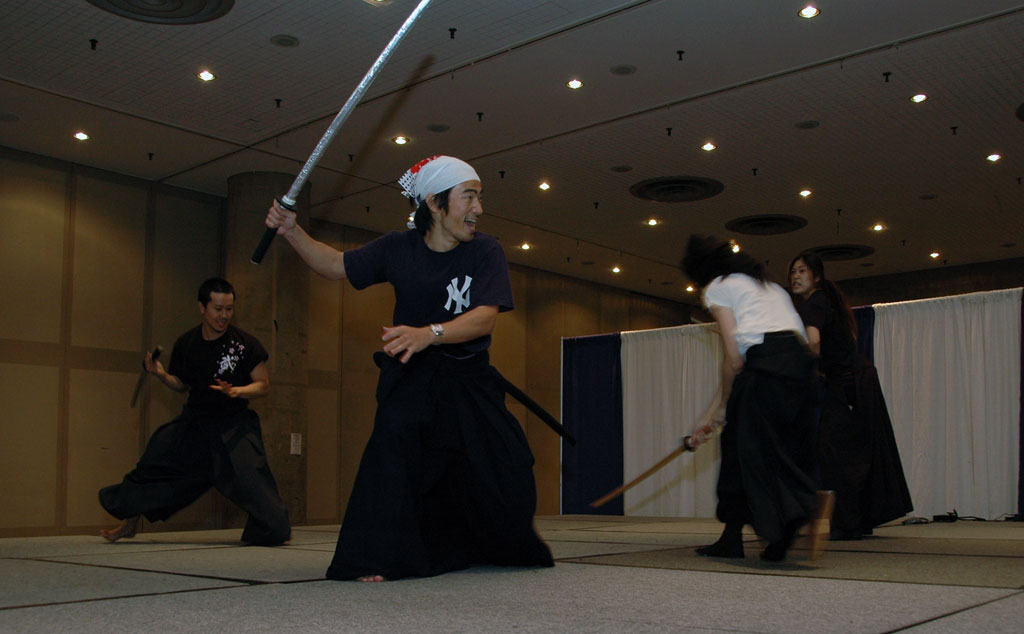
You are watching a man walk into a government office in 1950 to register a screenplay about a samurai who avenges his lord, and the clerk behind the desk tells him, without looking up, that the project requires additional review. The occupation censors — officially the Civil Censorship Detachment, dissolved only months earlier but still haunting the industry as institutional memory — had spent five years treating the sword as a symbol of militarist nostalgia, and that suspicion did not evaporate with a signature on a peace treaty. What the writer carries under his arm is not simply a story. It is an argument about who the Japanese are allowed to be when someone else is deciding.
The numbers tell their own kind of story. Between 1950 and 1960, Toei Studios alone produced more than five hundred jidaigeki films, flooding domestic theaters at a rate that makes the contemporaneous output of Hollywood look restrained by comparison. Daiei, the studio that would soon make the genre internationally legible, was churning through period productions at a pace that required multiple standing sets of Edo-period streetscapes to operate simultaneously. This was not artisanal filmmaking driven by singular vision. It was industrial, deliberate, and ferocious — a market responding to an audience that had been told for half a decade that its historical self-image was dangerous and was now consuming that self-image in the dark with something that resembled appetite but functioned more like thirst.
The critical mistake is to read this explosion as escapism. Scholars like Isolde Standish, in her 2005 work A New History of Japanese Cinema, have pressed hard against the comfortable idea that popular genre cinema is merely a retreat from political reality. The jidaigeki of the early 1950s was working on its audience precisely because it was doing political work through displacement — using the Edo period, the Meiji transition, the moment of the rōnin, as a coded vocabulary for questions that postwar Japanese society could not yet ask about itself directly. What does loyalty mean when the structure that demanded your loyalty has been declared criminal? What does masculinity mean when the military code that organized it has been dismantled by foreign decree?
The samurai as a figure had been officially pathologized. General Douglas MacArthur’s headquarters had categorized bushido alongside militarist propaganda, and between 1945 and 1949 the production of samurai films was either banned or severely restricted under SCAP directives. This created something unexpected: a genre that returned to screens not as the jingoistic instrument it had sometimes been in the 1930s and early 1940s, but sharpened by its own prohibition. Prohibition had made the sword mean something it hadn’t meant before — not imperial conquest, but cultural survival.
What Toei understood, with the commercial instinct of a studio that knew its audience better than the censors ever had, was that the chambara — the sword-fight sequence — was not violence in the way the occupation administrators had feared it. It was choreography of dignity, a body proving to itself that it retained the capacity for decisive, self-authored action in a moment when Japanese sovereignty was legally, geographically, and symbolically compromised. The American military presence was not abstract. Bases occupied real land. Soldiers walked real streets. The treaty signed in San Francisco in September 1951 restored formal independence while leaving behind an archipelago of concessions that made the word sovereignty feel hollow when spoken aloud. Into that hollowness walked the wandering swordsman, collecting no salary, answering to no foreign authority.
The genre did not speak this plainly, of course. It could not afford to. But the audience processed it at precisely this frequency — not because critics told them to, but because the body understands before the mind catches up what it means to watch someone refuse to kneel.
Honor as Ideological Apparatus
You have probably never noticed the exact moment in which a samurai film makes you root for a man destroying himself. He kneels. He apologizes for something that was not his fault. He accepts a punishment that the audience can see is unjust, and yet something in the staging — the stillness of the frame, the low angle, the silence held just a beat too long — makes the gesture feel like the highest thing a human being can do. The camera does not lie, exactly. It simply frames obedience as transcendence.
Ruth Benedict, writing in 1946 in The Chrysanthemum and the Sword, proposed that Japanese moral culture organized itself around what she called a shame culture rather than a guilt culture — meaning that the regulatory force was not an internalized conscience but an external social gaze. Her anthropology has been criticized, fairly, for its wartime political utility and its flattening of a vastly complex civilization. But one of her central observations about giri — the web of obligation binding a person to lord, family, and social station — describes something that jidaigeki as a genre has been metabolizing and transmitting for nearly a century. Giri is not merely a value system in these films. It is the aesthetic material from which tension is built.
The structural logic of giri-based narrative works by making every private desire a form of moral debt. A swordsman loves a woman he cannot marry because she belongs to another social world. A retainer knows his lord is corrupt but cannot denounce him without betraying the relationship itself. A son must avenge a father whose death he privately believes was deserved. The impossibility is not a dramatic flaw — it is the drama. What the genre sells, across decades and thousands of films, is the spectacle of a person choosing obligation over self, not because the obligation is just, but because the choosing itself becomes the proof of character. The suffering is the credential.
This is where aesthetics becomes ideology without announcing itself. When Kurosawa frames a ronin standing in the rain outside a castle gate — refused entry, unacknowledged, reduced to waiting — the visual composition is so precise, so controlled, that the humiliation reads as dignity. The genre trains its audience to locate virtue not in resistance or refusal but in the manner of endurance. The more quietly a man absorbs his erasure, the more the camera elevates him. Over time, this is not simply a cinematic preference. It is a rehearsal for a posture toward power.
The sociologist Norbert Elias argued in The Civilizing Process, published in German in 1939, that the management of affect — learning to suppress rage, grief, and immediate desire — is historically tied to the consolidation of hierarchical social structures. The court society required bodies that had learned not to react. Jidaigeki performs this process as spectacle, and invites the audience to experience the suppression of reaction as refinement. A man who does not weep when he should weep is not broken. He is finished. He is complete.
What makes this particularly difficult to interrogate is that the films are often genuinely beautiful, often genuinely sad, and often populated by characters whose internal conflicts carry real moral weight. The ideology does not require bad art to function — in fact it requires the opposite. It is precisely because these films achieve moments of devastating emotional clarity that the framework they rest on escapes scrutiny. You grieve for the man who destroys himself in service of a hierarchy that was never his friend, and in grieving for him you have, quietly, endorsed the terms of his destruction.
The Edo period setting is not incidental to this operation. By anchoring the genre in a world that officially ended in 1868 with the Meiji Restoration, jidaigeki can present hierarchical submission as historical costume — something worn by the past, observed from a safe distance — while the emotional grammar it installs in the viewer remains perfectly current.
The Rōnin Figure and the Myth of Autonomous Masculinity
You are walking through a story you already know before anyone tells it to you. A lone man arrives at the edge of a village, his clothes worn, his allegiances dissolved, his sword the only remaining proof that he once belonged to something. You have seen this figure so many times that you no longer ask where he came from, or what historical Japan actually did with men whose lords had died or been defeated.
The historical record is considerably less romantic. Rōnin in Edo-period Japan were frequently treated as social liabilities, men without the structural identity that Tokugawa governance required of everyone. The 1651 Keian Uprising, led by Yui Shōsetsu and drawing on the desperation of thousands of masterless samurai who could find no legitimate place in the pacified order, ended in failure and mass execution. What the period produced in abundance was not heroic wanderers but destitute men who became laborers, peddlers, or criminals — figures the state monitored with anxiety rather than admired. The rōnin was a symptom of institutional breakdown, not its cure.
Cinema converted that anxiety into fantasy with astonishing efficiency. By the time postwar Japanese studios began mass-producing chambara films through the 1950s and 1960s, the masterless samurai had been transformed from a figure of social precarity into an emblem of sovereign selfhood. The appeal was inseparable from its historical moment: Japan in 1945 had lost not just a war but an entire architecture of loyalty — to the emperor, to the nation, to a cosmology in which individual sacrifice had meaning. The rōnin offered something the postwar psyche desperately needed, a man whose detachment from institutional belonging looked like freedom rather than failure.
Erich Fromm, writing in Escape from Freedom in 1941, identified a paradox that runs directly through this cultural phenomenon: when genuine freedom becomes available or is forced upon people, the response is often not liberation but the search for a new form of submission. The rōnin narrative gives the audience the aesthetic sensation of radical autonomy — the lone sword, the man beholden to no lord — while the plot mechanics quietly ensure that this autonomy is either punished by death or domesticated by a cause worth dying for. The protagonist never actually escapes the logic of self-sacrifice; he simply chooses the altar himself, which feels like freedom but is structurally identical to the obedience it replaced.
What makes this particularly surgical as ideology is that the punishment is made beautiful. The deaths are choreographed, the self-erasure is lyrical, and the audience leaves the theater having consumed the spectacle of autonomy while absorbing the message that autonomy ends only one way. Roland Barthes in Mythologies described exactly this operation: myth does not deny things, it naturalizes them. The rōnin’s death does not say that individual freedom is dangerous — it says that this is simply what happens, this is the shape of things, this is what a true man looks like at the end of his story.
The masculine dimension of this structure deserves its own reckoning. The rōnin archetype made a specific and historically contingent form of manhood — stoic, unattached, lethal, incapable of domestic integration — appear as the natural baseline of male identity. Women in these films appear as either attachments the hero must sever or stakes for which he fights, never as agents within the same moral grammar. What the cinema was actually doing was projecting a 1950s crisis of male social role backward onto a feudal aesthetic, using the distance of history to make the projection feel like discovery rather than invention.
There is a scene that recurs across dozens of these films in slightly different costumes: the rōnin refuses the offer of a permanent home, turns away from the woman who would anchor him, and walks back into the road. The audience reads this as nobility. It might equally be read as a portrait of a man so thoroughly shaped by the expectation of sacrifice that he has lost the capacity to imagine himself as something other than a weapon waiting to be aimed.
A vision curated by a filmmaker, not an algorithm
In this video I explain our vision
Female Absence as Structural Violence

You watch a woman walk through the frame and something in you waits — waits for her to speak, to act, to refuse — and the camera moves past her before you finish the thought, and you realize she was never meant to stay.
The structural absence of women from jidaigeki is not a matter of historical accuracy, which is the defense most readily offered. It is a curatorial decision compounded across decades, a genre-level consensus about whose suffering generates meaning and whose generates only atmosphere. The samurai film arrived at its mature form during the 1950s and 1960s precisely as Japan was renegotiating its postwar masculinity — the Meiji ideal of the warrior-statesman had been militarized, catastrophically defeated, and then needed resurrection in a form that could sidestep accountability. Cinema obliged. The jidaigeki hero, wandering and self-sufficient, became a vessel for a national identity that could not yet look at itself directly, and that vessel required women to remain peripheral, decorative, or destroyed in order to keep its symbolic integrity intact.
The sociologist Ueno Chizuko, in her 1990 study Kafuchosei to Shihonsei, traced how patriarchal structures in Japan were not simply traditional survivals but were actively reconstructed during modernization to serve emerging power arrangements. What the jidaigeki encodes, then, is not feudal authenticity but a modern anxiety rehearsing itself in feudal costume. Women in the genre are overwhelmingly assigned three roles: the mother whose death inaugurates the hero’s quest, the prostitute whose tenderness humanizes him briefly before disappearing, and the aristocratic daughter whose honor must be protected — that is, controlled. Each role positions women as the ground the male narrative walks on, never as figures moving through their own time.
When the female swordswoman does appear — and she does, sporadically, precisely enough to seem like evidence of openness — the genre’s machinery responds with revealing precision. The onna-bugeisha figure, drawing on historical precedents like Tomoe Gozen or Nakano Takeko, is almost invariably coded as a tragic aberration. Her competence is real but it costs her femininity, her marriageability, her place in any social fabric the narrative has constructed as desirable. She wins fights and loses worlds. The revenge narrative given to women follows the same logic: films like Lady Snowblood, Toshiya Fujita‘s 1973 adaptation of Kazuo Koike‘s manga, present a woman who is essentially a weapon assembled by historical injustice rather than an agent who chooses her own terms. Meiko Kaji‘s Yuki is born from rape and raised for murder, her entire existence a function of male crimes committed before she had a name. She is extraordinary and she is still not free, because the narrative has pre-justified every movement she makes — she is permitted violence only because violence was done to her first, and at a scale so absolute that no one can object.
This is the boundary case’s precise function: it makes the exception so extreme, so saturated with prior victimhood, that it cannot contaminate the rule. The genre admits the female avenger and simultaneously ensures she can never become the genre’s center of gravity, because her story requires male atrocity as its precondition in a way that the male ronin’s story simply does not require female atrocity to exist. He wanders because he chooses to wander, or because a system failed him, and that difference in narrative origin is the entire architecture of who history is permitted to belong to.
What goes unfilmed accumulates its own pressure. The actual historical record of Edo-period Japan contains women who ran merchant enterprises, women who led rural uprisings, women whose letters survive as evidence of extraordinary intellectual lives — and the genre, in its six-decade dominance of Japanese popular historical imagination, has treated all of that as scenery rather than story, which means that millions of viewers have learned, without being told, that history has a gender.
When the Genre Turned on Itself
You are sitting in a darkened theater in 1962, watching a man beg for his life in a ceremonial courtyard, and the camera refuses to look away. He has been ordered to commit ritual suicide with a bamboo sword — because his real blade was sold months ago to feed his children — and the officials surrounding him know this, have always known this, and proceed anyway. The ceremony is not interrupted by his suffering. The ceremony is the suffering.
Masaki Kobayashi‘s Harakiri, released that year and awarded the Jury Prize at Cannes in 1963, did not arrive as a polemic. It arrived as a jidaigeki, wearing every formal convention of the genre with meticulous care — the Edo-period setting, the masterless samurai, the clan hierarchy, the duel — and then detonated those conventions from inside. What the film understood, with a precision that bordered on surgical, was that the genre’s iconography had always been doing ideological work. The lone swordsman, the honorable death, the code that supersedes personal feeling: these were not neutral aesthetic choices. They were arguments. Kobayashi simply made the argument visible by following it to its logical conclusion and showing what it cost in actual flesh.
This revisionist impulse did not emerge from nowhere. The postwar Japanese constitution, ratified in 1947 under occupation pressures, formally renounced militarism, but the cultural machinery that had glorified imperial sacrifice — including the wartime jidaigeki cycle that cast samurai as prototypes for the ideal soldier — had no equivalent formal dissolution. Akira Kurosawa’s Seven Samurai in 1954 had already introduced ambivalence, giving the warrior class a dignity inseparable from obsolescence, but the revisionist cinema of the following decade went further. It treated ambivalence as insufficient. The question was no longer whether the samurai was tragic but whether the code that produced him was a lie designed to serve those who would never die by it.
Hideo Gosha, working through the late 1960s, built his films around the structural gap between bushido as articulated by the ruling class and bushido as experienced by those asked to perform it. The doctrine that Yamamoto Tsunetomo codified in the Hagakure around 1716 — the famous formulation that the way of the samurai is found in death — was not a philosophy of liberation. It was a management tool. It solved, elegantly and cheaply, the problem of how to keep armed men loyal to masters who could not always pay them. Gosha’s films populated this gap with bodies, showing low-ranking swordsmen dying in service of clan interests that had never included them.
What the self-cannibalization of the genre exposed was not simply hypocrisy at the level of narrative — heroes who were villains in disguise — but a deeper structural problem about what genres do to history. Jidaigeki had never been history. It had been a relationship with history, a way of processing national identity through the selective dramatization of the past. The Meiji government had understood this as early as the 1870s when it banned the wearing of swords and effectively ended the samurai class as a social reality, transforming it immediately into a cultural icon available for whatever purposes the present required. The revisionist filmmakers of the 1960s were not simply critiquing the samurai. They were critiquing the act of iconization itself — the political convenience of turning a class of violent enforcers into vessels of spiritual meaning.
Shintaro Katsu‘s Zatoichi, the blind masseur who was also a lethal swordsman, ran across twenty-five films from 1962 to 1973 and embodied this contradiction without ever fully resolving it. The character’s appeal depended on a genre grammar the films simultaneously undermined — his kills were neither clean nor ceremonial, the social order he periodically restored never included him, and the audience’s pleasure in his competence was shadowed by the awareness that competence was all he had.
Contemporary Jidaigeki and the Nostalgia Trap
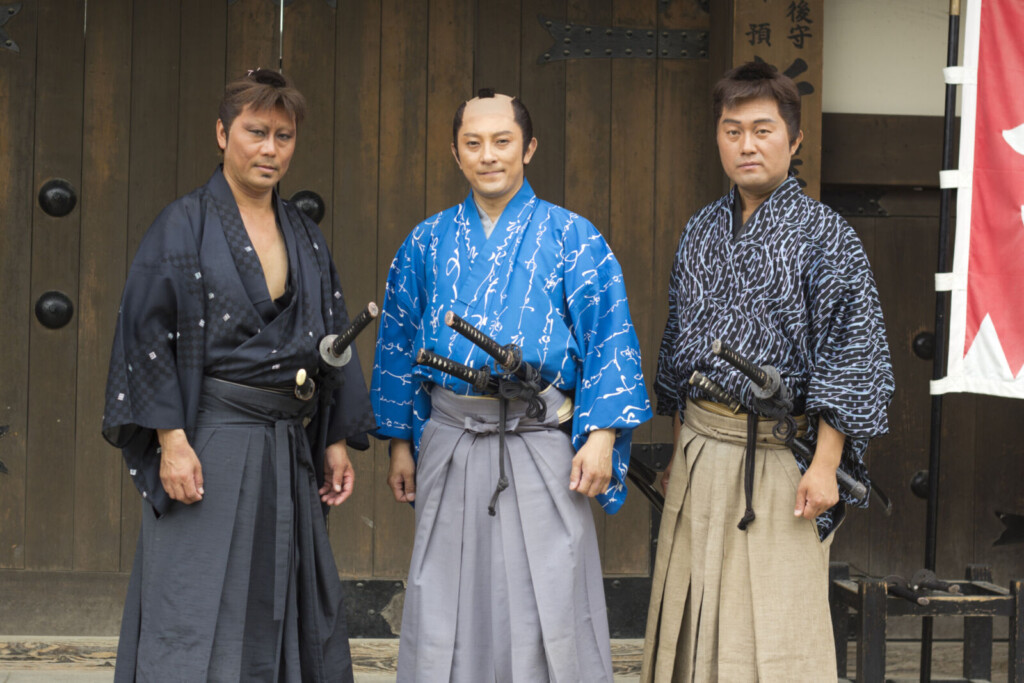
You are watching a samurai drama on a Sunday evening, the kind that has aired on NHK every January for decades, and you notice that you are not uncomfortable. The armor is lacquered and beautiful. The betrayals are legible. The grief arrives on cue and dissolves before the credits. Nothing in this experience asks anything of you, which is precisely the problem.
The taiga drama, NHK’s flagship annual historical serial, has by the early twenty-first century become one of the most reliable instruments of national emotional management in Japanese broadcasting. With budgets exceeding several hundred million yen per production and audiences in the tens of millions, these series do not simply tell stories about the Sengoku period or the Meiji Restoration — they perform a ritual function, converting historical rupture into domestic spectacle. The violence of unification, the coercion embedded in feudal loyalty, the systematic exclusion of women and outcaste populations from the official record: all of this becomes scenic backdrop, a theater of resolved tension in which the nation can recognize itself as having already survived its worst passages and emerged intact. This is not history. It is national therapy at scale.
What makes this regression culturally significant is that the genre once refused precisely this comfort. When Masaki Kobayashi released Harakiri in 1962, the film’s central argument — that bushido was a bureaucratic weapon wielded against the poor — was not abstract philosophy but a direct confrontation with the postwar rehabilitation of samurai aesthetics that Japanese conservatism was already engineering. The film landed with 127 minutes of accumulated structural rage. That capacity for structural rage has been almost entirely evacuated from contemporary mainstream jidaigeki, replaced by what sociologist Eva Illouz, writing in Cold Intimacies in 2007, identified as the therapeutic emotional style: the tendency to frame collective and political wounds as personal psychological journeys requiring individual healing rather than systemic interrogation.
Manga adaptations have accelerated this flattening. Properties like Rurouni Kenshin, which began serialization in 1994 and has since generated multiple live-action films, transpose the Meiji transition into a redemption narrative centered on individual guilt and physical skill, where history functions as costume rather than causation. The Meiji period actually produced Japan’s first modern penal system, abolished domains, forcibly assimilated Ainu communities, and conscripted a peasantry that had never chosen modernization — none of which survives translation into a narrative whose deepest concern is whether the protagonist deserves forgiveness for his past violence.
International co-productions have introduced a different kind of distortion. The global appetite for samurai aesthetics — fed by decades of Kurosawa exports and the subsequent rise of Japanese pop culture soft power — has created a market incentive to produce jidaigeki that is legible and pleasurable to non-Japanese audiences, which in practice means stripping away the class anxieties, the regional specificity, and the bureaucratic textures that made earlier genre films historically dense. What remains is a visual grammar: the sword, the courtyard, the falling cherry blossom, the honorable death. Anthropologist Ian Buruma noted in 1984 in Behind the Mask that Western fascination with Japanese warrior culture was always partly a projection of its own martial nostalgia, and the co-production economy has formalized that projection into a shared aesthetic contract between producers and audiences who agree not to ask what is missing.
What contemporary jidaigeki manages, then, is not the past but the present — specifically the ambient anxiety of a society navigating demographic collapse, economic stagnation since the lost decade of the 1990s, and the erosion of the lifetime employment model that once organized masculine identity as thoroughly as the samurai code ever did. The period drama offers a world in which hierarchy was visible, sacrifice was meaningful, and the rules, however brutal, were at least legible — a fantasy not of feudal Japan but of a structured life that late capitalism has made structurally impossible to inhabit.
🎌 Samurai, Ghosts & Feudal Japan: The World Behind Jidaigeki
Jidaigeki cinema draws its power from a rich cultural and historical soil that spans feudal warfare, aesthetic philosophy, and spectral folklore. To truly understand the genre, one must explore the traditions, conflicts, and artistic sensibilities that shaped it. These related articles offer essential context for the world behind the period film.
The Sengoku Period: History and Culture of Feudal Japan
The Sengoku period — Japan’s era of warring states — is the historical backbone of countless jidaigeki films, from Kurosawa’s epic battles to intimate tales of samurai loyalty and betrayal. Understanding its political chaos, shifting alliances, and warrior culture is indispensable for any serious viewer of Japanese period cinema. This turbulent epoch gave the genre its most enduring archetypes and moral dilemmas.
GO TO THE SELECTION: The Sengoku Period: History and Culture of Feudal Japan
Japanese Aesthetics: Wabi-Sabi Mono no Aware and Yugen
Japanese aesthetics — wabi-sabi, mono no aware, and yūgen — are not mere decorative concepts but the philosophical grammar through which jidaigeki directors compose every frame. The melancholy beauty of impermanence and the sense of things left unsaid permeate the visual language of the genre’s greatest works. Grasping these ideas transforms the act of watching a period film into a deeply meditative experience.
GO TO THE SELECTION: Japanese Aesthetics: Wabi-Sabi Mono no Aware and Yugen
Onryō: Vengeful Ghosts in Japanese Culture
The onryō, or vengeful ghost, is one of the most persistent figures in Japanese cultural imagination and appears with striking frequency in jidaigeki narratives, especially those rooted in Edo-period ghost stories. Filmmakers like Masaki Kobayashi drew directly on this tradition to explore themes of injustice, memory, and retribution in works that blur the boundary between historical drama and supernatural horror. Understanding onryō mythology illuminates some of the genre’s most haunting and morally complex sequences.
GO TO THE SELECTION: Onryō: Vengeful Ghosts in Japanese Culture
Yasujirō Ozu and the cinema of the soul
Yasujirō Ozu may seem a world apart from the sword-wielding heroes of jidaigeki, yet his cinema shares with the period genre a profound commitment to the textures of Japanese life, social ritual, and emotional restraint. His formal mastery and meditative pacing influenced an entire generation of filmmakers who brought similar aesthetic discipline to historical settings. Exploring Ozu’s work deepens one’s appreciation for the quieter, more contemplative strands of Japanese period cinema.
GO TO THE SELECTION: Yasujirō Ozu and the cinema of the soul
Discover the Depth of World Cinema on Indiecinema
If the layered history of jidaigeki has sparked your curiosity, Indiecinema’s streaming is the ideal place to continue your journey — a curated platform dedicated to independent, auteur, and world cinema that goes far beyond the mainstream. Discover rare masterpieces, bold new voices, and films that challenge, move, and illuminate.
👉 EXPLORE THE CATALOG: Watch Indie Films in Streaming
A vision curated by a filmmaker, not an algorithm
In this video I explain our vision

