
The Mountain as Palimpsest: Geological Time and Human Settlement
You place your hand flat against a wall of limestone in the Majella and feel nothing move, and that stillness is the first lie the mountain tells you. The rock beneath your palm was once seafloor, a sediment of shells and marine skeletons compressed across some sixty million years of Cenozoic accumulation, when the area now called Abruzzo lay submerged beneath a warm Tethyan sea whose name most people have never heard because its entire existence predates the concept of names. Then the African and Eurasian plates leaned into each other, slowly, with the patience of something that has never had to justify its own duration, and the seabed buckled upward into the massif that now interrupts the sky at nearly 2800 meters, at Monte Amaro, the second-highest peak in the Apennines. This is not backstory. This is the mountain’s actual condition, still happening, still folding, at a rate of millimeters per year that your nervous system is structurally incapable of perceiving as motion.

The trouble starts when you try to hold that timescale next to any human one. Fernand Braudel, writing in the 1940s from an Algerian prison camp before publishing The Mediterranean and the Mediterranean World in the Age of Philip II, proposed his own fracture of time into the geographical, the social, and the individual, insisting that history’s real protagonist was the almost motionless time of climates and mountain ranges, what he called la longue durée. Braudel wanted historians to feel small next to terrain. But even his slowest register, the geological one, was still being narrated by a man with a wristwatch, a prison sentence, a war outside the walls with an ending date. The Majella does not offer you even that courtesy. It offers a temporality so indifferent to narrative that your instinct to compress it into a story, this happened, then this happened, is itself the intrusion, a kind of category error committed by a species that has only existed for a few hundred thousand years trying to read a document written in a language with no verbs.
And yet the mountain is full of us. Caves scattered across its slopes, Grotta dei Piccioni at Bolognano among them, have yielded human traces stretching back through the Neolithic into the Mesolithic, hearths and tools and burials layered into the rock shelters like sediment of a different kind, human sediment, deposited at a pace that feels to us like history but is, from the limestone’s point of view, essentially instantaneous. Ten thousand years of human presence on the Majella is a rounding error against the massif’s formation. It is less than a rounding error. It is the kind of number that disappears entirely when you zoom out to the scale the rock itself operates on, and yet it is the only scale in which anything we call meaning, ritual, memory, or grief has ever occurred.
This is the destabilizing part, the part nobody tells you when they describe mountains as backdrops. The Majella was never a backdrop. It was already ancient, already finished with the violent portion of its formation, by the time anything resembling a human mind existed to stand at its base and feel small. The shepherds who later carved transhumance routes into its flanks, the hermits who would eventually seek its caves for reasons that had nothing to do with geology and everything to do with a different, interior kind of vastness, were not adding a new chapter to the mountain’s story. They were the briefest possible flicker against a surface that had already stopped changing in any way perceptible to a single lifetime. The unsettling question is not why humans have always been drawn to mountains. It is why we insist on believing the mountain notices us back, why every civilization that has stood before the Majella has needed, almost physiologically, to read intention into thirty million years of tectonic accident.
Hermits, Popes, and the Politics of Solitude
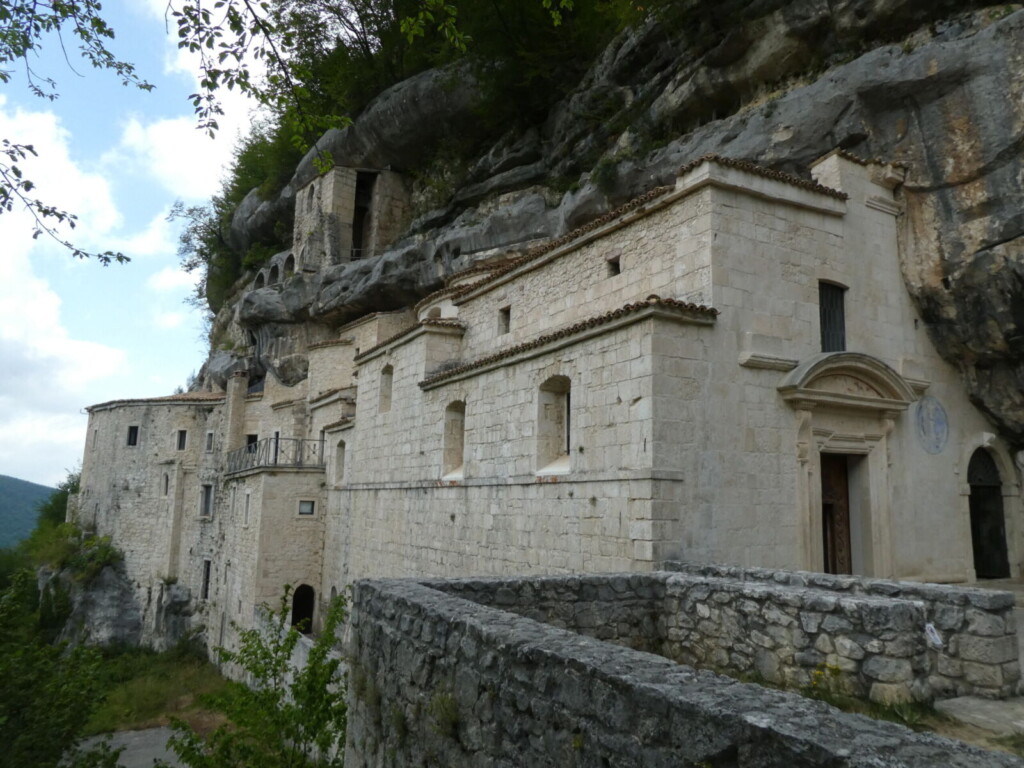
You climb toward the Grotta Sant’Onofrio at Serramonacesca and the first thing you notice is that it isn’t remote at all. The path is short, the valley opens beneath you within twenty minutes, and the cave itself sits in plain view of what was once a functioning transhumance route, the seasonal river of sheep and shepherds that connected Abruzzo’s highlands to the Puglian plains. This is not a hiding place. This is a threshold, positioned exactly where travelers would see it, where a hermit’s fire at night would have been visible to anyone moving through the valley below. The solitude was staged. It had an audience.
Pietro da Morrone understood this better than anyone, though the story usually gets told backward, as if his ascent to the papacy in 1294 were an interruption of his hermit life rather than its logical culmination. He had spent decades in the caves and gorges of the Majella, founding the monastic congregation that would later bear his name, the Celestines, and building a reputation for austerity so extreme that it functioned as a form of currency. Chroniclers of the period, including those feeding information to the future biographers of the Celestine order, describe him wearing an iron chain against his skin, eating only on Sundays and Thursdays, sleeping on bare rock. But austerity performed in total isolation generates no reputation at all. Someone has to know. Someone has to carry word of it down to Sulmona, to the monasteries of the valley, to the ears of cardinals deadlocked for over two years in the conclave that would eventually beg him, an eighty-four-year-old ascetic, to become Pope. The wilderness he inhabited was already, by the time of his election, a kind of media apparatus, transmitting sanctity outward through a network of monks, pilgrims, and local nobility who had every reason to publicize the holiness in their mountains.
This is not cynicism about the man’s faith, which by all accounts was genuine and consuming. It is a recognition that medieval sanctity was never a private transaction between a soul and God, however much the theology insisted otherwise. Max Weber‘s concept of charismatic authority, laid out in Economy and Society, depends entirely on recognition by others; charisma that nobody witnesses is indistinguishable from madness or irrelevance. The Majella’s caves produced hundreds of hermits across the centuries, but only a handful became famous, and fame followed a predictable geography: proximity to trade routes, patronage from local feudal families like the Caldora or the d’Aquino, and strategic distance from the ecclesiastical bureaucracy in Rome that was close enough to notice you and far enough that you seemed uncorrupted by it. Sacred wilderness, in this sense, was never simply found. It was assigned, negotiated, built by the very civilization it claimed to reject.
Pietro’s papacy lasted five months. He abdicated in December 1294, the first pope in history to do so voluntarily, and the reasons given, his own bewilderment at Vatican politics, his longing for the ascetic life, fit the narrative almost too conveniently, confirming exactly what everyone already wanted to believe about the incompatibility of true holiness and institutional power. Dante placed the shade of a soul who made “il gran rifiuto,” the great refusal, in the vestibule of Hell in the Inferno, a judgment scholars still argue over, since Dante never named him explicitly. But his successor, Boniface VIII, imprisoned him at Fumone until his death in 1296, which suggests that whatever Pietro represented, it wasn’t harmless enough to be left alone in a cave. The mountain had made him powerful precisely by making him seem powerless, and that contradiction was dangerous to the men who actually held power through more conventional means.

Shepherds, Transhumance, and the Economy of the Sacred
The man walking behind eleven hundred sheep in September of 1860 was not composing a psalm in his head. He was counting. He was counting the animals that had survived the summer pastures, calculating how many would die on the Tratturo Magno before reaching the Tavoliere delle Puglie, estimating whether the wool and cheese he carried would cover the debt owed to the landowner in Sulmona who had leased him the flock. The tratturi, those grassy royal roads up to 111 meters wide that crossed the Abruzzo mountains toward the Apulian plains, were not pilgrimage routes despite what later generations wanted to believe. They were infrastructure, taxed and regulated since the Aragonese crown established the Dogana della Mena delle Pecore in Foggia in 1447, an institution that would extract customs revenue from pastoral movement for nearly four centuries. Spirituality did not float above this system. It was produced by it, shaped by its ledgers and its losses, and to separate the shepherd’s prayer from the shepherd’s debt is to misunderstand what that prayer was for.
The romantic image of the pastore-mistico, the shepherd as natural contemplative, owes more to Gabriele D’Annunzio’s 1904 poem “I pastori,” with its wistful vision of men descending toward the Adriatic “lungo il tratturo antico al piano, quasi per un immenso fiume,” than to any lived reality on the Majella’s slopes. D’Annunzio wrote from Settignano, near Florence, homesick for an Abruzzo he had already left behind, and his shepherds move through an idealized, almost sacramental landscape. The actual men doing this labor faced mortality rates among transhumant flocks that could reach twenty percent in a hard winter, faced brigands, faced the Doganieri’s punitive fines for straying off the marked path onto cultivated land. Their religion, when it appears in the ethnographic record, is a religion of insurance against catastrophe, not an aesthetic communion with beauty.
Ernesto de Martino, the anthropologist who spent the 1950s documenting the magical and religious practices of southern Italian peasants, offered a framework that applies with precision here: what he called “crisi della presenza,” the crisis of presence, described how populations living at the edge of subsistence developed ritual technologies specifically to hold the self together against the constant threat of loss. In “Sud e magia,” published in 1959, de Martino showed that magic and popular Catholicism in the Mezzogiorno were not primitive holdovers from a pre-rational past but functional responses to precarity, techniques for managing anxiety when institutional protection did not exist. The shepherds of the Majella prayed to San Domenico Abate, whose cult centered at Villalago and Cocullo involved handling snakes as a ritual echo of pre-Christian practices tied to Angizia, precisely because wolves and vipers were daily threats to men sleeping in stone huts called tholos or in caves along the mountain’s eastern flank.
The sanctuaries scattered across the massif, San Bartolomeo in Legio carved into the Lama dei Peligni gorge, the hermitages built by Pietro da Morrone before his brief and disastrous reign as Pope Celestine V in 1294, were not built by men seeking scenery. Celestine himself, the ascetic elected pope who abdicated after five months, understood the mountain as a place of refuge from the political violence of the Kingdom of Naples, not as an aesthetic retreat. His hermitage at Sant’Onofrio, wedged into the cliff face, functioned the way a bunker functions. The economy of the sacred, then, was never a metaphor for something gentler happening alongside the material economy; it was the same economy, translated into vows, feast days, and the ritual calendar that told a shepherd when to leave and when it was too dangerous to stay.
The Invention of Wilderness: National Park, Tourism, and Ecological Control
![Exploring Abruzzo - Eremo San Bartolomeo, Majella, Abruzzo [Italy]](https://blog.indiecinema.co/wp-content/plugins/wp-youtube-lyte/lyteCache.php?origThumbUrl=https%3A%2F%2Fi.ytimg.com%2Fvi%2F4FOQGn7OQO8%2F0.jpg)
You climb toward Blockhaus on a paved switchback road built for the 1912 Coppa Acerbo motor race, past a visitor center with laminated signage explaining the “untouched wilderness” you are about to enter, and nobody laughs at the contradiction because nobody is meant to notice it. The road itself has been there for over a century. The wolves you might glimpse were reintroduced through careful management protocols, monitored by radio collar, counted in annual reports issued by park authorities headquartered in Sulmona. The wilderness has an office. It has a budget line in the Italian Ministry of the Environment, a director, a logo featuring a stylized Apennine chamois, an animal that itself vanished from the massif for decades before being reintroduced from Gran Sasso stock starting in the 1990s. What you are looking at, when you look at the Majella and feel that particular swelling sensation people call communion with nature, is a landscape that has been governed into looking ungoverned.
This is not cynicism, it is history. The Parco Nazionale della Majella was established in 1991, though proposals for protecting the massif date back to the 1920s, contemporaneous with the founding of Abruzzo National Park in 1922 under the fascist state’s own conservation ambitions, which were never separable from ambitions of national self-presentation, of showing the world an Italy capable of scientific modernity and civic virtue simultaneously. William Cronon, the American environmental historian, argued in his 1995 essay “The Trouble with Wilderness” that the very concept of untouched nature is a product of nineteenth-century romantic anxiety, a bourgeois invention that required erasing the human populations, usually poor, usually indigenous or rural, who had shaped supposedly virgin land for millennia. Cronon was writing about Yosemite and Yellowstone, but the logic travels intact to the Majella, where transhumant shepherds, hermit monks, charcoal burners, and sulfur miners worked this terrain continuously since before Rome existed, and where the park’s founding narrative nonetheless requires imagining a nature prior to and separate from all of them.
The wilderness idea depends on forgetting. It depends on the tourist not knowing, or not dwelling on the fact, that the beech forests he photographs as primordial were coppiced for fuel until fifty years ago, that the karst plateaus he calls lunar were grazing commons regulated by medieval statute, that the very emptiness he finds spiritually purifying is largely a twentieth-century emptying, the result of depopulation, of young people leaving for Rome and Turin and Germany after the war, of a mountain economy that collapsed and left behind exactly the kind of silence that modern eyes mistake for eternity. The philosopher and cultural geographer Denis Cosgrove, in his work on landscape as a way of seeing, insisted that landscape is never simply given, it is composed, framed, made legible through cultural codes borrowed from painting, poetry, and later photography and tourism marketing. When you stand at a scenic overlook on the Majella with a designated viewpoint, a bench, an interpretive panel, you are inside a composition someone else arranged for you, as surely as if you stood before a canvas.
None of this makes the beauty less real. It makes the beauty administered. The park today manages roughly 74,000 hectares, issues permits for controlled access to sensitive zones like the Valle dell’Orfento, regulates trail use to protect the Marsican brown bear population estimated at under sixty individuals across the whole central Apennines, a species so endangered that its survival has become a kind of conservation theater in its own right, filmed, tracked, celebrated in EU-funded LIFE project bulletins. Ecological control here is not a betrayal of nature, it is the precondition for nature’s continued existence in any form recognizable to the people who claim to love it. The bear survives because it is watched. The wolf returns because it is counted. The forest looks ancient because someone decided, at some bureaucratic juncture, which trees would be permitted to grow old and which paths would be permitted to exist at all.
Silence, Solitude, and the Contemporary Search for Meaning
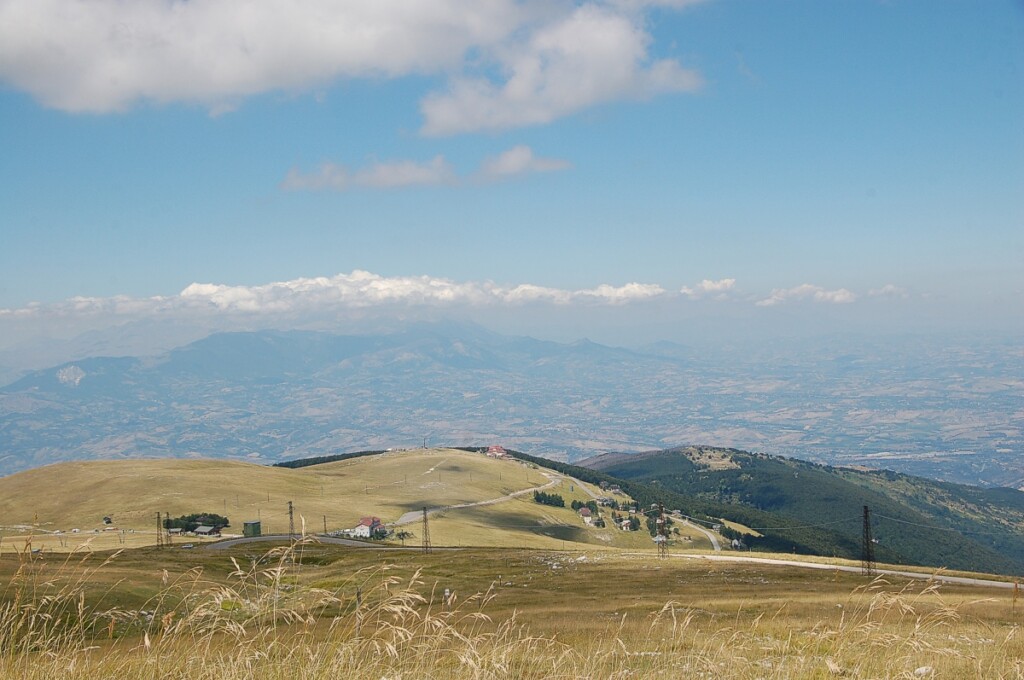
You arrive at the trailhead below Sant’Onofrio with a backpack containing an electrolyte mix, a mindfulness app downloaded for offline use, and a paperback about Celtic monasticism you will not finish. You have driven three hours to feel something you cannot name to your colleagues on Monday. The cave where Celestino starved himself into ecstasy is now marked with a small plaque and a suggested donation box, and you will stand there for exactly four minutes, take two photographs, and feel a vague disappointment that the silence is not silent, because somewhere below a group of hikers is arguing about lunch.
This disappointment is instructive. What the contemporary visitor wants from the Majella is not the God that the hermits fled toward but the absence that God’s disappearance left behind, dressed up in the vocabulary of wellness. Max Weber called this disenchantment, die Entzauberung der Welt, in his 1917 lecture Science as a Vocation, and he meant something quite specific: the world stops being a place where meaning is given and becomes a place where meaning must be manufactured, privately, exhaustingly, by each subject alone. The hermits of the thirteenth century climbed the mountain because meaning was oppressively present, arranged by a Church whose authority they found suffocating in its worldliness. The visitor of the twenty-first century climbs the same slopes because meaning has receded so far that even a plaque and a donation box start to feel like sufficient contact with the sacred.
Byung-Chul Han, in Müdigkeitsgesellschaft, describes contemporary subjects as trapped not by external repression but by self-exploitation, the internalized demand for optimization that never rests because there is no external tyrant to blame or resist. Solitude in this framework becomes another achievement to log, another form of self-improvement indistinguishable from the productivity it claims to escape. The retreat, the digital detox, the guided silence weekend priced at four hundred euros, all of it reproduces the very logic of performance it advertises itself as curing. The hermit’s solitude was involuntary in its severity and directed outward, toward a God who watched; the tourist’s solitude is voluntary, temporary, and directed inward, toward a self that must return home improved.
Yet something genuine survives this contradiction, which is worth not dismissing too quickly. Robert Pogue Harrison, in Forests: The Shadow of Civilization, published in 1992, argues that forests and wild mountains have always functioned in the Western imagination as the outside of law, the place where civilization’s categories stop applying and something older reasserts itself. The Majella still performs this function even for visitors who could not tell you who Celestino was. The body walking uphill for six hours does not know it is supposed to be disenchanted. Legs ache the same way they ached in 1240. Cold water from the same springs shocks the same nervous system. Whatever narrative the mind carries into the mountain, the mountain does not receive it, and this indifference is itself a kind of contact with something not manufactured by the visitor.
Martin Heidegger, in his essays on dwelling written after his own retreat to the hut at Todtnauberg, distinguished between building and dwelling, arguing that modern humans have building without the deeper belonging that dwelling requires. The pilgrim taking a selfie at Celestino’s cave is building an experience, curating it for later consumption, and this is not a moral failure so much as the only mode available to a subject formed by an economy of images. But the mountain itself does not distinguish between the hermit who dwelled and the tourist who merely builds. It offers the same rock, the same wind funneling through the same gorges, the same terrifying scale that makes a human being briefly, involuntarily, correctly small. What the contemporary seeker finds on the Majella is not the meaning the hermits found, because that meaning required a cosmology no longer available to us intact. What remains is the shape meaning used to take, walked again by people who no longer believe in it, in bodies that have not yet been told.
A vision curated by a filmmaker, not an algorithm
In this video I explain our vision
🏔️ Sacred Peaks and Wild Spirits
The Majella massif has long been revered as a threshold between the earthly and the divine, a place where hermits sought solitude and nature reveals its most contemplative face. These related articles explore the deeper currents of spirituality, myth and the sublime that resonate with the mountain’s timeless character.
The Aesthetics of the Sublime: When Beauty Is Frightening
The Majella’s rugged peaks and hidden hermitages evoke the very essence of the sublime, that trembling encounter between human smallness and overwhelming natural grandeur. This article traces how philosophers and artists have understood beauty tinged with awe and even fear, a concept perfectly embodied by the massif’s dramatic cliffs and silent valleys. Understanding this aesthetic category helps illuminate why the Majella has attracted mystics and wanderers for centuries.
GO TO THE SELECTION: The Aesthetics of the Sublime: When Beauty Is Frightening
Medieval Mysticism: History and Main Figures
The Majella has historically been called the ‘Mountain of the Hermits,’ hosting anchorites and mystics who sought God in its caves and forests. This piece surveys the great tradition of medieval mysticism, offering context for understanding the spiritual practices that once flourished in the massif’s remote sanctuaries. It illuminates the enduring human need to retreat into wild nature as a path toward transcendence.
GO TO THE SELECTION: Medieval Mysticism: History and Main Figures
Phenomenology of Nature: Husserl and Merleau-Ponty
Merleau-Ponty and Husserl’s phenomenological approach to nature offers a philosophical lens for experiencing landscapes like the Majella not merely as scenery but as lived, embodied presence. This article explores how perception and consciousness intertwine with the natural world, a theme deeply relevant to the massif’s tradition of contemplative wandering. It provides a rich theoretical companion to any spiritual encounter with mountain wilderness.
GO TO THE SELECTION: Phenomenology of Nature: Husserl and Merleau-Ponty
Philosophy of Nature: From Aristotle to Today
From Aristotle onward, philosophy has grappled with how to understand nature’s order, purpose and mystery, questions that feel especially alive amid the Majella’s ancient forests and stone hermitages. This article traces that long intellectual lineage, offering valuable context for the spiritual and ecological reverence the massif continues to inspire today. It bridges ancient thought with the contemporary search for meaning in wild places.
GO TO THE SELECTION: Philosophy of Nature: From Aristotle to Today
🎬 Continue the Journey on Indiecinema
If the Majella’s blend of nature, history and spirituality has stirred your curiosity, let independent cinema carry you further into stories of contemplation, wilderness and inner transformation. Discover a curated selection of thought-provoking films streaming now on Indiecinema.
👉 EXPLORE THE CATALOG: Watch Indie Films in Streaming
A vision curated by a filmmaker, not an algorithm
In this video I explain our vision

