
The Iron Cage You Already Live In
You are standing in a government office. Not because you want to be, but because the website said you had to come in person, and the person on the phone said the website was wrong, and the email you sent three weeks ago received an automated reply explaining that your query had been forwarded to the relevant department. The relevant department, it turns out, is this room. Fluorescent light. Chairs bolted to the floor in rows that face nothing in particular. A ticket in your hand printed with the number forty-seven, and a display on the wall showing thirty-one. You do not know what happened to the people who held numbers thirty-two through forty-six. No one will tell you, because no one knows, because knowing is not part of the procedure.

At some point you stop being angry and start being something worse: resigned. You begin to understand, without being able to articulate it, that the frustration you feel is not the result of incompetence or malice. There is no villain here. The woman behind the counter is following protocol. The protocol was written by a committee following guidelines. The guidelines were issued by a ministry interpreting a regulation. The regulation exists to ensure fairness, consistency, and accountability. Everything is as it should be. And yet something — some quality of being alive, of being a specific person with a specific problem on a specific afternoon — has been perfectly, efficiently, systematically excluded from the process.
Max Weber saw this coming. Not as prophecy, not as critique from the outside, but as diagnosis from within, the way a doctor names a disease they can already feel spreading through their own tissue. Writing in the opening years of the twentieth century, Weber looked at the institutions his society was building — the state bureaucracies, the legal systems, the industrial corporations, the scientific disciplines — and recognized them as expressions of a single underlying logic he called rationalization: the progressive replacement of tradition, intuition, and personal authority with calculable rules, measurable outcomes, and impersonal procedures. This was not, for Weber, simply an organizational trend. It was a transformation in the deep structure of how human beings relate to their world.
The concept that crystallized this insight — the one that has outlived every attempt to domesticate it into a management textbook — is the stahlhartes Gehäuse, translated into English as the iron cage, though the literal German carries something closer to a shell of hardened steel, a housing, a casing that has grown around you and which you now mistake for the shape of reality itself. The phrase appears at the end of The Protestant Ethic and the Spirit of Capitalism, published in 1905, in a passage of almost unbearable lucidity. Weber had spent the entire work tracing the historical arc by which Protestant theology — particularly the Calvinist doctrine of predestination — had inadvertently generated the psychological infrastructure of capitalist discipline: the compulsion to work, to save, to defer gratification, to treat worldly success as a sign of divine favor. But once that infrastructure was in place, once the material civilization it produced had taken on its own momentum, the theological scaffolding could be removed. The spirit evaporated. The cage remained.
What stayed was the rationalized form: the ledger, the schedule, the procedure, the hierarchy, the file. Weber called it specialists without spirit, sensualists without heart — a civilization of high technical competence and deep human vacancy. Not tyranny, which would at least imply a tyrant. Something more impersonal than that, and therefore more difficult to resist. You cannot argue with a procedure. You cannot shame a system. You can only take your ticket, find your chair, and wait for your number to appear on the wall.
Slow Life
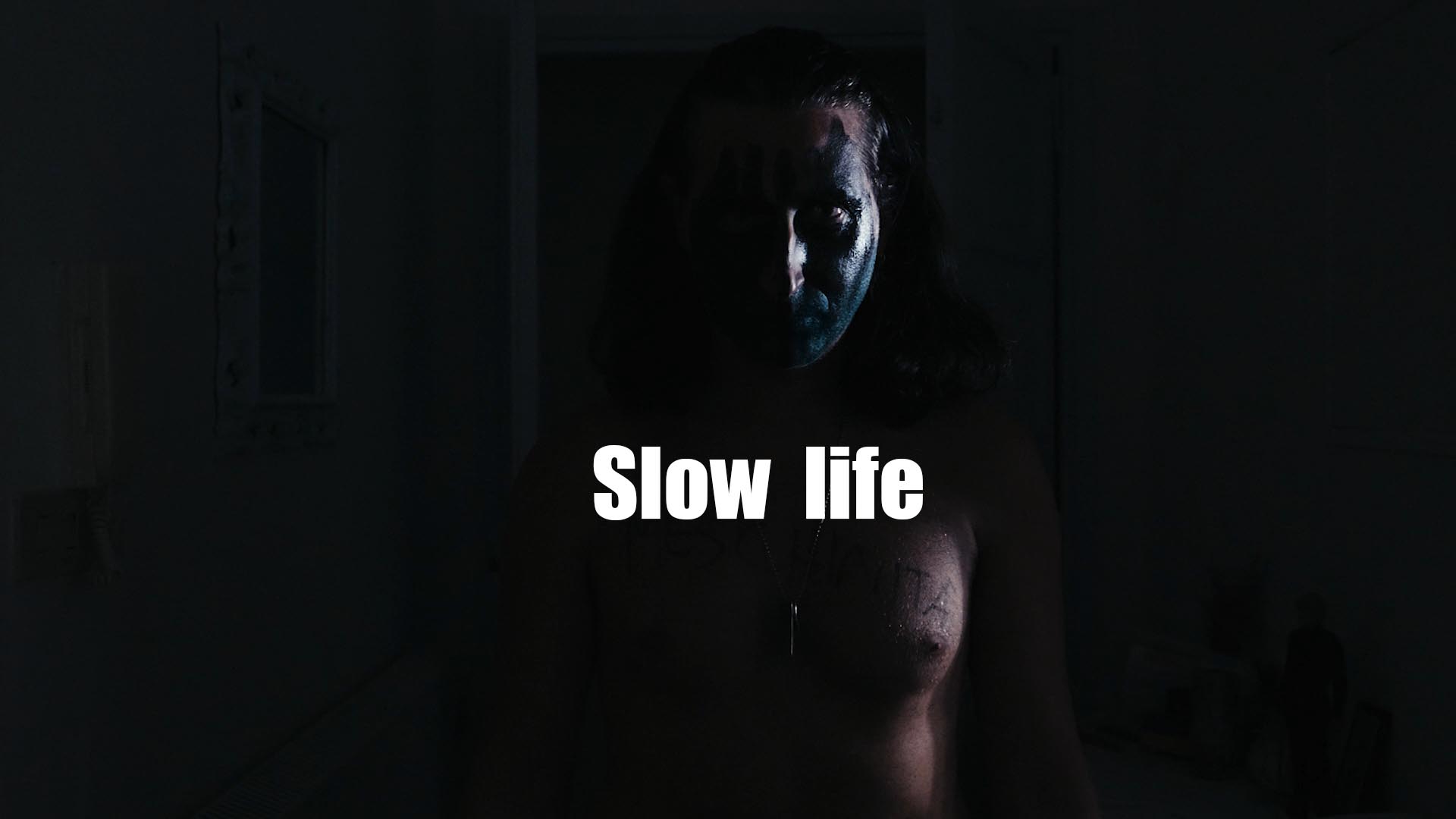
Drama, comedy, thriller, by Fabio Del Greco, Italy, 2021.
Lino Stella takes a period of vacation from his alienating job to devote himself to relaxation and his passion: drawing comics. But he did not foresee certain disturbing elements: the intrusive administrator of the building where he lives, the postman who delivers crazy fines and tax bills, an overbearing security guard, a very enterprising real estate agent, the old lady downstairs who raises the feline colony of the condominium. These characters will make his vacation hell.
Food for thought
The larger a social group is, the more rules and bureaucracy are needed, which often do not respect the individual. You have to learn to live with annoying people, but sometimes the social pressure and arrogance can become intolerable. The only laws that always come to our aid are the laws of Nature.
LANGUAGE: Italian
SUBTITLES: English, Spanish, French, German, Portuguese
Born Into a Germany That Was Making Itself Up
The year is 1864, and Germany does not yet exist. There is a Prussia, a Bavaria, a tangle of principalities still negotiating what they will become, and somewhere in that unfinished cartography a child is born in Erfurt, in Thuringia, into a household that mirrors, almost too perfectly, the contradictions the coming nation will spend a century failing to resolve.
Maximilian Weber — he will eventually shed the Roman numeral that distinguished him from his father — grows up in a Berlin house where two incompatible moral grammars are spoken simultaneously, under the same roof, at the same dinner table, sometimes in the same sentence. His father, Max Weber Senior, is a municipal politician, a man of the National Liberal Party, comfortable with compromise, fluent in the language of practical necessity, capable of bending principle when the situation requires it and sleeping well afterward. He is not corrupt. He is simply a man who has made his peace with the world as it is. His mother, Helene Fallenstein Weber, is something else entirely — a woman shaped by a Calvinist tradition that regards this world with profound suspicion, for whom every act carries moral weight, for whom comfort itself can be a form of moral failure.
Between these two people, the boy becomes a thinking instrument tuned to detect exactly that frequency of tension: the place where power justifies itself and conscience refuses to be satisfied.
It is not a metaphor when scholars describe Weber’s intellectual project as a working-through of his parents’ irreconcilable worldviews. It is almost biographically literal. The sociologist Joachim Radkau, whose 2005 biography of Weber remains the most psychologically penetrating account of his life, documents how the household dynamic left visible traces in Weber’s adult obsessions — his lifelong fascination with the relationship between ethical conviction and political responsibility, between the man who acts from principle and the man who acts from calculation, and whether either of them can be right. His father embodied what Weber would later call the ethic of responsibility. His mother embodied the ethic of conviction. He never resolved which was superior. That unresolvability became his method.
Germany itself, in those formation years, was performing a version of the same split. Bismarck was unifying the nation through what he famously called Blut und Eisen — blood and iron — a phrase that announced from the beginning that this new state would be built on force legitimized after the fact as order. By the time Weber is old enough to read newspapers, the Reich is six years old, still smelling of gunpowder from the Franco-Prussian War, already developing the bureaucratic skeleton that would define — and for Weber, deeply trouble — modern political life. The Germany into which Weber is born is not ancient. It is being manufactured in real time, and it shows.
To grow up inside that manufacturing process, inside a family that concentrated its central contradictions into domestic form, is to be educated in ambiguity before you know the word for it. Weber would later write, in a passage from his political writings that still carries the force of a wound, that the mature human being lives in the tension between these two ethics without being able to escape either. He was not theorizing. He was describing the view from his childhood bedroom.
That bedroom was not poor. The Weber family moved in educated, bourgeois circles, and Max Junior was reading Machiavelli and Spinoza by his mid-teens, letters to relatives that survive from that period revealing a mind already accustomed to treating ideas as serious instruments rather than decorative furniture. The comfort of the household made his mother’s moral severity more pointed, not less — because renunciation means nothing without something to renounce.

The Breakdown That Became a Method
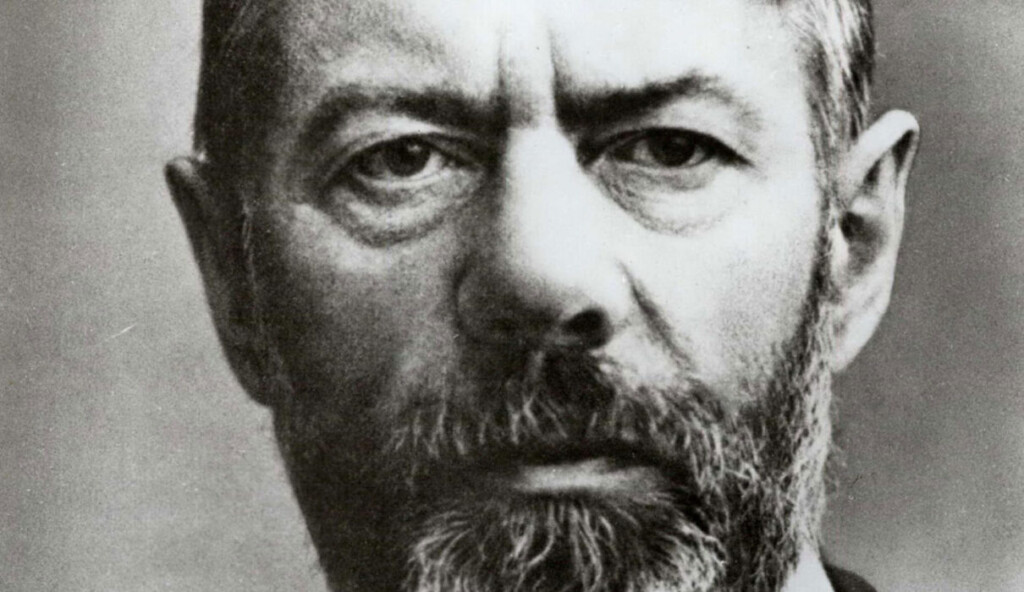
He stopped being able to read. Not metaphorically — he literally could not hold a page open long enough for the words to arrange themselves into meaning. Letters would arrive from colleagues, from students, from editors waiting on manuscripts, and they would sit unopened on the desk for weeks. In 1897, Max Weber was thirty-three years old, at the height of what should have been early productivity, and something inside him simply ceased to function in the way it had before.
The confrontation with his father that summer was not extraordinary by the standards of bourgeois German families. An argument, an ultimatum, a door closed harder than necessary. His mother had come to visit and Weber took her side against a man he had long recognized as a domestic tyrant — a man who consumed his wife’s inner life the way institutions consume individuals, through the slow withdrawal of any space that belongs to the self alone. His father left the house in anger. Weeks later, he was dead. There was no reconciliation, no last word that could be revised or taken back. There was only the permanent silence that follows events that cannot be undone.
What followed was five years of what Weber himself described as a nervous condition that made sustained intellectual work impossible. He resigned his professorship at Heidelberg. He traveled — to Italy, to Switzerland — not in search of inspiration but in search of the capacity to function at a basic level. His wife Marianne, whose own intellectual seriousness has too often been relegated to footnote status, became both his caretaker and, quietly, the architectural force that kept their household from collapsing entirely. Weber slept erratically, could not lecture, could not write with any consistency, could not do the thing that had defined him since adolescence: think systematically about large problems.
But something else was happening inside that incapacity, something that would not become visible until later. What the collapse seems to have forced open — violently, without permission — was the gap between reason and the person who reasons. Before the breakdown, Weber had operated with the implicit assumption, shared by most of the German academic world he inhabited, that rigorous thinking was a form of mastery, that intellectual method could hold experience at a regulated distance. After it, he knew differently, from the inside, in a way that no reading could have taught him. Reason does not protect you. It does not even necessarily accompany you. You can construct an iron cage around yourself and still find that the occupant has vanished.
This is precisely what becomes the central nerve of his mature sociology. The concept of rationalization — the process by which modern societies organize themselves through calculation, procedure, and formal efficiency — is not, in Weber, a triumphant narrative. It is a description of a loss so thorough it can barely be named as loss anymore, because the vocabulary for naming it has itself been rationalized away. When he writes in “The Protestant Ethic and the Spirit of Capitalism,” published in 1904 and 1905 just as he was beginning to recover some capacity for work, about the iron cage of modernity, he is not writing from the outside of that cage. He had lived inside it, had felt its bars not as metaphor but as the actual architecture of a particular kind of suffering.
What the breakdown gave him, at enormous personal cost, was the knowledge that modernity splits the subject it produces. It creates individuals who are formally free and substantively hollowed, equipped with rationality as a tool and deprived of the meaning that might have told them what to use it for. He did not arrive at this insight through argument. He arrived at it through five years of not being able to read.
The Protestant Ethic and the Guilt That Built Capitalism
You wake before your alarm. Not from excitement — from a low, sourceless dread that something essential remains undone, that rest itself is a kind of moral failure. You check your phone before your feet touch the floor. You measure your day in outputs. You feel, without being able to explain it, that you must justify your existence through productivity, and that leisure is at best a reward you have not yet fully earned. You have never read a word of Calvinist theology. You do not believe in predestination. And yet something in that sixteenth-century terror has been running through your nervous system since childhood.
This is precisely what Weber diagnosed in 1905, when he published The Protestant Ethic and the Spirit of Capitalism as a two-part essay in the Archiv für Sozialwissenschaft und Sozialpolitik. The argument is often misread as a claim that Protestantism caused capitalism, which is too blunt to be accurate. What Weber actually traced was something more surgical and more unsettling: a specific psychological structure, born from a specific theological anxiety, that produced behavioral patterns so useful to capital accumulation that capitalism eventually absorbed them wholesale — and then discarded the theology while keeping the guilt.
The anxiety in question had a name in Calvinist doctrine: the uncertainty of election. Calvin had taught that God’s grace was unconditional and predetermined — you were saved or damned before birth, and nothing you did could alter that. This was meant to be liberating, a purification of faith from the transactional logic of Catholic indulgences. Instead it produced what Weber described as an unprecedented inner loneliness, an isolation so complete that not even the church, not even the sacraments, not even the pastor could stand between the soul and its unknowable fate. The question that haunted Calvinist believers was not how to be saved but how to know whether they already were.
The answer that emerged — not from doctrine but from pastoral practice and lived religious anxiety — was behavioral. You could not purchase salvation. You could not pray your way into certainty. But you could look for signs. And the most legible sign available was worldly success achieved through disciplined, methodical, unceasing labor. Not wealth enjoyed, not pleasure taken — that would signal exactly the wrong kind of attachment to the world. But wealth produced through ascetic self-denial and reinvested into further productive activity: that looked like the conduct of someone God might have chosen. It felt like evidence. It never was evidence, which is why it could never stop.
Weber called this structure the spirit of capitalism long before capitalism in its industrial form had fully arrived to fill it. Benjamin Franklin, whom Weber quotes extensively, articulated it as secular common sense by the mid-eighteenth century: time is money, credit is virtue, idleness is sin. The theological scaffolding had already become invisible. What remained was the compulsion — rationalized, moralized, institutionalized — stripped of any eschatological horizon and therefore impossible to satisfy on any terms the original anxiety would have recognized.
What makes Weber’s analysis so difficult to dismiss is that he was not arguing from the outside. He understood, as someone who suffered from a nervous collapse so severe it incapacitated him between 1897 and roughly 1903, what it meant to be a person whose sense of moral worth was inseparable from productive output. When he could not work, he could not exist in any register that felt legitimate. The Protestant ethic was not an abstraction he had studied. It was a condition he inhabited, and its logic — that rest is failure, that the self must perpetually justify itself through measurable achievement — left marks that no amount of intellectual distance could fully dissolve.
The genius of the essay is also its cruelty: it shows you a cage and then points out that you built it yourself, with materials handed to you by people who have been dead for four centuries.
Charisma, Domination, and the Men Who Make History Move
There is a man at the front of the room and everyone is leaning forward. You have felt it yourself — that strange gravitational pull toward someone who has not yet said anything worth believing, who has not earned the trust they are already receiving. The room reorganizes itself around them before the first argument lands. This is not persuasion. It is something older and more dangerous, and Weber spent years trying to name it with the precision it deserved.
His typology of legitimate domination — the three forms by which power becomes something people accept rather than merely endure — was not built as a museum exhibit of historical curiosities. It was an attempt to explain why human beings keep surrendering their will, and why they call that surrender freedom. Traditional domination works through the sanctity of what has always been: the king rules because kings have always ruled, because the ancestors said so, because to question the arrangement is to question the ground beneath your feet. Legal-rational domination — the form Weber saw crystallizing around him in the bureaucratic states of early twentieth-century Europe — works through impersonal rules, through the logic of the office rather than the person who holds it. You obey the law, not the man. You obey the procedure, not the will behind it. This is the iron cage made legitimate, the administered world wearing the face of reason.
And then there is charisma. Weber defined it in Economy and Society, his unfinished masterwork assembled after his death in 1920, as a quality of an individual personality by virtue of which he is set apart from ordinary people and treated as endowed with supernatural, superhuman, or at least specifically exceptional powers. The definition sounds clinical until you realize it describes something that bypasses every rational checkpoint you think you have. The charismatic leader does not ask you to verify his credentials. He asks you to feel that he is necessary. And you do. History keeps demonstrating that this works.
What makes Weber’s analysis so unsettling is that he refuses to moralize about it. He does not tell you that charismatic authority is bad or that rational-legal authority is better. He shows you the mechanics. He notes that charismatic movements are inherently unstable — they cannot be routinized without destroying what made them compelling — and that the moment the leader dies or fails, his followers face the brutal problem of succession: how do you transfer a quality that was, by definition, personal and irreducible? The answer is always that you institutionalize it, which is to say you kill it and replace it with one of the other two forms. The revolution becomes the church. The prophet becomes the bureaucracy.
This is not a cycle Weber mourned in a simple way. He understood that the charismatic rupture was the only force capable of breaking open historical structures that had calcified beyond reform. In a world governed entirely by legal-rational logic — by the specialist without spirit and the sensualist without heart, as he wrote in the devastating final pages of The Protestant Ethic — the charismatic figure arrives as the one genuine disruption. He does not emerge from the system. He appears to stand outside it, which is precisely why people follow him into places they would never have gone by choice.
The terror is not that charisma is irrational. The terror is that it is historically productive. The men who have broken the world open and remade it in their image — Weber was writing in the shadow of several of them and could not yet see the worst still coming — did not arrive with a warning. They arrived leaning forward at the front of a room, and the room reorganized itself before anyone had time to ask what was actually being offered in exchange.
A vision curated by a filmmaker, not an algorithm
In this video I explain our vision
Science as a Vocation, or the God You Cannot Pray To

The lecture hall in Munich, November 1917. A war bleeding out across Europe, a generation of young Germans arriving to hear a famous sociologist speak about the meaning of academic life. They expected, perhaps, some reassurance. A framework. A reason to keep thinking when everything around them was collapsing into mud and ideology. What Weber gave them instead was one of the most merciless intellectual performances of the twentieth century.
Wissenschaft als Beruf — Science as a Vocation — is not a lecture about science. It is a lecture about what science cannot do, and why that fact is unbearable, and why you must live with it anyway. Weber opens by describing the material conditions of academic existence with forensic precision: the underpaid privatdozent waiting for a position that may never come, the institutional lottery of university appointments, the gap between intellectual calling and professional survival. He is talking about vocation, Beruf, which in German carries simultaneously the meanings of profession, calling, and destiny — the same word Luther used when he argued that secular work could be sacred. Weber strips that sacredness away systematically, without apology, without offering anything to replace it.
The central wound of the lecture is what Weber had been calling, since at least the early 1900s, the disenchantment of the world — Entzauberung. He borrowed the term from Friedrich Schiller, but the argument is entirely his own: modernity has expelled magic not merely from religion but from cognition itself. Where once a dying peasant could feel that life had a complete meaning, that the arc of existence was legible within a divine order, modern science offers instead an infinite regress of problems, each solution generating new questions, no terminus in sight. As Weber puts it with characteristic bluntness, science cannot answer the only question that matters: what should we do and how should we live? That question, he insists, falls entirely outside its competence.
This was not, in 1917, an obvious thing to say. The positivist confidence of the nineteenth century had barely cooled. The dream that empirical method could eventually adjudicate values, that sociology or biology or economics might one day tell us how to organize human life — that dream was still alive and lucrative. Weber killed it in a single lecture, and what made the killing so precise was that he himself believed in science completely. He was not a mystic retreating from rationality. He was rationality’s most rigorous practitioner announcing that rationality has a ceiling.
The polytheism of values is what he set in place of any unified ethical system. Without a god capable of arbitrating between them, the ultimate commitments by which human beings orient their lives — beauty, justice, love, power, truth — are in permanent conflict with one another, and no argument can resolve that conflict. You choose. The choice is not supported by reason; reason can only clarify what you are choosing and what it will cost. This is what Wilhelm Hennis, one of the most careful Weber readers of the last century, identified as the central question underlying all of Weber’s work: the conditions under which meaningful human existence remains possible within modern civilization. The 1917 lecture is where that question gets its most naked formulation.
What made the audience uncomfortable — what still makes readers uncomfortable — is that Weber offers no exit. He explicitly attacks those professors who smuggle values into their lectures under the cover of scientific authority, who confuse their own convictions with their scholarly conclusions. He calls this an intellectual swindle, or something very close to it. The lecture room is not a church, he says. If you need prophecy, go elsewhere. But his voice carries something close to grief when he says it, because he knows that the elsewhere he is pointing to is not somewhere he can follow.
Politics, Vocation, and the Ethics of Dirty Hands
There is a moment in that lecture hall in Munich, January 1919, when a man who has watched an empire collapse in real time stands before an audience of students hungry for revolution and tells them something they do not want to hear. The war is over. The Kaiser has abdicated. The streets are loud with the vocabulary of transformation. And Weber begins, methodically, to describe what power actually is, how it functions, what it costs the person who touches it.
Politik als Beruf, delivered that winter as Germany was still deciding what shape it would take, is not a tract for or against any political position. It is something rarer and more uncomfortable: an anatomy of the political vocation itself, conducted without anesthesia. Weber had already given its companion lecture on science the previous year. Together they form a diptych about what it means to dedicate a life to something that will never fully redeem you.
The central distinction he draws has become one of the most argued formulations in twentieth-century political thought. The ethic of conviction, Gesinnungsethik, belongs to the person who acts from principle, who measures the rightness of an action by the purity of the intention behind it, who refuses to compromise even when compromise might prevent greater harm. The ethic of responsibility, Verantwortungsethik, belongs to the one who accepts accountability for consequences, who understands that every action releases a chain of effects that no one controls, and who therefore calculates, negotiates, and sometimes does what is ugly in order to prevent what is worse.
Weber does not crown one over the other. That is the point most readers miss, then and now. He is not arguing that the responsible politician is right and the person of conviction is naive. He is describing a genuine tension that cannot be resolved by choosing a side. The conviction moralist who refuses to dirty their hands may, in refusing, produce outcomes far worse than anything the responsible actor would have chosen. But the responsible actor, following the logic of consequences far enough, can justify almost anything, including the systematic suspension of everything they claimed to be protecting.
Isaiah Berlin, writing decades later in his essays on political judgment, circled the same wound from a different angle. The conflict between values is real, he insisted, not a problem awaiting a technical solution. Weber had arrived there first and put it more brutally: the person who enters politics with genuinely clean hands will not stay clean, and if they somehow do, it means they have not actually governed anything. The state, Weber had already argued in his definitions, is the entity that holds the monopoly on legitimate violence. Everything that flows from that monopoly eventually lands on a human decision.
There is a scene that belongs to this understanding perfectly: a man in a position of authority signs an order he knows will cause harm to specific people in order to prevent a larger catastrophe. He is not wrong in any simple sense. He is not right in any simple sense. He lives afterward with both the outcome and the act. Weber would have recognized that figure immediately, not as a tragic hero but as a professional, someone who chose the vocation and therefore chose the weight that comes with it.
What Weber refuses to offer is the comfort of synthesis. He will not tell his Munich audience that a mature statesman somehow reconciles conviction and responsibility into a higher wisdom. He says, instead, that the person with a genuine political vocation holds both in tension simultaneously, acts nonetheless, and does not outsource the moral reckoning to history or to God or to the party. The wound stays open. That is not a failure of his analysis.
Economy and Society and the Unfinished Architecture
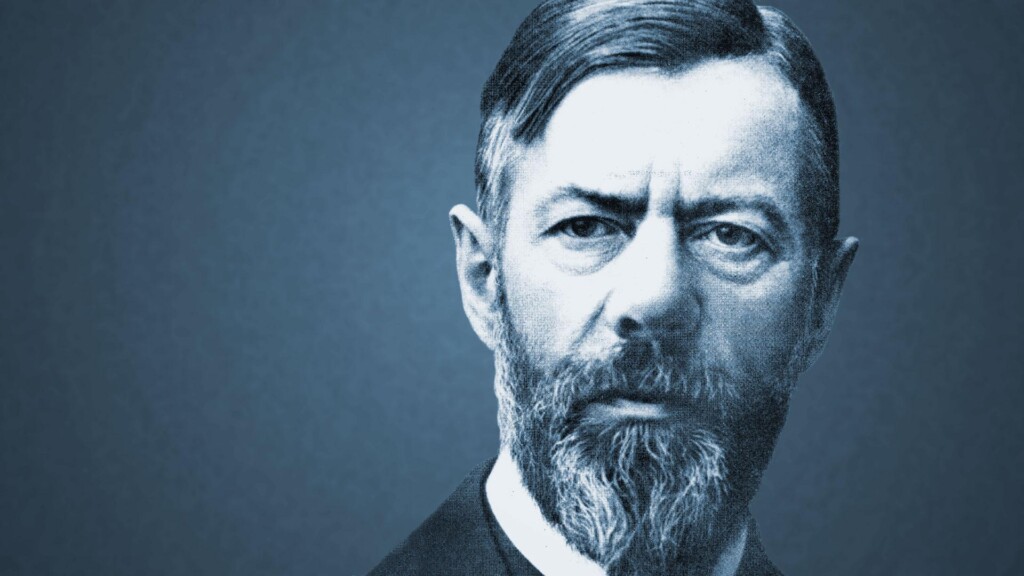
He died in Munich on the ninth of June, 1920, of pneumonia, in the middle of a sentence he would never finish. Not metaphorically — literally. The manuscript that would become Wirtschaft und Gesellschaft, known in English as Economy and Society, was scattered across his desk in fragments, chapters in various states of completion, taxonomies begun and not closed, typologies elaborated and then abandoned mid-argument. His wife Marianne and the sociologist Johannes Winckelmann would spend years assembling these pieces into something resembling a book, and the result, published in 1922, is one of the strangest monuments in the history of social thought: a cathedral built from rubble, magnificent precisely because you can see where the walls were never joined.
The irony is not incidental. Weber had spent his entire intellectual life constructing what he called ideal types — analytical categories that were, by his own definition, deliberate abstractions, never fully real, always approximations of a historical reality that exceeded them. He knew, with the clarity of someone who had read Kant carefully and disagreed with him productively, that the concepts we use to organize the world are scaffolding, not the building. In Economy and Society he attempted something almost hubristic: to map the entire architecture of social organization, from the most elementary forms of legitimate domination to the inner logic of law, religion, bureaucracy, and the market. He wanted to show how these domains were structurally related, how power operated through categories, how meaning became institution and institution became fate. And then he ran out of time.
What remained was not a failure. It was, in its incompletion, something more honest than most finished books. The three pure types of legitimate authority — traditional, charismatic, and rational-legal — appear in Economy and Society with a precision that has outlasted entire schools of thought. His analysis of bureaucracy as a form of domination rationalized through procedure and hierarchy anticipated everything from Hannah Arendt‘s work on the banality of institutional evil to Michel Foucault‘s later investigations into how power reproduces itself through the mundane machinery of administration. The categories held. But they held provisionally, which was exactly Weber’s point: a category that claims permanence has already become ideology.
There is something particular about reading a posthumous masterwork, the awareness that the organizing intelligence behind it was extinguished before the architecture was sealed. You read Economy and Society the way you might walk through a building where some rooms are finished and others are open to the sky — and you begin to suspect that the openness is not a defect but a condition of the whole project. Weber was not writing a system in the sense that Hegel wrote a system, as a closed totality that could account for its own completeness. He was writing an apparatus for interrogating historical reality, and historical reality, by its nature, does not close.
He had watched, in his own lifetime, the collapse of the Wilhelmine order, the catastrophe of the Great War, the failed revolution, the brittle birth of the Weimar Republic. He understood that rupture was not an exception to history but its recurring grammar. The categories in Economy and Society were designed to survive rupture, to be portable across historical transitions precisely because they did not claim to be more than heuristic tools. That he did not live to refine or complete them means only that the refinement was left to the rest of us — and that the incompletion itself stands as a kind of methodological argument, a final demonstration that the most rigorous intellectual honesty ends not with a system but with an open question carried as far as a single life permits.
🏛️ Society, Power, and the Modern World
Max Weber’s thought did not emerge in a vacuum: it was shaped by a dense web of intellectual encounters, sociological debates, and philosophical tensions. These related articles explore the thinkers and ideas that surround Weber’s legacy, from the sociology of community to the critique of industrial modernity.
Georg Simmel: Life and Sociological Thought
Georg Simmel was one of Weber’s closest intellectual contemporaries, sharing a deep concern for the fate of the individual within modern urban society. His sociological method, focused on forms of interaction rather than grand historical structures, offers a fascinating counterpoint to Weber’s rationalization thesis. Together, their works define the founding tensions of German classical sociology.
GO TO THE SELECTION: Georg Simmel: Life and Sociological Thought
Karl Marx and Alienation: Economic and Philosophical Manuscripts
Karl Marx’s concept of alienation stands as one of the central reference points against which Weber developed his own diagnosis of modernity. While Marx located the root of estrangement in capitalist production relations, Weber extended the analysis to encompass bureaucratic rationalization and the disenchantment of the world. Reading both thinkers side by side reveals the full depth of the modern condition.
GO TO THE SELECTION: Karl Marx and Alienation: Economic and Philosophical Manuscripts
Ferdinand Tönnies: Life and Works
Ferdinand Tönnies developed the foundational distinction between Gemeinschaft and Gesellschaft, a conceptual pair that profoundly influenced Weber’s understanding of social solidarity and modern institutions. His life and work illuminate the broader German sociological tradition from which Weber’s thought grew. Exploring Tönnies is essential for grasping the intellectual climate that shaped Weber’s project.
GO TO THE SELECTION: Ferdinand Tönnies: Life and Works
Spengler’s The Decline of the West: Analysis
Oswald Spengler‘s The Decline of the West offers a sweeping morphological vision of civilization that provocatively echoes and contests Weber’s analysis of Western rationalization. Where Weber saw bureaucratic iron cages as the destiny of modernity, Spengler prophesied cultural death and cyclical collapse. Their differing responses to the same historical crisis illuminate the great anxieties of early twentieth-century thought.
GO TO THE SELECTION: Spengler’s The Decline of the West: Analysis
Discover the Films That Think
If these ideas about society, power, and modernity have stirred something in you, Indiecinema streaming is where thought meets moving image. Explore independent and auteur cinema that dares to ask the same questions Weber never stopped asking — about freedom, meaning, and the world we have built.
👉 EXPLORE THE CATALOG: Watch Indie Films in Streaming
A vision curated by a filmmaker, not an algorithm
In this video I explain our vision

