
Welcome to the margins, where laughter is a subversive act. Black comedy is not simply a sub-genre of comedy; it is a distorting lens aimed at our deepest anxieties, a scalpel that cuts through the fabric of social conventions to expose their absurdity. There are the great classics that have used the macabre to shock and entertain, but it is in auteur cinema that this expression finds its most fertile ground, a refuge for the voices that dare to find humor in the tragic and the grotesque.

In narrative, the term black comedy can also describe a category in which dark humor is a fundamental component. The term “black humor” (from the French humour noir) was coined by the surrealist theorist André Breton in 1935 while analyzing the works of Jonathan Swift. Breton’s choice was to designate many of Swift’s works as a subgenre of comedy and satire in which laughter develops from cynicism and uncertainty, usually about topics like death.
Breton created the term for his 1940 Anthology of Black Humor, in which he credited Jonathan Swift as the pioneer of black humor. In his publication, Breton also included excerpts from 45 other writers. In some situations, the victim’s suffering is trivialized, which leads to sympathizing with the tormentor, as is similarly found in the writings of Sade. This guide is a path that unites the most famous films with the most subversive independent cinema, works that use cynicism as an art form.
History of Black Comedy

Among the early American authors who used black comedy in their works were Nathanael West and Vladimir Nabokov. At the time, the category was not well known in the United States. The concept of black humor was initially popularized with the 1965 magazine titled Black Humor. The paperback was only one of the earliest American collections committed to the concept of black humor as a literary genre. Author Friedman has identified a selection of writers as “black humorists”, such as JP Donleavy, Edward Albee, Joseph Heller, Thomas Pynchon, John Barth, Vladimir Nabokov, Bruce Jay Friedman himself, and even Louis-Ferdinand Céline.
Among the current authors recommended as black humorists by journalists and literary critics are Roald Dahl, Kurt Vonnegut, Warren Zevon, Christopher Durang, Philip Roth, Veikko Huovinen. They have written books, poems, stories, plays and songs in which horrific events have been comically portrayed.
The Psychology of Black Comedy
Sigmund Freud, in his 1927 essay Humor (Der Humor), presents the following theory of black comedy: “Vanity refuses to be distressed by the provocations of truth, to allow itself to be forced to bear it. It cannot being influenced by the wounds of the outside world; it reveals, in fact, that such traumas are nothing more than occasions to procure pleasure. ”
Black comedy has the social impact of strengthening the spirits of the oppressed and also undermines the morale of the oppressors. According to Wylie Sypher, “being able to laugh at evil and error suggests that we have actually overcome them.” Black comedy is a natural human impulse and examples of it can be found in the histories of the classical era.
A 2017 research published in the journal Cognitive Processing concludes that individuals who appreciate black humor “may have higher IQs, reveal lower aggression, and even resist unfavorable feelings better than people who turn up their noses.

Indie Black Comedy: The Independent Dark Comedy to Watch
This is not a simple list, but a curated journey through thirty years of cinema that has used dark humor as a weapon. We will explore films that have turned mortality into farce, mental illness into satire, and cultural collapse into a hilarious gag. Here is a selection of works that perfectly embody the soul of independent black comedy: films that will make you laugh until you cry, and then leave you to reflect on why you were laughing. Prepare for an immersion into cinema that is not afraid of the dark, but rather, shines a light on it and laughs.
After Hours (1985)

Paul Hackett, a quiet office worker, tries to escape the boredom of his life with a date in SoHo. What should be a promising evening quickly turns into a Kafkaesque nightmare, a surreal and paranoid descent into a nocturnal New York populated by eccentric characters and increasingly dangerous situations. Every attempt to return home pushes him deeper into a labyrinth of tragicomic misfortunes.
Martin Scorsese, lending his genius to a lean, independent production, creates the prototype of the “yuppie nightmare movie.” After Hours is a symphony of urban anxiety, where the comedy arises not from jokes, but from the frantic and unstoppable pace of events. The New York of the film is a hostile and incomprehensible organism, a purgatory of deserted bars, threatening punk clubs, and apartments hiding deadly secrets. It is a film that uses black humor to explore the alienation and powerlessness of the modern individual in the face of metropolitan chaos.
Heathers (1988)

Veronica Sawyer is part of the most popular and ruthless clique in her high school, dominated by three girls named Heather. Tired of their cruelty, she forms an alliance with the new, mysterious student J.D. Together, they begin to eliminate the most popular students, disguising the murders as suicides and turning their tormentors into tragic martyrs. What starts as a cynical game soon spirals into out-of-control violence.
Heathers is the poisonous antidote to the optimistic teen cinema of John Hughes that dominated the 1980s. With a razor-sharp script and iconic dialogue, Michael Lehmann’s film demolishes the innocent facade of high school life to reveal a social battlefield governed by a ruthless hierarchy. Using taboo themes like suicide and murder, the film constructs a fierce social satire on popularity, peer pressure, and the superficiality with which the media treats youth tragedies. A box office flop, it became an immortal cult film, whose influence on independent film and TV is incalculable.
A vision curated by a filmmaker, not an algorithm
In this video I explain our vision
Delicatessen (1991)

In a post-apocalyptic France where food is the most precious commodity, the tenants of a dilapidated apartment building have a secret agreement with the butcher who lives on the ground floor. The man, Clapet, lures unsuspecting handymen with the promise of a job, only to slaughter them and sell their meat to the other residents. The arrival of Louison, a kind-hearted former clown, threatens to break this macabre balance, especially when the butcher’s daughter falls in love with him.
Jean-Pierre Jeunet and Marc Caro create a visually stunning universe, a grotesque microcosm where the horror of cannibalism is tempered by surreal and poetic comedy. Delicatessen is not a horror film, but a dark fable about survival, community, and love in a world that has lost hope. The humor stems from the characters’ eccentricities and from sequences choreographed with musical precision, turning desperation into a unique and unforgettable visual spectacle that marked the beginning of a new wave of French cinema.
Slow life
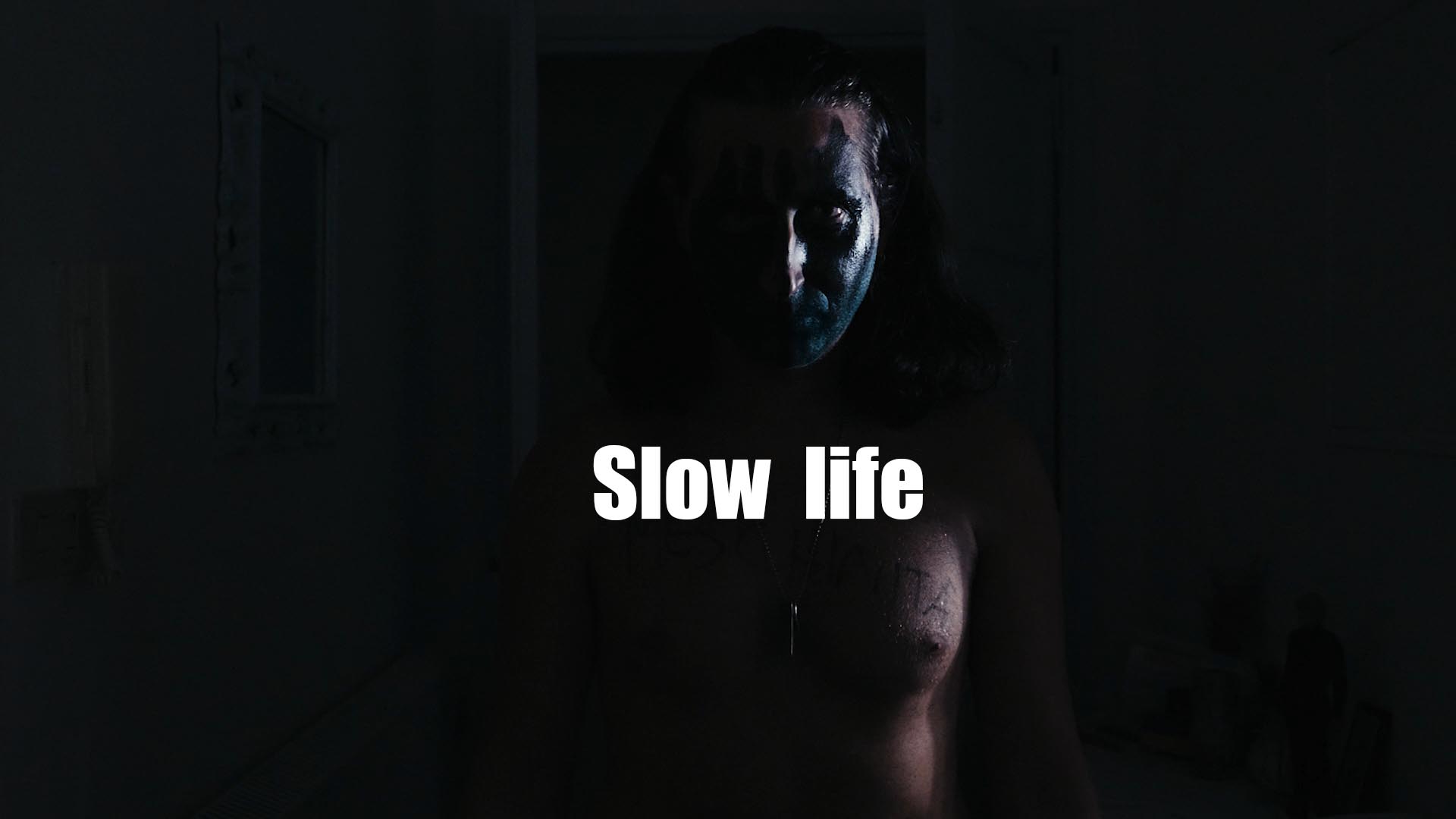
Drama, comedy, thriller, by Fabio Del Greco, Italy, 2021.
Lino Stella takes a period of vacation from his alienating job to devote himself to relaxation and his passion: drawing comics. But he did not foresee certain disturbing elements: the intrusive administrator of the building where he lives, the postman who delivers crazy fines and tax bills, an overbearing security guard, a very enterprising real estate agent, the old lady downstairs who raises the feline colony of the condominium. These characters will make his vacation hell.
Food for thought
The larger a social group is, the more rules and bureaucracy are needed, which often do not respect the individual. You have to learn to live with annoying people, but sometimes the social pressure and arrogance can become intolerable. The only laws that always come to our aid are the laws of Nature.
LANGUAGE: Italian
SUBTITLES: English, Spanish, French, German, Portuguese
Man Bites Dog (1992)

A film crew decides to make a documentary following the daily life of Ben, a charismatic, cultured, and frighteningly loquacious serial killer. As Ben commits his crimes with chilling nonchalance, discoursing on art, architecture, and poetry, the filmmakers transition from passive observers to active accomplices, becoming increasingly entangled in his nihilistic spiral of violence.
This Belgian mockumentary, shot in raw, low-cost black and white, is one of the most brutal and intelligent satires ever made about the media’s fascination with violence. The film forces the viewer to confront their own voyeurism, making them complicit in Ben’s crimes through the impassive eye of the camera. The humor, pitch-black and disturbing, arises from the contrast between the banality of the conversations and the atrocity of the acts committed. Man Bites Dog is a punch to the gut, a radical independent work that analyzes society’s desensitization and the ethical responsibility of storytellers.
Welcome to the Dollhouse (1995)

Dawn Wiener is an awkward, unpopular, and constantly tormented eleven-year-old. At school, she is the target of bullies, while at home, she is the invisible middle child, ignored by parents who dote on her pretty younger sister. In a desperate attempt to find her place in the world, Dawn navigates daily humiliations, unrequited teenage crushes, and revenge plans as clumsy as they are moving.
Todd Solondz directs a masterpiece of cruelty and compassion, a ruthless and painfully honest portrait of the hell of pre-adolescence. A world away from sanitized coming-of-age stories, the film revels in discomfort, finding bitter humor in the alienation and casual brutality of human relationships. The comedy arises not from gags, but from the embarrassment and desperation of its characters. Winner of the Grand Jury Prize at Sundance, Welcome to the Dollhouse established Solondz as one of the most important and provocative authors of American independent cinema.
Very Bad Things (1998)
![Very Bad Things Trailer [1998]](https://blog.indiecinema.co/wp-content/plugins/wp-youtube-lyte/lyteCache.php?origThumbUrl=https%3A%2F%2Fi.ytimg.com%2Fvi%2FjJ9vJiBo5T0%2F0.jpg)
A group of friends goes to Las Vegas for a bachelor party full of excess. The situation escalates when, during an encounter with a stripper, she accidentally dies. In a panic and under the guidance of the sociopathic Robert, the group decides to dispose of the body, triggering a chain of increasingly violent and paranoid events that will test their friendship and their sanity.
Peter Berg’s directorial debut is a nihilistic and unrestrained dive into the fragility of bourgeois morality. Very Bad Things takes the cliché of the “wild night” and pushes it to its extreme and bloodiest consequences. The film’s comedy is hysterical and brutal, fueled by the escalation of panic and the protagonists’ terrible decisions. It is a fierce satire on toxic masculinity and the speed with which the veneer of civilization can be torn away by the instinct for self-preservation, revealing selfishness and primal violence.
Happiness (1998)

The intertwined lives of three sisters and the people around them reveal a universe of loneliness, perversions, and a desperate search for connection. Between a pedophilic family man, a successful but dissatisfied author, and a perpetually disappointed dreamer, the film explores the dark secrets hidden behind the facade of suburban normality. Each character is desperately searching for happiness, but finds it, or fails to, in the most unexpected and controversial ways.
Todd Solondz creates one of the most courageous and disturbing films in American independent cinema. Happiness is a black comedy that is not afraid to confront society’s deepest taboos, treating subjects like pedophilia with an approach that mixes empathy and repulsion. The film’s humor is profoundly uncomfortable, stemming from the disarming honesty of its characters and their awkward conversations. Rejected by major distributors for its content, the film is an emblem of independent cinema as a space of absolute artistic freedom.
Drop Dead Gorgeous (1999)

In the small town of Mount Rose, Minnesota, the annual teen beauty pageant is underway. The competition between the sweet and optimistic Amber Atkins, from a trailer park, and the rich and spoiled Becky Leeman, daughter of the organizer, soon turns into a no-holds-barred fight. Deadly accidents and sabotage begin to decimate the contestants, while a documentary crew films everything.
Shot as a mockumentary, Drop Dead Gorgeous is a scathing and irresistible satire of the American dream and provincial competitiveness. The beauty pageant becomes a metaphor for the ruthless struggle for success, where ambition turns into sociopathy. The film lovingly and ferociously mocks Midwest culture, finding grotesque humor in the discrepancy between the girls’ polished aspirations and the deadly reality of the competition. A timeless cult classic that celebrates the absurdity of the pursuit of perfection.
Ghost World (2001)

Fresh out of high school, best friends Enid and Rebecca, cynical and disillusioned, face the summer with a vague plan to find a job and an apartment. Their friendship is tested when Enid, as a joke, answers a personal ad and ends up forming an unlikely friendship with Seymour, a lonely middle-aged record collector. While Rebecca adapts to adult life, Enid finds herself increasingly alienated, trapped between adolescence and an uncertain future.
Based on Daniel Clowes’ graphic novel of the same name, Ghost World is a melancholic and sharply funny portrait of post-adolescent alienation. Director Terry Zwigoff perfectly captures the deadpan tone and sarcastic humor of the comic, creating a unique atmosphere that blends comedy and sadness. The film is a bittersweet reflection on friendship, the search for authenticity in a conformist world, and the painful transition to adulthood. It is a black comedy of the soul, finding humor not in events, but in the apathy and disenchantment of its unforgettable protagonists.
Secretary (2002)

Lee Holloway, a young woman recently discharged from a hospital for self-harm, finds a job as a secretary for the enigmatic lawyer E. Edward Grey. Soon, their professional relationship transforms into an intense sadomasochistic one. What begins as a series of punishments for Lee’s typing errors evolves into a game of power and submission that allows both to explore their deepest desires and, unexpectedly, find a form of love.
With masterful tonal balance, Secretary transforms a taboo subject into a love story as bizarre as it is touching. Steven Shainberg’s film avoids all sensationalism, using the BDSM relationship as a metaphor for the search for control and acceptance. The black humor stems from the collision between the monotony of office life and the increasingly elaborate sexual rituals. It is a subversive romantic comedy that celebrates individuality and the ability to find happiness outside of conventions.
Thank You for Smoking (2005)

Nick Naylor is the top spokesman for Big Tobacco, a master of rhetoric capable of defending the indefensible with a dazzling smile. While he battles anti-smoking senators and tries to make cigarettes “cool” again in Hollywood, Nick must also try to be a role model for his son. His life is a constant exercise in moral relativism, where winning a debate is more important than the truth.
Jason Reitman’s direction transforms Christopher Buckley’s novel into one of the most intelligent and funny satires of the new millennium. Thank You for Smoking is not so much a film against smoking as it is a brilliant deconstruction of the art of persuasion and the culture of “spin.” The comedy is verbal, sharp, and cynical, based on the logical absurdity with which Naylor justifies his work. It is a film that celebrates argumentation as an art form, even when used for the most reprehensible causes.
Wristcutters: A Love Story (2006)

After taking his own life, Zia awakens in a desolate afterlife reserved exclusively for those who have committed suicide. This world is identical to ours, but slightly worse: the colors are faded, no one can smile, and boredom reigns supreme. When he discovers that his ex-girlfriend has also committed suicide, Zia embarks on a surreal road trip to find her, accompanied by a Russian rock musician and a mysterious hitchhiker convinced she is there by mistake.
Wristcutters is a one-of-a-kind black comedy that addresses the theme of suicide with a surprisingly sweet and melancholic approach. Instead of wallowing in despair, Goran Dukić’s film builds a surreal fable about the search for hope and connection in the most unexpected places. The humor is subdued and bizarre, born from the absurdities of this bureaucratic purgatory and its eccentric inhabitants. It is a cult film that finds beauty in sadness and suggests that sometimes, life (or death) is only worth living when you have someone to share it with.
Death at a Funeral (2007)

The funeral of a family patriarch should be a solemn occasion, but for Daniel and his dysfunctional British family, it turns into total chaos. Between a rival brother, a fiancé under the influence of hallucinogens, a mysterious guest threatening to reveal a shocking secret, and a corpse that won’t stay in the coffin, the day becomes a spiral of comic disasters and embarrassing revelations.
In its original British version, Death at a Funeral is a lesson in modern farce masterfully directed by Frank Oz. The film orchestrates a symphony of misunderstandings and accidents with impeccable comedic timing. The black humor stems from the contrast between the sanctity of mourning and the profane absurdity of the events. It is an ensemble comedy that shows how family secrets, repressed for years, can explode at the least opportune moment, with hilarious results.
Four Lions (2010)

A group of young British jihadists in Sheffield aspire to become martyrs, but their incompetence is matched only by their fanaticism. Led by the pragmatic but frustrated Omar, these aspiring terrorists devise disastrous plans, argue over the most iconic target to hit, and try to train crows to carry bombs. Their mission culminates in an attempt to attack the London Marathon, as clumsy as it is tragic.
Chris Morris, a master of British satire, creates a comedy as courageous as it is hilarious. Four Lions tackles the theme of terrorism with a “Dad’s Army” approach, revealing the absurd banality and ineptitude that can hide behind the most extreme ideology. The film does not mock religion, but human stupidity, and finds pitch-black humor in the discrepancy between the protagonists’ grand ambitions and their pathetic execution. It is a political farce that elicits bitter laughter, showing the grotesque side of extremism.
Super (2010)

When his wife, a recovering drug addict, leaves him for a charismatic drug dealer, mediocre cook Frank Darbo has a divine vision. Convinced he has been chosen by God, he creates a costume and becomes “The Crimson Bolt,” a superhero with no superpowers, armed only with a pipe wrench. His crusade against crime, however, is brutal and disproportionate, and the situation worsens when he recruits a young and unstable comic book store clerk as his sidekick, “Boltie.”
Before directing Guardians of the Galaxy, James Gunn deconstructed the superhero myth with this violent and disturbing black comedy. Super explores the fantasy of vigilantism by taking it to its logical and bloody conclusion. The film mixes moments of slapstick comedy with shocking bursts of violence, questioning the sanity of its protagonist. It is a bitter satire that suggests how the desire for justice, in a broken man, can easily turn into a psychotic rage.
God Bless America (2011)

Frank, a middle-aged, divorced, terminally ill man disgusted by the vulgarity of American culture, decides to end it all. Before committing suicide, however, he chooses to eliminate the people who, in his view, embody the degradation of society. He is joined by Roxy, an equally nihilistic and disillusioned teenager. Together, they embark on a bloody crusade against reality TV stars, hateful pundits, and anyone lacking common decency.
Bobcat Goldthwait directs a vitriolic satire, a revenge fantasy for anyone who feels alienated by the stupidity and cruelty of the modern world. God Bless America is an uncompromising black comedy that articulates the repressed anger of a part of society through cathartic violence. The humor is cynical and provocative, and the film, despite its exaggeration, poses a disturbing question: what happens when civilization ceases to be civil?
Bernie (2011)

In the small town of Carthage, Texas, Bernie Tiede is the most beloved funeral director of all. Kind, thoughtful, and always smiling, Bernie befriends the rich and despotic widow Marjorie Nugent. Their relationship soon turns into a nightmare for Bernie, who finds himself a prisoner of the woman’s possessiveness, until, in a moment of exasperation, he kills her. For months, no one notices, and Bernie continues to use Marjorie’s money to do good for the community.
Richard Linklater directs a unique black comedy, based on a true story and shot in a semi-documentary style, with interviews with the real residents of Carthage. The film explores with humor and affection the psychology of a small community willing to forgive a murder just to not lose its most beloved citizen. Jack Black gives an extraordinary performance, capturing the duality of a genuinely good man who commits a terrible act. Bernie is a fascinating and funny analysis of the relativity of justice and the power of charisma.
Sightseers (2012)
![Sightseers Official Trailer [HD]: Pitch Black Comedy Directed by Ben Wheatley & Edgar Wright](https://blog.indiecinema.co/wp-content/plugins/wp-youtube-lyte/lyteCache.php?origThumbUrl=https%3A%2F%2Fi.ytimg.com%2Fvi%2F-57LRQdXqD0%2F0.jpg)
Tina, a shy and repressed woman, goes on her first caravan holiday with her new boyfriend, Chris. Their journey through the bucolic landscapes of England should be romantic, but Chris’s intolerance for rude tourists and minor daily injustices soon turns into a trail of murders. Tina, initially shocked, discovers a dark and liberating side of herself, becoming an enthusiastic accomplice.
Directed by Ben Wheatley, Sightseers is a hilarious and brutally violent black comedy that turns a couple’s vacation into a murderous road movie. Written by and starring the protagonists Alice Lowe and Steve Oram, the film is a caustic satire of the banality of petit-bourgeois life and repressed frustrations. The humor arises from the contrast between the picturesque setting and the sudden violence, and from the couple’s dynamic that evolves through the murders, becoming a bizarre and twisted form of therapy.
Cheap Thrills (2013)

Craig, a new father recently fired and at risk of eviction, meets an old friend, Vince, at a bar. Their evening takes an unexpected turn when a rich and bored couple involves them in a game of increasingly extreme and humiliating bets in exchange for money. What starts as an innocent challenge quickly turns into a spiral of depravity and violence, exposing the desperation and true nature of the two friends.
Cheap Thrills is a social thriller disguised as a black comedy, a sadistic experiment that explores how far a man is willing to go for money. E.L. Katz’s film is tense, unpleasant, and incredibly compelling. The humor is cruel and stems from the viewer’s discomfort, forced to watch the progressive disintegration of human dignity. It is a fierce critique of capitalism and social inequality, showing how economic desperation can turn people into entertainment for the rich.
What We Do in the Shadows (2014)

A documentary follows the daily lives of four vampire flatmates in Wellington, New Zealand. Viago, Deacon, Vladislav, and Petyr, of different ages and origins, try to adapt to modernity, facing mundane problems like paying rent, doing chores, and trying to get into nightclubs. Their un-life is turned upside down when they turn a young hipster into a vampire, who introduces his human friend, Stu, into their circle.
Taika Waititi and Jemaine Clement create a brilliant mockumentary that affectionately desecrates the clichés of the vampire genre. The film’s comedy lies in applying everyday logic to a supernatural situation. The vampires are not terrifying creatures, but individuals with insecurities, vanities, and relationship problems, made hilarious by their clash with 21st-century technology and customs. What We Do in the Shadows is an irresistible comedy, full of memorable lines and unexpected warmth.
The Voices (2014)

Jerry, a cheerful and lonely factory worker at a bathtub factory, suffers from schizophrenia. His hallucinations manifest through his pets: his dog Bosco, who represents his good conscience, and his cat Mr. Whiskers, who incites him to violence. When a date with a colleague ends tragically, Jerry spirals into a series of murders, guided by the voices in his head and the advice of his victims’ severed heads.
Marjane Satrapi directs a bold and stylistically unique black comedy that takes us inside the mind of a serial killer. The film plays with genres, shifting from romantic comedy to slasher horror with surprising fluidity. The humor stems from Jerry’s colorful and optimistic worldview, in stark contrast to the gruesome reality of his actions. Ryan Reynolds gives an extraordinary performance, making Jerry a character who is both terrifying and strangely compassionate.
The Lobster (2015)

In a dystopian future, being single is illegal. Uncoupled people are arrested and transferred to a hotel, where they have 45 days to find a partner. If they fail, they are turned into an animal of their choice. David, a man recently left by his wife, checks into the hotel hoping to find love, but the pressure and absurd rules of the place push him to escape and join a group of rebellious loners living in the woods.
Yorgos Lanthimos directs a brilliant and surreal allegory about the tyranny of social relationships. With its deadpan style and deliberately unnatural dialogue, The Lobster is a fierce satire on the pressure to conform, whether it’s society imposing couples at all costs, or the counterculture that forbids them. The humor is cerebral and absurd, a ruthless critique of the superficiality with which we search for a soulmate, often based on insignificant traits.
Swiss Army Man (2016)

Hank, a man shipwrecked on a deserted island, is about to commit suicide when he sees a corpse wash ashore. Initially disappointed, he discovers that the body, which he names Manny, possesses a series of surreal “powers,” mainly fueled by unstoppable flatulence. Using Manny as a multi-purpose Swiss army knife, Hank embarks on an epic journey to return home, during which he teaches the corpse the joys and oddities of life.
Swiss Army Man is one of the most original, bizarre, and surprisingly moving comedies of recent years. The directing duo Daniels builds a story about friendship, loneliness, and self-acceptance from a deliberately absurd premise. The humor is as scatological as it is philosophical, and the film manages to find profound humanity in the relationship between a desperate man and a talking corpse. It is an ode to weirdness and a reminder that human connection can be found in the most unthinkable ways.
The Death of Stalin (2017)

Moscow, 1953. When the dictator Joseph Stalin suffers a cerebral hemorrhage and dies, the members of his council of ministers launch into a frantic and ruthless power struggle. Amid plots, betrayals, and clumsy decisions, figures like Nikita Khrushchev, Lavrentiy Beria, and Georgy Malenkov backstab each other to gain control of the Soviet Union, while the country descends into chaos.
Armando Iannucci, creator of The Thick of It and Veep, applies his satirical genius to Soviet tyranny, creating a political farce that is both hilarious and terrifying. The film transforms the horror of history into a comedy of errors, where humor arises from bureaucratic absurdity and the pathetic pettiness of powerful men fighting for survival. With an exceptional cast and lightning-fast dialogue, The Death of Stalin is a brilliant satire that shows how, even in the most brutal regimes, power is often in the hands of incompetents and narcissists.
Sorry to Bother You (2018)

Cassius “Cash” Green, a young African-American from Oakland, gets a job at a call center. He struggles at first, but when an older colleague suggests he use his “white voice,” Cash becomes a successful salesman and is promoted to the top floor, where they sell morally questionable products. His rise alienates him from his friends and girlfriend, who are busy unionizing the company, and leads him to uncover a horrific corporate conspiracy.
The directorial debut of musician and activist Boots Riley is an explosion of creativity, a surreal and politically incendiary black comedy. Sorry to Bother You is a wild satire of capitalism, racism, and labor exploitation, mixing magical realism, science fiction, and absurd humor. The film is unpredictable, intelligent, and visually bold, a radical critique that uses comedy as a Trojan horse to deliver a powerful and uncompromising message.
The Art of Self-Defense (2019)

Casey, a shy and insecure accountant, is brutally attacked on the street. Traumatized, he decides to join a karate dojo run by a charismatic and mysterious Sensei. Under his guidance, Casey begins to transform, becoming more assertive and aggressive. However, he soon discovers that the dojo has a dark side, a world of violence and toxic masculinity that will push him beyond all limits.
Riley Stearns directs a dry, stylized, and deeply unsettling black comedy. The film is a sharp satire on toxic masculinity and the culture of violence, exploring how fear and insecurity can be manipulated to create monsters. The humor is deadpan and derives from the contrast between the formal dialogue and the absurdity of the situations. The Art of Self-Defense is a film that, beneath its comedic surface, hides a fierce and intelligent critique of power dynamics and indoctrination.
Greener Grass (2019)

In a bizarre and colorful version of the American suburbs, where all adults wear braces and travel in golf carts, best friends Jill and Lisa are engaged in a constant passive-aggressive battle for perfection. Their rivalry reaches new heights of absurdity when, during their sons’ soccer game, Jill impulsively gives her newborn baby to Lisa. This act triggers a series of surreal events that disrupt their perfectly curated lives.
Jocelyn DeBoer and Dawn Luebbe write, direct, and star in a surreal and visually dazzling satire on suburban competitiveness and the pressure to conform. Greener Grass creates an alternate universe where social norms are taken to the extreme, generating a strange and irresistible humor. It is a sharp critique of the superficiality of relationships, the obsession with image, and the emptiness of the American dream, filtered through a lens reminiscent of a nightmarish version of a John Waters film.
Dinner in America (2020)

Simon, an aggressive punk rocker constantly on the run from the law, accidentally meets Patty, a clumsy and socially awkward girl obsessed with his band. To hide, Simon stays at Patty’s house, disrupting her prim and proper bourgeois family. Unexpectedly, a bond forms between the two outsiders, and together they embark on a chaotic journey through the American suburbs, finding love and their own voices.
Dinner in America is an unconventional romantic comedy, an explosion of punk rock energy and black humor. Adam Rehmeier’s film celebrates outcasts and misfits with an irreverent tone and a surprisingly sweet heart. The comedy is raw, often vulgar, but always in service of a genuine love story between two people who feel misunderstood by the world. It is a film that finds beauty in chaos and shows that sometimes the most unlikely people are the ones who save us.
Triangle of Sadness (2022)

A couple of models and influencers, Carl and Yaya, are invited on a luxury cruise with a group of super-rich passengers, including a Russian oligarch, British arms dealers, and an alcoholic, Marxist American captain. The dream vacation turns into a nightmare when a storm triggers a wave of seasickness during the captain’s dinner. The ship sinks, and the survivors find themselves on a deserted island, where social hierarchies are completely overturned.
Ruben Östlund, winner of the Palme d’Or at Cannes, directs a ruthless and scatological satire on the world of fashion, wealth, and privilege. Divided into three acts, the film fiercely dismantles power dynamics based on money and beauty. The humor is grotesque, provocative, and often disgusting, culminating in a vomiting sequence that has already made cinema history. Triangle of Sadness is an unflinching critique of class inequality, demonstrating that, in the face of survival, capital loses all value.
A vision curated by a filmmaker, not an algorithm
In this video I explain our vision

