
The Comfortable Life That Kills
You have arranged the furniture exactly right. The sofa sits at the angle that tells visitors something about your taste without making them ask about it. The curtains were chosen with your spouse over a weekend that felt productive, a shared decision that stands now as evidence of a life being correctly assembled. You go to work along a route that has stopped requiring thought. You greet colleagues whose names you know and whose inner lives you have never once considered, and this is not cruelty — it is simply the rhythm of a well-organized existence. At some point in the recent past, and you could not name the date if asked, you stopped being someone things happened to and became someone who manages what has already happened. The difference felt, at the time, like maturity.

Leo Tolstoy published The Death of Ivan Ilyich in 1886, and in its 68 pages he performed something that neither a legal treatise nor a philosophical argument could accomplish: he made the terror of an ordinary life legible as terror. Ivan Ilyich Golovin is not a villain, not a coward, not a man defeated by exceptional misfortune. He is a mid-level judge in imperial Russia who has made every correct move available to a man of his station. He studied law, advanced through the civil service with competence and without scandal, married a woman of appropriate social standing, furnished his house with objects that communicated tasteful prosperity, and experienced the slow encroachment of boredom as something to be managed rather than interrogated. Tolstoy’s stroke of devastating precision is that Ivan is not wrong to do any of this. The machinery he feeds himself into was built before he arrived and will run long after him. The horror is structural, not personal.
What Tolstoy understood, and what the sociology of his century was only beginning to articulate, is that respectability is a technology of self-suppression. Émile Durkheim, writing in 1897 in Suicide, identified the condition he called anomie — the dissolution of self that occurs not from too little social structure but from too much of it, from being so thoroughly absorbed into external norms that one’s own desires become unrecognizable. Ivan does not suffer from anomie in the clinical sense, but he inhabits its mirror image: he has been so successfully integrated into his role that the integration looks, from the outside, like flourishing. His colleagues admire his reliability. His home is admired by guests. The gap between what he feels and what his life performs has closed so completely that he has forgotten a gap ever existed.
The furniture in Ivan’s newly decorated house — Tolstoy lingers on it with an attention that reads almost like satire — is described as the kind of thing that all people of a certain class acquire, distinguished only by the illusion that it has been individually chosen. A curtain, a knick-knack, an upholstered chair: each object is both an assertion of personal taste and evidence that the taste is not personal at all. Ivan falls from a ladder while hanging a curtain and bruises his side, and this fall — this ordinary, slightly embarrassing domestic accident — is the physical origin of the illness that will kill him. Tolstoy embeds mortality inside the act of interior decoration with a causality that is not metaphorical but structural: the life that required the curtain produced the fall that produced the death. The comfort was always also the mechanism.
There is a reason Ivan cannot, for most of his dying, allow himself to feel what he is actually feeling. He has spent decades in a life whose central demand was the suppression of authentic experience in favor of its correct performance. The illness does not introduce a new problem. It exposes the problem that was already there, the one the furniture was arranged to hide.
I Am Nothing
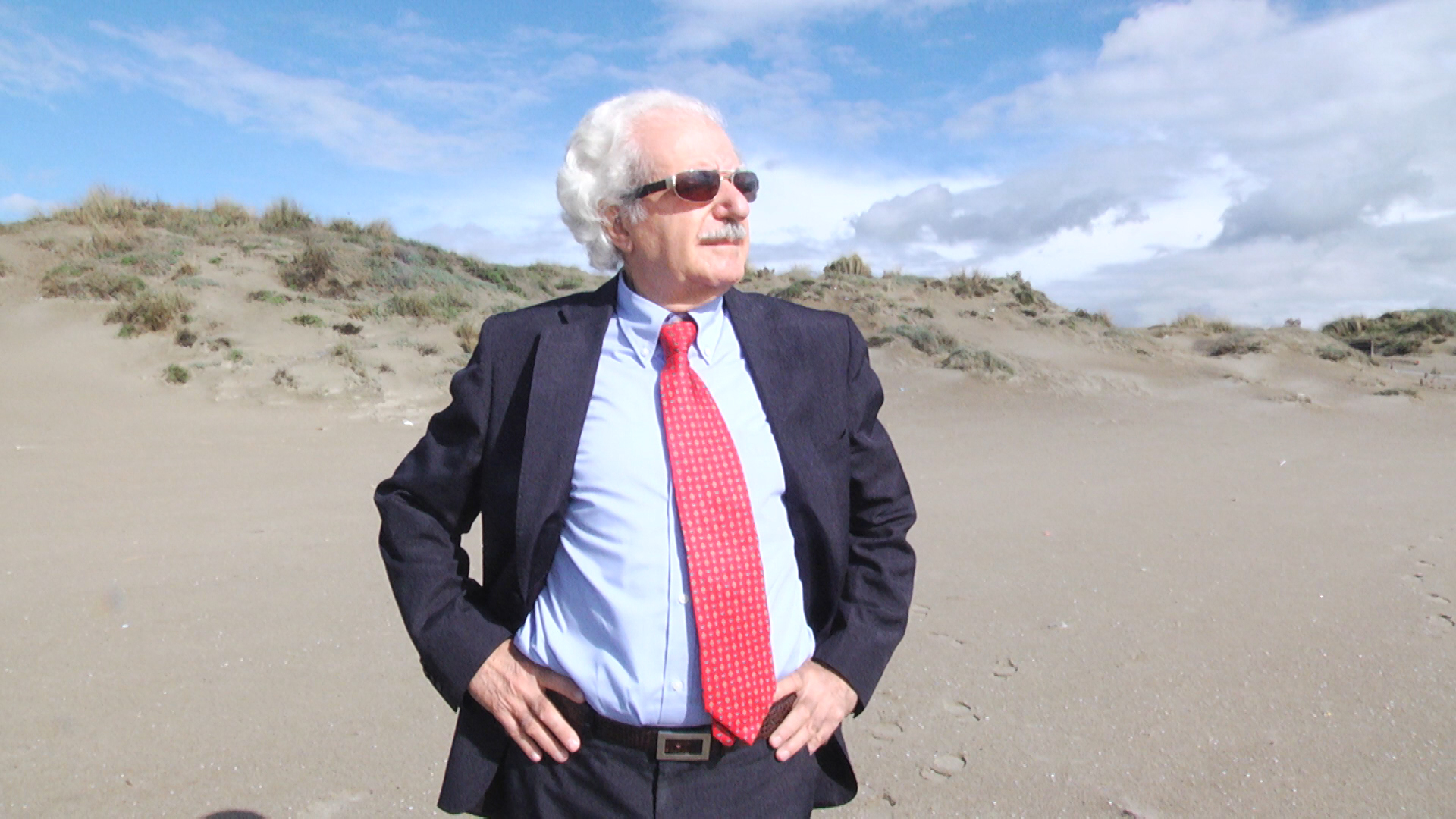
Drama, thriller, by Fabio Del Greco, Italy, 2015.
The story revolves around Vasco, a Roman builder who, at the age of 74, enjoys a life of absolute comfort. His human parable takes a dramatic turn when a mysterious encounter leads him to an ambush. Having survived, but marked by a long coma, Vasco wakes up with a new sensitivity, developing an intimate and poetic bond with nature. This new relationship with the world around him leads him to deeply explore himself, in an internal and external journey. through Italy, the United States and India, in search of a higher meaning and a cure. In parallel, the threat of a planetary cataclysm adds an epic dimension to the story.
I Am Nothing explores universal themes such as time, memory, oblivion and the connection with nature. Fabio Del Greco creates an existential drama full of food for thought. The director skillfully combines different visual materials, mixing archive images with nature photographs and dreamlike visions. This visual experimentation translates into an editing that captures the viewer's attention, guiding him through a cycle of creation and destruction. The sequences that alternate the buildings, Vasco's pride, with Indian landfills and natural landscapes create a hypnotic rhythm, underlining the beauty and fragility of life. Vasco's existential journey is a hymn to transformation and rebirth. The evolution of the protagonist, from unbridled luxury to the rediscovery of purity, represents a powerful metaphor on the meaning of life and the need to reconnect with authentic values. Io sono nulla stands out for its ability to combine introspection and visual experimentation, offering a suggestive and engaging narration. It is a film that invites us to reflect on the human condition, on our relationship with power and nature, and on the possibility of finding ourselves through change. A work that leaves its mark and lends itself to multiple readings.
LANGUAGE: Italian
SUBTITLES: English, Spanish, French, German, Portuguese
Tolstoy’s Surgical Strike Against Bourgeois Propriety
You have arranged your furniture correctly. You have married appropriately, secured the promotion that justified the years of studied deference, and learned — with genuine craft — how to make your face show exactly the right amount of concern during conversations about other people’s suffering. You have not done anything wrong. This is precisely the problem.
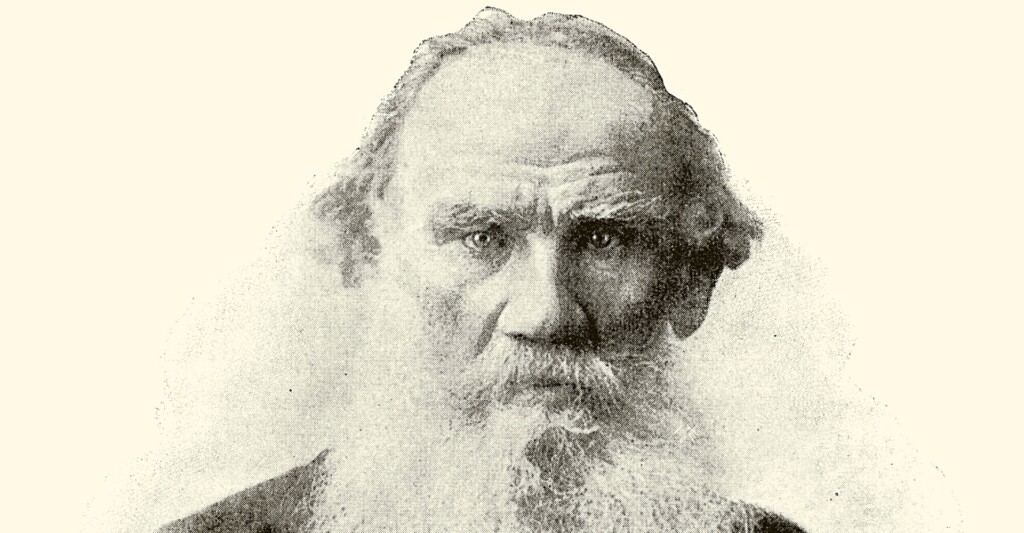
Tolstoy was fifty-eight years old when he finished the novella, and he was writing from the far side of a breakdown that had left him unable to explain why he should not hang himself from a rafter in his own study. He documented this with clinical precision in A Confession, completed in 1882, where he described a man who had achieved everything Russian educated society recognized as achievement, and who found the achievement to be a room with no exits. The novella he produced four years later is not a continuation of that inquiry. It is the surgical application of it to a body that cannot feel the blade.
Ivan Ilyich Golovin is not a bad man. Tolstoy is ruthless enough to deny the reader that comfort. He is, instead, a man who has perfected the substitution of appearance for substance so completely that the substitution is no longer visible, even to him. His career in the judiciary advances not through corruption but through competence, through the clean mechanical satisfaction of applying codes to cases, of reducing the irreducible mess of human conflict into procedural resolution. He decorates his house with objects chosen not because they please him but because they announce that a man of a certain standing lives there — and Tolstoy records, without commentary, that he considers the result genuinely his own taste. The lie has eaten the liar.
What makes this a strike against a whole social order rather than a portrait of one hollow man is the sociology embedded in the narrative structure. Pierre Bourdieu would later spend his career describing the way class reproduction masquerades as individual merit, the way habitus — the internalized grammar of a class’s values — operates below the threshold of conscious choice. Ivan Ilyich does not choose his values in any meaningful sense of the word choose. He absorbs them the way a child absorbs a language, before the capacity for refusal is developed. By 1886, the Russian professional class had constructed an entire civilization of correct behavior, and Tolstoy understood that the cruelty of such systems is not that they punish the deviant but that they reward the compliant so thoroughly that the compliant never develop the musculature needed to survive what cannot be managed by compliance.
The illness arrives as the first event in Ivan’s life that refuses to perform correctly. It does not respond to his characteristic technique of reducing problems to their procedural elements. It cannot be handled by finding the right specialist and following the correct regimen in the way one assigns a case to the appropriate court. Pain, it turns out, does not care about jurisdiction. And the people around him — his wife, his colleagues, his doctors — respond to his dying in exactly the way he spent his life responding to other people’s problems: with the managed sympathy of those who need the situation to resolve cleanly and not disturb the furniture.

The Body as the First Honest Witness
You wake one morning and something is wrong, not emotionally wrong, not professionally wrong, but wrong in the specific and humiliating register of the body. The sensation does not ask your permission. It does not negotiate with your calendar or defer to your social obligations. It simply announces itself, and in that announcement it reveals something about the nature of all the performances that preceded it: they were only possible because nothing had yet interrupted them.
This is precisely the mechanism Tolstoy constructs with such surgical precision in his 1886 novella. Ivan Ilyich does not collapse under the weight of an idea or a moral revelation. He collapses under the weight of a bruise, a persistent ache in his left side that refuses to respond to the logic by which he has organized his entire existence. He consults physicians, submits to examinations, purchases the correct medicines, behaves exactly as a man of his professional station is expected to behave when confronted with bodily inconvenience. And the pain does not care. It continues. It accelerates. It begins to speak in a register that his entire social world has no vocabulary to address.
Elaine Scarry, writing in The Body in Pain in 1985, made an argument that carries a particular violence when placed beside Tolstoy’s text: that intense physical pain is the most radically world-destroying experience available to a human being, because it resists language, resists sharing, resists the fundamental social act of communication. Pain, Scarry writes, has no referential content — it does not point outward toward an object the way fear points toward a threat or grief points toward a loss. It simply is, filling the entire field of consciousness with itself, dismantling the structures of meaning that the sufferer has spent a lifetime constructing. What Ivan Ilyich encounters is not merely illness. It is the experience of having his interiority colonized by something that owes nothing to the social contract he signed without reading it.
The physicians in the novella perform a particularly revealing function. They approach Ivan’s body the way Ivan himself approached judicial cases: with professional detachment, procedural competence, and an implicit message that the matter can be managed by those who know how to manage such things. The patient is not a person in crisis; he is a problem to be correctly categorized. And Ivan, trained as he is in the same epistemology, initially receives this treatment with gratitude, because it allows him to believe that his body is simply another domain of life that professionals can administer on his behalf. The collusion between his denial and their detachment is not accidental — it is the medical institution functioning as an extension of the broader social apparatus that has kept him comfortable and unconscious.
But the body will not be delegated. This is the specific cruelty that Tolstoy understood and that Scarry theorized nearly a century later from a different angle: pain is incommunicable not only because language fails it but because it cannot be transferred, softened by witness, or absorbed into a shared narrative. Every other form of suffering Ivan might have experienced — financial ruin, professional disgrace, marital failure — could have been metabolized socially, assigned meaning by the community, integrated into a story about fate or character or bad luck. Physical agony in its terminal form offers none of these exits. It is radically private in a way that no social institution, no professional credential, no accumulated dignity can penetrate.
What begins to happen to Ivan Ilyich is therefore not simply a confrontation with mortality. It is the forcible evacuation of the performed self, not by his own choice or his own courage, but by a process that operates entirely without his consent. The body becomes the first witness to testify honestly in a life otherwise structured around testimony that serves power rather than truth. And the testimony it delivers is not gentle.
The Lie Rooms We Build Together
You have watched someone die, or you will. And when that moment comes — or came — the room around the bed will have been full of people doing something that is not quite grieving and not quite waiting and not quite anything that has an honest name. Someone checks a phone and replaces it with a look of appropriate solemnity. Someone squeezes a hand with calibrated tenderness. Someone else, in the corridor, whispers a question about the apartment, about the savings account, about who gets the dacha, and then walks back through the door wearing a face assembled for display.
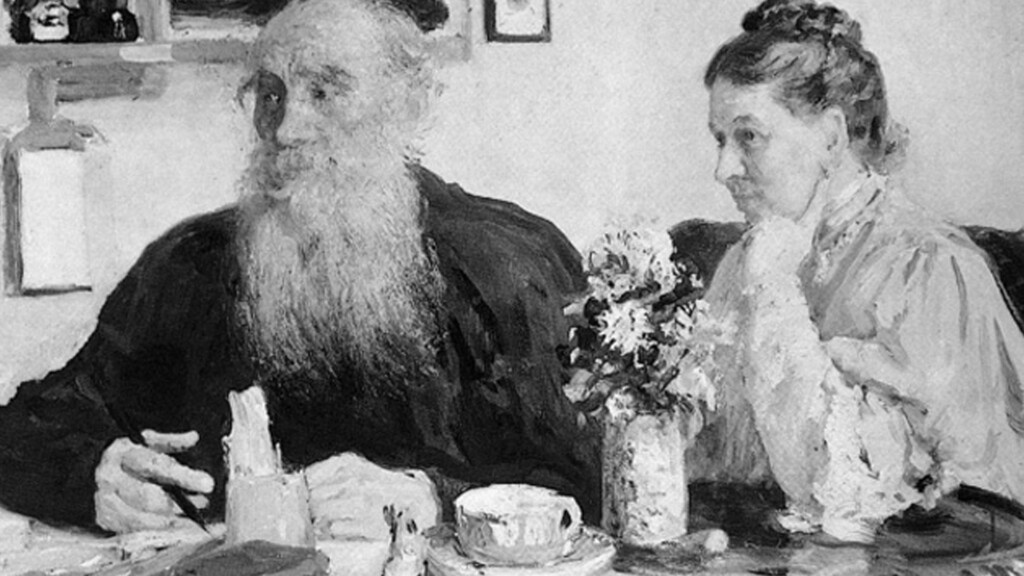
Tolstoy did not invent this observation. He excavated it with a precision so surgical that readers in 1886 recognized it the way you recognize your own handwriting on a note you have no memory of writing. Ivan Ilyich’s wife Praskovya Fyodorovna is not a villain. That is the most unsettling part. She is a woman who has genuinely organized her life around appearances so thoroughly that she can no longer locate the boundary between performance and feeling, because that boundary dissolved long ago. When she performs concern for her husband, she may even believe she feels it. The performance has become the only available interior life. She thinks about his suffering primarily in relation to the inconvenience it represents, and Tolstoy renders this not with contempt but with something far more disturbing — with anthropological accuracy.
Erving Goffman, writing in 1959, gave the machinery underneath this a theoretical skeleton. In The Presentation of Self in Everyday Life, he described social interaction as dramaturgy: every person moves between front stage, where behavior is managed for an audience, and back stage, where the mask briefly drops. What Goffman mapped as sociological structure, Tolstoy had already rendered as moral catastrophe. The difference is that Goffman described a universal condition with detached academic interest, while Tolstoy placed a dying man at the center of it and asked what it costs to be the only one in the room who can no longer afford the performance.
Ivan’s illness destroys his access to the front stage. Pain is not stageable. The body in extremity refuses the choreography that social life requires. And so the people around him, still perfectly capable of performing, find his inability to perform not sad but somehow offensive — a violation of the implicit contract by which everyone agrees to pretend together. His suffering makes them uncomfortable not because it reminds them of their mortality, though it does that too, but because it exposes the architecture of every ordinary interaction they have ever had. A man who cannot pretend is a mirror no one asked for.
What emerges from this is a particular species of loneliness that has no comfortable category. It is not the loneliness of isolation, because the room is crowded. It is the loneliness of being surrounded by people who are relating not to you but to the version of you that fits their narrative management. The doctors give him diagnoses calibrated to maintain professional composure rather than communicate reality. His colleagues visit with expressions borrowed from some shared cultural inventory of how one behaves near death. His daughter’s fiancé seems primarily concerned with how visible his concern appears. Everyone in that apartment is running a kind of continuous social calculation, and Ivan has fallen out of the economy entirely.
The peasant servant Gerasim is the only one who does not perform, and Tolstoy makes this pointed: he is the only one whose class position has never required the particular bourgeois theater of managed emotion. He holds Ivan’s legs because it eases the pain, without ceremony, without the performance of sacrifice. His simplicity is not sentimentalized — it is structural. He never learned the rooms everyone else has been building and inhabiting and mistaking for reality their entire lives.
Gerasim and the Obscenity of Simplicity
You already know how to behave in a room where someone is dying. You know to speak in a slightly elevated tone, as if the person has gone partially deaf. You know to arrange your face into something between concern and optimism. You know, above all, not to acknowledge what is actually happening, because acknowledgment would be a kind of violence, and you have been taught that kindness means silence about the unbearable.
Gerasim does none of this. The peasant servant who appears in the final stretch of Ivan Ilyich’s deterioration is not a saint and Tolstoy is careful not to make him one. He is young, strong, uncorrupted by the particular anxieties that professional life and social aspiration produce in a person. When he empties the bedpan he does not perform discomfort or dignity. He does it and moves on. When Ivan asks him to hold his legs elevated through the night because this position relieves the pain, Gerasim agrees without the transaction of false cheerfulness that every other figure in the novel requires. He says, simply, that it is no trouble. And he means it.
The obscenity here is not Gerasim’s behavior. The obscenity is that his behavior reads as radical. Philippe Ariès, in his 1977 work The Hour of Our Death, traced the long historical arc through which Western societies progressively removed dying from communal life. Where death in the medieval period was a public, collective, even ritualized event — the dying person surrounded, acknowledged, witnessed — modernity gradually pushed it behind institutional walls, into hospitals, into professional management, into a bureaucracy of the clinical. By the late nineteenth century, when Tolstoy was writing, the Victorian bourgeoisie had already developed elaborate codes around death: mourning clothes with precise timelines, the drawing of curtains, the language of euphemism. What Ariès called the “dirty death” — death as biological reality, as smell and weight and physical need — had become unspeakable in polite society. The emotional labor required to maintain this unspeakability fell on everyone in the room except the person dying, who was expected to cooperate in the pretense of their own irrelevance.
This is the cultural machinery that Gerasim simply does not possess. He has not been educated into the performance. His directness is not philosophical — it is the directness of someone who grew up in a world where animals died, where grain rotted, where bodies were not hidden from children. His ease around Ivan’s physical deterioration is not noble resignation; it is the absence of a particular kind of learned revulsion. And this absence, in the context of every other character’s elaborate avoidance, operates like a mirror held at an unexpected angle.
What becomes visible in that mirror is the specific shape of everyone else’s dishonesty. Praskovya Fyodorovna’s management of her own inconvenience. The doctors’ conversion of a dying man into an interesting case. The colleagues’ rapid recalculation of which desk they might now occupy. None of these people are monsters. They are doing exactly what their world has trained them to do: treat the dying as a social problem requiring management rather than a human being requiring presence. The institutionalization of concealment that Ariès documented was not a conspiracy; it was a consensus, reproduced in every drawing room where discomfort was smoothed over with the right words, in every medical consultation where prognosis was delivered in Latin so the patient might not fully understand, in every novel that ended with a tasteful death and a chapter of grief rather than three weeks of a man lying in his own soiled sheets trying to find a position that does not make him scream.
Gerasim’s simplicity does not heal Ivan, and it does not redeem the world around him. It only makes the performance of that world suddenly impossible to unsee, the way a wrong note in a familiar piece of music suddenly makes you aware you have never actually been listening.
A vision curated by a filmmaker, not an algorithm
In this video I explain our vision
The Forty-Five Minutes Before the Admission

You are sitting in a waiting room that you have been in for years. The chairs are familiar, the lighting is institutional, the forms you fill out ask questions whose answers you memorized long ago. You are not waiting for anything in particular. You are waiting in order not to think about what happens when the waiting ends.
This is the room Ivan Ilyich built and furnished over the course of a career. The appointments, the promotions, the apartment decorated with such painstaking correctness — not too expensive, not too modest — the dinner parties calibrated to reflect the right social register. Ernest Becker argued in 1973 that human beings are, at the biological and psychological root, creatures in flight from the awareness of their own death, and that what we call civilization — its hierarchies, its honors, its elaborate systems of meaning — is fundamentally the architecture of that flight. The symbolic self, Becker wrote, is the self we construct to feel permanent when the body insists we are not. Ivan’s entire ascent through the Russian judicial system, his accumulating titles and dignities, his scrupulous adherence to propriety — these were never really about status. They were about the peculiar relief that comes from being too busy, too credentialed, too socially embedded to confront the fact that the body under the tailored coat is mortal and indifferent to rank.
What makes Tolstoy’s portrait so precise is that Ivan does not know he is fleeing. That is the structure of the trap. The man who consciously suppressed his mortality anxiety would at least have to acknowledge, in some private moment, that there was something to suppress. Ivan feels no such tension. His life has been, in his own assessment, entirely correct. He is not a hypocrite in the ordinary sense — he has not privately believed one thing while publicly performing another. He has simply never looked. The career, the marriage entered into partly from social pressure and partly from a vague sense that it was expected, the pleasure taken in a game of cards among respectable men — all of this is not a mask over a hidden truth. It is a construction so total that there is no interiority left behind it, which is perhaps the more frightening possibility.
The illness ruptures the construction not through some dramatic revelation but through a pain in the side that will not yield to the logic Ivan has always used to manage reality. He consults doctors the way he once consulted procedural manuals — methodically, with the expectation that the correct application of expertise will produce the correct result. The medical encounters in the novella, published in 1886, are rendered with a satirical precision that has aged with shocking accuracy: the physicians who address the symptoms while steadily refusing to address the patient, the consultations that generate terminology rather than truth, the way the institutional language of medicine performs the same social function as Ivan’s legal language — it holds the unbearable at arm’s length through the authority of specialized vocabulary. Ivan recognizes this dynamic immediately, because he has spent his life inside an identical one, and the recognition does not console him. It devastates him. He sees his own professional self reflected in the doctors’ evasions, and he understands for the first time that the evasion was never a technique. It was the entire content.
Gerasim — the peasant boy who empties the bedpan without disgust and holds Ivan’s legs aloft for hours because it eases the pain — does not appear in this section of the story as a symbolic figure. He appears as a functional contrast. His lack of pretense is not a philosophy. He simply has not yet built the room with the waiting chairs and the familiar lighting. Whether that is innocence or a different kind of knowledge is a question Tolstoy does not answer cleanly, which is precisely why it continues to press.
The Thirteen Days That Undo a Biography
You are lying in a room you have furnished with great care, and none of it belongs to you anymore.
The gerasim who holds your legs through the night is the only honest presence left, because he has no investment in your surviving. Everyone else — the wife measuring the grief she will need to perform, the colleagues already calculating the vacancy — circulates around the bed with the quiet arithmetic of people redistributing an estate. The dying man watches this and understands, with a clarity he never permitted himself while upright, that the entire architecture of his adult existence was constructed for an audience that was never watching him at all.
Tolstoy compresses the last thirteen days of Ivan Ilyich’s life into a duration that feels both endless and brutally accelerated, and this is not a structural accident. The novella spends more prose on those final days than on the three decades preceding them, inverting the proportions that biography normally assigns to a life. What fills a career, a marriage, a household of correctly acquired furniture, receives less attention than a single night of unmanageable pain. This inversion is the argument. The conventional life, the one that accrues and ascends and decorates itself, turns out to be thin — narratively thin, experientially thin — while the moment of its undoing carries a density that the rest could not sustain.
Walter Benjamin, writing in Illuminations in 1955 from the essays he produced in the 1930s, argued that the dying man holds a unique authority over meaning — that it is at the threshold of death that life becomes transmissible, that the retrospective gaze of the one leaving is the original source of what he called the storyteller’s wisdom. The dying person, Benjamin suggested, is the figure from whom others borrow the right to narrate. Tolstoy seems to have understood this structurally before Benjamin articulated it theoretically, because the entire novella is organized around the reversal of Ivan’s gaze: a man who spent forty-five years looking outward at social surfaces is forced, by pain that cannot be managed or rationalized, to look inward at the hollow ground those surfaces were covering.
What he finds is not, crucially, a hidden depth of authentic self. That would be too consoling, too close to the Romantic redemption narrative that Tolstoy explicitly refused. What Ivan finds is the absence of a self that was never formed — a lifetime of performed correctness where interiority was supposed to be. The biographical logic that governed his rise through the judiciary, the careful marriages of professional convenience, the apartments furnished to signal taste rather than reflect desire — all of it operated on the assumption that the shape of a life could be managed from the outside in. The thirteen days annihilate this assumption not by revealing a truer Ivan beneath the social one, but by demonstrating that the social one was the only one there was, and that it was never enough to die on.
The terror Ivan experiences — the black sack, the invisible hand pushing him into it, the resistance that collapses only when he finally stops resisting — is not terror of death in the abstract. It is the specific terror of a man who realizes that he cannot produce a single memory that feels genuinely his. He searches his past for evidence that he lived rather than performed, and the search yields almost nothing: a few moments from childhood before the training took hold, before propriety and advancement became the operative grammar of his days. Benjamin’s storytelling authority, which is supposed to accrue at the threshold, arrives for Ivan as an authority over nothing — a retrospective gaze that surveys a landscape of borrowed gestures and finds no original ground beneath them.
The light that breaks through in the final hours is not enlightenment in any spiritual sense the word usually carries. It is the simple cessation of a particular kind of effort — the effort of maintaining a self constructed entirely for the approval of people who were never present to what he actually was.
What Recognition Costs
You are lying in a room where no one can reach you anymore. Not because they have left, but because the distance has finally become honest — the performance has collapsed under its own weight, and what remains is something so stripped of social utility that it no longer registers as a self the world knows how to address. This is where Tolstoy places his character in the final hours, and the brutality of the placement is the point.
What arrives in those last moments is not wisdom in any conventional sense. It is the cessation of a particular kind of labor — the exhausting, invisible work of assembling oneself for consumption by others. Erving Goffman spent much of his career, most precisely in The Presentation of Self in Everyday Life published in 1959, mapping the theatrical architecture of ordinary social existence: the front stage, the back stage, the costumes, the cues. He wrote it as sociology, nearly clinically, but what his framework cannot quite contain is the grief embedded in the observation. Every performance requires a performer who has forgotten, or agreed to forget, that performing was a choice.
The philosophical tradition has a long relationship with the idea that death clarifies. Heidegger argued in Being and Time that authentic existence only becomes available when one confronts finitude not as an abstraction but as one’s ownmost, non-relational possibility — something no one can do in your place, something that strips away the anonymous comfort of das Man, the generalized “they” whose opinions and standards ordinarily govern a life. What Tolstoy understood viscerally, without the systematic apparatus, is that this confrontation does not produce revelation on its own. It only removes the noise. What is heard in the silence depends entirely on whether anything was ever allowed to grow beneath it.
This is where the novella becomes genuinely disturbing rather than merely sad. The question it raises — quietly, structurally, never in direct speech — is whether the liberation Ivan reaches in his final hours represents the emergence of an authentic self or simply the dissolution of a constructed one. These are not the same thing. A man who has spent forty-five years building his identity entirely through external validation, through rank and propriety and the approval of his social class, may not have a self waiting beneath the scaffolding. He may have only the absence of scaffolding. The light that floods in during his last three hours might be grace, or it might be the particular brightness that enters a room after everything has been removed from it.
Gerasim, the peasant servant who tends to Ivan without embarrassment or pity, functions in the text as a kind of negative proof. His uncomplicated presence — his willingness to hold Ivan’s legs for hours without complaint, his refusal to pretend that dying is not happening — represents a mode of being that never required the social machinery in the first place. He is not liberated because he was never imprisoned. The contrast is not offered as consolation. It is offered as measurement.
What makes the novella intolerable to sit with, and why it has never stopped finding readers since its publication in 1886, is that it refuses to locate the tragedy at the moment of dying. The dying is almost peaceful. The tragedy is retrospective — it spreads backward through a life and asks, with terrible patience, at which point the cost was paid. Not the cost of dying, but the cost of the recognition that precedes it: the cost of seeing clearly what was traded, what was never risked, what was kept so safe it never became real. Ivan Ilyich does not die having wasted his death. He dies having finally understood the precise dimensions of what was wasted long before it.
⚗️ Death, Meaning, and the Examined Life
Tolstoy’s The Death of Ivan Ilyich confronts us with the terror of a life unlived and the desperate search for authentic meaning in the face of mortality. These related articles trace the same burning thread — from spiritual conversion to the phenomenology of grief — illuminating how literature and philosophy have wrestled with existence, suffering, and transformation across centuries.
Lev Tolstoy and Spiritual Conversion
Lev Tolstoy‘s spiritual crisis was not merely a biographical episode but the very crucible from which works like The Death of Ivan Ilyich emerged. This article explores how Tolstoy renounced his aristocratic life, embraced a radical Christian ethics, and came to see the fear of death as a symptom of moral emptiness. Understanding his conversion is indispensable to grasping the philosophical weight behind Ivan Ilyich’s final agonized hours.
GO TO THE SELECTION: Lev Tolstoy and Spiritual Conversion
C.S. Lewis and the Death of His Wife: A Grief Observed
C.S. Lewis‘s A Grief Observed offers one of the most raw and intellectually honest accounts of confronting death and loss ever written, making it a powerful companion to Tolstoy’s novella. Like Ivan Ilyich, Lewis is stripped of every comfortable illusion and forced to encounter existence without the armor of social convention. The article examines how grief becomes an involuntary philosophical education, dismantling the self and reconstructing it on more truthful ground.
GO TO THE SELECTION: C.S. Lewis and the Death of His Wife: A Grief Observed
Joan Didion and Loss: The Year of Magical Thinking
Joan Didion‘s The Year of Magical Thinking stands as a modern monument to the literature of loss, exploring how the mind refuses to accept death even when confronted with irrefutable evidence. This article traces Didion’s narrative strategy of obsessive rationality used as a shield against the unbearable, a mirror image of Ivan Ilyich’s desperate denial. Together, these works form a literary conversation about what it means to remain among the living when death has entered the room.
GO TO THE SELECTION: Joan Didion and Loss: The Year of Magical Thinking
Viktor Frankl: Life and Logotherapy
Viktor Frankl‘s logotherapy emerged directly from his confrontation with suffering and death in the Nazi concentration camps, producing a psychology centered on the irreducible human need for meaning. This article presents Frankl’s central argument that even in the most extreme conditions, the freedom to choose one’s attitude toward suffering cannot be taken away — a thesis that illuminates Ivan Ilyich’s final spiritual awakening. The parallels between Frankl’s existential framework and Tolstoy’s moral vision are as striking as they are profound.
GO TO THE SELECTION: Viktor Frankl: Life and Logotherapy
Discover Cinema That Asks the Questions That Matter
If these reflections on mortality, meaning, and inner transformation resonate with you, Indiecinema streaming is the place where cinema dares to ask the same questions. Explore our curated selection of independent and auteur films that refuse easy answers and illuminate the depth of human experience — just as Tolstoy’s greatest pages do.
👉 EXPLORE THE CATALOG: Watch Indie Films in Streaming
A vision curated by a filmmaker, not an algorithm
In this video I explain our vision

